
 Omnisend AI


 OFFER
OFFER







Research

Drive sales on autopilot with ecommerce-focused features
See FeaturesSummer vacation season is fully underway, and at this moment, the majority of people are supposed to be finalizing their travel plans. However, this year’s travel season is set to be quite different. In fact, it’s bound to be the slowest in recent history. Our recent survey of 1,075 Americans, 1,114 Brits, and 1,068 Canadians shows that half of them are either scaling back their vacation plans or scrapping them altogether.
Data from similar surveys confirms the story. According to Deloitte, U.S. summer travel intent has reached its lowest point in six years, with only 45% of Americans having plans for a vacation with overnight stays. Bank of America also forecasts that spending for tourism-related services will decrease compared to last year. What’s going on here?
Key takeaways
- 47% of those surveyed have downgraded or canceled their this year’s summer travel plans due to high costs
- 46% of those who canceled or downgraded their vacations cite gas prices as the main reason for the decision
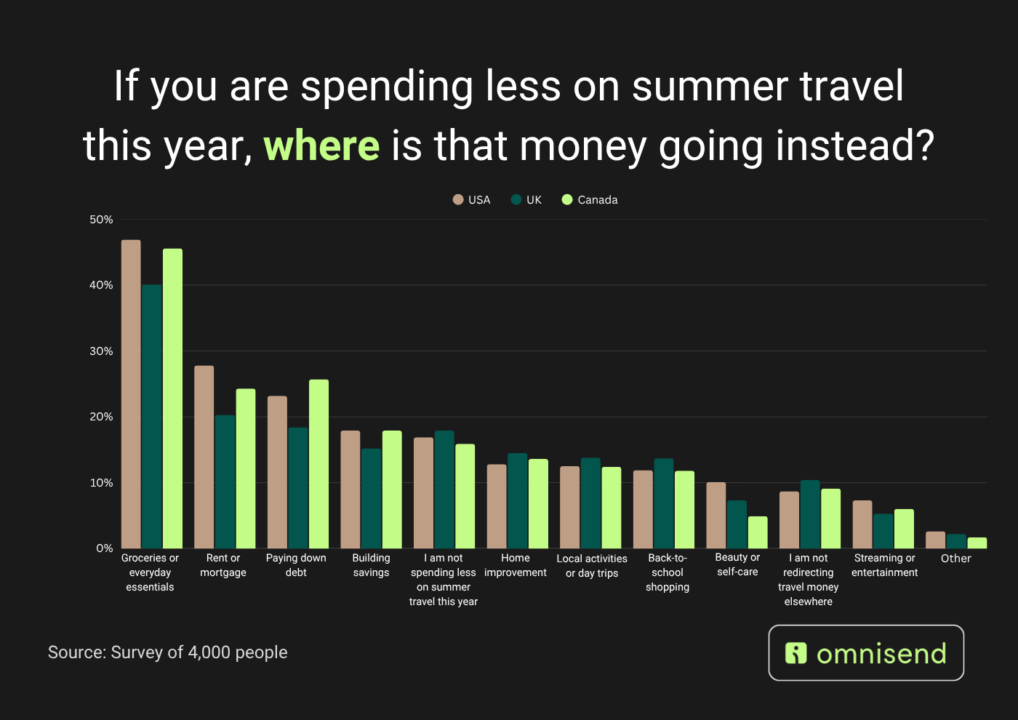
- 47% of those who are scaling back on their vacation plans will spend that money on groceries instead
- 68% of those who canceled or altered their vacation plans will spend the money they saved on “little treats”
Higher prices mean shorter vacations
At first glance, our survey doesn’t show anything out of the ordinary. 59% of Americans, 67% of Brits, and 67% of Canadians are planning to travel this summer. Sounds predictable.
However, when you take a deeper look at the data, it tells a bit of a different story. This vacation season is going to be quite unusual and characterized by the trend of people scaling back on their plans. In fact, only 17% of Americans, 24% of Brits, and 17% of Canadians are going on major trips with flights and paid lodging.
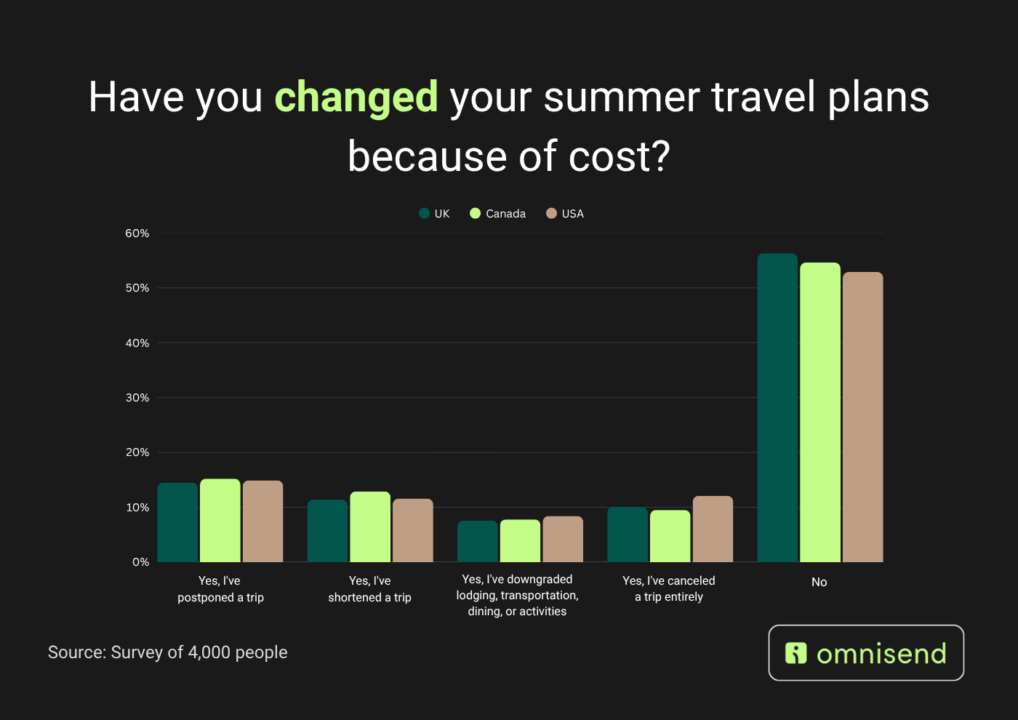
A major portion of people are opting for more affordable vacation alternatives. Shorter trips and more localized travel destinations are increasingly popular, with 19% to 28% of those surveyed choosing them for their vacations. Additionally, 21% to 24% are actively looking for cheaper options or cutting the trip’s length.
Furthermore, a substantial portion of the population is canceling their vacation plans altogether. Internet folklore even has a name for this trend: staycations. It is especially common in the US, where 18% of people aren’t doing anything vacation-like at all, with an additional 14% staying home instead.
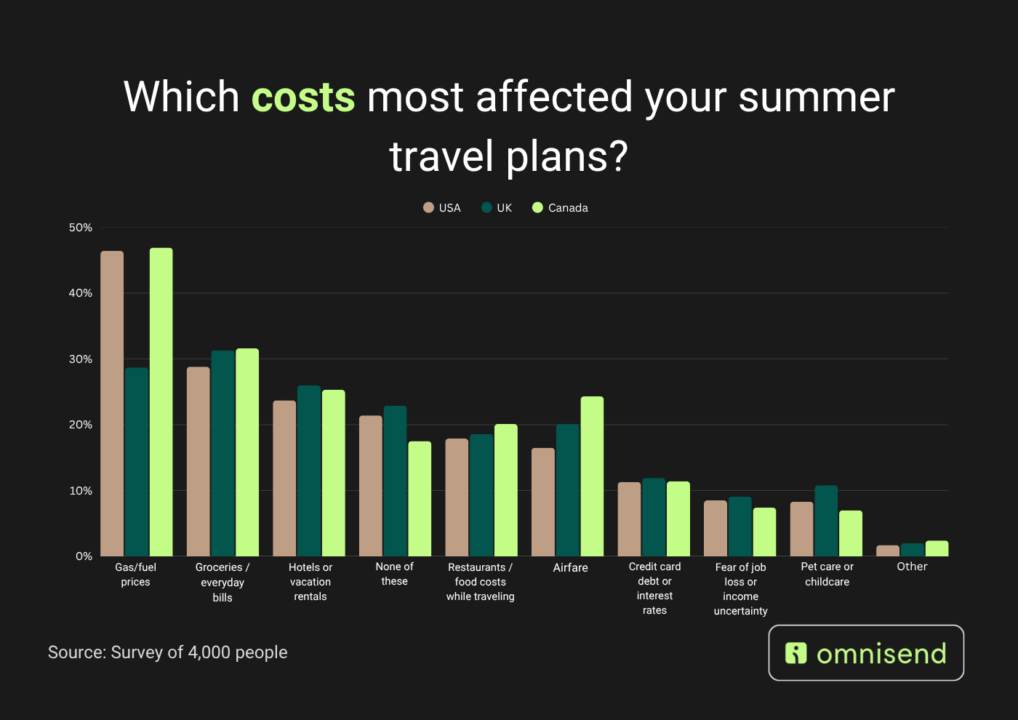
The main culprit for people scaling back on their vacations or choosing to stay at home is high costs. 47% of Americans, 44% of Brits, and 45% of Canadians cite them as the primary reason. Recent increases in gas prices were the most painful, especially for North Americans. 46% in the U.S. and 47% in Canada named them as a key factor for altering their summer travel plans, while for Brits it’s groceries and everyday bills at 31%.
“Gas prices have a ripple effect. It’s not just that traveling or flying are more expensive. It also inflates the prices of other commodities that we’re used to while vacationing. Plus, the more you spend on gas or flights, the more your vacation budget shrinks. People are then left with an uncomfortable conundrum. Is it worth it to sacrifice the quality of your leisure time, or is it more worthwhile to spend that money elsewhere?” says Marty Bauer, Ecommerce Expert at Omnisend.
Travel money goes towards daily essentials and little treats instead
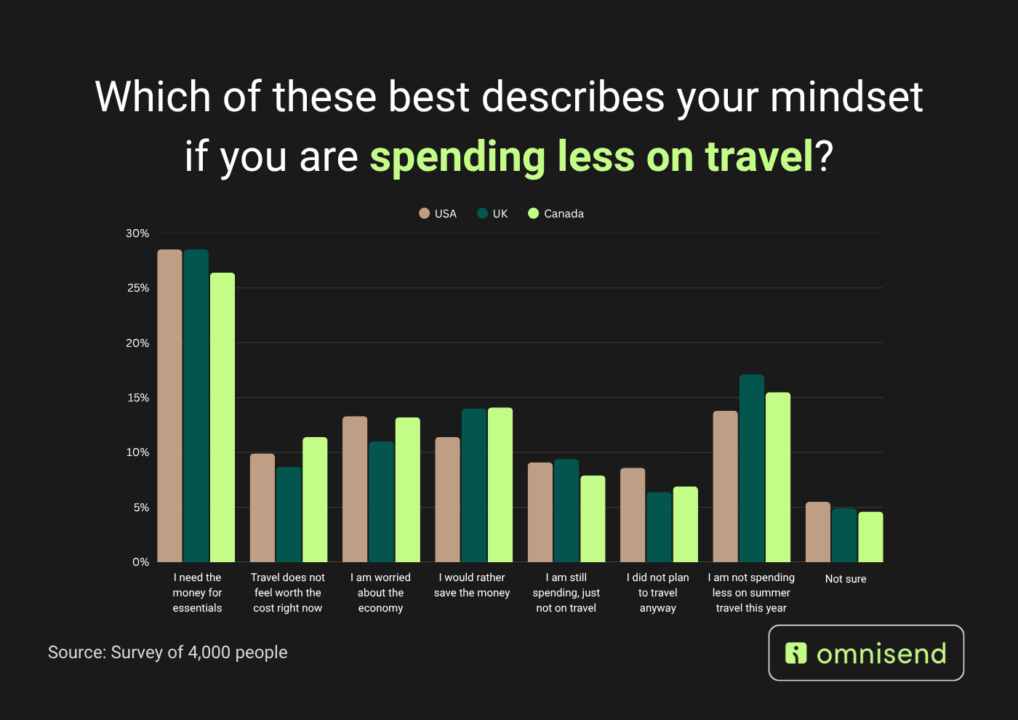
Our survey reveals that people are spending less on travel simply because they need that money for everyday essentials. That is the main motivation for 29% of Americans, 29% of Brits, and 26% of Canadians. The sense of economic uncertainty also affects their decision-making process. 11% to 13% of those surveyed expressed their concerns, while 9% to 11% said that travel does not feel worth the cost right now.
Those who are spending less on travel are choosing to invest in their everyday lives instead. Their money goes towards seemingly mundane categories like groceries or daily essentials (40% to 47%), rent or mortgage expenses (20% to 28%), and paying down debt (18% to 26%).
For a large portion of those surveyed, this isn’t just a question of being frugal. 29% of Americans, 25% of Brits, and 24% of Canadians who scaled back their vacation plans are cutting back not only on travel, but on everyday purchases as well.
However, the staycation trend is not all doom and gloom. People who have canceled their travel plans are finding other ways to treat themselves with finer things in life. 58% of Americans, 60% of Brits, and 60% of Canadians who will staycate this year admit they’re very likely to buy smaller “treats” for themselves.
Among the most popular treats are clothes (14% to 17%), food delivery (9% to 13%), local experiences (11% to 16%), restaurant meals (9% to 15%), and premium groceries (8% to 10%). Bauer argues that in this shaky economy, people are seeing these kinds of little treats as a way of rewarding themselves for all their everyday efforts.
“You could say that we’re witnessing the lipstick effect in action. During economic downturns, people often forgo larger purchases, but keep paying for small luxuries. It fulfills their need to treat themselves, simultaneously allowing them to reduce spending on other goods. In this case, travel. In fact, economists call it one of the best indicators that the trust in the economy is in a downturn,” he says.
Are staycations here to stay?
The percentage of people who are choosing to either scale back on their vacation or cancel their plans entirely might seem concerning. However, this staycation trend has more to do with the sense of economic uncertainty than with decreased interest in traveling.
It all comes down to consumers’ ability to acquire enough disposable income and feel confident that their vacation budget will be sufficient enough. This will depend on various factors such as growth of average salary, gas and airfare prices, and hotel and vacation rentals affordability
Despite the growing number of those who choose to staycation, people’s desire to relax and enjoy finer things is still very much there. When you think about it, “vacation” is less about specific activities, and more about the mood. You can just easily get into a relaxing kind of mood simply by distancing yourself from work-related haste and spoiling yourself some.
FAQ
Why are consumers cutting back on summer travel in 2025 and 2026?
High costs of gas, air travel, and hotels are the main driver. 47% of Americans, 44% of Brits, and 45% of Canadians cited overall cost as the primary reason for canceling, shortening, or downgrading their trips.
What everyday costs are most responsible for canceled, shortened, or downgraded summer trips?
Gas prices are the standout factor, especially in North America (46% of Americans, 47% of Canadians). For Brits, that’s groceries and everyday bills (31%).
Where are consumers redirecting their travel budgets when they don’t take a vacation?
Most goes toward practical needs: groceries or daily essentials (40–47%), rent or mortgage (20–28%), and debt repayment (18–26%).
Are consumers spending less overall, or just shifting what they spend money on?
Both. For some, travel money is going into groceries, rent, or debt. But 29% of Americans (25% of Brits, 24% of Canadians) who scaled back travel are also cutting back on everyday purchases.
How to cite this report
Short citation (inline-friendly): Omnisend (2026). Are staycations the hottest trend of summer 2026? New survey reveals why people downgrade or cancel altogether. Retrieved from https://www.omnisend.com/blog/summer-travel-trends-2026/
APA format: Omnisend. (2026). Are staycations the hottest trend of summer 2026? New survey reveals why people downgrade or cancel altogether. Omnisend. https://www.omnisend.com/blog/summer-travel-trends-2026/
MLA format: Omnisend. “Are staycations the hottest trend of summer 2026? New survey reveals why people downgrade or cancel altogether.” Omnisend, 8 July 2026. https://www.omnisend.com/blog/summer-travel-trends-2026/
Chicago format: Omnisend. “Are staycations the hottest trend of summer 2026? New survey reveals why people downgrade or cancel altogether.” Omnisend. July 8, 2026. https://www.omnisend.com/blog/summer-travel-trends-2026/

TABLE OF CONTENTS
TABLE OF CONTENTS


Subscribe and don’t miss any updates!
No fluff, no spam, no corporate filler. Just a friendly letter, twice a month.