- Features
- Pricing
- Migration
- Integrations
- Resources

With over 280+ pre-built integrations and flexible APIs, you can easily centralize data from across your tech stack
Make the most out of your data and unlock powerful growth marketing possibilities with these other top marketing tools.
Build any custom integration with our open, flexible APIs that are simple to use and implement.
Check out apps that have been stealing all the spotlight.
Email and SMS marketing insights, ecommerce resources, and the latest Omnisend news
Expert-led sessions covering email, SMS, and ecommerce marketing strategies.
Latest feature releases, product improvements, and bug fixes.
The holiday season is supposed to be a time for family, festivities, and gifts. Yet, for millions of households, the holiday season is a source of stress and financial strain. As they try to cut back on spending, consumers fall back on various tactics, such as spreading out costs, shopping earlier, downgrading, using BNPL services, or even going into debt.
Our new survey of more than 4363 consumers across the U.S., UK, Canada, and Australia explores how consumers are approaching this year’s holiday season, what their main sources of stress are, and where they plan to make the most significant cuts.
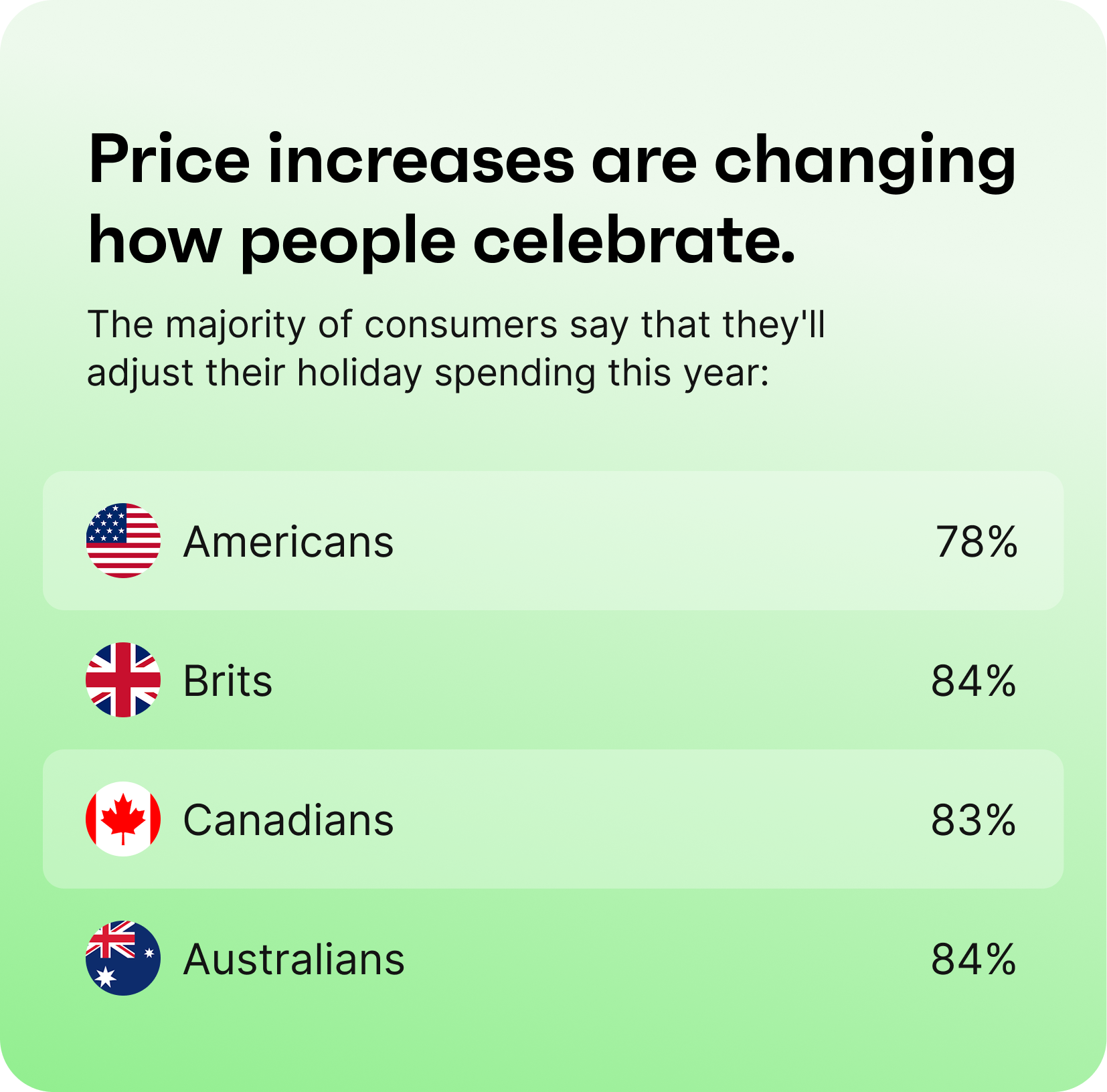
As the holiday season slowly but surely approaches, consumers are anticipating it with apprehension. This is due to price increases. Across the US, UK, Canada, and Australia, people admit they will be more conservative with their spending this year, with 78% to 84% saying that they feel the effects of price increases, and 21% to 27% planning to significantly lower their expenses.
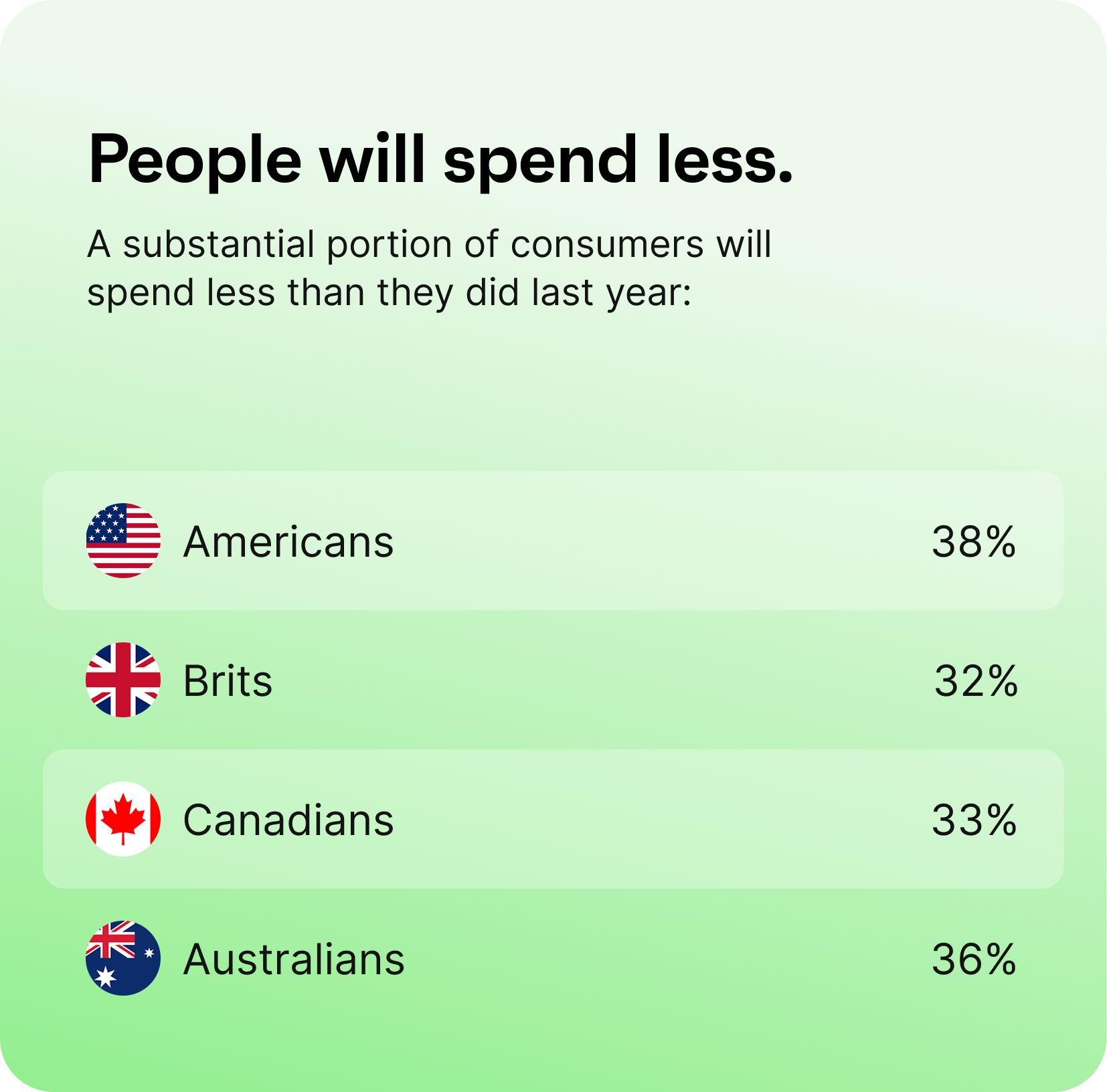
With continually rising grocery prices and relatively high inflation rates, consumers increasingly see holiday spending as non-essential. A significant portion of Americans (38%), Brits (32%), Canadians (33%), and Australians (35.5%) expect to spend less this season than they did last year, choosing to spend that money on necessities instead.
The 2026 holiday season is characterized by the diversity of consumers’ budgets. While last year’s most common spending range was $250–$499, this year, most Americans (18%) will spend up to $200. Most Brits (20%) will spend either $200–$499 or $500–$999. Most Canadians (21%) will spend $200–$499, and most Australians (17%) will spend $500–$999. However, 30%-43% across markets will allocate an even larger budget of $1,000 or more.
Most consumers will spend these sums on gifts (61% to 68%). Gift cards are especially popular, with 24% to 38% of respondents planning to purchase them. Groceries for hosting the festivities will also be a significant expense. People in different countries will spend between 28% and 45% of their budgets on them
Unsurprisingly, the biggest portion of the holiday budget goes towards gifts. 39% to 44% of consumers across the markets say so, although people are being much more deliberate with their spending.
Gift giving is just a part of the Holiday experience. Some would say the least important part. After all, the Holiday season is all about family time. It typically takes the form of a family dinner. This year is no exception. 53% to 54% of the respondents will be hosting or cooking for the festivities. However, these preparations can be a major source of stress for many.
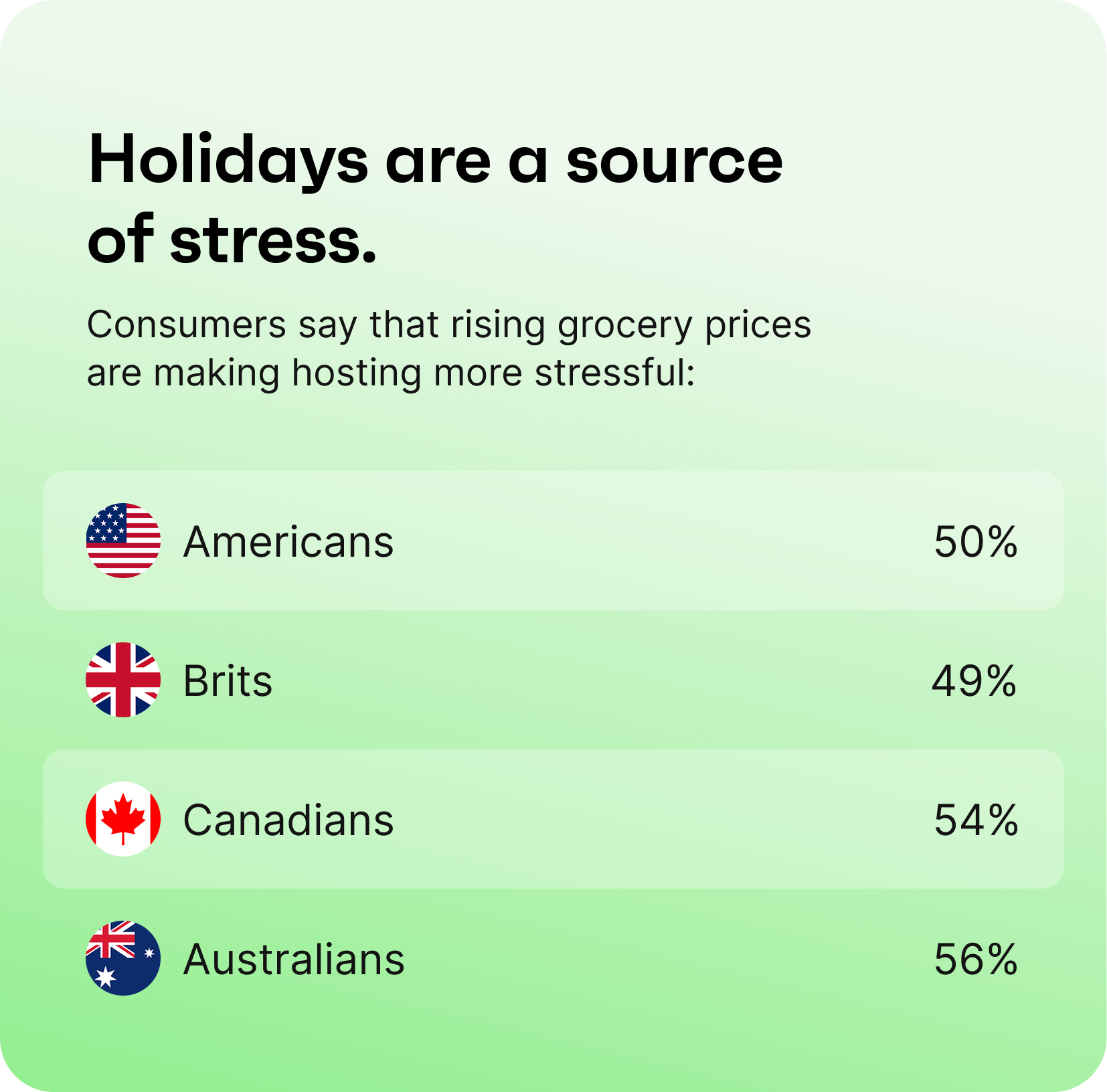
Rising grocery prices are to blame. 33% to 43% of consumers across the markets say they’ll spend more on food than last year, and 49% to 56% admit that they feel significantly more stressed about hosting compared to last year.
This price-related stress is also why consumers plan to do most of their shopping at major retailers that offer both relatively lower prices and extensive inventories. Walmart is the favorite choice in the US (37%) and Canada (23%), while Costco and Woolworths are top choices in the UK (20%) and Australia (36%), respectively.
In preparation for the Holiday season, consumers are pondering which budgeting tactics to employ. Most of those surveyed are planning to rely on various discount codes and coupons. 35% to 39% of respondents in different markets will actively look for them as the Holiday season approaches. There is also a universal trend of setting a strict budget limit and sticking to it no matter what.
Another common trend (26% to 28% across the markets) is starting shopping earlier than usual. There are a couple of main reasons why consumers are doing this. People are trying to spread out costs over more paychecks (29% to 34%), avoid further price rises (23% to 29%), or take advantage of a good but limited-time offer (22% to 26%).
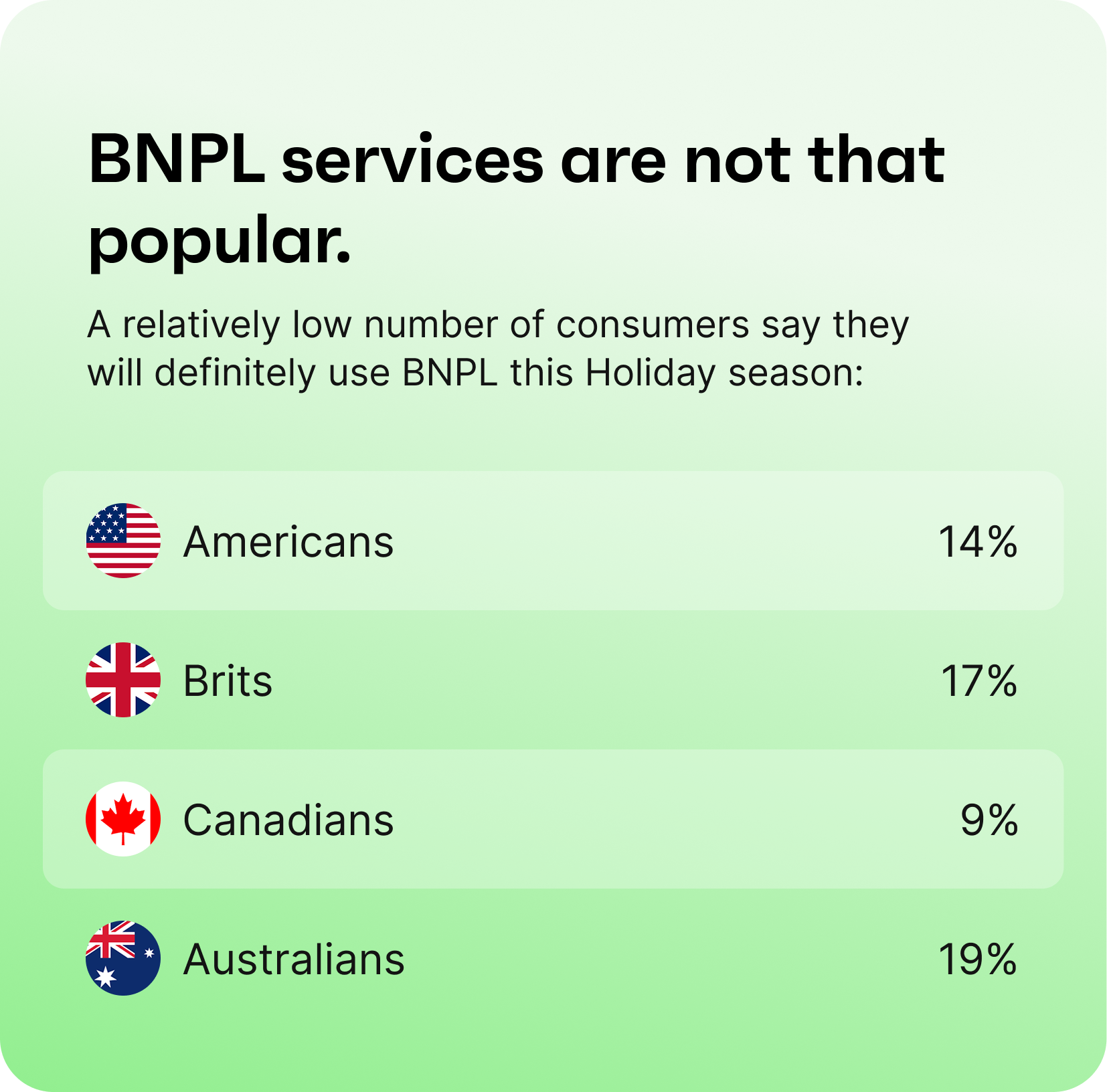
The trend of setting a strict limit on the budget is also reflected by the decreasing popularity of BNPL services. Last year in the US and Australia, 44.8% of shoppers said they would either use it or think about it. The UK and Canada weren’t far behind with 41.8% and 36.6%, respectively. This year, however, only 39% of Americans and 29% of Canadians say so. On the other hand, Brits (43%) and Australians (44%) are still willing to use BNPL.
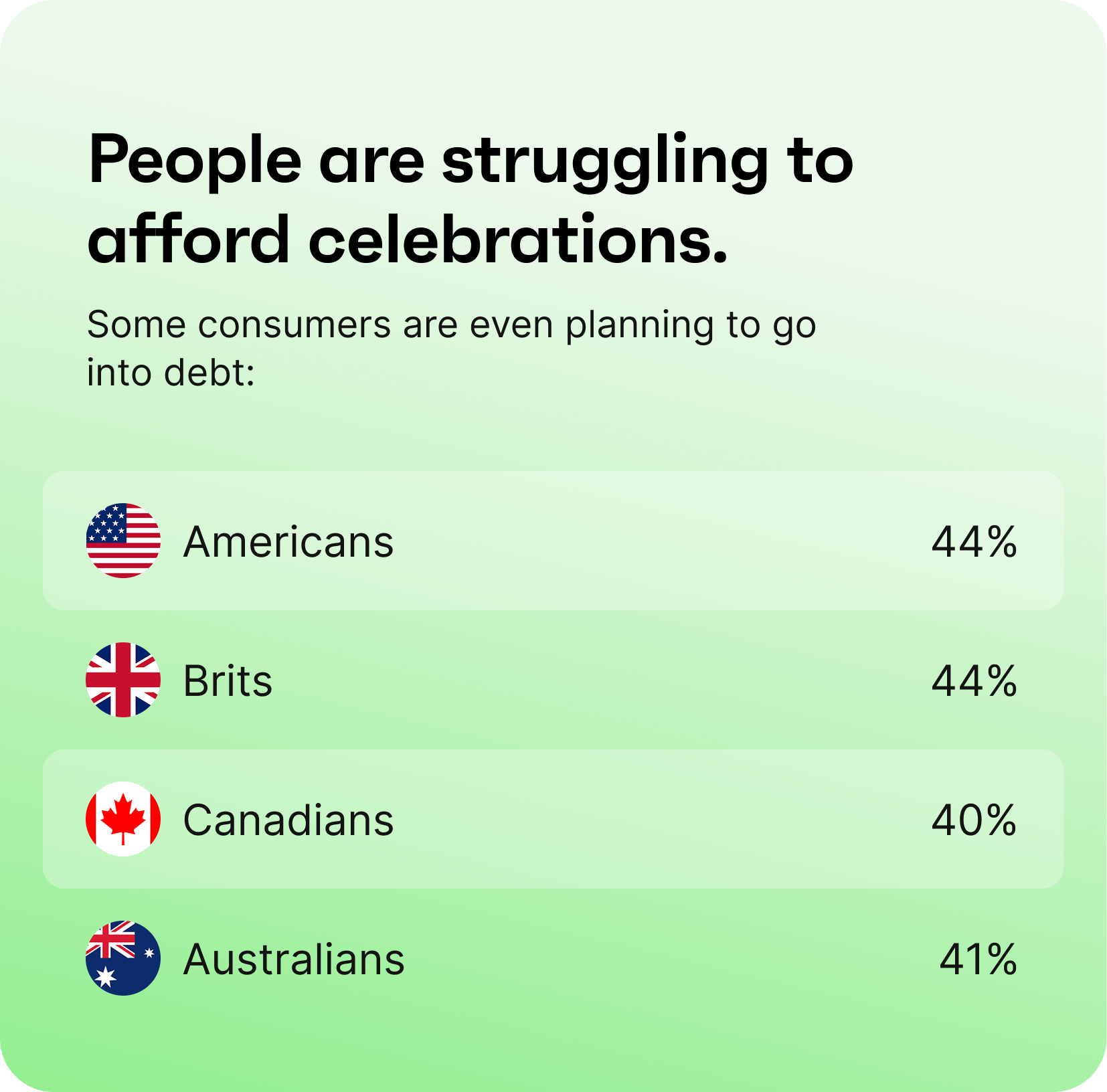
Despite growing financial conservatism, a big portion of consumers have already made peace with the fact that they’re likely to go into debt for the holiday season. 44% of Americans, 44% of Brits, 40% of Canadians, and 41% of Australians will carry additional debt when the festivities are all said and done, with the biggest share (12% US, 14% UK, 10% CA) saying they’ll owe $100-$249, while for most Australians, that’ll be $250–$499.
Among those who’ll carry debt, the average will be $408 per person, making it $48.6 billion in the US. In comparison, last year US shoppers racked up $55 billion in post-holiday debt ($213 per adult). In Canada, it totaled $6.08 billion, or $187 per adult. Australians ended the season with $5.43 billion in debt, averaging $249 per adult. And in the UK, shoppers added £6.79 billion, which breaks down to about £171 per person.
The survey was commissioned by Omnisend and conducted by Cint in August 2026. It included 1123 respondents from the U.S., 1076 from the UK, 1075 from Canada, and 1089 from Australia. Quotas were placed on age, gender, income, and place of residence to achieve a nationally representative sample among users. The margin of error is +/-3 percent.
Self-reported survey data reflect stated intentions and perceptions, not observed behavior. Results are subject to recall and social desirability bias. Findings are representative of the sampled population and may not reflect all adult consumers.
Budgets vary noticeably by market this year. Most Americans (18%) plan to spend up to $200, most Canadians (21%) will spend $200–$499, most Brits (20%) are split between $200–$499 and $500–$999, and most Australians (17%) will spend $500–$999.
Yes, a significant share plan to cut back compared to last year: 38% of Americans, 32% of Brits, 33% of Canadians, and 35.5% of Australians expect to spend less.
Gifts account for 39% to 44% of the total holiday budget. Groceries for hosting are the other major expense, taking up 28% to 45% of budgets.
78% to 84% of consumers say they feel the effects of rising prices, and 21% to 27% plan to significantly lower their holiday spending as a result.
The main reasons are spreading costs across more paychecks (29% to 34%), trying to avoid further price increases (23% to 29%), and wanting to lock in limited-time offers (22% to 26%).
Yes. 33% to 43% expect to spend more on food than last year, and 49% to 56% say hosting feels significantly more stressful compared to last year.
The most common tactic is using discount codes and coupons (35% to 39% of consumers), followed by setting a strict budget and sticking to it, and shopping earlier than usual (26% to 28%).
This year, 39% of Americans and 29% of Canadians say they'll use or consider BNPL, down from 44.8% and 36.6% last year, respectively. In contrast, Brits (43%) and Australians (44%) remain about as willing to use BNPL as before.
44% of Americans, 44% of Brits, 40% of Canadians, and 41% of Australians expect to carry additional debt once the holidays are over.