• Features
  • Pricing
  • Migration
  • Integrations
  • Resources

Main meniu
Main meniu
Main meniu
Main meniu

U.S. Porch Piracy
Report 2025:

$12.8 Billion Lost Across 228 Million Stolen Packages

Package theft is now a mainstream cost of online shopping in the USA. In 2025, Americans lost an estimated $12.8 billion across roughly 228 million stolen packages, with nearly 1 in 3 households (29.7%) affected in the last 12 months. Building on Omnisend’s previous package theft research, this report combines FBI crime data with nationally representative consumer survey data to show where theft is concentrated, how often it strikes, what it costs, and how it changes shopper and retailer behavior.

At-a-glance: Main findings
  • Nearly 1 in 3 USA households (29.7%) experienced package theft in 2025.
  • Retailers absorbed an estimated $7.9 billion through refunds and free replacements.
  • Maryland and Colorado had the highest household exposure, with theft affecting roughly 50% and 41% of households, respectively.
  • California, New York, and Texas together accounted for about 28% of all dollar losses nationwide.
  • The average USA household experienced about 1.8 thefts and lost roughly $101 to porch pirates in 2025.
  • December was the peak month for package theft, and Clothing, Shoes & Jewelry was the most stolen category.


Those losses are also shaped by how exposed delivered packages are in the first place. According to a Pinkerton analysis of package-theft research, 98% of stolen packages were visible from the street, 61% were located within 25 feet of the street, and 46% featured clear branding. In other words, porch piracy is not just about what people buy, but also about how visible and accessible those packages are left at the door.

Which USA states have the
highest package theft rates
in 2025?

Package theft in 2025 was not evenly distributed across the country. By total dollar losses, California, New York, and Texas alone accounted for about 28% of all money lost to theft nationwide. But dollar totals only tell part of the story. When looking at household exposure, a different map emerges: Maryland had the highest share of households affected at 49.97%, followed by Colorado at 41.41%. At the other end of the range, Illinois was at 8.82%, with Mississippi also identified as a relatively cold spot in the broader analysis.

The intensity of theft also varies sharply by state. Nationwide, households averaged about 1.8 stolen packages in 2025 and lost roughly $101 per household. Most individual losses were still relatively modest, with about 73% falling under $100 and the average lost package valued at $56. But repeated theft adds up quickly in harder-hit states: Arizona households lost an average of $298 over the year, while Tennessee households lost $175.

Expert insight

Package theft risk is genuinely local. In states like Maryland or Arizona, it’s practically a routine hazard of ordering online. In others, it barely registers. For millions of households, this isn’t a rare bad-luck event — it’s a recurring cost of ecommerce.

Marty Bauer
Omnisend’s Senior Ecommerce Expert

Who pays for stolen
packages in 2025, and how
does theft change shopper
behavior?

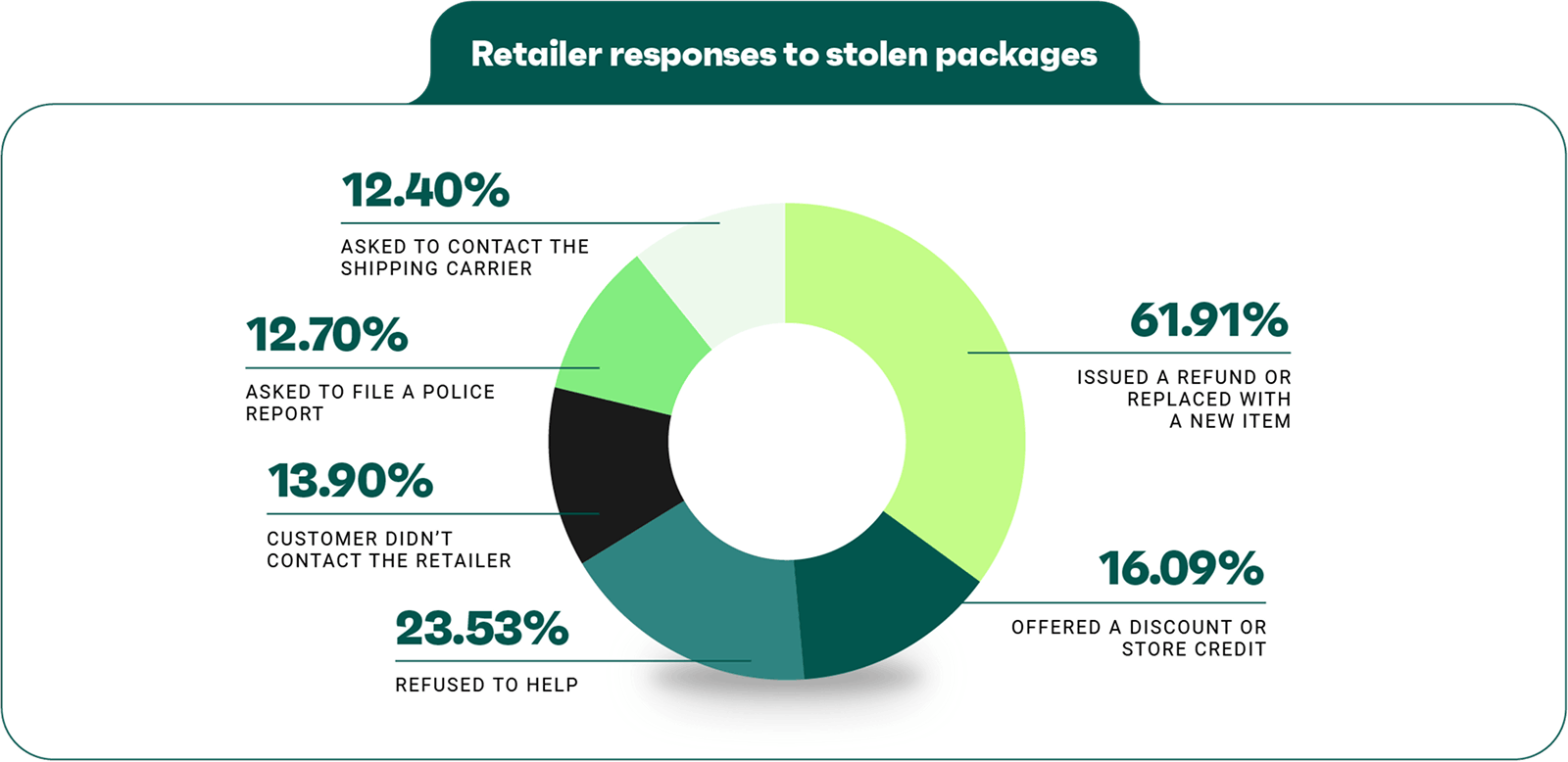
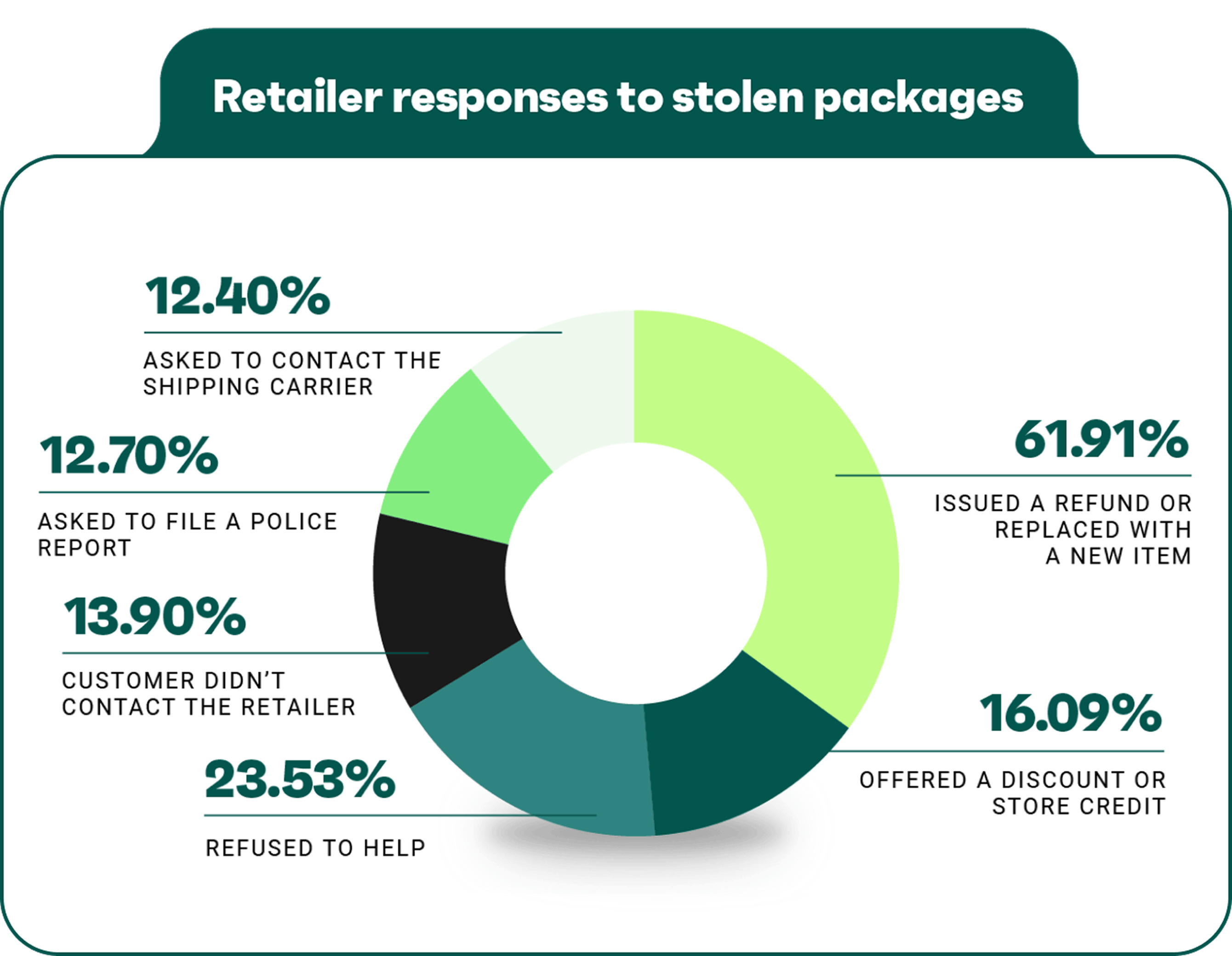
When packages disappear, consumers are not always the only ones absorbing the loss. Roughly 62% of victims said they received a refund or a free replacement, and those resolutions are estimated to have cost retailers about $7.9 billion in 2025. Another 16% were offered a discount or store credit. At the same time, nearly a quarter of retailers (23.5%) refused responsibility entirely, leaving those customers to absorb the loss themselves.

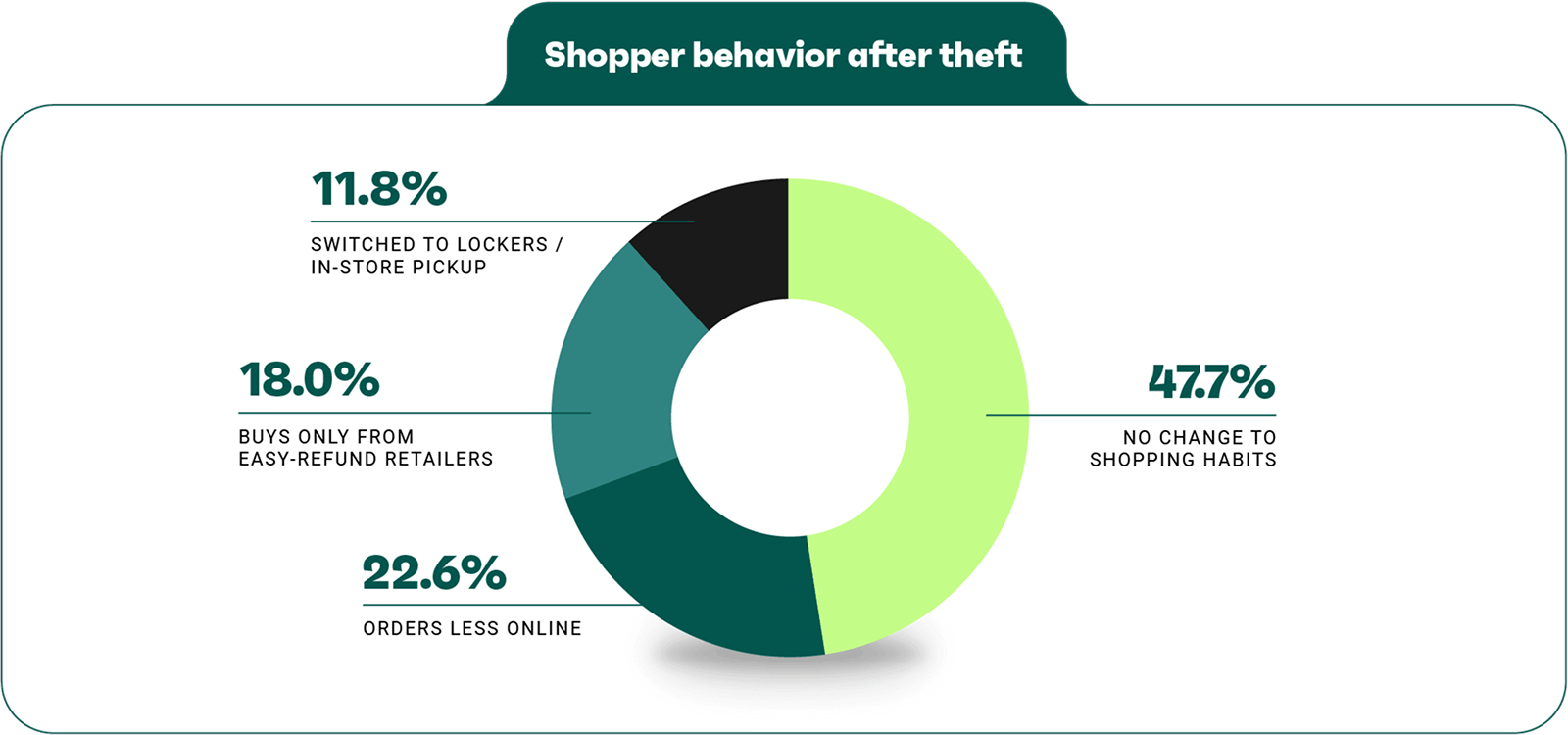
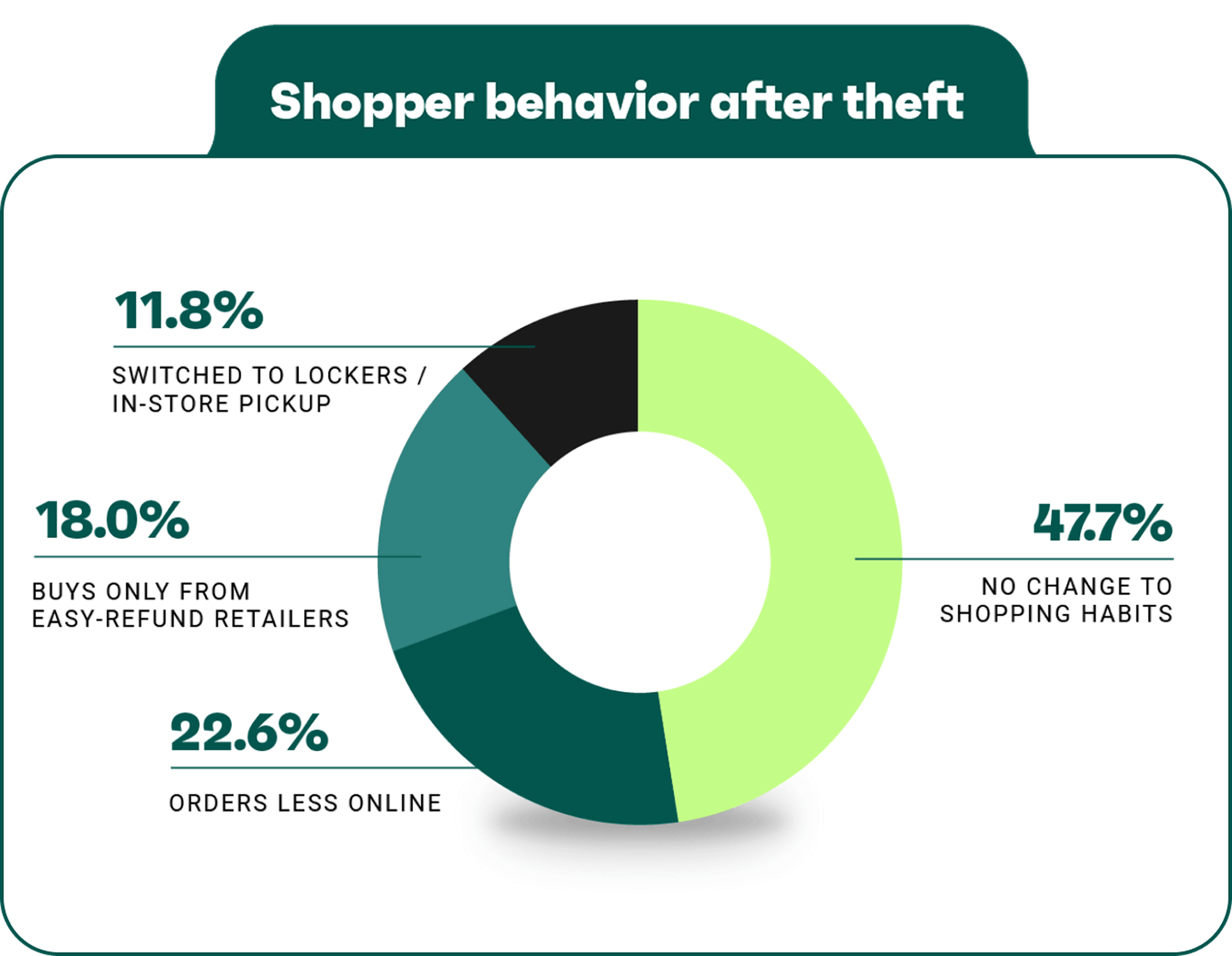
The experience also changes how people shop. After theft, 22.6% of victims said they order online less often, 18.0% said they now buy only from retailers with easy refund policies, and 11.8% said they shifted some purchases to lockers or in-store pickup. Still, 47.7% reported no change to their shopping behavior, suggesting that for many consumers, package theft is becoming an accepted part of ecommerce. On the carrier side, stolen packages were most commonly tied to Amazon at 61.3%, followed by USPS at 30.0%, then UPS at 26.0%, and FedEx at 25.1%.

Expert insight

When you have 228 million stolen packages and retailers quietly absorbing $7.9 billion of that loss, it stops being a consumer inconvenience and starts being an industry-wide cost of doing business. The retailers who will win in the long term aren’t just reacting to theft claims — they’re building delivery and returns infrastructure around the reality that roughly 1 in 3 of their customers will face this at some point.

Marty Bauer
Omnisend’s Senior Ecommerce Expert

When is package theft most
common in 2025?

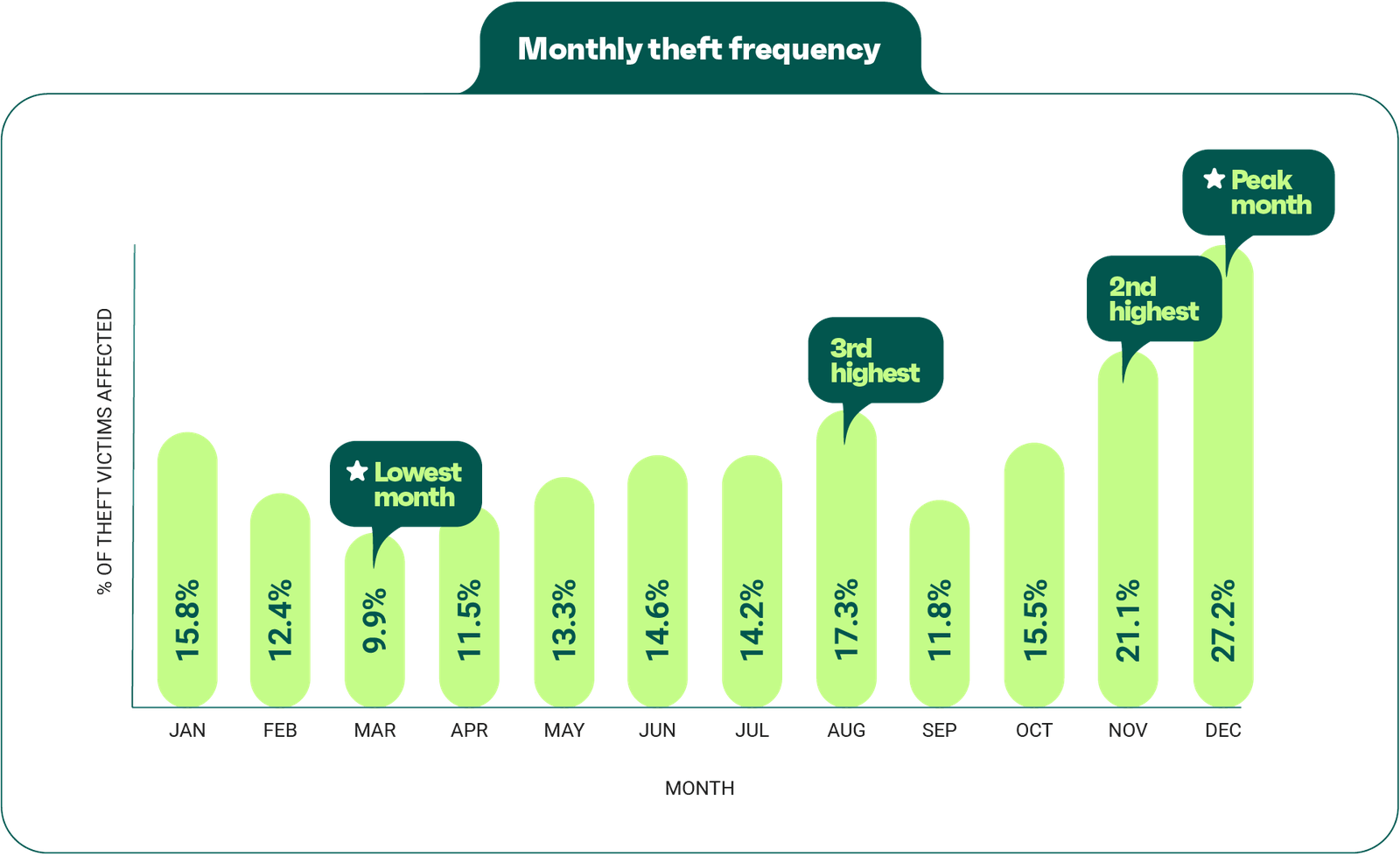
Package theft in 2025 followed a clear seasonal pattern tied closely to ecommerce activity. December was the peak month, with 27.2% of theft victims reporting an incident during the holiday rush. November followed at 21.1%, and August ranked third at 17.3%. March was the quietest month at 9.9%. Taken together, November and December accounted for nearly half of the year’s heightened theft risk, making the holiday delivery season the most vulnerable stretch.

That timing matters for both retailers and shoppers. The more packages moving through the last mile, the greater the risk of theft, especially during periods when deliveries pile up faster and sit unattended longer. Seasonality does not create the problem on its own, but it clearly intensifies it.

Expert insight

The brands that come out ahead are the ones that make resolution easy. Clear refund policies and flexible delivery options aren’t a nice-to-have — for a growing share of consumers, they determine where the next order goes.

Marty Bauer
Omnisend’s Senior Ecommerce Expert

What items are stolen most
often in 2025?

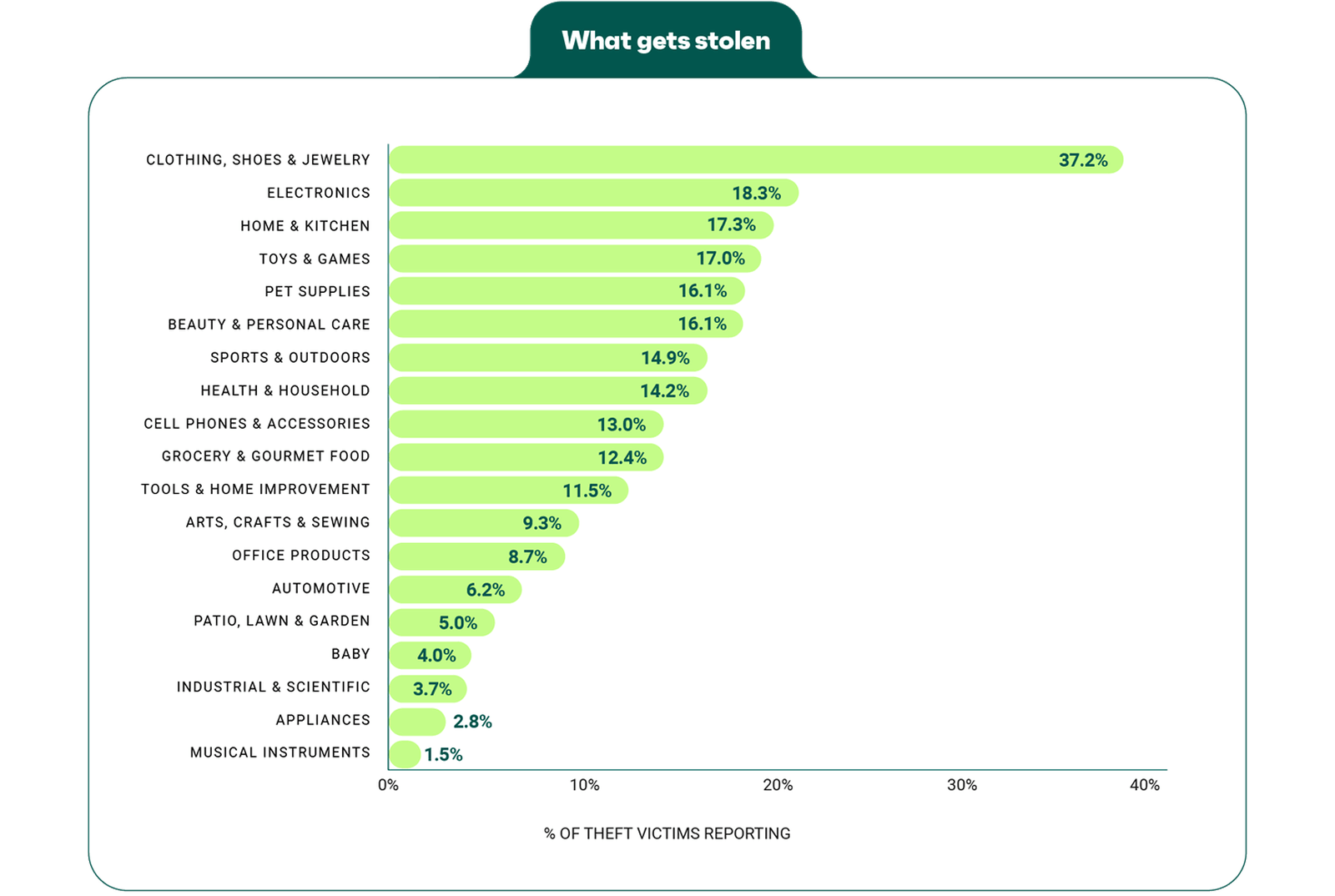
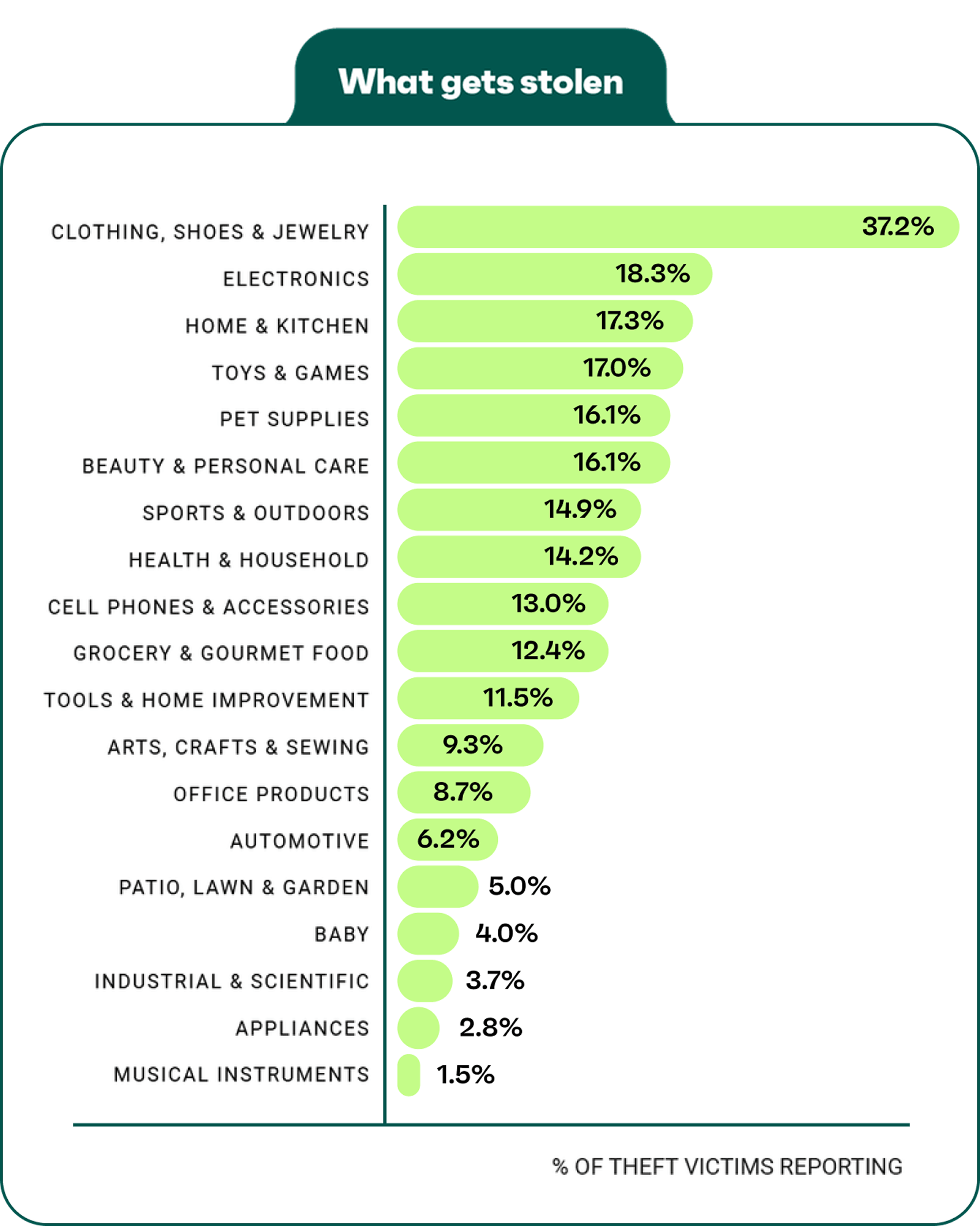
The data suggests that porch pirates are not mainly targeting rare or obviously high-value deliveries. Instead, they are taking everyday ecommerce purchases left within easy reach. Clothing, Shoes & Jewelry was the most stolen category in 2025 at 37.2% — more than double the next category. Electronics followed at 18.3%, with Home & Kitchen at 17.3% and Toys & Games at 17.0%. Pet Supplies and Beauty & Personal Care both reached 16.1%, reinforcing the idea that theft often involves ordinary household buying patterns rather than selective targeting of luxury goods.

That category mix helps explain why package theft feels so widespread. These are not edge-case purchases. They are the kinds of items people order all the time, especially during busy shopping periods. The pattern points less to thieves hunting for premium goods and more to opportunistic theft of whatever happens to be sitting on the doorstep.

Expert insight

The data makes it clear that thieves aren’t waiting for a high-value shipment — they’re taking the next thing that arrives. A jacket, a toy, a kitchen gadget. That’s what makes the holiday season so dangerous: more packages, more doors, more opportunity.

Marty Bauer
Omnisend’s Senior Ecommerce Expert
Conclusion

Porch piracy is no longer just a fringe inconvenience, but a routine cost of USA ecommerce. The scale of the losses is striking on its own, but the bigger story is how widespread the problem has become. At this scale, package theft doesn’t feel like a one-off inconvenience anymore — it feels like something millions of shoppers simply have to factor into buying online. But the risk is not the same everywhere, and retailer policies often determine whether the cost lands on the customer or the merchant. Many consumers are already adjusting by shopping more carefully, choosing retailers with simpler refund processes, or avoiding doorstep delivery altogether. That’s why package theft is no longer just a shopper pain point — it’s a broader ecommerce and delivery challenge.


Have any questions?

Reach out to our Public Relations team by
email [email protected] for more details. We're here to
help and provide any additional information you might need.

Methodology

Crime data from the FBI

In early April 2026, we used the FBI’s state-by-state crime data as one starting point for our analysis. We looked at “other larceny” cases tied to homes and residences, since that category typically includes package theft. And because not every police department reports to the FBI, we adjusted the totals to account for gaps in coverage.

Nationally representative consumer survey

We also conducted a nationally representative survey of 1,000 U.S. adults through CINT. Respondents were asked whether they had experienced package theft in the previous 12 months, how many packages were stolen, whether they reported the theft to police, the value of the loss, and what happened afterward, including retailer responses and changes in shopping behavior. The survey’s margin of error was 3%.

Adjusting and aligning the data

To better estimate the true scale of package theft, we adjusted FBI state-level figures using the survey’s reporting-rate data to account for incidents that were never reported to police. We then assigned dollar values to those theft estimates based on the average loss per reported incident, as reported by survey respondents.

Calculating final estimates

To estimate the national total, we combined adjusted FBI data with what consumers told us in the survey. Since not every theft is reported to police, the survey carried more weight in the final calculation, accounting for 75% of the estimate, while FBI data made up the other 25%. Together, those two sources provide a more realistic picture of package theft in the U.S.


FAQ

How common was package theft in the U.S. in 2025? + -

Package theft was widespread in 2025. Omnisend’s analysis estimates that Americans lost $12.8 billion due to roughly 228 million stolen packages, with 29.7% of U.S. households reporting package theft in the previous 12 months.

Who pays when a package is stolen? + -

In many cases, retailers absorb the cost. About 62% of victims said they received a refund or free replacement, and those resolutions are estimated to have cost retailers around $7.9 billion in 2025. At the same time, 23.5% of victims said the retailer refused responsibility, meaning not every shopper got compensation.

When is package theft most likely to happen? + -

Package theft peaks during the holiday shopping season. December was the highest-risk month in 2025, with 27.2% of theft victims reporting an incident then, followed by November at 21.1%. Together, those two months accounted for nearly half of the year’s elevated theft risk.


How to cite this report?
  • Short Citation: Omnisend (2025). Package Theft in America 2025. Retrieved from [Insert URL]
  • APA Format: Omnisend. (2025). Package Theft in America 2025: Survey of 1,000 U.S. adults reveals $12.8 billion in losses across 228 million stolen parcels. [Insert publication date]. Retrieved from [Insert URL]
  • MLA Format: Omnisend. "Package Theft in America 2025: Survey of 1,000 U.S. Adults Reveals $12.8 Billion in Losses Across 228 Million Stolen Parcels." Omnisend, [Insert publication date], [Insert URL]
  • Chicago Format: Omnisend. "Package Theft in America 2025: Survey of 1,000 U.S. Adults Reveals $12.8 Billion in Losses Across 228 Million Stolen Parcels." Omnisend. [Insert publication date]. [Insert URL]
Omnisend

Email and SMS marketing so good, it’s boring

Omnisend is a leading email and SMS marketing platform, trusted by over 150,000+ brands worldwide and with a 4.7-star rating from more than 6,000 Shopify reviews. With powerful tools like automation, segmentation, reporting, push notifications, and product reviews, Omnisend merchants generate $79 for every $1 spent.

Learn more