• Features
  • Pricing
  • Migration
  • Integrations
  • Resources

Main meniu
Main meniu
Main meniu
Main meniu
Request migration
Report

BFCM 2026: Shoppers are still there, but their baskets are shrinking

Povilas Sabaliauskas

Black Friday and Cyber Monday remain the biggest shopping weekend of the year, with tens of billions of dollars spent worldwide. Although shoppers remain as active as ever, their behavior is evolving.

A new Omnisend survey of 4,363 consumers in the US, UK, Canada, and Australia shows that shoppers plan to spend up to 32% less than last year.

Key takeaways
  • Shoppers are still there, but their baskets are smaller. 44–55% across markets plan on shopping during BFCM. However, their budgets should shrink by 17–32%.
  • The biggest change compared to 2025 is that the share of those planning to spend 1,000+ roughly halved in the US, UK, and Canada. However, spending in the lower and mid-tier brackets should grow across all markets.
  • Shoppers will go into debt for a good deal. 30–40% are willing to use Buy Now, Pay Later, especially for big-ticket deals.
  • Clothing and accessories (38–42%), tech products (33–37%), and toys (26–31%) will be the most popular product categories. However, the demand for them should be lower than last year.
  • The size of discounts motivates 52–57% of shoppers. People are being proactive in their search for them, with 18–22% using generative AI for this purpose.

Consumers are planning to spend less on BFCM

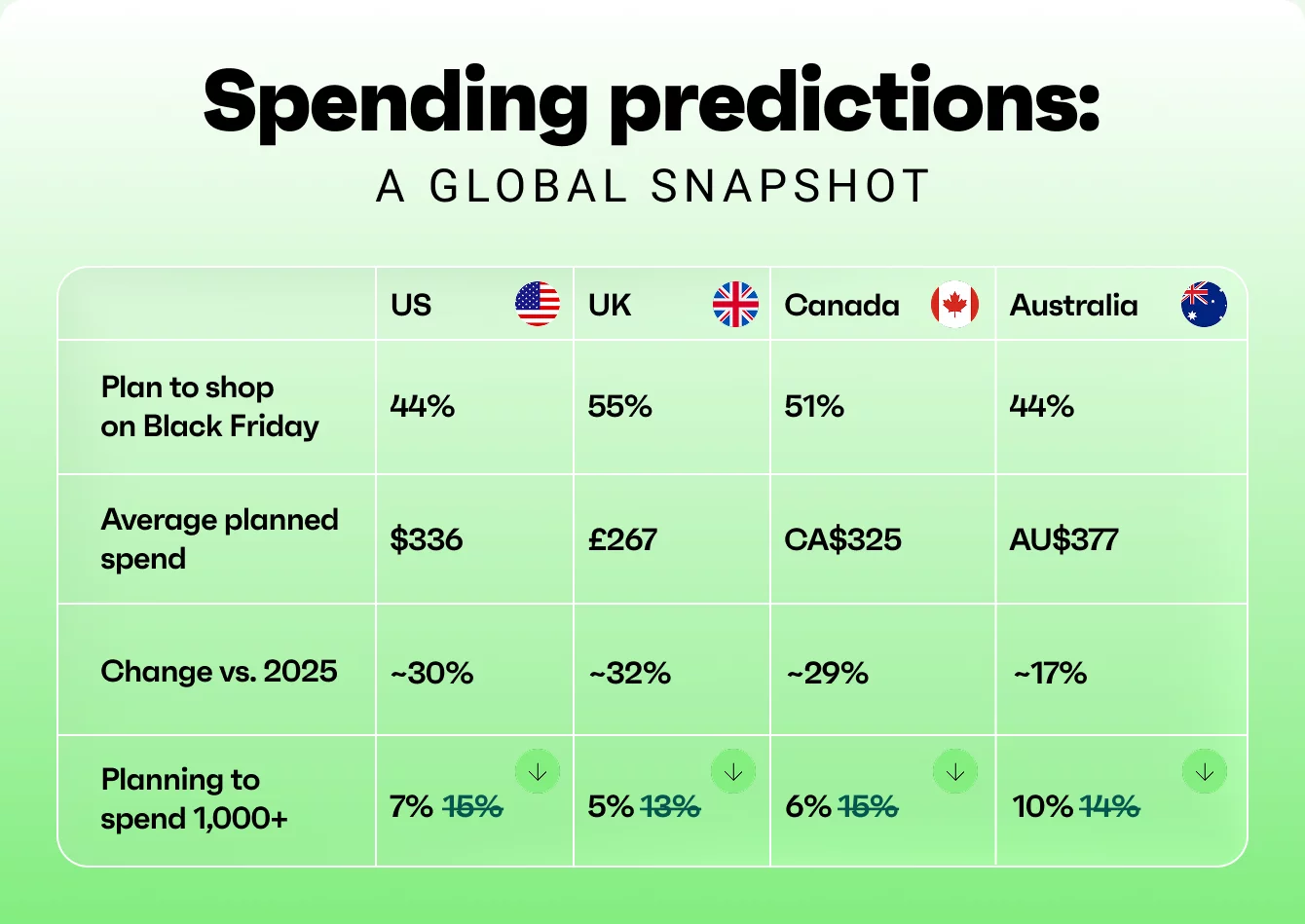
Last year, Americans, Brits, Canadians, and Australians who participated in BFCM spent an average of $479, £390, $458, and $455, respectively. Our survey reveals that this number will be noticeably lower this year. In fact, consumers in these countries plan to allocate an average of $336 (30% less), £267 (32% less), CA $325 (29% less), and AU $377 (17% less), respectively, to BFCM shopping.

The event itself remains as popular as ever, with 44% to 55% of consumers planning to participate across the markets.

What has changed is how much people are willing to spend. The size of an average shopping basket should shrink due to the fact that there will be fewer big-ticket spenders.

The portion of those spending $1000+ or $500- $999 will shrink in all four markets. This is the main factor behind why the average BFCM budget is expected to shrink by 17% to 32%, depending on the market. 

How much do you expect to spend during Black Friday/Cyber Monday this year?
USA
USA
UK
Canada
Australia

Consumers are eager to save money

Just as in 2025, clothing and accessories remain the most popular items to buy during BFCM. 38% to 42% of consumers across the markets plan to purchase clothing and accessories this year. Tech gadgets and electronics are second (33% to 37%), followed by toys and games (26% to 31%). However, compared to last year, all of these categories have decreased in popularity.

What kind of items are you planning to buy during Black Friday/Cyber Monday?
USA
USA
UK
Canada
Australia

Buying decisions are mainly influenced by the eagerness to save money. 52% to 57% are most influenced by the size of the discounts. Meanwhile, 34% to 38% are motivated by free shipping. People also appreciate gift bundles and limited-time offers (19%-26%).

Finding the best deals and offers is essential for consumers, and AI is an increasingly popular tool for this purpose. 22% of Americans, 18% of British people, 20% of Canadians, and 21% of Australians say they use generative AI to find relevant deals and coupons.

What factors influence your decision to buy during Black Friday/Cyber Monday?
USA
USA
UK
Canada
Australia

People are also willing to borrow money if this means that they’ll save money in the long run. 39% of Americans, 40% of Brits, 31% of Canadians, and 40% of Australians are willing to use Buy Now Pay Later services, especially if big-ticket deals will be available.

Are you planning to use Buy Now, Pay Later for Black Friday/Cyber Monday this year?
USA
USA
UK
Canada
Australia
We must face an uncomfortable reality. Consumers are stressed and concerned about their financial standing, and they're looking for ways to balance their budgets. Traditionally, BFCM deals were used mainly to make larger purchases, such as clothes, consumer electronics, or gifts. However, in recent years, food and beverages have also evolved into an important category. For retailers, this means that they need to adjust their messaging and focus on the value that they offer. Whether you manage to successfully communicate this, as well as offer limited-time offers and bundles that the audience craves, should be the key to a productive BFCM. The goal for this year should be catering to shoppers in all of the budget brackets, and being able to offer them flexible payment options.
Marty Bauer
Omnisend’s Senior Ecommerce Expert

Expert tips for retailers

Cover all of the budget brackets. The number of shoppers with bigger budgets is expected to shrink. At the same time, lower- and mid-tier spending should grow. Make sure that you have something to offer for shoppers with very different budgets.

Good deals on food and drinks are essential. These products are now a major part of BFCM, with almost one-fifth of all consumers planning to buy them. Don’t forget to make sure that you have something to offer for them. 

Discounts and free shipping are a must.  For the majority of shoppers, BFCM is all about saving money, so these two are the biggest motivators to buy. 

AI is potentially a major gateway to a bigger client base. 1 in 5 shoppers say they will use generative AI to find relevant deals and coupons. Clean product data and clear offer pages help your deals surface in AI searches.

Flexible payment options are a must. Up to 40% of shoppers are open to using BNPL. Especially if it’s a big-ticket deal, make sure that you provide them with that option.  


Methodology 

The survey was commissioned by Omnisend and conducted by Cint in August 2026. It included 1123 respondents from the U.S., 1076 from the UK, 1075 from Canada, and 1089 from Australia. Quotas were placed on age, gender, income, and place of residence to achieve a nationally representative sample among users. The margin of error is +/-3 percent.

Average spend estimates were calculated using midpoints of reported spending ranges (e.g., $175 for 100–249, $375 for 250–499). To estimate total market size and growth, averages were extrapolated to the U.S. shopping population using National Retail Federation data, which reported ~197 million Americans participated in BFCM 2025, the Canadian adult population who plan to shop on BFCM(~22.5 million), the Australian adult population who plan to shop on BFCM (~14,8M), and the UK adult population who plan to shop on BFCM (~37M), with participation levels based on survey responses.

Self-reported survey data reflect stated intentions and perceptions, not observed behavior. Results are subject to recall and social desirability bias. Findings are representative of the sampled population and may not reflect all adult consumers.

FAQ

How many consumers plan to shop during BFCM 2026? + -

Roughly half. 44% of Americans, 55% of Brits, 51% of Canadians, and 44% of Australians plan to shop during Black Friday.

Will people spend more or less than last year? + -

Less. Average planned spending is $336 (30% less) in the US, £267 (32% less) in the UK, CA $325(29% less) in Canada, and AU$377 (17% less) in Australia.

What are the most popular BFCM purchases this year? + -

Clothing and accessories come first, then tech gadgets and electronics, and toys and games. All three categories are less popular than in 2025.

What motivates people to shop during BFCM? + -

Discounts come first, motivating 52–57% of shoppers. Free shipping comes next (34–38%), followed by limited-time offers (19–26%) and gift ideas and bundles (19–26%).

How are shoppers using AI to find deals? + -

22% of Americans, 18% of Brits, 20% of Canadians, and 21% of Australians use generative AI to find deals and coupons.

Will shoppers use Buy Now, Pay Later (BNPL) during BFCM? + -

Many will. 39% of Americans, 40% of Brits, 31% of Canadians, and 40% of Australians are willing to use BNPL, especially for big-ticket deals.

Have any questions?
Reach out to our Public Relations team. We're here to help and provide any additional information you might need.
[email protected]