Omnisend AI


 OFFER
OFFER









According to Joy S., FLEXTAIL’s growth manager, Omnisend stood out for three reasons: clear data pipelines, rapid integration updates, and powerful automation controls that are not overly granular.
“Omnisend has a clear data pipeline and a clean UI, which makes it easy to inspect what’s happening at a glance,” he explains. “It’s logical to operate, and it doesn’t force you into endless micro-decisions just to build workflows that work.”
That clarity mattered because FLEXTAIL doesn’t build lifecycle messaging as a set of disconnected campaigns. They build it as a system: flows, segments, and rules that adapt to customer behavior — and scale with the list.
The strategy to map the journey, find the leaks, then build workflows to fix them
FLEXTAIL’s automation process starts with a blank sketch. Instead of copying templates, the team maps out the customer journey and builds exactly what they need inside the automation builder.
They look at website behavior and traffic patterns first, then cross-reference that with audience groups and existing touchpoints. That’s how they decide where automation should step in: welcome, education, follow-up, or winback.
“We cross-reference website traffic data with our audiences and automation touchpoints,” says Joy. “That’s how we identify where we’re missing opportunities and what the next workflow should do.”
How FLEXTAIL maintains engagement at scale with segmentation and winback rules
One of the most impressive parts of FLEXTAIL’s approach is that they maintain high engagement even with a large list. With 150K+ subscribers, they still report around 60% open rates — by treating customers as people moving through distinct stages.
Their model has three phases:
- Becoming a user
- Active engagement
- Enthusiasm transfers forward — or slowly fades away
This is where segmentation becomes more than a targeting tool. FLEXTAIL uses it as a filter: identifying highly engaged audiences and reducing send pressure on people whose interest has cooled.
“Not everyone is sensitive to email — and some customers simply don’t want frequent contact,” Joy notes. “So we use winback rules and segmentation to avoid annoying those people, while keeping our engaged segments strong.”
That approach does two things at once:
- It improves the experience for subscribers (less irrelevant noise)
- It makes performance metrics more meaningful because engagement is measured on an audience that actually wants to hear from the brand
Results: a welcome automation that drives real revenue
Today, automation is a meaningful sales channel for FLEXTAIL. The team estimates that their automation strategy contributes around 8% of total website sales — while also supporting higher repeat purchase rates and ARPU over time.
And their top-performing workflow is clear: the welcome series.
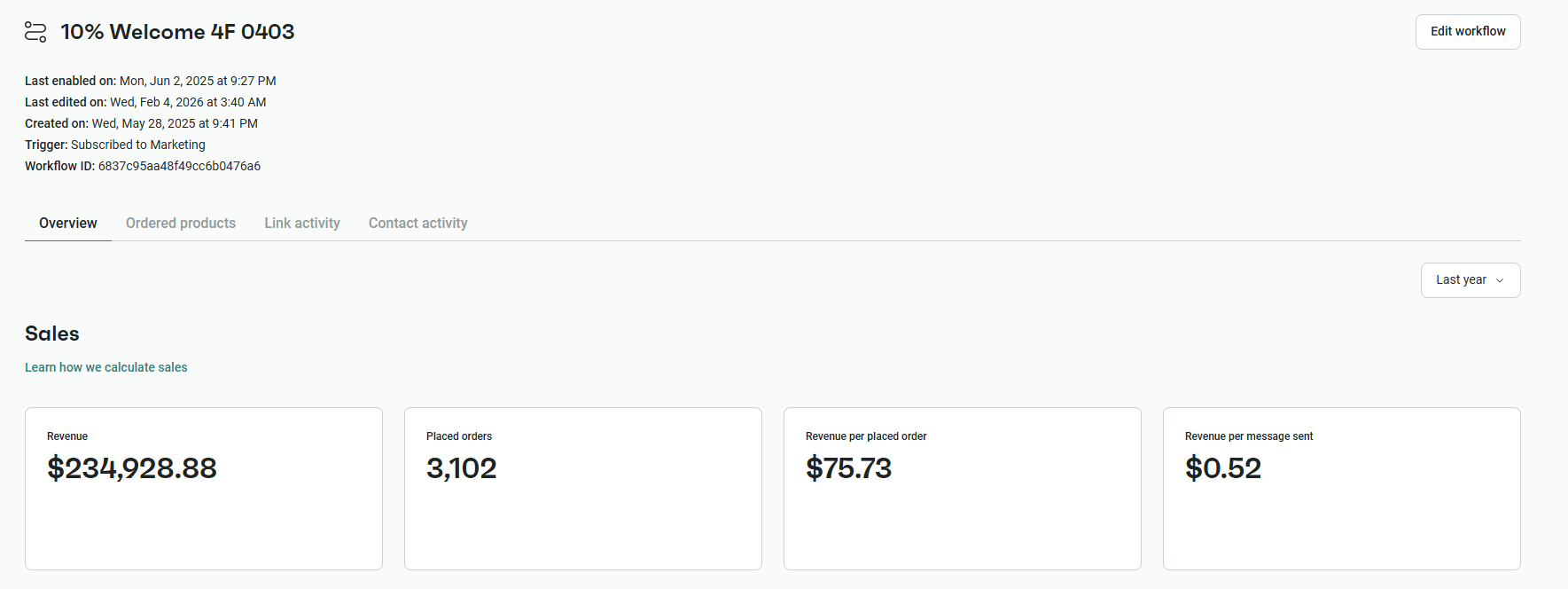
FLEXTAIL shared performance data from their Welcome automation:
- $235K in attributed sales
- 3,102 placed orders
- $75.73 revenue per order
- $0.52 revenue per message sent
This is a structured system that turns new subscribers into customers — and does it consistently, without requiring manual campaign effort every day.

What’s next
FLEXTAIL is still refining how they “serve customers in time” — especially when a visitor doesn’t convert and doesn’t leave an email or SMS subscription.
They’ve started using Retention to re-engage a portion of those lost visitors (within compliance boundaries), and they see it as another way to recover attention when buying intent is there, but the moment gets interrupted.
Looking ahead, FLEXTAIL plans to keep evolving the same system-first mindset: clearer journey mapping, deeper segmentation, and workflows designed to protect engagement as the list continues to grow.