- Features
- Pricing
- Migration
- Integrations
- Resources
With over 335+ pre-built integrations and flexible APIs, you can easily centralize data from across your tech stack
Make the most out of your data and unlock powerful growth marketing possibilities with these other top marketing tools.
Build any custom integration with our open, flexible APIs that are simple to use and implement.
Check out apps that have been stealing all the spotlight.
Email and SMS marketing insights, ecommerce resources, and the latest Omnisend news
Expert-led sessions covering email, SMS, and ecommerce marketing strategies.
Latest feature releases, product improvements, and bug fixes.
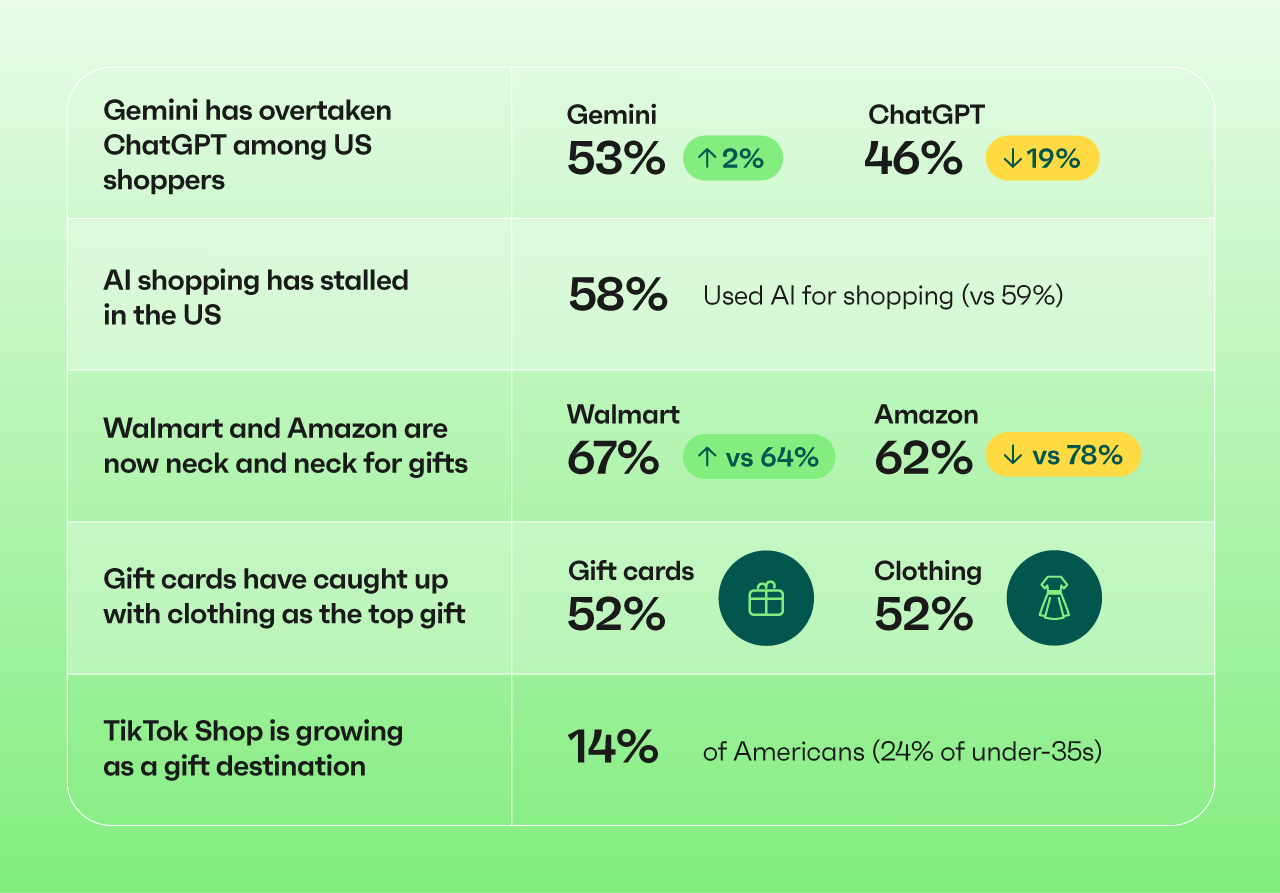
This holiday season, Americans are rethinking where they buy gifts and which tools help them decide. Our survey of 4,363 people in the US, the UK, Canada, and Australia found that Amazon’s 14-point lead over Walmart as Americans’ go-to gift destination has disappeared. Google’s Gemini has overtaken ChatGPT as the AI assistant American shoppers use most. And TikTok Shop has become a gift stop for almost a quarter of younger Americans.
Although AI chatbots are emerging as key shopping assistants and young people are trying out new gift-buying platforms, shoppers themselves haven’t changed much. Gift cards and clothing remain the most popular choices, and consumers are buying gifts for themselves as well as for friends and relatives.
AI is already part of how many people shop. In fact, more than half of consumers (58% to 60%) say that they have used AI for at least one shopping task in the past six months. In the US, that’s essentially unchanged from last year (59%), while in the UK, Canada, and Australia, AI use rose slightly. Between a quarter and a third of shoppers in each market say they use AI for this purpose several times a week. Outside the US, that share grew compared with last year.
Holiday plans follow the same pattern. A third of Americans (34%) plan to use AI during the upcoming holiday shopping season, the lowest share of the four markets. In the UK, the figure is 36%, in Canada 39%, and in Australia 40%.
On the other hand, many Americans are still hesitant about using AI. The main source of their concern is privacy and data security (41%). People also worry about being able to distinguish between genuine and sponsored recommendations (33%) and trusting AI to correctly interpret their preferences (31%).
While ChatGPT used to dominate, that’s no longer the case in the US. Last year, ChatGPT led Gemini among American AI shoppers by 65% to 51%. This year, Gemini has taken the lead: 53% of Americans who use AI tools for shopping use Gemini, compared with 46% who use ChatGPT. Nevertheless, the US is currently something of an outlier. In the UK, Canada, and Australia, ChatGPT remains the preferred choice, used by 62%, 65%, and 70% of AI shoppers, respectively.
The results are hardly surprising when it comes to choosing an ecommerce platform on which to buy holiday gifts. Amazon is still the default choice in most markets: 77% of Brits and 75% of Canadians plan to buy holiday gifts there.
The US is a different story. Last year, Amazon led Walmart by 14 points (78% vs 64%). This year, the two are neck and neck: 67% of Americans plan to buy holiday gifts at Walmart and 62% at Amazon.
At the same time, TikTok Shop has been quietly gaining ground. 14% of Americans plan to shop there this year, up from 9% in 2025. TikTok Shop is also rapidly growing in the UK, with 20% of consumers planning to shop there this year, up from 13% last year. Nevertheless, it still has a long way to go in Canada and Australia, where it’s unchanged at 3% and 6%, respectively.
The platform is most popular among young consumers, with 24% of Americans under 35 planning to use TikTok Shop this holiday season. Overall, one in four Americans under 35 (25%) discovers and buys gifts directly through social media.
By its very design, gift-giving is a social ritual. When asked whom they are buying gifts for, most Americans name their immediate family members and closest friends first. The most common responses were children (48%), partners (42%), parents (32%), friends (31%), and siblings (28%).
Interestingly, a third of American shoppers (34%) are also buying presents for themselves. This is especially common among young people: half of those under 35 (53%) will buy themselves a gift this holiday season. Pets are popular recipients too, with 16% of Americans planning to buy something for theirs.
As for the gifts themselves, two categories stand out as clear favorites. Clothing and accessories have traditionally been the top choice (52%), but this year, gift cards share this position (also 52%). Our survey shows that gift cards are more popular among older shoppers: 61% of those aged 55 and older give them, compared to 44% of those under 35. The top five is rounded out by toys (40%), electronics (37%), and beauty products (28%).
See also: Holiday shopping trends 2026
Methodology
This report compares two surveys commissioned by Omnisend and conducted by Cint, one in August 2025 and one in August 2026. Both covered four countries: the US, the UK, Canada, and Australia. The 2026 survey included 1,123 respondents from the US, 1,076 from the UK, 1,075 from Canada, and 1,089 from Australia. Quotas were placed on age, gender, income, and place of residence to achieve a nationally representative sample among users. The margin of error is +/-3 percent. Percentages are based on respondents who answered each question and are rounded to the nearest whole number.
Self-reported survey data reflect stated intentions and perceptions, not observed behavior. Results are subject to recall and social desirability bias. Findings are representative of the sampled population and may not reflect all adult consumers.
Gemini. Among Americans who use AI tools for shopping, 53% use Gemini and 46% use ChatGPT. In the UK, Canada, and Australia, ChatGPT is still ahead, used by 62%, 65%, and 70% of AI shoppers, respectively.
Not really. 58% of Americans used AI for at least one shopping task in the past six months, compared with 59% last year. In the UK, Canada, and Australia, AI use rose slightly, to between 59% and 60%.
Privacy and data security are the top concerns (41%). Next come worries about distinguishing genuine recommendations from sponsored ones (33%) and doubts that AI will interpret their preferences correctly (31%).
Walmart (67%) and Amazon (62%) are now neck and neck, after Amazon led by 14 points last year. TikTok Shop is also growing and is now a gift destination for 14% of Americans.
Mostly close family and friends: children (48%), partners (42%), parents (32%), friends (31%), and siblings (28%). A third of shoppers (34%) also buy gifts for themselves.
Gift cards and clothing and accessories are tied at 52% each. Gift cards are more popular with older shoppers: 61% of people aged 55+ give them, compared with 44% of under-35s.
Yes, and more than last year. 14% of Americans plan to shop there this holiday season, up from 9% in 2025. Younger shoppers lead the trend: 24% of under-35s plan to use TikTok Shop.