• Features
  • Pricing
  • Migration
  • Integrations
  • Resources

Main meniu
Main meniu
Main meniu
Main meniu

How, where, and why consumers really shop online

We surveyed 4,000 consumers across the U.S., UK, Canada, and Australia to understand how online shopping fits into everyday life — where it happens, when it happens, and how emotion, price pressure, and convenience shape the decisions.

Key findings

Shopping happens everywhere

In which places have you shopped online?

USA
UK
Canada
Australia

There’s no such thing as the “right” time anymore, when it comes to online shopping. It slips into whatever moment is available — between emails, before bed, during workouts, and in places people don’t usually admit out loud.

66.5% of Americans shop online on the couch, and 42.1% shop in bed. But shopping extends well beyond the home. Nearly 3 in 10 Americans (28.8%) report shopping at work, with similar levels in the UK (33%), Canada (24%), and Australia (33%).

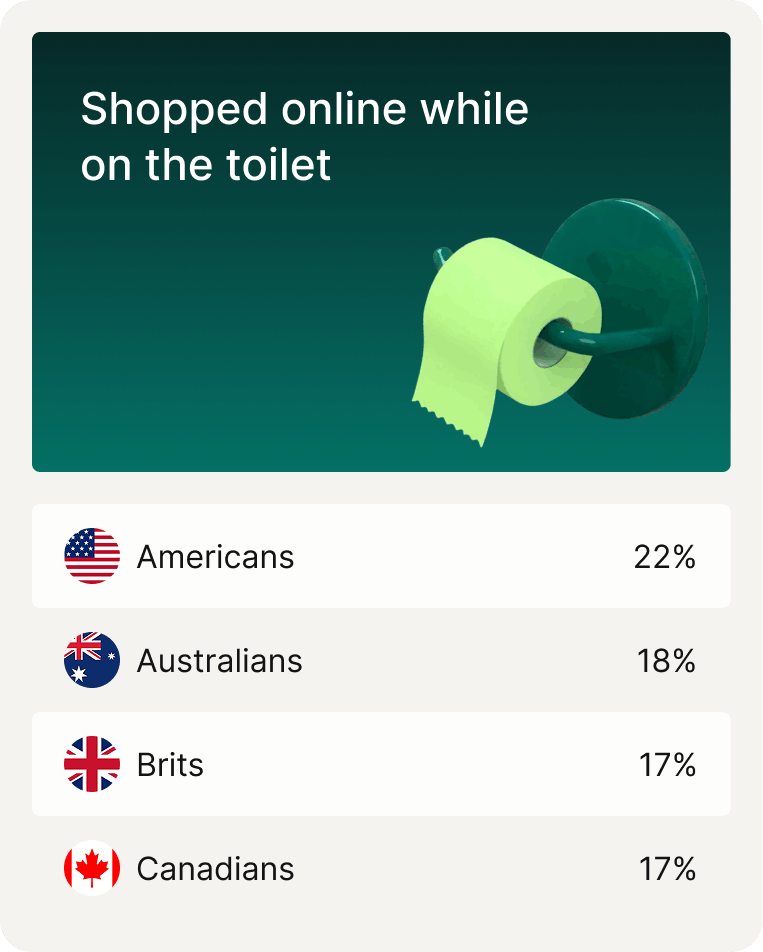
Many purchases happen in short, in-between moments. 21% of Americans say they’ve shopped online in the bathroom or on the toilet, alongside 17% in the UK, 17% in Canada, and 18% in Australia. Others shop while watching TV (49.4%), waiting in line (14.5%), or socializing (14.7%).

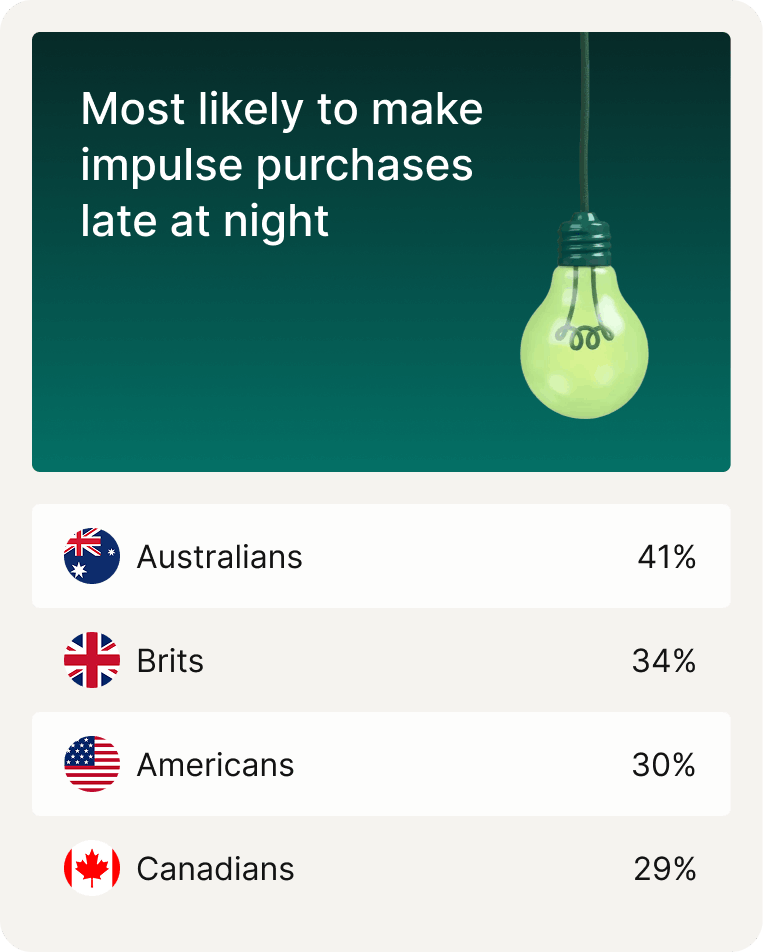
Timing reinforces this behavior. 30% of Americans are most likely to make impulse purchases late at night, rising to 34% in the UK and 41% in Australia. Across all four countries, around one in four shoppers say boredom plays a role in their online shopping.

Social platforms feed these moments. 49% of Americans say social media or influencer content leads them to shop online very often or sometimes, with similar responses in the UK (46%), Canada (37%), and Australia (42%).

The pattern is consistent: online shopping follows moments, not locations. It fills gaps in the day, driven by convenience, boredom, and whatever screen happens to be nearby.

The thrill of shopping comes
with mixed feelings

Have you ever hidden an online purchase from any of the following?

USA
UK
Canada
Australia

Online shopping delivers a quick reward, but for many shoppers, that dopamine hit comes with some mixed feelings close behind.

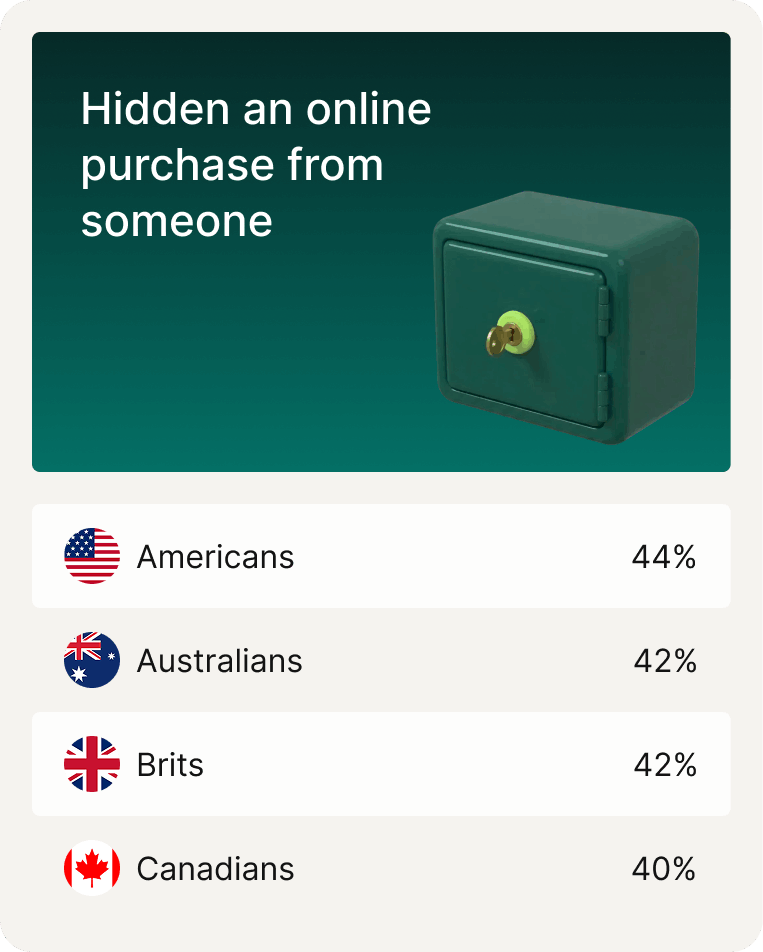
In the U.S., 44% of consumers say they’ve hidden an online purchase from someone, a pattern echoed across the UK (42%), Canada (40%), and Australia (42%). While many shoppers are open about what they buy, a substantial share choose not to be — especially with the people closest to them.

The most common person shoppers hide purchases from is a spouse or partner. 21% of Americans say they’ve done so, alongside 22% in the UK, 17% in Canada, and 22% in Australia. Others report hiding purchases from parents (12.1%), children or teens in the household (14.4%), friends (11.8%), or even coworkers (5.2%).

The reasons aren’t always financial — but money is often part of the picture. 17% of Americans say they hid a purchase because it was expensive, while 15% say they hid it because it felt unnecessary or impulsive. In many cases, discomfort comes from anticipating judgment.

But not all secrecy is driven by guilt. 32% of Americans who hid a purchase say it was because the item was a gift for the same person. So sometimes it’s simply practical.

Still, impulse plays a major role. 58% of Americans say they’ve bought something online mainly because it felt like a good deal, even if they didn’t need it, with similar responses in the UK (56%), Canada (52%), and Australia (60%).

Taken together, the data shows that online shopping carries emotion — excitement, justification, guilt, and anticipation — and that emotional layer often determines what gets shared and what stays private.

Cutting back without
quitting

What types of substitutions have you made to save money while shopping online?

USA
UK
Canada
Australia

Even with the rising prices, online shoppers aren’t ready to quit their habit entirely. But they’re for sure making some adjustments.

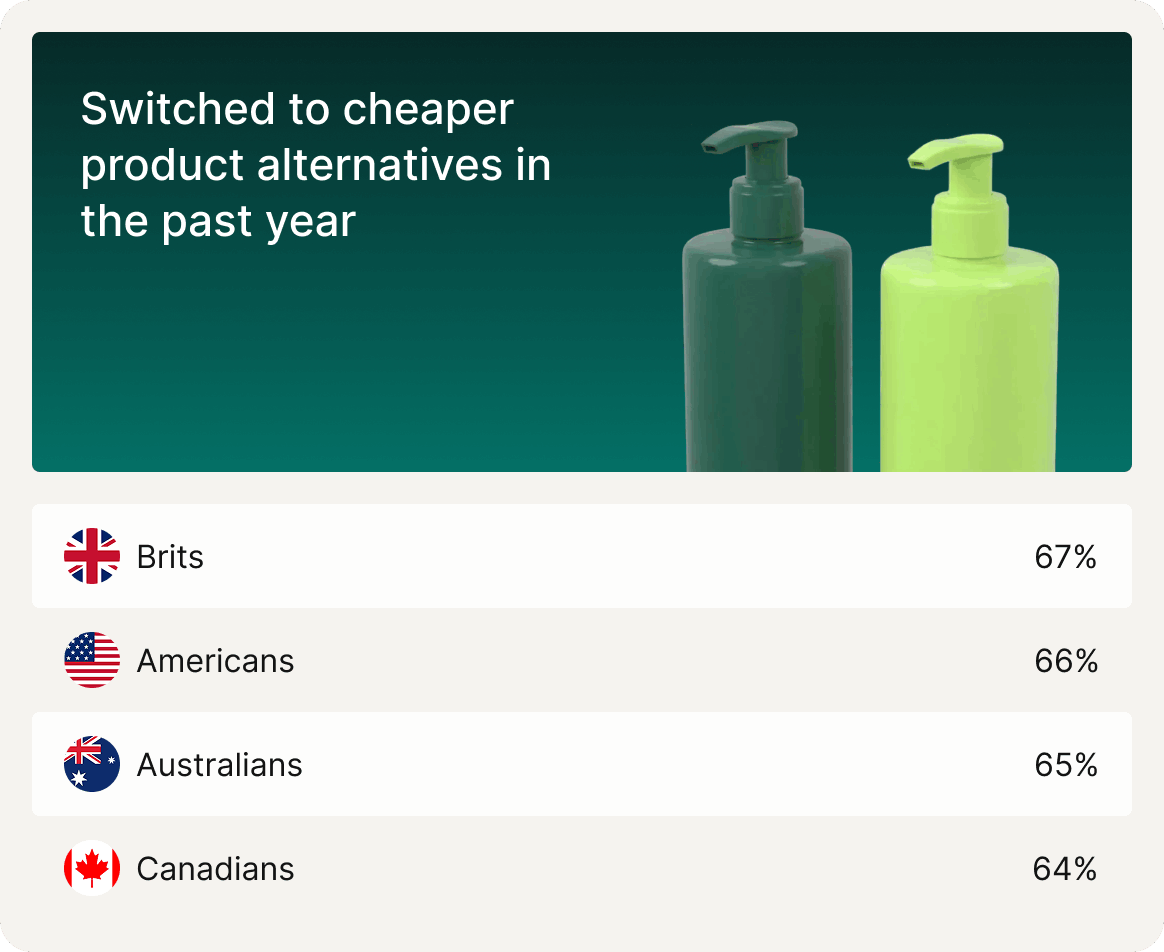
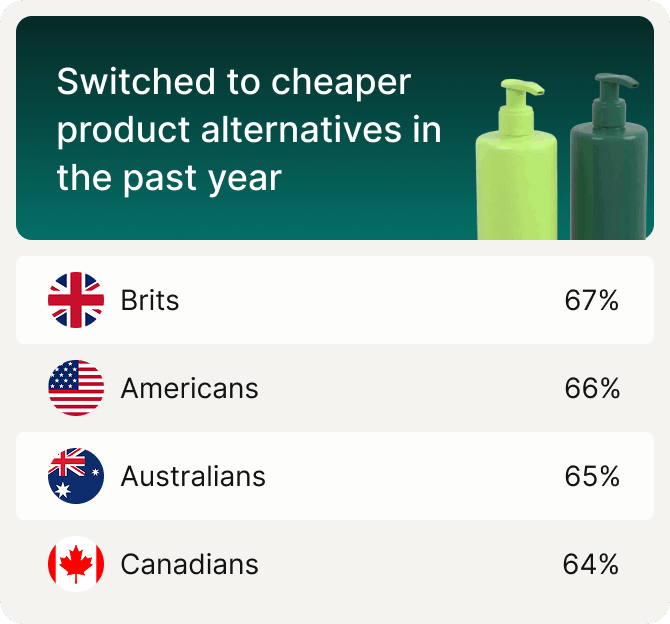
Substitution has become a common response. 66% of Americans say they’ve switched to cheaper alternatives often or occasionally in the past year, closely aligned with the UK (67%), Canada (64%), and Australia (65%). Rather than stopping purchases altogether, most consumers are adjusting what they buy.

The most common adjustment is trading down. 57% of Americans say they’ve chosen lower-priced brands, alongside 54% in the UK, 62% in Canada, and 59% in Australia. Only 7.5% say they don’t substitute at all and simply buy less.

Some categories feel the pressure more than others. 32% of Americans say they’ve reduced or stopped buying non-essential clothing or fashion items, the highest cutback across categories, with similar patterns in the UK (34%), Canada (33%), and Australia (37%).

Spending restraint also shows up in discretionary moments. 23% of Americans report cutting back on holiday or birthday gifts, while 27% say they’ve reduced impulse or “just for fun” purchases. These numbers are even higher in the UK (30%), Canada (31%), and Australia (35%).

At the same time, shoppers are looking for ways to stretch their money. Around one in three consumers across countries say they’re buying in bulk more often to take advantage of discounts. Payment behavior reflects similar pressure: 21% of Americans say they use Buy Now, Pay Later more than a year ago, compared to 17% in the UK, 10% in Canada, and 19% in Australia.

Overall, the data points to adaptation rather than withdrawal. Shoppers are becoming more price-sensitive, more selective, and more willing to compromise on brand, features, or timing to keep spending within reach.

Deal-hunting as a habit

When shopping online, which of the following do you do to save money?

USA
UK
Canada
Australia

For many shoppers, discounts have become built into how they make shopping decisions.

In the U.S., 50% of shoppers say they regularly wait for sales or promotions, with similar behavior in the UK (44%), Canada (41%), and Australia (42%). Buying at full price is increasingly the exception, not the default.

This expectation shows up in how shoppers compare options. 43% of Americans and Brits say they compare prices across multiple websites, alongside 43% in Canada and 46% in Australia. Before committing, many shoppers want reassurance they’re not overpaying.

Deal-hunting is also a standard step at checkout. 40% of Americans search for discount codes before completing a purchase, mirrored by 44% in the UK, 41% in Canada, and 42% in Australia.

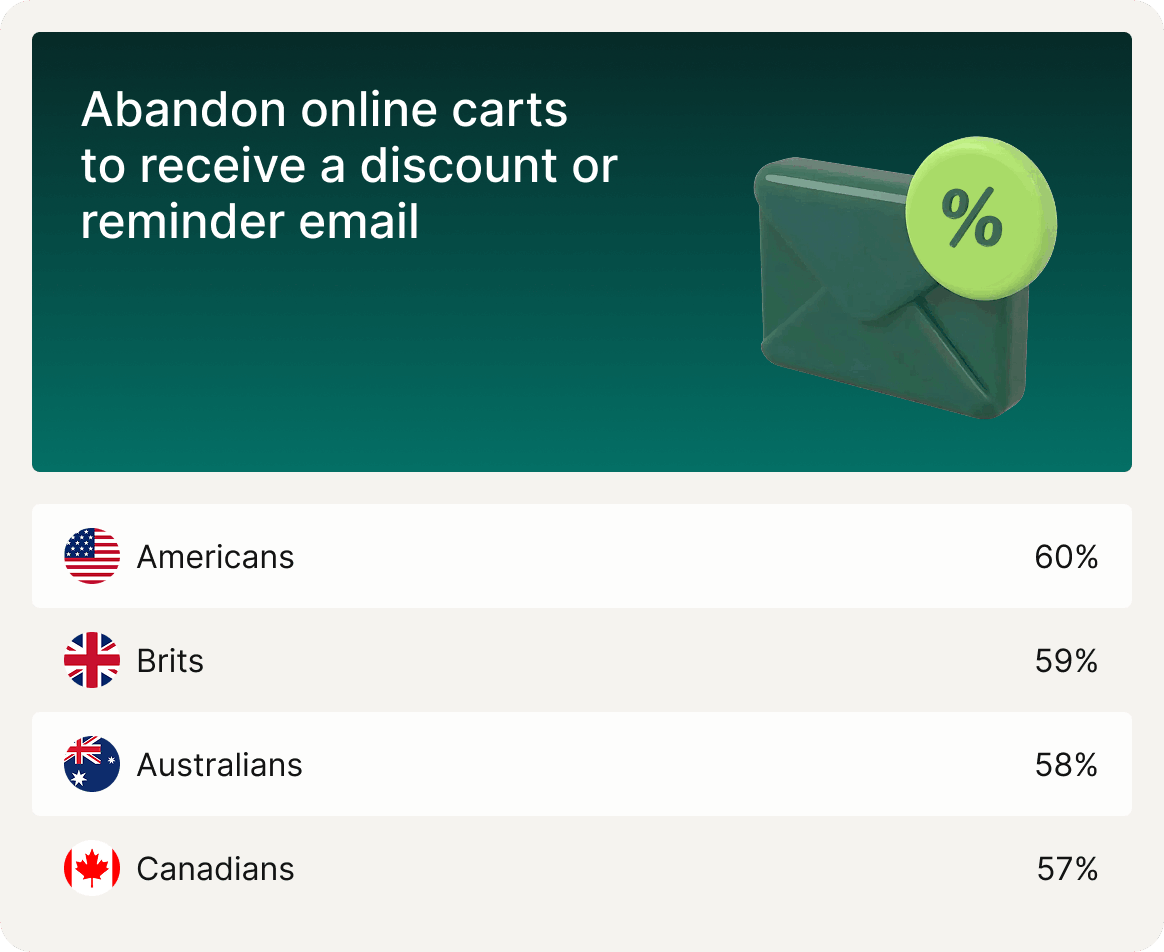
In addition, 19.1% of Americans say they abandon carts to see if they receive a discount email, and when asked more broadly, 60% say they abandon carts often or occasionally with that expectation. Similar patterns appear across the UK, Canada, and Australia. In many cases, cart abandonment reflects strategy rather than indecision.

Discount-driven behavior also changes timing. 18.7% of Americans delay purchases even when they want the item, while 24.3% choose cheaper alternatives than originally planned, balancing desire against price.

All this data leads to one conclusion —  for an increasing share of shoppers, the path to purchase assumes a deal somewhere along the way.

Methodology

The survey was commissioned by Omnisend and conducted by Cint in January of 2026, polling 4,000 consumers from the US, Canada, Australia, and the UK about their shopping habits from the last 12 months. Quotas were placed on age, gender, and place of residence to achieve a nationally representative sample among users. The margin of error is +/-3 percent.

Have any questions?

Reach out to our Public Relations team by email [email protected] for more details. We're here to help and provide any additional information you might need.

Omnisend

Email and SMS marketing so good, it’s boring

Omnisend is a leading email and SMS marketing platform, trusted by over 150,000+ brands worldwide and with a 4.7-star rating from more than 6,000 Shopify reviews. With powerful tools like automation, segmentation, reporting, push notifications, and product reviews, Omnisend merchants generate $79 for every $1 spent.

Learn more