Omnisend AI


 OFFER
OFFER









Consumer appetite for movie merchandise is growing, but the way people shop for it is changing. The global movie merchandising market was valued at about $149 billion in 2019 and is projected to reach $280 billion by 2026, according to the Facts & Figures. But in a more cautious spending environment, that growth is not coming from impulse buys and collectibles alone. Shoppers are becoming more selective, with more demand going toward products that feel useful in everyday life.
New data from Omnisend’s analysis of merchandise tied to this year’s most anticipated film releases shows how that shift is playing out. Family-oriented titles still lead on scale, and toy categories remain a major part of the market. Still, many of the strongest-performing individual products are practical items like drinkware, bedding, and apparel. In other words, movie merch is no longer just about fandom. More and more, it is becoming part of consumers’ daily routines.
Key findings
- Blockbuster movie merch generated $97.4 million in revenue and sold 4.48 million units in just 30 days.
- Family-oriented films dominated the market, with the top five titles accounting for 86% of total tracked revenue.
- Paw Patrol: The Dino Movie led all films with $23.7 million in pre-release merch revenue, nearly a quarter of total sales.
- Moana generated the highest revenue per product at $7,218, more than double the category average.
- For 71% of films studied, the top-performing products came from practical everyday categories such as apparel, baby items, and home products.
Which 2026 Blockbusters Are Generating the Most Merchandise Revenue and Units Sold?
Blockbuster movie merchandise generated $97.4 million in revenue and 4.48 million units sold in just 30 days, and those sales were heavily concentrated among family-oriented titles. According to Omnisend’s analysis, the top five films alone accounted for 86% of all tracked revenue, underscoring how strongly a handful of major franchises dominate the market.
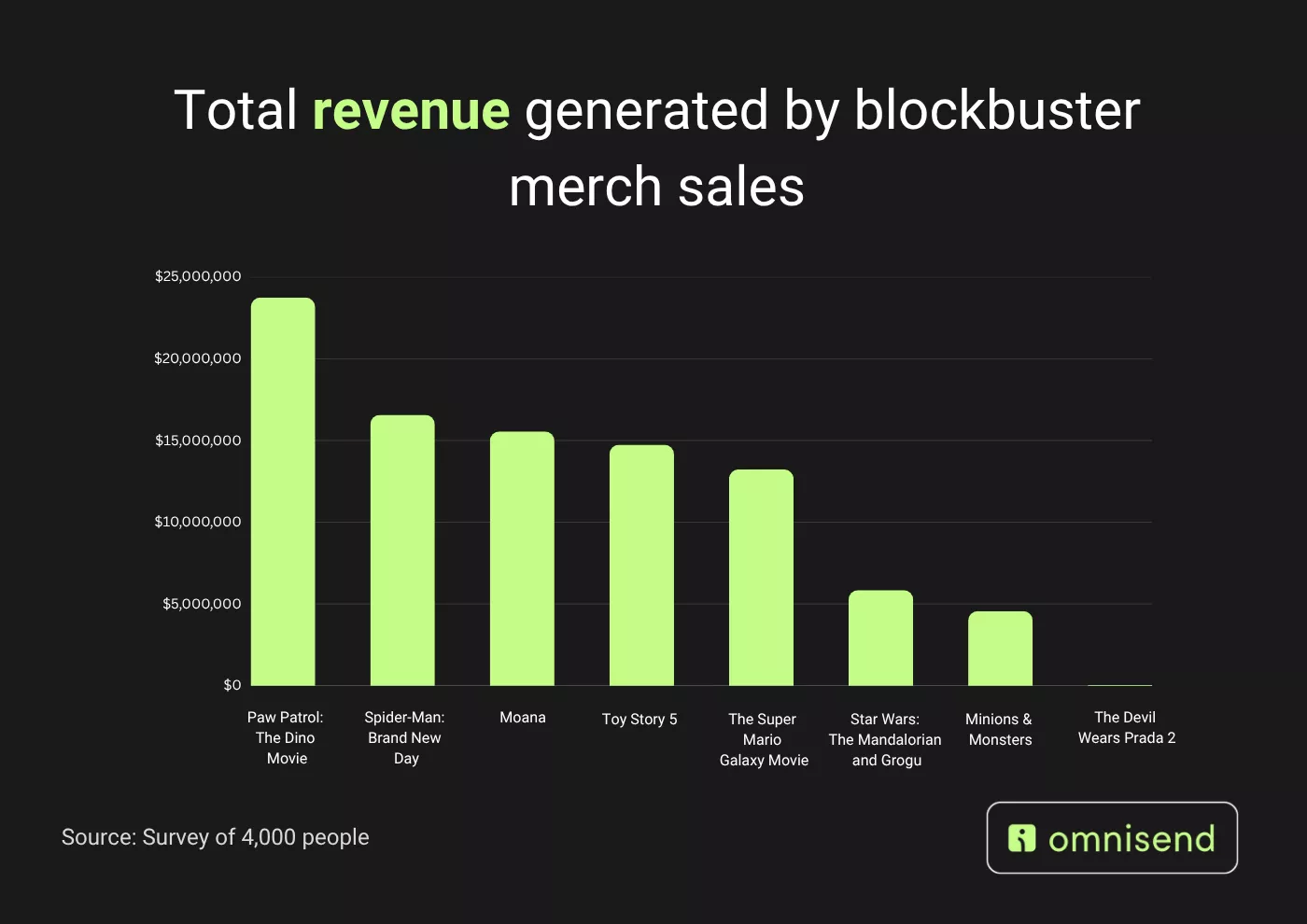
Paw Patrol: The Dino Movie leads the category with $23.7 million in revenue and 1.1 million units sold in just 30 days, or roughly a quarter of all tracked sales. One product alone — a Paw Patrol toddler tumbler set — generated $1.19 million on its own. Spider-Man: Brand New Day ranks second with $16.6 million in revenue and 694,000 units sold, while Moana stands out for efficiency, generating $15.5 million from 691,000 units at more than $7,200 per product, which is more than double the category average. Toy Story 5 follows with $14.7 million in revenue and 653,000 units sold. In comparison, The Super Mario Galaxy Movie rounds out the top five with $13.2 million in revenue and 705,000 units sold, giving it one of the strongest volume performances in the dataset.
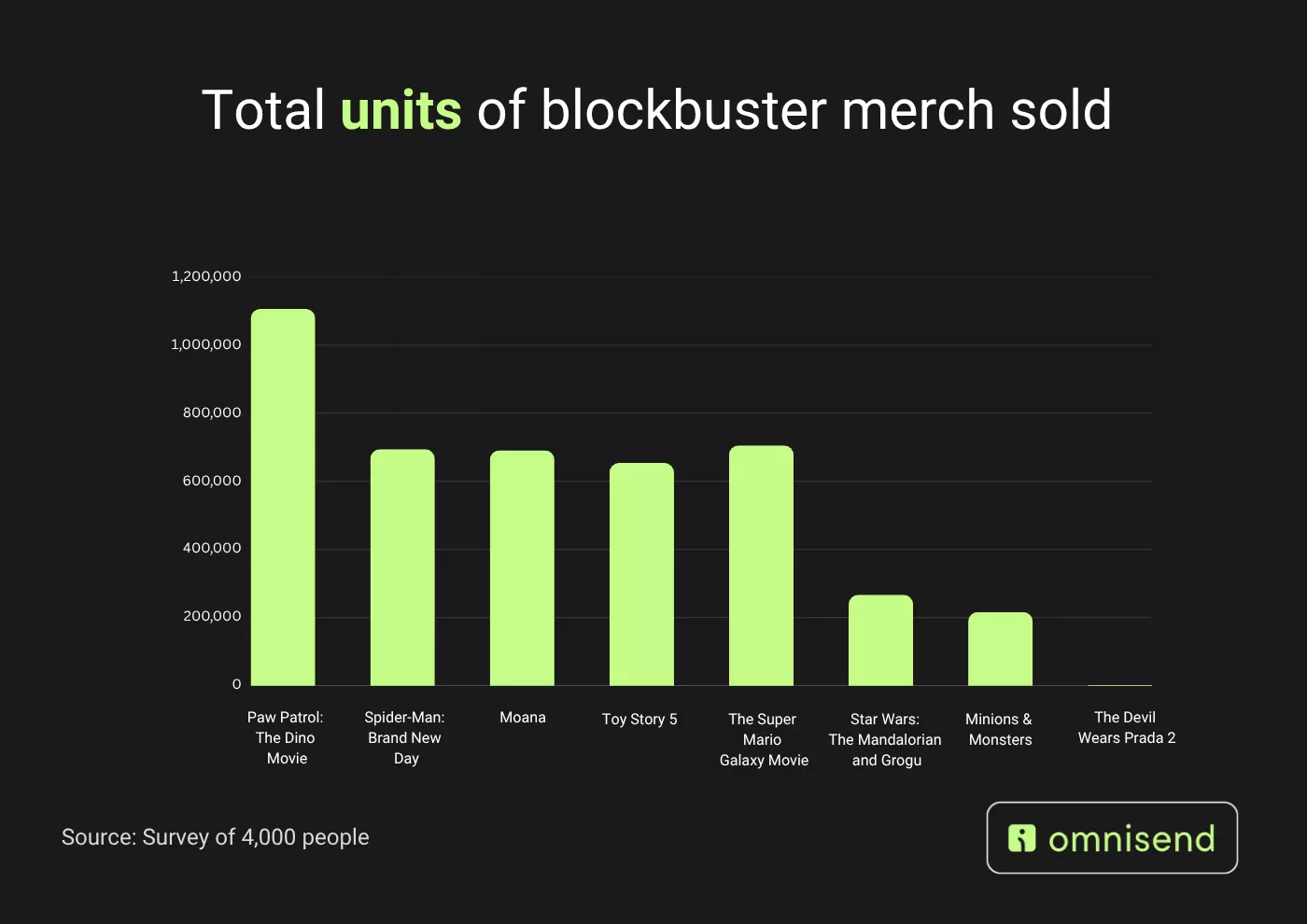
The chart above makes the pattern easy to spot. The revenue graph shows a steep drop after the top five films, while the units chart shows that family titles are also dominating in volume, not just dollar value. That matters because it suggests this is not simply a premium-pricing story. These franchises are moving products at scale. The only clear outliers on the low end are more adult-skewing titles like The Devil Wears Prada 2, which barely registers by comparison on both revenue and units.
By contrast, titles aimed more at older audiences contribute far less overall. Project Hail Mary generated $531,000 from 26,000 units, while The Devil Wears Prada 2 brought in just $42,000 from 2,000 units. Their top-performing products also tend to be simpler apparel items rather than broader merchandise lines, which points to a narrower kind of demand.
“For families, entertainment is often a more cost-effective way to spend time together compared to bigger expenses like travel, and that drives repeat engagement with the same franchises,” says Marty Bauer, Ecommerce Expert at Omnisend. “Kids don’t just watch a movie once — they build ongoing relationships with characters, which naturally extend into merchandise. In turn, repeat consumption and emotional attachment make family titles far more likely to generate sustained, high-volume product demand before a film even hits theaters.”
That demand is not coming only from children, though. As retail expert Catherine Erdly has noted, “kidult” culture — where adults buy playful or nostalgic products for themselves — now accounts for up to a third of toy sales. That helps explain why family-oriented franchises continue to outperform: they appeal not only to younger audiences but also to adults seeking familiarity, comfort, and emotional connection.
What Types of Movie Merch Products Sell Best in 2026?
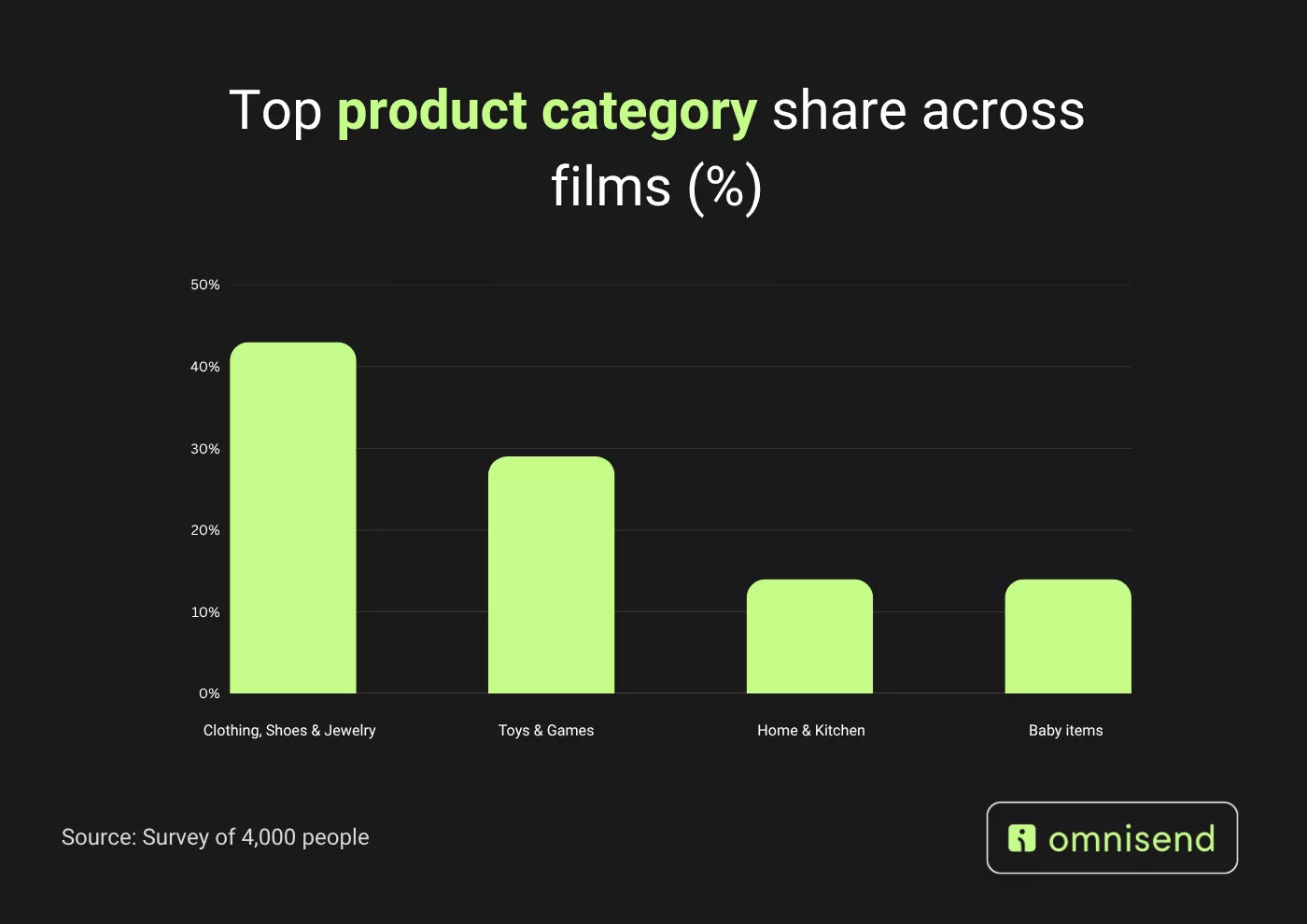
Movie merch is still selling, but the products leading that demand are not always toys or collector-style items. In Omnisend’s analysis, 71% of films studied had top-performing products in practical, everyday categories, with apparel accounting for 43%, baby items for 14%, and home products for 14%. That points to a broader shift in how consumers shop: licensed merchandise is increasingly bought for regular use, not just for display or fandom alone.
One of the clearest examples is drinkware. Variations of Zak Designs’ Kelso tumbler and toddler cup sets appear as the top-performing products for Paw Patrol: The Dino Movie, Moana, and Star Wars: The Mandalorian and Grogu, all in the Baby category. That is a strong signal that shoppers are choosing items they can use every day, especially when the product also fits naturally into family routines.
The same pattern shows up in Home & Kitchen. For The Super Mario Galaxy Movie, the top-performing product is Franco’s Super Mario kids’ bedding set (7-piece). Franco also leads Minions & Monsters with similar bedding products, suggesting repeat demand for licensed home items that go beyond one-time novelty appeal.
In Clothing, Shoes & Jewelry, the strongest products vary more by audience. Spider-Man: Brand New Day is led by a Disney Girls’ Spider-Man Fantasy Gown nightgown, while titles aimed more at older audiences lean on simpler apparel formats. Project Hail Mary is led by a “Rocky the Alien” graphic T-shirt, and The Devil Wears Prada 2 by an “Everybody Wants to Be Us” slogan T-shirt. Apparel works across both audience types, but the product style becomes much simpler once the franchise shifts away from family viewing.
Toys still matter, just not as universally as they once might have. They account for 29% of top products in the dataset and lead in selected franchises such as Toy Story 5 and Masters of the Universe, where standout items include the Disney Store Bullseye Talking Action Figure and the Origins action figure line. Outside reporting has also noted that toy makers are expecting blockbuster releases in 2026 to help lift demand after tariff pressure in 2025.
“What we’re seeing is that merch is becoming part of everyday life rather than just something people collect,” says Marty. “In tighter economic conditions, consumers naturally gravitate toward items that deliver ongoing value. Products like drinkware, bedding, and everyday apparel perform better because they can be used repeatedly.”
Methodology
To build this report, Omnisend used Jungle Scout estimates of Amazon merchandise sales in March 2026. The analysis focused on products tied to 20 films slated for release in 2026.
These numbers capture 30 days, so they are best read as a snapshot of early demand, not a full view of long-term sales. The data is also limited to the products and retail channels that were available in the tracked dataset.
FAQ
How much revenue is the upcoming film’s merchandise generating?
Merchandise tied to upcoming 2026 film releases generated $97.4 million in revenue and sold 4.48 million units in just 30 days, indicating strong pre-release demand.
Which films are driving the most merchandise sales?
Family-oriented titles are driving most of the market. The top five films account for 86% of total tracked revenue, led by Paw Patrol: The Dino Movie at $23.7 million, followed by Spider-Man: Brand New Day and Moana.
Which merchandise categories generate the most revenue?
This analysis does not measure total revenue by category across the full dataset. What it does show is that Toys & Games, Clothing, Shoes & Jewelry, and Home & Kitchen appear often among the top-performing products tied to individual films.
What types of products perform best at an individual level?
Practical items stand out most often. Products like drinkware, bedding, and apparel repeatedly appear as the best-performing individual items across the films studied, suggesting strong demand for everyday-use merchandise.
What is the top-selling product across all films?
The standout product in the dataset is the Zak Designs Kelso 15 oz tumbler set tied to Paw Patrol: The Dino Movie. Similar drinkware products also rank highly for films like Moana and Star Wars: The Mandalorian and Grogu.
Are toys still important in movie merchandising?
Yes. Toys & Games account for 29% of top products in the analysis and lead for specific franchises such as Toy Story 5 and Masters of the Universe. At the same time, they do not dominate across the full set of films.
How do adult-oriented films perform in merchandise sales?
Films aimed more at older audiences generate much less merchandise revenue overall. For example, The Devil Wears Prada 2 brought in $42,000 in the 30 days, and its top products are mainly simple apparel items like slogan T-shirts.
How to Cite This Report
Short Citation (Inline Use): Omnisend (2026), “Pre-Release Film Merchandise Sales Study 2026.”
APA Format: Omnisend. (2026). Pre-Release Film Merchandise Sales Study 2026: $97.4M in Revenue Across 4.48M Units Tracked. Retrieved [Insert publication date], from [Insert full URL].
MLA Format: Omnisend. “Pre-Release Film Merchandise Sales Study 2026: $97.4M in Revenue Across 4.48M Units Tracked.” Omnisend Research, 2026, [Insert full URL]. Accessed [Insert access date].
Chicago Format: Omnisend. “Pre-Release Film Merchandise Sales Study 2026: $97.4M in Revenue Across 4.48M Units Tracked.” Omnisend Research, 2026. [Insert full URL].