
 Omnisend AI


 OFFER
OFFER







Research
Drive sales on autopilot with ecommerce-focused features
See FeaturesChinese online marketplaces are no longer just occasional bargain stops in English-speaking markets. Across the USA, UK, Canada, and Australia, platforms such as Temu, Shein, AliExpress, and TikTok Shop are becoming part of regular shopping routines, with Omnisend’s latest survey showing widespread annual usage and rising repeat engagement across all four countries.
To understand how those habits are changing, Omnisend surveyed 4,000 consumers across the four markets.
This report also compares the latest findings with Omnisend’s earlier marketplace research from 2024 and 2025, enabling tracking of how adoption, shopping frequency, and shopper sentiment have shifted over time.
Key findings
- Chinese marketplace adoption remained high across all four markets, reaching 71% in the USA, 75% in the UK, 73% in Canada, and 80% in Australia.
- Temu recorded the strongest usage growth across the markets tracked since 2024.
- In the USA, 46% of consumers support tariffs on imported goods.
- In the USA, 59% of consumers say they are willing to pay more for products labeled “Made in the USA.”
- Among shoppers who reduced or stopped buying from Chinese ecommerce platforms, the most common reasons were price increases, product quality concerns, unreliable shipping, and delivery fees.
Chinese marketplace adoption rates 2024–2026: Temu, Shein, AliExpress, and TikTok Shop
Chinese ecommerce platforms are growing in all four markets examined in Omnisend’s survey. This trend goes beyond just occasional bargain hunting. Over the past year, 71% of shoppers in the USA, 75% in the UK, 73% in Canada, and 80% in Australia reported buying from at least one Chinese marketplace, such as Temu, Shein, AliExpress, or TikTok Shop.
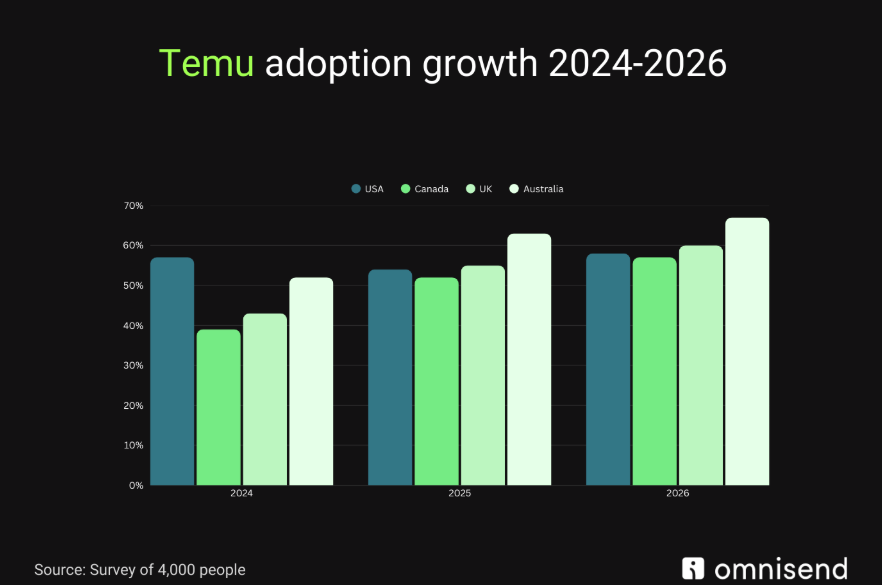
Temu shows the clearest long-term growth story. Compared with 2024, its adoption rose from 57% to 58% in the USA, from 43% to 60% in the UK, from 39% to 57% in Canada, and from 52% to 67% in Australia.
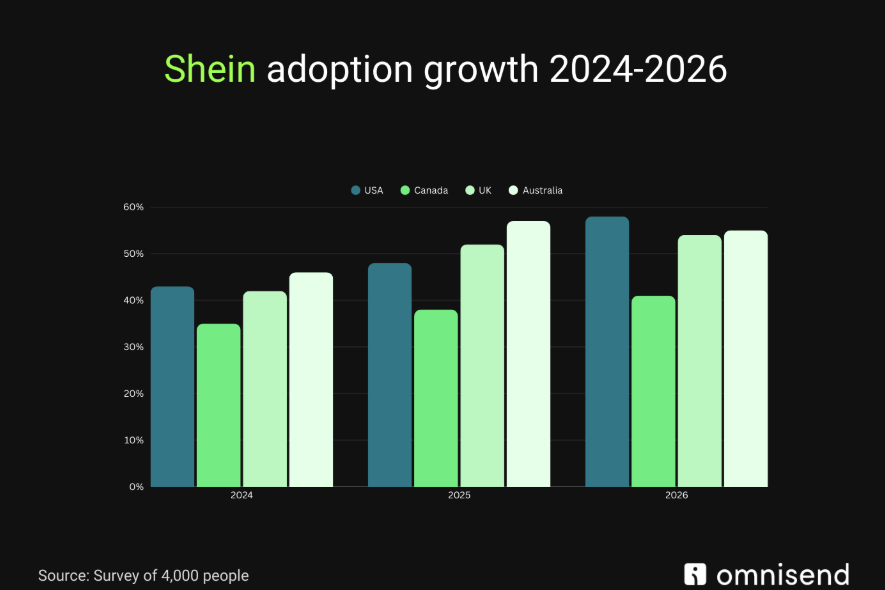
Shein also posted strong gains, climbing from 43% to 49% in the USA, from 42% to 54% in the UK, from 35% to 41% in Canada, and from 46% to 55% in Australia.
AliExpress saw especially notable growth in the UK and Australia. At the same time, TikTok Shop made some of its biggest gains in the UK and the USA, suggesting the broader marketplace ecosystem is strengthening rather than relying on a single platform. It is important to mention that Australia and Canada haven’t launched their respective native local TikTok Shop seller platforms.
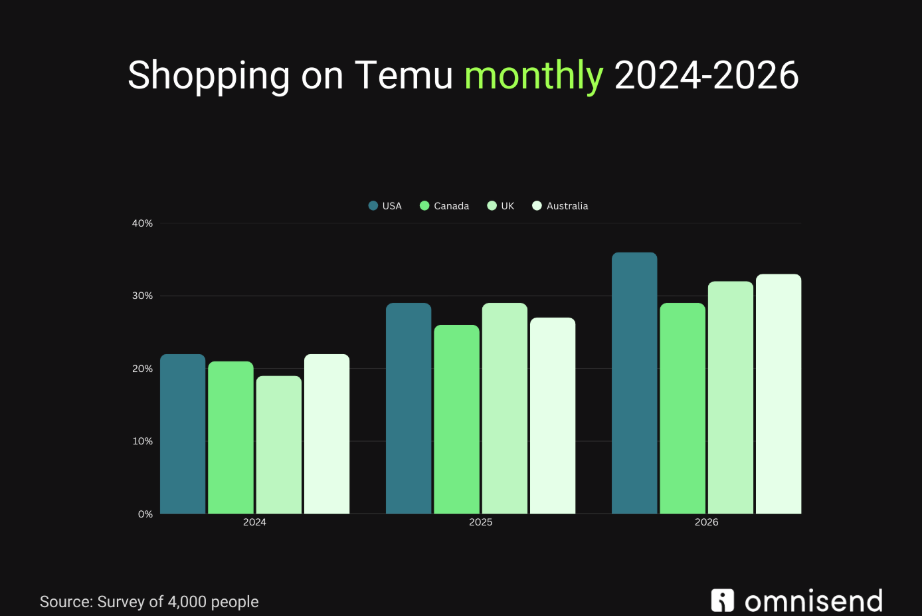
The bigger signal, though, is frequency. Monthly Temu shopping increased across every market, rising from 22% to 36% in the USA, from 19% to 32% in the UK, from 21% to 29% in Canada, and from 22% to 33% in Australia.
Monthly Shein shopping also moved up, reaching 31% in the USA, 29% in the UK, 19% in Canada, and 28% in Australia in 2026. That suggests these platforms are becoming part of regular purchase behavior, not just occasional deal-driven visits.
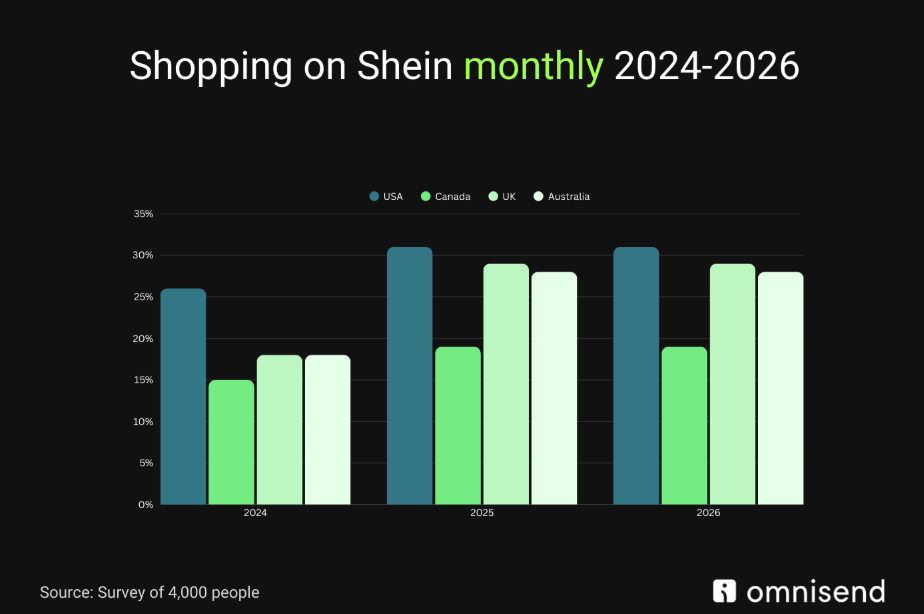
“These marketplaces are no longer occasional discount options — they’re becoming embedded in everyday shopping behavior,” says Marty Bauer, Ecommerce Expert at Omnisend. “The biggest shift isn’t just how many consumers have tried them — it’s how often they’re returning on a monthly and weekly basis.”
Why USA shoppers support tariffs but still buy from Chinese marketplaces in 2026
These marketplace gains are not happening in isolation. They reflect a broader shift in global cross-border ecommerce, which, according to Capital One Shopping data, places the market at $1.21 trillion in 2025. Separate data from the International Post Corporation shows how quickly the competitive landscape has changed: Temu’s share of the most recent cross-border orders rose from less than 1% in 2022 to 24% in 2025, putting it level with Amazon by that measure.
In the USA, however, that growth sits alongside strong support for domestic production and trade protection. Nearly 46% of American consumers support tariffs on imported goods, while 59% say they are willing to pay more for products labeled “Made in the USA.” On paper, that sounds like a clear vote for domestic buying. In practice, though, Chinese marketplaces continue to attract regular shoppers, suggesting that price, convenience, and product availability still outweigh stated preferences in many real purchase decisions.
That tension is not especially surprising to supply chain experts. As Yao Jin, Associate Professor of Supply Chain Management at Miami University, told CNBC, “American consumers overall don’t really care about an app’s association with any specific country as long as they can find something they want at an affordable price. (That) is exactly the competitive advantage of most China-originated apps.” In other words, shoppers may express support for tariffs or domestic manufacturing in principle, but many still prioritize low prices and easy access when they actually check out.
Even so, the latest survey suggests shoppers who remain active on these platforms are becoming more selective. Among consumers who reduced or stopped shopping on Chinese ecommerce platforms, the most common reasons were price increases, product quality concerns, slower or less reliable shipping, and additional fees or duties at delivery. In the USA, 23% cited higher prices, 20% pointed to product quality concerns, and 12% said shipping had become slower or less reliable. Another 12% said extra delivery fees pushed them away. But it’s also notable that USA consumers most often report noticing price increases on larger ecommerce platforms such as Amazon and Walmart, showing that price pressure is not limited to Chinese marketplaces alone.
“Cross-border shopping hasn’t disappeared — but shoppers are less forgiving than they were a year ago,” says Bauer. “They’ll chase savings, but not if it comes with uncertainty. Tariffs and rising costs have made transparency and predictability part of the value equation.”
How can ecommerce brands compete with Chinese marketplaces in 2026?
There are clear steps ecommerce brands can take to compete in a market where Chinese marketplaces are gaining shoppers — and tariffs are raising expectations:
- Compete on predictability, not just promotions. If shoppers are prioritizing faster shipping and fewer surprises, brands should make delivery timelines, tracking, and return policies impossible to miss.
- Lead with total-cost transparency. With import fees and surprise duties contributing to churn — and 25% saying tariff or fee reductions would influence their return — clarity on full costs is a trust builder.
- Treat fulfillment strategy as a messaging strategy. The fact that 28% want U.S.-based warehouses or sellers shows how much fulfillment location influences confidence. If you have domestic fulfillment, say it clearly.
- Address quality concerns head-on. With 20% citing product quality as the main reason for pulling back, clear product specs, reviews, and straightforward return and refund processes become levers for conversion.
- Use email and SMS to reduce uncertainty before it becomes churn. Proactive updates on shipping timelines, policy changes, and pricing shifts can prevent the “surprise factor” that drives abandonment and distrust.
“When shoppers are splitting their budgets across more platforms, retention becomes critical,” Bauer adds. “Brands that build direct relationships with customers — instead of relying solely on paid acquisition — will be in a stronger position long term.”
Methodology
This survey was commissioned by Omnisend and conducted by Cint in June 2024, August 2025, and February 2026. In each wave, 4,000 consumers across the USA, UK, Canada, and Australia were surveyed using the same set of questions to evaluate how they shop on Chinese marketplaces. Quotas were applied for age, gender, and place of residence to create a sample that represents the entire country of online consumers. The margin of error is +/-3%.
As with any survey based on self-reported behavior, the findings may be subject to recall bias. The results are representative of online populations in the surveyed countries and may not fully reflect offline or non-English-speaking consumer groups. Year-over-year comparisons are based on a consistent methodology across all three survey waves.
FAQ
What percentage of USA consumers shop on Temu or Shein in 2026?
In Omnisend’s 2026 survey, 58% of USA consumers said they had shopped on Temu over the past year, while 49% said they had shopped on Shein. More broadly, 71% of USA shoppers said they had used at least one Chinese marketplace, including Temu, Shein, AliExpress, or TikTok Shop, in the past 12 months.
How often do people in the UK shop on Chinese ecommerce platforms?
The UK data suggests these platforms are becoming routine shopping destinations, not just occasional bargain stops. In 2026, 32% of UK consumers shop on Temu monthly and 29% on Shein, while 75% say they bought from at least one Chinese marketplace over the past year.
Are Chinese marketplace adoption rates increasing or decreasing in Canada and Australia?
Yes. In Canada, Temu’s adoption rose from 39% in 2024 to 57% in 2026. Shein increased from 35% to 41%. In Australia, Temu climbed from 52% to 67%, while Shein went from 46% to 55%. Australia also had the highest overall usage in the study. About 80% of consumers shopped on at least one Chinese marketplace in the past year.
How do tariffs on Chinese goods affect prices on Temu and Shein?
In general, tariffs raise the landed cost of imported goods, which makes it harder for marketplaces built on ultra-low prices to keep those prices unchanged. Reuters reported that Shein and Temu told USA customers in April 2025 that prices would rise, and that the end of duty-free treatment for many low-value China shipments increased their costs; Temu also shifted toward locally based sellers and USA-warehouse fulfillment to soften the impact.
What are the main reasons consumers stop shopping on Chinese marketplaces?
The most common reasons are higher prices, product quality concerns, slower or less reliable shipping, and extra fees or duties at delivery. In the USA, for example, 23% of consumers who reduced or stopped shopping cited price increases, 20% cited quality concerns, and 12% pointed to slower shipping or extra delivery fees.

TABLE OF CONTENTS
TABLE OF CONTENTS


Subscribe and don’t miss any updates!
No fluff, no spam, no corporate filler. Just a friendly letter, twice a month.