Omnisend AI


 OFFER
OFFER











Corporate LGBTQ+ engagement is contracting. According to Gravity Research’s 2025 Pride Pulse Poll, 39% of companies reduced overall Pride Month engagement in 2025, up from just 9% in 2024 – a fourfold increase year over year.
Our recent survey of 4,000 consumers across the United States, United Kingdom, Canada, and Australia shows that while companies are becoming more hesitant about their participation, consumers still closely watch how brands engage and increasingly distinguish between genuine support and performative marketing.
Key findings:
- 48% to 57% of consumers across markets say that brand participation in Pride Month is important to them. The trend is most pronounced among Gen Zs (69-75%), Millennials (66-78%), and LGBTQ+ community members (76-85%).
- 32% to 37% of respondents expect brands to participate in Pride Month. 39-46% say that brands shouldn’t participate if they don’t genuinely support LGBTQ+ rights.
- 28% to 37% of consumers say that in recent years, they’ve noticed brands scaling back Pride Month participation.
- Year-round support, donations, and public advocacy are considered the most important signs of authenticity in brands, while participating only when it’s commercially convenient is seen as performative.
- 26% to 32% say that they have purchased a Pride-themed product in the past, mostly because they liked the design or wanted to support the community.
Consumers expect brands to show up for Pride — especially younger ones
In this past decade, we’ve gotten used to companies changing their logos, rolling out LGBTQ+ related marketing campaigns, and coming up with all sorts of limited edition products or offers in June. However, this kind of behavior is slowly changing as brands scale back their Pride activities.
This shift is happening despite our survey showing that Pride participation meaningfully influences brand perception. 48% of Americans, 51% of Brits, 56% of Canadians, and 57% of Australians said it’s important to them that brands participate in Pride Month, with 11% to 14% noting it’s extremely important.
This trend is most evident among younger consumers and those who identify with the LGBTQ+ community. Gen Z (69%–75%) and Millennials (66%–78%) are the most aware of how brands show their values. Brand support is also very important for LGBTQ+ community members. 76% to 85% of them said they appreciate this kind of support.
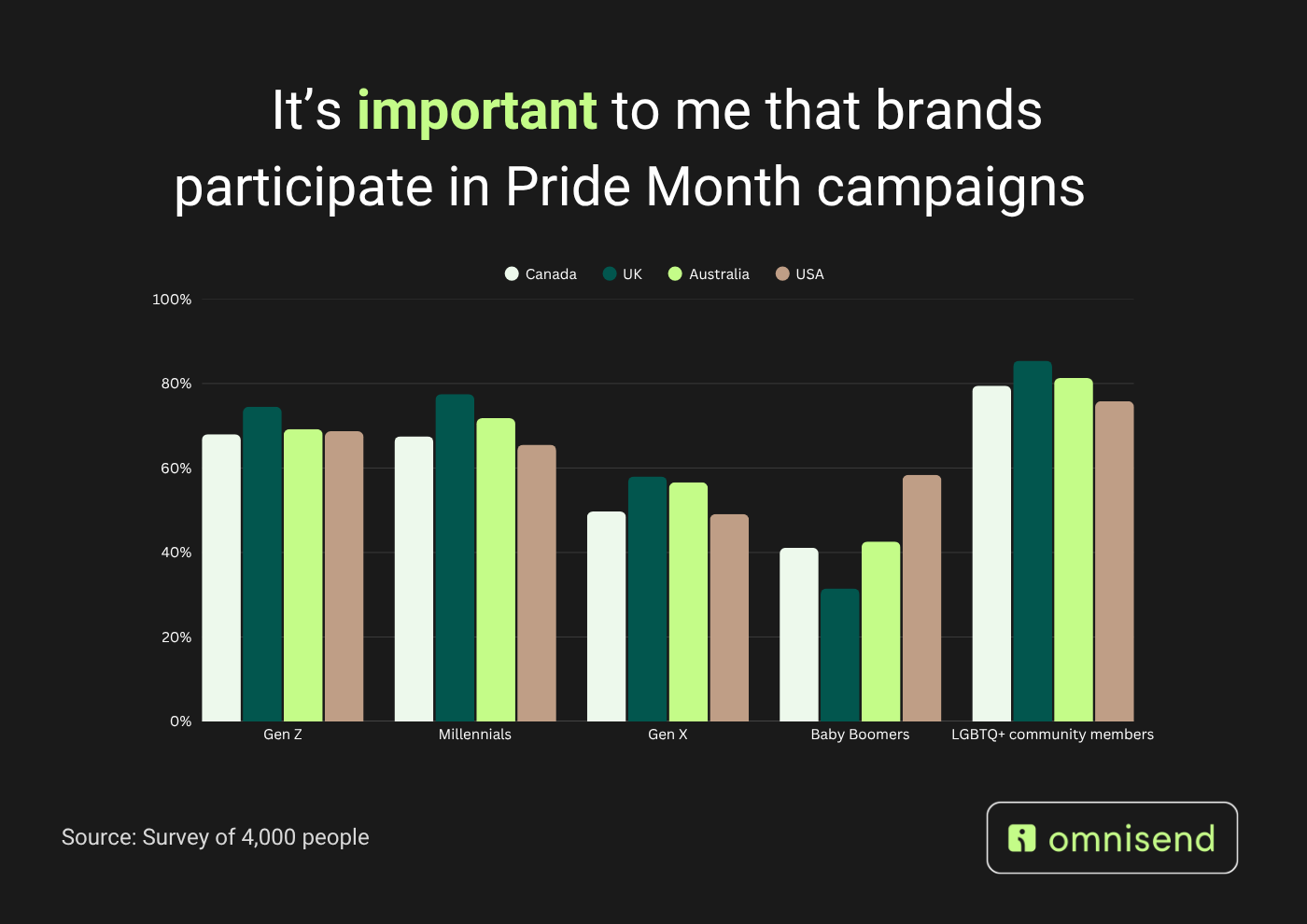
Baby boomers care the least about Pride participation. However, their perception varies significantly by country. Only 28% of American and 31% of British boomers care about brand involvement in Pride Month, while in Canada and Australia, the percentages reach 41% and 42%, respectively.
Unsurprisingly, the shift in how brands approach Pride Month hasn’t gone unnoticed by consumers. The survey shows that 37% of Americans, 28% of Brits, 33% of Canadians, and 34% of Australians say they’ve noticed brands reducing their participation in Pride events in recent years. Among LGBTQ+ members, this awareness was even higher, ranging from 58% to 67% across countries.
“Consumers are paying much closer attention to whether brands stick to the values they talk about,” says Marty Bauer, Ecommerce Expert at Omnisend. “That applies to Pride campaigns, but also to sustainability, social issues, and company culture in general. Topics tied to identity tend to draw even more attention because people often take them personally.”
Why is authenticity a key part of a good Pride campaign?
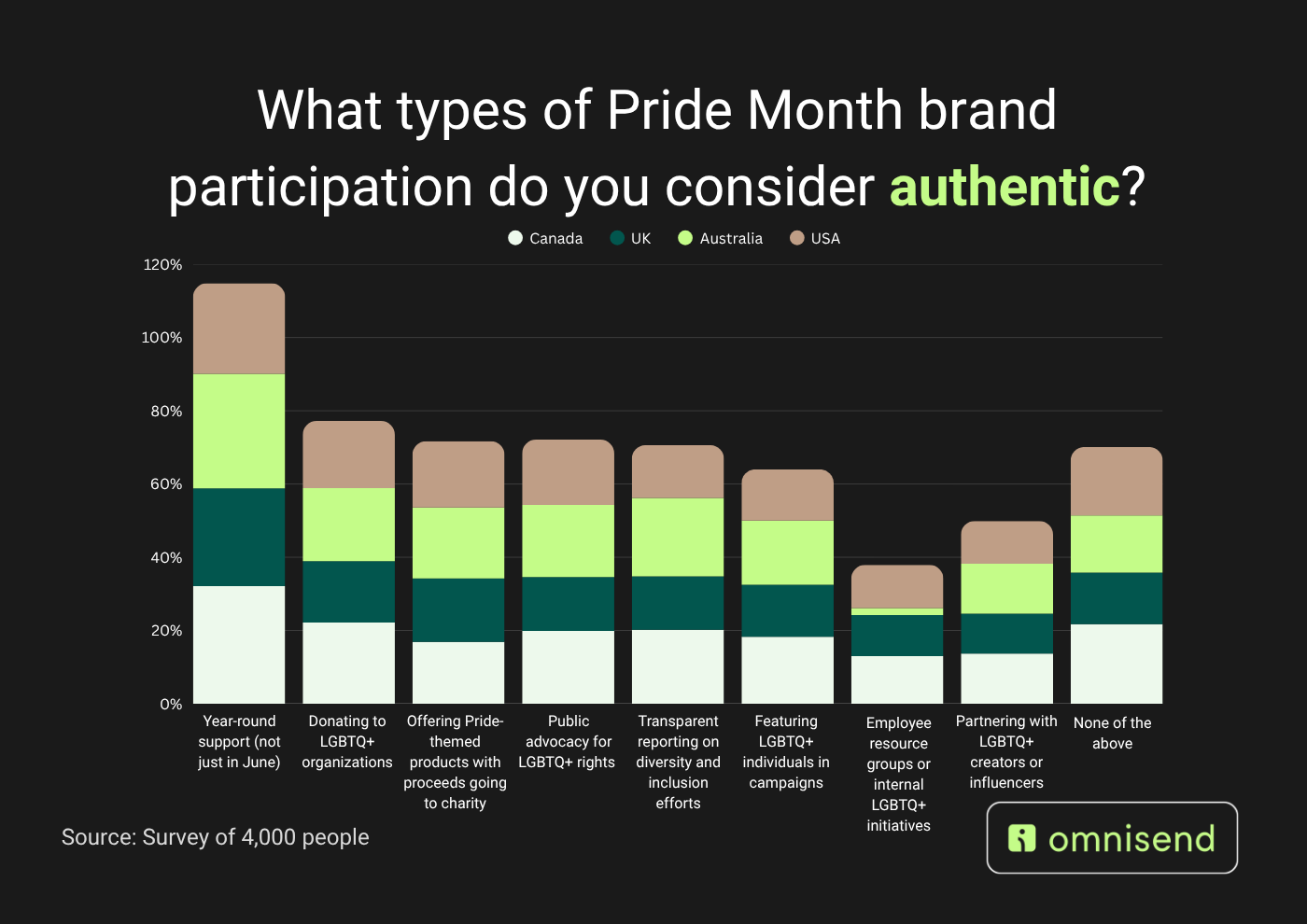
Whether consumers accept a brand’s participation in Pride events comes down to authenticity. The survey shows that 39-46% of consumers across markets would prefer to see Pride Month participation only from brands that genuinely support LGBTQ+ rights.
There is quite a clear divide between what is considered authentic and what is considered performative brand behavior. People see year-round support (25-32%), donations tied to LGBTQ+ organizations (17-22%), and public advocacy (15-20%) as the best indicators of genuine care for the community’s issues.
On the other hand, behaviors such as changing logos to rainbow colors for a month (25-32%), selling Pride-themed products without any charitable donations (24-29%), and overall participation only when profitable or politically safe (27-31%) are considered most inauthentic.
“Consumers are so incredibly savvy and are so incredibly aware. Brands that change their point of view and values based on macro, economic, and/or political environments are the ones that are going to look the most performative and stand the chance of losing the most consumer affinity,” says Kaitlyn Barkley, Data Director at Do the Werq, in a Marketing Dive interview.
While liking the design is the most common reason (47% in the US, 47% in the UK, 45% in Canada, and 51% in Australia) for buying Pride-related products, the perceived sincerity of a brand’s support for the LGBTQ+ community also influences buying decisions.
For example, 27% of Americans, 26% of Brits, 25% of Canadians, and 21% of Australians say that they bought Pride-themed products because proceeds supported LGBTQ+ causes. Marty Bauer urges companies to keep in mind that performative support might even have an opposite effect.
“What retailers can take away from this data isn’t limited to Pride Month. Consumers are getting better at spotting when a marketing campaign is disconnected from how a company actually operates. People don’t expect every brand to make bold political statements, but what they do expect is that messaging and company behavior feel real rather than reactive,” he says.
What this means for brands
The data we collected points to a clear takeaway: consumers haven’t lost interest in Pride. What’s changed is that they’ve just gotten better at distinguishing between brands that mean it and those that don’t.
Scaling back participation may feel like the safer move in today’s climate, but it doesn’t go unnoticed, especially by younger and LGBTQ+ consumers who pay the closest attention.
The brands that come out ahead are the ones whose Pride Month activities match what they do the rest of the year. Changing your logo to rainbow colors for June without any year-round support, donations, or advocacy is exactly the kind of disconnect consumers are now accustomed to spotting instantly.
So don’t focus on big Pride Month campaigns. Focus on consistency year-round.
Methodology
The survey was commissioned by Omnisend and conducted by Cint in March 2026. A total of 1,370 respondents in the US, 1,084 in the UK, 1,029 in Canada, and 1,028 in Australia took part in the survey. Quotas were set for age, gender, income, and place of residence to achieve a nationally representative sample of users. The margin of error is +/-3 percent.
Self-reported data reflects consumer perceptions and stated preferences, not verified purchasing behavior. Findings are representative of online adult populations in the four surveyed countries and may not reflect the views of consumers in other geographies. Awareness of brand behavior during Pride Month is subject to individual recall bias.
Generational breakdowns were based on respondents’ age ranges: Gen Z (18–24), Millennials (25–44), Gen X (45–54), and Baby Boomers (55-74).
FAQ
How important is it to consumers that brands participate in Pride Month?
32% of Americans, 32% of Brits, 35% of Canadians, and 37% of Australians expect brands to participate in Pride Month. What people care about, however, is for support to be authentic.
Which generations are most supportive of Pride Month brand participation?
Gen Z (68% to 75%) and Millennials (66% to 78%) are the most supportive, and Baby Boomers (28% to 43%) are the least supportive.
How do LGBTQ+ consumers feel about brand participation during Pride Month?
The majority of them (60% to 70%) expect brands to participate in Pride Month activities. However, they also expect the support to feel genuine.
How many consumers expect brands to participate in Pride Month campaigns?
32% of Americans, 32% of Brits, 35% of Canadians, and 37% of Australians expect brands to participate in Pride Month activities.
Have consumers noticed brands reducing Pride Month participation in recent years?
Yes, the shift hasn’t gone unnoticed. 37% of Americans, 28% of Brits, 33% of Canadians, and 33.5% of Australians noticed that brands reduced their participation.
What kinds of Pride Month campaigns do consumers consider authentic?
People value year-round support the most (25% to 32%), followed by donations to LGBTQ+ organizations, giving proceeds from Pride-themed products to charity, and advocacy for LGBTQ+ rights and legislation.
What types of Pride marketing are viewed as performative or “rainbow-washing”?
Participating only when it’s profitable and safe is considered the worst offense (27% to 31%), followed by simply changing logos in June, selling Pride-themed products without donations, and making public statements without taking any action.
Why do consumers buy Pride-themed products?
Half of them simply liked the design. One-third wanted to show their support for the community, while one-fourth were motivated by the proceeds going to LGBTQ+ causes.