Omnisend AI


 OFFER
OFFER









In an uncertain economy, many households are approaching tax refunds with more caution than excitement. This year, the money looks less like extra income and more like a tool for regaining a sense of safety, with many Americans planning to direct it toward essentials such as emergency savings, bills, and credit card debt rather than treating it as pure discretionary cash.
At the same time, the emotional side of spending has not disappeared. The Omnisend 2026 survey of 1,370 USA respondents shows a pretty familiar pattern: people want to be responsible with their refund, but they also want a little room to enjoy it. For many households, that money is going toward practical needs first, with some of it still reserved for smaller personal spending.
Key findings
- 56.7% of Americans expect to receive a tax refund in 2026, and 33.1% have already received one.
- Many consumers plan to put that money to use quickly, with 17.8% spending it immediately and 21.9% within one to two weeks.
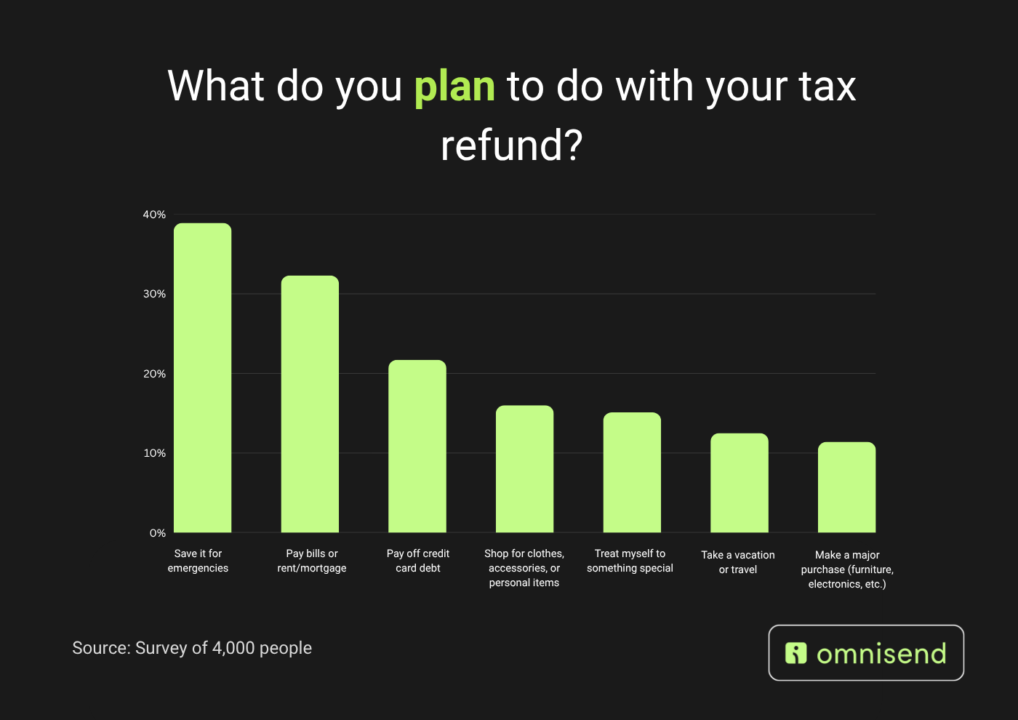
- Financial security is the top priority, with 38.9% planning to put their refund into savings.
- Bills and housing costs remain a major use for refunds, with 32.3% planning to put the money toward bills, rent, or mortgage payments.
- Debt repayment is also a key priority, with 21.7% planning to use their refund to pay off credit card debt.
- Discretionary spending remains, with 47.5% planning to spend up to 25% of their refund on shopping and 24% expecting to spend half or more.
How quickly do Americans spend their tax refunds in 2026?
Tax refunds are arriving, and many Americans are not holding onto them for very long. Omnisend’s survey found that 56.7% of Americans expect a refund this year, including 33.1% who have already received one, and 59.2% say they plan to spend that money immediately, within 1 to 2 weeks, or within a month. That suggests refunds are being put to work quickly, but not necessarily impulsively.
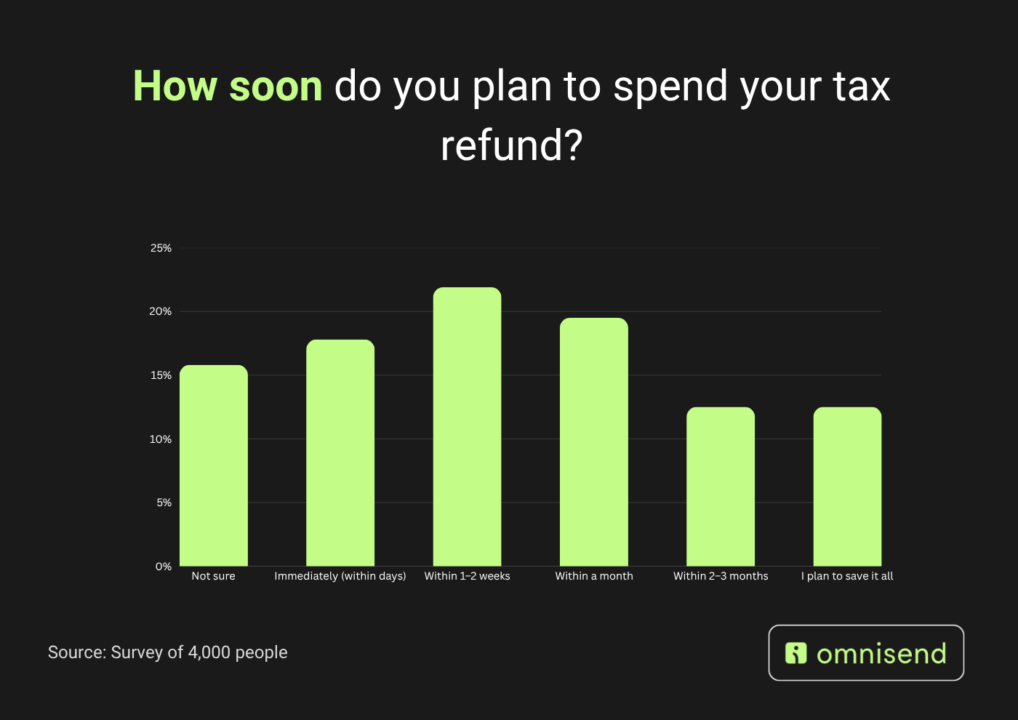
In fact, the data points to fast allocation rather than reckless spending. While 12.5% say they plan to save their entire refund, the most common planned uses among those who will spend it are practical ones: 38.9% say they will save for emergencies, 32.3% will put the money toward bills or rent or mortgage payments, and 21.7% plan to pay off credit card debt. In other words, many households appear to be treating tax refunds less like bonus money and more like a tool to stabilize their finances.
That pattern fits a broader picture of financial strain. Achieve reported in February 2026 that 55% of consumers carry credit card balances to cover essential expenses, while the Federal Reserve Bank of New York said credit card balances rose by $44 billion in the fourth quarter of 2025 to a record $1.28 trillion. The New York Fed also noted that signs of repayment stress were concentrated in lower-income areas, reinforcing the idea that financial pressure is not hitting all households evenly.
Researchers often describe this kind of split as a K-shaped economy: some households remain relatively insulated, while others see incoming money absorbed almost immediately by existing obligations.
As Achieve co-founder Andrew Housser put it, “financial triage and tradeoffs are a way of life” for many Americans. In that context, tax refunds look less like discretionary income and more like immediately allocated funds, used first to restore a sense of financial control.
How much of their tax refund are Americans spending on shopping in 2026?
Still, this is not just a story about saving and catching up on bills. Omnisend’s data shows that 47.5% of Americans plan to spend up to 25% of their tax refund on shopping, while another 24% expect to spend half or more. That tells us many households are trying to strike a balance between being careful and enjoying at least some of that money.
The chart supports that. Practical expenses are still leading the list, but smaller personal purchases are clearly part of how people are thinking about their refunds too. 16% say they plan to shop for clothes, accessories, or personal items, 15.1% plan to treat themselves to “something special,” 12.5% plan to take a vacation, and only 11.4% are planning a major purchase like furniture. In other words, most discretionary refund spending appears to be selective and moderate rather than aimed at big-ticket splurges.
“Tax refunds are arriving in a pretty strained psychological environment this year. With ongoing economic uncertainty and global instability, people are treating this money less like a bonus and more like a buffer, something to put to work quickly to feel more secure,” says Marty Bauer, Ecommerce Expert at Omnisend.
“On one hand, that means covering essentials like bills, emergency savings, and credit card debt. On the other hand, consumers are still carving out a portion for shopping, particularly in categories like clothing or simply ‘something special’. This ‘lipstick effect’ reflects a simple reality: especially in tougher times, people allow themselves small, feel-good purchases to regain a sense of normalcy.”
That makes sense in the context of refund size, too. According to the brief, 58.7% of refunds are under $3,000, while only 16.9% are expected to exceed $5,000, suggesting that for most Americans, tax season is not producing a major windfall. Instead, many households are using their refunds to handle what needs to be handled, while still setting aside a little for something that feels good to buy.
Conclusion
Overall, the picture is fairly clear: many Americans are not looking at tax refunds as extra money to play with. They are using that money to cover real needs, whether that is emergency savings, bills, or debt, while some are still leaving room for smaller purchases that feel enjoyable or overdue.
For retailers, the takeaway is simple. Shoppers are likely to respond better to products and offers that feel practical, affordable, and easy to justify. The sweet spot is not bigger spending. It is spending that feels sensible and satisfying at the same time.
Methodology
This survey was commissioned by Omnisend and conducted by Cint in March 2026. A total of 1,370 U.S. respondents were surveyed, with quotas applied for age, gender, income, and place of residence to produce a nationally representative sample of U.S. consumers. The margin of error is +/-3%.
As with any survey based on self-reported behavior, the findings may be subject to recall bias or social desirability effects. The results reflect consumer intentions and expectations at the time of fielding and may not capture behavior changes shaped by macroeconomic developments that occurred afterward.
FAQ
What is the average tax refund in 2026?
The IRS said the average refund was $3,462 through April 3, 2026. That figure can still change as more returns are processed.
How are Americans planning to spend their tax refunds in 2026?
Most Americans are planning to use tax refunds for practical needs first. Omnisend’s survey shows the top uses are emergency savings (38.9%), bills, rent, or mortgage payments (32.3%), and credit card debt (21.7%). Some also plan to spend part of the money on clothes and personal items (16%), something special (15.1%), and vacations (12.5%).
What percentage of Americans expect a tax refund this year?
Omnisend found that 56.7% of Americans expect a tax refund in 2026. Another 33.1% said they had already received it at the time of the survey.
Are tax refunds higher in 2026 compared to 2025?
So far, yes. The IRS said the average refund was $3,462 through April 3, 2026, compared with $3,116 through April 4, 2025.
How quickly do Americans spend their tax refunds?
Many plan to spend the money quickly. Omnisend found that 17.8% plan to spend it immediately, 21.9% within one to two weeks, and 59.2% within a month or less overall.
What is the most common use for tax refunds?
The most common planned use is saving for emergencies, chosen by 38.9% of respondents in Omnisend’s survey.
How much credit card debt do Americans have in 2026?
The New York Fed reported in February 2026 that U.S. credit card balances stood at $1.28 trillion at the end of 2025.
Are Americans using tax refunds to pay off debt or save?
Yes. Omnisend’s survey shows 38.9% plan to put tax refunds into emergency savings, 21.7% plan to use them to pay off credit card debt, and another 32.3% plan to use the money for bills or housing costs.