
 Omnisend AI


 OFFER
OFFER







Industry updates

Drive sales on autopilot with ecommerce-focused features
See FeaturesKey takeaways 
Gmail's new AI features aim to enhance user experience by summarizing emails and prioritizing relevant content, but they don't fundamentally change email marketing rules.
Marketers must focus on sending emails that engage recipients, as low-engagement messages will be deprioritized by Gmail's AI-driven filtering.
Clear communication is key; emails should have a single purpose, matching subject lines, and visible calls to action to avoid being overlooked by both users and AI.
Maintaining good email hygiene, such as segmenting audiences and controlling sending frequency, remains crucial for successful email marketing in the Gemini era.
Reveal key takeaways
Google recently announced that Gmail is entering what it calls the Gemini era — with AI helping users summarize emails, prioritize what matters, and generally spend less time managing their inbox.
If you follow email industry news, you’ve probably already seen the louder takes: “Email is about to change forever, AI will decide who gets seen, generic marketing is dead.”
Let’s slow that down.
Based on what our deliverability team is seeing in real inbox data, this is not a reset moment for email marketing. It is a continuation of a trend that’s been building for years.
Below, we’ll walk you through what’s actually changing and what email marketers should realistically pay attention to.
What Google actually announced
Here’s what’s rolling out:
- AI overviews: Automatically summarize long email threads and give you quick answers from your inbox using natural language. Think: “Who sent the final quote on that project?” without hunting through threads.
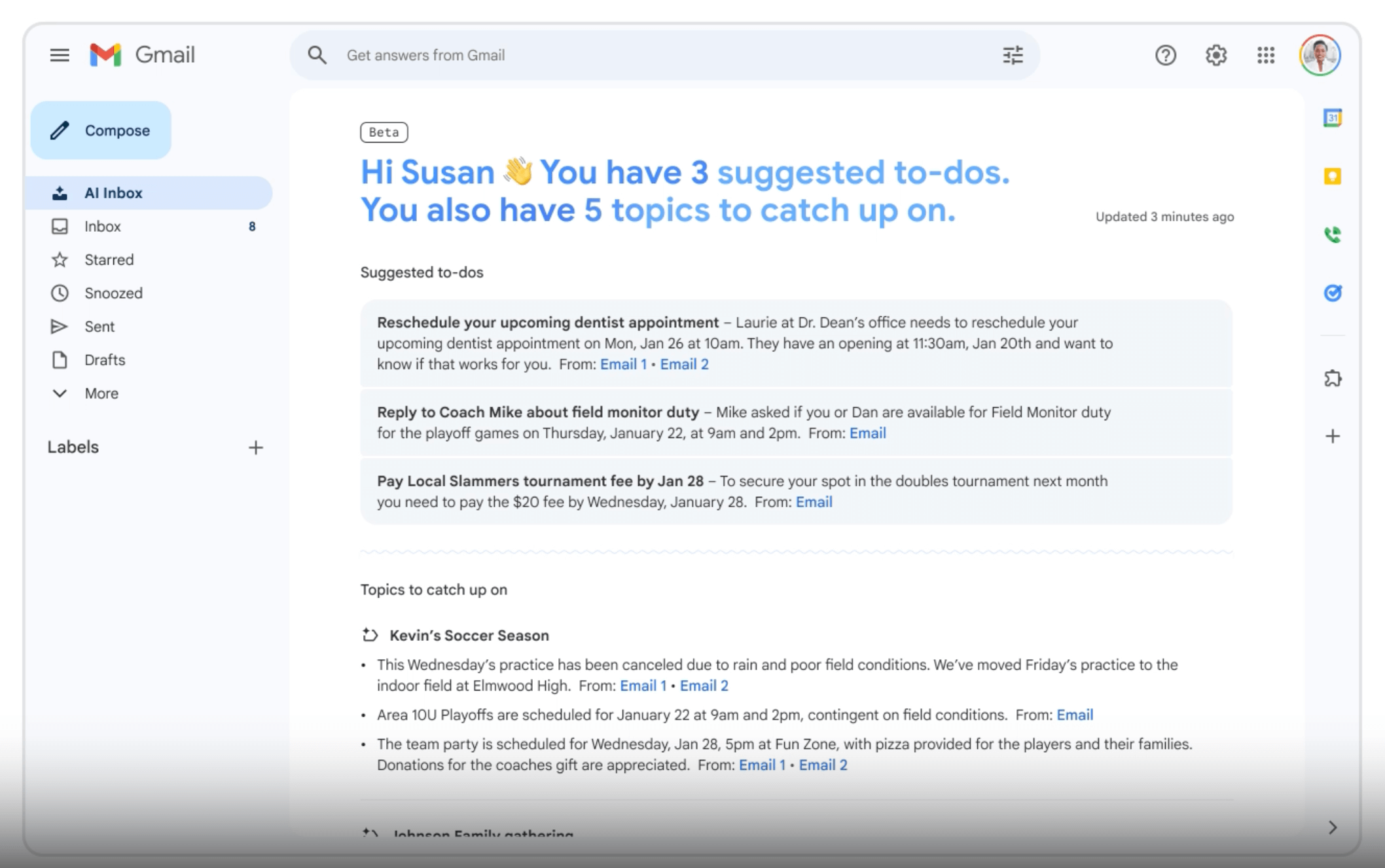
- Ask your inbox questions: Beyond summaries, you can now ask Gmail questions about your email content and get direct answers powered by Gemini AI.
- Help me write: A new AI writing assistant helps you draft or polish messages from scratch — now free for everyone.
- Suggested replies: An upgraded version of Smart Replies that offers contextually relevant, one-tap responses that feel more like you.
- Proofread: Advanced grammar, tone, and style suggestions — available now for Google AI Pro and Ultra subscribers.
- AI inbox view: A smarter inbox that surfaces what matters most by filtering clutter and highlighting priorities like tasks and key messages. Initially available to trusted testers, with broader rollout later.
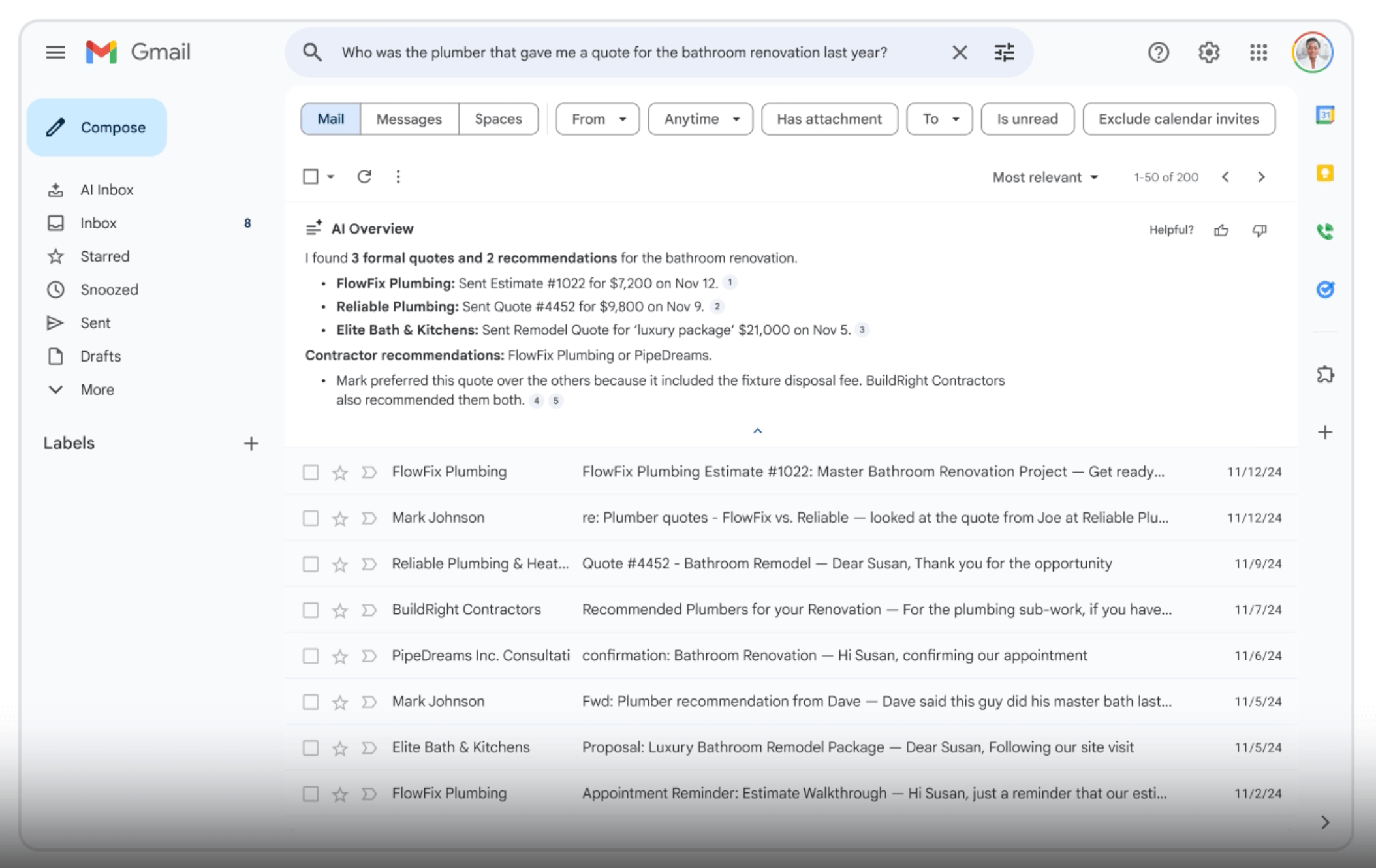
As you can see, not all of these are concerns for email marketers — some features are focused on personal use. But a few of the new updates are definitely worth paying attention to.
How these new features impact email marketers
From Google’s point of view, the goal of these new features is simple: show people fewer emails they don’t want, and surface the ones they do — faster. Currently, the most relevant changes for email marketers involve priority inbox rankings, AI-powered summaries, and filtering. Here’s how it’ll look in practice:
Change #1: Priority inbox ranking is becoming more dynamic
Gmail is moving away from a fully “passive” inbox.
Instead of always showing the newest email at the top, Gmail’s Gemini-powered priority ranking increasingly surfaces emails based on predicted relevance — especially in the Promotions tab.
What this means for senders
Your email doesn’t just compete on when it arrives anymore. It competes on whether Gmail believes the recipient actually wants it.
This doesn’t mean:
- Your emails suddenly stop landing
- Deliverability rules have changed overnight
- You need to game the new algorithm
It does mean, however, that low-engagement emails lose visibility faster.
“Gmail doesn’t introduce new penalties or secret thresholds. What it really does is shorten the feedback loop. If a segment consistently ignores your emails, Gmail learns that faster and deprioritizes future sends.
The fix isn’t trying to “optimize for AI” — it’s sending less to low-engagement segments and focusing volume on flows and campaigns for audiences that already show clear intent.”
— Desislava Zhivkova, CX Deliverability Team Lead at Omnisend
What to look out for
- High frequency without clear engagement signals
- Relying on volume instead of relevance
If your emails are already wanted, this change is more likely to help than hurt.
Change #2: AI-powered summaries reward clarity, not shorter emails
Gmail’s AI-powered summaries can now condense emails and threads, helping users pull key information without reading everything line by line.
This has led to fears that “long emails won’t be read anymore.” That’s not quite the right takeaway.
What’s actually happening
Gemini summaries are mainly designed to:
- Help users understand emails faster
- Reduce effort when scanning crowded inboxes
- Surface the point of an email more quickly
They don’t replace intentional behavior — like shopping, researching, or comparing offers.
What this means for marketers
The risk isn’t length, but rather an unclear intent. If your email:
- Has multiple competing messages
- Buries the main offer
- Uses vague or misleading subject lines
…it becomes easier to skip — whether by a human skimming or an AI summarizing.
“AI summaries don’t penalize longer emails — they struggle with unclear ones. If an email has one clear purpose, a subject line that matches the content, and a visible primary CTA, Gemini can surface it accurately. Problems usually start when multiple offers, vague headlines, or buried CTAs make it hard to understand what the email is actually about.”
— Desislava Zhivkova, CX Deliverability Team Lead at Omnisend
What to do
- One primary message per email
- Clear subject line that matches the content
- Obvious value in the first screen
This is good email hygiene — not a new AI-specific tactic.
Change #3: Gemini-driven filtering evaluates behavior, not keywords
One important thing Gmail’s deliverability teams have been clear about: there are no spam words. Modern filtering — now heavily AI-driven — looks at behavior, not vocabulary.
What Gemini evaluates instead
- How recipients interact with your emails over time
- Whether people keep opening or quickly disengage
- Consistency of sending patterns
- Trust signals tied to your domain
This actually reduces the value of gimmicks like deceptive subject lines.
“Short-term tricks still exist, but they don’t compound. A misleading subject line might earn one extra open, but when people disengage immediately, that behavior is tracked and remembered. Over time, consistent messaging that matches expectations builds far more inbox trust than any single clever send.”
— Desislava Zhivkova, CX Deliverability Team Lead at Omnisend
What this affects
- Misleading subject lines
- Clickbait tactics
- ‘Send now, explain later’ campaigns
If your email doesn’t match expectations, engagement drops — and Gemini notices.
A few features that worry marketers, but have limited impact
Some Gemini features sound big, but don’t materially change how most marketing emails perform.
AI writing tools like Help Me Write and Proofread help users write clearer personal emails. They don’t change why marketing emails get ignored. Relevance, timing, and frequency still matter far more than polish.
Meanwhile, Suggested replies are built for one-to-one conversations. For promotional campaigns, they rarely change behavior. They matter more for service-style emails — order updates, account issues, and support — where replies already happen.
In short, these features add convenience for users, but they don’t rewrite the rules of engagement for marketing email.
What email marketers should realistically focus on
Based on what we’re seeing across inbox providers — not just Gmail — the priorities stay familiar:
- Segment by engagement: send more to people who engage with your content, less to those who don’t
- Control frequency: over-sending now hurts faster than it used to
- Protect consent quality: low-consent contacts drag down performance
- Stay predictable: sudden volume spikes raise flags, even with good intent
None of this requires reinventing your email strategy, just a little tightening.
“When you break down the functionality and purpose of the new features email service providers have released over the past few years, you’ll see the goal is always the same: build trust, stay relevant, and be considerate of how you reach your audience.
None of this is new. These principles have been advised by mailbox providers and deliverability experts consistently for years — and if you’ve been following best practices, you’re going to be rewarded.”
— Desislava Zhivkova, CX Deliverability Team Lead at Omnisend
The bottom line
You can breathe a little easier — Gmail’s Gemini era won’t kill email marketing. It’ll remove more friction for users — and that’ll naturally expose weak sending practices faster.
If your emails are relevant, expected, and consistently useful, Gemini is unlikely to be a threat. If they aren’t, AI just shortens the feedback loop.
And that’s not a bad thing — it just makes the basic best practices harder to ignore.

TABLE OF CONTENTS
TABLE OF CONTENTS


Subscribe and don’t miss any updates!
No fluff, no spam, no corporate filler. Just a friendly letter, twice a month.