Omnisend AI
 Migration


 OFFER
OFFER










Despite how well Klaviyo works, many customers leave due to how the platform bills its customers. We analyzed 300 reviews across G2, Trustpilot, and Capterra to find the reasons why people are leaving and what they have to say.
Pricing was by far the most prominent complaint, appearing in 4 out of 10 reviews (118 of 300). But rather than the headline cost, the active-profile billing and extras are people’s biggest gripes.
Disclaimer: Klaviyo representatives dispute the allegations of data deletion, unnotified suspensions, and arbitrary bill increases, and maintain that all account actions follow its system rules and settings.
Methodology and dataset scope
We manually read and tagged 300 reviews, 100 each from G2, Trustpilot, and Capterra. The reviews we read ran from late 2024 to mid-2026.
Each review platform draws a different crowd with a distinct set of complaints. Here’s how the three compare:
| Source | Review character | Top complaints |
|---|---|---|
| G2 (100 reviews) | Mostly incentivized and seller-invited. The reviews skew positive and frame complaints as trade-offs. | Pricing and learning curve |
| Capterra (100 reviews) | A mix of incentivized and organic reviews, similar to G2, but a little more candid on cost. | Pricing |
| Trustpilot (100 reviews) | Mostly unprompted. The reviews skew negative, with sharper complaints. | Customer support and billing trust |
We tagged each review for the complaints it raised. Some reviews may have raised more than one issue. A review that covers two categories (eg. both price and support) counts in both. The totals top 300. The categories came from what reviewers wrote, grouped into seven themes.
Top-line findings: the seven complaints ranked
Pricing is the top Klaviyo complaint, followed by support quality. Here are the mentions for each, with their share of the 300:
| Complaint | Reviews flagging it | Share of 300 | |
|---|---|---|---|
| 1 | Pricing | 118 | ~39% |
| 2 | Support | 58 | ~19% |
| 3 | Attribution | 38 | ~13% |
| 4 | Integrations | 36 | ~12% |
| 5 | Billing trust | 34 | ~11% |
| 6 | Learning curve | 30 | ~10% |
| 7 | Technical bugs | 22 | ~7% |
Here are our findings presented in a bar chart:
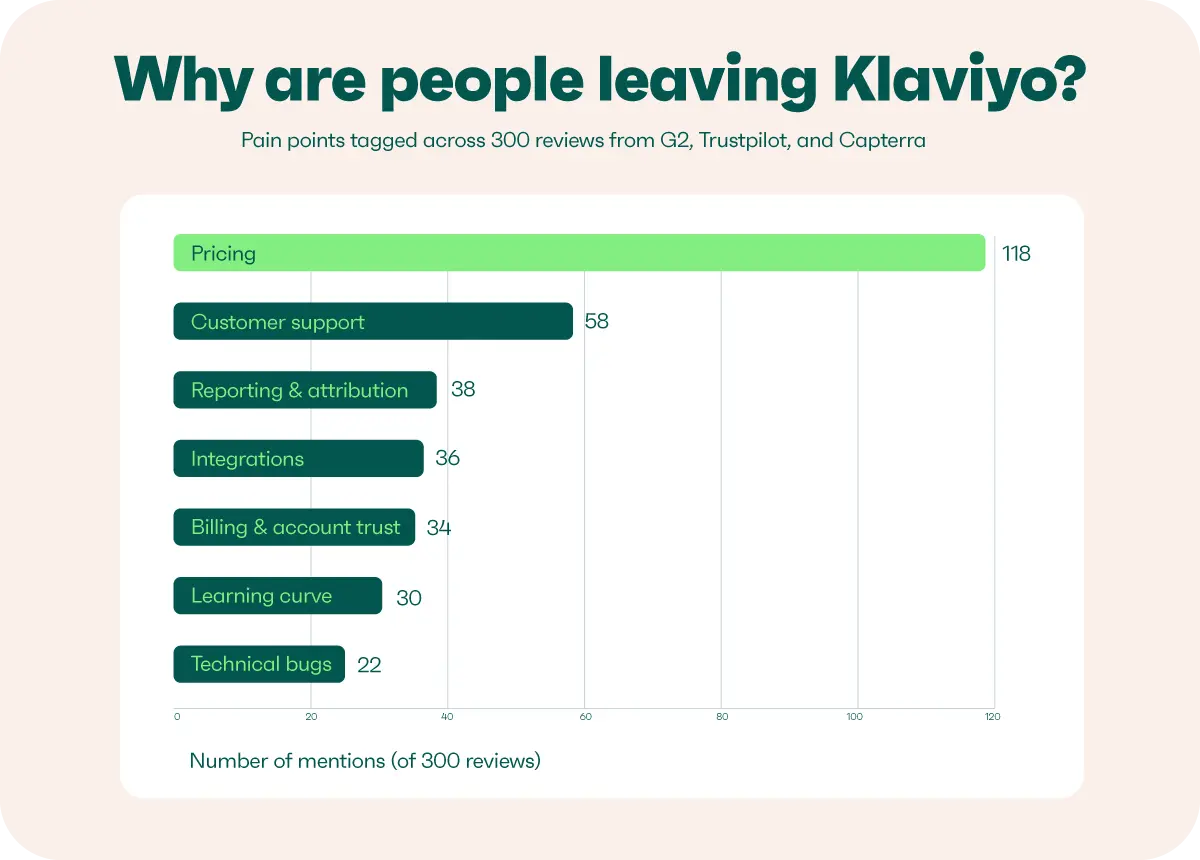
Findings by category
1. Pricing mechanics and active-profile inflation (~39%)
Pricing was Klaviyo’s top complaint, appearing in 39% of reviews, mostly over billing for active profiles, which are all emailable profiles except unsubscribed or suppressed ones.
Out of 300 reviews we checked, 118 complained about pricing. Part of the complaint is Klaviyo’s billable tiers, which charge by active profiles: these are any contacts with a valid email who haven’t been suppressed or unsubscribed.
Reviewers hit a few different snags. Bots clear the sign-up forms and become billable profiles. A busy month can tip an account into the next bracket, one reviewer from $150 to $250.
And once a profile is unsuppressed, Klaviyo won’t let you re-suppress it for 90 days, so it keeps billing the whole time.
Finally, snapshot billing came up in Trustpilot reviews, with some reviewers saying they were charged on a prior profile-count snapshot even after cutting their list.
“Klaviyo charges by the number of active profiles, not just the emails you send. As your list grows, the bill jumps significantly.” G2 reviewer, graphic designer, small business.
“We have barely used Klaviyo for email sending over the past few months, yet our monthly bill suddenly jumped from $150 to $250, thousands of fake profiles were automatically created via the Shopify integration.” Trustpilot reviewer, Germany.
“Bots keep signing up, we suppress them, and we can’t re-suppress for three months, meanwhile we’re charged per active profile.” Trustpilot reviewer, United States.
What to do about it
- Suppress profiles who don’t engage after a set period, such as six months
- Enable double opt-in so that new subscribers have to confirm their email
- Add CAPTCHA to all forms to reduce bots
- Turn on auto-downgrade; your plan will then drop when your active profile count falls into a lower tier
2. Customer support and AI chatbot friction (~19%)
19% of Klaviyo reviews showed frustration with support levels, particularly around AI bots being unable to resolve account-level problems and delays in receiving email responses.
Customer support was the second most mentioned complaint, at 58 of 300 reviews. It was the most consistently negative category, with reviewers rarely mentioning it in a positive light.
Three problems came up: a support bot that couldn’t resolve account issues, email responses that took hours or days, and cases where support didn’t help at all.
“When you contact Klaviyo support, staff give information that contradicts their published documentation and often don’t give the correct advice at all, resulting in going around in circles trying to get issues resolved.” Capterra reviewer, Digital Producer.
“Chat support available 24/7… chat support is an AI bot which is poorly trained.” Trustpilot reviewer, United Kingdom.
“The chat is a bot and can’t handle specific questions, and email support can take hours or days.” G2 reviewer, small business.
What to do about it
- Test email response times thoroughly during your trial period
- Determine if 24/5 live chat with a paid plan is good enough; if it isn’t, then you’ll need to purchase the Professional or Enterprise support tier or look for a tool that has 24/7 support as standard
3. Revenue attribution and integration limitations (~13% / ~12%)
Attribution disputes accounted for 13% of reviews due to inflated revenue reports, and 12% of reviews complained about integration friction.
Reporting and attribution had 38 mentions, integrations 36. Both come down to the same gap: reviewers said Klaviyo overstated the revenue it generated, and that it worked far better on Shopify than off it.
Klaviyo’s revenue numbers ran higher than what Google Analytics (GA4) or Shopify credited. Reviewers say they stopped trusting the platform’s figures and cross-checked in Shopify instead.
“I have issues with the reporting/attribution, where the revenue is often massively inflated compared to GA4/Shopify attribution.” G2 reviewer, small business.
Integrations were the other half of the complaint: customers complained that they had to find a separate integration tool for customer contacts. Additionally, some noted that the platform hasn’t kept up with industry developments, especially in terms of AI.
“Integrations and deliverability were where Klaviyo fell short. For example, we needed to integrate Google Sheets, which is where we store many of our customer emails (fed in through Facebook forms). We had to download a separate integration tool…” Capterra reviewer, Developer.
“It’s a bit behind in how customer email is changing now. There are some things we’d like to be able to do, but its limitations prevent us – especially in the AI sector.” Capterra reviewer, Controller.
What to do about it
- Narrow your attribution windows from Klaviyo’s default five days so it only credits purchases that closely follow an email
- Turn on bot-click filtering to prevent Klaviyo from over-crediting itself
- Cross-reference attributed revenue against analytics you know is accurate, such as Shopify or Google’s
4. Billing trust and secondary complaints
11% of reviews complained about billing trust, 10% about learning curve, and 7% about technical bugs, mainly the template editor’s latency.
Out of the 300 reviews we analyzed, 34 mentioned a lack of trust or a problem with billing, such as account cancellation without any warning.
Complaints also included problems with downgrading, and one reviewer said that suppressed profiles were reactivated without consent.
“They suspended my account without any notice. Not even an email… they delete all your data and profiles.” Trustpilot reviewer, Netherlands.
“Réactivent des profils sans mon consentement afin d’augmenter la facturation (reactivates profiles without my consent to increase billing).” Capterra reviewer, France.
The last two categories had a share of 10% or less. Klaviyo’s learning curve came up 30 times, usually alongside an admission that it works fine once you know it. Editor lag had 22 mentions, mostly for the template editor due to its auto-save feature.
“The template editor text box is extremely slow — almost dysfunctional due to the auto-saving function. It can take hours to edit a template.” Trustpilot reviewer, Denmark.
What to do about it
- Downgrades in Klaviyo are scheduled and don’t refund mid-cycle, so if you’re dropping a tier, do it 24+ hours before renewal
- Update your payment details when necessary to avoid account suspension from non-payment
- Save your email templates and reuse them rather than rebuilding from scratch to avoid potential technical bugs with the editor
Cross-platform comparison: G2 vs. Trustpilot vs. Capterra
G2, Trustpilot, and Capterra attract different review sentiments. The reason is who bothers to submit reviews. G2 and Capterra include vendor invites, with those customers being more likely to leave a review when they have positive things to say. Trustpilot users typically arrive unprompted because something went wrong and they want to let it be known.
The table below provides a count of the complaints per platform. We’ve bolded the highest count in each row.
| Complaint | G2 | Trustpilot | Capterra |
|---|---|---|---|
| Pricing | ~32 | ~38 | ~48 |
| Support | ~6 | ~45 | ~7 |
| Attribution | ~19 | ~11 | ~8 |
| Integrations | ~17 | ~9 | ~10 |
| Billing trust | ~2 | ~28 | ~4 |
| Learning curve | ~13 | ~2 | ~15 |
| Technical bugs | ~2 | ~12 | ~8 |
Note: the figures in the table are directional estimates from our manual tagging, not a precise recount. They show the pattern across the sites.
Study limitations and official disclaimers
Our review sample carries a high share of incentivized reviews from G2 and Capterra. It likely understates negative sentiments against Klaviyo’s customer base. Likewise, Trustpilot attracts unprompted reviews, and likely overstates negative sentiments.
We manually tagged the complaints in all 300 reviews without software. Tagging was performed in batches over an extended session. Treat our totals as close approximations, not audited figures.
Review authenticity was not a factor we assessed, and we didn’t independently verify incidents or problems.
Some of the most serious complaints are disputed by Klaviyo in public replies. These include data deletion, unnotified suspensions, and arbitrary bill increases. Klaviyo says its actions follow system rules and settings.
Klaviyo’s Shopify App Store app wasn’t included in our study because an early pass found that many reviews focus on the Reviews feature, not the wider platform.
Additional Klaviyo research
Read these guides for more information about Klaviyo:
Klaviyo review: Features, pricing, and honest verdict
Best Klaviyo alternatives for ecommerce in 2026
Frequently asked questions
Why is my Klaviyo bill higher than expected?
Your Klaviyo bill may be higher because it counts all active profiles toward your billable tier. These soon add up when you’re a busy ecommerce store. Your bill increases even when you’re not sending to all your contacts.
How can I bring my Klaviyo bill down?
To bring your Klaviyo bill down, suppress inactive profiles so they don’t count toward your bill. Only unsuppress profiles for good reason, because you can’t re-suppress them for 90 days. Double opt-in and CAPTCHA will cut out most bots.
Why do Klaviyo review scores differ so much between sites?
Klaviyo reviews differ between sites because some review sites are incentivized and attract positive comments; others are unprompted. Trustpilot is unprompted and skews more negative than G2 or Capterra.
Is Klaviyo’s revenue reporting accurate?
Klaviyo’s revenue reporting is not always accurate, as some reviewers found it ran higher than Google Analytics 4 and Shopify due to wide attribution windows.