
 Omnisend AI


 OFFER
OFFER







Drive sales on autopilot with ecommerce-focused features
See FeaturesKey takeaways 
Increasing email frequency is effective only when each message is relevant and contextually tailored to the recipient, not just when sent more often.
Segmenting your audience based on their purchase history helps create targeted communications that resonate with their interests and needs.
Dynamic segments that automatically update based on customer behavior reduce maintenance efforts and ensure ongoing relevance in email marketing.
Consistent engagement metrics across campaigns indicate a successful segmentation strategy, allowing brands to increase sending frequency without sacrificing customer interest.
Reveal key takeaways
When you increase sending frequency, someone always asks the same question: “Aren’t we becoming too pushy?”
It’s a fair concern. More emails mean more chances to annoy people, right? More chances to get unsubscribes, more chances to burn goodwill you’ve spent months building. The instinct to pull back makes sense on the surface.
But in practice, frequency is rarely the real problem. We’ve seen brands send once a week and still feel intrusive. We’ve seen others send three times a week and get thanked for it. The difference isn’t volume. The problem is when an email shows up without any context, without a reason that the reader can immediately understand.
You can send rarely and still be ignored. You can send consistently and get real attention. The variable that actually matters is whether each message has a clear reason to be there, a reason that makes sense to the specific person receiving it, not just to the marketing team that sent it.
With Alberoshop, an ecommerce store specializing in crystal and home goods with over 15,000 products in the catalog, we worked on making that principle concrete and operational. Not as a one-off campaign experiment, but as a sustainable system that could hold up as send volume grew.
The core idea was simple: use the purchase as a signal to guide what gets sent and when.
Not a revelation. One of those things that sounds obvious the moment you say it out loud, and then turns out to require real work to actually build and maintain. But when it works, it changes the results in ways that are pretty hard to argue with.
Why large catalogs make this harder
Most of the email marketing advice out there is written with relatively focused stores in mind. A brand that sells three types of bags. A DTC company with one hero product and a handful of accessories. For those, relevance is almost automatic — you know what someone bought, you know what else they might want, and the catalog is small enough that even a broad newsletter feels somewhat targeted.
With 15,000 products across dozens of categories, the problem is different. The catalog covers crystal glasses, decorative objects, cutlery, kitchen accessories, gift items, tableware, and more. Some customers come for a specific occasion. Others browse across categories. Some buy once for a gift, others come back regularly.
When you try to serve all of that in a single newsletter, the result is usually a collage: too many categories in one message, too many product types competing for attention, too many unguided choices. Nothing feels like it was picked with the reader in mind, because it wasn’t.
The deeper issue is that without context, the reader has no frame for evaluating what they’re looking at. If I receive an email showing me crystal vases, ceramic plates, a set of wine glasses, and a decorative centerpiece all in the same scroll, I don’t know which one I’m supposed to care about. I don’t know what problem any of them solves for me right now. So I skim, I close, and eventually I stop opening at all.
The question we kept coming back to wasn’t “what discount do we send?” or “what’s performing well this week?” It was more fundamental: how do we make an email feel relevant to someone even when we’re not running an aggressive promotion? How do we give the reader a reason to pay attention that doesn’t depend entirely on a price cut?
The answer, at least the one that worked for us, starts before the email is even written. It starts with knowing who you’re writing to.
Purchase as context
Segmenting by purchased category sounds, at first, like a pretty conservative idea. You bought glasses, so we’ll only ever talk to you about glasses. You bought a vase, so here are more vases.
That’s not what we mean.
Segmenting by purchased category doesn’t mean limiting the conversation to what someone already owns. It means using that purchase to figure out where to start, what register to write in, what level of familiarity to assume, and what adjacent territory might actually be relevant.
Someone who bought a full set of crystal wine glasses for a dinner party probably cares about table setting in a way that someone who bought a single decorative item as a gift might not. Those two people can receive content about overlapping products, but the framing, the tone, the angle of entry will be different. One person is already invested in the ritual of a well-set table. The other might just be looking for something beautiful to give.
The category isn’t a cage, it’s a starting point. It tells you what context is probably relevant for this person right now, and it stops you from sending something that feels completely random. That shift, from “what do we want to promote” to “what does this person already care about,” is what makes the difference between an email that feels like an interruption and one that feels like it arrived at the right moment.
This sounds abstract, but the implementation is actually quite concrete.
How we built the segments in Omnisend
The first question we had to answer wasn’t strategic, it was operational: what kind of segmentation could we actually sustain over time?
It’s easy to build elaborate segments for a single campaign. You spend a few hours defining the logic, it works well, and then three months later, nobody remembers how it was set up, and the whole thing has drifted. We’ve seen that happen. The initial enthusiasm doesn’t survive contact with the reality of running ongoing email programs at scale.
So the constraints were clear from the start. The segmentation had to be easy to understand by anyone on the team, not just the person who built it. It had to update automatically based on behavior, so it didn’t require manual maintenance. And it had to stay valid even as the catalog evolved, which for a store the size of Alberoshop means new products being added regularly.
In Omnisend, we built dynamic segments based on purchase behavior using one concrete criterion: Ordered product combined with a filter by Collections. A contact enters a segment when they’ve ordered at least one product that belongs to one or more Collections defined in the store’s backend.
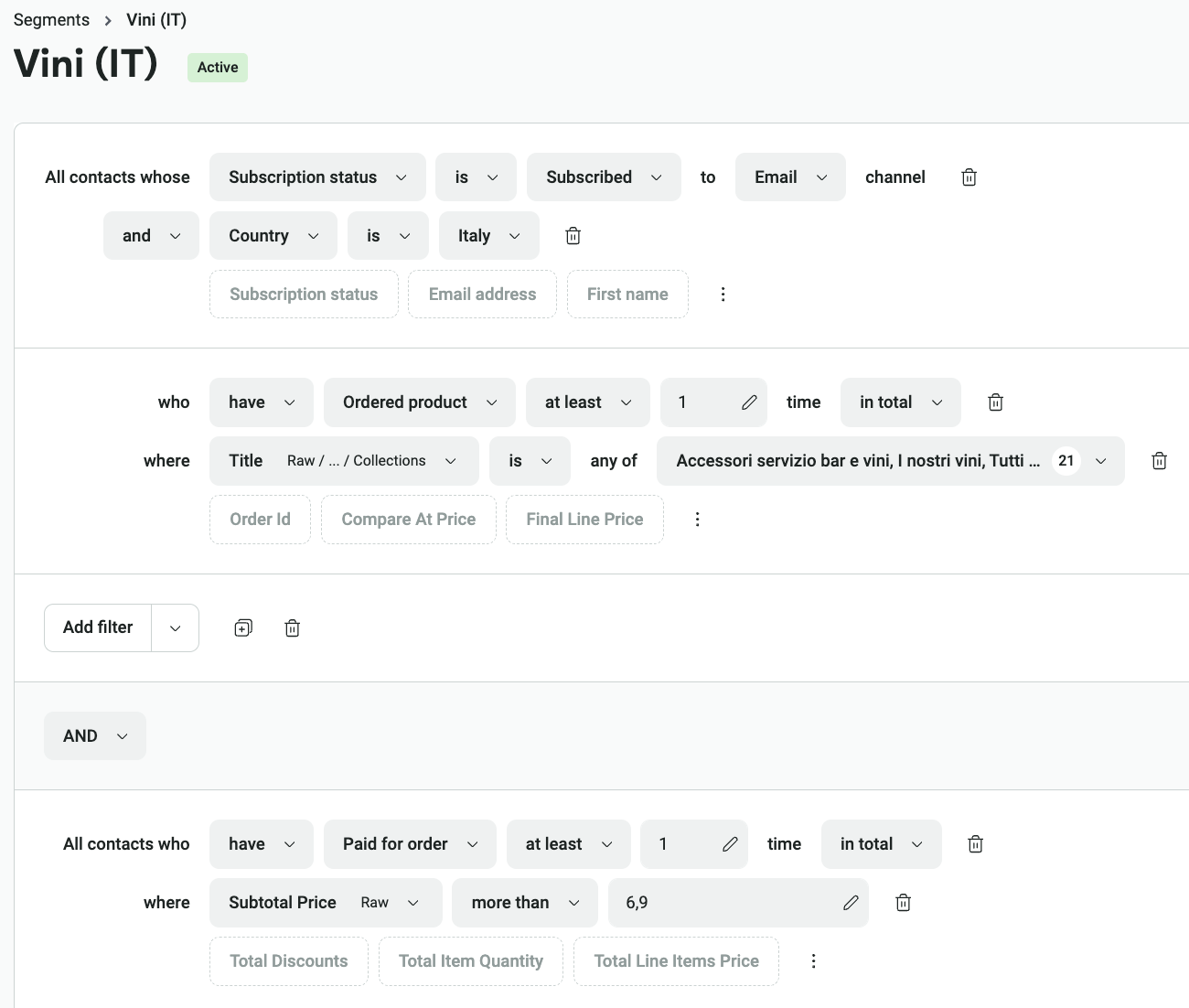
The Collections are the groupings the store already uses to organize the catalog. They’re not invented for marketing purposes, they reflect the actual product structure. Crystal glasses. Decorative items. Kitchen accessories. Gift sets. The taxonomy already existed; we just used it as the basis for the segmentation logic.
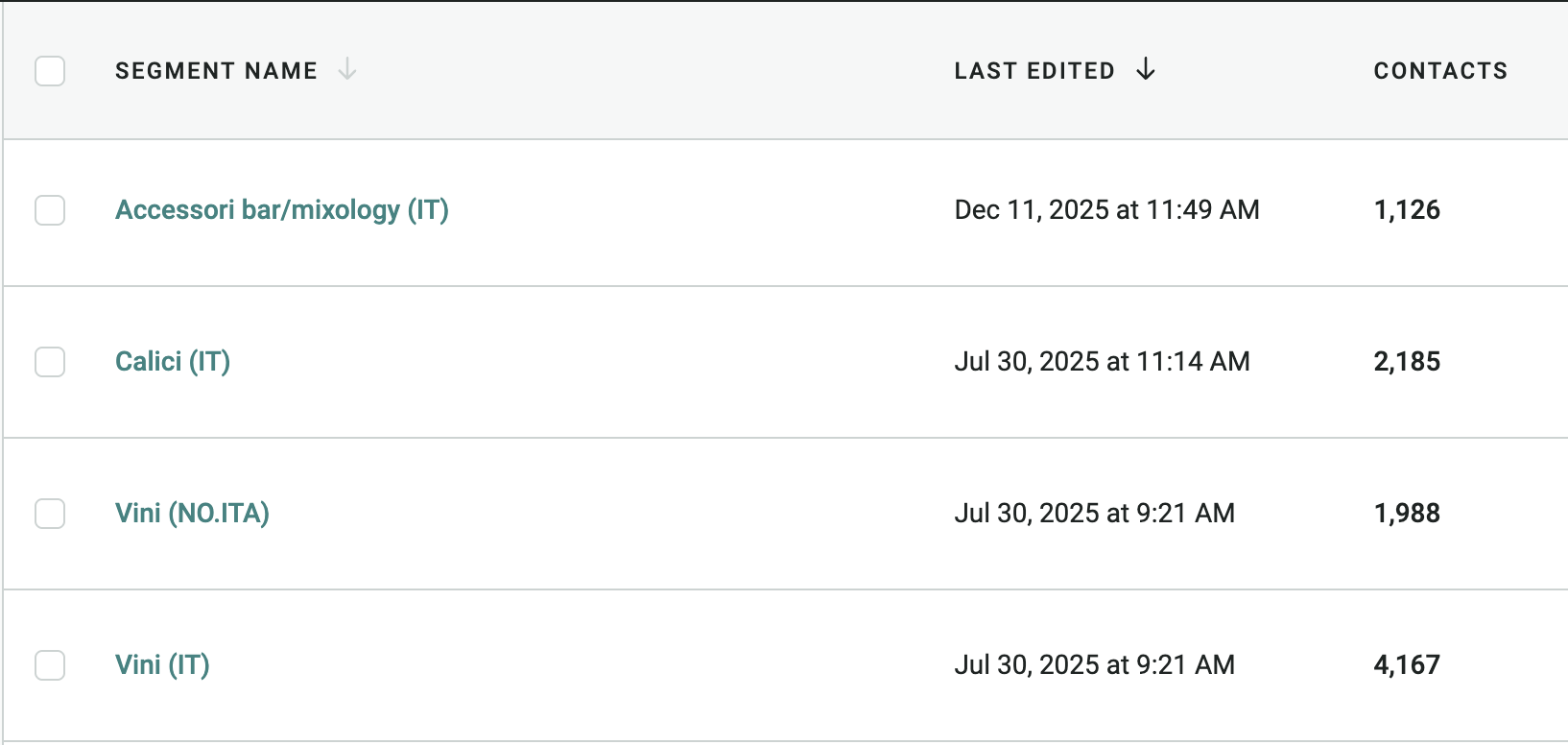
We went with Collections rather than individual product tags, manual lists, or custom fields for a few specific reasons.
First, it mirrors how the catalog actually works. Every product in the store is already assigned to one or more Collections as part of normal catalog management. We didn’t need to create a parallel system or ask anyone to do extra work. The segmentation piggybacks on infrastructure that already exists and is already maintained.
Second, it holds up when the catalog changes. New products get added, old ones get retired, prices change, variants get updated. None of that breaks the segment logic, as long as products are correctly assigned to Collections when they’re created, which they already are. The segmentation doesn’t need to be touched just because the catalog evolves.
Third, it’s a rule anyone can read and verify. There’s no ambiguity in “ordered at least one product from the Crystal Glasses collection.” You can check it, audit it, explain it to a new team member, and be confident it means what you think it means. That kind of clarity is underrated when you’re running multiple segments across multiple campaigns.
Dynamic segments: Less maintenance, more consistency
The word “dynamic” is worth pausing on, because it’s doing a lot of work here.
A static segment is a list that was true at a specific moment in time. Someone bought crystal glasses in November, they get added to the list, and they stay there. That might be fine for a one-time campaign, but over months it becomes misleading. People’s interests evolve. Someone who bought table accessories last year might have since bought several items in the decorative objects category and is now much more relevant for communications in that direction. A static segment wouldn’t reflect that.
A dynamic segment recalculates continuously based on actual behavior. If someone makes a new purchase in a different category, they move into the relevant segment for that category. If they buy across multiple categories, they can be in multiple segments. The list isn’t a snapshot, it’s a live reflection of what the customer has actually done.
This has a direct effect on communication quality. You’re not talking to someone based on something they did eighteen months ago. You’re talking to them based on their current relationship with the store. That’s a meaningful difference, both in how the email feels to the reader and in how it performs.
The operational benefit is just as real. When segments are dynamic, the maintenance load drops sharply. You’re not manually reviewing lists, removing people who are no longer relevant, or adding people who should have been included but weren’t. The logic does that work. What you’re managing isn’t a set of lists, it’s a set of rules. And rules scale in ways that manual lists don’t.
As sending frequency increased and the number of active segments grew, this became important. You can run six, eight, ten segment-specific campaigns in a month without needing to dedicate significant time to list hygiene, because the lists are managing themselves.
The numbers
We’re somewhat cautious about leading with metrics, because they tend to get decontextualized fast. An open rate means different things depending on the audience size, the send cadence, the subject line, the time of year, and a dozen other variables.
But with that caveat in place, across campaigns sent to different purchased-category segments, we saw recurring open rates in the 34% to 47% range. Several individual sends generated thousands of opens. Some reached tens of thousands.
For a store with a broad catalog and a mixed audience, those aren’t numbers you get from random batch-and-blast. They’re numbers you get when people open an email because something about it seemed like it was actually meant for them.
The more useful signal, in our view, isn’t any single campaign result. It’s the consistency across campaigns. When open rates are solid across different segments, different times of the month, and different types of content, that tells you the underlying logic is sound. It’s not a lucky send. It’s a system working the way it’s supposed to.
That consistency is also what makes it sustainable to increase frequency. When readers are opening emails, when engagement stays high, when unsubscribes don’t spike after every additional send, you have room to communicate more. The segmentation earns that room.
Our takeaway
You can only increase sending frequency if you increase relevance at the same rate. That’s the core of it.
When frequency goes up without relevance going up, inboxes get noisier, and results get worse. When they scale together, you get more touchpoints that actually work, more chances to be in front of someone at the right moment, more opportunities to sell without having to discount your way into attention.
Segmenting by purchased category isn’t a complicated technical project. It doesn’t require a data team or a custom integration. In Omnisend, with the right logic and a catalog that’s already organized into Collections, it’s something you can set up once and rely on. The infrastructure does the heavy lifting. What you’re left with is the creative and strategic work — figuring out what to actually say to each segment, and how to say it in a way that feels worth reading.
That’s the part that requires ongoing effort. And it’s the part that makes the real difference.
Author bio

Arianna Del Buono is a Project Manager at Weirdoo, where she works on ecommerce and digital marketing projects with a focus on paid media, customer acquisition, and growth. She helps develop strategies and campaigns designed to make brand communication more relevant, effective, and scalable. Learn more about the agency here.

TABLE OF CONTENTS
TABLE OF CONTENTS


Subscribe and don’t miss any updates!
No fluff, no spam, no corporate filler. Just a friendly letter, twice a month.