Omnisend AI


 OFFER
OFFER









If you’ve run SMS campaigns for your store, you’ve probably seen the term “SMS aggregator” on a platform’s pricing page or in a vendor FAQ. Chances are you likely kept scrolling.
It sounds like telecom plumbing, and in a way it is.
But the quality of that plumbing decides whether your flash sale sends lands in seconds. It also determines whether your abandoned cart text arrives inside the recovery window or whether a post-purchase message reaches the phone at all.
This guide explains what an SMS aggregator is. You’ll learn why it matters for your ecommerce SMS campaigns in 2026 and how to use that knowledge to evaluate SMS marketing platforms.
Here’s the short version: you don’t deal with aggregators directly. Your SMS platform does. But knowing what sits under the hood helps you choose a platform that makes smart infrastructure decisions on your behalf.
Quick sign up | No credit card required
What is an SMS aggregator?
An SMS aggregator is the intermediary layer between businesses and mobile carriers.
It consolidates message traffic from many senders and routes each text to the right network. As such, a business needs one connection instead of a separate agreement with every carrier.
For instance, when your store sends a text, that message has to find its way onto AT&T, Verizon, T-Mobile, or whichever network your customer uses.
An aggregator holds those carrier relationships and handles the routing for everyone plugged into it.
Importantly, store owners never interact with an SMS aggregator directly. You log into your SMS marketing platform, write a message, and hit send.
The platform is connected to the aggregator, and the aggregator is connected to the carriers. Your job stops at the campaign, and everything below that line is infrastructure your platform manages for you.
How does an SMS aggregator work?
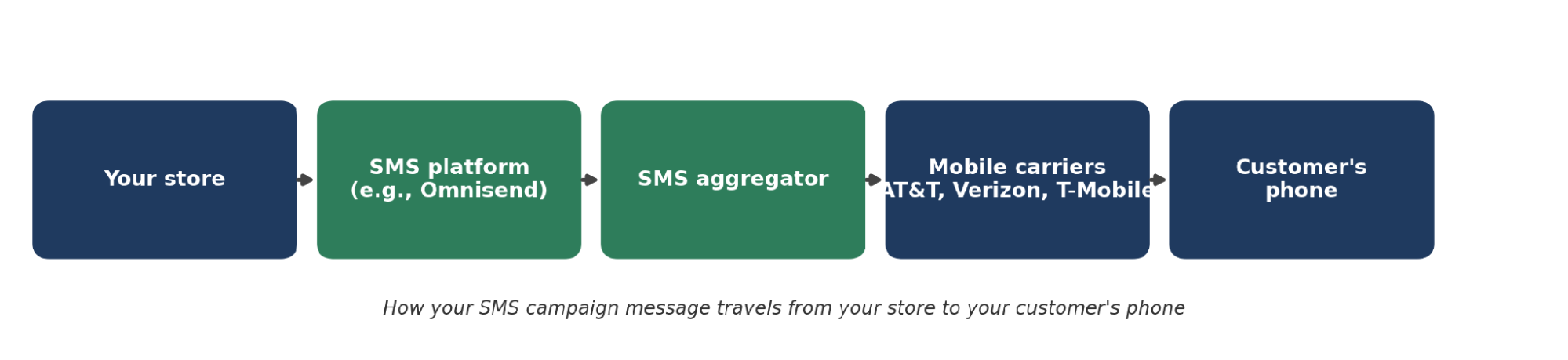
An SMS aggregator moves your message through a short chain with a few handoffs.
You send a message from your store through your SMS platform. The platform passes it to an SMS aggregator. The aggregator connects to the mobile carriers. Then the carrier delivers it to your customer’s phone.
Most of the complexity in this process lives in the middle two steps.
Your platform handles the connection to the aggregator, and the aggregator handles carrier routing, formatting, and compliance checks.
None of this is visible to you, and that’s the point. From your side, you click send once.
Here’s the five-step path your campaign message follows from your store to your customer:
What is A2P SMS — and why does it need an aggregator?
A2P SMS stands for application-to-person messaging. It’s any text sent from a business application or platform to a customer’s phone. Your welcome texts, order updates, and promotional sends are all A2P.
It’s the opposite of P2P, or person-to-person, texting, which is the conversational back-and-forth between two individuals.
P2P SMS traffic is low-volume and conversational. A2P SMS traffic is high-volume, automated, and heavily regulated, which is exactly why it needs an aggregator.
Also, carriers treat business messaging differently. It has to be registered, compliant, and routed through approved channels, or it gets filtered out.
According to Grand View Research, the U.S. SMS marketing market could grow to about $10 billion by 2030, at a CAGR of 20.8%:

A bulk SMS aggregator is what makes that volume possible, moving millions of compliant business messages without tripping carrier filters.
Tier 1 vs. Tier 2 SMS aggregators: What’s the real difference?
Not all SMS aggregator companies operate at the same level. The market splits into two tiers, and the difference shows up directly in how your campaigns perform.
| Criteria | Tier 1 aggregator | Tier 2 aggregator |
|---|---|---|
| Carrier connection | Direct links to mobile carriers | Routes through a Tier 1 middleman |
| Delivery speed | Faster — fewer hops | Slower — an extra routing layer |
| Reliability at peak (Black Friday, flash sales) | Holds up under high volume | Can bottleneck when traffic spikes |
| Compliance risk | Lower — carrier-vetted routes | Higher — more grey-route exposure |
| Typical use case | Time-sensitive, high-volume ecommerce sends | Low-priority or budget bulk traffic |
A Tier 1 SMS aggregator has direct connections to the mobile carriers. A Tier 2 aggregator routes through a Tier 1 provider, adding a hop.
The practical effect is speed and reliability, especially when you’re sending thousands of messages during a flash sale.
One thing to watch for is grey routes. These are unofficial paths where business traffic is disguised as personal texting to dodge carrier fees.
They may look like a less expensive option, but carriers often detect and filter them out. This could mean delays, dropped messages, and compliance exposure for your store. Tier 1 routing keeps your campaigns off those routes.
SMS aggregator vs. SMS gateway: Clearing up the confusion
An SMS aggregator and an SMS gateway often get used interchangeably, but they handle different tasks. An SMS gateway handles protocol conversion — it translates your message into a format the carriers can accept and passes it along.
An SMS aggregator manages the broader infrastructure. This could include multi-carrier routing, carrier relationships, compliance, and scale.
| Role | SMS gateway | SMS aggregator |
|---|---|---|
| Main job | Converts your message into a carrier-ready format (protocol conversion) | Manages routing, multi-carrier relationships, compliance, and scale |
To remember the SMS aggregator vs. SMS gateway distinction better: a gateway is often one component inside an aggregator’s system.
For an ecommerce sender, the practical point is that the aggregator is the layer that most affects how your campaigns actually perform.
How SMS aggregator quality affects your store’s campaigns
Aggregator quality is where the infrastructure stops being abstract. It decides whether your time-sensitive sends actually land, and a weak route shows up as lost revenue.
There are a few common ecommerce scenarios that make it concrete.
First is the Black Friday blast that arrives late. You schedule a promo to 20,000 subscribers for 9 a.m. On a congested Tier 2 route, those messages queue and trickle out over hours. By the time many land, the doorbuster is gone and the urgency with it.
The next ecommerce scenario is the abandoned cart text that misses its window. Recovery messages work because they’re timely — usually within 30 minutes of the cart being left.
Routed through a slow or grey path, that text can arrive 90 minutes later. By then, the shopper has likely already moved on or bought elsewhere.
The last scenario is the post-purchase request that gets filtered as spam. A review or replenishment message sent over a non-compliant route can be flagged and blocked by the carrier. As a result, the customer never sees it, and you never know it failed.
Industry data from Digital Applied puts post-10DLC delivery at over 97% for vetted, Tier 1 routes. It was also noticeably lower for unregistered traffic.
SMS aggregator pricing: what you’re actually paying for
When you compare SMS platform pricing, the per-message rate is more about the infrastructure behind it, not the message.
SMS aggregator pricing reflects the quality of the routes your platform buys, and that’s the real line item you’re evaluating.
Tier 1 routing costs more to maintain because direct carrier relationships and compliance work aren’t cheap. You pay for that, and in return you get speed, reliability, and far less filtering.
Tier 2 or grey-route infrastructure can look cheaper on a rate card, but the savings come with hidden costs. Some of these are failed deliveries you still partly pay for. You could also incur compliance penalties all while messages are quietly dropped by carrier filters.
So when one platform looks notably less expensive than another, ask what you’re actually paying for.
Ultimately, the right question isn’t “What does a text cost?” but “What’s the delivery quality behind that cost?”
What to look for in an SMS platform’s aggregator infrastructure
You’ll never pick an aggregator yourself, but you can read the signals in how a platform talks about its infrastructure. Here are five things worth checking before you commit:
- Does the platform disclose its aggregator relationships? Transparency about how messages are routed usually signals a platform that’s confident in its delivery.
- Does it use Tier 1 routing? Direct carrier connections mean fewer hops, faster sends, and lower filtering risk for your campaigns.
- How does it handle compliance? Look for built-in TCPA support, opt-in and opt-out management, and 10DLC carrier registration handled for you.
- What happens during high-volume sends? Ask how delivery holds up on peak days like Black Friday, when a slow route can quietly cost you the sale.
- Is global reach covered? If you sell across borders, confirm the platform sends reliably to the countries where your customers actually live.
Treat these as a short checklist when you’re comparing SMS marketing platforms. The answers tell you whether infrastructure quality is something the platform has thought about or not.
How Omnisend handles SMS aggregator complexity for you
Omnisend makes these infrastructure decisions so you don’t have to. Your messages route through reliable, carrier-compliant paths. You don’t have to worry about negotiating with aggregators, managing routing tables, or grey routes eating at your delivery.
If you’re weighing your options, our guide to the best SMS marketing software for ecommerce walks through what to look for.
Omnisend is purpose-built for ecommerce and features SMS that reaches customers in 150+ countries. It also has native integrations for Shopify, WooCommerce, Wix, and BigCommerce.
Compliance work like opt-in management and carrier registration runs in the background. This way, a flash sale doesn’t turn into a compliance headache.
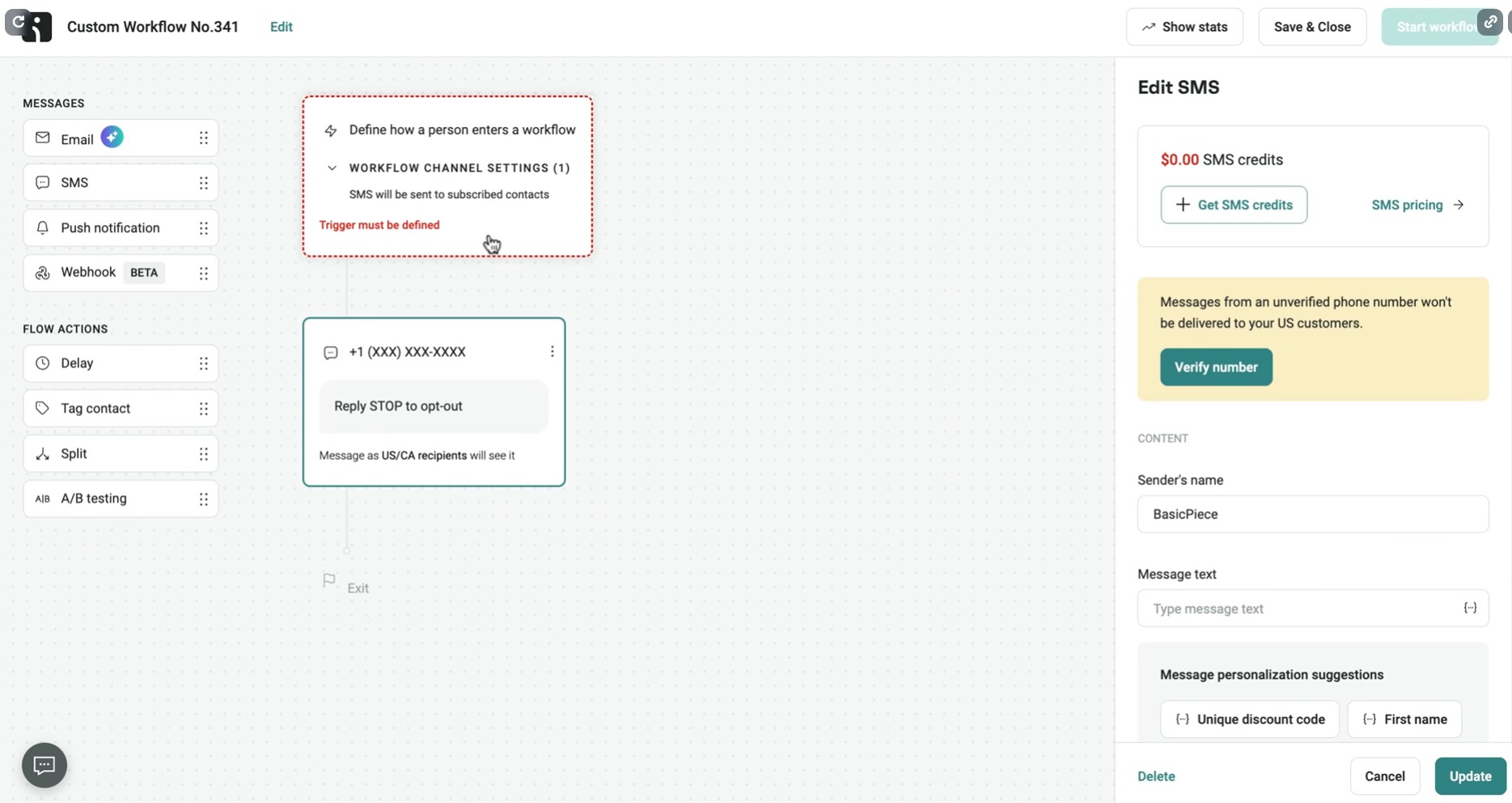
Inside Omnisend, building and automating an SMS campaign happens on one screen, with routing and compliance handled for you:
That reliability ties straight to results.
Omnisend merchants on paid plans averaged $79 back for every $1 spent across email, SMS, and push in 2025, based on Omnisend’s internal analysis. Not only that, every plan, including the free plan, comes with award-winning 24/7 support.
You get the same power as platforms like Klaviyo at a better price-to-feature ratio, with the infrastructure work already done.
Conclusion
An SMS aggregator is the infrastructure layer that carries your text from your store to your customer’s phone. And you’ve now seen why its quality is not a background detail.
It decides whether your Black Friday blast lands on time or whether your messages clear carrier filters at all.
The takeaway for a store owner is that you don’t need to become a telecom expert or choose an aggregator yourself.
You need a platform that makes those infrastructure decisions well on your behalf. These decisions include Tier 1 routing, real compliance support, and reliable delivery at volume.
So when you evaluate or switch SMS marketing platforms, look past the feature list to the infrastructure underneath.
Quick sign up | No credit card required
FAQ
Who are SMS aggregators?
SMS aggregators are companies that sit between businesses and mobile carriers, routing each text to the right network. Your SMS platform connects to them, so you never deal with an aggregator directly.
Who are the Tier 1 SMS aggregators?
Tier 1 aggregators have direct connections to mobile carriers, rather than routing through a middleman. That direct link gives faster, more reliable, more compliant delivery. The status is defined by carrier connections, not by any fixed list of companies.
What is the difference between SMS gateway and SMS aggregator?
An SMS gateway converts your message into a carrier-ready format (protocol conversion). An SMS aggregator manages the broader infrastructure — routing, carrier relationships, compliance, and scale. A gateway is often one component inside an aggregator’s system.
What is a message aggregator?
A message aggregator is another name for an SMS aggregator — the intermediary that collects business messages and routes them to mobile carriers for many senders at once. It handles the carrier connections so businesses don’t have to.
What is A2P SMS and how does it relate to SMS aggregators?
A2P (application-to-person) SMS is any message sent from a business app to a customer’s phone. Because it’s high-volume and regulated, it must move through an aggregator’s compliant, registered routes to reach carriers.
Does SMS aggregator tier affect my campaign delivery?
Yes. Tier 1 routing tends to deliver faster and with less filtering, while Tier 2 or grey routes raise the risk of delays and drops. Your platform’s routing choices shape how reliably your campaigns land.
Do I need to choose my own SMS aggregator as an ecommerce store owner?
No. You choose an SMS marketing platform, and the platform manages the aggregator relationships for you. Your job is to pick a platform that makes strong infrastructure choices, not to manage routing yourself.
How does SMS aggregator pricing affect what I pay for SMS marketing?
Aggregator route quality flows through to your per-message price. Tier 1 routing costs more but delivers reliably. But cheaper routes can carry hidden costs in failed deliveries and compliance risk. You’re paying for delivery quality, not just a message.