Omnisend AI

 OFFER
OFFER









SMS segmentation involves dividing your list into groups based on shared traits or behaviors. It makes the difference between a text that converts and one that’s flagged as spam.
Text messages grab attention faster than almost any other marketing channel. However, if you send an irrelevant SMS, you can lose your subscribers’ trust just as quickly.
According to Omnisend’s Ecommerce Marketing Report, automated SMS messages generated $0.74 per send in 2025. Standard broadcast campaigns only earn $0.15 per send. The right message, sent to the right person at the right moment, is worth nearly five times more.
In this guide, you’ll learn what SMS segmentation is, why it works, and the most effective criteria. You’ll also discover how to build an effective strategy and tools that make the process smoother.
See which shoppers are drifting and which are ready to buy — Omnisend builds the segments for you
Try Omnisend’s segmentation tools
What is SMS segmentation?
SMS segmentation is the process of dividing your subscriber list into smaller groups. You’ll sometimes see the same idea called message segmentation.
You can group contacts based on shared traits, preferences, or behaviors. Instead of broadcasting one message to everyone, you tailor campaigns to specific groups. For example, repeat customers can get a different promotion than first-time buyers.
You might already segment your email list, but SMS segmentation raises the stakes. A text message is more personal than an email because it goes directly to your customer’s phone.
So, if you send an irrelevant SMS, it feels more intrusive and annoying than a generic email. Plus, when someone opts out of your SMS marketing list, it’s harder to get them back compared to an email subscriber.
There are two main types of SMS segmentation:
- Static segmentation: This strategy lets you build SMS segments based on fixed attributes. These include a subscriber’s location, gender, age, language, or SMS signup source.
- Behavioral segmentation: These groups change based on customers’ actions. You can use buying history, browsing activity, SMS engagement patterns, or product preferences.
Segmentation protects performance and list health at the same time. Every irrelevant text you avoid sending preserves the most direct line you have to your customers. For most ecommerce brands, that line is the hardest one to rebuild once it breaks.
SMS segmentation benefits
Segmenting your list helps you increase revenue, protect your list, and remain compliant. It also improves targeting and drives long-term business growth.
Here are five SMS segmentation benefits that matter most for ecommerce brands:
Higher revenue per send
Omnisend’s 2026 Ecommerce Marketing Report reveals that segmented SMS drives more revenue. It shows that behavior-triggered text messages earn $0.74 per send in 2025. Standard broadcast campaigns only generate $0.15 per send. That’s nearly a fivefold difference simply because the messages were more timely and relevant.
Real-world results tell the same story. Wig retailer Divatress built its SMS list to nearly 70,000 contacts in eight months. Even better, automated, segmented SMS messages generate 54% of the company’s Omnisend-driven revenue.
Lower unsubscribe rates
Most people will unsubscribe from your list when messages feel irrelevant. SMS segmentation reduces the frequency with which a subscriber receives texts that don’t apply to them. This means they’re more likely to stay and keep engaging with your brand.
Agency Vyber Media grew Headbanger Sports’ SMS list from zero to 30,000 subscribers in two years. Email grew right alongside it, and the combined program now drives over $1.5 million in annual revenue. Disciplined targeting is what kept those subscribers from churning along the way.
Better compliance posture
Segmenting by consent type, acquisition source, and communication preference helps you stay compliant.
Each message type goes only to contacts who agreed to receive it. That reduces compliance risks under TCPA in the US and GDPR in Europe. It also gives you a clear record of customer permissions if you ever need to verify consent.
Improved timing precision
Timing matters in every marketing channel, but it does even more in SMS marketing. No one wants a promotional text at 2 a.m. in the dead of night. It will likely go unnoticed. SMS segmentation by time zone and behavior patterns prevents this mistake.
Behavior-based segments make timing even more effective. A cart reminder resonates more one hour after abandonment than three days later.
Higher overall channel ROI
According to Omnisend’s Top Agencies report, SMS marketing delivers strong returns. Agencies using SMS generate 202% more revenue than those that skip the channel. SMS becomes even more profitable when combined with effective segmentation strategies.
Omnisend customers earn an average of $79 for every $1 spent. That figure covers the full marketing mix rather than SMS alone, but brands using SMS see a much bigger share of those returns.
Kate Backdrop combined segmented SMS flash-sale triggers with lifecycle email and push notifications. As a result, the brand achieved an impressive 1:300 return on investment.
Measure your SMS marketing ROI by segment, and the pattern becomes hard to ignore. Targeted text messages carry the program.
SMS segmentation criteria
These seven SMS segmentation criteria are your working toolkit. Each one below covers what it is, when to use it, and a sample application. Most ecommerce brands combine three or four, rather than all seven at once. Treat the list as a menu, not a mandate, and pick what your data can support.
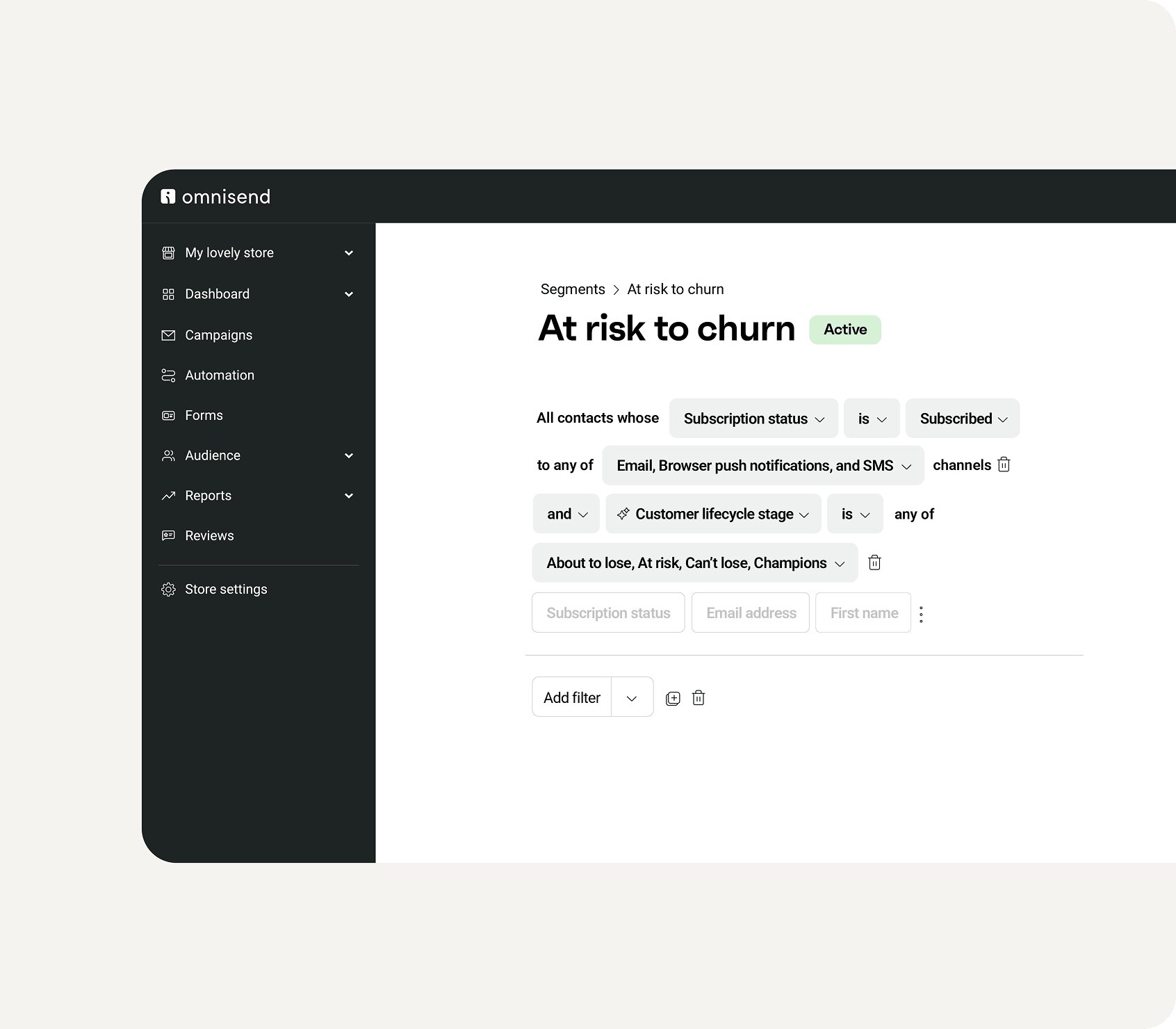
Here’s how the conditions stack inside an SMS segmentation tool. This is Omnisend’s segment builder, where criteria combine without any code:
1. Demographic segmentation
Demographic SMS segmentation groups subscribers based on their personal traits. You can segment contacts by:
- Age
- Gender
- Location
- Language
Use this approach if you sell different products meant for separate customer groups. It’s also suitable when you run location-based promotions or serve customers in multiple regions.
Market-level targeting pays off in measurable ways. UK SMS campaigns reached a 5.1% click-to-conversion rate in 2025, far above the 0.97% global average, per the 2026 report.
Spanish pet brand Dukier adapted its automations into five languages. The brand used Omnisend to tailor catalogs and SMS sending timing to each market. As a result, its revenue increased by 525%.
The same idea applies to SMS segmentation. When customers receive messages in their preferred language, they engage and buy more.
Key watch-out: Never guess demographic information. Collect it during signup, at checkout, through surveys, or from purchase history.
2. Behavioral segmentation
This segmentation method focuses on the actions your subscribers take. It’s one of the most powerful types of SMS segmentation because it reflects customer intent.
You can segment subscribers by:
- Purchase history
- Browsing activity
- Cart abandonment
- Product category interests
- Last purchase date
This approach works best for trigger-based SMS flows that respond to customer behavior. Here are some ecommerce automation examples you can run:
- Cart abandoners: A text within one to two hours of abandonment, with a nudge built on urgency
- Category browsers: A text featuring products from the category the customer viewed
- Repeat buyers of one product: A replenishment reminder timed to the reorder cycle
Browse abandonment also deserves its own SMS segment. Someone who viewed a product thrice without adding it to the cart needs a softer nudge than a cart abandoner.
Behavioral signals predict buying intent more reliably every year. Click-to-conversion jumped 53% year over year in the 2026 report. This means shoppers who click are increasingly ready to buy. The same logic extends across channels, where automated push notifications converted 22.9% of clicks in 2025.
Cosmetics retailer INGLOT Canada connected its in-store point-of-sale and behavioral data using Omnisend. The brand used this data to trigger personalized automated SMS and email workflows. This resulted in a 2,130% lift in revenue per message.
3. Purchase history segmentation
This SMS segmentation method groups customers by how they buy. You can segment them by:
- Total spend
- Number of orders
- Last purchase date
- Average order value (AOV)
- Product categories purchased
You can use this approach for VIP programs, loyalty tiers, replenishment reminders, and winback offers. It also separates your most profitable customers from one-time bargain hunters:
- High-average-order-value customers: Early access to new products and VIP-only offers
- One-time buyers: A second-purchase incentive while your brand is still top of mind
- Lapsed buyers at 90+ days: Bring them back with a special winback reward that has a strict deadline
4. Engagement-based segmentation
Segment by open rate, click rate, last engagement date, and response behavior. This SMS segmentation strategy improves your list health. It also decides who should hear from you more often and who needs a break.
Bag brand Vagari keeps SMS click rates at 6–7% using texts mainly for launches and exclusive offers. Since messages are selective and relevant, subscribers stay engaged:
- Highly engaged subscribers: Higher frequency and early access offers for your fresh products
- Low-engagement subscribers: Reduced frequency, then a re-engagement text before sunsetting
- Non-openers after 60 days: A final sunset flow helps you maintain a healthy sender reputation and SMS deliverability rates
5. Lifecycle stage segmentation
This method groups customers according to their stage in the buying journey. Here are common lifecycle stages you can use to create SMS segments:
- New subscribers
- First-time buyers
- Repeat buyers
- At-risk customers
- Lapsed customers
Use it to match the message to the relationship. A brand-new subscriber and a five-order regular shouldn’t receive the same text:
- New subscriber: A welcome text introducing the brand, with a first-purchase incentive
- First-time buyer: Follow up with shipping updates, followed by a review request later
- At-risk customer: Tailor your winback message with an irresistible offer matching their last order
6. Acquisition source segmentation
Segment by how each subscriber joined your list — popup, checkout opt-in, keyword opt-in, in-store, or loyalty program. The first message should match the context of the signup. Someone who texted a keyword at an event expects a different opener than a checkout opt-in:
- Keyword opt-ins: You can mention the keyword they texted so they remember who you are
- Checkout opt-ins: Start with transactional SMS messages like order updates, before introducing promotions
- Popup opt-ins: Send your shoppers the exact discount or deal that your website popup promised right away
7. Time zone and send-time segmentation
Time zone SMS segmentation groups subscribers by their local time or location. You should use it whenever you send campaigns across regions.
A 9 a.m. send from the East Coast hits West Coast phones at 6 a.m. For subscribers on the other side of the world, it lands in the middle of the night.
Poor timing is one of the fastest ways to increase unsubscribe rates. It matters for the law, too. In the US, TCPA rules limit marketing texts to the hours between 8 a.m. and 9 p.m. in the recipient’s local time.
Some states apply even stricter rules. This makes time zone segmentation an important compliance requirement, rather than only a performance tactic. Omnisend supports SMS in markets worldwide, so build this criterion into your setup from day one.
How to build an SMS segmentation strategy
A working SMS segmentation strategy starts with the data you already hold and adds one layer at a time.
Step 1: Audit your current SMS list
Before building segments, take stock of what you know about each contact. List the attributes your signup flow captures. Also, note which purchase and browsing data is linked to each phone number. Any missing data limits your SMS segmentation options.
The audit shows which of the seven criteria you can act on today, and which need new collection points first.
Check what your SMS marketing software records automatically. Then spot-check 20 contacts by hand, because empty fields show you exactly where to start. Omnisend integrates with ecommerce platforms like Shopify, WooCommerce, Wix, BigCommerce, and more. It syncs your store’s purchase and on-site behavior into segments for you.
Step 2: Define your segmentation goals
It’s difficult for SMS segmentation strategies to work if you don’t know your goals. So, decide what you want to achieve before choosing your segments:
- Reduce unsubscribes: Prioritize engagement-based segments and frequency caps
- Increase revenue per send: Focus on behavioral and purchase history segments
- Improve compliance: Build segments around consent and acquisition source
Try focusing on one main goal each quarter to improve performance. If you chase too many goals at once, segments often become complicated and difficult to maintain.
Step 3: Start with behavioral segmentation
Create the highest-impact SMS segments first. For most ecommerce brands, that means starting with behavioral triggers such as:
- Cart abandonment
- Browse abandonment
- Purchase triggers
- Engagement flows
These workflows often generate the highest revenue. As noted earlier, behavior-triggered sends drove $0.74 per send against $0.15 for broadcasts in 2025.
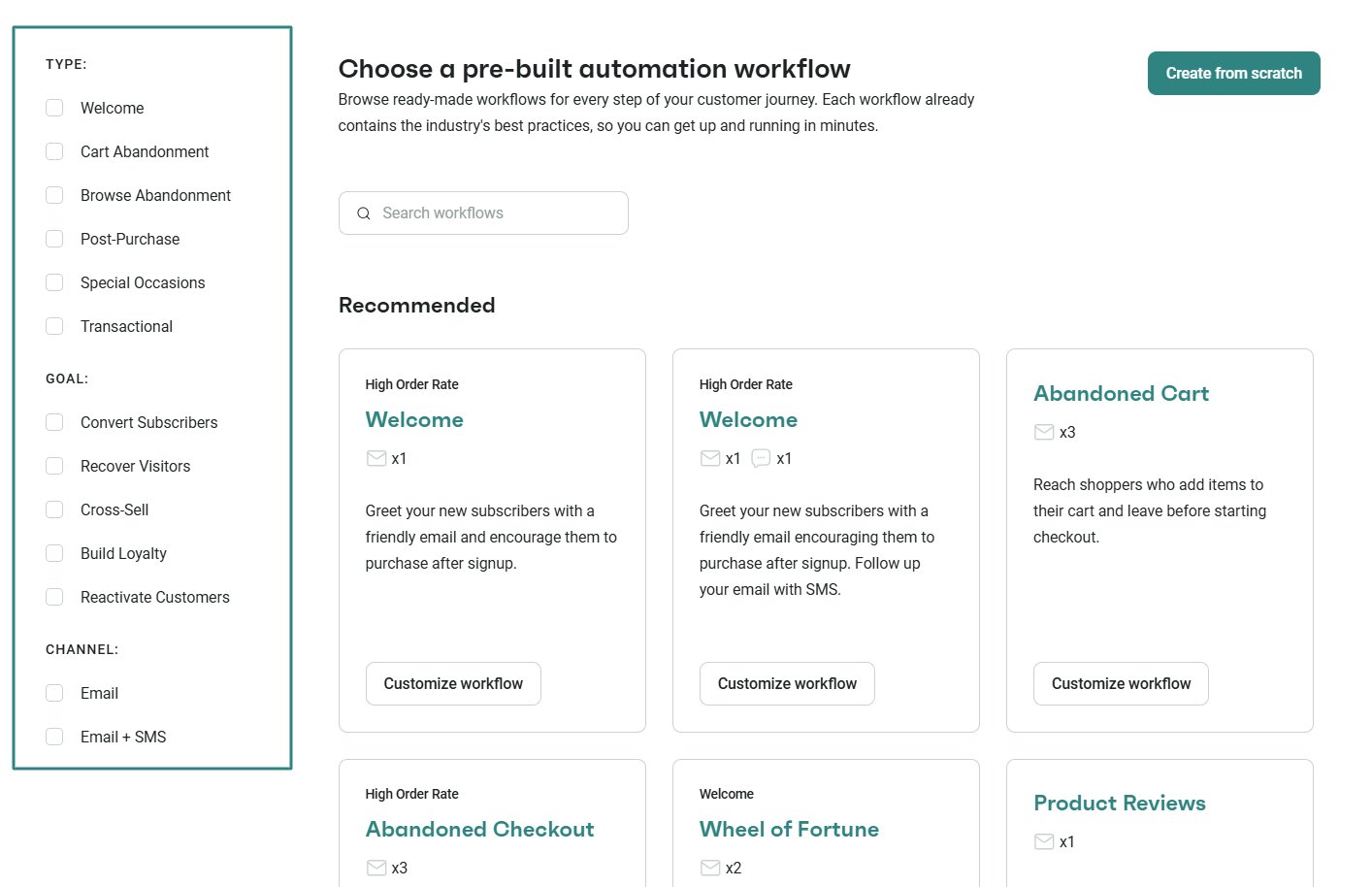
Here’s where those flows live inside Omnisend’s SMS tools:
Step 4: Layer demographic and lifecycle segmentation
Once your behavioral segments are ready, add demographic and lifecycle data to your campaigns. These additional pieces of data ensure that the right tone, language, and offer reach each distinct audience.
You wouldn’t send a welcome text that sounds like a VIP prize. Likewise, a winback text shouldn’t greet a loyal customer like a total stranger.
Just use the facts you already have, then update your list every quarter as you learn more.
Dukier does this well with its five-language setup. The brand adjusts its texts to five different languages to match each local market.
Step 5: Build in time zone logic from day one
Treat time zone segmentation as a default setting, never an afterthought. Configure it before your first campaign goes out. Confirm that quiet hours match the strictest jurisdiction you sell into.
Retrofitting send-time rules after the first angry midnight reply is an expensive way to learn this lesson. The cheap way takes about ten minutes in your platform settings.
Step 6: Test and optimize by segment
Experimenting with different variations of your campaigns helps you discover what works best. A/B test your SMS copy, offer types, and send times within each SMS segment.
Agencies that test regularly see 192% higher revenue, per Omnisend’s Top Agencies report. SMS segmentation creates the audiences, while testing sharpens what each group receives.
SMS segmentation examples in practice
Here’s what the criteria above look like as live segments. Ecommerce teams run these six flows every day:
- Cart abandonment segment: Contacts who added to cart in the last two hours without purchasing. The text goes out within an hour or two, carrying a product image and a direct link. The first send leans on urgency without a discount, and the second send introduces one.
- VIP customer segment: Subscribers whose total spend passes a defined threshold. They get early access to new products and private sales before the general list hears anything. The message tone is exclusivity and recognition, never plain promotion.
- Lapsed customer segment: Recipients with no purchase in 90+ days, adjusted by product category. The winback text pairs a time-limited offer with a concrete reason to return. It references their last purchase, which lands far better than a generic “we miss you.”
- New subscriber segment: These are contacts who opted in within the last seven days. The welcome text delivers the promised incentive with a single clear call to action. Honor the opt-in promise immediately, while the signup is still fresh in their minds.
- Post-purchase segment: Shoppers who bought within the last three to five days. Send a delivery update first, then a review request about a week after the order arrives. Always send transactional messages first, then promotional ones later. This approach helps you build trust by placing customers’ needs first.
- Seasonal buyer segment: Customers whose only purchases fall within Q4. Exclude them from win-back flows from Q1 through Q3, since they aren’t lapsed. They’re simply between seasons. Re-engage in October with early access messaging timed to their actual buying window.
Start segmenting your SMS list with Omnisend
According to Omnisend’s Ecommerce marketing report, SMS volume grew by 40% in 2025. This number is higher than the 31% growth recorded in 2024. Brands building SMS segmentation strategies now will stay ahead of competitors as their lists grow.
Omnisend is built for ecommerce, so you don’t need technical expertise to get started. Its store integrations pull purchase and behavioral data into segments automatically. You can also access segmentation features on every plan.
We’ve done the heavy lifting so you can focus on your products. Start with one behavioral segment this week and measure it against your broadcasts.
Quick sign up | No credit card required
SMS segmentation FAQs
What is SMS segmentation?
SMS segmentation is the practice of splitting an SMS subscriber list into groups that share traits or behaviors. Each group then gets its own targeted texts, rather than one broadcast to everyone. You can match messages to each subscriber’s interests, purchase history, or engagement level.
What are the most effective SMS segmentation criteria?
Behavioral criteria perform best because they reflect what subscribers actually do. The top-performing segments include cart abandonment, purchase triggers, and engagement level.
Purchase history follows closely, powering VIP and winback segments. Time zone segmentation also applies to every campaign you send.
How is SMS segmentation different from email segmentation?
The logic is identical, but texting raises the stakes. A text is more personal and immediate than an email. This means irrelevant messages lead to more opt-outs. These are often harder to recover than email unsubscribes. SMS segments need tighter targeting and stricter timing rules than email segments.
How many SMS segments should I have?
There is no fixed number. Start with three to five core segments. These include engaged subscribers, recent buyers, lapsed customers, new subscribers, and cart abandoners. Expand only when your data supports finer splits. A few accurate segments will outperform a dozen thin ones built on guesswork.
Does SMS segmentation help with compliance?
Yes. Segmenting by consent type and acquisition source helps you remain compliant. Each contact only receives message types they agreed to. Time zone segments keep your sends inside legally defined quiet hours. Together, those segments form a working record of consent that lowers TCPA and GDPR risk.