Omnisend AI
 OFFER
OFFER






Your guest experience is a journey, not just one booking. The most reliable means of communicating with them before, during, and after their stay is via SMS marketing for hotels, with time-sensitive messages being the perfect candidates for automation.
Some 98% of people read their text messages, according to Optimonk, and Omnisend’s research shows that click rates more than doubled in 2025 over 2024. You really won’t find a more engaged, high-intent audience than your SMS subscribers.
Another pull factor for hotel SMS is retention and lowering your customer acquisition costs. The personal nature of text messaging provides new angles for anniversary and winback messages, helping you maximize ROI long after initial bookings.
This article is a complete guide to the best SMS marketing for hotels. You’ll learn what it is, why it works, its role in your customer journey, grab templates to use in your efforts, and discover the best practices our experts use for results.
Quick sign up | No credit card required
What is SMS marketing for hotels?
SMS marketing for hotels is a pre- and post-booking communication channel for providing instantaneous, time-sensitive messages to customers.
Your SMS hotel marketing strategy will likely include:
- Welcome messages
- Confirmations
- Reminders and service updates
- Feedback requests
- Promotional messages, such as cross-sells
All these messages are automated, not one-time campaigns or bulk texts. You need a hotel text messaging system, enabled by a third-party tool, to grow and manage your list, build flows, and monitor SMS deliverability and engagement.
Why SMS marketing works so well for hotels
Hotels collect phone numbers when customers enquire, book, and visit, so there’s an organic path to information sharing. Your customers are receptive to SMS because they expect it when interacting with the transactional side of your hotel.
Here’s why SMS marketing works well for hotels:
- High open and read rates: 98% of people read text messages, and 90% of people read them within three minutes, according to Optimonk
- Immediacy: Texts appear in messaging apps without the tabs of email inboxes, putting your travel messages front and center
- Less inbox competition: Texts appear in your customer’s messaging app alongside personal conversations, so they’re more immediate than email and likely to get buried
- Direct bookings and revenue: Your texts can have links to payment pages and provide a fast path to checkout
- Improves your guest experience: They’ll receive timely confirmations and alerts that make staying with you a pleasure
- Supports your complete customer journey: SMS is suitable for welcoming, nurturing, converting, and retaining customers
Hotel SMS marketing across the guest journey
Your guests book, arrive, and head home, but there are multiple additional moments and steps in their journey where hotel SMS can enhance their experience.
Customers should receive timely communication from pre- to post-checkout to ensure they get all the information and offers they need.
Consider these stages of your guest journey when planning your texts:
Pre-arrival messages
Pre-arrival messages include confirmations, information, upsells, and reminders. Your flow could include one text message or a series of them, depending on how much of your customer journey you want to cover before guests arrive.
A four-text series to consider for your hotel SMS marketing:
1. Booking confirmation, sent within five minutes of booking:
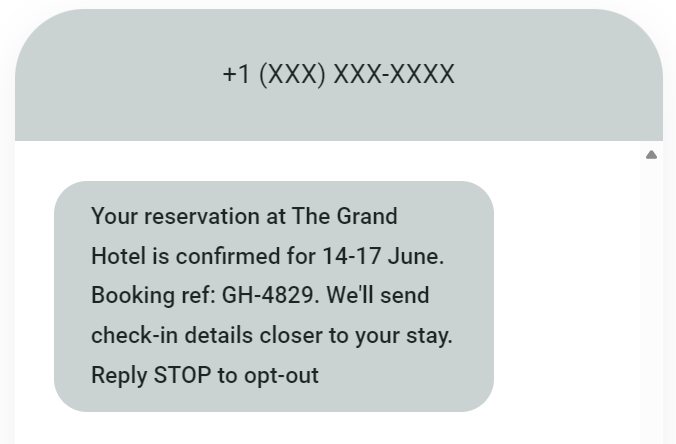
2. Pre-arrival message, arrives at the 72-hour point before checking in
3. Upsell text, when appropriate, offering room upgrades and add-ons
4. Reminder text message, for the steps your guests need to take, or the things they need to bring
Arrival and check-in
These texts trigger following your guest’s arrival. They are relatively sparse and timed so they don’t interrupt their experience or create fatigue.
The SMS series below works well in most hotel scenarios:
1. Digital check-in text, sent on the day of arrival:
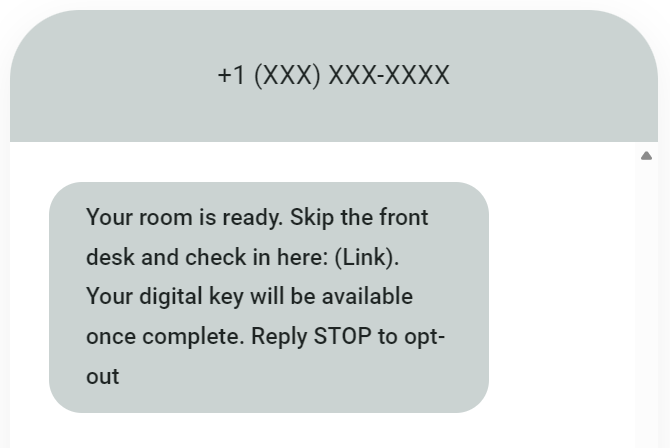
2. Room ready notification, sent after checking in
3. Welcome message, send after your guest has had time to get into their room
During the stay
Guests can receive reminders, offers, and activity notifications via text during their stay, helping them enjoy their time without having to hunt for information or visit your help desk.
Text messaging opportunities include:
- Spa deals and restaurant offers
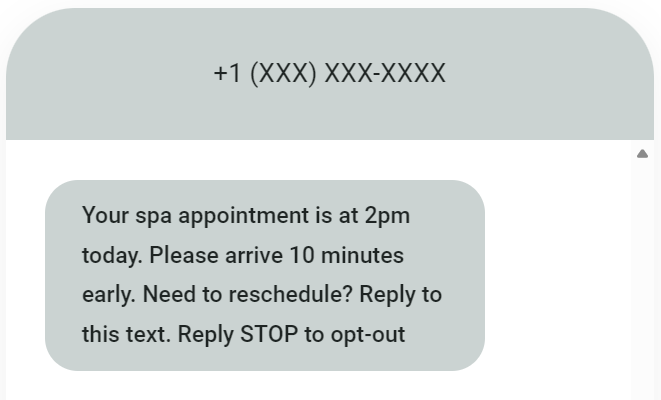
- Service reminders, such as spa appointments:
- Notifications for hotel events
- Local weather alerts
- Changes to opening and closing times
Post-stay and re-engagement
SMS marketing for hotels doesn’t end when guests check out. Your texts can thank them, ask for feedback, invite them to receive rewards, and offer a return discount.
It’s best to treat post-stay SMS marketing as a personalized series, so that customers receive texts with appropriate delays and contextual information.
Texts in your series will typically include:
- A thank-you SMS, sometimes part of your checkout confirmation
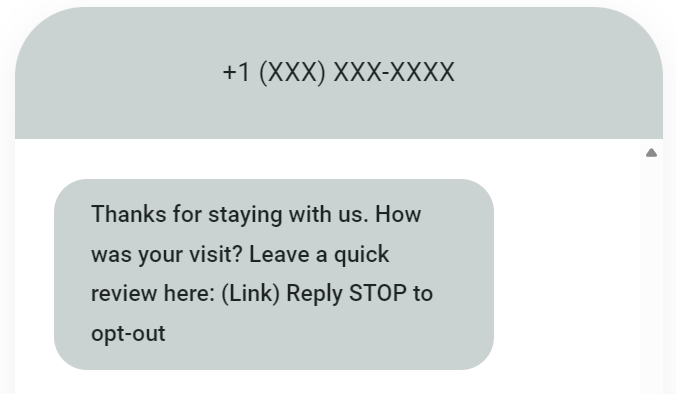
- Feedback requests, sent 24 hours after checkout:
- Loyalty program invitations, sent seven days after checkout
- A re-engagement offer, such as 10% off future bookings, sent near the anniversary of your customer’s stay
Hotel SMS marketing use cases and message templates
Ready-to-use hotel SMS templates are extremely helpful for covering the most important steps in your customer journey, from confirmations to review requests.
The templates below are for you to copy, paste, and use as you like. Replace the placeholders with your own information, and you’re good to go.
Where we’ve used (Name) and other personalized placeholders, different SMS tools handle dynamic personalization differently, so you should refer to what tags they use. In Omnisend, you use liquid syntax, such as [[ contact.email ]].
The table below reveals different SMS types per guest journey stages and when to send them:
| Guest journey stage | SMS type | When to send |
|---|---|---|
| Booking | Confirmation | Immediately after the reservation |
| Pre-arrival | Reminder | 24-48 hours before check-in |
| Pre-arrival | Upsell or cross-sell | Between booking and arrival |
| Arrival | Digital check-in instructions | Morning of arrival |
| During stay | Service reminders and alerts | As needed based on bookings |
| During stay | Requests and housekeeping | Contextual to guest activity |
| Post-stay | Feedback and review request | 24 hours after checkout |
| Post-stay | Review reminder | Three to seven days after checkout |
| Re-engagement | Loyalty offer | Around booking anniversary or key dates |
| Re-engagement | Winback | Six months after the last stay |
Booking confirmations and reminders
Confirmations are instantaneous text messages that your customers expect to receive. A delay between five and 10 minutes is also acceptable. The template below is suitable for hotels and other accommodation bookings:
Confirmed. We have your booking at (Hotel) for (date). We’ll email you additional details. Reply STOP to opt out.
Why it works:
- Mentions the hotel name and booking date immediately
- Provides the booking reference
- Sets expectations for the next message in the series (check-in details)
Your customers also expect a reminder closer to their booking date. 24-48 hours before arrival is the typical period, and you can include a link for additional information. The template below invites conversational SMS, you can replace “Just reply” with “Visit (link)” if you prefer:
Tomorrow’s the day. Check-in from 3 PM at (Hotel Name). Anything you need before you get here? Just reply. Reply STOP to opt out.
Why it works:
- It confirms the stay and hotel name
- Customers have a concrete check-in time
- The link to additional information preserves character count
Upselling and cross-selling
Upsells and cross-sells are revenue-generating text messages for your hotel. You can automate them pre- and during your guests’ stays to increase their average spend.
Here’s a cross-sell SMS template you can use:
Your stay includes one 30-minute massage session. Add a 30-minute foot massage for only $40 (link). Reply STOP to opt out.
Why it works:
- It references existing value to improve the deal quality
- Customers can book directly from the text
- The message arrives before treatment, making the offer convenient
Digital check-in instructions
Sending digital check-in instructions to your guests can go two ways. Either you send a digital check-in form to reduce queues at reception, or you send information on how to find the desk and which side to queue on (among other details). Here are two templates:
Skip the queues and check in digitally at (Hotel) by visiting this link (Link). Reply STOP to opt out.
And if you want to help people check in faster on arrival:
Our check-in desk is in the hotel lobby. Please have your booking confirmation email to hand when you arrive. Reply STOP to opt out.
Send these texts around 24 hours before check-in.
Why these work:
- Both texts help guests streamline their check-in
- Sending them ahead of time helps your guests prepare
- There’s less friction for guests when they first visit your hotel
In-stay service and requests
You can use SMS marketing for hotels during your guests’ stays to reduce front-desk calls. Reminders and alerts for activities are good use cases.
Here’s an example template you can use for a spa reminder:
Hi (Name), your spa appointment is ready from 2 PM today. Please arrive 10 minutes early to get comfortable. Reply STOP to opt out.
Requests are another way to use hotel SMS:
Dear (Name), Please remember to drop off your beach towels for cleaning every Tuesday before 11 AM. Reply STOP to opt out.
Why these work:
- Mentioning your customer by name creates a connection
- Both texts are contextual to the guest’s stay
- The information delivery is concise without any promotional language
Feedback and review requests
A post-trip feedback request is best sent 24 hours after checkout. Any later and the motivation to leave a review drops off, although you can send review reminders as part of a series with an additional two or three messages over seven days.
The hotel SMS marketing template below is a good option:
We loved having you. How was it for you? Review us at (link) for a chance to win 10% of your booking value back. Reply STOP to opt out.
Why it works
- It creates a positive impression immediately
- The link takes your customer to a dedicated reviews app
- Adding an incentive increases the chances of review collection
Loyalty offers and winback campaigns
Guests who had positive experiences are highly receptive to loyalty offers and winback text messages. You can send these around the anniversary of their booking, or near popular dates such as Valentine’s Day.
Past guests who haven’t rebooked within six months are your target. Here are two SMS hotel templates you can use:
You can grab 10% off your next stay at (Hotel) until (Date). We’d love to see you again! Reply STOP to opt out.
Another enticing option for customers is freebies and extras. The template below encourages additional bookings with tangible add-ons, rather than discounts:
Get a free room upgrade, a meal for two, and a spa treatment thrown into your next stay. Visit (link) to claim. Reply STOP to opt out.
Why these work:
- Rewarding loyalty increases retention
- Retargeting existing customers lowers your acquisition costs
- You can collect engagement data and target those who click through with additional offers in the future
Best practices for hotel SMS marketing
Even if you use our proven SMS templates, your hotel text marketing can have low click-through and conversion rates if it lacks personalization, or your messages and poorly timed or out of context.
These pointers will keep your hotel text messages on track:
- Keep messages short and action-oriented. You literally have 160 characters before your SMS gets split into multiple messages, which costs more and breaks formatting. Use Omnisend’s SMS length calculator to check your character count.
- Segment your audience. Create segments for booking type, room category, and travel purpose, then tailor your cross-sells accordingly.
“Segmentation enables the deep personalization your hotel guests appreciate, such as contextual offers and information based on their booked activities. Going beyond names in your texts is a proven way to establish rapport and create better customer experiences.”
— Agnė Ganchev, Director of Customer Success at Omnisend
- Respect the guest’s context. Send hotel SMS messages that match your guests’ customer journey. New arrivals should receive tips, guests who book treatments should receive offers, and so on.
- Use automations rather than campaigns. Send guests a welcome, confirmation, thank-you, and feedback SMS via automations. Your SMS tool should let you build flows that are triggered by your booking system and customer behavior.
- Test your message copy. For any messages that are templated and sent to multiple guests, an A/B test can work in your favor and improve click-through rates. Test different lines in your cross-sells and upsells to see which get the most clicks.
- Don’t over-send. Fatigue will only frustrate your guests and lead to them not rebooking, or they might even block your number and impact your deliverability score.
- Send at appropriate times. Confirmations should be near-immediate, and reminders should give customers enough time to get things or themselves ready. Send SMS no later than 9 PM to avoid annoying people.
“Our research shows that the best times to send marketing texts are 9 AM to 12 PM and 5 PM to 9 PM. However, optimal send times go out the window for confirmations, which should always occur within five to 10 minutes. “
— Andrius Šeršniovas, Conversion Specialist at Omnisend
- Integrate your hotel text messaging system with your hotel management system (PMS). You can then trigger automated texts based on bookings, check-ins, guest profiles, and more.
How to build your hotel guest SMS list
You’ll build your guest SMS list naturally via transactions, such as hotel and service bookings, and from newsletter subscriptions. Collecting marketing opt-ins is crucial for both subscriber types if you want to send them offers and deals.
These proven list-building methods are perfect for your hotel:
- Online booking form. A simple checkbox during reservation does the job. “Text me booking updates and exclusive offers” tells the guest what they’re signing up for.
- Loyalty and rewards programs. Position SMS signup as one of the criteria for becoming a VIP or exclusive member.
- Front desk and check-in. “We’ll text you when your room is ready” is a far better ask than “Would you like to receive marketing messages?” Give staff a reason to offer, and guests will say yes.
- QR codes on property. Print QR code stickers and place them near your hotel’s restaurants, bars, spas, and activity areas. Offer guests a small discount in return for subscribing to text messages.
- Post-booking confirmation email. Your confirmation email already has a high open rate, so include an SMS sign-up invite in it. “Want updates and offers by text? Add your number here” is enough.
- Social media. Instagram and Facebook lead-gen ads can drive SMS list growth when you offer something in return. An exclusive rate or welcome gift in exchange for a phone number converts well from paid social.
Pro tip
A list of 500 opted-in, high-intent SMS subscribers is worth more to your hotel than one containing thousands of generic phone numbers.
Getting started with SMS marketing for your hotel
Hotel SMS marketing requires only an opt-in list and a text messaging tool to create segments and automations based on customer actions and behavior.
You can then deliver timely messages across your guests’ pre- and post-booking experience in complete compliance with the TCPA and GDPR.
These steps will get you started with SMS for hotels:
- Sign up for an SMS marketing tool. Omnisend is one example. Its Pro plan includes bonus SMS credits equal to the price of your monthly plan. The best text messaging tools let you create standalone SMS campaigns and multichannel flows (email + SMS + push messaging). Also look for these features:
- Forms and popups
- List cleaning tools
- Depth of segmentation
- Toll-free number requirements
- SMS coverage (is it global or restricted)
- Start with high-impact text messages first. Such as those that complement your customer journey rather than promoting products. These are the best starting points:
- Confirmation messages for bookings
- Reminder texts
- Feedback requests
- Segment your guest list. Create customer groups based on booking type, spend, preferences, business vs. leisure, returning vs. new, and age. These let you build unique flows and target them accordingly.
- Run automated text messages as much as possible; they earned an average of $0.74 per send in 2025, compared to $0.15 per send for SMS campaigns.
- Use A/B tests to improve your SMS content. Add splits to your SMS flows to see which messages get the most clicks, then use the winning versions.
- Monitor your SMS metrics and act on the data. Check for high opt-out rates and low click rates weekly. Poor results indicate that your messaging, timing, or context is off and needs adjustment.
Omnisend helps you achieve all these steps in one go. It is an all-in-one tool for hotel text message marketing, letting you build flows triggered by booking events, segment guests, and meet compliance standards.
Quick sign up | No credit card required