Omnisend AI


 OFFER
OFFER









Klaviyo wins for email and SMS automation; Privy is a better list-growth tool, and there’s enough of a difference that there’s an opportunity to use both.
You need to know each tool’s strengths before deciding on your setup. We’ve done the hard work and tested them for two and a half days, with our comparison below covering their uses, pricing, list-growth tools, automation capabilities, and more.
Klaviyo vs. Privy: Quick comparison
Choose Klaviyo for email and SMS with basic pop-ups; pick Privy for better list-growth tools and leaner marketing capabilities. Consider both when you have the budget and want the most advanced stack for pre- and post-capture.
| Category | Privy | Klaviyo | Better fit |
|---|---|---|---|
| Primary focus | List growth and pop-ups | Data-driven revenue and retention | - |
| Ease of use (based on hands-on testing) | ★★★★★ | ★★★★ | Privy |
| Pop-up/form builder | 240+ templates, more formats (spin-to-win, quizzes), more on-site triggers | 120+ templates, drag-and-drop fields, CRM-based targeting | Privy |
| Email marketing depth | One-time and automated flows; no omnichannel campaigns; 50+ templates | One-time, omnichannel, and flows; 160+ templates; A/B testing | Klaviyo |
| Automation/flows | 12 named triggers, two-tier filtering, back-in-stock; 11 email flow templates | 80+ flow templates, price-drop and low-inventory triggers, predictive filters, Composer AI | Klaviyo |
| Segmentation | Custom and Smart segments; can't edit once built | Predictive segments, real-time updates, AI build and auditing, editable | Klaviyo |
| SMS | U.S. and Canada only; email + SMS in one flow | 20+ countries; two-way conversational | Klaviyo |
| Integrations | 20+ | 350+ | Klaviyo |
| Support availability | Email and live chat on all plans, business hours | 24/7 email and 24/5 live chat on paid plans; free plan 60 days only | Klaviyo |
| Free plan | 15-day trial only | Free up to 250 contacts | Klaviyo |
| Pricing model | Per mailable contact; cheaper at most tiers | Per active contact | Privy |
Accurate as of August 2026.
Once you’re ready for more than a Privy vs. Klaviyo comparison, watch the video below to discover two more options for ecommerce:
What do customers say about Klaviyo and Privy?
Privy equals Klaviyo’s total review score on G2 but loses out on Capterra and the Shopify App Store. The table below shows their ratings:
| Review platform | Klaviyo | Privy |
|---|---|---|
| Shopify App Store | 4.7/5 based on 2,927 reviews | 4.5/5 based on 3,973 reviews |
| G2 | 4.6/5 based on 1,358 reviews | 4.6/5 based on 122 reviews |
| Capterra | 4.6/5 based on 531 reviews | 4.4/5 based on 50 reviews |
Accurate as of August 2026.
The overall picture: Klaviyo has higher total ratings on the Shopify App Store and Capterra, with both tools drawing on G2.
Klaviyo’s integration, setup, flows, and analytics receive praise among Shopify App Store customers. “We’ve been using Klaviyo for a long time and have continued to stay with the platform because of its rich feature set,” says IMBIBE.
Price increases and active-profile billing come up as Klaviyo’s biggest pain points, with those sentiments also shared among G2 customers. Additionally, using Klaviyo to its full extent requires “tech-savviness,” a sentiment expressed by Glen Lyon and another reviewer on Shopify.
Privy’s warmest reviews are about people rather than features, such as named reps, alongside ease of use and pop-up depth. Mill Creek Apiary says, “The customer service is very easy to reach, responsive, and eager to resolve any issues. I highly recommend Privy.”
Some Privy customers complain about unexpected usage and profile fees, charges continuing after cancellation, and poor customer service.
Shopify App Store reviewer Collecto saw its $15/month Privy plan spiral to $45/month based on contact count, despite only wanting to create a pop-up.
In a nutshell, pricing is a core pain point for both Klaviyo and Privy, whereas platform complexity is echoed by Klaviyo users.
Klaviyo and Privy solve different problems
Privy is a list-growth and pop-up-first tool with email and SMS capabilities; Klaviyo is a data-first revenue and retention tool for email and SMS. Klaviyo’s granular segments, flows, and predictive analytics go much further than Privy’s for ecommerce. Conversely, Privy’s list-building tools do more for lead capture.
The comparison table below sets out their positioning:
| Privy | Klaviyo | |
|---|---|---|
| Built for | List growth and pop-ups | Data-driven revenue and retention |
| Best at | Lead capture (top of funnel) | Segments, flows, analytics (post-capture) |
The overlap is that both tools handle your list growth, email, and SMS marketing. But their depth differs enormously across those.
There’s a question to ponder here: whether to run two specialist tools, each best at its end of the funnel, or one platform that covers the whole thing but isn’t the deepest at either.
Klaviyo vs. Privy pricing
Privy wins with lower-cost email plans at most contact tiers. Its SMS bundles also include more credits at the same price.
Privy’s Email plan is cheaper than Klaviyo at most contact tiers. The table below compares them at 500 to 25,000 contacts. The bold Klaviyo entry is the only tier at which it works out less:
| Contact count | Klaviyo Email | Privy Email |
|---|---|---|
| 500 | $20/month | N/A |
| 1,500 | $45/month | $30/month (starting threshold) |
| 3,000 | $70/month | $60/month |
| 5,000 | $100/month | $90/month |
| 10,000 | $150/month | $165/month |
| 12,000 | $250/month | $195/month |
| 15,000 | $350/month | $240/month |
| 25,000 | $400/month | $390/month |
Accurate as of August 2026.
Only Klaviyo has a free plan, suitable for 250 contacts and 500 emails/month. Privy offers a 15-day free trial for its Email plan.
Another cost factor in Privy’s favor is that it counts only mailable contacts toward your quota: people who have opted in. A contact who orders without opting in is non-mailable, so they don’t count until they subscribe.
Klaviyo counts active contacts. These are anyone you can email, including subscribers and general-engagement contacts who shared their email at checkout. Active list management is necessary to avoid escalating costs.
So, if your store collects lots of checkout emails from non-subscribers, they’ll count towards your limit on Klaviyo but not on Privy.
SMS pricing starts at $15/month for both Klaviyo and Privy. The table below compares their credit allowances per monthly spend up to $90/month:
| Monthly price | Klaviyo credits | Privy credits |
|---|---|---|
| $15/month | 1,000 | 1,250 |
| $25/month | 1,700 | 2,500 |
| $45/month | 3,300 | 5,000 |
| $90/month | 7,000 | 10,000 |
Accurate as of August 2026.
The price per SMS reduces with volume. Klaviyo’s rates start at $0.011 per send plus provider fees, which Klaviyo notes are included in the displayed price where applicable. Privy’s credits start at $0.012 per U.S. SMS, inclusive of carrier fees.
Privy also offers a Pop-Ups & Displays Only plan with no email marketing capabilities. Pricing starts at $24/month for 10,000 page views.
Klaviyo vs. Privy: Pop-ups and list growth tools
Privy wins. Its display builder has more design elements and provides a broader range of triggers, audience targeting features, and formats to grow your list.
Privy’s pop-ups and other display formats span a modern editor and a classic editor that’s legacy but is necessary for accessing more templates. There are more on-site behavior triggers in Privy. Klaviyo provides one editor that’s easy to use but has fewer targeting options.
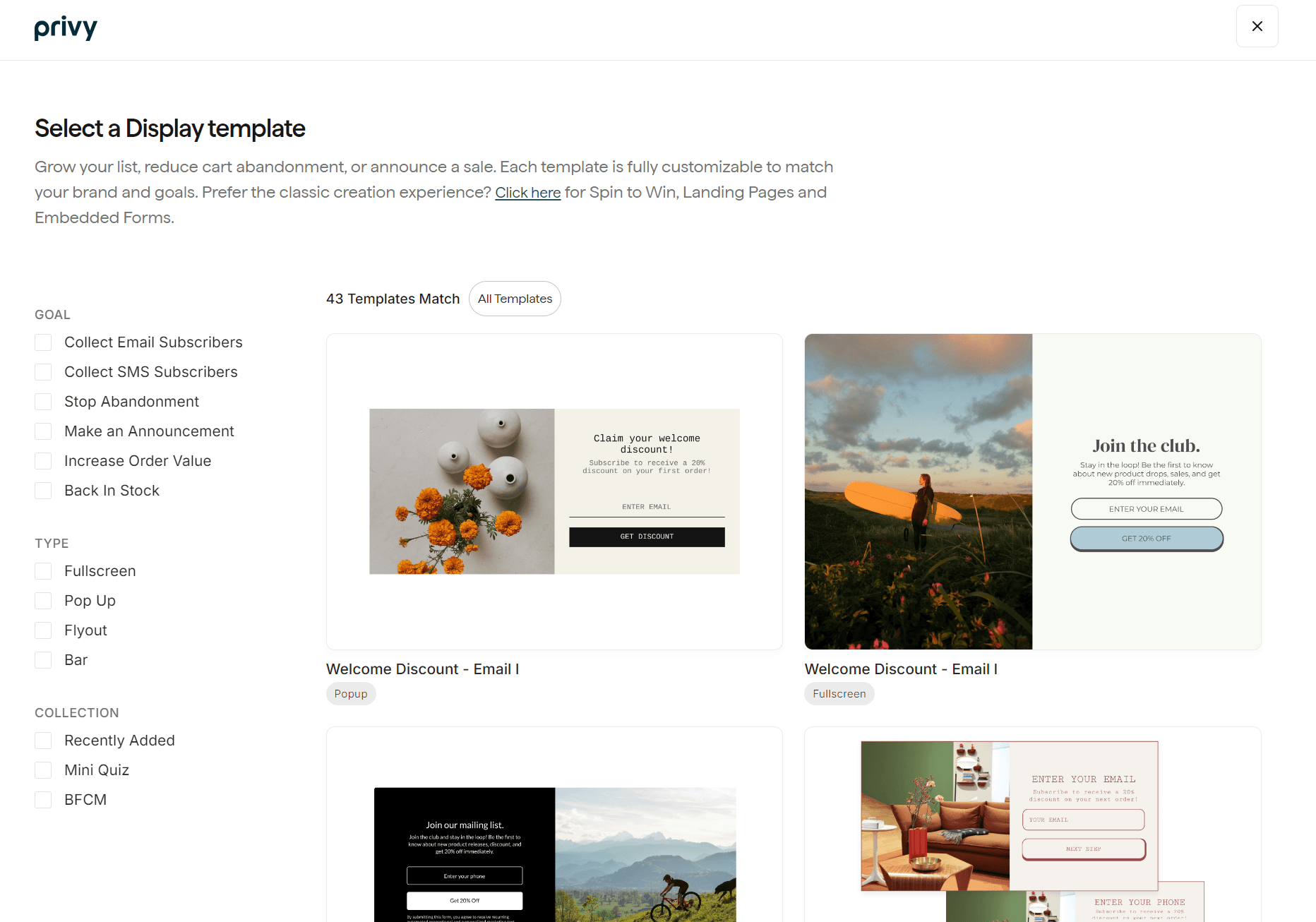
The modern templates include 43 pre-built designs across fullscreen, pop-up, flyout, and bar formats. The gallery lets you filter by goal for collection, stopping abandonment, increasing order value, back-in-stock, and making an announcement.
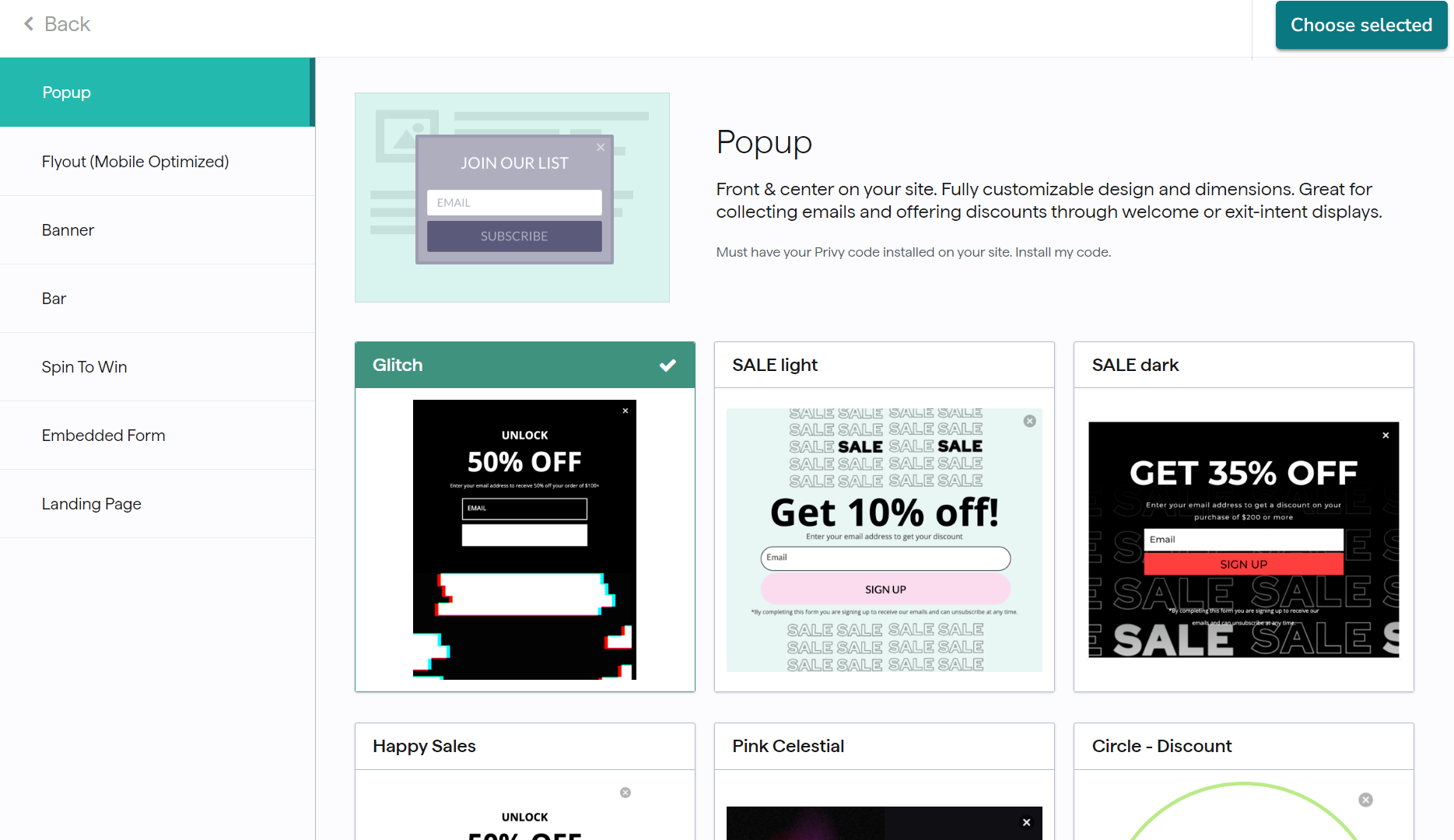
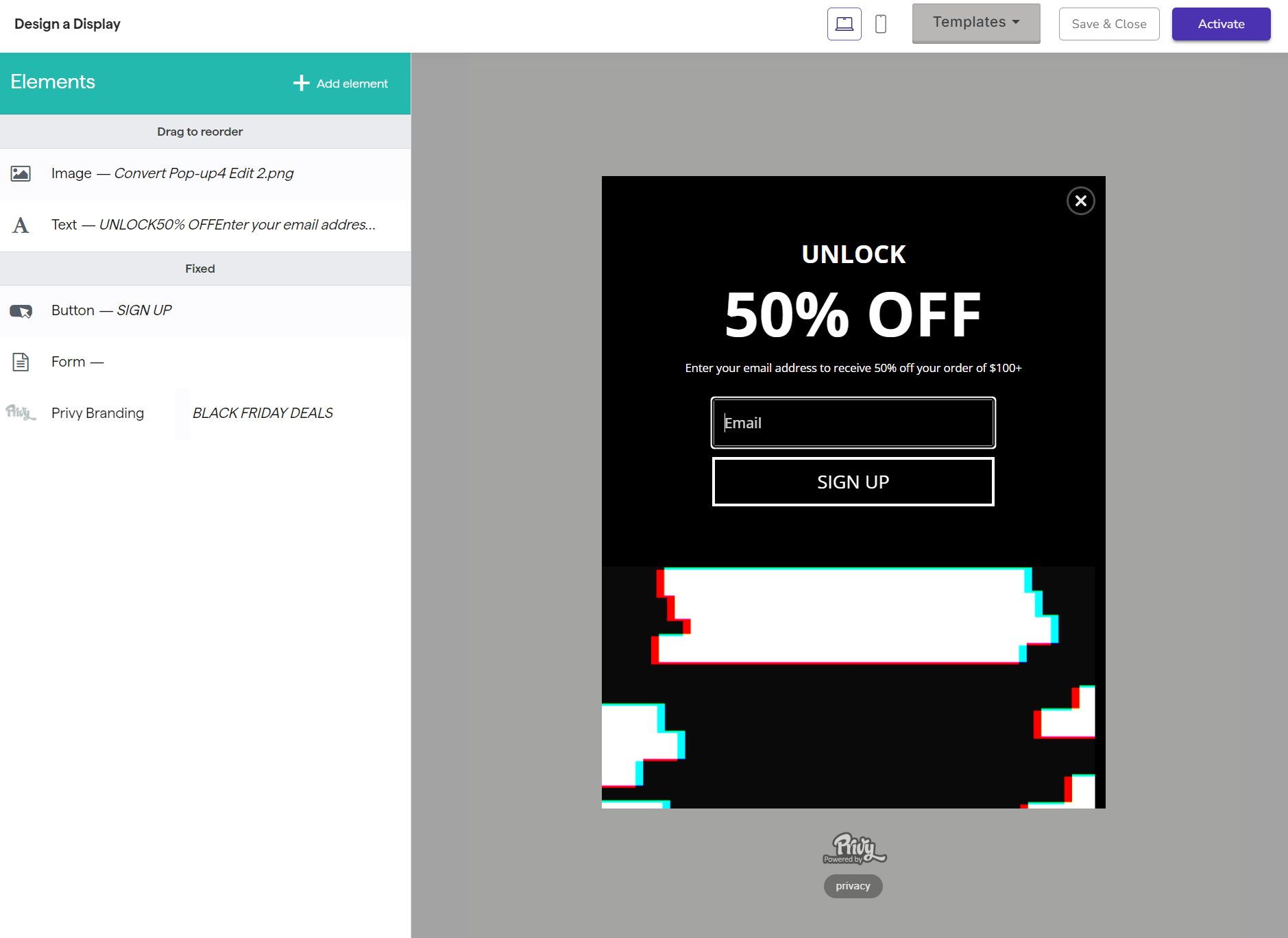
The classic editor has more pop-up, spin-to-win, landing pages, embedded forms, and other formats. We counted 200+ templates here.
Spin-to-win and mini quiz templates provide Privy’s gamified element. Those quizzes are something Klaviyo doesn’t match natively. Landing pages are also supported, with pre-built templates for webinars and sales.
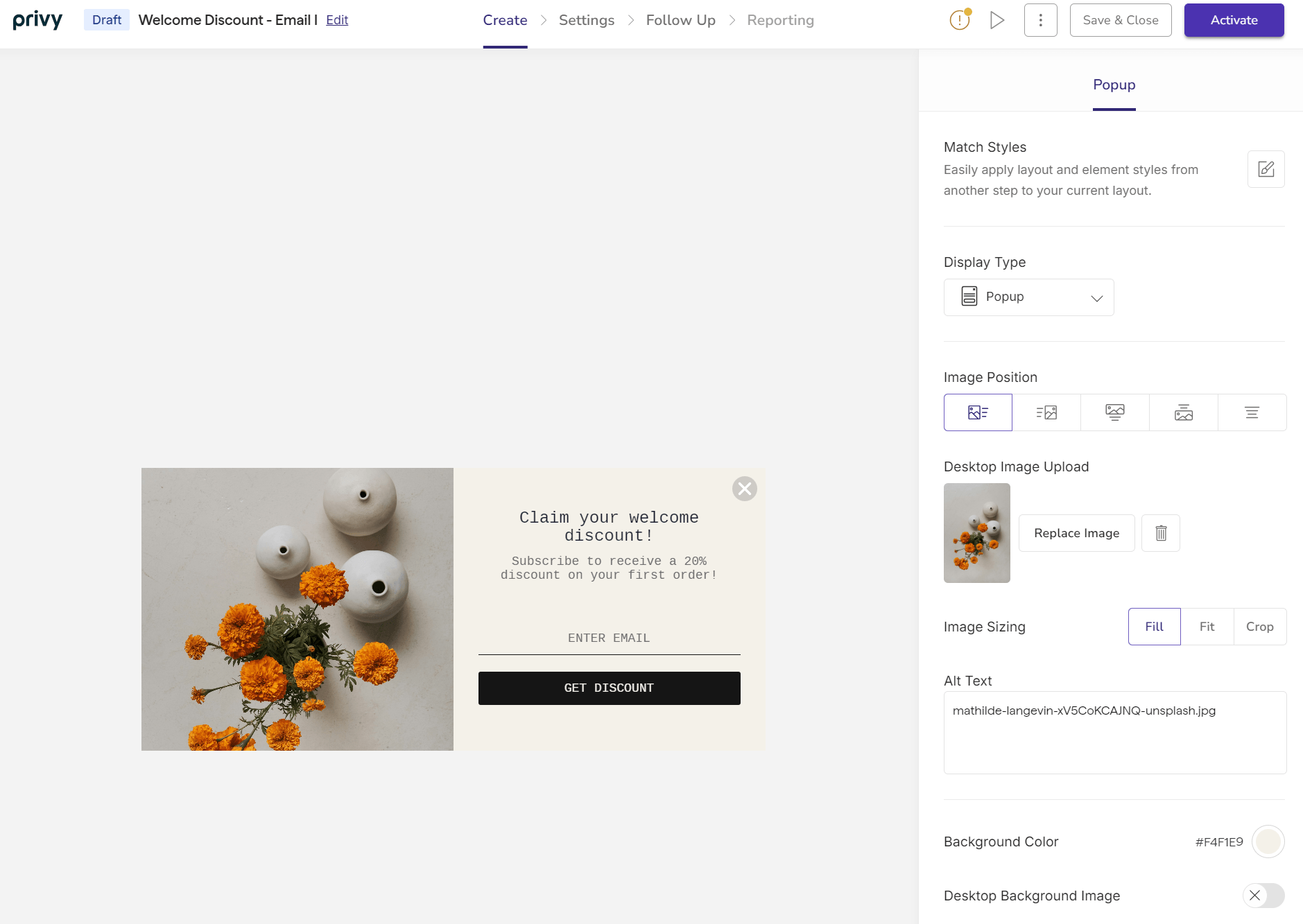
Both of Privy’s builders are intuitive for beginners and pros alike. The modern editor keeps settings on one page, with a top bar allowing you to cycle through them. It uses drag-and-drop for elements in the template, but requires clicking the + symbol to add new elements.
The Settings page provides multiple triggers and visibility settings that far outstrip what Klaviyo offers. These include time on page, show on scroll, on exit intent, and when a product is out of stock.
Audience targeting settings then narrow who sees it, drawing on the customer attributes, shopping activity, and website behavior you set.
You combine those conditions with match-all or match-any logic, so a display can require someone to live in a region and arrive from social media, or accept either on its own. Remove those targeting settings, and everyone sees it.
The classic editor shifts the creation and targeting settings to different screens, but allows the same targeting rules.
Klaviyo’s list-building tools include sign-up forms and landing pages. It has 120+ form templates across pop-ups, full page, flyout, embedded, and banner formats.
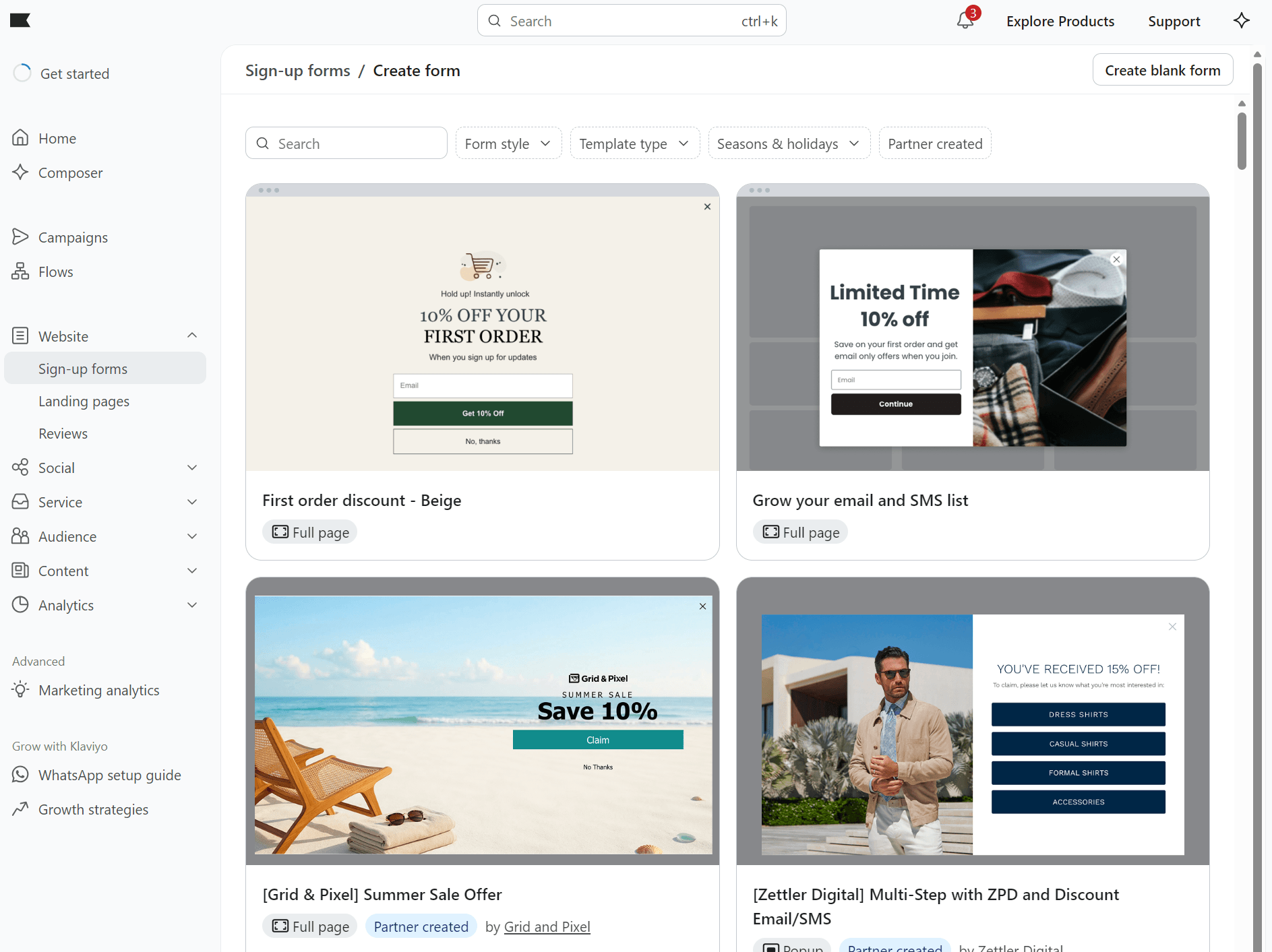
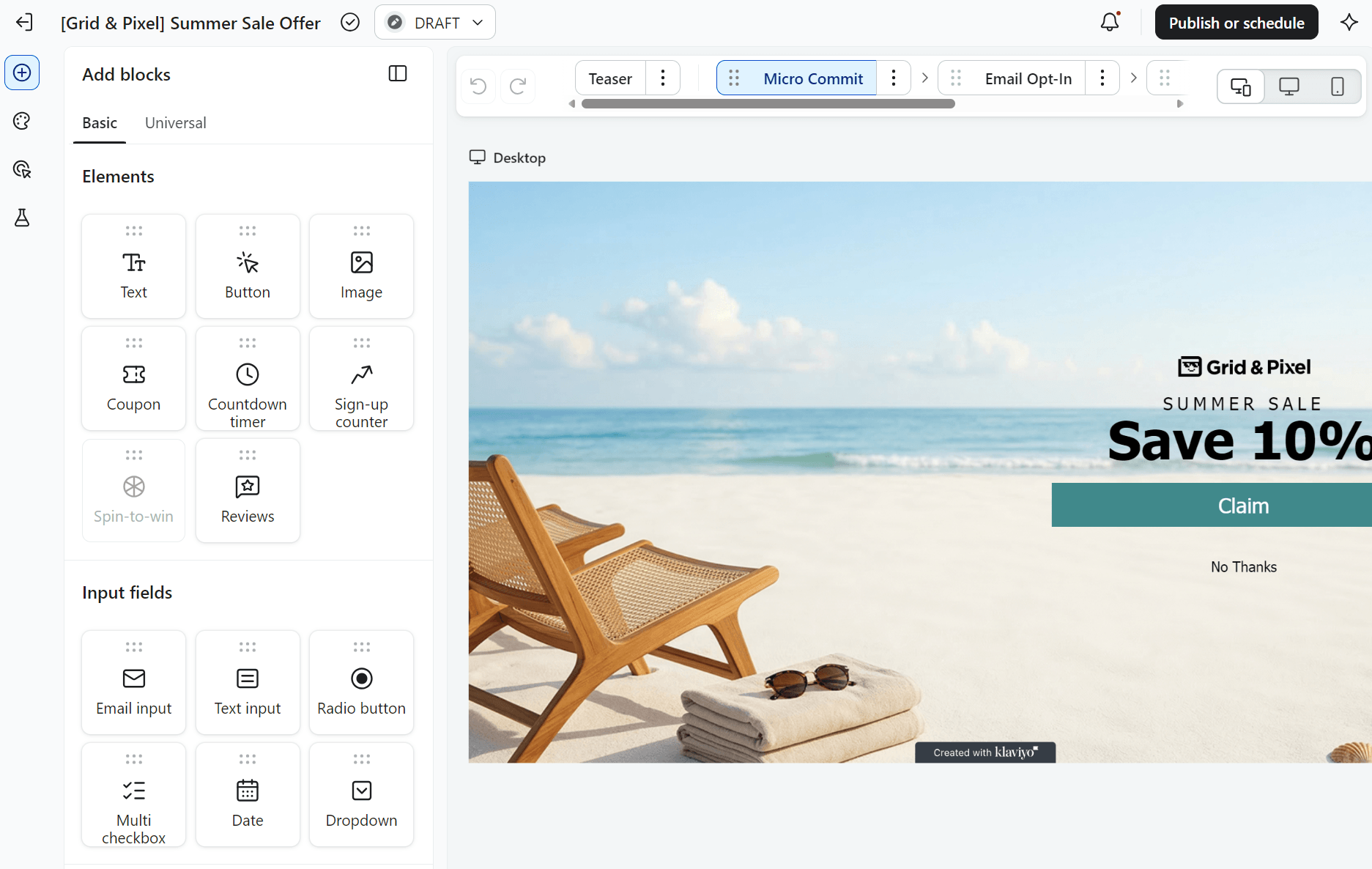
The form builder in Klaviyo lets you select formats via a top bar, such as a Micro Commit or Email Opt-In, and it uses a drag-and-drop interface for elements and fields. You can drag these into the template, unlike in Privy.
Klaviyo’s triggers cover exit intent, a time delay, and scroll depth, plus the ability to trigger on pageview count, and it can require all selected rules at once.
Targeting is where the two diverge: Privy draws on on-site behavior and shopping activity, whereas Klaviyo draws on its CRM capabilities.
Under the Audience section in Klaviyo, forms show or hide based on subscription status and profile data. For instance, your forms can target email subscribers who haven’t given a phone number, or exclude anyone who already has a profile.
There are additional options to include or exclude lists and segments, and because those update live, someone entering or leaving a segment changes who sees the form automatically.
Klaviyo vs. Privy: Email marketing comparison
Klaviyo wins. Where Privy leads on capture, Klaviyo is built around the messaging layer, with more campaign, flow, and reporting capabilities.
Klaviyo’s email marketing capabilities include one-time and omnichannel campaigns for sending a series to your audience, and flows, which are automated emails that trigger for customers according to conditions you set.
Privy matches Klaviyo’s email types, one-time campaigns, and automated flows, but has no omnichannel campaign equivalent for sending a coordinated, multi-path message series to different audiences in a single send. That said, Privy acquired Sendlane in February 2026, with plans to expand its email and SMS, automation, and reporting capabilities. As the company stated, users can expect more innovation and reduced operational maintenance.
Both tools have extensive pre-built email template libraries, but Klaviyo has more designs, with 160+ templates to Privy’s 50+ templates.
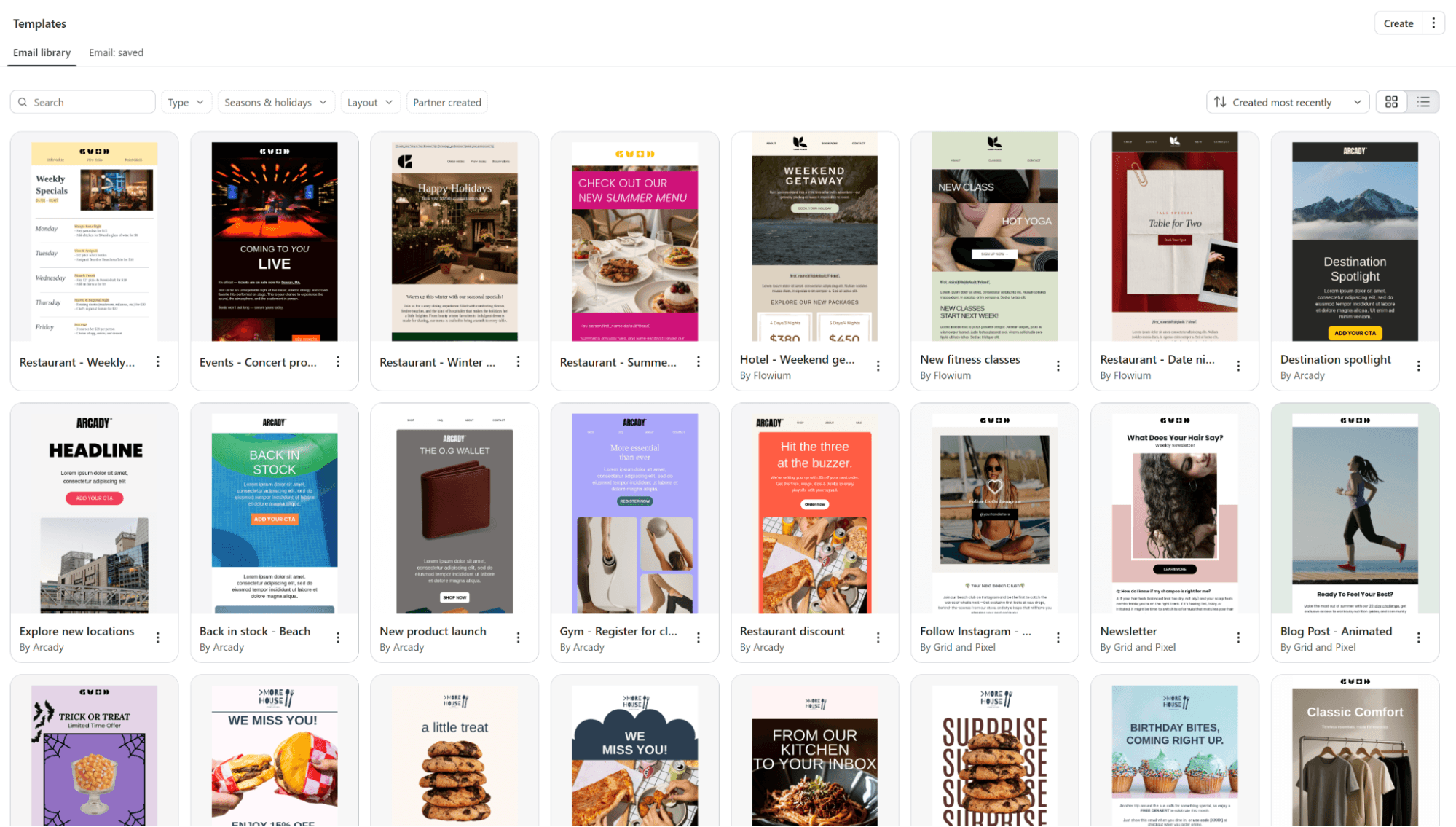
Dropdown menus to search by season and holidays, layout, and type (such as deals, outreach, and sales) help you locate the best templates.
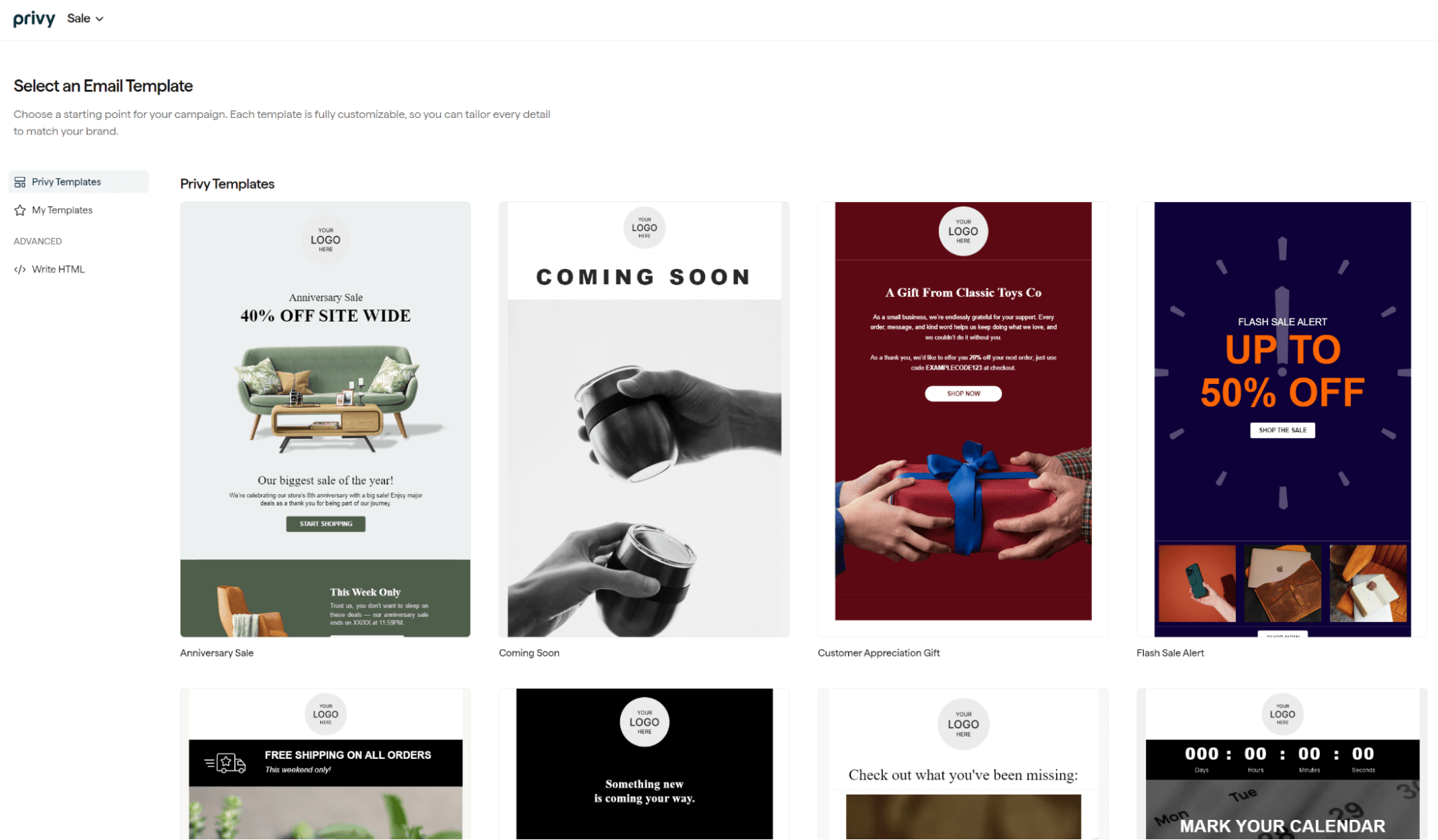
Searching Privy’s template library takes more time, as there are no filters to narrow down selections, and you have to scroll right down to the bottom to see the next page.
As for their email builders, both have drag-and-drop interfaces, pre-built blocks, and a clear path from design to review. But Klaviyo’s builder has more creative features.
Our Privy vs. Klaviyo email marketing comparison found that Klaviyo has more pre-built sections and blocks for design control, such as Split, Dropdown, and Spacer.
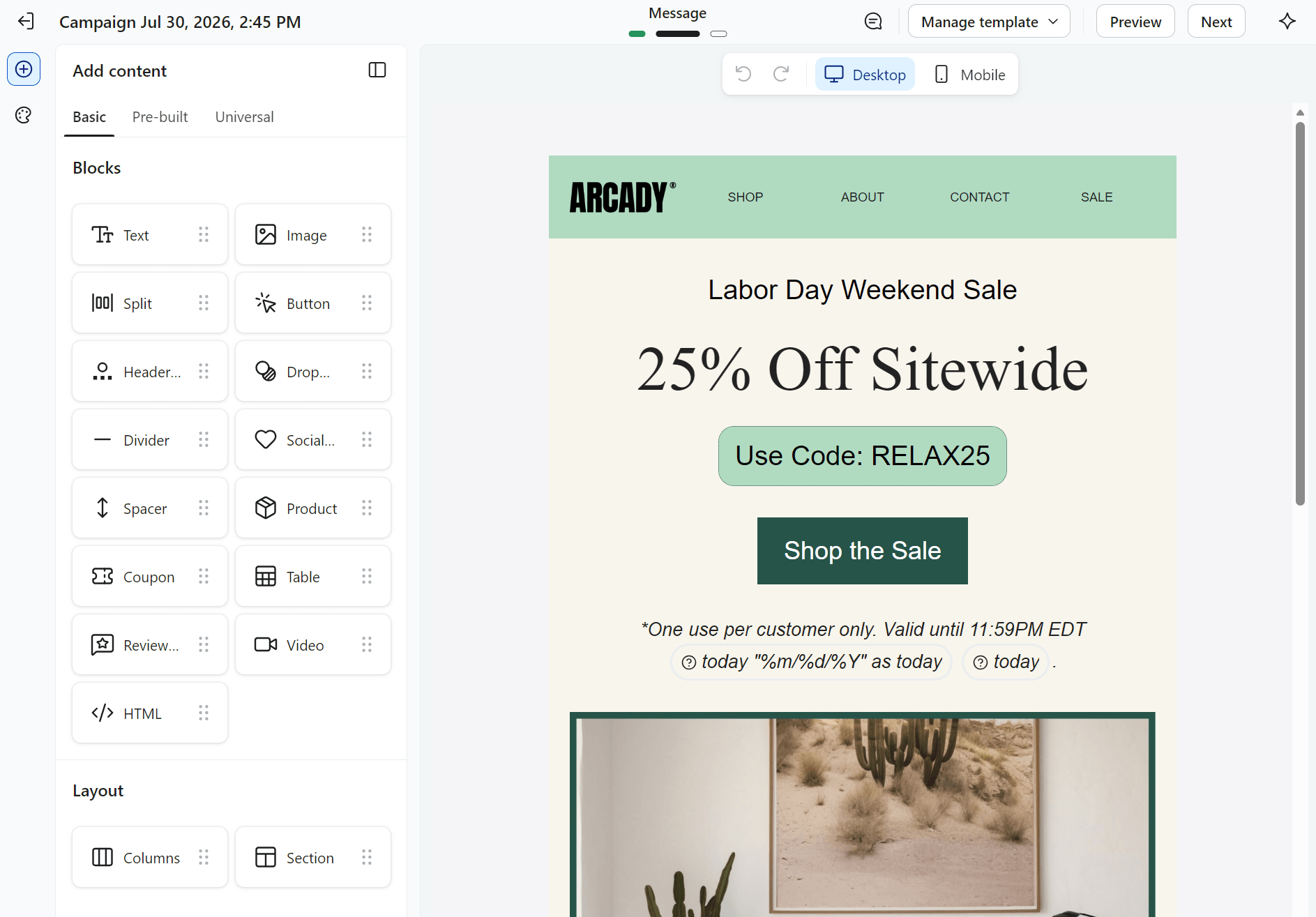
Klaviyo’s product block shows best-sellers, new arrivals, recently viewed, or category picks, with filters and personalization. It draws on your live product feed from Shopify or another integration, and falls back to the option you set when data is thin.
In Privy, the product block is also dynamic, able to show recently added, most-viewed, and best-selling products with fallbacks.
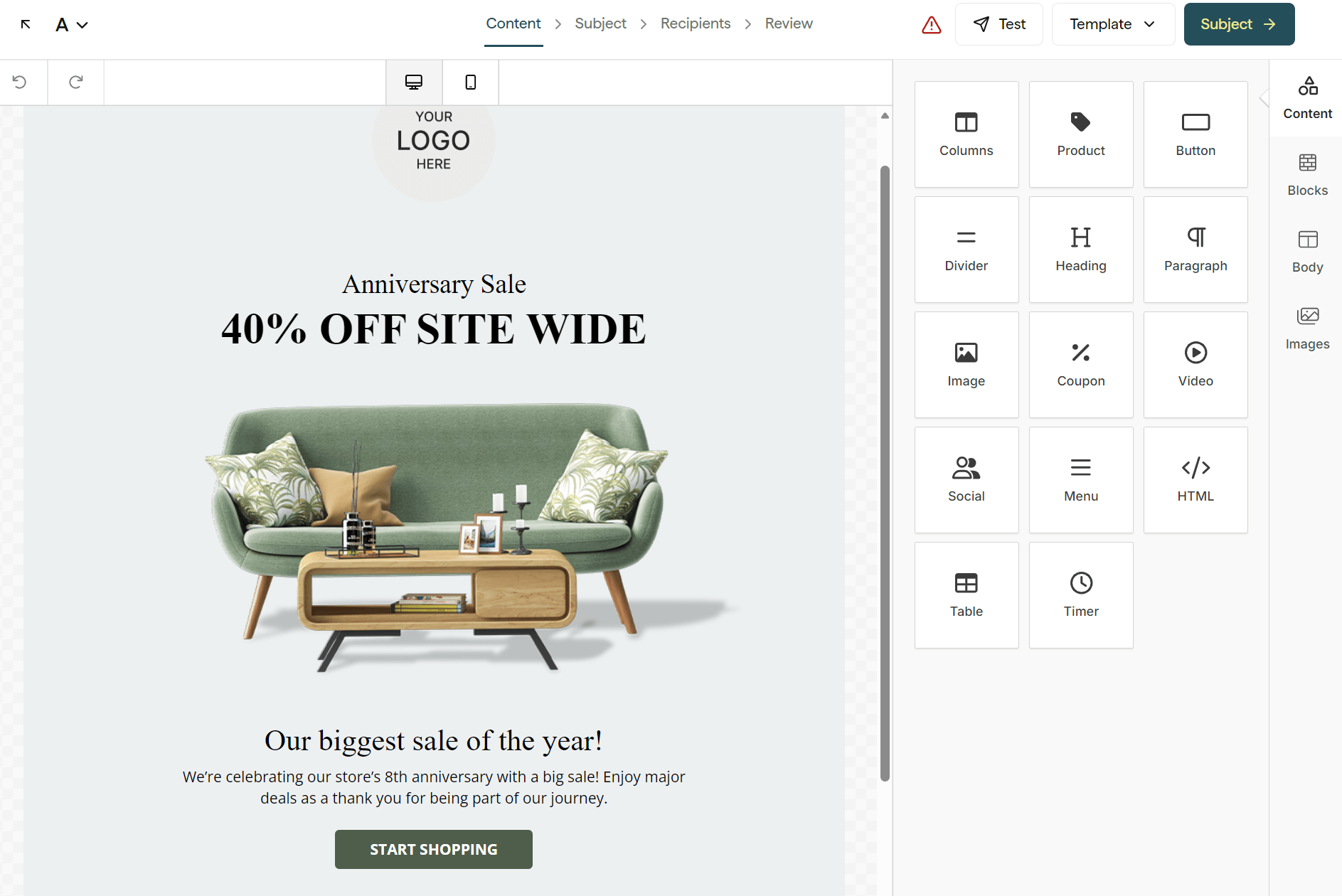
Privy’s email builder shifts all creative elements over to the right versus Klaviyo’s left-hand sidebar. The look and feel of the editor is more minimalistic, and that translates into an easier initial experience working through the content and settings.
A unique feature in Privy is the Images library, which sources royalty-free images from Unsplash, Pexels, and Pixabay for use in your emails.
A notable downside to Privy is that it lacks A/B testing for emails, with A/B tests limited to pop-ups and displays. There’s no such limitation in Klaviyo, which lets you test multiple email versions and forms to refine your approach based on how they perform.
Klaviyo vs. Privy: Automation
Klaviyo wins for automation depth. It offers 80+ pre-built automations and creates flows for you using Composer, an AI feature (in beta) included in all plans.
Both Klaviyo and Privy cover your standard ecommerce journeys with pre-built flows. Privy has 11 email flow templates to Klaviyo’s 80+. Your welcome series, abandoned cart/checkout, browse abandonment, winback, and follow-ups have templates that require no editing to work.
The difference between Privy and Klaviyo, other than their template libraries, is their depth when creating custom flows that target customers with granular filters and triggers. Klaviyo’s six trigger types include added to list, added to segment, date property, price drop, low inventory, and a metric trigger for checkout started, viewed product, placed order, and added to cart.
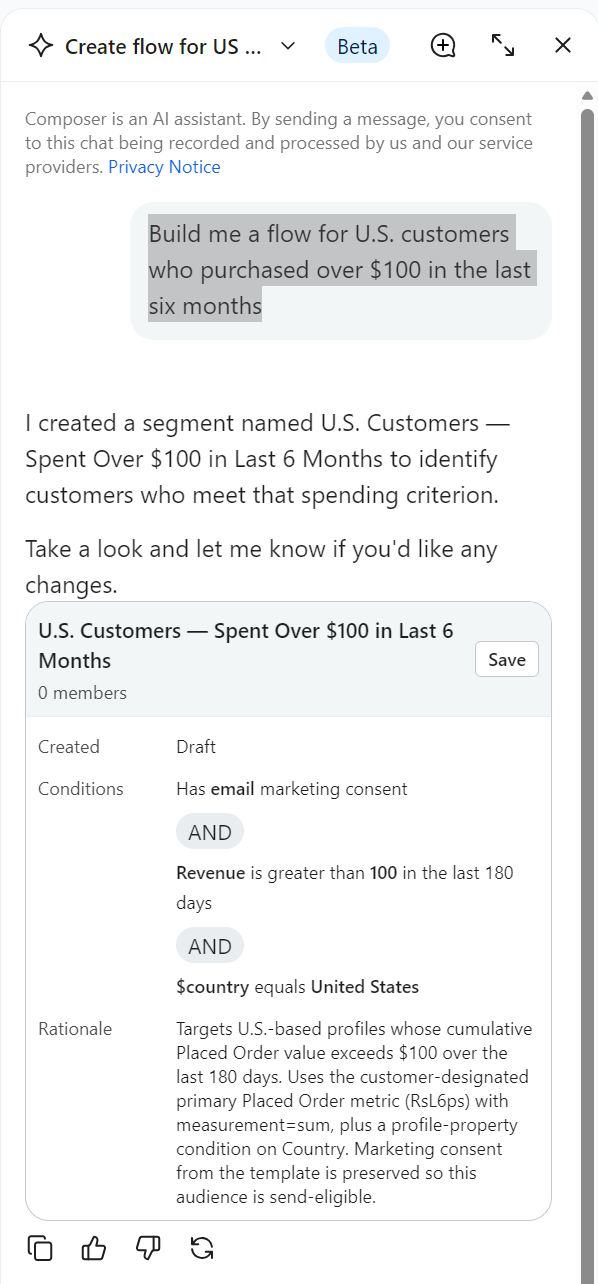
Klaviyo’s Composer builds flows for you and saves a lot of time doing so. The prompt below asked, “Build me a flow for U.S. customers who purchased over $100 in the last six months,” and it provided it in less than 10 seconds:
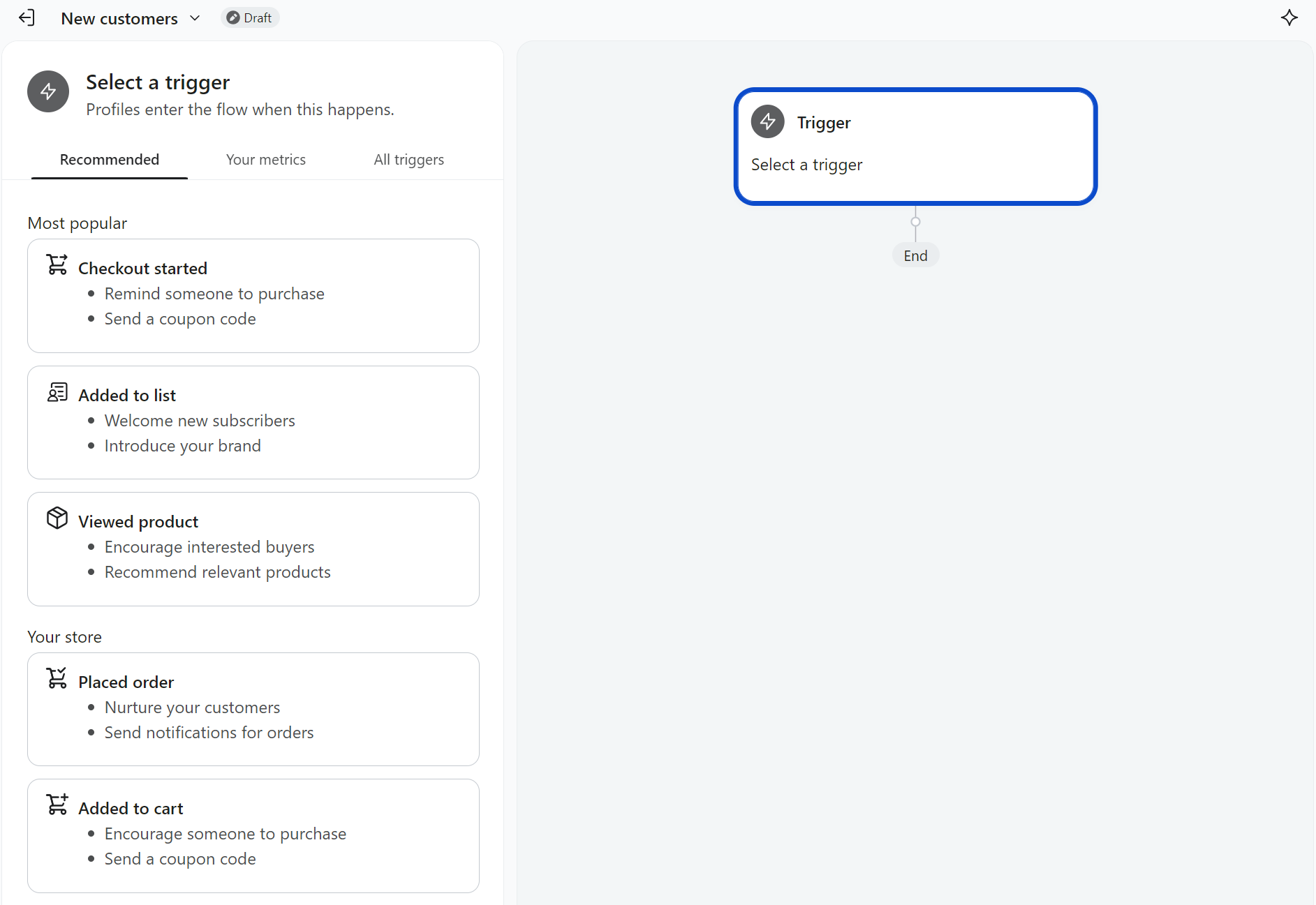
Privy takes the opposite approach and names each trigger separately, so its menu runs to 12: order placed and received, product added to cart, started checkout, viewed product, back in stock, subscribed to marketing, date, contact tagged/untagged, flow completed, and API event.
It has no price drop or low inventory trigger, where Klaviyo alerts shoppers when a watched item falls in price or runs low in stock.
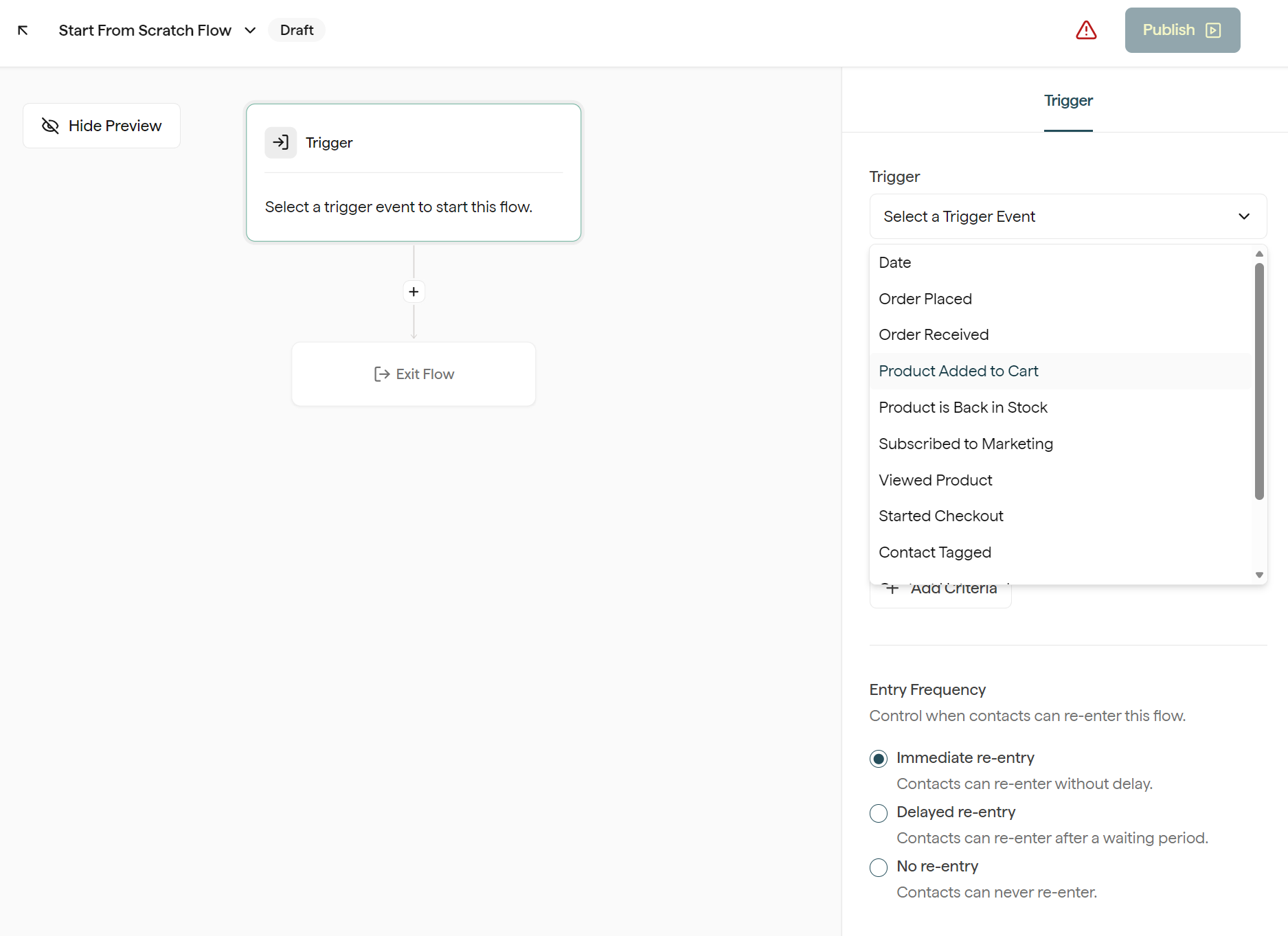
Privy does have a back-in-stock flow, which notifies shoppers who opted in on an out-of-stock item once it’s restocked. That covers the restock case, but not the low-inventory or price-drop alerts Klaviyo triggers before an item sells out or when its price falls.
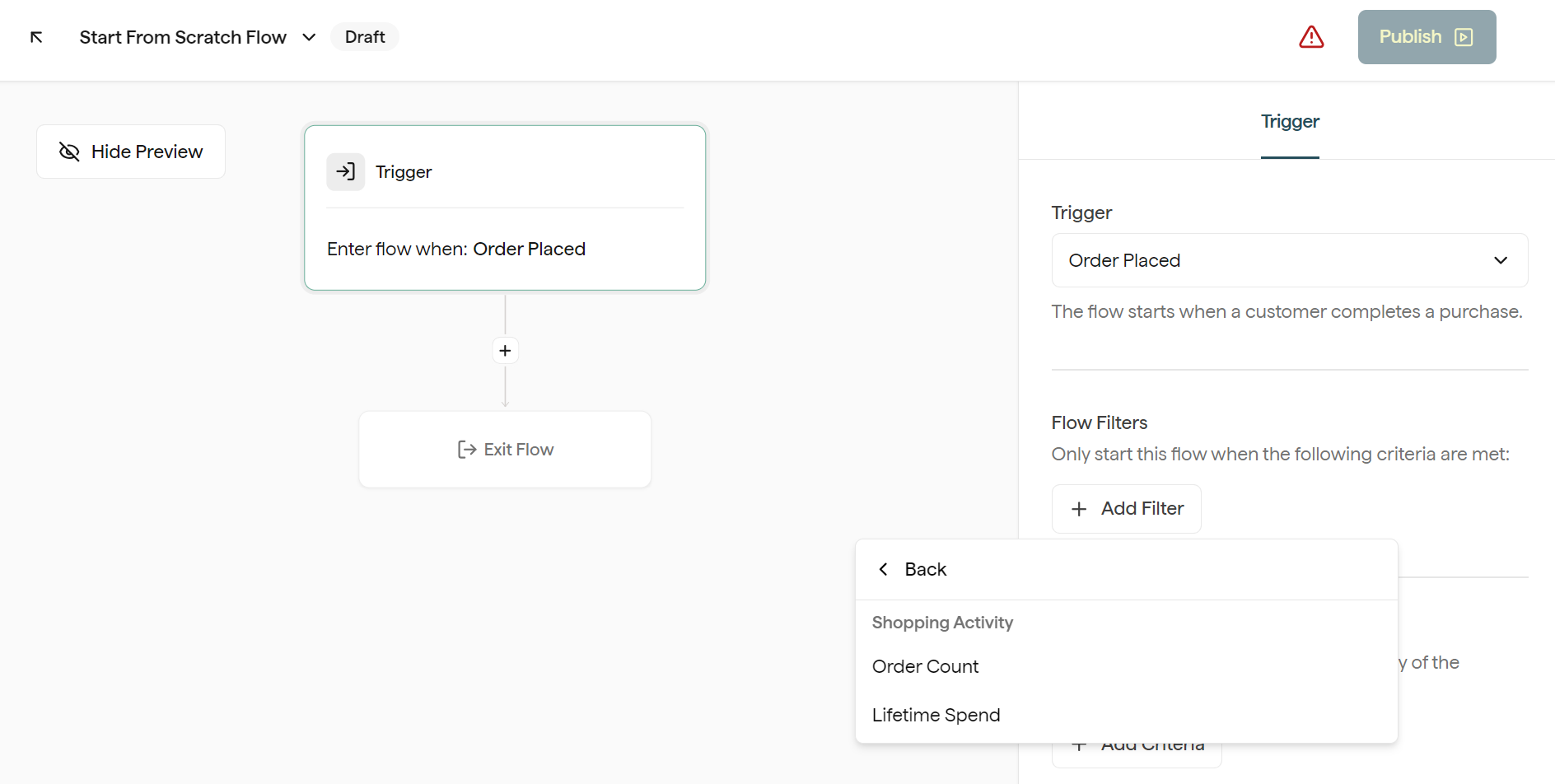
Both platforms filter who continues on two levels. The first narrows the triggering event: Privy on purchased product, collection, variant, order value, and order count.
The second checks the contact, where Privy filters on country, first and last order, last seen, custom fields, segment, tags, and lifetime spend.
Klaviyo’s second level goes further. It filters on predictive analytics like churn risk and predicted next order date, on GDPR status, on location, and on what someone has or hasn’t done.
Those predictive filters only appear once your store has 500+ customers who’ve ordered, 180 days of order history, and some repeat buyers, so newer stores don’t have them yet.
Klaviyo vs. Privy: Segmentation
Klaviyo wins with 25 pre-built segments, plus Composer, which builds segments for you on request. Klaviyo’s segmentation also extends into its CRM, with segments updating based on contact profile data.
Moving on to segmentation, Privy segments split into two kinds and cover less depth than Klaviyo’s overall due to a lack of predictive elements.
Custom Segments are meant for you to build them yourself, combining conditions across shopping activity, website behavior, customer attributes, and email or SMS engagement. Smart Segments come pre-built, such as engaged, unengaged, current customers, and potential customers.
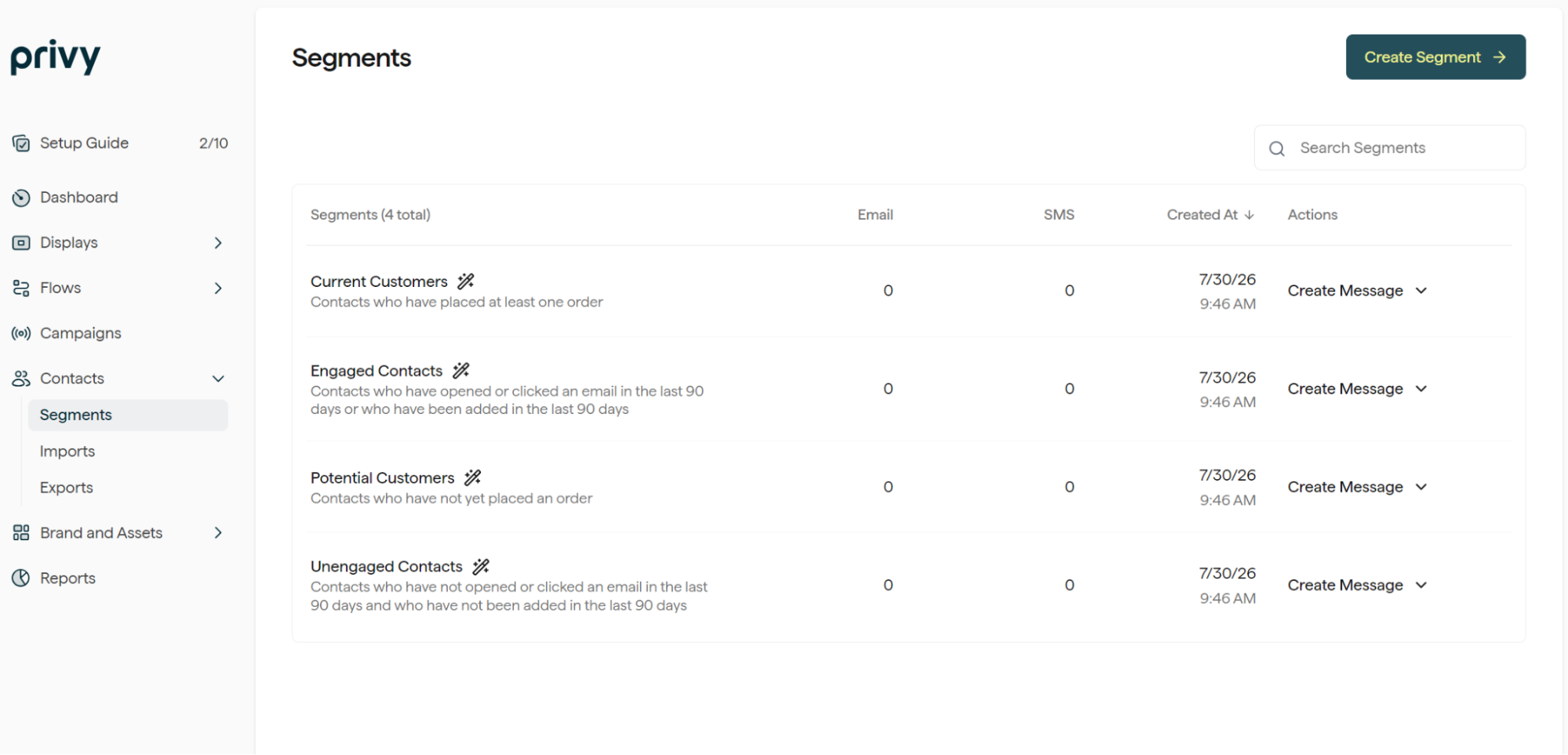
Privy’s segment builder offers shopping conditions for cart value, lifetime spend, order count, first and last order, and purchase history by product or collection.
You also combine those shopping conditions with match-all or match-any logic, then target an email, an SMS, or a split flow. One limit: once you create a segment, you can’t edit its conditions.
Klaviyo’s segment library covers engagement windows and past purchasers, and lets you organize contacts by the channels they subscribed to.
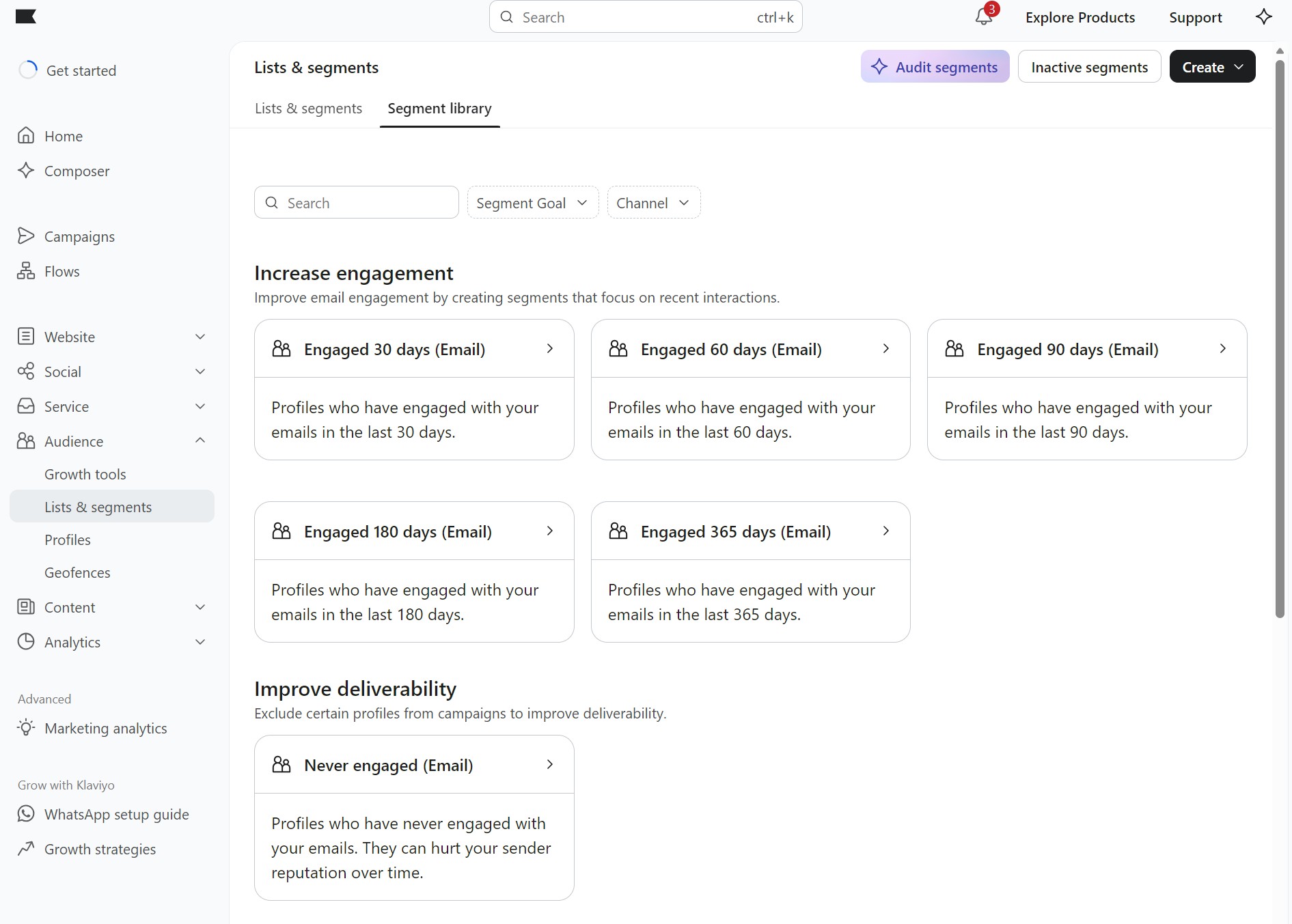
Building segments in Klaviyo uses similar conditions to Privy: shopping activity, location, and engagement. But it adds two things Privy doesn’t have.
The first is predictive, letting you segment on churn risk, predicted lifetime value, and expected date of next order, once your store has 500 customers who’ve ordered and 180 days of history.
The second is Composer. Describe the segment in a sentence, and it drafts the conditions for you. It will also audit your segments, listing all of them and recommending changes.
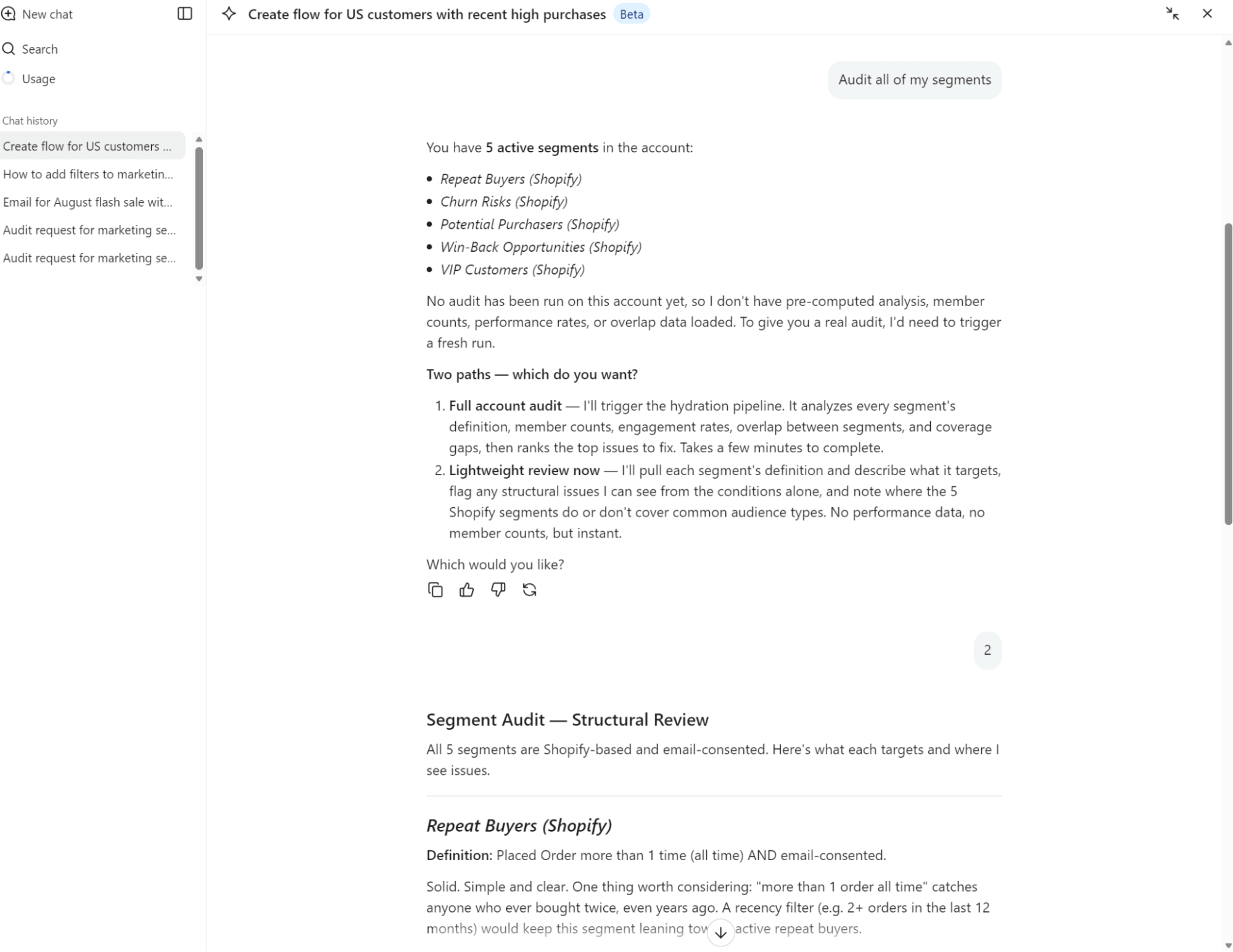
Segments update in near real-time and pull from every contact, not just subscribers. And unlike Privy, you can edit a segment’s conditions after building it.
SMS marketing
Klaviyo wins. Its SMS coverage spans more countries, and it supports more number formats (toll-free, 10DLC, and short codes) to suit your business.
Klaviyo and Privy both handle SMS through standalone campaigns and flows, and both include some credits to start. Privy provides 250 SMS credits on its email plans; Klaviyo provides $5 of mobile messages a month. Additional credits are sold in bundles starting at $15/month in both.
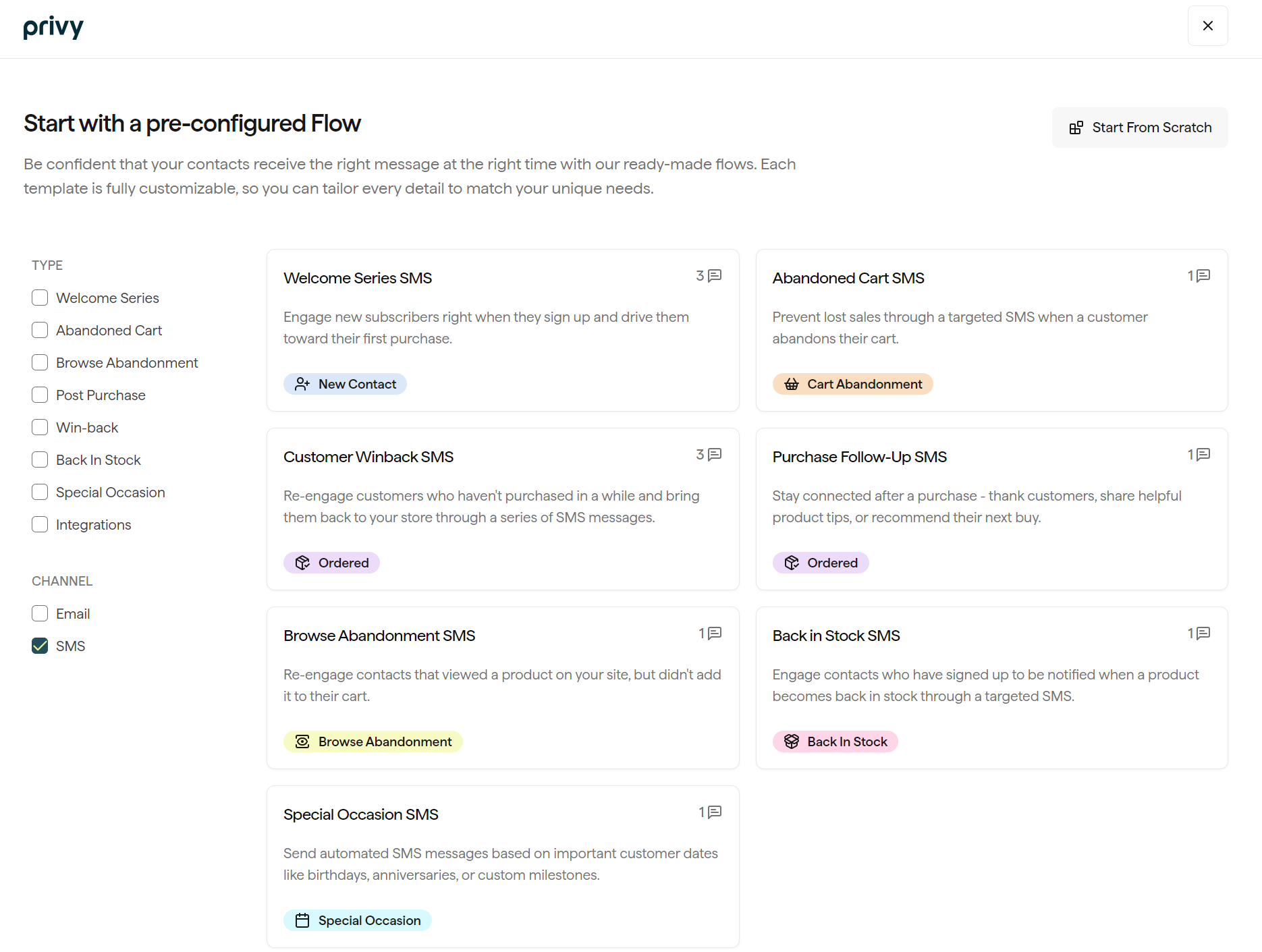
Privy’s pre-built flows library includes seven SMS flows, covering your welcome series, abandoned cart, customer winback, purchase follow-up, browse abandonment, back-in-stock, and special occasion messages.
SMS campaigns let you send one-time and scheduled texts to customer lists and segments, such as during Black Friday for a flash sale.
Limited global availability is Privy’s weak spot, and it affects you if you’re an international seller. SMS is U.S. and Canada only, requiring a verified toll-free number.
Klaviyo SMS also requires number registration, but supports toll-free, 10DLC, and short codes across its supported countries.
SMS covers 20+ countries, including the United States, Canada, the United Kingdom, Australia, New Zealand, and a list of European countries, with per-country compliance handling.
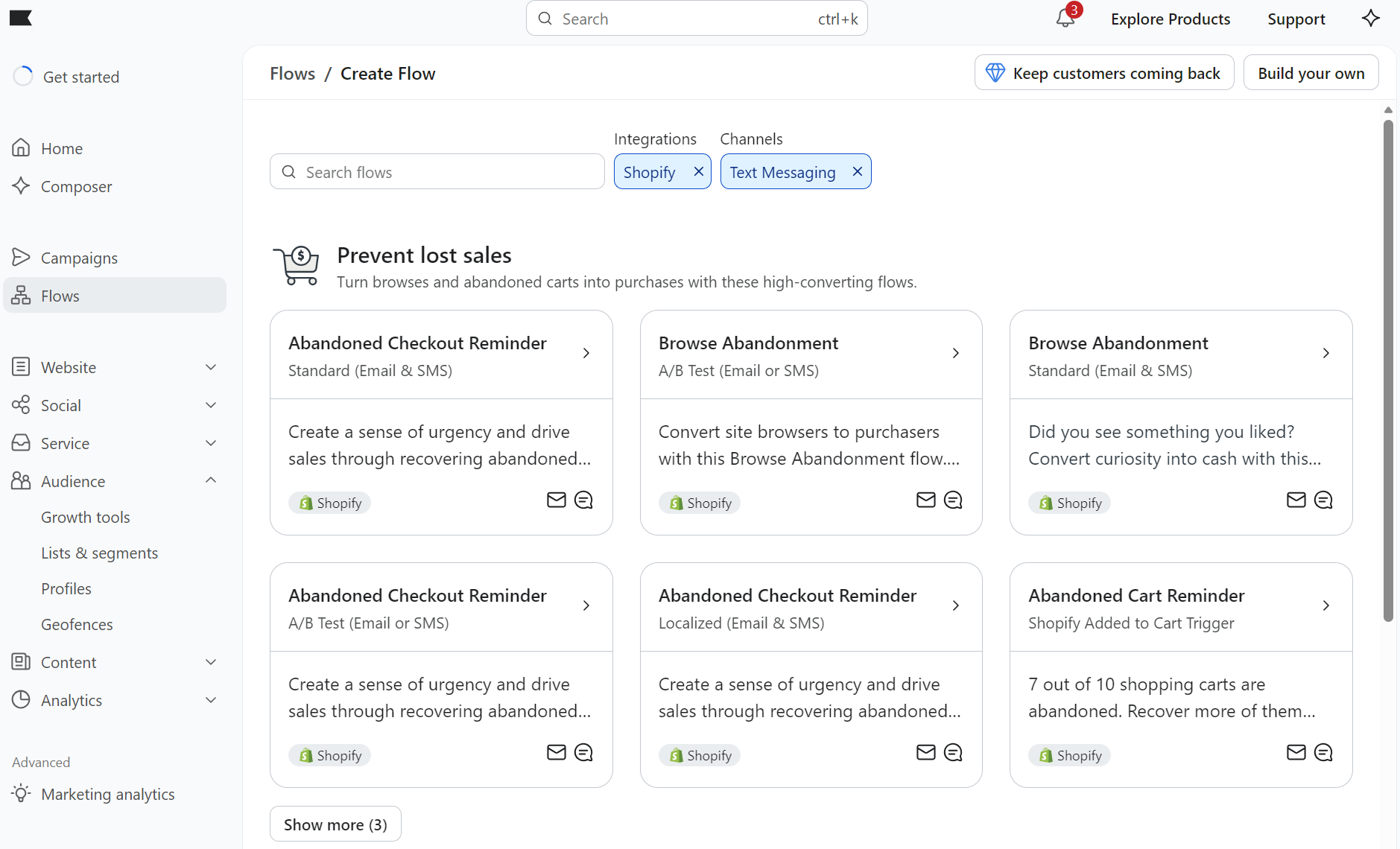
Klaviyo is the more advanced SMS platform, mainly for conversational two-way automation, underlying flow logic, and global compliance.
It can trigger and personalize a text based on any data on a customer profile (purchase history, predicted CLV once your store has the data, segment membership). When someone texts back, that reply is saved to their profile and can trigger the next step.
Integrations and support
Klaviyo wins. You can connect to significantly more tools via native apps and purchase premium support should you need it. Plus, Klaviyo offers support outside of business hours. Plus, Klaviyo offers support outside of business hours
Klaviyo has significantly more integrations at 350+ to Privy’s 20+. Both have native apps for Shopify, BigCommerce, Squarespace, and Wix. Privy has a native Klaviyo integration, which lets you collect subscribers with Privy and then sync that data to Klaviyo to feed your marketing.
The fact that Klaviyo’s integration ecosystem is so much larger than Privy’s makes it the better pick if you use lots of tools that need to communicate. Zapier is available with both, so there’s also the option to move data that way when native apps aren’t available.
As for support, Klaviyo’s free plan includes a 60-day trial of email support. Standard support (included in paid plans) provides 24/7 email support and 24/5 live chat with no weekend coverage.
Privy’s Email plan includes email and live chat support Monday to Friday. Email support runs 9 am–6:30 pm EST and live chat 10:30 am–6:00 pm EST; outside chat hours, the widget converts your message to a ticket for follow-up.
Klaviyo also sells Professional and Enterprise support tiers that add weekend live chat (local business hours on Professional, 24/7 on Enterprise) and faster email response times. Pricing requires contacting sales.
Can you use Klaviyo and Privy together?
Yes, using Klaviyo and Privy together is quite a common setup with the right plan combination.
Privy’s Pop-Ups & Displays Only plan includes all templates and list-building features. Add a Klaviyo Email plan to your stack, and you can benefit from Privy’s more capable list-growth tools and Klaviyo’s granular marketing capabilities.
Any contacts and customers you collect from Privy’s forms can feed into Klaviyo using Privy’s native Klaviyo integration. All that data will feed into Klaviyo’s CRM.
The downside is having two subscriptions and higher monthly costs; the cheapest combination is Klaviyo’s free plan and then paying Privy $24/month for up to 10,000 page views. Just be aware that once you have over 250 active contacts, Klaviyo starts at $20/month.
The pairing that makes no sense is a Privy Email plan and a Klaviyo Email plan. That would only provide conflicting capabilities and attribution data.
Which is better, Klaviyo or Privy?
Klaviyo wins for full-funnel email and SMS, with deeper flows, segmentation, and reporting. Privy wins for list growth, with a better display builder and more formats and on-site triggers.
Choose Privy if
Your priority is growing your list and generating leads, and you’re happy with no predictive data and leaner email and SMS marketing.
Choose Klaviyo if
You’re moving into advanced ecommerce segmentation, automation, and reporting, with a focus on revenue and retention.
Choose both if
Privy’s on-site triggers are needed to capture as many people as possible, but you also want Klaviyo’s data and ecommerce depth for post-capture.
The use cases table below will help you make further sense of Privy vs. Klaviyo:
| Business situation | Recommendation | Reason |
|---|---|---|
| You mainly need to capture visitors and grow your list | Privy | More display formats and on-site triggers |
| You want gamified capture like spin-to-win or quizzes | Privy | Native formats Klaviyo doesn't match |
| You're scaling into segmentation, automation, and reporting | Klaviyo | Flows, live CRM-driven segments, and customizable reporting |
| You want one platform to run the full funnel | Klaviyo | Handles capture through email, SMS, and flows on its own |
| You want AI to build campaigns, flows, and segments | Klaviyo | Composer generates all three |
| You run Klaviyo but want to improve capture | Both | Add Privy's displays-only plan and sync contacts into Klaviyo using the native integration |
What are the best Klaviyo and Privy alternatives?
Omnisend is the best alternative for ecommerce. It provides similar capabilities to Klaviyo and Privy in multiple areas, and brings several of each’s advantages to your store in one tool.
First, the overlap. Omnisend has list-growth tools including pop-ups and gamification, and it covers email and SMS in campaigns and multichannel flows. Where Omnisend moves ahead of Privy is in its ecommerce depth across flows, segmentation, and reports, which are more comparable to Klaviyo’s, yet easier to use.
Multi-store support with one-click store switching and shared assets is another selling point, most helpful if you want to run multiple stores in one account. 24/7 email and live chat support is provided in all of Omnisend’s plans, and if you have 250+ contacts, there’s a complimentary migration service to switch from Klaviyo.
You also don’t pay for features you don’t use. Omnisend’s Standard plan omits SMS, but gives you all core email marketing features with savings of up to 35% versus Klaviyo. Use our comparison calculator to see the savings. Should SMS be necessary for your store, there’s the Pro plan with global SMS across 190+ countries, more than Privy’s U.S. and Canada-only coverage or Klaviyo’s 20+ countries.
Quick sign up | No credit card required
Privy vs. Klaviyo: FAQs
Is Privy or Klaviyo better?
Privy is better for growing your list with pop-ups and other sign-up forms, while Klaviyo is better for reaching your audience across email and SMS.
Can you use Privy and Klaviyo together?
Yes, Privy has a native Klaviyo integration that syncs sign-ups into your Klaviyo account. The setup is to purchase Privy’s Pop-Ups & Displays Only plan and then one of Klaviyo’s Email plans per your contact count.
Does Klaviyo have popups?
Yes, Klaviyo has an extensive pop-up library with 80+ templates. These use a drag-and-drop editor and can use multiple steps.
What’s cheaper, Klaviyo or Privy?
Privy is cheaper at similar contact tiers in most plans, and its SMS add-on includes more credits per month, with inclusive carrier fees.
What’s the connection between Privy and Sendlane?
Privy purchased Sendlane in February 2026 and began folding it into its own platform, combining Privy’s on-site conversion and list-growth tools with Sendlane’s email and SMS automation capabilities.