Omnisend AI

 OFFER
OFFER









Your email marketing platform will either provide the tools to achieve a return on investment (ROI), or it won’t. Omnisend vs. Brevo (formerly Sendinblue) is a choice between ecommerce features that convert browsers into buyers and business tools for marketing and sales.
Omnisend is the best choice for ecommerce businesses of all sizes. It maps your customer journey with abandoned cart, browse recovery, post-purchase, and behavior-triggered flows, and lets you create omnichannel automations that include email, SMS, and push notifications.
Brevo is also suitable for ecommerce, but its focus is on small and medium-sized businesses, with CRM and sales tools to close deals and manage pipelines.
This article provides a complete Brevo vs. Omnisend comparison, including features, pricing, use cases, and performance to help you pick the right email tool for you.
Quick sign up | No credit card required
Omnisend vs. Brevo: A brief overview
Omnisend and Brevo both automate your customer journey, with Brevo’s CRM catering to service businesses that also sell products. Omnisend is an ecommerce-first automation tool for maximizing revenue across email and SMS.
Both platforms have proven track records. Brevo serves 600,000+ customers globally, and 150,000+ ecommerce brands use Omnisend. On G2, Omnisend scores slightly higher with 4.6/5 from 1,200+ reviews. Brevo holds 4.5/5 from 2,600+ reviews.
Their pricing is different and could sway you to one or the other. Brevo’s send-based pricing is cheaper for large lists versus Omnisend’s contact-based pricing. However, Omnisend offers unlimited access to automations for free and generous send limits per contact count.
It’s fair to say both are reputable email marketing software solutions with practical features to help your business grow.
Brevo offers CRM and sales pipeline tools alongside email marketing. Small and medium businesses choose Brevo for its integrated business tools, not just marketing automation.
Omnisend builds every feature around ecommerce, including automations such as cart recovery, product recommendations, and purchase-based segmentation. Fast-growing online stores like Hallmark Cards Australia rely on Omnisend to target customers at optimal moments.
Omnisend vs. Brevo: A side-by-side comparison
The table below compares Brevo and Omnisend’s features:
| Omnisend | Brevo | |
|---|---|---|
| Email campaigns | • Drag-and-drop email editor with HTML access • 250+ pre-built email templates | • Drag-and-drop email editor • 50+ email templates |
| Marketing automation | • Omnichannel email, SMS, and web push notification flows; email and web push in all plans, SMS in Pro • Build complex flows for your complete customer journey | • Drag-and-drop flow builder • Multichannel automations in single flows; email and SMS in all plans, web push in Starter • Real-time event triggers • Abandoned cart recovery across channels |
| Transactional email | • Fully supported in all plans • Pre-built templates for order and shipping confirmations | • Supported via application programming interface (API) and SMTP in all plans • Extends to transactional SMS and WhatsApp |
| Email list-building | • Fullscreen, embedded, and flyout forms, pop-ups, and landing pages that meet General Data Protection Regulation (GDPR) requirements, in all plans • Double opt-in setting • Forms AI in paid plans | • GDPR-compliant forms • Pop-ups only available in the Professional plan • Landing pages limited to one page in Standard, 10 in Professional |
| Segmentation | • 32 pre-built segments • AI segment builder in all plans • Build unlimited segments | • 28 pre-built email segments • Manual segment builder • Advanced segmentation in all plans |
| Analytics and reporting | • Tracks opens, clicks, click-through rate, and all other standard metrics • Attributes sales and revenue to campaigns and automations • Contact scoring and customer breakdowns | • Sales cycle and revenue reports • Forecasting for deal stages • Statistics pages in Starter and Standard plans; pre-built dashboards in Professional plans |
| AI features | • Content creation: AI Writer, subject line and preheader generators, Brand assets AI, Forms AI • Targeting: product recommendations, segment builder, send time optimization • Analysis: Reports AI, RFM analysis • MCP integration: Claude and ChatGPT | • Aura AI with four agents: • Marketing agent, generates content and automations • Sales agent (requires the Sales Essentials add-on), creates sales sequences • Data management agent, answers data questions • Conversations agent, summarizes live chats and edits replies |
| Pricing | • Pricing based on the number of contacts • Paid plans start from $16/month | • Pricing based on monthly email volume with contact caps per tier • Paid plans start from $9/month |
| Free plan | • Supports email and web push notifications • Send up to 500 emails/month to 250 contacts • No advanced reporting • No personalized product recommender | • Limits standard features, including contact scoring, dynamic coupons, A/B testing, and push notifications • Send up to 300 emails/day • Limits automations to 2,000 contacts |
| Customer support | • Email support • 24/7 live chat support • Account Expert on Standard and Pro plans >$400/month | • Email support • Phone support in Professional plans • Customer support manager in Enterprise plans |
| SMS campaigns | • Available in Pro plans with an add-on • Bulk SMS campaigns • Personalized transactional SMS • Run SMS campaigns along with email and push notifications • 190+ countries | • Available in all plans • Bulk SMS campaigns • Personalized transactional SMS • Ability to run SMS campaigns along with email and push notifications • 180+ countries |
| Integration | • Supports 285+ integrations | • Supports 140+ integrations |
Email campaigns
Omnisend suits email campaigns better than Brevo, with 250+ templates compared to Brevo’s 50+, and A/B testing available in all plans.
Brevo and Omnisend both suit sending and scheduling email campaigns such as promotions, sales events, price drop alerts, and newsletters. You can use pre-built templates and modify them using a drag-and-drop editor in either tool.
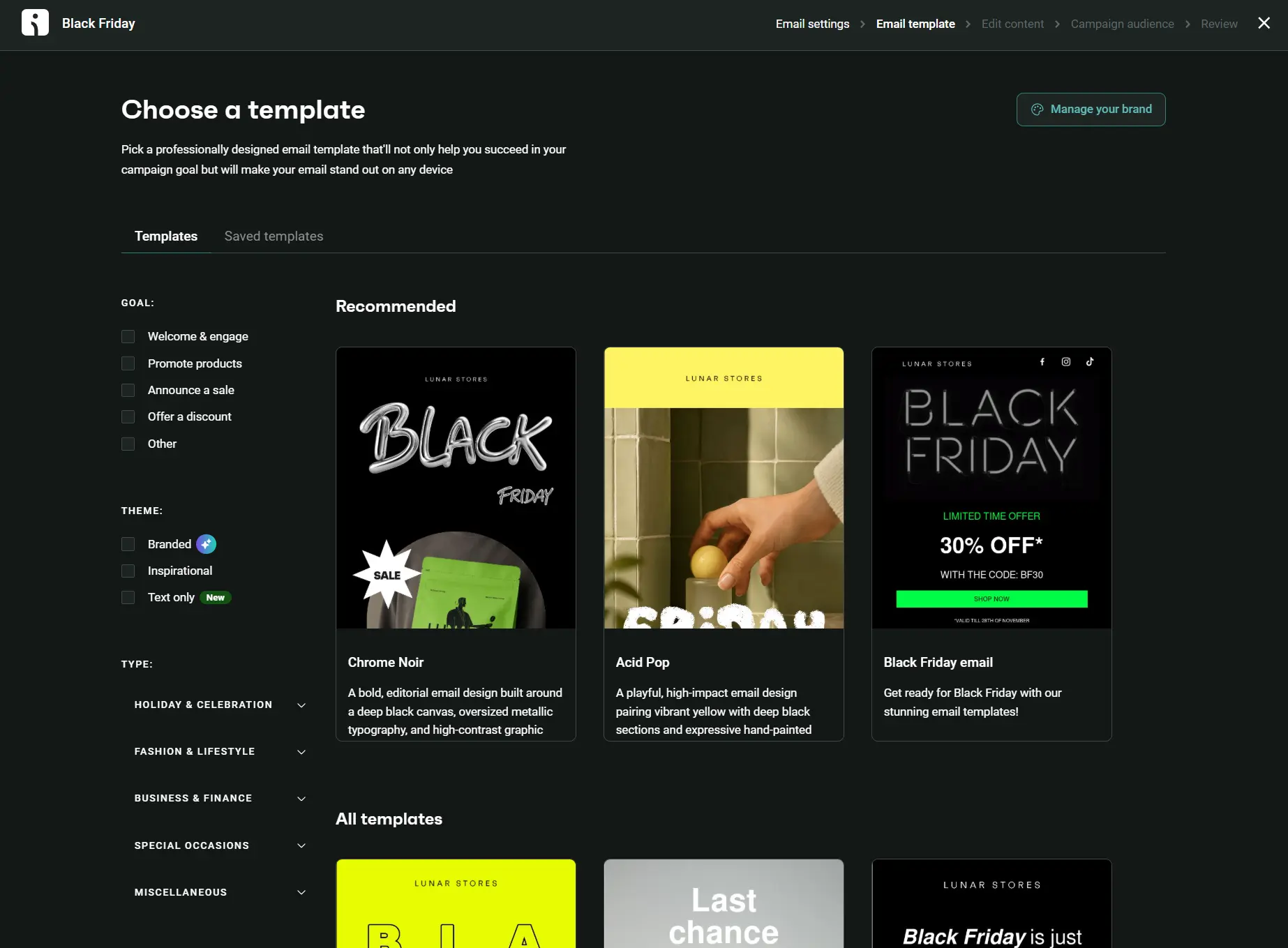
Omnisend’s templates suit ecommerce emails. You can browse email templates by goal, such as welcome and engage, by theme, such as inspirational, and by type, such as fashion & lifestyle. In total, there are 250+ customizable email templates that you can edit.
In addition to saving your templates and sharing them across other stores you may have, you can save individual blocks to reuse in future campaigns. All this is a time-saver.
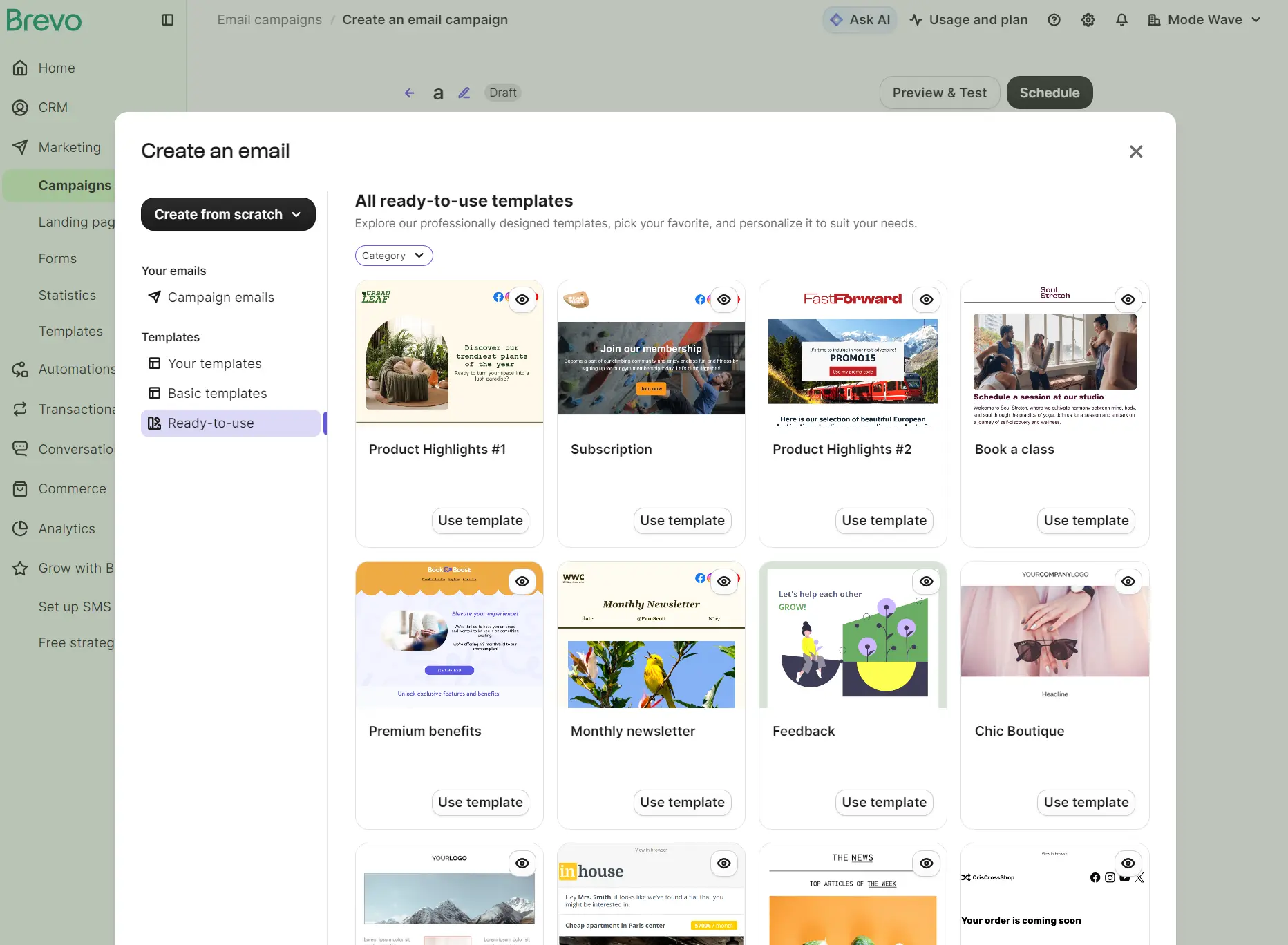
Brevo’s template library is best suited to general business campaigns. It lets you search by template type (anniversary, announcement, confirmation, etc.), and there are multiple unique templates, although many of the designs are similar.
You’ll appreciate the sheer number of items you can add to your email templates in Omnisend. For instance, it lets you add a product listing or product recommender item with or without personalization.
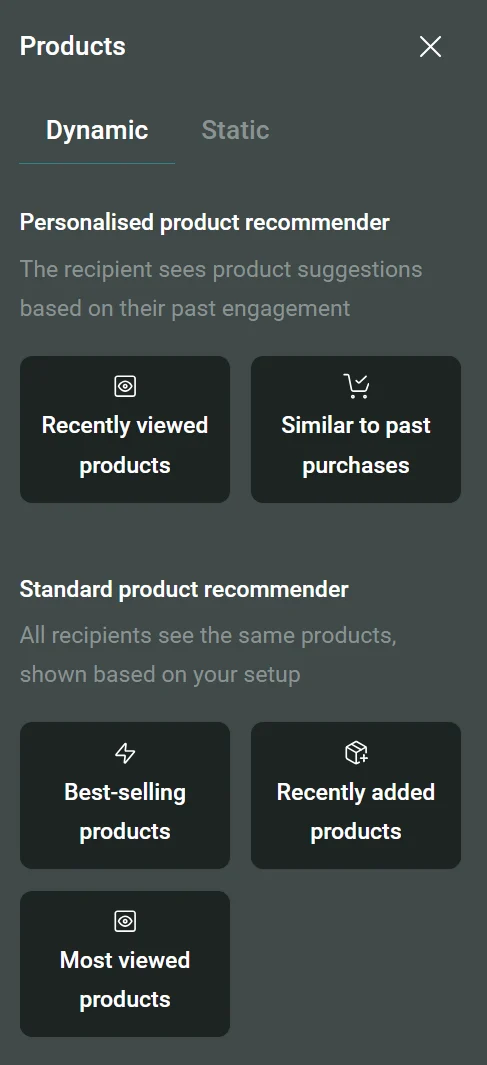
Do you see the options above for recently viewed products and similar to past purchases? Those are available in the Pro plan, using AI to recommend products based on your customers’ behavior. You can add them to your campaign and automation emails.
Brevo doesn’t offer a comparable AI product recommendation item unless you are a Professional plan customer. All plans include a product block, which lets you select up to nine products for display in your emails.
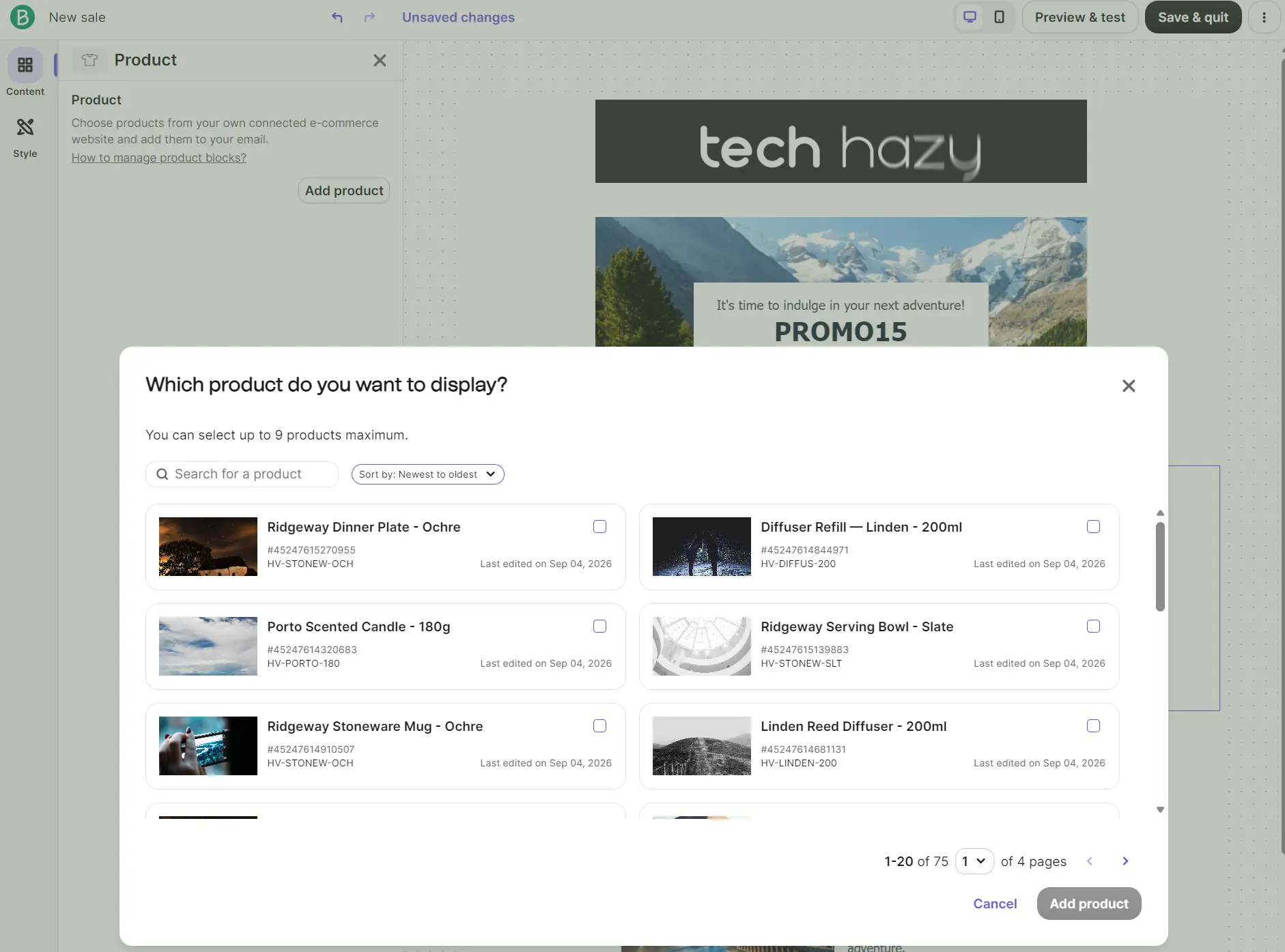
When it comes to creating content for your emails, Omnisend and Brevo have AI features to assist. Aura (Brevo’s AI chatbot) lives within the template editor, letting you prompt it to generate a paragraph, title, or button.
Omnisend’s AI appears in subject line and preheader fields with one-click generation based on campaign context. It offers grammar fixes, rephrasing, and tone adjustments.
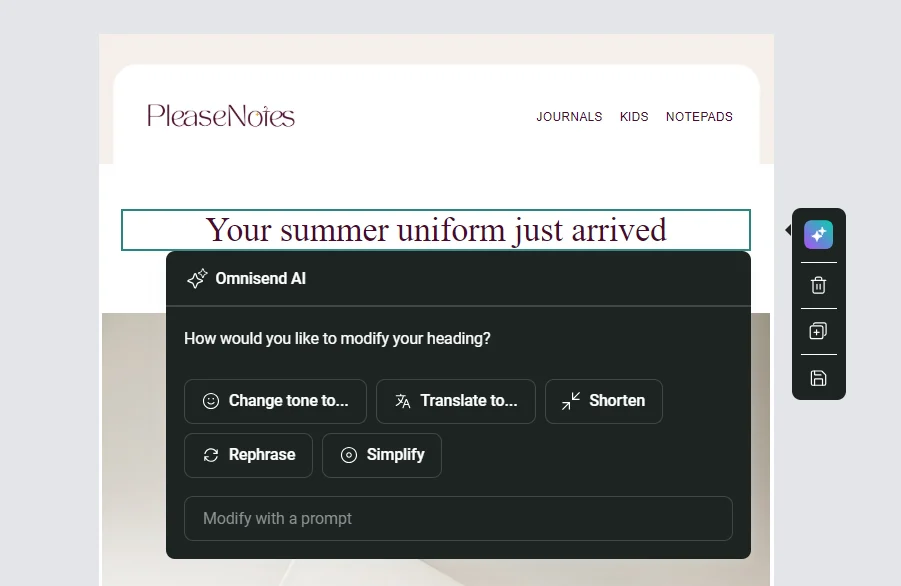
Additionally, you can request custom prompts, such as “make this more celebratory,” or “shorten to 50 characters.” The AI saves conversation history during campaign creation.
Omnisend offers a campaign booster across all plans, which helps your emails get more opens by automatically resending emails that go unopened. You can use it to improve engagement and conversions in campaigns.
Both tools also offer campaign A/B testing to find winning email versions. However, only Omnisend includes A/B testing across all plans. Brevo restricts A/B testing to its Standard plan, which starts at $18/month.
Brevo’s A/B tests focus on subject line and content variations only; Omnisend adds sender name/email testing options for additional insights.
Marketing automation
Omnisend is better than Brevo if you have an ecommerce store and want to set up automations that cover customer actions. It has more pre-built templates and lets you use push notifications across all plans.
Email automations cover your customer journey from welcome series to post-purchase in both tools. Additionally, they let you add an SMS to your flows to reach customers who are subscribed to text messages.
Brevo supports SMS and email in all plans, plus web push notifications from Starter; Omnisend supports email and web push in all plans and SMS in the Pro plan.
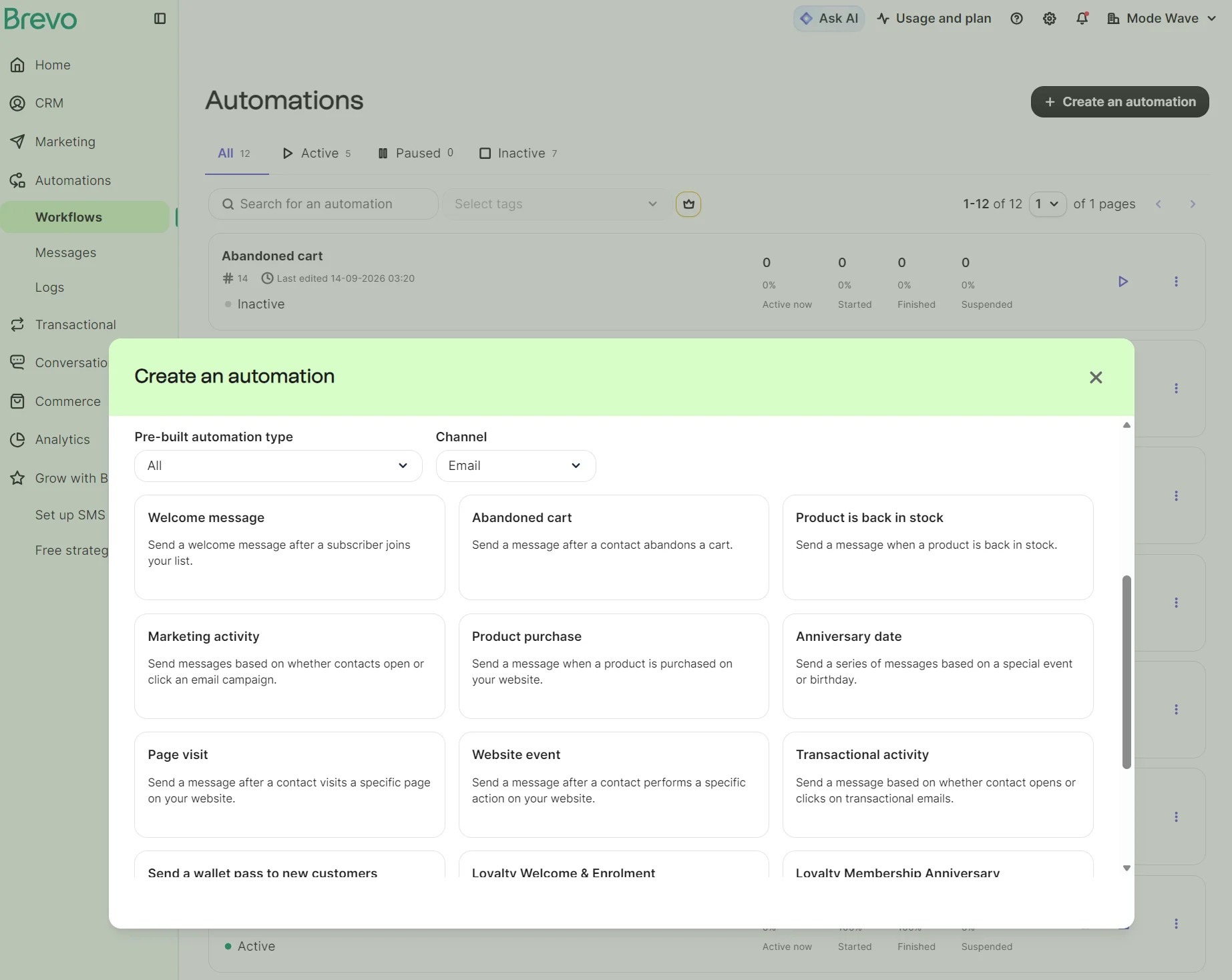
Brevo has 19 pre-built automation templates: 15 for email and four for SMS. The automation editor walks you through the different steps and prompts you to add new information for a working configuration:
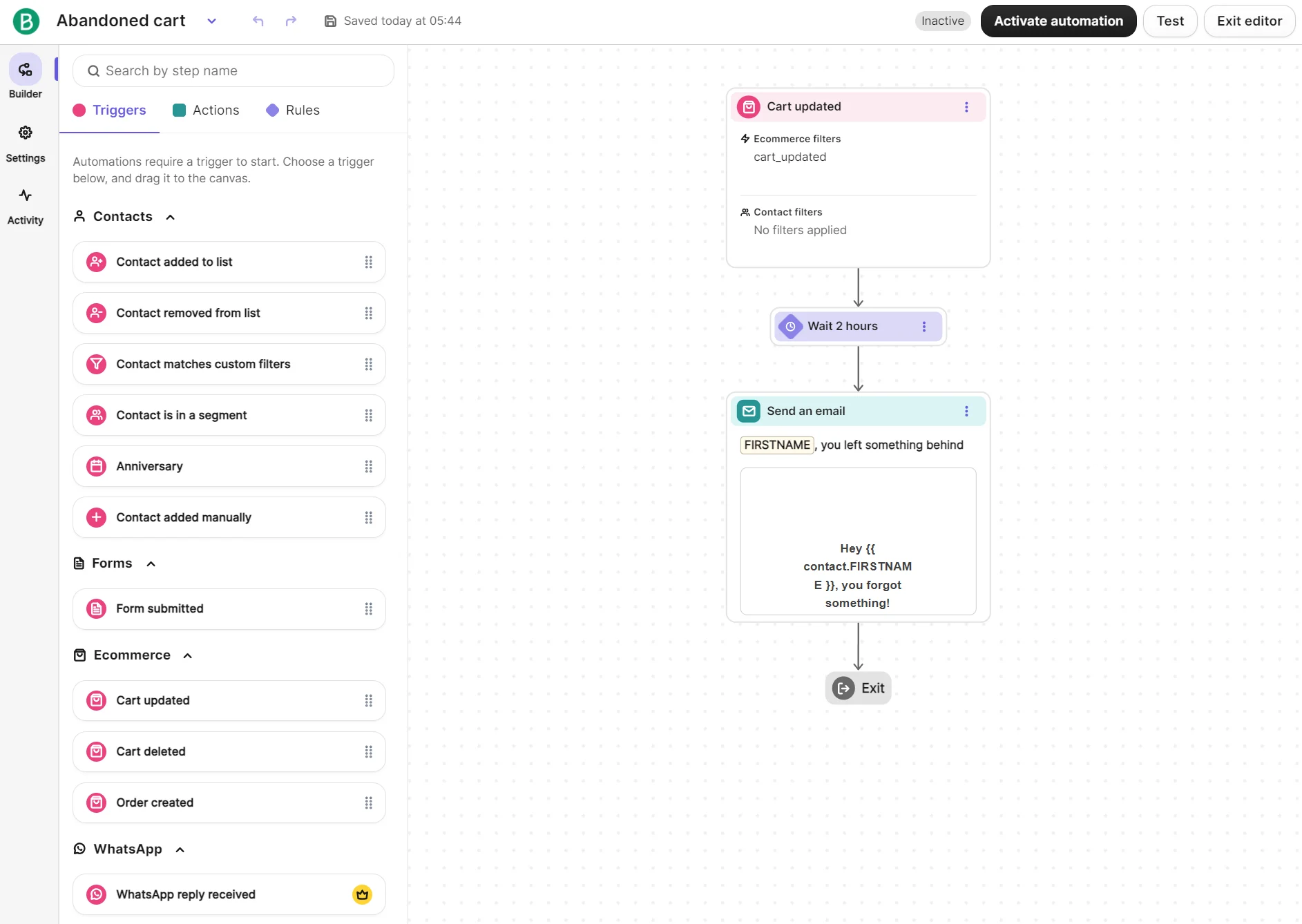
All Brevo and Omnisend plans have real-time event triggers (such as making a purchase) and multiple entry points for automations.
Omnisend has a clear advantage over Brevo in its 30 pre-built automation templates. These include welcome, abandoned cart, abandoned checkout, product abandonment, back-in-stock, and order follow-ups.
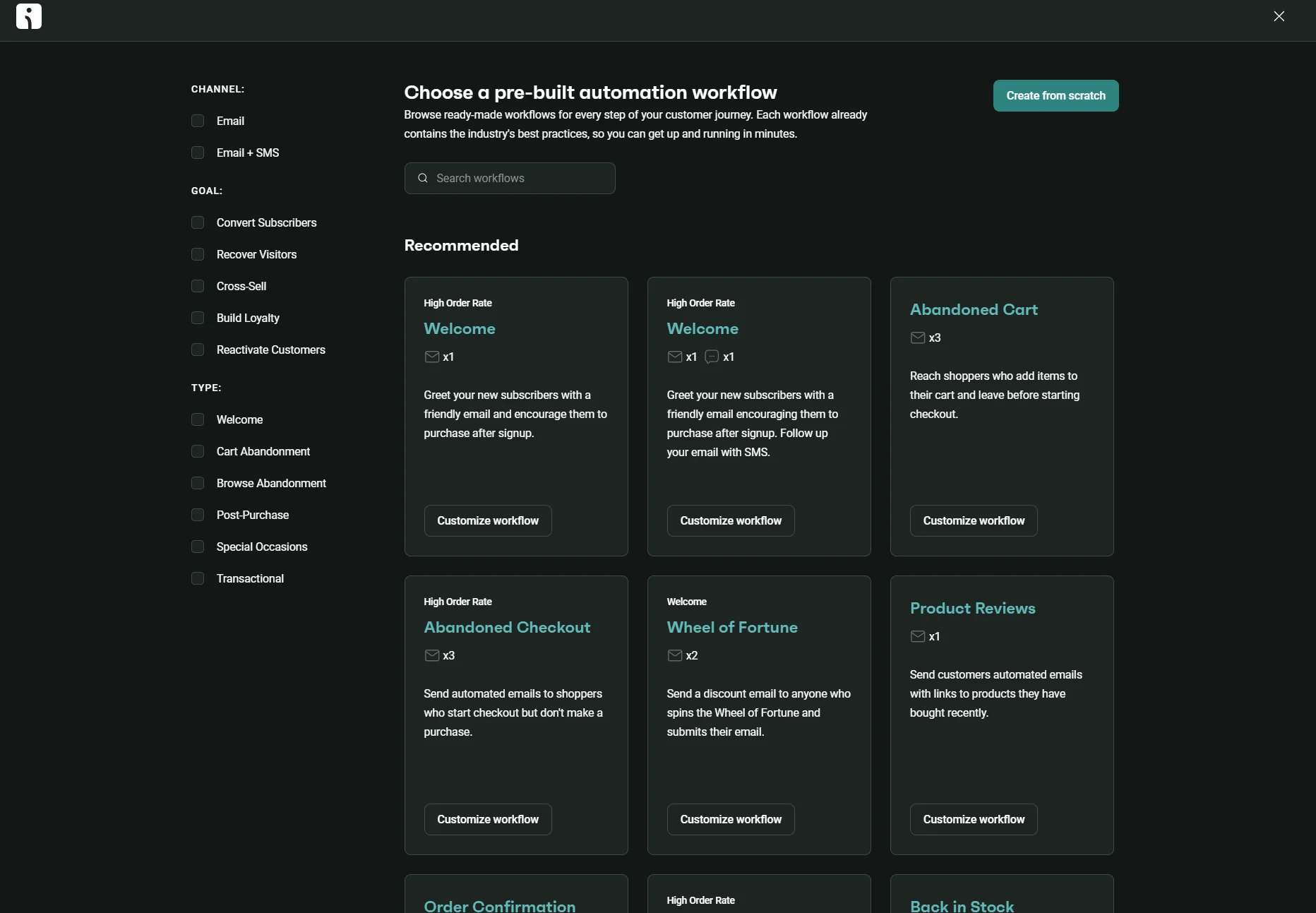
The workflow editor uses visual drag-and-drop blocks for messages, delays, splits, tags, and additional touchpoints, so building a flow takes very little time.
Setting up conditional splits based on customer behavior or purchase history improves targeting and requires just a few clicks in Omnisend and Brevo.
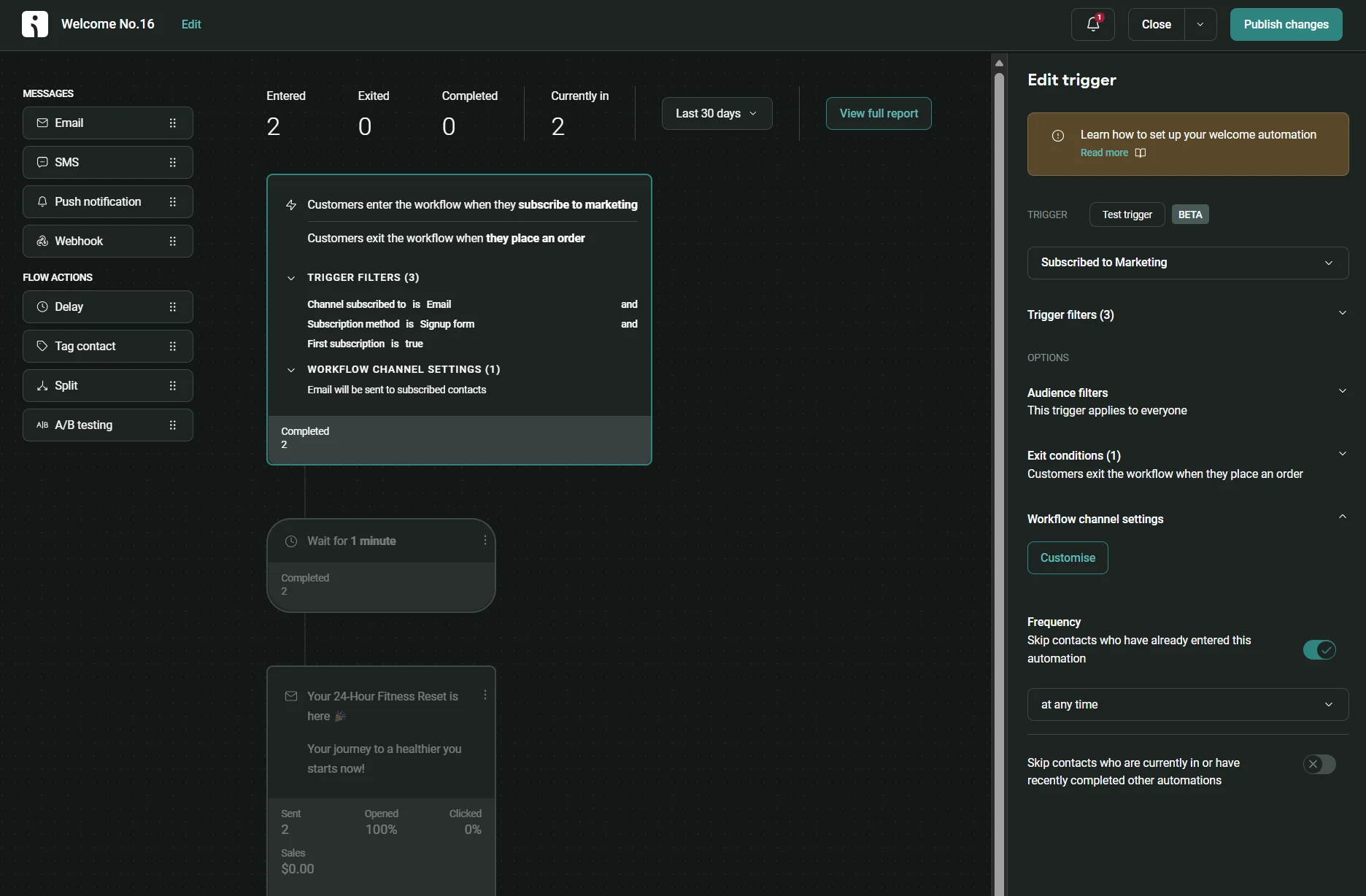
Do you see the A/B testing flow action in the image above? Dragging it into the builder lets you test two email or SMS versions to improve your results. Brevo also has A/B testing features in Standard plans and above.
Brevo manages deals and sales and suits your business if it needs a CRM, pipeline management, and outreach sequences.
Brevo has three sales packages:
| Package | Cost | What it has |
|---|---|---|
| Sales Free | $0/month | 50 open deals, automated meeting scheduling, revenue reports, forecasting |
| Sales Essentials | $31/month; additional seats are $31/month per seat on top | Multi-user access for five, unlimited open deals, sales automation |
| Sales Advanced | $65/month; additional seats are $65/month per seat on top | VoIP, multiple currencies, outreach sequences, 1:1 SMS |
Remember that pipeline and sales features are irrelevant to most ecommerce scenarios and don’t fall into the same category as marketing automations.
Email list-building capabilities
Omnisend has better list-building features than Brevo, with pop-ups and landing pages available in all plans. Brevo restricts pop-ups to the Professional plan, and the Standard plan supports only one landing page.
Both tools offer GDPR-compliant email list-building features like landing pages and pop-ups. Omnisend supports more formats and makes these widely available.
If you purchase Brevo Standard, you can build up to one landing page; Professional plans support up to 10. The landing page builder includes 15 templates and a drag-and-drop editor.
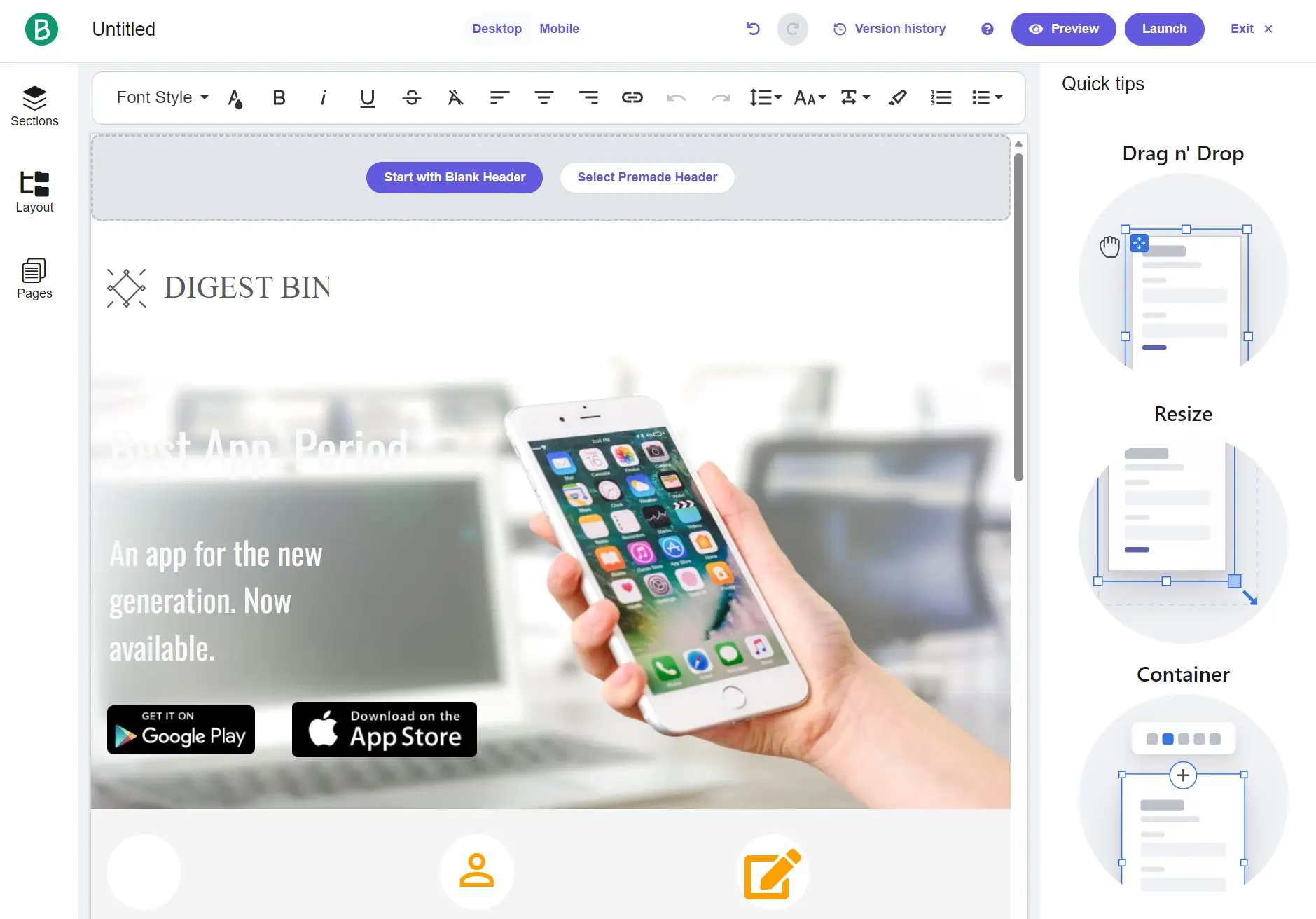
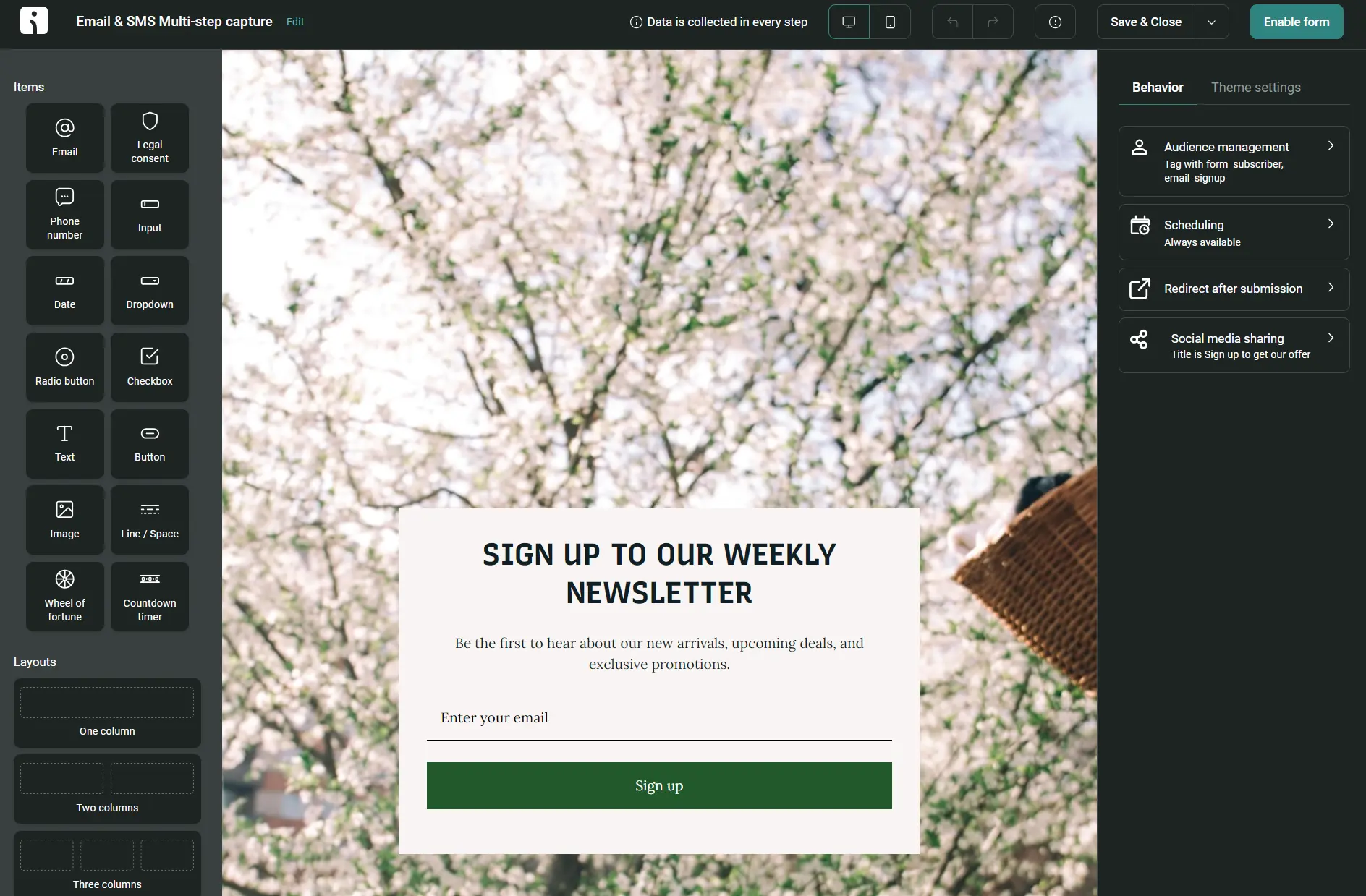
Brevo also lets you build custom sign-up forms across all plans using a drag-and-drop editor that supports text input fields, images, radio button lists, and dropdown lists.
With Omnisend, all plans include pop-ups, fullscreen, embedded, and flyout forms, and landing pages to build your list in multiple ways.
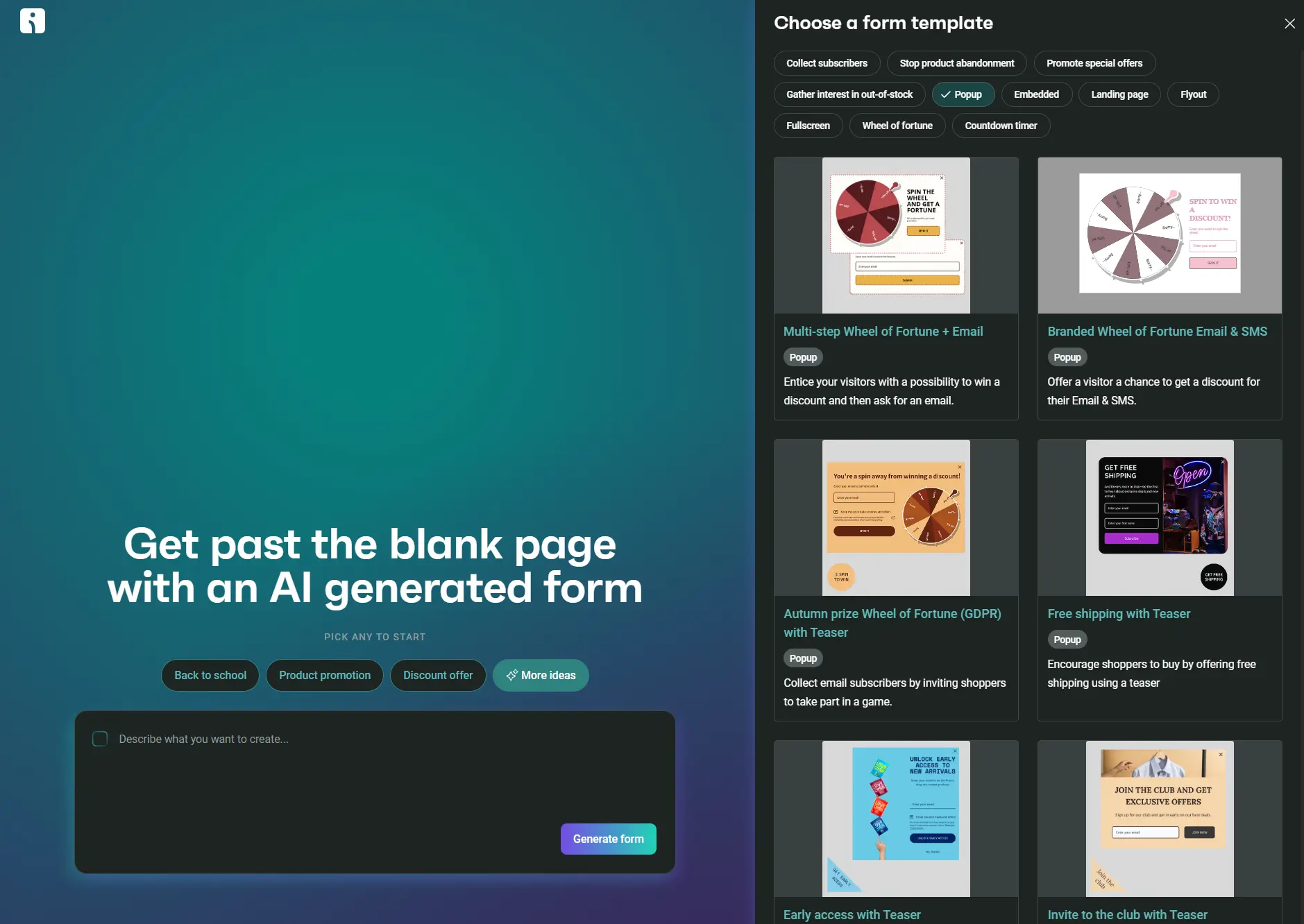
Omnisend’s pop-up targeting controls visibility based on visitor behavior and status. Display forms to new visitors only, existing contacts, or segment contacts by browsing patterns and cart activity. Similar targeting controls are available across other sign-up form types, including flyouts, fullscreen, and embedded forms.
In addition to pop-ups, Omnisend has Wheel of Fortune gamification, multi-step forms, unobtrusive teasers that remain minimized on-screen until clicked, and landing pages.
Segmentation features
Omnisend’s segmentation features are better than Brevo’s. They include an AI segment builder and more pre-built templates to group customers based on purchase activity linked to your ecommerce store. Brevo’s segmentation suits businesses with predictable customer journeys.
Brevo and Omnisend both offer behavioral segmentation, purchase history filtering, and demographic grouping. The difference lies in execution and depth, with Omnisend’s 32 segment templates covering more ecommerce scenarios.
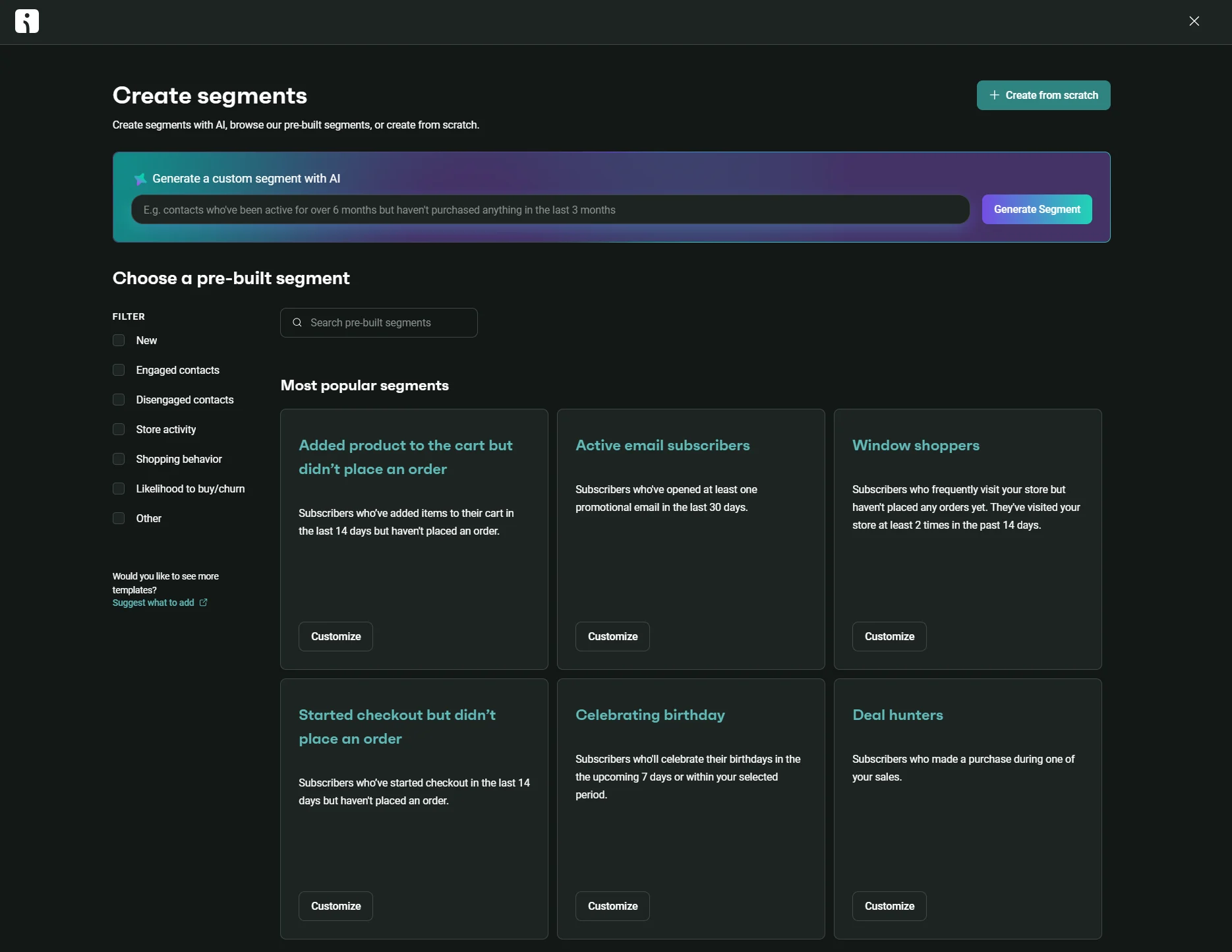
Omnisend provides seven segmentation categories for customers who are at different stages of their journey, from pre- to post-purchase.
These segments update automatically and work across email, SMS, and push notifications. Additionally, segments include Facebook and Google sync capabilities for retargeting your customers on social media.
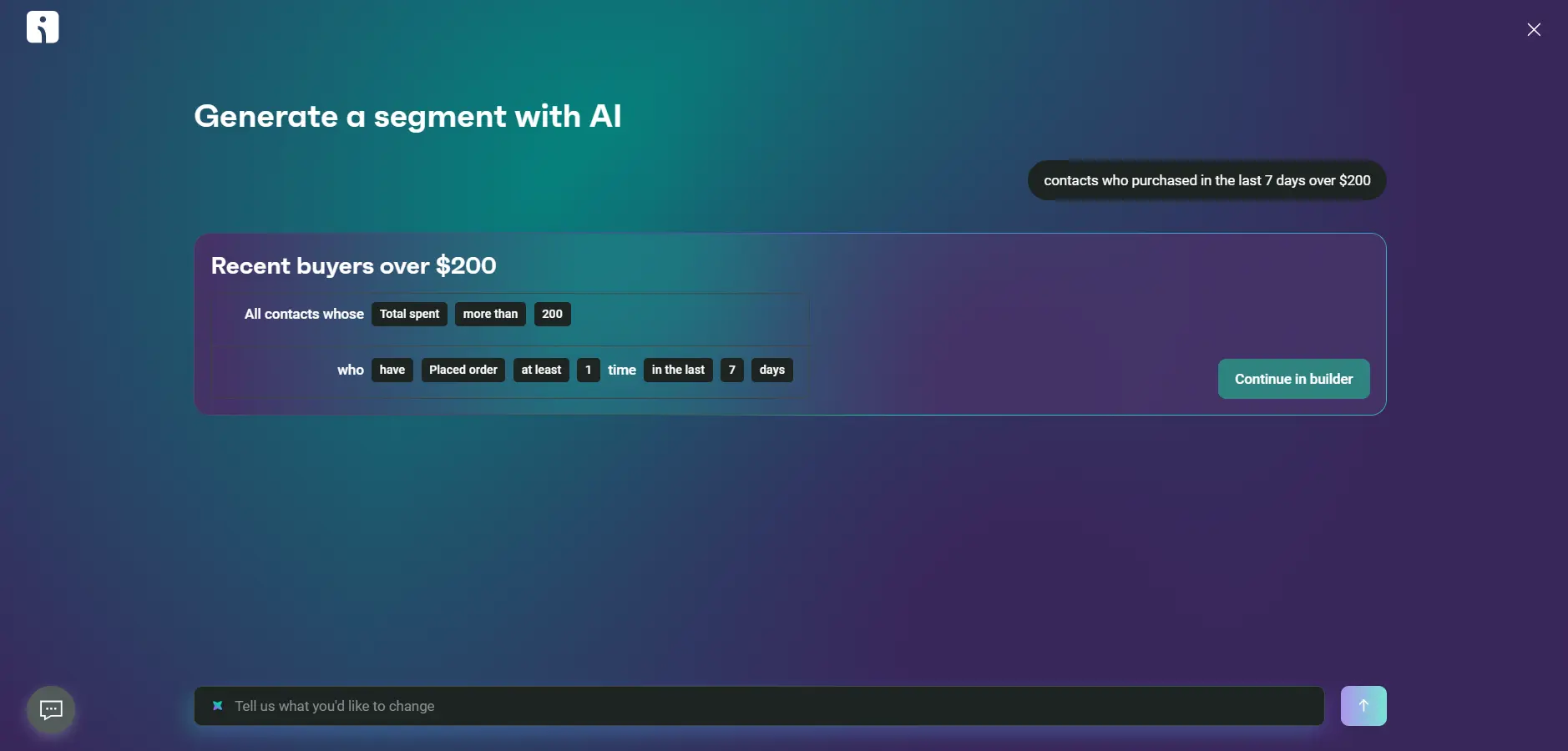
Omnisend’s AI segment builder is available across all plans: type what you want (“high-value customers from last quarter”) and it builds the rules. Brevo requires manual rule creation, with AI assistance limited to Professional plans and above.
One G2 reviewer reports, “The segmentation features have been genuinely useful for organizing our contacts by property type, location, and lease status.”
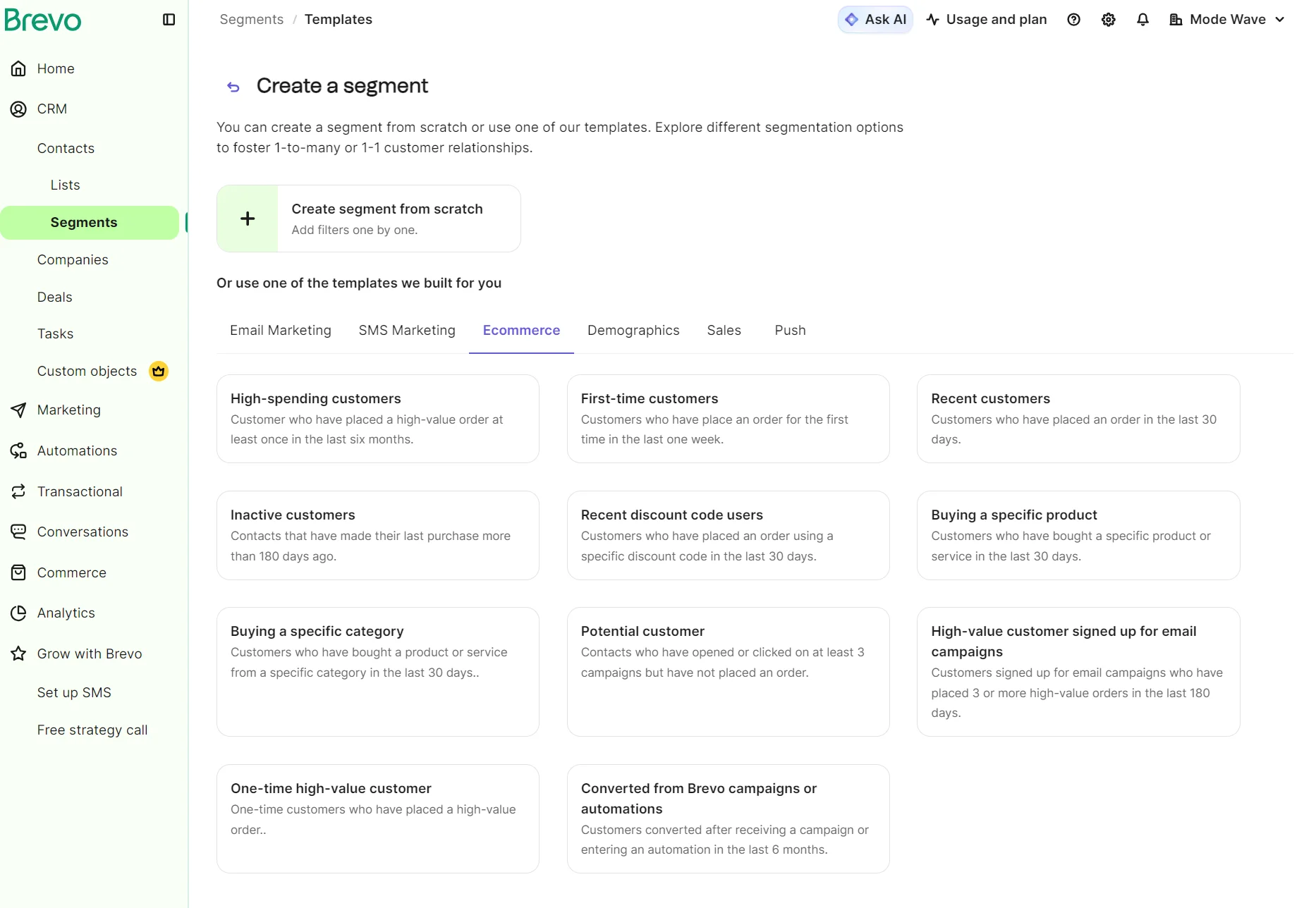
Brevo handles standard segmentation with a cap of 100 conditions. You can segment across email and SMS channels, though it focuses more on straightforward contact filtering than complex behavioral patterns.
There are 28 segmentation templates in Brevo, including 11 in the ecommerce category.
Brevo users on G2 have overwhelmingly positive thoughts on its segmentation features, with one reviewer saying, “Manage Email Lists makes it much easier to organize contacts, segment audiences, and send the right campaigns to the right people.”
Analytics and reporting
Omnisend has better reporting capabilities than Brevo with pre-built campaign, automation, and form dashboards. Only Brevo’s Professional plan has pre-built dashboards. Both report on ecommerce revenue with a connected store.
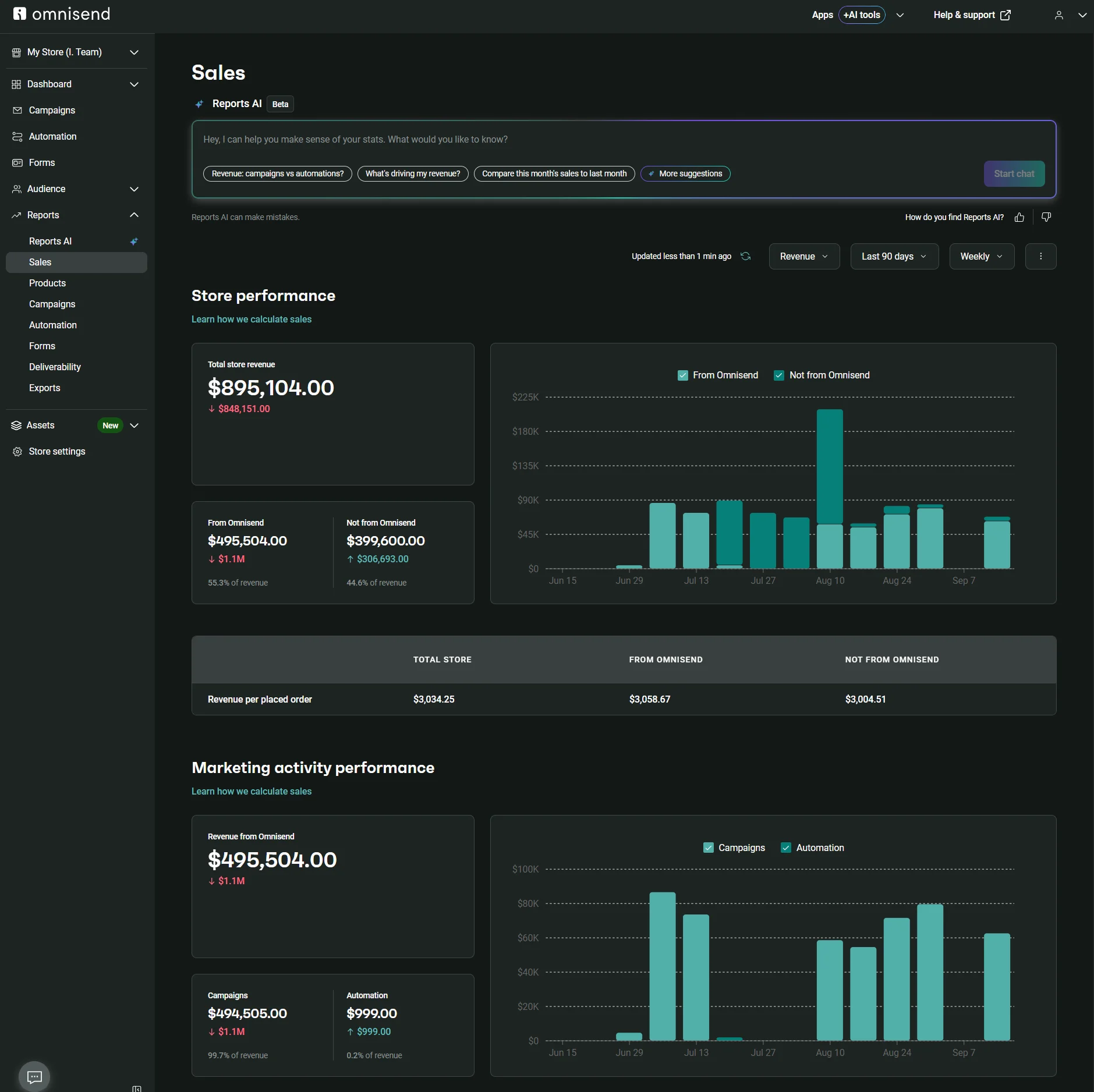
All Omnisend plans track revenue attribution, conversions, and purchase data, which flow automatically from your store integration.
The dashboard displays total store revenue versus Omnisend-attributed sales, letting you see marketing ROI instantly. Individual workflow performance breaks down revenue by automation type, such as abandoned cart recovery versus welcome series.
With Brevo’s Statistics pages, available from Starter, you can track email campaign performance across soft and hard bounces, opens, clicks, conversions, revenue, unsubscribe rate, and more.
Sent campaigns and automations have a dashboard with statistics and a timeline to break down performance and activity.
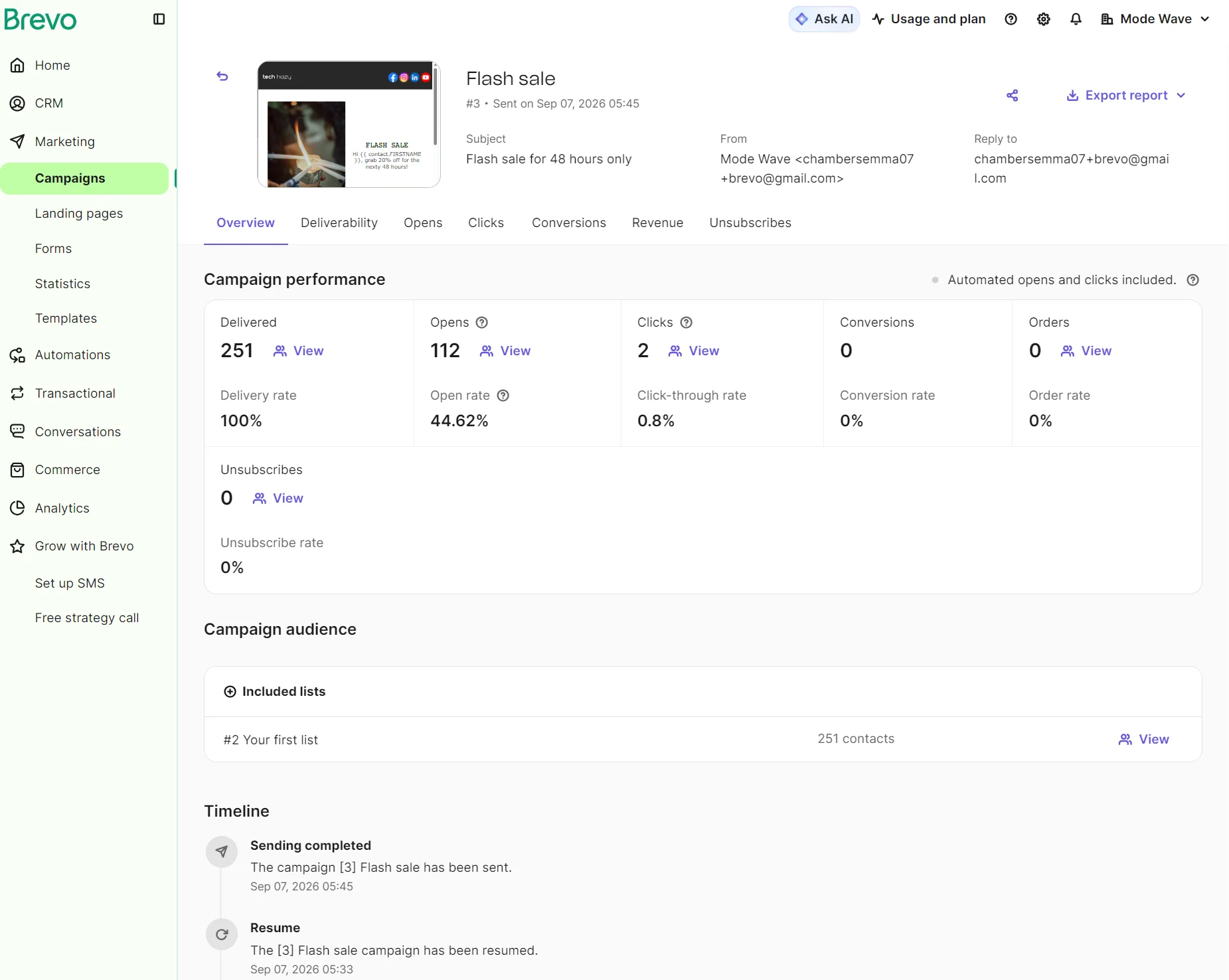
Brevo’s Shopify and WooCommerce apps automatically track sales, although a script or API is necessary for custom-built stores.
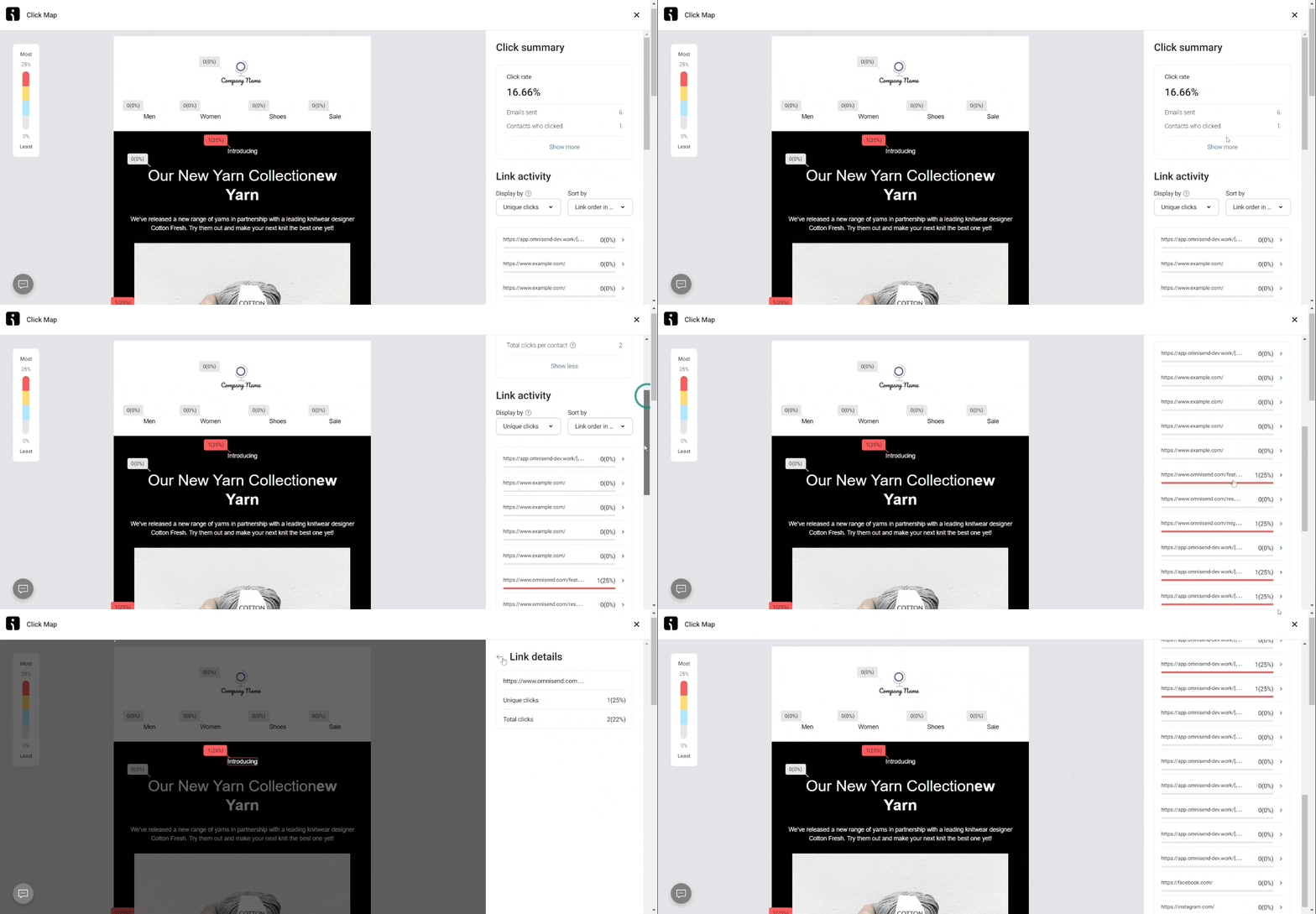
Email client breakdown (Gmail versus Outlook performance) and geographic distribution maps in Brevo provide detailed recipient analysis. Click heatmaps appear in both platforms for visualizing engagement patterns.
Brevo has a Deliverability Center that scores your deliverability with analytics for open rate, click rate, bounce rate, negative engagement, and domain authentication. Omnisend’s Deliverability dashboard provides a sender health overview with poor, fair, good, and no status ratings.
SMS capabilities
Omnisend has broader SMS coverage across 190+ countries compared to Brevo’s 180+, and it treats SMS as a primary channel with multichannel automation templates.
Brevo and Omnisend require purchasing SMS credits. Brevo has SMS available as a channel in all plans with prepaid credits that roll over and don’t expire; Omnisend supports SMS in its Pro plan with volume-based pricing.
You can build standalone SMS campaigns in either tool and send bulk/mass messages to your customers.
If you want to include SMS alongside email in automations, Omnisend and Brevo both offer these capabilities. Omnisend has pre-built templates for email + SMS, whereas Brevo provides single-channel templates you can edit to contain both channels.
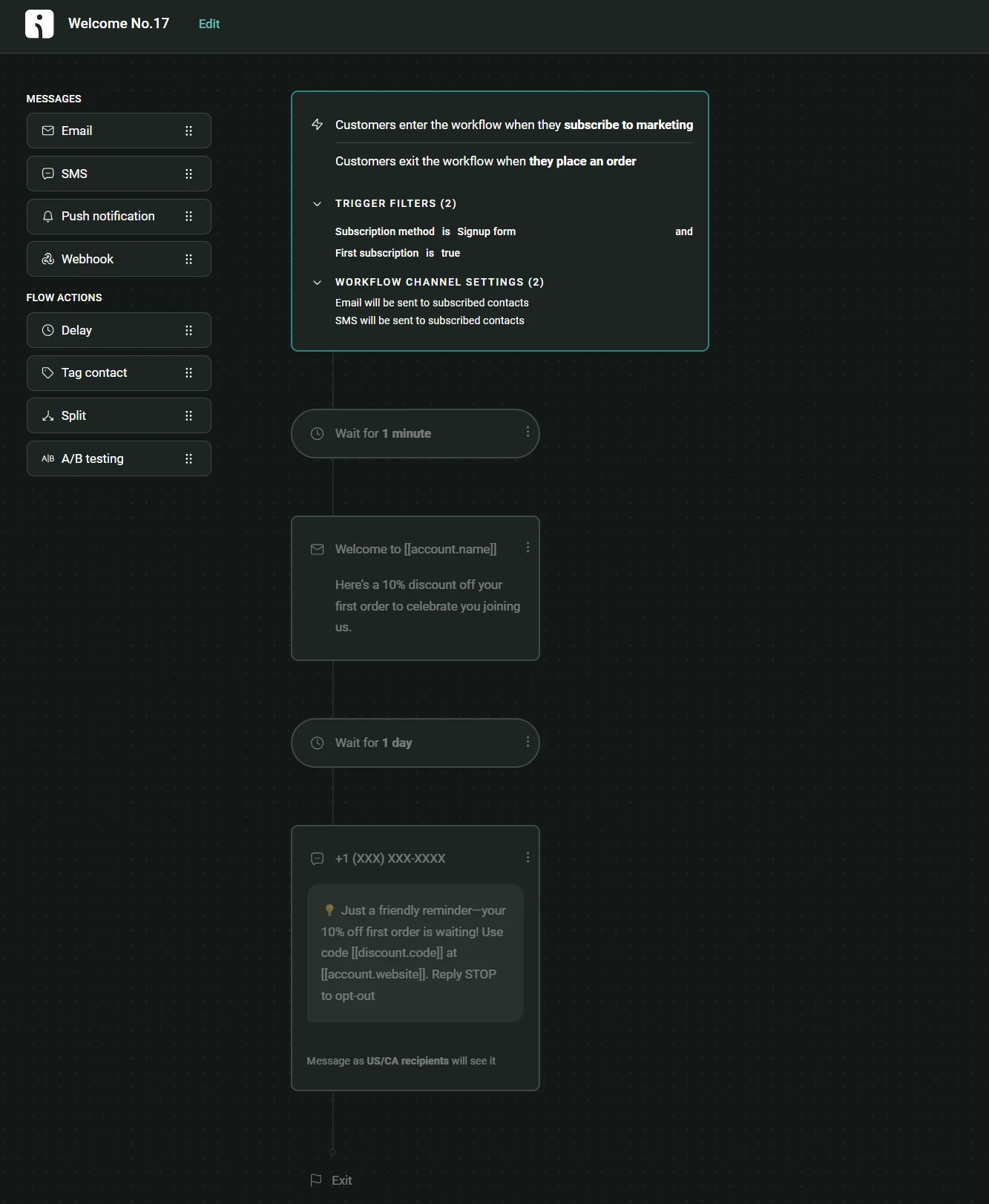
Brevo’s automation builder supports SMS and email regardless of automation type, and asks you to complete settings per message when dragging the channel onto the canvas.
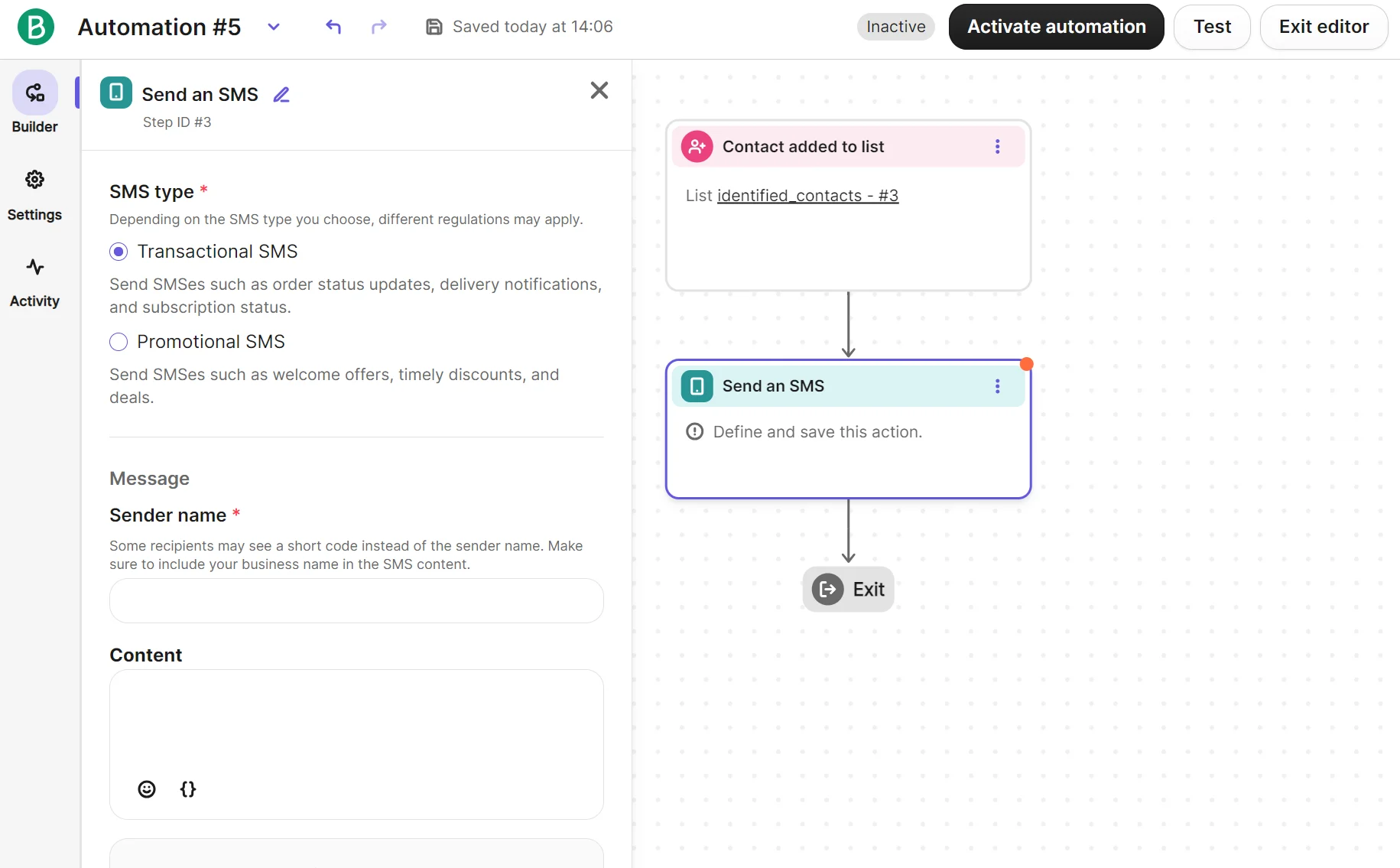
Omnisend consolidates reporting across channels. You can view the number of SMS sent, revenue, click rate (if you use trackable links), campaign costs, and unsubscribe rates.
Brevo provides SMS analytics, including delivery rates, click tracking, and geographic distribution, separately from email reports.
Watch this video to learn how to create your first email and SMS campaign in Omnisend:
Ecommerce capabilities
Omnisend is better than Brevo for ecommerce stores. It supports building emails with more dynamic product recommendations, plus abandonment flows with pre-built templates that target cart, checkout, and browse scenarios.
Shopify, WooCommerce, and BigCommerce apps are available in Brevo and Omnisend. These pull your customer, product, collection, order, and customer behavior data over and effectively create the link to segments, forms, automations, and campaigns.
Brevo’s ecommerce features tie into prospect and booking flows, its CRM, and sales capabilities. There’s less focus on marketing and optimizing revenue and retention than there is in Omnisend.
Product recommendations
Omnisend has better product recommendation options than Brevo. Its Free plan supports best-selling, recently added, and most viewed product blocks in campaigns and automations.
If you have the Pro plan, you can assign custom contacts to the above blocks to show unique recommendations per segment. Additionally, you can add the recently viewed and similar to past purchases blocks, which use AI to recommend products.
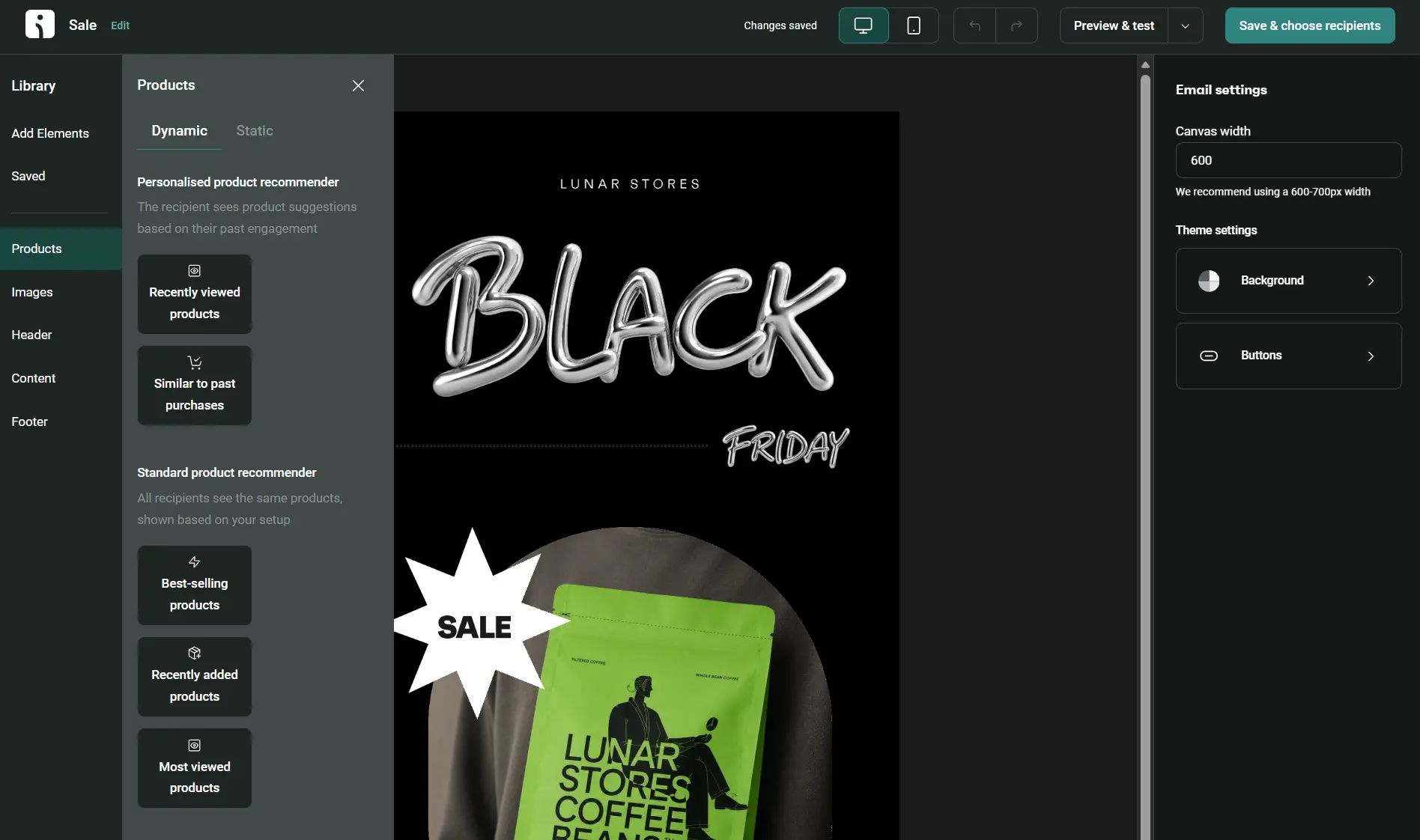
Brevo doesn’t allow AI product recommendations below its Professional plan. You can import products from your store and add them to a product block to show in email campaigns.
The product block pulls images, names, descriptions, prices, and URLs directly from your connected store into emails. You can add up to nine products per block and customize layout and content display order.
Abandoned cart automation
Brevo and Omnisend have pre-built abandoned cart automations. Brevo’s flow contains one trigger, a delay, and an email to start.
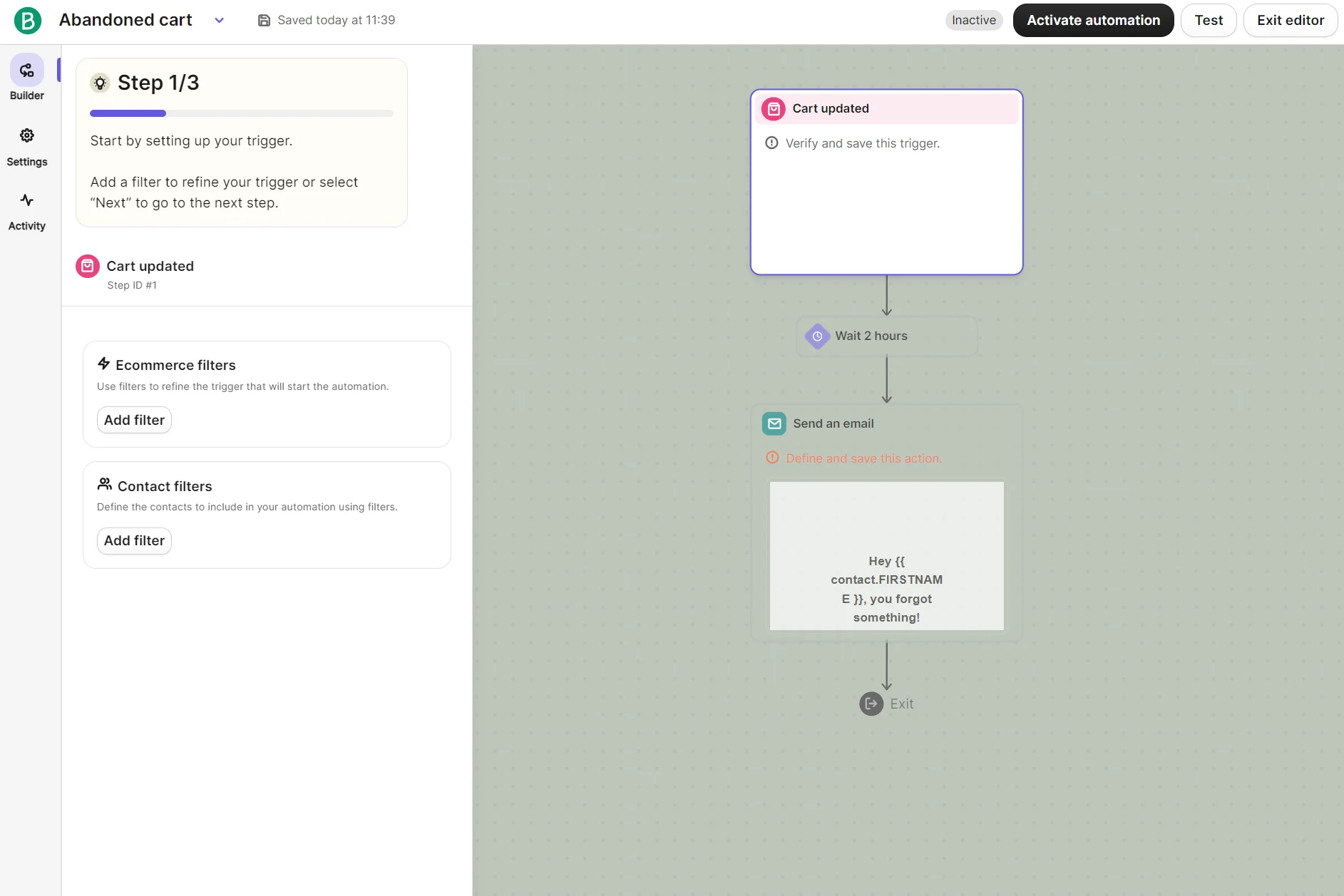
The drag-and-drop flow builder lets you add new delays and emails to your flow, effectively turning the standalone automation into a series. Plus, you can add an SMS to your flow for a multichannel approach.
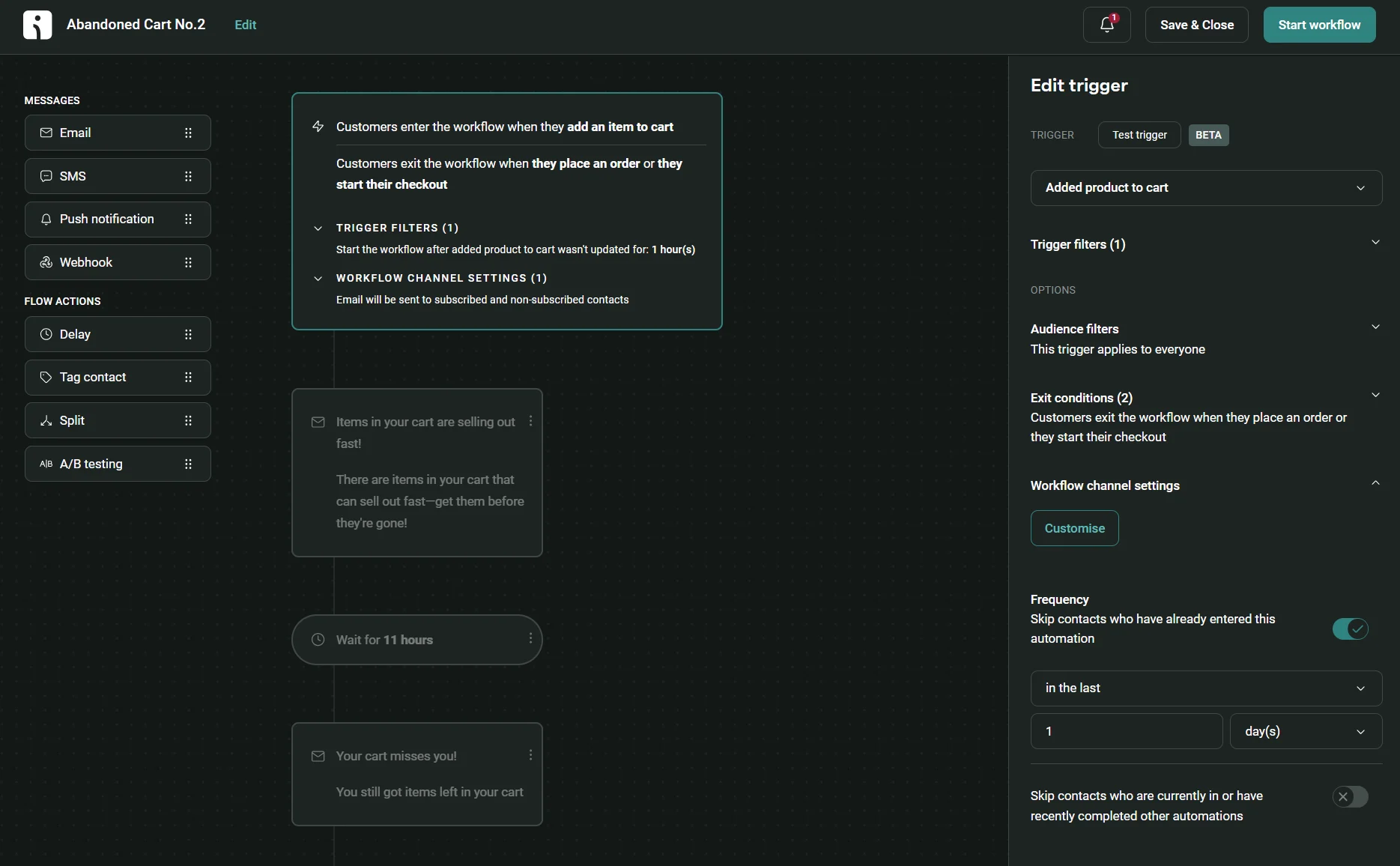
Omnisend has more abandonment flows than Brevo, including a three-email cart recovery series, a checkout series with or without SMS, and browse abandonment emails. Its flow builder lets you add additional audience filters, exit conditions, and triggers.
Purchase-based segmentation
Omnisend segments update in real time as shopping behavior changes. You can filter by products ordered or viewed, order value, purchase frequency, and combine conditions with AND/OR logic.
The AI segment builder converts prompts into rules, and any segments you set up can work as automation triggers, campaign audiences, and form targeting filters.
Brevo auto-updates segments based on order history, product purchases, and spending thresholds, letting you layer up to 100 conditions using AND/OR operators.
Aura AI lets you generate segments from text prompts on the Professional plan. Segments are usable in targeted campaigns, automations, and database analysis.
Revenue attribution
Omnisend gives you last-touch attribution with flexible windows, the defaults being seven days for email and 24 hours for SMS and push.
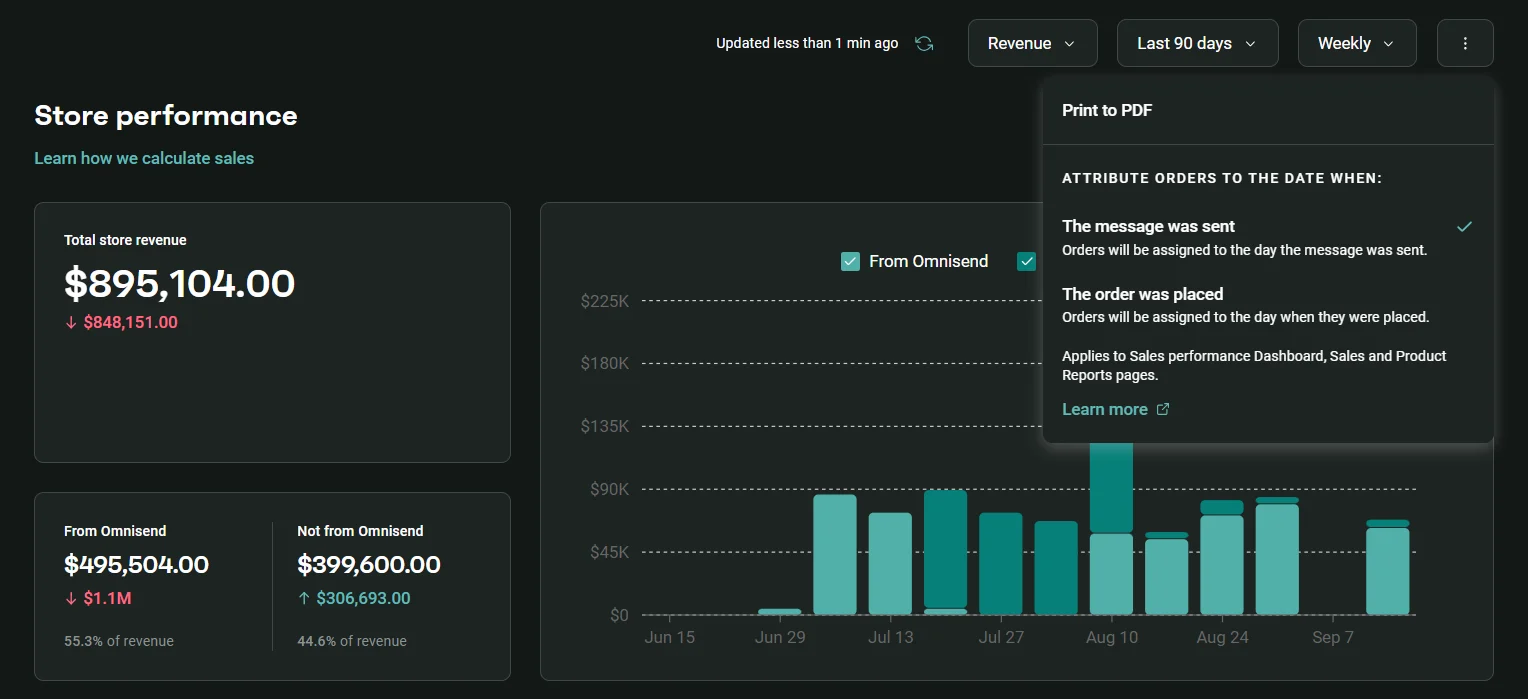
Sales count when customers engage (open or click), and you can track multiple orders from the same message. Revenue gets assigned to the day you sent the campaign, so you see what’s working in real time.
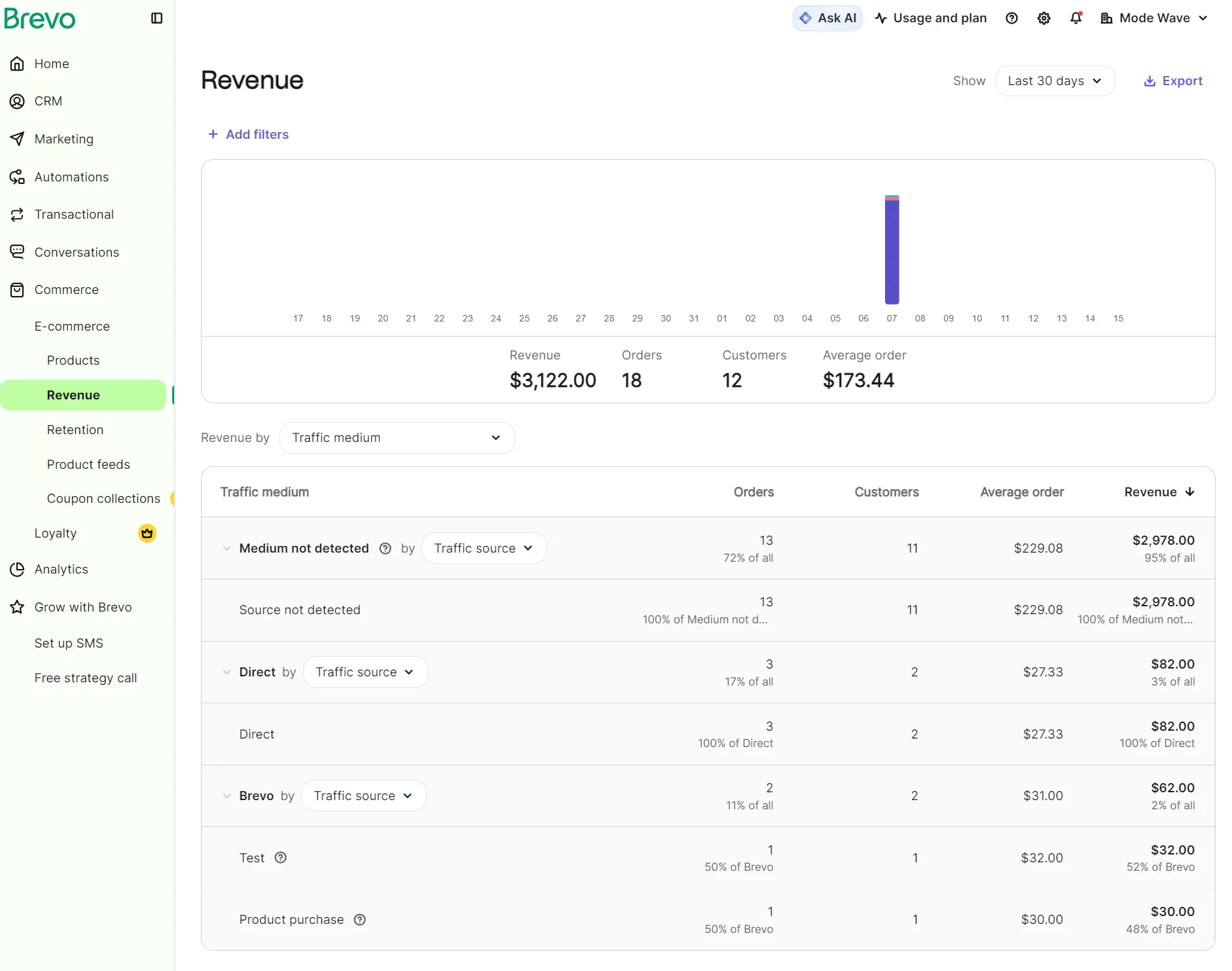
Brevo gives you 48 hours from the last touchpoint (email, SMS, or automation) to claim the sale. Store connection via the Shopify app or API is required.
Instead of just channel metrics, you get cross-platform context, including traffic sources, devices, billing locations, and payment methods.
Integration capabilities
Omnisend has a broader integrations library with coverage of more apps that Shopify and WooCommerce stores use in their daily workflows.
The Omnisend App Market has 305+ app integrations; Brevo has 140+. Both connect to Zapier, offering additional connections to thousands of apps. Brevo’s integrations stack leans heavily on CRM and data integrations, whereas Omnisend syncs more ecommerce apps.
One of Omnisend’s biggest pluses is that it integrates with additional email capture and marketing apps, such as Recart, OptiMonk, WisePops, and OptinMonster. It also has more apps in popular categories: 39 for loyalty and rewards, 21 for advertising, and 27 for subscriptions.
Additionally, it has one-click ecommerce integrations for Shopify, WooCommerce, BigCommerce, and more. These let you connect your store, import contacts and orders, and start creating email campaigns and automations within 10 minutes.
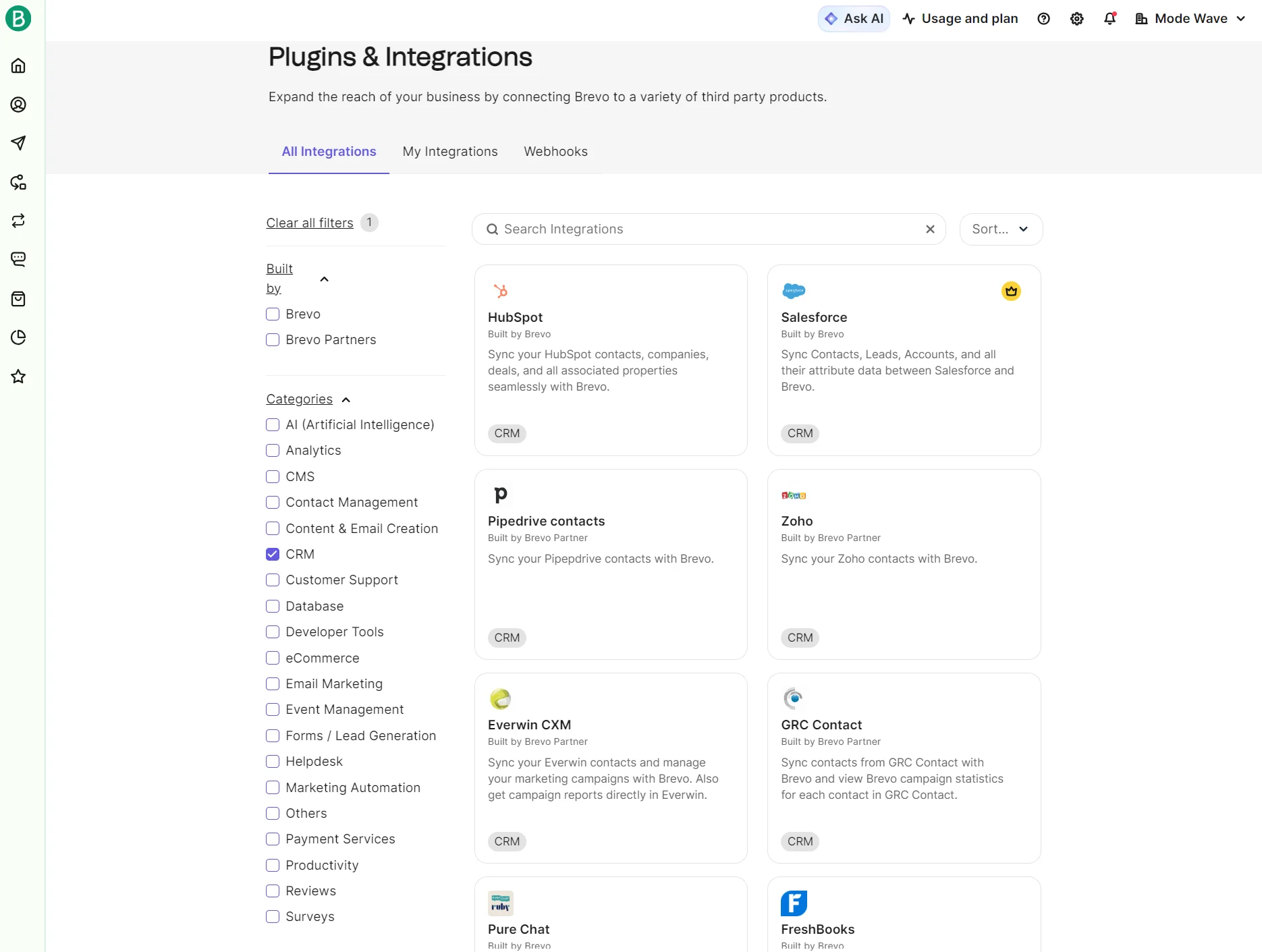
Brevo has similar ecommerce integrations. Its selling point is integrations with CRMs, including Salesforce, HubSpot, Zoho, Pipedrive Contacts, Everwin, Streak, Microsoft Dynamics, and GRC Contact. Omnisend has fewer CRM integrations.
Here’s what Brevo’s integrations page looks like in the backend:
And here’s Omnisend’s App Market page within the backend:
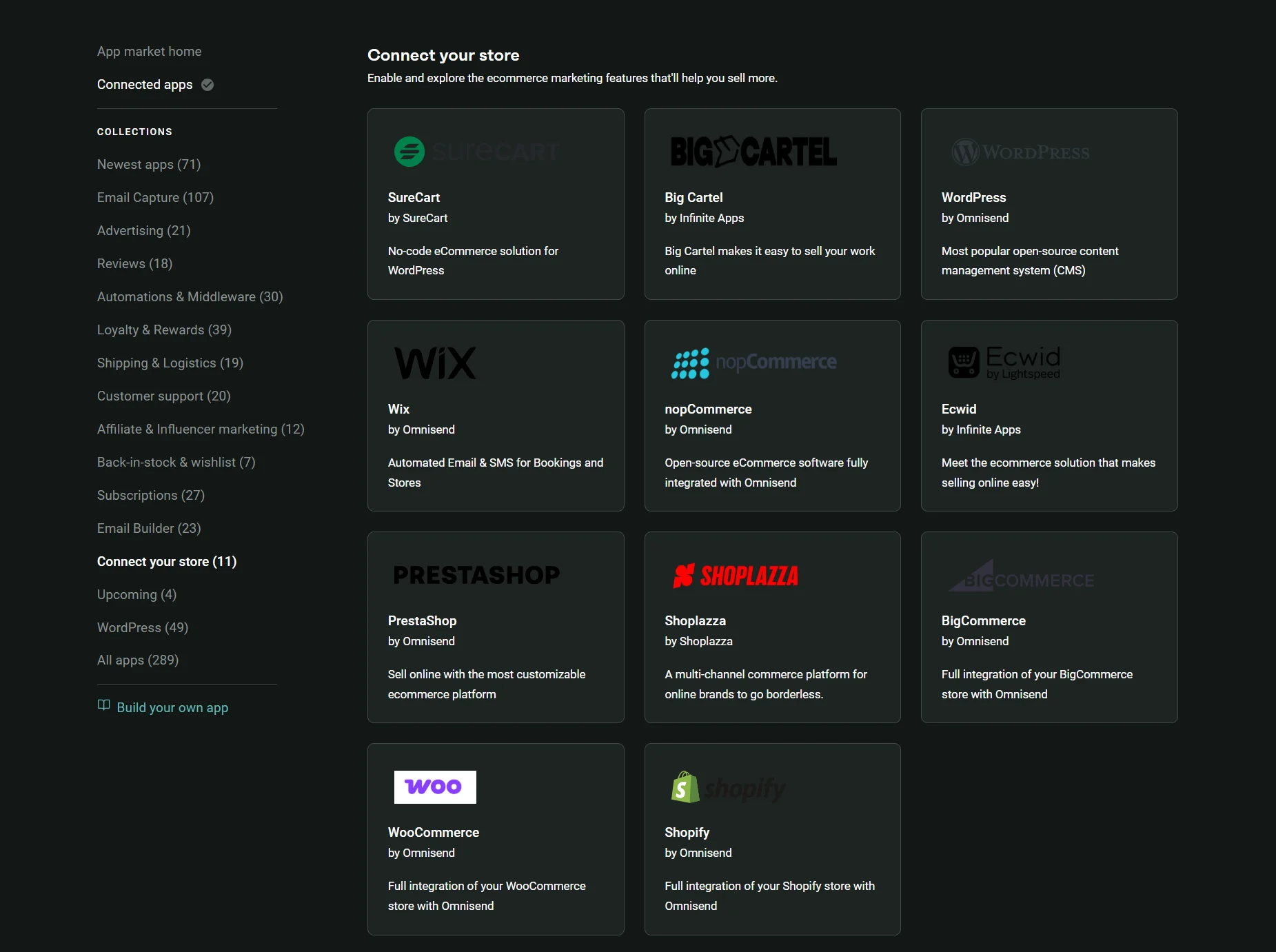
The fact that Omnisend provides an app count for its categories is beneficial when assessing scope. Brevo only provides a count at the bottom of results pages, making it difficult to determine whether it’s suitable for your existing stack.
Pricing
Brevo has a lower entry point at $9/month versus $16/month, and it charges you less to store large lists. Omnisend works out to be a better value when your send-to-contact ratio is high, or when you want access to the most advanced features without spending a minimum of $499/month for Brevo’s Professional plan.
Brevo charges based on email volume; Omnisend charges based on contact count. The Brevo pricing model suits large lists with infrequent sends. Omnisend suits frequent senders.
We’ve compared Brevo’s Starter and Standard plans with Omnisend’s Standard and Pro plans below.
| Contacts | Brevo Starter | Brevo Standard | Brevo sends/month | Omnisend Standard | Omnisend Pro |
|---|---|---|---|---|---|
| 1,500 | $17 | $35 | 10,000 | $25 | – |
| 2,500 | $25 | $49 | 15,000 | $44 | $59 |
| 10,000 | $32 | $69 | 20,000 | $132 | $150 |
| 20,000 | $32 | $69 | 20,000 | $265 | $375 |
The table shows that Omnisend Standard is better value than Brevo Standard at 1,500 and 2,500 contacts. Brevo is better value for large list sizes at 20,000 sends, because that tier in Starter and Standard plans includes storage for 500,000 contacts.
Omnisend’s Pro plan has unlimited email sends, and the Standard plan has a 12x contact send multiplier. If you send lots of emails relative to your list size, then Omnisend could be cheaper than Brevo on a per-send basis.
Brevo‘s plans also restrict ecommerce features that Omnisend includes at a lower price. Only the Professional plan, from $499/month, has pop-ups, email frequency management, reusable content sections, dynamic coupons, and AI product recommendations.
SMS pricing
SMS pricing in Brevo starts at $1.09 for 100 message credits. Prices depend on volume and destination country, with different countries consuming different credit volumes per message. SMS credits never expire and are non-refundable.
| Brevo number of messages | Bundle cost |
|---|---|
| 100 | $1.09 |
| 200 | $2.18 |
| 500 | $5.45 |
| 1,000 | $10.90 |
Omnisend’s SMS pricing starts at $10/month for approximately 1,111 SMS/month in the United States. Prices go as low as $0.007/SMS with $10,000/month in spend.
| Omnisend number of credits | Bundle cost per month |
|---|---|
| 1,111 | $10 |
| 2,222 | $20 |
| 5,882 | $50 |
| 11,765 | $100 |
Use our quick pricing calculator to compare email marketing costs for your list size:
Quick email provider pricing comparison
Quickly and easily compare the top email marketing providers so you can find the best platform for your ecommerce store needs.
prices for:
You can compare Omnisend and 2 more providers at once.
- Omnisend
- Klaviyo
- Mailchimp
- Drip
- Moosend
- Active Campaign
- Get Response GetResponse
- MailerLite
You can compare Omnisend and 2 more providers at once.
Select at least one provider.
Try out the full version of this calculator
Customer support
Omnisend has more support options than Brevo across all plans. You can chat with an expert 24/7, whereas Brevo’s human support is limited to a ticket and email system below Professional.
Free, Starter, and Standard Brevo plans receive email support only. Phone support and a deliverability specialist are included in Professional. No plans have human live chat, although Aura AI can answer questions.
In comparison, Omnisend provides 24/7 live chat and customer email support across all plans, including the Free plan. Standard and Pro plan customers with $400/month or more spend get a dedicated Account Expert.
So, how do Brevo vs. Omnisend stack up for real-world customer service?
Omnisend has won five Stevie Awards for customer support over five consecutive years from 2022–2026. Brevo’s latest awards include the Capterra Shortlist 2026.
G2 is the best review platform for gauging feedback about customer service, and it doesn’t disappoint for insights into both tools:
Omnisend customer support reviews
The onboarding process was smooth, and the support team was available to answer questions whenever we needed them.
– Dr. Anya S.
The customer support is really helpful with quick response times through chat, which isn’t always the case with marketing tools.
– Aman D.
Brevo customer support reviews
Overall, if 24/7 support via live chat is important to your business, Omnisend is the best tool. However, Brevo’s email support is highly rated among customers.
Who should use each platform?
Omnisend suits you if you’re an ecommerce store interested in optimizing your customer lifecycle from pre- to post-purchase. It provides the forms, segments, flows, and reports you need to maximize revenue across email and SMS.
Brevo suits you if you occasionally sell products and are primarily a service business, a business-to-business (B2B) company, or manage leads and sales as part of your operations. It lacks an ecommerce focus but handles CRM and sales pipelines better than Omnisend.
Consider these factors and scenarios when choosing between Brevo vs. Omnisend:
Omnisend is best for
Omnisend is the best-fit email app if you want to improve ecommerce sales and customer experience with omnichannel automations.
Being able to create flows combining email, SMS, and push notifications that trigger based on purchases, engagement, and segment activity ensures your marketing stays synchronized with customers for appropriate targeting.
Native integration with Shopify, WooCommerce, and BigCommerce is a feature shared with Brevo. Omnisend’s integrations include more apps that stores typically use.
24/7 live chat and email support help you maximize these features regardless of plan level, with Omnisend’s customers generating a $79 ROI for every $1 spent in 2025.
Brevo is best for
Brevo is best for your small- to medium-sized business if it manages sales pipelines and sells products online. For instance, you manage service contracts but also sell replacement parts. Brevo gives you a bit of everything, at the expense of advanced ecommerce features.
The built-in CRM connects marketing to sales activities. Track leads, score prospects, and manage deals, all while running email campaigns.
WhatsApp business messaging and additional CRM integrations support you better if you have complex customer relationships.
Brevo’s pricing accommodates irregular sending patterns, and the generous free tier (300 emails/day) works for genuine small operations. If the pricing does not work for you, try looking at Brevo alternatives.
Omnisend vs. Brevo (formerly Sendinblue): Final thoughts
Omnisend vs. Brevo comes down to who your customers are and to what level you want to optimize your customer journey across email and SMS.
If you sell products, Omnisend takes a lifecycle approach to your marketing, helping you appear at more high-intent moments, retain customers, and increase revenue.
Brevo is the pick if you have sales cycles, business customers, and deals to manage, with a side of ecommerce. Its CRM and basic automations do enough.
| Category | Better choice |
|---|---|
| Email campaigns | 🏆 Omnisend |
| Marketing automation | 🏆 Omnisend |
| Email list-building | 🏆 Omnisend |
| Segmentation features | 🏆 Omnisend |
| Analytics and reporting | 🏆 Omnisend |
| SMS capabilities | 🤝 Tie |
| Ecommerce capabilities | 🏆 Omnisend |
| Integration capabilities | 🏆 Omnisend |
| Pricing | 🏆 Brevo |
| Customer support | 🏆 Omnisend |
Both have free plans that don’t require payment card information; sign up for both and see what you think. Omnisend includes more features at that tier, such as pop-ups.
Quick sign up | No credit card required