Omnisend AI

 OFFER
OFFER









Personalized SMS marketing helps ecommerce brands send text messages that match customers’ needs. It focuses on relevance, not mass messaging. This leads to better engagement than generic SMS campaigns.
In fact, a recent report shows that 65% of customers are open to receiving and engaging with messages if they are personalized. When messages reflect customer interests, shopping habits, or choices, they are more likely to grab attention and encourage action. Personalization also helps brands create better customer experiences, increase conversions, and encourage repeat purchases.
This article explains what personalized SMS marketing is and why it matters for ecommerce brands. You’ll learn how to personalize text messages using data like names, purchase history, location, and loyalty status. You’ll also learn to use personalized bulk SMS and automation to scale your efforts.
Quick sign up | No credit card required
What is personalized SMS marketing?
Personalized SMS marketing involves sending text messages tailored to each customer. It uses customer data like names, purchase history, location, and interests. This makes messages more relevant and useful for each person.
Generic SMS marketing sends the same message to everyone on your list. No changes, no adjustments — one version for all customers. That’s why these messages often get ignored. When content doesn’t match what a customer actually wants, they tune it out.
Personalized SMS marketing uses customer data to send messages that actually match what each customer wants. That might be a product recommendation based on past purchases, a birthday offer, or a cart reminder sent at the right moment. The message feels like it was written for them — because it was.
Today, customers expect this kind of experience. They want brands to remember their preferences and send relevant offers. Personalization is no longer a special feature. It is now a normal and important part of ecommerce marketing.
Personalized SMS marketing can include:
- First name personalization in messages
- Product recommendations based on past purchases
- Location-based offers and store updates
- Messages triggered by browsing or cart activity
- Loyalty rewards and VIP status updates
- Birthday and milestone messages
Personalized SMS vs. generic broadcast SMS: The performance gap
SMS marketing already performs well because text messages are fast and easy to read. In fact, data shows that SMS campaigns see an open rate of 98%. But personalization improves performance even more. Customers respond better when messages feel relevant to them.
Also, personalized SMS marketing messages often get better conversion rates than generic texts. Customers are also less likely to unsubscribe because messages match their interests. Generic messages may reach many people, but not connect with individual customers.
Here’s an overview of how generic and personalized SMS marketing differ in performance.
| Metric | Personalized SMS | Generic broadcast SMS |
|---|---|---|
| Open rate | Up to 98% | Around 90 - 98% |
| Click-through rate | Around 31.84 - 66.67% click-through rate for Back in Stock SMS with product interest and history personalization | Average rate of 27.7% |
| Conversion rate | 6-13% conversion rate for SMS abandoned cart campaigns | Average conversion rate of 0.19% for SMS campaigns |
| Unsubscribe or opt-out rate | Average rate of 0.34% for targeted campaigns | Average opt-out rate of 0.40% for broadcast SMS |
| Customer satisfaction | 93% of shoppers stay loyal when experiences are personalized | 80% are likely to ignore generic or irrelevant messages |
Personalized SMS marketing works because it focuses on relevance. These details can make a big difference in how customers react to SMS campaigns.
Types of personalized SMS messages (with real examples)
Personalized SMS marketing uses different types of customer data to make messages more relevant. Ecommerce brands can personalize based on identity, behavior, location, and timing. Below are key types of personalized SMS messages and how they work in real campaigns.
First name and basic profile personalization
First-name personalization is the most basic form of SMS personalization. It uses simple customer details like the name or profile info. Customer profile information can include details such as location, gender, birthday, or preferences collected during signup. This helps messages feel more direct and personal. It is often used in welcome messages or first-time offers. However, it is only a starting point and works best when combined with other data, like product interest or purchase behavior.
SMS example:
Hey Sarah, welcome to (Name of Brand or store). We noticed you signed up for women’s activewear updates.
Here’s 15% off your first order today. Shop our new arrivals here (link to store) before your welcome offer expires tonight.
Data used: First name + product interest
Outcome: Increase engagement and first purchase conversions
Purchase history and product-based personalization
This type of personalization in ecommerce uses data on what a customer has bought before. It helps brands recommend related products or remind customers to reorder items. It also supports upselling by suggesting better or newer products.
This makes the message more relevant because it connects to shopping behavior. It also increases the chance of repeat purchases.
SMS example:
Hi Sarah, we noticed you recently purchased our Vitamin C Serum. Complete your skincare routine with our Hydrating Face Cream and get 15% off today.
Shop now: (Link)
See a real-world example of an SMS that incorporates these personalization elements:
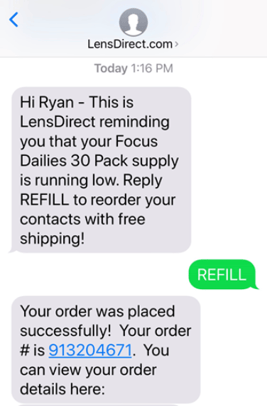
Data used: Purchase history + reorder timing
Outcome: Drive repeat purchases and increase order value
Location and geo-targeted SMS
Location-based personalization uses a customer’s city, ZIP code, or store location to personalize text messages. Brands often use this strategy for local events, in-store promotions, or new product launches.It also helps brands send messages at the right local time, which leads to better engagement since customers get them when they’re more likely to pay attention.
SMS example:
Hi Amanda, our Dallas store is hosting a one-day spring sale this Saturday. Stop by for up to 25% off select home decor items.
You can also pick up online orders in store during the event. Doors open at 9 AM local time.
Data used: Customer location + local store activity
Outcome: Increase local store visits and regional sales
Loyalty status and VIP tier messaging
This type of personalized SMS marketing message uses loyalty program data. Brands can send early-access offers, point reminders, birthday rewards, or VIP-only promotions. These messages help customers feel recognized and appreciated. Customers are more likely to engage when they feel they are getting special treatment.
SMS example:
Hi Jason, you’ve officially reached Platinum status. As one of our top customers, you now get early access to your favorite summer collection. Shop 24 hours before the public launch and enjoy free express shipping. Your VIP reward is now active in your account
Data used: Loyalty tier + product interest
Outcome: Increase customer retention and repeat purchases
Birthday and milestone triggers
Milestone messages focus on important customer moments. These can include birthdays, customer anniversaries, loyalty milestones, or first purchase anniversaries. These messages help brands create stronger emotional connections with shoppers.
SMS example:
Happy Birthday, Emily.
To celebrate, we added a special 20% birthday reward to your account. Use it on any order this week and treat yourself to something new. Thanks for being part of our community this year.
Data used: Birthday date + customer history
Outcome: Increase engagement and strengthen customer loyalty
Abandoned cart and browse abandonment SMS
Cart abandonment SMS targets shoppers who added products to their cart but did not complete checkout. Browse abandonment messages focus on products a customer viewed but didn’t add to the cart. Both strategies target high-intent shoppers who have already shown interest in specific products. This makes them among the highest-converting personalized SMS marketing campaigns.
SMS example:
Hi James, you left the Wireless Noise-Canceling Headphones in your cart. They’re still waiting for you, but stock is running low. Complete your order today and enjoy free shipping: (Link)
See an example of a cart abandonment SMS:
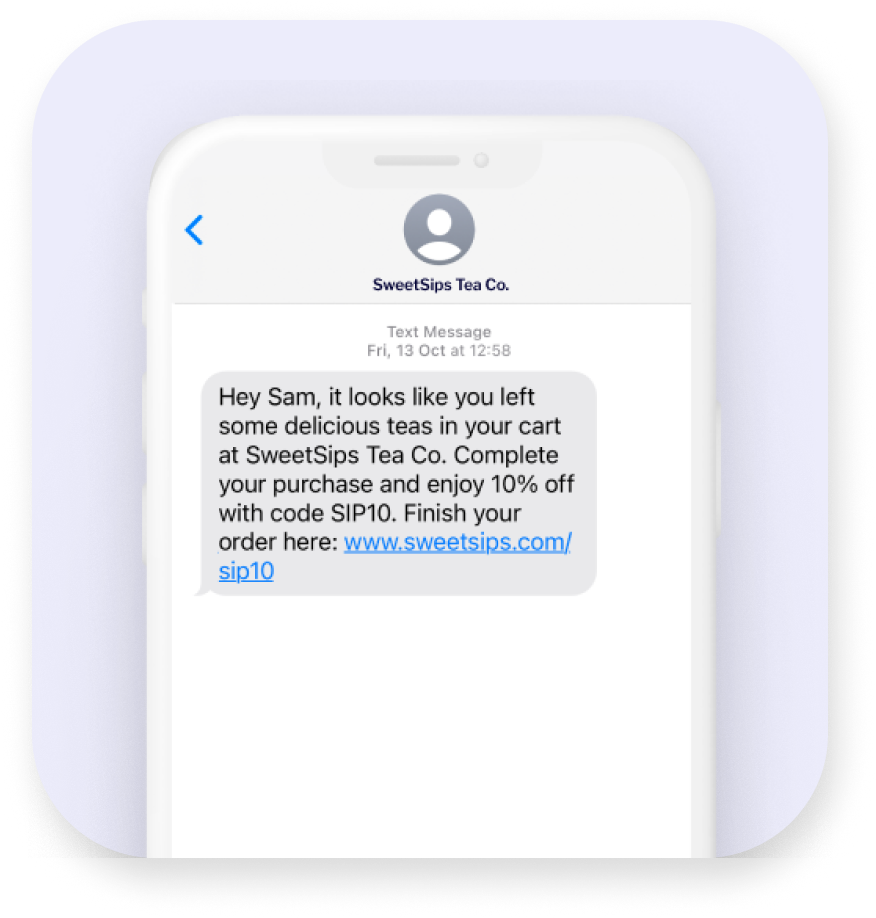
Data used: Cart activity + product data
Outcome: Recover abandoned carts and increase conversions
Re-engagement and win-back messages
Re-engagement messages target customers who have not interacted in a while. They are often used to reduce churn and recover lost revenue. These messages usually include personalized offers or reminders based on past activity. Brands may reference the customer’s favorite category, previous purchases, or time since the last order.
SMS example:
Hi Chris, we miss you. It has been 60 days since your last order. Your favorite fitness apparel collection now has new arrivals.
Here is 15% off your next purchase to welcome you back. Come back and shop with us again today.
Here’s an example of a re-engagement SMS message:
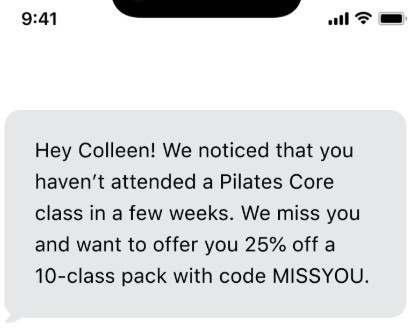
Data used: Inactivity period
Outcome: Re-engage inactive customers and recover lost sales
How to collect data for SMS personalization
Effective personalized SMS marketing depends on the quality of customer data. Brands need to collect useful details to personalize SMS messages without overwhelming subscribers. This process starts at opt-in and continues through customer interactions and engagement.
Opt-in forms and preference centers
Signup or opt-in forms are often the first step in collecting customer data for SMS campaigns. This is where brands collect baseline details to build their SMS marketing list. Most opt-in forms ask for simple information like a phone number, first name, and email address.
Preference centers build on this data after subscription. Subscribers get to choose the type of messages they want to receive and how often.
Some recommended data fields to collect for personalized SMS marketing include:
- First name — Helps personalize SMS greetings and welcome offers
- Phone number — Required for SMS delivery and consent tracking
- Email address — Supports cross-channel campaigns with SMS and email personalization
- Product interests — Helps segment subscribers by category preferences
- Birthday or birth month — Supports birthday rewards and milestone campaigns
- SMS frequency preferences — Let subscribers choose how often they hear from your brand
Zero-party and first-party data tactics
Zero-party data is information customers share with a brand. This may include style preferences, favorite products, or shopping goals. First-party data comes from tracking customer behavioral data over time. This includes website visits, clicks, purchases, and browsing activity.
Both types of data help brands create relevant campaigns and better customer experiences. Personalized SMS marketing improves when brands use this data for better targeting.
Here are a few effective ways to collect zero-party data:
- Preference quizzes: Ask customers a short set of guided questions during signup. The answers will help understand preferences and improve SMS targeting.
- SMS surveys: Send short follow-up surveys after key actions like signup or purchase. These capture insights on interest, intent, and satisfaction.
- Interactive text replies: Invite customers to respond to SMS prompts with keywords. These replies become engagement data for future campaigns.
Post-purchase surveys and loyalty enrollment
Data collection for personalized SMS marketing should continue even after sales. This helps brands learn more about customers and improve future messages and offers.
Post-purchase surveys are one way to collect this data. They help brands understand how customers feel about their products and services. They can also show how smooth or difficult the shopping experience was.
Feedback can also reveal what products or experiences customers value most. Brands can then use this information to improve future SMS campaigns and product recommendations.
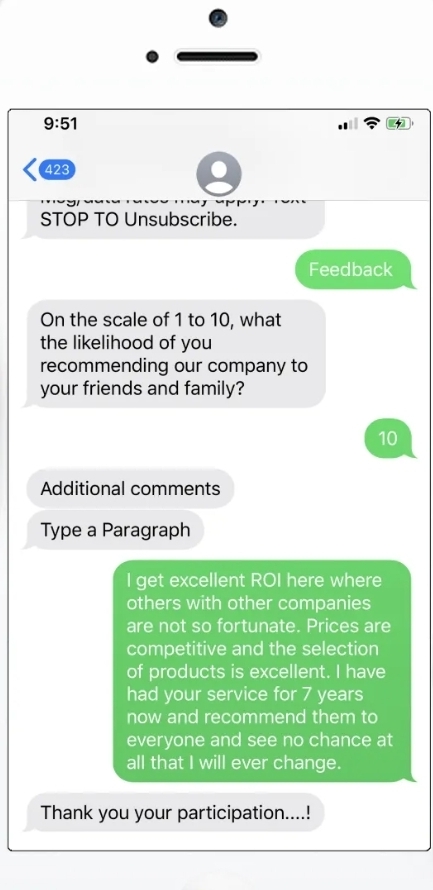
SMS example:
SMS 1: Hi Joe, thanks for your recent purchase. How satisfied are you with your new Running Shoes? Reply with a number from 1-5.
Customer Reply: 5
SMS 2: Great! What did you like most? Reply with A – Comfort, B – Style, C – Durability, D – Price.
Customer Reply: A
SMS 3: Thank you for your feedback. You can join our Rewards Club and earn 100 bonus points on your next purchase: (Link)
The example below shows how a brand can collect customer feedback using a post-purchase SMS survey flow:
Loyalty enrollment helps brands track how often a customer buys and how they use rewards. It also shows how engaged a customer is over time through points, tiers, and redemption activity. This helps brands improve SMS segmentation and send better product promotions.
What is personalized bulk SMS — and how does it work at scale?
Personalized bulk SMS is the practice of sending tailored text messages to large groups of subscribers. It keeps the reach of bulk messaging but adds relevance by adjusting content for each person. Brands can combine customer data with messaging rules to define how messages should change.
At scale, this means a brand can run one SMS campaign and still deliver thousands of different experiences. This works through a few technical tools, such as:
- Merge fields: These are placeholders inside a message that automatically fill with customer data
- Dynamic content blocks: They involve message sections that change based on customer attributes
- Automation triggers: SMS automation rules that trigger messages based on customer actions
Together, these systems help marketers scale personalized campaigns. They remove the need to write each message individually.
Here’s a practical scenario to make this clearer. A fashion retailer sends a weekend sale campaign to 5,000 subscribers. The system uses customer data to adjust each message:
- Customers who bought sneakers before get shoe recommendations.
- VIP customers get early access to the sale.
- Customers in colder regions see jackets and coats.
- Customers who recently abandoned carts get reminders with their saved items.
All this happens automatically through the same campaign setup. It removes the need for manual segmentation for every campaign but still keeps messages relevant to each customer.
To see how this process works in real campaigns, the video below explains how brands build and manage personalized bulk SMS using Omnisend:
Personalized SMS campaign best practices
Personalized SMS marketing works best when every campaign follows a clear process. To get results, you need the right timing and reliable performance measurement. The sections below cover the key practices behind successful SMS campaigns.
Timing and frequency
Good SMS marketing timing matches customers’ time zones and behavior. The goal is to send messages when customers are most likely to read and act on them.
Data shows that different times of day affect SMS engagement. SMS performs best between 4 PM and 7 PM overall. Also, Monday and Tuesday tend to be the best days for performance.
These patterns can give a starting point, but customer behavior should guide final timing decisions.
Here are some best practices to improve timing and frequency in your SMS campaigns:
- Send messages based on each subscriber’s time zone instead of one global schedule
- Send messages in response to actions by using behavioral triggers, such as cart activity or product views
- To prevent fatigue and lower the risk of unsubscribing, set frequency limitations
- Adjust send timing based on historical engagement data by customer segment
Compliance: Opt-in, consent, and opt-out
SMS compliance is a strict requirement in both the US and international markets. SMS regulations like TCPA and GDPR require clear permission before sending marketing messages. Brands must collect explicit consent and explain what users are signing up for.
They must also provide an easy way to opt out at any time. Failure to follow these rules can lead to penalties or the shutdown of an entire SMS program.
Key compliance requirements include:
- Collect explicit opt-in consent before sending any SMS messages
- Use clear language that explains what type of messages users will receive
- Disclose expected message frequency at the point of signup
- Include a visible opt-out option in every message, such as the SMS keyword STOP
- Honor all opt-out requests without delay
- Store proof of consent to meet SMS regulatory requirements
A/B testing and performance measurement
A/B testing can help improve personalized SMS marketing campaigns over time. It involves comparing two versions of an SMS message to see which one performs better.
For example, you can test a message that includes a customer’s first name against one that does not. You can also compare product-specific recommendations with a general discount offer. Another option is to test different send times to find when subscribers are likely to engage. The goal is to learn what drives engagement and better performance for your campaigns.
Here are some key metrics to measure performance of your personalized SMS marketing campaigns:
- Open rate: Shows the percentage of recipients who opened your SMS message
- Click-through rate (CTR): Measures how many recipients clicked a link in your message
- Conversion rate: Tracks the percentage of recipients who completed a desired action, such as making a purchase
- Revenue per message: Shows how much revenue each SMS generates on average
- Unsubscribe rate: Measures how many recipients opted out after receiving a message
Common mistakes to avoid in personalized SMS marketing
Personalization in SMS marketing can improve engagement and conversions. However, it needs to be done properly. If you want better results from personalized SMS marketing, avoid these common mistakes.
1. Personalization that feels invasive
Customers like relevant messages, but they don’t want to feel like they are being watched. If a text includes information they don’t expect you to have, it can feel uncomfortable instead of helpful.
What to do instead: Stick to data customers have shared directly or through their interactions with your brand.
2. Using old or inaccurate data
If a customer gets messages with incorrect details, the experience can feel disconnected. Poor data quality can reduce the effectiveness of your personalized SMS marketing campaigns.
What to do instead: Keep customer profiles updated and use recent behavioral data whenever possible.
3. Sending messages at the wrong time
Even a well-tailored message can perform poorly if it arrives at an inconvenient time. Sending texts too early, too late, or without considering time zones can affect engagement.
What to do instead: Use time zones, engagement history, and behavioral triggers to guide your send times.
4. Cluttering SMS with too many personalization variables
It can be tempting to add a name, location, product recommendation, loyalty status, and discount into one text. The result is often a message that feels crowded and hard to read.
What to do instead: Focus on the one or two details that matter most for that campaign.
5. Forgetting to create fallback values
Not every subscriber profile contains complete information. If a particular field is empty, a message might display a broken placeholder instead. Errors like this can make your campaigns look unprofessional.
What to do instead: Set default values for missing data fields so every message still reads naturally.
How Omnisend makes personalized SMS marketing scalable
As your subscriber list grows, managing personalized messages manually can become difficult. Omnisend helps ecommerce brands scale personalized SMS marketing. It offers SMS segmentation, automation, and messaging tools in one platform.
With Omnisend’s segmentation builder, you can create audience groups for targeted messaging. You can create segments using shopping behavior, location, and other customer data. Also, you can use SMS automation workflows to trigger messages based on customer actions.
Omnisend includes pre-built automation templates for common use cases. These include cart abandonment reminders, post-purchase follow-ups, birthday messages, and welcome series. Customers often interact with brands across many channels. Omnisend helps keep those interactions connected across SMS and email campaigns. This creates a more consistent experience throughout the customer journey.
Another advantage is global SMS reach. Many marketing platforms limit SMS support to a few countries. However, Omnisend helps brands connect with customers around the world. Plus, with the recent SMS price drop, businesses can manage messaging costs better across markets.
Most importantly, Omnisend delivers strong SMS marketing ROI. On average, merchants earn $79 for every $1 spent, according to the recent ecommerce marketing report. Brands can start with Omnisend’s free plan. This includes access to ecommerce-focused features and award-winning 24/7 support.
Conclusion
Personalized SMS marketing focuses on sending messages that match customers’ behavior and data. It replaces broad, generic blasts with targeted communication. Each customer receives content that fits their actions or interests. This makes the message feel more direct and drives more engagement.
Different types of personalization make this possible. Brands can use first names, past purchases, location data, and behavioral signals. Each of these adds context to a message and makes it more useful. Personalization at scale works when the right platform and data strategy are in place.
Personalized SMS marketing will continue to shape how brands communicate in 2026 and beyond. Customers now expect messages that reflect their needs and timing. Brands that meet this expectation will see stronger engagement, conversions, and long-term loyalty.
Quick sign up | No credit card required