
 Omnisend AI


 OFFER
OFFER







Drive sales on autopilot with ecommerce-focused features
See FeaturesEmail still does a lot of heavy lifting for ecommerce brands. It drives revenue, supports retention, and anchors most lifecycle programs. But it’s also facing more competition than ever, both in the inbox and across channels.
At the same time, customer acquisition costs continue to rise. According to Statista, digital advertising costs have increased steadily over the past few years, while returns have become harder to predict. For agencies, this often means tougher conversations with clients who want growth but are less willing to keep increasing spend.
That tension has pushed many teams to examine retention more closely – viewing it as a way to get more out of the work that’s already in place. And this is where SMS and push notifications tend to come in, helping brands stay present when email alone isn’t enough.
Why retention has become harder to ignore
Most ecommerce clients already understand the basics of retention. They know it costs less to keep an existing customer than to acquire a new one. Recent research also suggests that improving retention by just 5% has been linked to a 25%–95% jump in profitability. What’s changed is how difficult it’s become to maintain attention using a single channel.
The thing is, email deliverability rules are stricter, inbox filtering is smarter, and even well-segmented campaigns don’t always land where or when you expect.
Meanwhile, customer behavior has shifted too: people check their inbox less frequently, but they still look at their phones constantly. And that doesn’t mean email is losing relevance – it means it needs support.
For agencies, this shows up in familiar ways:
- Revenue plateaus even though email programs are “set up correctly”
- Repeat purchase rates stall
- Clients start asking what else can be done, without increasing budget
In those moments, adding more campaigns usually isn’t the answer, but adding better-timed touchpoints often is.
That’s exactly what Silver Street Jewellers did when they expanded their ecommerce program. Instead of relying on email alone, they layered in SMS alongside automations like abandoned cart and other intent-based flows. In one example, they even used SMS as a fast “tap on the shoulder” to get customers to check their inbox when an email offer was time-sensitive, essentially using SMS to support and amplify the email program.
Where SMS and push fit into existing workflows
SMS and push notifications work best when they’re attached to clear intent signals, not sent as “just another channel” for the sake of it. Their role in retention isn’t to replace email, but to support it when timing, attention, or urgency matters more than detail.
Use SMS when speed matters
SMS is strongest when you need the message to land immediately and get a quick action. That’s why it works so well inside flows like:
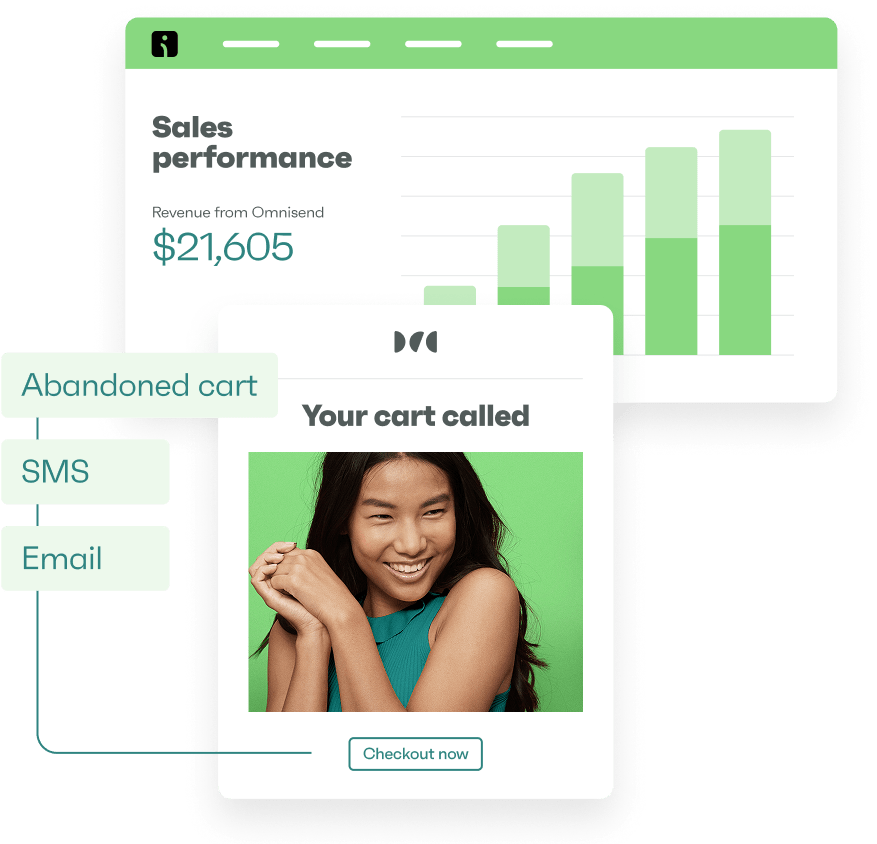
- Abandoned cart: a short SMS reminder while intent is still high often does more than a second or third email
- Back-in-stock/price drop: people want to know right now, not later
- Reorder reminders: a simple “time to restock” nudge works best when it hits at the right moment
Email can still do the heavy lifting (product context, recommendations, reassurance), but SMS is what catches the customer when they’re not lurking in their inbox.
Use push when the customer is already in “browse mode”
Conversely, push notifications are a great fit when the customer is already on their phone and doesn’t need a long message, just a nudge:
- “Your order is out for delivery”
- “Your wishlist item is back”
- “Still thinking about that product?”
Push is lightweight and real-time, so it’s the closest thing you get to the aforementioned “tapping someone on the shoulder” without being somewhat creepy.
Why this matters for client retention
From an agency perspective, results are only part of the equation. Retention depends on how clearly clients see the value of the work being done.
When email is the only visible channel, progress can feel slow, even if it’s steady. Adding SMS and push often helps clients notice movement sooner. They see higher engagement, faster responses, and clearer signs that customers are paying attention.
In fact, according to our latest research, automated emails generated 37% of sales from just 2% of email volume, and SMS and push showed similar patterns (with 18% of sales from 9% of SMS volume and 15% from 3% of push volume). That kind of lift makes it much easier for clients to connect “what we’re doing” with “what’s actually working.”
That visibility changes the conversation. Instead of discussing why acquisition costs are rising, you’re talking about how repeat purchases are improving. Instead of defending budgets, you’re reviewing performance across channels that work together.
Over time, that makes programs feel more resilient. And resilient programs tend to keep clients around longer.
How Omnisend supports this kind of setup
When agencies start adding SMS and push into existing email programs, the biggest challenge usually isn’t strategy – it’s execution.
Managing multiple channels across different tools quickly turns into more work than it’s worth. And Omnisend solves that by keeping email, SMS, and push in the same workflows, using the same triggers and segments agencies already rely on.
In practice, that means less rebuilding and more refinement. A cart recovery flow can stay exactly as it is, with SMS or push added only where timing matters.
Reporting also stays in one place, consent and quiet hours are handled automatically, and clients see results without feeling like the strategy suddenly became more complex. For agencies, that combination – visible gains without added friction – is often what keeps retention conversations simple.
“Our returning customers already made up a significant portion of our revenue, but Omnisend allowed us to engage them more effectively through multiple channels. By pairing time-sensitive promotions with SMS and push notifications, we’ve seen incredible results.”
– Shan Jiang, Customer Growth Manager at Kate Backdrop
Kate Backdrop now enjoys 1:300 ROI using Omnisend omnichannel marketing and a 62% view rate for push notifications.
Read the full case study here.
Final thoughts
Retention isn’t about adding more campaigns, it’s more about showing up at the right moments, via the right touchpoints.
By layering SMS and push into existing email workflows, agencies can help clients get more value from the programs they already run – without increasing acquisition spend or complexity. The result is faster engagement, clearer impact, and strategies that feel easier to sustain over time.
And when performance feels steady and visible, client relationships tend to last longer too.
Create omnichannel workflows for better engagement with Omnisend
Quick sign up | No credit card required

TABLE OF CONTENTS
TABLE OF CONTENTS


Subscribe and don’t miss any updates!
No fluff, no spam, no corporate filler. Just a friendly letter, twice a month.