
 Omnisend AI


 OFFER
OFFER







Drive sales on autopilot with ecommerce-focused features
See FeaturesKey takeaways 
Enhance your email strategy by implementing bounce-back offers immediately after purchase to capitalize on buyer excitement and drive additional sales.
Proactively communicate with customers about shipping delays through a plain-text email to build trust and improve their overall experience.
Automate follow-ups for negative reviews to address customer concerns directly, turning potential dissatisfaction into brand advocacy.
Keep customers engaged during long wait times for custom products by sending weekly updates that highlight the production process and reinforce their purchase decision.
Reveal key takeaways
By now, most ecommerce brands have already mastered the foundational ecommerce email flows. You deploy the ready-made templates Omnisend offers, letting your welcome and abandonment series run smoothly on autopilot. But once those essential automations are bringing revenue, it is tempting to put the whole strategy on cruise control.
The best opportunities, though, often hide in the messy parts of the customer journey. Standard flows handle standard behavior, but ecommerce is rarely predictable. Your store needs automated safety nets to handle the reality of shipping delays, negative feedback, and complex production timelines.
Relying only on the basics leaves money and goodwill on the table. By implementing a few unconventional automations, you can proactively manage customer expectations and secure long-term loyalty. Here are four lesser-known email flows you should be using right now.
1. The bounce-back offer: Capturing post-checkout momentum
The moment immediately following a purchase is when a buyer’s trust in your brand is at its absolute peak. Instead of simply sending a standard digital receipt, you can make the most of this excitement. A bounce-back flow sends a time-sensitive, highly targeted offer right after the initial checkout completes.
Transactional emails get open rates that standard promotional campaigns can only dream of. By placing a low-friction, one-time offer in front of a highly engaged buyer, you capture impulse interest. You are essentially recreating “the candy bar at the register” effect found in brick-and-mortar stores.
To make this strategy work, the offer must be highly relevant and strictly time-bound. For instance, if a customer buys a pair of leather boots, the bounce-back email should offer a discounted leather care kit. Set the trigger to fire minutes after the purchase, with the discount expiring in just a few hours.
How to set up the bounce-back flow:
- Trigger: Customer completes checkout.
- Delay: 10 to 15 minutes.
- Content: A simple email offering a complementary product at a steep discount.
- Subject lines: “Want to add this to your shipment?” or “A quick offer before your order ships”
- Urgency: A clear, tight deadline (“This offer expires in 3 hours/today”).
💡 Tip: To protect your profit margins, use segmentation to exclude customers who have already applied a high-value discount code to their initial order.
2. The delayed fulfillment apology: Getting ahead of shipping issues
Supply chain delays and warehouse bottlenecks are just a fact of life when running an online store. Keeping customers in the dark while they wait is a guaranteed way to flood your support inbox and generate negative reviews. A delayed fulfillment flow acts as an automated, proactive damage-control mechanism.
You should trigger an “order not sent” email when an order remains unfulfilled past your standard operational timeframe. Reaching out before the customer has to ask “where is my order?” completely changes the dynamic of the conversation. Transparency builds immense trust, turning a potential frustration into a positive brand experience.
This specific email should never look like a slick marketing brochure. It needs to appear as a plain-text, direct message from the warehouse manager or the founder. When you own your operational hiccups sincerely, customers are incredibly forgiving.
Flow template for delayed orders:
- Trigger: Order status remains “unfulfilled” for X days.
- Format: Plain-text only.
- Email copy: “Hi [Name], I noticed your order hasn’t shipped yet, and I wanted to personally apologize. We are experiencing high volume in your warehouse, but my team is prioritizing your package right now. You will receive a tracking link within 48 hours, and we truly appreciate your patience.”
Mastering this type of proactive communication is essential for maintaining strong customer retention.
3. The negative review follow-up: Automating service recovery
Unresolved negative sentiment is dangerous for brand reputation. When prospective buyers see unaddressed one-star reviews, their trust plummets, and they often abandon their carts. You can automate the recovery process by integrating your review apps directly with Omnisend.
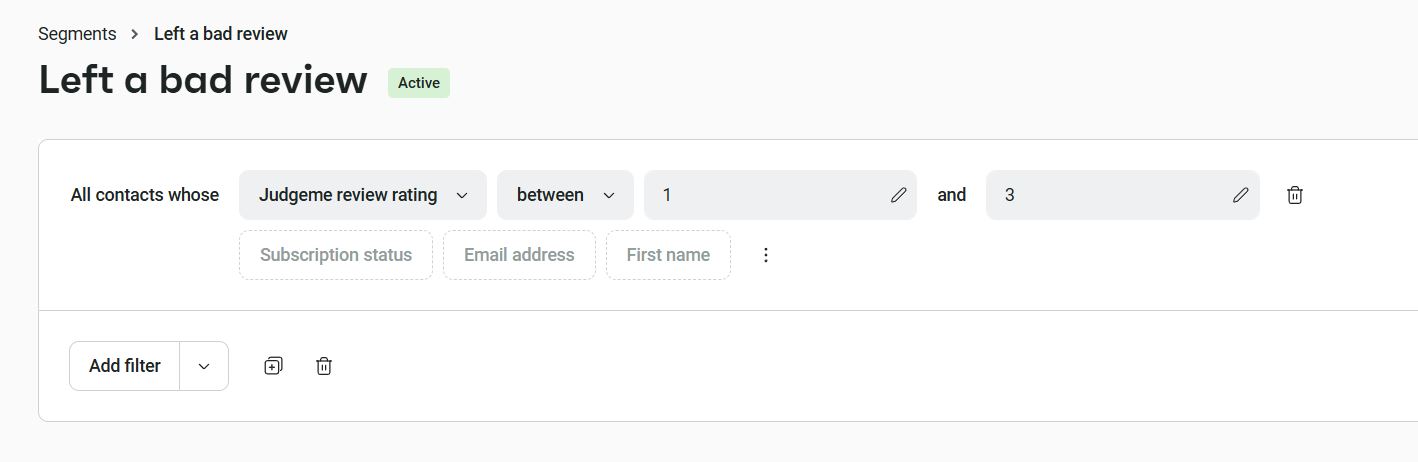
This flow triggers a personal email when a customer leaves a poor rating through your integrated review tools. Reaching out directly shows the customer you value their experience and are genuinely willing to fix the root problem. If done correctly, this approach can turn unhappy buyers into vocal brand advocates who willingly update their initial reviews.
Similar to the delayed fulfillment apology, this flow must appear entirely manual. A highly designed, automated-looking email will only further agitate an already frustrated customer. You simply want to ask for the cause of the problem in a conversational, human way.
How to structure the recovery outreach:
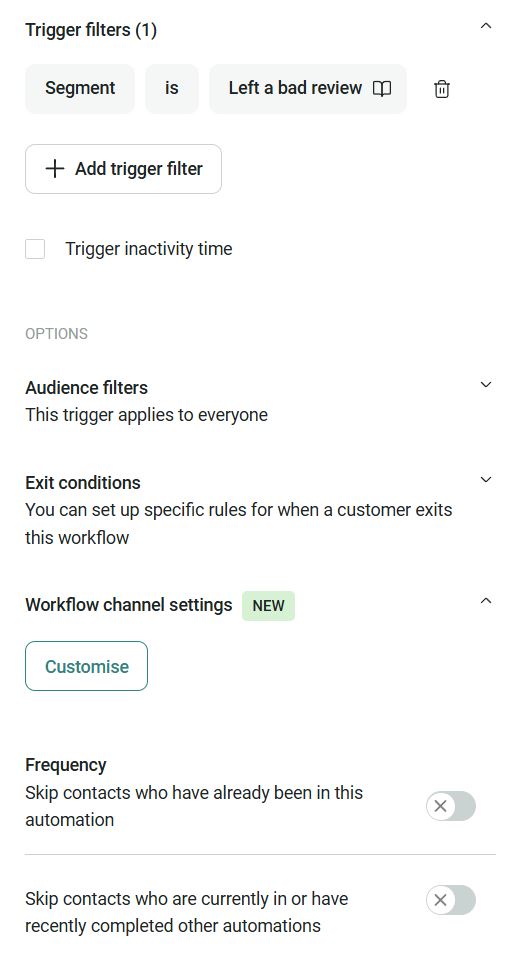
- Trigger: Customer submits a 1- or 2-star review via your integrated app.
- Delay: 1 to 2 hours during business hours (simulating a human reading the feedback).
- Sender settings: Use a personal name (“Sarah from [Brand]” or “Sarah Richards”) and set the reply-to address to your customer support inbox.
- Action: Send a plain-text email from a founder/customer support asking how you can make things right.
- Next steps: Resolve the issue via a private reply, then politely ask if they would consider revising their review.
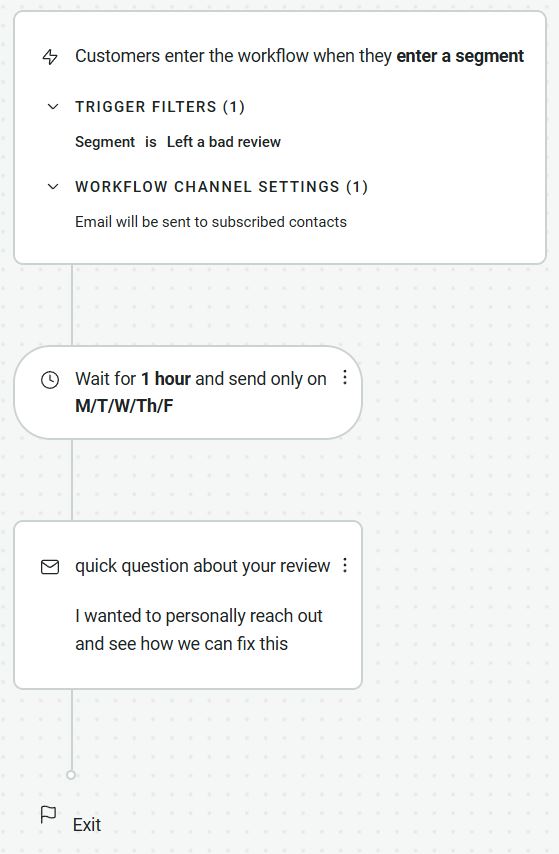
💡 Tip: Use a casual, lower-case subject line like “quick question about your review” to increase open rates and reinforce the personal feel.
4. The time-based production sequence: Engaging buyers during long waits
If you sell custom-made goods, furniture, or pre-order items, the waiting period can span several weeks. High-ticket items with long lead times often trigger buyer’s remorse during this silent waiting phase. A weekly update sequence keeps the customer excited and reassured about their purchase decision.
You can use a time-based flow to send weekly educational or “behind-the-scenes” content. This shows the buyer exactly how their product is coming to life and builds anticipation for the delivery. Furthermore, it drastically reduces the volume of anxiety-driven support tickets.
The sequence should make the customer feel uniquely involved in the manufacturing process. By breaking the silence regularly, you reaffirm their purchase and build a narrative around your craftsmanship. You can map out a simple three-part flow to structure this journey.
A sample weekly production sequence:
- Week 1: An introduction to the artisans or the raw materials being used for their specific order.
- Week 2: A visual update showing the assembly process, quality control standards, or intricate packaging details.
- Week 3: Final shipping preparation notes and a digital guide on how to care for the product once it arrives.
Wrap up
Building a robust email automation strategy means looking past the obvious touchpoints. When you automate your responses to delays, negative feedback, and long wait times, you protect your brand reputation. You also uncover hidden revenue opportunities by smartly utilizing post-purchase momentum.
We recommend auditing your current active automations this week. Identify which of these four operational gaps exists in your current strategy, and build out just one new flow to address it.
Author bio
Alvaro Díaz-Rato is the Founder of STRAT, a Spain-based performance marketing agency helping ecommerce brands scale globally through advanced paid media and email marketing. When he’s not optimizing campaigns, you can find him planning his next trip or trying out new recipes in the kitchen.

TABLE OF CONTENTS
TABLE OF CONTENTS


Subscribe and don’t miss any updates!
No fluff, no spam, no corporate filler. Just a friendly letter, twice a month.