
 Omnisend AI


 OFFER
OFFER







Drive sales on autopilot with ecommerce-focused features
See FeaturesKey takeaways 
Conversational SMS allows for two-way interactions, enabling brands to provide personalized responses and gather valuable customer insights that enhance marketing strategies.
Unlike traditional SMS, which is one-sided, conversational SMS fosters ongoing dialogues that can address customer concerns and increase conversion rates.
Implementing AI in conversational SMS can streamline responses to common inquiries while maintaining a human touch for more complex interactions.
To maximize the effectiveness of conversational SMS, brands should automate out-of-hours replies and ensure customer data is integrated for contextually relevant conversations.
Reveal key takeaways
Your SMS campaigns and automations tell customers about sales, shipping updates, and abandoned carts. But conversational SMS takes it a step further by letting them reply when they have questions about sizing, stock, or whether something will arrive in time.
Most brands do the first part via one-way SMS, which doesn’t keep the conversation going, but in doing so, you could be missing out on revenue and nurturing opportunities.
In a two-way SMS conversation, your customer enjoys advice that helps them buy, and you learn their blockers and preferences. Feed that into your marketing activities, and your campaigns, segmentation, and product recommendations become more effective.
This is your complete guide to conversational SMS marketing, covering benefits, limitations, examples, best practices, the role of AI, and getting started.
Turn SMS into a two-way revenue channel with Omnisend
Quick sign up | No credit card required
What is conversational SMS?
Conversational SMS is a differentiating customer service channel for your store, letting you instantly chat with and provide personalized answers, information, and advice to customers.
The word “conversational” makes it sound like every chat is human and requires someone, somewhere, to respond. However, conversational SMS is a sequence, with its makeup including these texts, depending on your tech stack:
- Automated texts, such as thank-yous, message receipt notifications, and in-chat updates
- AI responses cover the mundane and everyday questions
- Human responses provide a personalized approach for revenue-generating conversations
The key aspects of conversation SMS include:
- Two-way: Not a one-sided affair at all. Conversational SMS brings you and your customers together in their text message inbox.
- Personalized: It’s the same concept as chatting in-store with a sales rep. Customers can get information that is unique to them.
- AI: For everyday conversations that have the same answers, with AI handing over chats to people when appropriate.
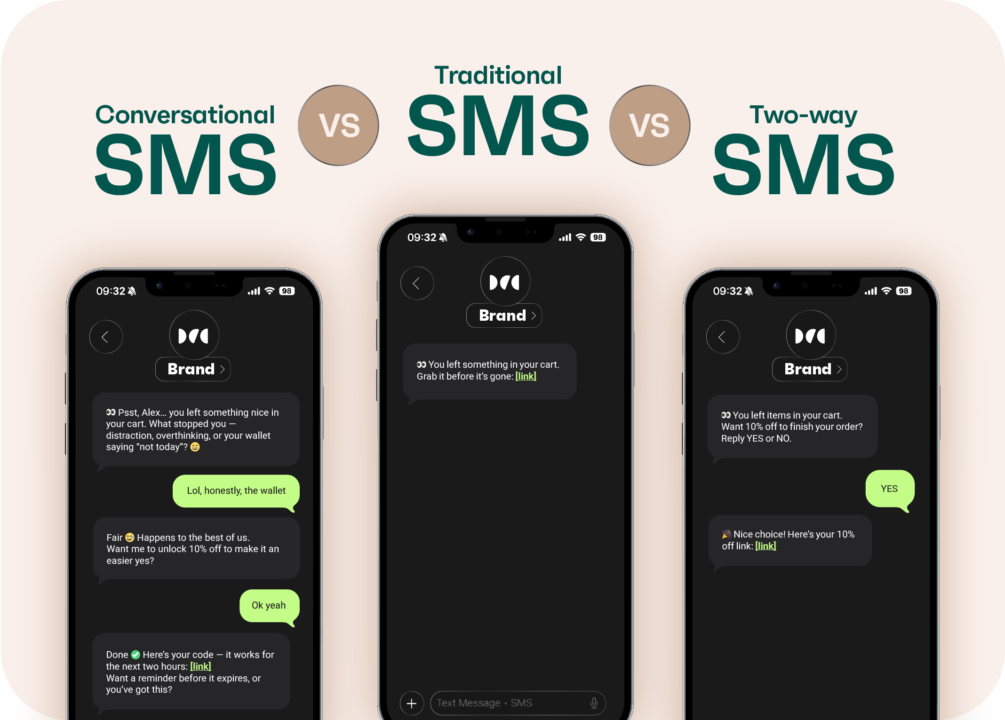
Conversational SMS vs. traditional SMS vs. two-way SMS
It’s confusing knowing what your ecommerce store needs between conversational, two-way, and traditional SMS. The comparisons below will help you determine the best SMS types for different scenarios.
- Conversational SMS: Somewhat confusingly, a type of two-way SMS, but more capable for continuing conversations. You and customers message one another and mimic in-person experiences and chats between friends. Your texts are human-written, AI, or automated replies depending on the context.
- Two-way SMS: An automated, less personalized option suitable for basic inquiries. Sees your SMS tool reply to customers with predetermined, automated messages. Your customers can receive replies and feel like they are getting a unique experience without any human effort on your side.
- Traditional SMS: These are SMS blasts, campaigns, no-reply flows, and other one-way messages. A Black Friday sale notification counts, so too does an abandoned cart text. One-way is the keyword here. If your customers can’t reply, you’re using traditional SMS.
Conversational SMS vs. one-way SMS
One-way SMS includes messages you plan and send in campaigns and automations without any functionality for customers to reply. No dialogue is necessary.
Conversational messaging is a real-time customer service feature that lets you and customers chat and share personalized information.
Both SMS types contribute to your customer experience. One-way SMS covers flows, such as welcome series, abandonment, and transactional texts. Adding SMS conversational text marketing helps you generate revenue from your expertise.
Conversational SMS vs. two-way SMS
Two-way SMS allows replies and responds with predetermined, automated messages, such as for confirmations. It can include customer names and other contextual personalization.
Conversational SMS is a human approach to two-way messaging, handing over texts to your people when appropriate for contextual, engaging chats.
Your SMS strategy could use both, with two-way SMS handling everyday inquiries that require only one response, and conversational SMS taking over for greater engagement periods.
Benefits and limitations of conversational SMS
Making SMS marketing conversational is worthwhile if you have complex sales cycles or customers with questions before they buy. It’s more personal than email and more available than live chat.
Here are its benefits:
- Stand out from competitors: Live chat and email are so common that customers expect them. Conversational SMS is rarer, and as such, it can differentiate you.
- Aid product discovery: Your site might make sense to you, but customers get lost. In fact, 44% of shoppers take at least three minutes to find what they need on ecommerce sites (Constructor). With conversational SMS, you help customers find what they need.
- Move customers closer to purchase: Questions are buying signals. Answer them correctly, and the sale follows. It’s crucial to note here that one-way texts can’t do that.
- Increase average order values: “Does this come in blue?” often leads to “What else would go with it?” if you ask.
- Higher conversion rates from SMS: Automated SMS earned $0.74 per send in 2025. Campaigns managed $0.15. Conversational SMS sits somewhere between.
- Free up time answering everyday questions: Conversational SMS tools can use AI to respond to the questions your team is always answering. You can effectively use it as a filter and spend more time with customers who need it.
- Relatively simple to roll-out: You need only one or two tools if you’re wondering how to start conversational commerce over SMS. For instance, Omnisend integrates with Gorgias for two-way SMS replies.
Of course, conversational SMS isn’t the endgame for your customer service. It has multiple limitations and isn’t the best fit for every message type.
Consider these limitations:
- Consent collection: Customers who text you first haven’t necessarily opted into conversational SMS marketing messages, so you should segment them from those who have.
- Operational complexity: Someone’s going to have to monitor your SMS inbox and respond when automations don’t cut it or when AI hands the conversation over.
- Message fatigue: Satisfaction from conversational SMS boils down to how effective and fast you are at solving inquiries. If you drag things out and provide irrelevant advice, your customers could complain and unsubscribe for good.
- Data dependency: Any automated and AI responses need accurate data. The same goes for the data you have in front of you when writing messages by hand. The quality of the connection between your ecommerce store and SMS tools matters here.
Additional reading
10 key benefits of SMS marketing your business needs
Conversational SMS examples and use cases
You can use conversational SMS throughout your customer journey. Pre-purchase, customers might ask questions or tell you why they abandoned their cart.
After buying, they’ll text about delivery or share feedback. Between purchases, they might reply to early access announcements or ask when something’s back in stock.
The examples below show practical, real-world conversational SMS examples:
1. Answering customer questions
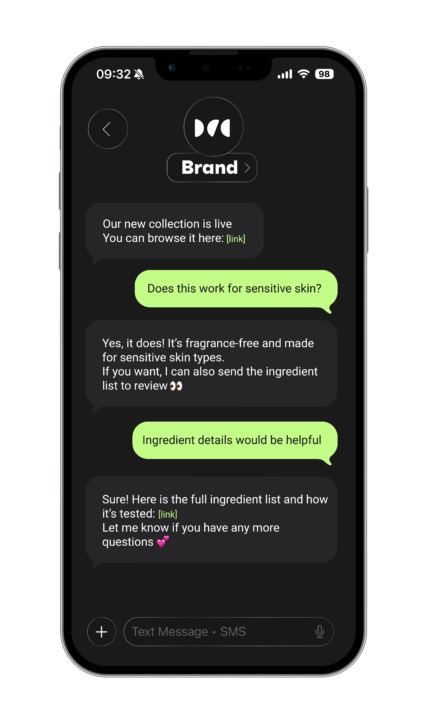
The conversational SMS example below shows how a one-time campaign can become a two-way exchange once the customer replies with a product question. The brand’s helpful answers move the customer closer to purchase.
Why this works
- The customer shows a concern (sensitive skin) that would stop them from buying
- The brand addresses the question
- The customer now has confidence to buy
2. Recovering abandoned carts
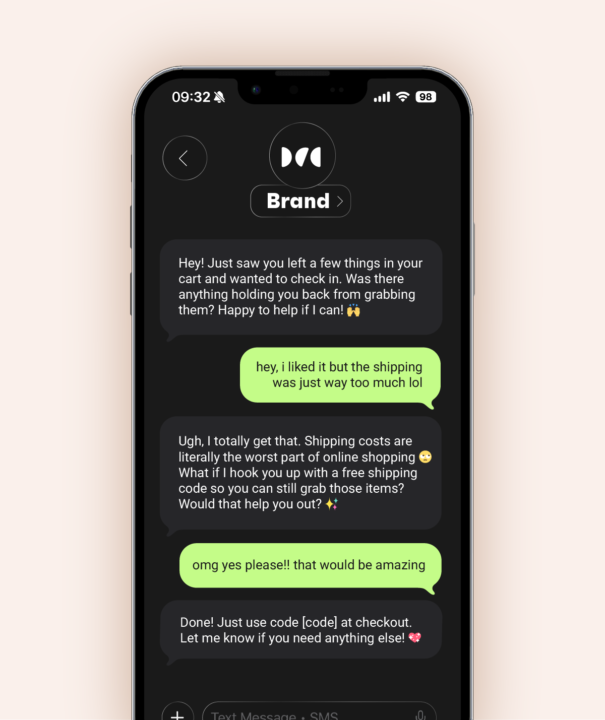
An abandoned cart doesn’t always mean lost interest. Here, the brand asks what went wrong instead of sending a generic reminder. The customer shares the blocker (shipping costs), and the brand removes it on the spot.
Why this works
- The customer was ready to buy, but hit a barrier
- Asking what went wrong surfaces the objection
- A free shipping code costs less than losing the sale
3. Delivery and shipping updates
A shipping update becomes a conversation when the customer asks for more details. The brand below confirms the delivery date and offers to monitor it, turning a transactional message into a moment of reassurance.
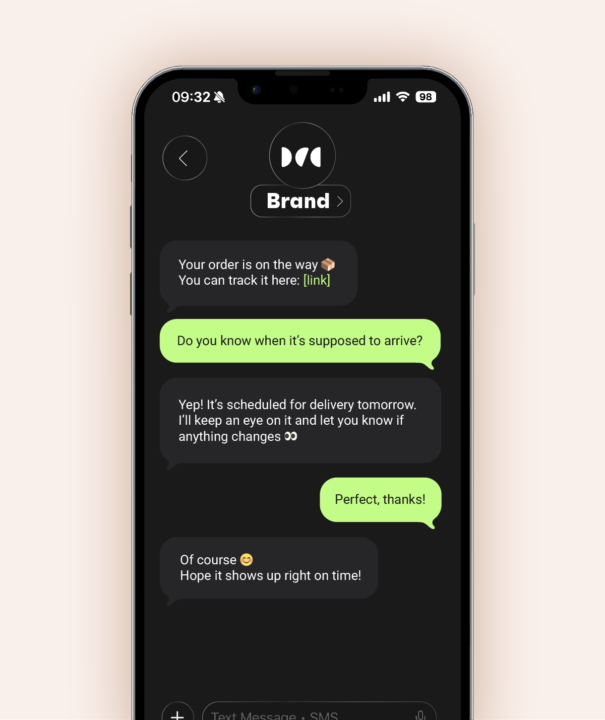
Why this works
- Post-purchase anxiety leads to support tickets and complaints
- A quick answer stops the customer from repeatedly checking the tracking
- The customer didn’t have to chase, which builds confidence in the brand
4. Sending exclusive updates
Early access announcements reward loyal subscribers, but this one goes further. The brand asks what the customer is waiting for, then commits to alerting them when it drops. The customer feels prioritized, not just notified.
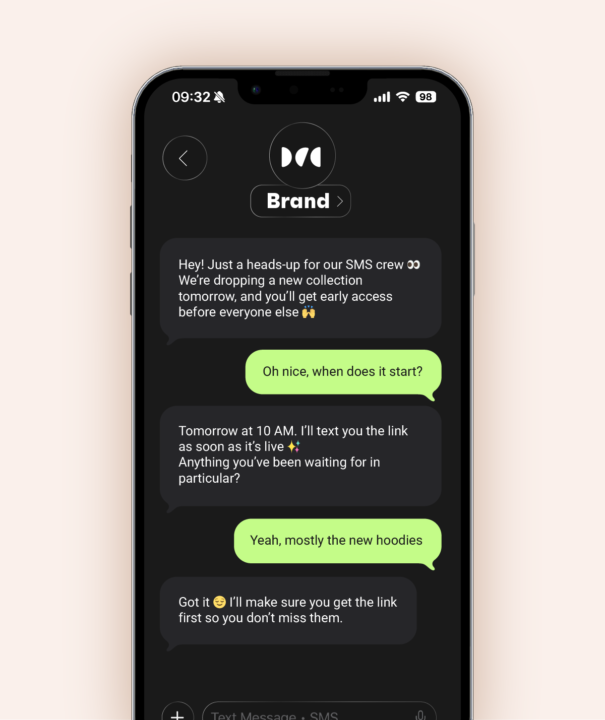
Why this works
- Asking what they’re waiting for gets the customer to commit to a product
- The brand can now send a direct link to hoodies, not the whole collection
- A promise to text when the collection goes live creates anticipation
5. Collecting feedback
Post-purchase check-ins do more than collect praise. Here, the brand asks what could be better and gets actionable feedback. The customer feels like their input matters, not just their money.
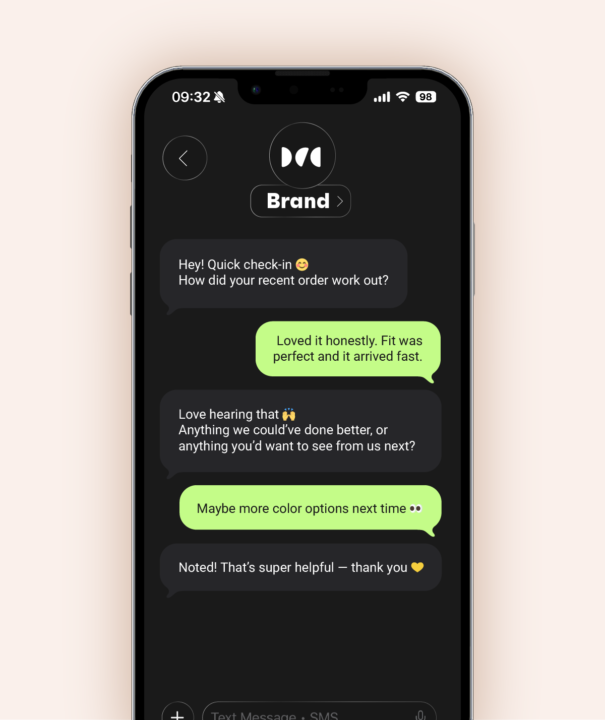
Why this works
- Positive experiences make customers more open to follow-up questions
- The brand gets a product suggestion without running an SMS survey
- Feedback via text feels like a conversation, not a form to fill in
Best practices for conversational SMS
There are significantly more customer engagement opportunities during conversational SMS than there are in one-way campaigns. That means you have more chances to influence buying behavior and satisfaction, to the benefit of your store.
These best practices will get you started:
- Automate out-of-hours responses: You can’t reasonably text customers personally at 11 PM or before opening hours. You also need to comply with TCPA regulations. Use automated SMS to say a representative will be with them by X time, and provide supporting links to any potentially helpful information.
“Silence leaves your customers wondering if their text went through, and could send them down a rabbit hole for information. Provide as much of what they need in links as you can and set their expectations for responses to improve satisfaction.”
— Karolina Petraškienė, Marketing Projects Lead at Omnisend
- Roll out AI responses: Some inquiries are answerable with AI. These could be predetermined responses you approve, or dynamic responses based on training data. These tie back into out-of-hours responses and can slash demand on your teams.
“AI is fantastic for speeding up response times and answering everyday questions your customer service team receives all the time. However, it isn’t a replacement for contextual human responses. Don’t lose your human touch. Otherwise, there’s nothing unique about your conversational SMS, and customers may as well be asking ChatGPT.”
— Bernard Meyer, AI Operations Manager at Omnisend
- Limit promotional responses: Unless your customer is asking about discounts, bundles, and other things with revenue opportunities, skip the pitch to reduce fatigue and improve confidence in your conversational SMS.
- Stick to the topic in your messages: If an inquiry is about a return or exchange, you shouldn’t recommend products or ask them to become a VIP.
- Identify yourself as the sender: Simple to do just by adding your name, position, and the company you are representing at the start of your conversational texts. These work well:
- “Hi, this is Samantha from InVogue Fashion.”
- “Thanks for reaching out. I’m James, a sales assistant at InVogue.”
- Use a human tone: A balance between formal and informal. Nothing excitable, and definitely no daft emojis.
- Use behavior-triggered flows: These will improve your conversational SMS efforts with messages tied into customer activity, such as signing up and abandoning carts. They sit as separate messages and tie into your customer journey.
“Build SMS + email flows for all common ecommerce scenarios such as welcomes, abandonment messages, confirmations, and reactivations. Those flows create revenue-generating experiences and can stop customers from making inquiries that create backlogs in your conversational SMS.”
— Agnė Ganchev, Director of Customer Success at Omnisend
- Let customers opt out: Easy enough to do if your SMS tool supports it. Omnisend adds “Reply STOP to opt-out” to the end of messages, for example.
- Connect your marketing tools: Your segments and customer conversations across all tools should sync to avoid silos. It’s worthwhile checking what your email/SMS app integrates with natively before picking a third-party conversational tool.
Getting started with conversational SMS
To run conversational SMS marketing, your marketing platform needs to connect with a help desk, so replies have somewhere to go. Without this, customers reply, and nobody sees it.
Omnisend integrates with Gorgias for this. Customer replies to your SMS campaigns create tickets in Gorgias. Your team responds in Gorgias, and the message goes back to the customer through SMS. Close the ticket after answering, and the next customer reply creates a new ticket.
Your SMS also needs customer data behind it, which Omnisend provides. If you know what someone browsed or abandoned, your opening message has context.
Then there’s who handles replies:
- Human agents: Every reply goes to your team through the helpdesk
- Automated: AI or rules handle common questions without involving your team
- Hybrid: Automation takes the straightforward stuff, and humans get the rest
So, you have two options for conversational SMS:
- Standalone platform: Handles two-way messaging without needing other tools
- Integration: Adds conversation capabilities to your existing SMS marketing platform, like connecting Omnisend with Gorgias
The role of AI in conversational SMS
More SMS platforms are rolling out AI for their conversational SMS features, particularly generative AI, to speed up and increase the quality of your responses.
Some AI can interpret messages, recommend multiple responses, and pull customer data, which you can reference. Others are SMS conversational bots that reply and sound human.
However, AI isn’t necessary for conversational SMS in the first place. It can augment and improve your conversations, but it doesn’t create the functionality. Contextual, ongoing chats are its defining feature, not the technology or tool.
AI capabilities in conversational SMS
AI brings several potential improvements to your SMS:
- Making sense of language: Texts with acronyms, slang, emojis, and incomplete sentences might confuse your team. AI can clarify things before you respond.
- Reducing language barriers: Extremely helpful if you have a global team whose first language doesn’t always match the customer.
- Context retention for other chats: AI can reference past conversations, use information from other chats, and recommend responses.
- Personalization for customers: Provided your SMS tool has customer data, such as purchase and browsing history, then AI can tap into it and use it in messaging.
- Routing to humans: AI has its limits and recognizes them, handing its chats over to your people when appropriate.
For example, conversational AI SMS is perfectly capable of:
- Answering questions about products and your services based on the data you give it
- Recommending products to customers based on what they have in their wish lists
- Scheduling in-store appointments, returns, and other busywork
Limitations and realities
The biggest reality is that customers are becoming increasingly aware of when AI is responding to their conversations. Some will expect to speak with a person and won’t appreciate a conversational SMS bot even if it has suitable answers, which could damage trust in your brand.
Additional realities of conversational AI SMS include:
- Nuanced situations: AI struggles with complexity, such as customers who already chatted with customer service but are back because the advice didn’t work.
- Emotional conversations: Complaints requiring empathy and reasonable solutions typically need human agents.
- Unexpected questions: Queries outside its training data can trip it up, in which case, it’ll have to hand over to a human and extend the conversation after wasting your customer’s time. You’ve created friction when you didn’t need to.
Conversational SMS: Key takeaways
Hesitant buyers and window shoppers often need only a few questions answered before purchasing. Emailing is slow, and live chat is usually too robotic, plus it has no inbox for them to come back to. Conversational SMS solves both.
Either your customer replies to your campaign, or they message you first. Both open a conversation you can learn from. Preferences, concerns, buying context, it all feeds back into your segmentation and marketing strategy.
That could be something as simple as adding FAQ blocks to your product pages based on the questions you get via SMS. Or as complex as building new flows that anticipate questions and answer them when customers add products to wish lists.
To manage these conversations at scale, you need the right setup, such as integrating Gorgias with Omnisend to turn customer SMS replies into help desk tickets. Replies in Gorgias go back out to customers via SMS, and satisfaction scores and ticket tags sync too.
Send personalized SMS that drives sales, not opt-outs
Quick sign up | No credit card required

TABLE OF CONTENTS
TABLE OF CONTENTS


Subscribe and don’t miss any updates!
No fluff, no spam, no corporate filler. Just a friendly letter, twice a month.