
 Omnisend AI


 OFFER
OFFER







Best customer lifecycle marketing software for ecommerce (2026)
With over 130+ pre-built integrations and flexible APIs, you can easily centralize data from across your tech stack
Make the most out of your data and unlock powerful growth marketing possibilities with these other top marketing tools.
Build any custom integration with our open, flexible APIs that are simple to use and implement.
Check out apps that have been stealing all the spotlight.
Email and SMS marketing insights, ecommerce resources, and the latest Omnisend news
Expert-led sessions covering email, SMS, and ecommerce marketing strategies.
Educational video and live training to help you make the most out of Omnisend.
Drive sales on autopilot with ecommerce-focused features
See FeaturesCustomer lifecycle stages describe how online shoppers move from discovering a brand to becoming its advocate.
For ecommerce and DTC marketers, each stage reflects a different customer mindset, need, and level of engagement. A first-time visitor browsing products will behave differently from a repeat buyer recommending your brand to friends.
That’s why understanding the stages matters. It helps marketers create better customer experiences and build stronger relationships over time.
In this guide, you’ll learn what each stage of the customer lifecycle is and what defines it. You’ll also see why customers move forward, stall, or drop off, and what that means for your marketing.
Quick sign up | No credit card required
Customer lifecycle stages are the phases customers move through during their relationship with a brand. They describe the process of discovering a business to becoming a loyal customer and an advocate.
Think of these stages as a framework, not a campaign plan or to-do list. This framework helps you understand how customer behavior changes over time. It also shows what customers need at each point in the relationship.
Here’s what it captures:
Customer lifecycle stages help you understand how customer relationships grow over time. Each stage reflects a different mindset, level of trust, and business value.
The customer lifecycle shows the big picture of a relationship. It maps the full arc of a customer’s relationship with your brand. The customer journey, on the other hand, zooms in. Its focus is on the specific touchpoints and experiences within that relationship.
In ecommerce, the lifecycle might show that a shopper is in the consideration stage. The customer journey explains how they got there. For example, they may have discovered your brand through Instagram. They then visited your store twice, joined your email list, and clicked on a product recommendation email.
Essentially, the lifecycle indicates the stage a customer is in. Meanwhile, the journey tells you how they got there.
| Aspect | Customer Lifecycle | Customer Journey |
|---|---|---|
| What it is | A framework for relationship stages | A map of specific touchpoints, experiences |
| Scope | Full relationship arc | Individual experiences and actions |
| Focus | Stages of engagement and loyalty | Touchpoints and user interactions |
| Timeframe | Long-term view | Moment-by-moment path |
| Primary use | Strategy and segmentation | UX and conversion optimization |
Most ecommerce brands use five customer lifecycle stages. However, some frameworks use six or more. The difference usually comes down to how a model splits certain stages.
For example, some models separate purchase and post-purchase into different lifecycle stages. Others combine loyalty and advocacy into one final stage.
The core relationship pattern stays the same. Customers first discover a brand. They then consider their options, make a purchase, and return over time. Eventually, they become loyal supporters.
The universal stages found in almost all stages of customer relationship lifecycle models are:
Different frameworks may change the number of stages. However, the core customer lifecycle stages remain largely the same across all ecommerce models.
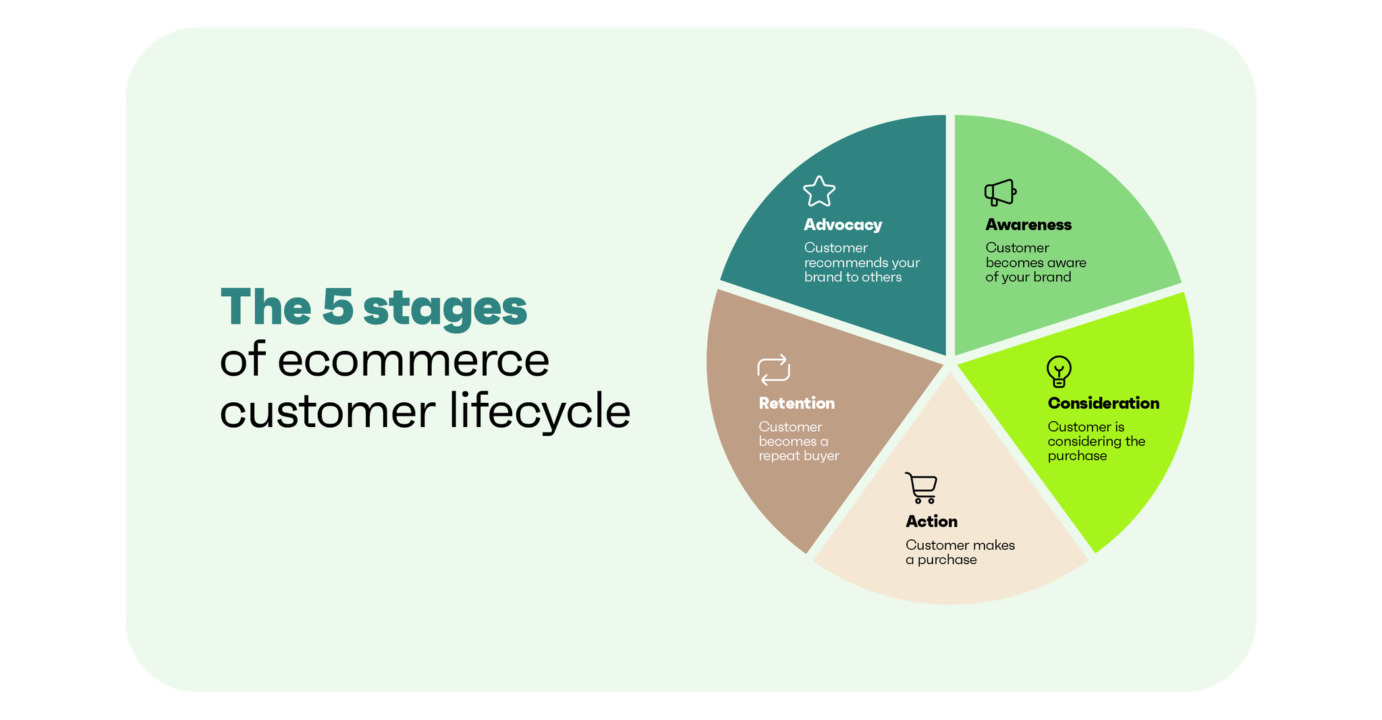
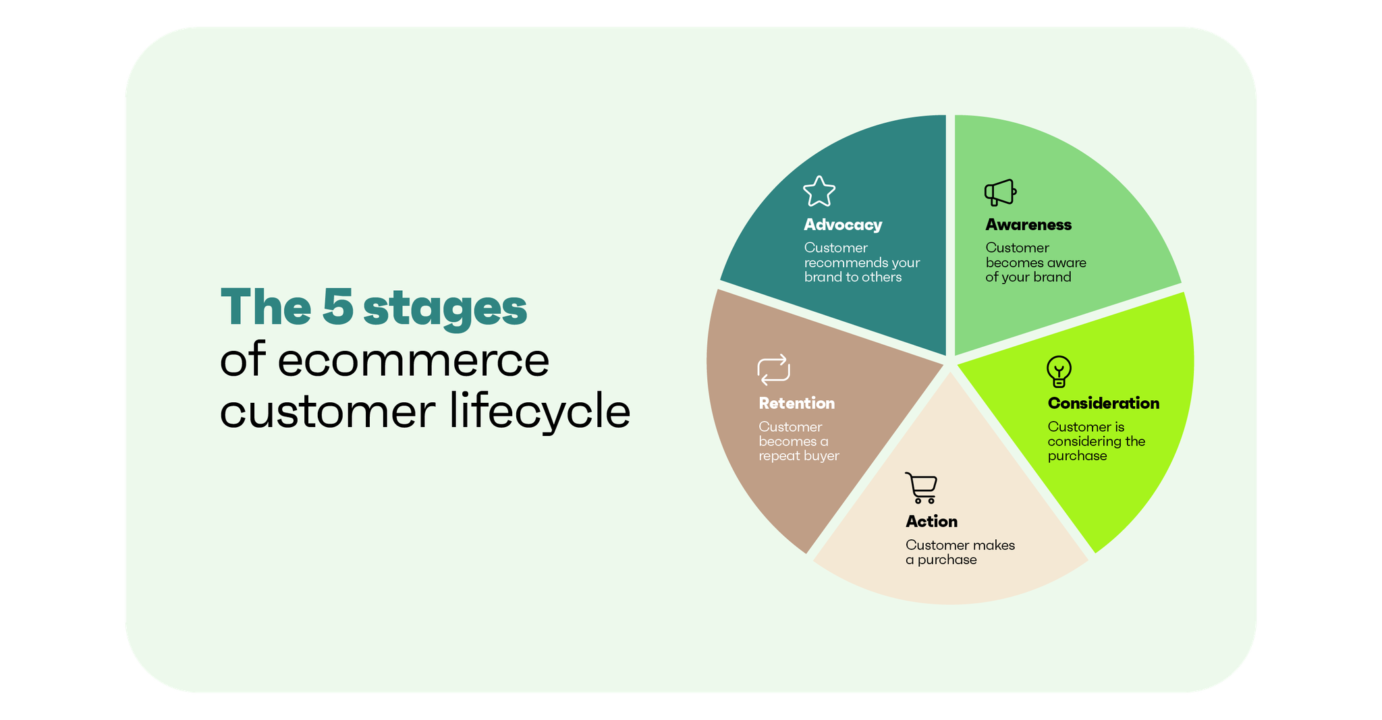
The five-stage framework is the most widely used customer lifecycle model. It offers a clear way to understand how customer relationships grow, without becoming too complex.
These customer lifecycle marketing stages cover the full relationship. They also match how most online shoppers behave.
Here’s a breakdown of all five stages of the customer lifecycle:
The awareness stage is when a prospect first discovers your brand, product, or store. This could be through ads, influencer content, search results, or social media.
At this stage in the customer lifecycle, the customer may not know much about your business yet. They’re usually exploring a problem, need, or interest. Rarely are they looking for a specific brand.
For a DTC brand, this might look like someone scrolling Instagram and stopping on your ad. Or they might Google “best natural skincare for sensitive skin” and land on your blog.
What characterizes this stage:
This stage shapes first impressions and early trust. Within the customer lifecycle marketing stages, brands emphasize visibility and education during the awareness phase. Don’t push sales.
The shift to consideration happens when a shopper moves from passively noticing your brand to actively exploring it — clicking through to a product page, comparing options, or coming back for a second look.
Awareness is about being found. If the right people don’t discover you, the rest of the lifecycle never starts.
Here, customers actively check whether your brand or product meets their needs.
During this stage of the customer lifecycle, shoppers move beyond discovery and begin comparing options. They want more details, reassurance, and proof before making a decision.
For example, think about how people shop online. A customer might come back to the same product several times, check out reviews, compare alternatives, or even place it in their cart before deciding. They haven’t bought it yet, but they’re no longer just browsing.
What characterizes this stage:
This stage plays a major role in the customer lifecycle marketing stages. That’s because customers are weighing risk against value. Many brands use educational content and follow-up messaging to support decision-making here.
The transition into the purchase stage happens when the customer completes a transaction or commits to buying.
Consideration is where trust is built or lost. What customers find, or don’t find, at this stage determines whether they buy.
During purchase, the customer completes their first transaction with your brand.
They’ve made a decision, and they’ve acted on it. This is a key milestone in the customer lifecycle stages, but it’s not the end of the relationship.
What characterizes this stage:
Of all the stages in the customer lifecycle, retention is the most critical. Acquiring new customers is expensive. That makes retaining existing ones more profitable over time.
Retention isn’t about sending discount codes and hoping they stick. It’s about building consistency, trust, and long-term value — so customers keep coming back instead of quietly drifting away.
What characterizes this stage:
A solid retention marketing strategy helps keep customers longer.
Customers who are happy become repeat buyers and active promoters of your brand.
It’s the most rewarding phase of the customer lifecycle stages. Here, trust turns into long‑term value. Every ecommerce brand works toward it, as customers don’t need much convincing.
They come back on their own, leave glowing reviews, and refer friends. No one even asks them. They might post unboxing videos or defend your brand in comment sections. Their lifetime value is high. Plus, their influence extends well beyond their own purchases.
What characterizes this stage:
Some frameworks separate loyalty and advocacy into two different lifecycle stages. Loyalty focuses on repeat buying behavior. Meanwhile, advocacy focuses on active promotion. This is usually the case in SaaS or enterprise contexts.
Loyal advocates are your highest-value customers. They buy more, cost less to keep, and bring new customers in for free.
Customers move between lifecycle stages as their relationship with your brand changes. These shifts show up in actions, buying patterns, and how people use your content.
Customers can skip stages, stall, or regress. They may buy immediately after discovering a product through social media. Another may remain in the consideration stage for a long time before making a purchase.
Loyal customers can also become less engaged after a poor support experience or delayed shipping. Signs of falling back include fewer purchases, lower engagement, or longer periods of inactivity.
Recognizing these patterns can help you adapt your customer lifecycle stages marketing strategy to meet customers where they are.
The customer lifecycle isn’t a one-way street. Smart brands track signals and re‑engage customers before they drift.
For ecommerce companies, customer lifecycle stages often progress more quickly. They can also happen across multiple channels at once.
Shoppers may discover a brand on social media and browse its products on mobile. They might then complete purchases later through email or SMS.
Stages might also look slightly different. This depends on whether the brand sells one‑time products or subscriptions.
Understanding what the customer lifecycle stages in ecommerce are is crucial. It helps brands tailor automation and messaging to each phase.
The five stages apply to every ecommerce brand. Yet, what each stage looks like depends on your model. Both subscription and one-time purchase brands follow the same lifecycle. They just have different pressure points.
Customers can disengage at any point in the customer lifecycle stages if expectations aren’t met or trust weakens over time. The reasons often change depending on the stage.
You can measure signals at every lifecycle stage. Tracking the right metrics helps ecommerce brands spot friction before it becomes a bigger problem.
Lifecycle metrics help brands understand how customers engage, progress, and disengage at different relationship stages.
The five customer lifecycle stages map the full arc of a customer relationship. These are awareness, consideration, purchase, retention, and loyalty/advocacy.
But they’re not a straight line. Customers progress, stall, and sometimes slide backward.
Winning brands recognize where each customer stands. They also understand what drives their customers forward. That starts with knowing what defines each stage and what triggers each transition.
From here, the natural next step is putting this foundation to work. To this end, you can explore lifecycle segmentation, marketing, and the right customer lifecycle software to support your strategy.
Quick sign up | No credit card required
The customer lifecycle stages are the phases a customer moves through with your brand — from first discovering you to becoming a loyal buyer who recommends you to others.
Most frameworks identify five core stages. Some models split purchase and post-purchase. Others separate loyalty from advocacy.
Retention is widely considered the highest-stakes stage. Keeping an existing customer costs far less than acquiring a new one. Additionally, retained customers are far more likely to become loyal advocates over time.
The key metrics you should track include:
In marketing, the customer lifecycle describes the full journey a customer takes with a brand. That’s usually from first discovery to long-term loyalty. Understanding customer lifecycle stages helps marketers deliver the right message at each point in the relationship.

TABLE OF CONTENTS
TABLE OF CONTENTS

What’s next



No fluff, no spam, no corporate filler. Just a friendly letter, twice a month.