Omnisend AI


 OFFER
OFFER









Your customers have a lifecycle that scheduled email sends can’t cover. The result is a lower-quality experience for them and less revenue for you. One of the benefits of email automation is that it puts you in inboxes at optimal moments without adding to your workload.
Automated emails are contextual to what your customers do on your site, their activity in emails, and the data you hold about them.
The combination of timing and relevance is why email automations accounted for 30% of revenue from 2% of sends in 2025. Omnisend’s 2026 Ecommerce Marketing Report also shows they earned 16x more per send than scheduled emails.
There’s more to know. Email automations also increase engagement, scale with your business, and complement other channels, such as SMS.
Let’s quantify those. This article breaks down the benefits of email marketing automation with up-to-date statistics and real-world examples from ecommerce stores.
Quick sign up | No credit card required
Quick answer: What are the benefits of email automation?
Email automation places revenue-generating messages in your customers’ inboxes at high-intent moments with minimal manual work. It helps you retain customers, improve engagement, and personalize experiences for greater satisfaction.
The alternative to no automation is email campaigns only, which are one-time and scheduled sends. These don’t use behavior or engagement triggers, so they are less contextual and best suited to mass sends like newsletters and promotions.
Main benefits of email automation
Some of your emails are already automated, such as order confirmations, which customers expect. The additional automations you build to welcome, nurture, and retain them are pivotal to maximizing customer value and email marketing ROI.
We’ve listed the main benefits of email automation below, with statistics to quantify them and provide sound reasoning for adoption. Click any of the links in the table to jump to our analysis:
| Benefit | What it means |
|---|---|
| Disproportionate revenue | 30% of revenue from 2% of sends; 16x more per send than campaigns |
| Right-moment delivery | Triggers fire on customer behavior, not scheduled calendars |
| Higher engagement | 24% higher opens, 6x more clicks, 19x higher conversions than campaigns |
| Scales without any notable headcount | Built once and then refined over time, minimal team necessary |
| Revenue recovery | Abandoned cart, browse, and checkout flows reclaim lost orders |
| Long-term customer value | Post-purchase, loyalty, win-back, and birthday flows extend retention |
| Multichannel fit | Same logic extends to SMS and push notifications |
| Continuous improvement | Performance data feeds optimization, with gains that compound |
1. It generates disproportionate revenue relative to effort
Automated emails made up 2% of sends in 2025, with a staggering 30% revenue capture and 16x more revenue per send than scheduled campaigns, via Omnisend’s 2026 Ecommerce Marketing Report. The difference between them was $2.87 versus $0.18.
Welcome and abandoned cart emails made up 76% of all automation-related orders, so even if you only build those two flows, you’re on your way to maximizing revenue.
Consider FLEXTAIL’s success. It sells outdoor electronics gear and runs a welcome email for new subscribers, which generated $235K in attributed sales spanning 3,000+ orders.
Dog accessories retailer Dukier is another example, growing its Omnisend revenue by 525% over three years, with 55% attributed to email automations. Welcome, abandoned cart, and lead capture automations generated the most revenue.
Top-performing marketing agencies go further, leaning into automations across the customer lifecycle. Omnisend’s Top Agencies report shows that they saw revenue of $5.96/send for automations versus $0.67 for campaigns, and pulled 45% of email revenue from automations.
“Our data shows that email automations account for significantly more revenue than campaigns for standalone ecommerce brands and agencies. Consider all the touchpoints that benefit from them, and you can see why. A welcome series for new subscribers, a thank-you email for first-time buyers, a browse abandonment email for window shoppers, and so on. Scheduled and one-time emails can’t touch those moments.”
— Karolina Petraškienė, Marketing Projects Lead at Omnisend
2. It reaches customers at the exact right moment
Automations earn more than one-time and scheduled sends because they reach customers at moments of high intent. There’s no better example than back-in-stock emails, which had the highest revenue per email in 2025 at $8.46 and the highest conversion rate at 6.46%.
Nearly one in three clicks on automated emails resulted in a purchase in 2025, according to Omnisend’s 2026 Ecommerce Marketing Report.
Those results come down to emails arriving when customers want and expect them, although the quality of in-email cross-sells and product recommendations matters equally.
Email automations use triggers based on behavior, time, date, lifecycle, and cross-channel, so your customers receive emails at optimal moments in their journey.
For instance, welcome emails arrive immediately after sign-up, back-in-stock emails arrive as soon as your stock updates, and abandoned cart emails land an hour or so after abandonment, giving your customer time to complete their other tasks.
Your email automations can also play out as a series rather than a single message, reaching customers across days, weeks, or months. That one series spreads your reach and keeps you in inboxes for longer.
3. It dramatically improves engagement rates
Email automations have high engagement rates regardless of their intent. Omnisend’s 2026 Ecommerce Marketing Report shows they generated 24% higher open rates, 6x more clicks, and 19x higher conversion rates than scheduled campaigns in 2025.
Email engagement has also become more intent-driven across the board, with click-to-conversion rates jumping 53% YoY in 2025 (fewer clicks and more purchases per click).
The reason automations see such healthy metrics is that they catch customers at points where they’re already engaged or provide a worthwhile interruption. They earn their place with relevant messaging, rather than volume-based sending.
Your automated emails can also have personalized content, and some customers see them as more valuable than random promotional messages. Customers being more receptive is one of the top email marketing automation benefits.
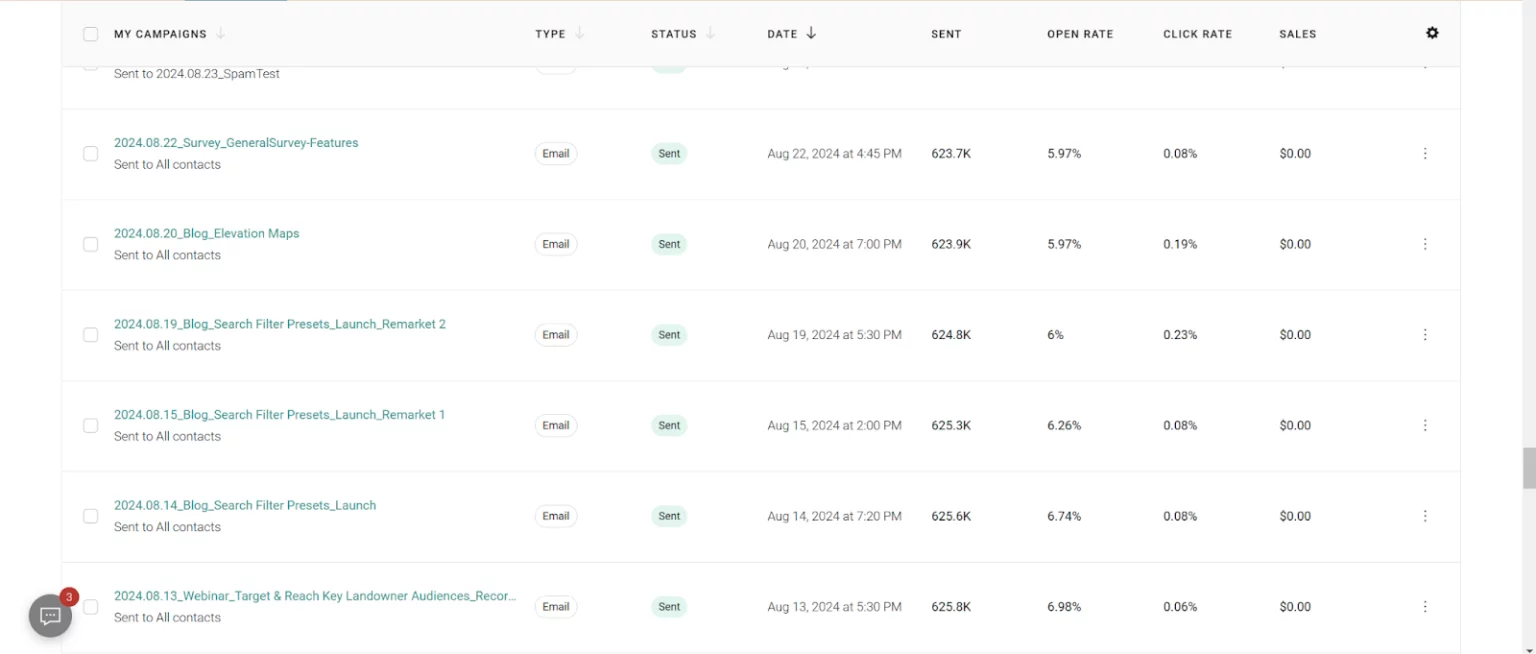
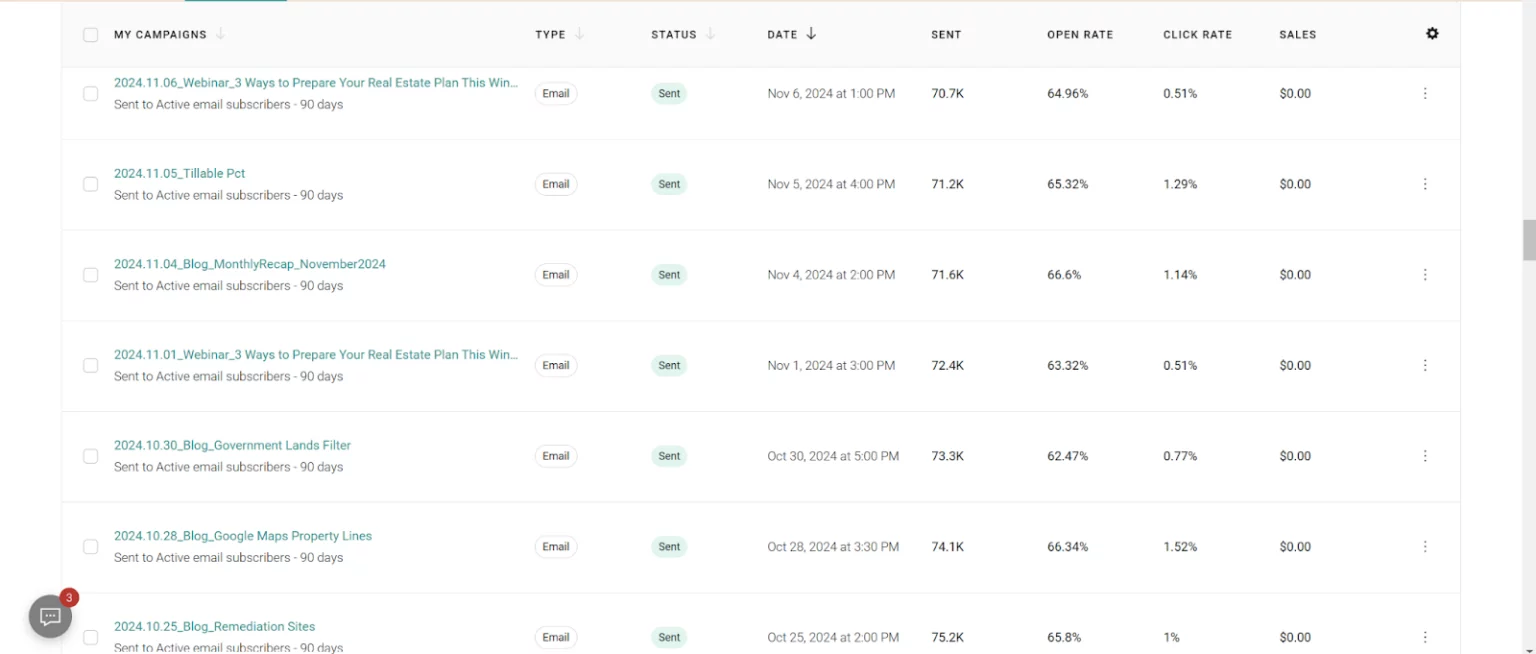
Land intelligence platform AcreValue saw its open rates increase from 5–7% to 60–70% with a sunset automation that re-engaged 10% of inactive subscribers in two months.
Email campaign results before:
Email campaign results after:
It also fixed deliverability with better segmentation and a dedicated IP to control its sender reputation.
4. It scales revenue without scaling headcount
Email automations are built once, and you then refine them over time depending on their performance metrics, such as opens and clicks. It’s a scalable activity, requiring minimal build time and only small optimizations when necessary.
Luxury baby accessories brand Bowy Made has an automation-heavy email marketing strategy, letting its flows run in the background. 70% of its revenue now comes from email automations.
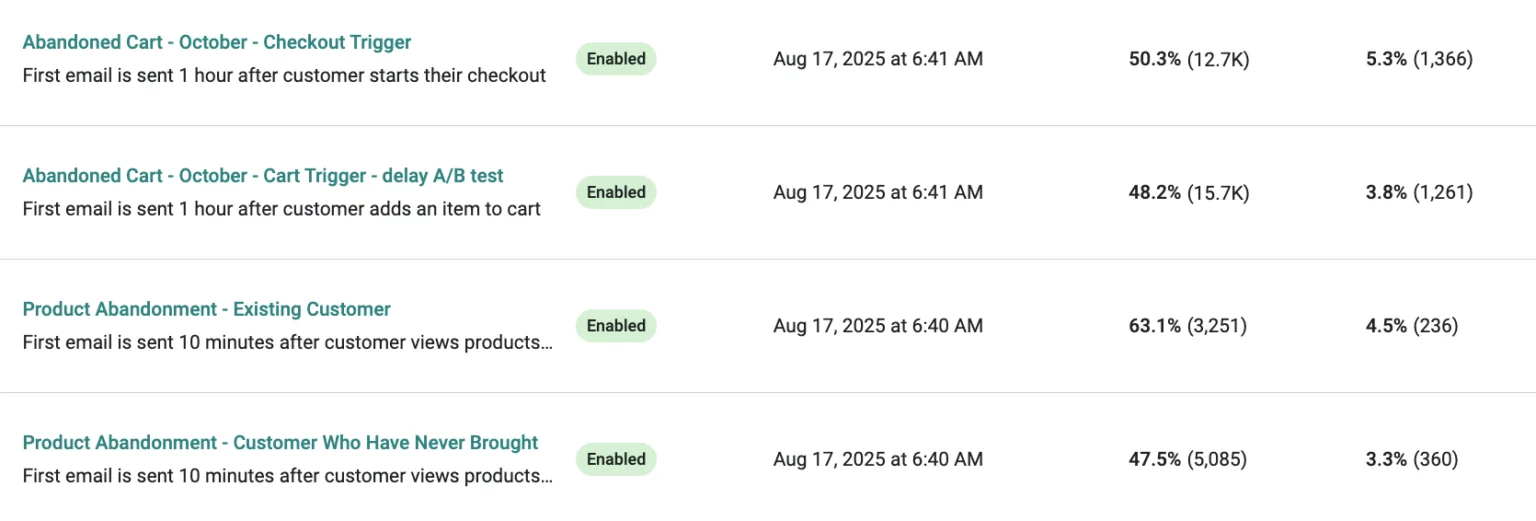
Marketing agencies are also leaning into email automations to scale, with an average of 5.3 active automations per client according to Omnisend’s Top Agencies report.
Omnisend and most other high-quality email tools also let you save email templates and auto-apply brand assets to new ones. So, even when you’re designing, which is traditionally one of the most labor-intensive tasks, you aren’t losing time.
The scale provided by email automations also plays well with one-time and scheduled sends, which you can use to reach entire lists and segments at once. Your automations can follow up with any openers or clickers of those emails.
“There are ecommerce stores with millions of dollars in turnover, tens of thousands of customers, and marketing teams of fewer than five people. Those lean brands owe it all to automation. In the case of email, we’re talking about automated customer experiences across confirmations, alerts, purchases, and follow-ups, via software such as Omnisend. The more you automate, the lower your workload, even at scale.”
— Karolina Petraškienė, Marketing Projects Lead at Omnisend
5. It recovers revenue you’d otherwise lose
Customers regularly leave items in carts, abandon checkouts, and browse products without buying. Without automation in place, that revenue is gone.
Abandonment emails change that, triggering after a customer leaves their cart, checkout, or session. They land in your customers’ inboxes with a reminder, the product they left behind, and sometimes a small incentive or time-sensitive offer to come back.
The numbers explain why every store needs one. Abandoned cart and welcome emails made up 76% of all automation-related orders in 2025, according to Omnisend’s 2026 Ecommerce Marketing Report.
Revenue recovery is one of packaging supplies retailer Verpakgigant’s most significant email marketing automation benefits. It recovered €25K across 147 orders with its abandoned cart automation, which saw a 46.4% open rate.
Any scenario where customers are walking away is an opportunity for a well-timed email that brings them back and encourages them to continue shopping.
Browse abandonment, checkout abandonment, and back-in-stock automations are prime examples to catch customers who showed interest but didn’t convert. It’s worthwhile setting all these up and seeing which generates the most revenue.
6. It builds long-term customer value, not just one-time sales
A one-time buyer has the potential to become a repeat customer who spends more, recommends you to others, and becomes an ambassador.
Most ecommerce revenue comes from repeat customers, not first-time buyers. Without automation, staying in touch with them after their first order is hard to keep up with.
Loyalty, win-back, birthday, and post-purchase emails do that work in the background. They send the right message at moments where customers might lapse, spend more, or come back.
Birthday emails are the highest-AOV automation in 2025. Omnisend’s 2026 Ecommerce Marketing Report shows they produced an average order value of $744.37, more than 4x the overall average. One trigger per customer per year.
Verpakgigant used a post-purchase review request to grow its Google reviews from 15 to 240+, a 1,500% increase. The reviews help retention and acquisition together.
Loyalty and win-back automations work on similar logic. These reward your repeat customers, catch them before they go quiet, and keep their lifetime value going up without adding to your team’s workload.
7. It fits into your multichannel marketing strategy
Your email automations can include an SMS and a web push notification in Omnisend. Emails are best for delivering your long-form content and detailed product recommendations, while text messages provide time-sensitive alerts and notifications.
For example, you could send an email with personalized product recommendations, and also text them saying, “Check your email.” Plus, your abandoned cart flow could trigger both an email and a text, spaced a few hours apart, with links to their basket.
Automated SMS earned $0.74 per send in 2025, compared to $0.15 for SMS campaigns, according to Omnisend’s 2026 Ecommerce Marketing Report.
Higher revenue per SMS is something cosmetics brand INGLOT Canada achieved, lifting revenue per message by 2,130% with SMS and email workflows running together.
Push automations did even better, with 10x higher conversion and 7x higher ROI than push campaigns, and click-to-conversion went from 13.9% to 22.9%.
Top agencies are already on this. Omnisend’s Top Agencies report shows that those using SMS marketing see 202% more revenue than those that don’t.
Of course, you can only use SMS in your email flows if you collect customer numbers and obtain their explicit consent to receive marketing texts. Consent is necessary to send SMS under the TCPA and GDPR, and you must also include opt-out language.
8. It continuously improves through testing and optimization
All the email automations you run collect data for send volume, opens, clicks, placed orders, deliverability, and revenue. Your email tool’s reports then provide a visualization of those and help you analyze your best and worst performers.
Omnisend’s Top Agencies report shows agencies that A/B test see 192% higher revenue on average, and segmentation adds up to 8% incremental revenue uplift.
Continual testing and optimization will help you maximize email automation benefits. It could well be that your welcome series converts better when the discount is in email two, or that your birthday flow sees higher open rates with a personalized subject line.
Those improvements compound as well. A 3% increase in open rates from one change seems meager, but it could give you 1% more clicks and a 0.5% conversion lift. Now do that across all your automations, and you have a lot more revenue.
Another avenue for improvement is the default confirmation emails your ecommerce platform, such as Shopify, sends. You can replace these with better templates and remove the thank-you messaging, leaving that for a dedicated, more appropriate automation.
Start capturing the benefits of email automation
Now that you’ve taken in all of Omnisend’s data, you’ll no doubt agree that email automation is an enormously effective marketing channel for ecommerce.
Automations provide branded touchpoints throughout your customer’s lifecycle and influence your relationship and their subsequent behavior. You can create experiences that competitors can’t match and foster retention with contextual messages.
The opportunities for revenue recovery are also unequaled. Any customer who abandoned their browsing session, a product, cart, or checkout can enter your flow and receive a well-timed email with a link to their cart.
If you don’t already have an Omnisend account, sign up today to create automations with the depth of an enterprise tool without the learning curve. Agencies take only eight days to create and launch their first automation.
Omnisend’s native apps for Shopify, WooCommerce, and other platforms provide the deep data sync necessary to trigger your automations based on behavior and events.
Quick sign up | No credit card required
FAQs
What are the benefits of email automation?
Revenue from email automations outperforms scheduled email campaigns by 16x, with 30% of revenue coming from 2% of sends in 2025. Once you have your flows set up, they require minimal ongoing management, and the triggers and filters you set ensure emails reach the right people. Automations can scale, reach customers across multiple channels, and provide new opportunities to recover revenue and increase retention.
How much revenue can email automation generate?
Luxury baby accessories brand Bowy Made generates 70% of its total revenue from automations, and electric gear retailer FLEXTAIL generated $235K revenue from a welcome series alone. Omnisend’s 2026 Ecommerce Marketing Report shows that back-in-stock alerts have the highest revenue per email at $8.46, no surprise when customers who opt into those are waiting to purchase the product.
Is email automation worth it for small businesses?
Your small business doesn’t have the time to send emails manually, nor can it afford to miss out on automation opportunities to nurture, convert, and retain customers. Automations, such as a welcome series, abandoned cart flow, thank-you message, and feedback request, improve your customer experience with timely messages. Omnisend customers achieved a 76x return on email alone in 2025, growing to 79x across email, SMS, and web push.
What types of automated emails deliver the most benefit?
Abandoned cart and welcome messages accounted for 76% of automated email revenue in 2025. Start there. Your welcome email, or series, triggers when customers sign up via a form, or you can send it following an order confirmation. Abandoned cart emails target shoppers who shared their email but didn’t complete checkout. These email automations have high success rates because they appear at the discovery and consideration stages of your customer journey.
How is email automation different from regular email marketing?
Email automation is a type of email marketing. Email automations are one channel, and campaigns are another. An automation sees you build flows that trigger based on customer, store, or segment activity. A campaign is an email you schedule or send as a one-time effort. Your automations reach customers while they engage with your store and at other crucial moments, such as on an important date. Campaigns reach customers when you decide.