Omnisend AI

 OFFER
OFFER









Most ecommerce brands can rattle off their standard lifecycle stages, but few have actually mapped out the customer lifecycle journey as a connected, visual path. You know the difference between a new subscriber and a loyal buyer. But without plotting the exact touchpoints between those phases, you’re just guessing when to send a campaign or trigger an SMS.
Instead of throwing another glossary definition at you, we’ll break down the specific differences between a lifecycle and a journey map. Then, you’ll understand exactly how to merge them.
By the time you’re done reading the guide, you should have a practical framework to visualize your touchpoints, identify drop-off moments, and build personalized automated workflows that drive revenue non-stop.
Quick sign up | No credit card required
What is the customer lifecycle journey?
A customer lifecycle journey is the exact intersection where your macro business framework meets your micro touchpoints. It’s not a generic marketing buzzword, nor is it a loose synonym for a standard customer journey.
Think of the customer as your high-level roadmap. It outlines the broad, stage-based phases a shopper goes through, from learning your brand exists in the first place to becoming a repeat buyer.
A traditional journey map, on the other hand, zooms in on the granular details. It tracks individual clicks, page views, and specific email customer-journey interactions.
The customer lifecycle journey marries the two. It takes abstract stages, like retention, and anchors them to concrete, trackable actions. For example, automated winback SMS is triggered after 60 days of inactivity.
Without this intersection, your marketing strategy lives entirely in theory. You might know which part of your shoppers are in the acquisition phase, but you’ll have no idea which pop-ups, emails, or SMS messages actually push them toward a purchase.
Once you do start mapping this hybrid journey, you’ll be able to track intent and match a personalized message to that intent at the exact right moment.
Customer lifecycle journey vs. customer journey: key differences
To map this out correctly, you need to understand where a standalone journey map ends and the full lifecycle journey begins. They’re often treated as the same thing, but doing that is a huge mistake.
It can get confusing trying to understand what’s what, so here’s a table of key differences:
| Dimension | Customer journey | Customer lifecycle journey |
|---|---|---|
| Focus | Specific interactions and short-term goals, like navigating the checkout flow | The entire relationship from start to finish, and everything in between |
| Scope | Micro and touchpoint-based | Macro and micro (combining stage-based progression with specific touchpoints) |
| Perspective | The customer’s immediate experience and pain points | The brand’s long-term retention marketing strategy |
| Timeframe | Short-term (minutes, hours, or days) | Long-term (months or years) |
| Primary use | Fixing friction in highly specific environments | Building multi-channel automations across the customer lifecycle |
| Key data sources | Session recordings, heatmaps, and UX feedback | RFM analysis, complete purchase history, and overall engagement data |
If you want to be a true lifecycle email marketing expert, understanding this distinction is crucial for your success. If you just pick one and pay no mind to the other, you’ll either be missing out on the bigger picture or lose customers due to lower-scale friction points.
For example, you might perfectly optimize a single checkout journey to boost immediate conversions. But if you aren’t mapping that into a broader customer lifecycle marketing framework, you’ll fail to engage that buyer three months later when they’re ready to buy again.
Once you get the hang of this difference, you’ll be able to see the difference between a good singular campaign and a highly profitable automation system that runs on its own. It allows you to build audience segments more accurately, create highly personalized and complex automation workflows, and actually reduce churn before it even becomes a problem.
The 5 stages of the customer lifecycle journey
Every customer lifecycle journey is built around five core stages. Understanding these customer lifecycle stages is the foundation of any effective journey map. Just make sure you remember that the process is cyclical, which means your customers don’t always move linearly. They skip stages, stall, or re-enter entirely.
- Awareness: The customer discovers your brand for the very first time. They are curious but uncommitted. Your goal is to grab their attention and show why you should matter to them.
- Acquisition: The customer shows intent and starts evaluating your products. Your goal is to earn their contact info so you can start engaging with them on your terms.
- Conversion: The customer makes their first purchase with you. They transition from just browsing to buying. Your goal is to provide a frictionless checkout and set the stage for a great post-purchase experience.
- Retention: You want to bring them back for more. They might be satisfied, but they could still easily drift away. Your goal is to keep them engaged and feeling valued.
- Loyalty and advocacy: The customer becomes a true fan and advocate who completely trusts your brand. Your goal is to reward their loyalty and inspire them to share your business with others.
Each stage requires a tailored approach to touchpoints, messaging, and timing. The journey map in the next section turns these abstract concepts into an actionable plan.
The ecommerce customer lifecycle journey map
The lifecycle framework is one of the things where simply thinking about it won’t cut it. It’s realistically impossible to keep it all in your head; you need to translate those broad stages into specific touchpoints, emotional states, and automation triggers. It’s a lot of work to do.
If you refuse to do that, however, you won’t be able to map the customer’s mindset to the correct channel, and you’ll end up sending aggressive sales pitches to people who have just learned that you exist.
So, take this map we’ve prepared below and use it as a reference in your strategy. It will allow you to bridge the gap between high-level strategy and daily fixes.
| Stage | Customer mindset | Key touchpoints | Friction point | Automation type |
|---|---|---|---|---|
| Awareness | Curious | Google ad, social post, influencer | Doesn't engage | — |
| Acquisition | Evaluating | Welcome email, pop-up, wishlist | Doesn't subscribe | Welcome series |
| Conversion | Committed | Checkout, order confirmation, SMS | Abandons cart | Post-purchase flow |
| Retention | Satisfied / At-risk | Replenishment email, win-back SMS | Goes silent | Win-back flow |
| Loyalty | Loyal advocate | VIP program, referral, review request | Disengages after a bad experience | Loyalty automation |
Reading this map is rather straightforward. Moving up to the bottom across the stages follows the customer journey from their first idle scroll to becoming a vocal brand advocate. It allows you to look at the process exactly how your buyer experiences it.
The one you may want to pay closest attention to is the friction point column, since it shows where intervention is most critical. If left unchecked, customers will inevitably stall at that friction point. You don’t need to pretend that drop-offs won’t happen, but anticipate exactly when they will. When someone abandons their cart or goes radio-silent after three months, you need a system that’s ready to respond.
That’s where the automation column comes in. It shows which workflows can help you catch the shoppers who are dropping off. Instead of manually trying to win back a dormant buyer, you set up an intuitive workflow to do all the heavy lifting for you.
You map the behavior, set the trigger, and let the automation run while you focus on the rest of your business. This is how you secure a high ROI without burning out your team.
How to map your customer lifecycle journey
Building a theoretical model is fine for a boardroom, but executing customer lifecycle journey mapping requires practical steps. To handle customer lifecycle mapping effectively, you need to break down your audience’s behavior into actionable triggers and assign specific marketing responses.
Here’s a five-step process to build a working, automated map for your ecommerce store.
Step 1 — Define your lifecycle stages for ecommerce
Start by establishing the specific phases your buyers go through. Ecommerce lifecycle stages look fundamentally different from generic B2B models. Instead of dealing with a drawn-out software onboarding phase, you need to focus entirely on driving that critical first purchase.
Regardless of what ecommerce business you run, there are at least three distinct phases that you must consider: awareness, conversion, and retention. These are your key markers that will define how effective your lifecycle marketing is.
For example, a high-end furniture brand will likely have a much longer, content-heavy consideration stage than a fast-fashion retailer. But either way, both these stores need to define the stages that reflect their actual sales cycles before attempting to buy any automations.
Step 2 — Build customer personas for each stage
Once your stages are set, you need to know exactly who is standing in each one. A new visitor casually browsing your site requires a completely different approach than an at-risk VIP buyer.
A common mistake is to rely on gut feelings and fictional marketing avatars. They’re not truly real. At least not as real as data, built on actual purchase history, is. Use email engagement metrics like open rates, click rates, and unsubscribe rates along with customer lifecycle segmentation models like RFM (Recency, Frequency, Monetary value).
To define personas for every stage, think about these core attributes:
- Behavioral triggers: What did they do on your website that resulted in being placed in this stage?
- Purchase intent: Are they just looking around, ready to buy, or completely inactive?
- Value tier: What is their historical or potential customer lifetime value?
- Communication preference: Which channels do they actually open and click?
Step 3 — Map touchpoints and channel triggers to each stage
Next, match your channels to the exact moments your buyers are experiencing. You need to assign specific channels, like email, SMS, on-site pop-ups, or paid retargeting, to each lifecycle phase.
The most important thing here is to keep your touchpoints highly relevant to where the customer actually is, not just where you’d like them to be. If your subscriber is completely ignoring their inbox, it’s not the best idea to just send another promotional email. Instead, try another channel where they might be more present.
For example, here’s what you could do with customers in the retention stage: set up an automation that triggers a win-back email or an SMS after 60 days of inactivity. However, that email or SMS shouldn’t be the regular promotional email you send to your regulars. It would make more sense to make it an “We miss you” message or a “Here’s what happened while you were away.”
Step 4 — Identify friction points and drop-off moments
The customers’ path to checkout is rarely a smooth experience with zero interruptions. There are moments where they stall, hesitate, or just quit completely. Your job is to identify those moments and act on them.
These friction points are the most critical elements of your entire map. They highlight the exact vulnerabilities in your revenue stream and serve as your priority intervention points. If you have no idea where people leave, you cannot build a safety net to catch them.
Here are some common drop-off moments, categorized by phases:
- Acquisition phase: High site traffic but severely low email signup rates.
- Conversion phase: Continuous cart abandonment or checkout processes that result in quits.
- Retention phase: Total post-purchase silence and ignored replenishment reminders.
- Loyalty phase: Sudden churn signals from previously high-value VIP customers.
Step 5 — Assign automation and content to each stage
The final step is turning this theoretical map into an active email marketing engine. You take the behaviors and friction points you just identified and build automated workflows to address them.
This is where planning turns into actual revenue. You build out the welcome series for new subscribers, cart abandonment flows for hesitant buyers, loyalty triggers, and win-back sequences for dormant accounts.
What’s best is that you don’t have to build these workflows from scratch. You can use pre-built templates inside Omnisend for both email designs and automation workflows to instantly start sending relevant messages to segmented audiences. Omnisend comes with an intuitive design that lets you execute complex lifecycle strategies without fighting clunky customer lifecycle software.
Map the trigger, launch the automation, and let the system do its job.
Non-linear behavior: when customers don’t follow the map
We like to pretend the customer lifecycle is a straight line, but that’s not the case. In a perfect world, a shopper may see an ad, subscribe, buy, come back, and become the best thing that’s ever happened to the brand by advocating for your business to others.
Ecommerce customers rarely move through these stages in a straight line. They loop back, go silent for months, or skip some phases entirely. Here’s a more realistic scenario:
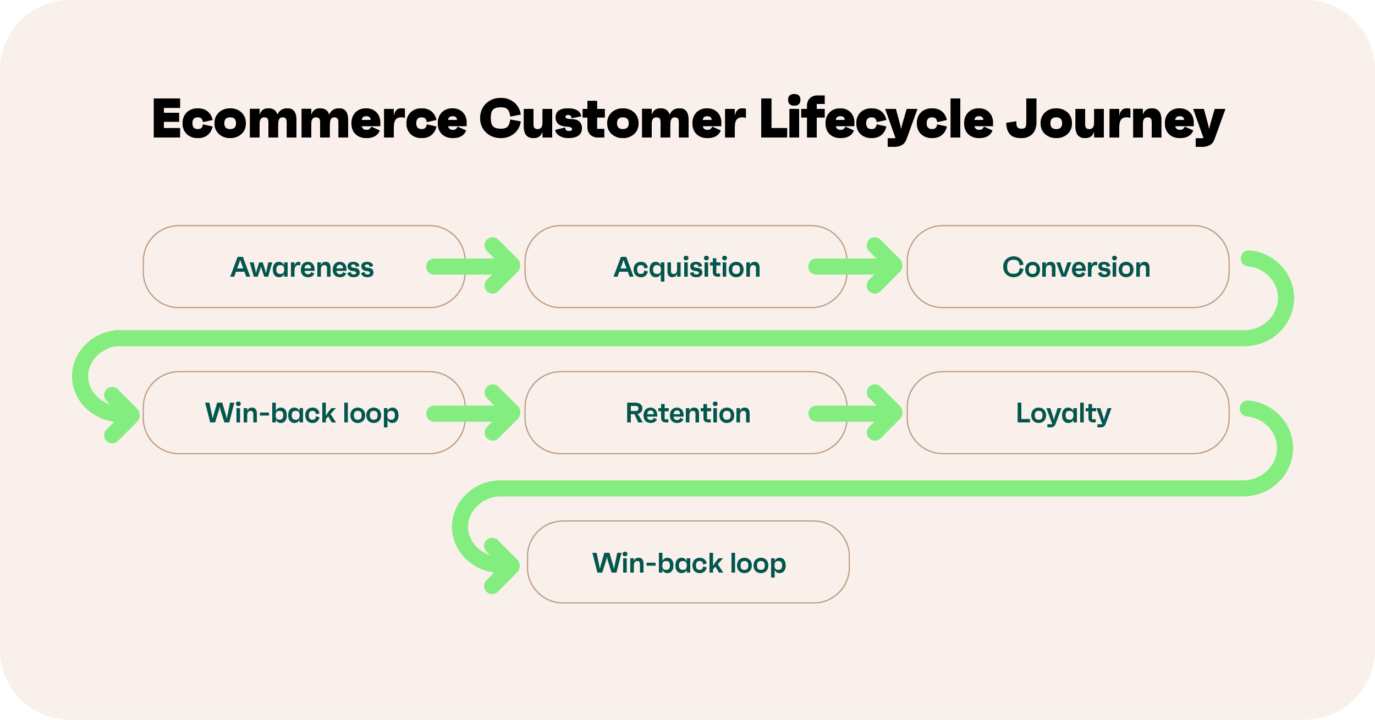
If your map only accounts for the optimistic, perfect-world path, you risk losing money on every single customer who eventually takes the scenic route.
Here’s what a non-linear behavior looks like in reality:
- The second purchase cycle: A customer buys once, then immediately drops back into an evaluation mindset for their next purchase. They’re technically in the retention stage, but they need to be nurtured almost like a new prospect.
- Dormancy periods: People are unpredictable, and even if they like your brand, they might just stop opening your emails for six months. That doesn’t mean they’ve churned forever; it’s just a natural pause. So, the best idea here is to stop pushing them with aggressive promotions and give them some space for a few months while subtly reminding them of you every once in a while.
- Win-back flows: If that customer did actually lapse, it’s important not to start treating them as new customers again. They didn’t fall back to the awareness stage. They already know you, after all. You need to send win-back campaigns and acknowledge their history with you while encouraging them to come back.
- Re-engagement at the loyalty stage: Even VIPs get bored. A loyal customer might suddenly stop buying, and that’s your cue to show them that they’re important to you. Re-engaging a VIP is not the same as re-engaging a regular customer, so you need to prepare a highly personalized approach with a relevant offer.
A well-built lifecycle journey map accounts for these unpredictable loops instead of just drawing a straight line to the checkout page and hoping for the best. The goal is to understand that customers will wander off the intended path and anticipate it by placing automated workflows for different scenarios to pull them back in.
How lifecycle journey mapping improves ecommerce retention
Once you figure out how to do it right, mapping your customer lifecycle journey becomes a direct lever for revenue growth. The real shift happens when you stop relying on generic promo blasts and start aligning your messages with real customer behaviors.
It will take some work, but you can expect a measurable increase in retention, repeat purchase rates, and overall customer lifetime value in return.
Here’s how lifecycle mapping directly impacts your bottom line:
- Smarter personalization drives repeat purchases: Sending the right message at the right time is the core of journey mapping. Recent HubSpot personalization data shows that 96% of marketers believe personalization directly increases the likelihood of repeat purchases. When a customer receives a highly relevant replenishment reminder instead of a generic newsletter, they are far more likely to buy.
- Proactive friction removal reduces churn: A mapped journey highlights exactly where your buyers decide to quit. To prevent continuous reactions to lost customers, you can deploy automated re-engagement flows to bring them back before they churn. According to Customer.io research, 83% of teams acknowledge email as their proven ROI channel when used strategically instead of just blasting generic emails to everyone.
- Higher customer lifetime value (CLV) through targeted loyalty: A lifecycle map helps you ensure that you treat your VIPs as actual VIPs and not just other customers. When you automate exclusive perks, early access, and tailored referral requests for your best customers, you increase their lifetime value without inflating your acquisition budget. Tailoring these specific moments keeps your best customers closely connected to your brand.
By understanding these points of impact, you can eliminate the guesswork entirely and focus on acting based on data. Once you build a reliable system that naturally nurtures relationships and retains buyers for the long haul, you should see a noticeable impact on your revenue stream.
Conclusion
The customer lifecycle gives you the high-level stages, while the journey map tracks the specific touchpoints and interactions. The real value comes from merging the two, which allows for translating abstract marketing concepts into concrete, automated interactions that actually drive revenue and move the needle.
Remember, the framework we outlined is just your starting point. It’s not a finished product, and it must evolve as you gather more customer data.
In 2026, spray-and-pray campaigns are a dead end. The ecommerce brands that scale will be the ones that efficiently tie hyper-personalization and intelligent automation directly to their customer lifecycle journey.
Quick sign up | No credit card required