Omnisend AI


 OFFER
OFFER









Mapping out an entire ecommerce customer lifecycle requires a massive amount of data, along with manual work to process it and turn it into actionable insights. Online shoppers don’t follow a precise pattern applicable to other consumers.
They compare competitor product features and prices, abandon carts abruptly, and make purchase decisions either on the spot or over the course of a few days. Despite the complexity, understanding how consumers act and what motivates them to make purchases is what inevitably differentiates successful ecommerce businesses.
This in-depth guide will explore the ecommerce customer lifecycle framework, detailing the stages and the key metrics that define each one.
What makes the ecommerce customer lifecycle different
It’s important to define why and how the ecommerce customer lifecycle is different from other models. For starters, customer lifecycle marketing was initially built with B2B or service businesses in mind. They’re more predictable and easier to establish.
Ecommerce is different — it breaks virtually every known assumption about how customers react. Here’s a rundown of the fundamental differences that make ecommerce unique:
- Anonymous-first behavior: Consumers don’t have to share their names, emails, or other details, so compared to B2B and service businesses, the ecommerce lifecycle starts with anonymous customers coming in and buying what they need.
- Cart abandonment becomes a lifecycle stage: Anonymity leads consumers to add items to the cart on impulse, only to leave it midway without any discernible reason, which in itself requires a dedicated response strategy.
- Completely different purchase frequencies by category: Ecommerce is a huge industry. A skincare customer might return to buy every month, but a person buying an electronic gadget might buy once every few years, or not at all. In other words, a lapsed customer needs to be defined differently for every business.
- Seasonal spikes and tendencies: Buyers behave differently around seasons and events, with the most common examples showing major spikes around events like Christmas, BFCM, or back-to-school. In this case, these shoppers are seasonal shoppers, so sending a winback flow in January would simply be a strategic mistake and a waste of resources.
- Multi-device and multi-session purchasing: Most ecommerce businesses have optimized their businesses for mobile use, which results in a unique pattern — customers casually browse on their phones, find an interesting product ad, save it for later, and if they remember, continue browsing and purchasing on desktop.
The ecommerce customer lifecycle stages
The main stages of the ecommerce customer lifecycle are the same as with any other business — acquisition, conversion, retention, and reactivation. However, in ecommerce every stage transition looks completely different.
How ecommerce brands turn anonymous visitors into subscribers
As we’ve briefly mentioned, consumers start interacting with brands without sharing any details about themselves, so essentially, the customer acquisition stage starts anonymously, without a brand knowing who their customer is.
That’s why ecommerce businesses rely so heavily on carefully placed popups, spin-to-win games, checkout opt-ins, and quiz funnels. All of these methods become conversion mechanisms to gather information about customers and create reliable subscriber lists, all at the same time.
Key metrics for this stage include:
- Signup rate.
- Subscriber source.
- Zero-party data captured at opt-in.
Unsurprisingly, the challenge here is subscriber quality. A good example would be comparing a visitor who quickly signs up for a 15% discount for a one-time purchase, and a customer who has opted in to receive skincare-related content to learn more about their purchases.
Automation becomes integral to the customer acquisition strategy. In our 2026 Ecommerce Marketing Report, we’ve analyzed and compiled a list of marketing statistics, one of which shows that welcome and abandoned cart flows together drive 76% of all automation orders.
Why ecommerce customers abandon — and what moves them to buy
In physical stores, when a person puts an item they intend to buy in their cart, it’s highly likely they’ll complete the purchase. However, in ecommerce, cart and browse abandonment are conversion-stage behaviors that help brands act on those signals to generate revenue.
Most important metrics to track:
- Add-to-cart rate.
- Cart abandonment rate.
- Time to first purchase.
- First-purchase AOV.
In this stage, it’s all about getting the right timing. Purchase intent peaks at the moment a customer abandons their cart and starts dropping drastically with every passing hour. Brands that react accordingly and send abandonment emails within the first few hours typically get higher conversion than those who wait.
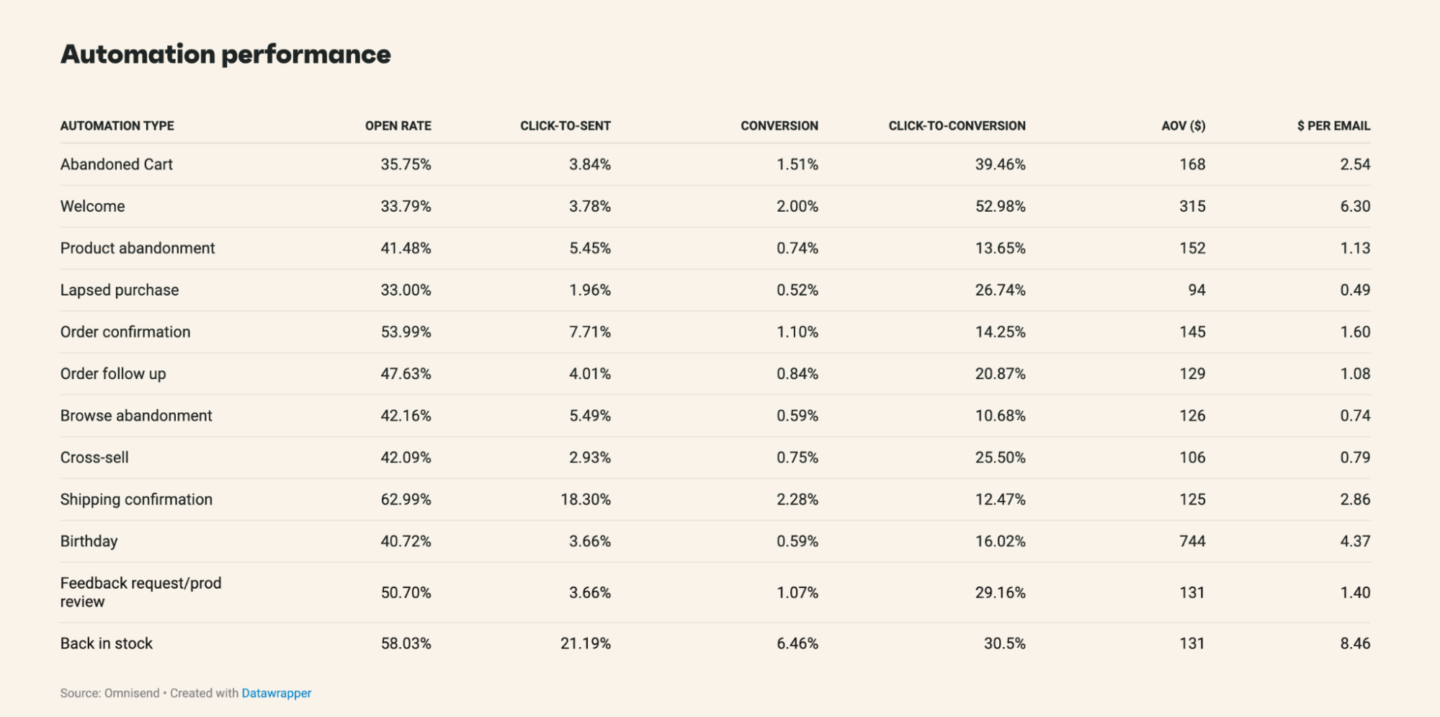
Email automation can be a great tool here. Our 2026 Ecommerce Marketing Report shows that click-to-conversion rates jumped 53% year-over-year in 2025, showing that when ecommerce shoppers engage with a conversion-led message, they follow through and complete their purchases.
The post-purchase window most ecommerce brands waste
Many ecommerce brands end their customer lifecycles with order confirmations, but it can actually become a new and often overlooked window of opportunity.
The period between order delivery and customers making a second purchase is noticeably unmanaged, yet the customers who buy a second time are twice as likely to buy a third time. In contrast, the biggest challenge with first-time buyers is that they won’t come back at all.
To illustrate the difference that focusing on post-purchase flows can make, according to our Top Agencies Report, top-performing agencies generate an average order value (AOV) of $44 thanks to systematic retention and post-purchase strategy.
On top of that, back-in-stock automations convert at 6.46%, showing how product availability announcements can lead to higher customer retention rates.
Here are some metrics to keep an eye on for the post-purchase stage:
- Repeat purchase rate.
- Time between first and second purchase.
- Review submission rate.
How to tell a lapsed customer from a seasonal one
As we briefly mentioned earlier in this guide, a “lapsed” customer is a relative term that needs to be defined according to the needs of different ecommerce brands. Treating every customer the same, particularly when it comes to determining churn, can be a costly mistake. Brands need to adjust their purchase cycle to correctly identify who their lapsed customers are, and this is a seasonal one.
Metrics to help benchmark this stage:
- Days since last purchase.
- Engagement rate with reactivation emails.
- Reactivation conversion rate.
A winback campaign can be either a massive revenue-driving strategy or a waste of budget, depending on whether the email chain is sent to the right audience segment. To avoid losing subscribers, one of the best things to do is to separate seasonal buyers and include a dedicated email flow for them before the reactivation emails are triggered.
Getting this stage right can have a measurable impact on performance. For example, AcreValue increased email open rates from just 5% to 60-70% through a systematic reactivation strategy, demonstrating how much difference a well-managed reactivation stage can make compared to a poorly managed one.
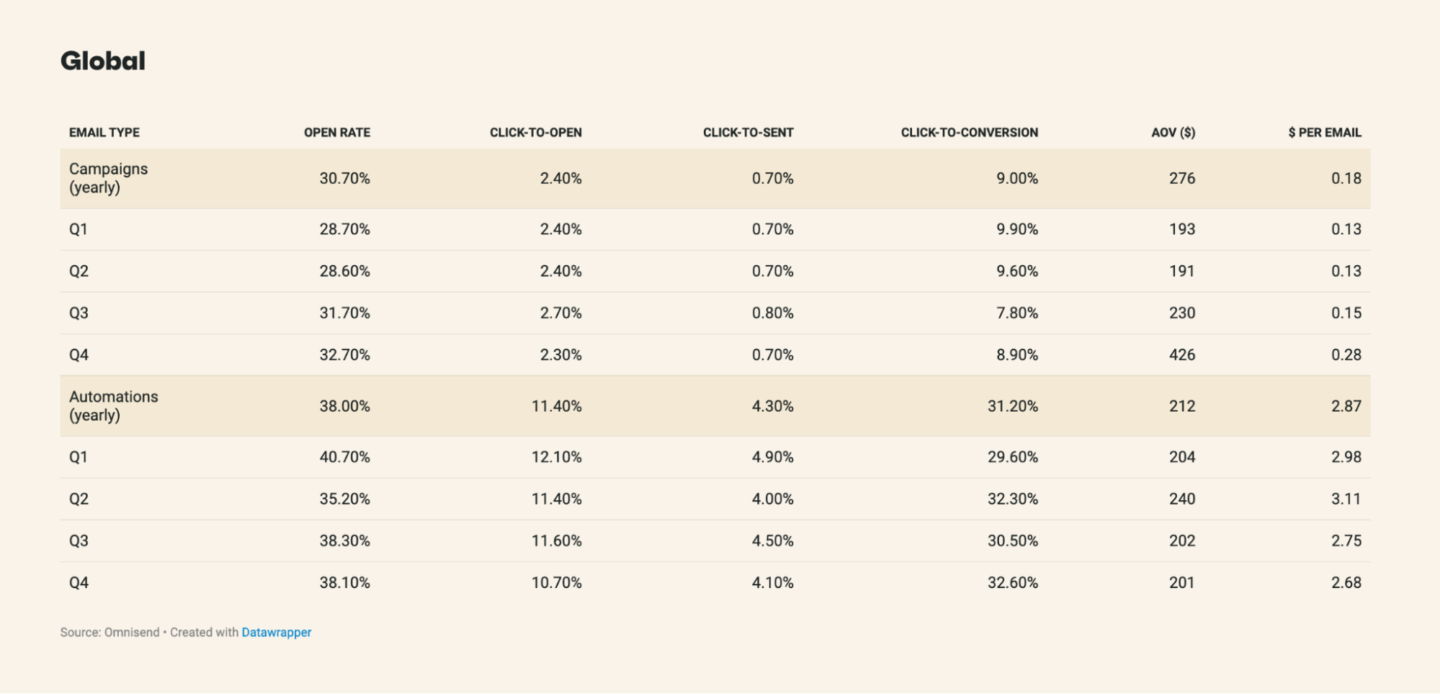
In short, seasonal buyers don’t need to be reminded or reengaged to continue buying. In fact, our analysis showed that in 2025 Q4, AOV doubled, which goes to show that high-intent online shoppers are motivated differently.
Ecommerce lifecycle metrics that actually matter
Some of the most popular lifecycle metrics brands use to track campaign performance are open rates, click rates, and return on ad spend (ROAS). But while these are the core metrics, not many businesses track metrics that predict growth from one stage to another.
Acquisition metrics
- Signup rate: Probably the most important metric for establishing a baseline measure of your campaign’s acquisition efficiency. Even the smallest changes to email timing, copy, and incentive type can stack up quickly. Vape Superstore, for example, increased its signup rate from 18% to 32% after optimizing its signup forms.
- Cost per subscriber by source: Calculates paid traffic subscribers to compare against lifetime value, crucial to estimating budgets.
- Zero-party data capture rate at signup: Reviews the percentage of subscribers who share their preferences, interests, or category data at opt-in.
Conversion metrics
- Cart abandonment rate: The industry average is 70%, so brands strive to keep it lower. If, however, brands exceed the 70% threshold, there’s a high possibility of checkout friction.
- Time to first purchase: The time it takes customers to complete a purchase, which shows businesses how long to run their nurture sequences.
- First-purchase AOV: Creates a baseline for downstream retention and LTV modeling.
Retention metrics
- Repeat purchase rate: Tracks the most direct measure of retention performance.
- Days between first and second purchase: Measures the time between first and second purchases to define post-purchase flows.
- Revenue per subscriber: Shows how much companies earn per subscriber, with the top-performing agencies generating around $16.70 per subscriber annually.
- Automation revenue share: According to our 2026 report, automations account for just 2% of all emails yet bring in 30% of revenue, outperforming broad email sends by 16x.
Reactivation metrics
- Reactivation rate from winback flows: Shows the percentage of targeted lapsed customers that make a purchase.
- Days since last purchase at reactivation trigger: Defines when to send winback sequences.
- Sunset rate: Identifies the percentage of lapsed customers who have been removed from email lists after failed reactivation attempts.
What separates ecommerce brands that grow from those that plateau
We found that the top 5% of the best-performing ecommerce brands generated 57% of total order growth in 2025. What puts these brands in that top 5%?
To begin with, these brands treat every lifecycle stage as a managed system, meaning that they build acquisition workflows that segment subscribers by source and serve different sequences based on how a subscriber chooses to opt-in. For that, these companies dedicate considerable resources to test timing, message sequence, and discount thresholds for every customer segment.
Another key differentiating factor is how these brands measure stage transitions, not just campaign performance. We already established that in ecommerce, analyzing individual stages isn’t enough — brands also need to review how one stage relates to another. That’s why stage transition rates are now leading indicators for predicting revenue.
Finally, the brands that show consistently higher order growth by choosing to automate lifecycle stages, averaging 5.3 active automations per client. The bottom line is that correctly automated flows built on accurate customer data bring better results, help optimize workflows, and allow businesses to distribute their resources to other business operations.
Managing the ecommerce customer lifecycle with Omnisend
Omnisend is an all-in-one tool designed specifically to support the ecommerce customer lifecycle with dynamic email elements, extensive flow libraries, and templates.
- Acquisition: Businesses can use Omnisend’s pop-up builder, signup forms, and spin-to-win tools to convert anonymous visitors into subscribers and customers while also getting zero-party data at opt-in. Moreover, these forms can be integrated with segmentation to increase automation enrollment.
- Conversion: Our services include abandoned cart, browse abandonment, and back-in-stock automations as native features that businesses can use to almost immediately cover high-intent situations after creating conversion-focused automations.
- Retention: We provide advanced features for post-purchase flows, replenishment reminders, and loyalty announcements. Omnisend works with leading loyalty programs to include points balances, discount tier statuses, and reward availability.
- Reactivation: Winback and sunset automations are crucial for brands to systematically manage lapsed customers and suppress seasonal buyers from generic winback segments.
To put this into numbers, Omnisend customers generate $73 back for every dollar they spend, making this one of the strongest ROI figures in lifecycle email marketing. Plus, we offer a completely free plan with ecommerce-focused features that customers can use to test our services without commitment.
Start building your own ecommerce customer lifecycle flows
Some businesses believe that they need to spend months tracking and analyzing different data on customer behavior and segments before they automate their first email sequences. But that’s not necessary — top agencies and ecommerce brands launch their first automation flows within eight days of onboarding a new client.
While it’s true that ecommerce customer lifecycle stages are different and often require unique strategies and tactics, the initial welcome, abandoned cart, post-purchase, and winback flows can be set up in a single week.
However, if you’re wondering where to start, it’s often best to look at the ecommerce lifecycle stage that’s currently costing you the most revenue. For most businesses, this will likely be the conversion stage or the retention stage. Once you’ve identified the problem stage, build a flow specifically dedicated to targeting any gaps, and grow from there.
Quick sign up | No credit card required
Frequently asked questions
What is the ecommerce customer lifecycle?
Ecommerce customer lifecycle is a series of stages that define how an online shopper moves through the entire buyer’s journey. Most commonly, these stages are acquisition, conversion, retention, and reactivation, and each of these stages has its own metrics and marketing strategies.
How is the ecommerce customer lifecycle different from a generic customer lifecycle?
The main difference between the ecommerce customer lifecycle and the generic customer lifecycle is that ecommerce includes new stages and customer dynamics that aren’t common for other industries. Specifically, ecommerce has anonymous-first acquisition, cart abandonment as a separate stage, category-dependent purchase frequency, and seasonal distortion that makes distinguishing lapsed customers from seasonal ones that much more difficult.
What are the stages of the ecommerce customer lifecycle?
The main stages of ecommerce customer lifecycle are:
- Customer acquisition: Converting anonymous visitors to listed subscribers.
- Conversion: Encouraging subscribers to become first-time buyers.
- Retention: Turning one-time buyers into repeat customers.
- Reactivation: Reengaging inactive customers who have lapsed and are on the verge of churn.
How do I measure ecommerce customer lifecycle performance?
The best starting point to measure ecommerce customer lifecycle performance is to start with transition rates between stages. To help with this, look at signup, cart-to-purchase, repeat purchase, and reactivation rates. Once you’ve launched your stage automations, you can use automation revenue share and revenue per subscriber to measure your overall lifecycle health.