Omnisend AI


 OFFER
OFFER






As the National Retail Federation expects Halloween spending to increase by $400 million in 2026, Halloween email marketing is a must to capture seasonal demand. This article provides 10 practical Halloween email examples, ranging from early-bird discounts and themed bundles to mystery offers and quick Halloween newsletters.
You can adapt these strategies to your October campaigns to test what works best for your audience. This way, you’ll feel more confident with your choices going into BFCM, Christmas, and New Year.
Why Halloween email marketing matters
Halloween email marketing matters because it captures seasonal demand and is your entry point to your customers’ inboxes before all the major winter holidays. If you’re not feeling your best about sending BFCM campaigns yet, Halloween email marketing is the perfect opportunity to dip your toes in.
Data from Firework shows that:
- Halloween emails get 14.7% higher open rates than the average promo
- 40% of shoppers say they’ve bought something because of a Halloween-themed email
- Altogether, those campaigns drive around $200 million in extra revenue every year
You can use Halloween emails to test out creative campaign opportunities, clear out specific inventory related to the holiday, highlight seasonal bundles, or introduce mystery discounts.
10 Halloween email marketing ideas and examples
Here you will find practical Halloween email marketing ideas supported by real examples you can adapt for your own campaigns. Each example highlights a different angle, be it discounts, teaser campaigns, last-chance offers, themed products, bundles, mystery offers, or post-Halloween clearance.
- Halloween sale or discount email
- Halloween teaser email
- Last-chance Halloween email
- Halloween-themed product email
- Halloween costume inspiration email
- Trick-or-treat mystery offer email
- Food and drinks Halloween email
- Halloween pet supplies email
- Halloween bundle email
- Post-Halloween clearance email
1. Halloween sale or discount email
A Halloween sale email offers a limited-time discount to increase revenue. Use this campaign in late October to give your subscribers a compelling incentive to make a purchase.
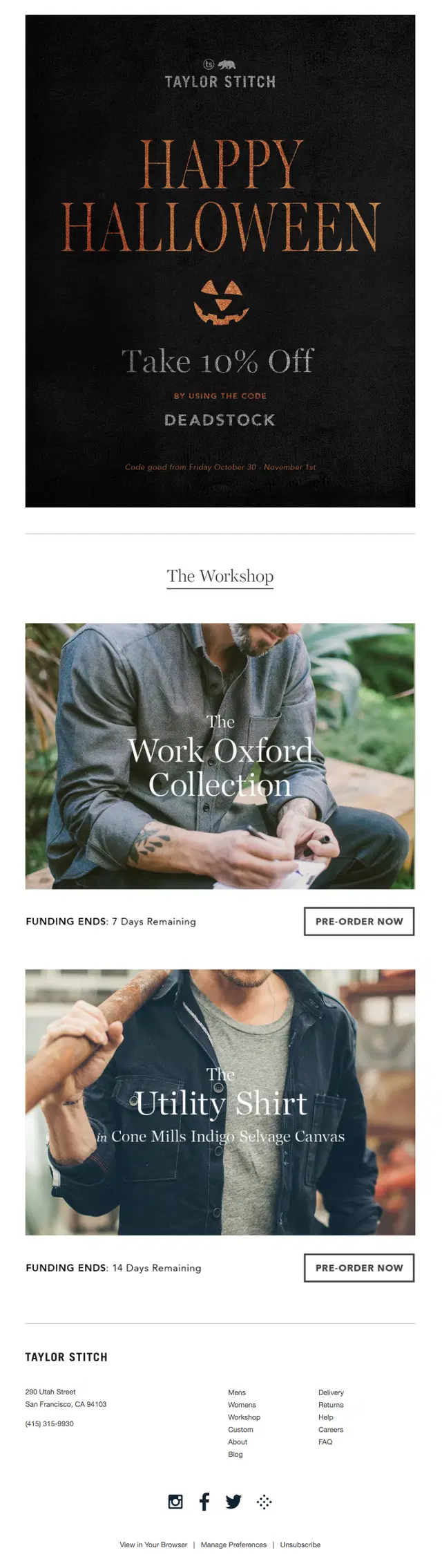
Taylor Stitch keeps its Halloween sale email straightforward, pairing a minimalist jack-o’-lantern graphic with a 10% off promotion. The email centers on a themed discount code (“DEADSTOCK”) and a clear expiration date. It shows how you can participate in the holiday even if you’re not selling costumes or candy.
Why this Halloween email works
This Taylor Stitch email works because it maintains the brand’s core aesthetic while introducing a clear seasonal deadline and offer.
- It creates strict urgency by highlighting a tight three-day window (October 30 to November 1st) directly beneath the offer
- The thematic promo code (“DEADSTOCK”) playfully fits both the Halloween season and the apparel industry
- The contrasting background makes the Halloween typography and the 10% discount highly visible
How to adapt this idea
You can adapt this idea by offering a straightforward discount. If you can’t come up with a Halloween-themed word that fits both your industry and your brand voice, you can use one of the classics: BOO15 or SPOOKY10. If that doesn’t fit either, you can just use a string of numbers and letters.
Keep the design minimalist and stick to a dark background so it contrasts with the text color and conveys a clear message. State the discount code, the discount amount, the expiration date, and eligible items (if applicable).
2. Halloween teaser email
A Halloween teaser email builds suspense and hints at upcoming promotions or launches before revealing the full details. You should use this campaign in early-to-mid October to capture your audience’s attention, which will turn into higher engagement rates when the mystery is revealed.

Piknik builds anticipation by inviting subscribers to “Get into the Halloween spirit” with a series of hidden secrets and themed activities. The email teases interactive experiences, like a new “Trick-or-Treat” feature and glow-in-the-dark coloring pages. It connects perfectly to the teaser concept by keeping the audience engaged and curious about the full experience.
Why this Halloween email works
- It creates intrigue by revealing the Halloween-themed features but not entirely
- It offers immediate value through free DIY printables and activities
- The design uses colorful blocks of seasonal colors, which works both for the brand and the reader
How to adapt this idea
Build a campaign that hints at a mysterious release before Halloween starts. Use blurred products, silhouettes, lock icons, riddles, or whatever else matches your brand personality. If relevant, add a “Join the waitlist” CTA to see how many people are interested in your teaser.
3. Last-chance Halloween email
A last-chance Halloween email highlights the final hours of the promotion to drive conversions through urgency and FOMO. You should use this campaign on the final day of the sale to capture shoppers who may have wanted to buy initially but got distracted or decided to wait.
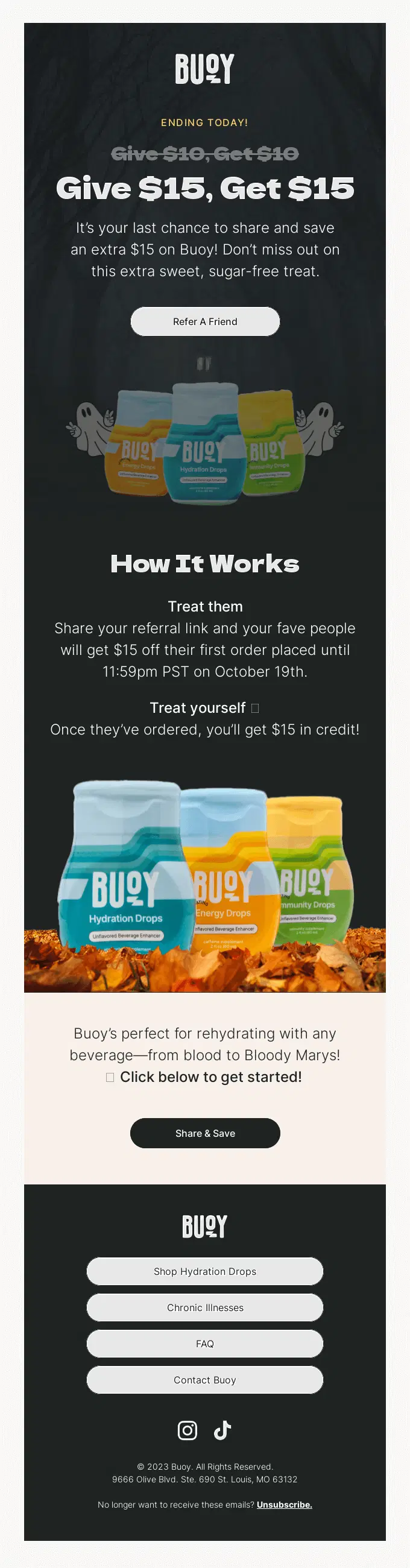
Buoy uses a last-chance email to promote a boosted “Give $15, Get $15” referral offer that expires before midnight. It places a small “ENDING TODAY!” message at the top and continue with ghostly graphics around its product, which is a nice touch for conveying a fading offer.
Why this Halloween email works
- It clearly shows that the offer is ending today and provides a hard expiration date in-text as well
- It emphasizes the value of the offer by crossing out the former offer and replacing it with a better one
- The design blends seasonal elements without overshadowing the core product and the message
How to adapt this idea
Send a final reminder on the last day of your promotion, and make the design and message as loud and clear as possible. Use bold labels like “Ends tonight” or “Last chance” so it’s the first thing the subscriber sees. Clearly state the expiration date and stick to a single CTA with no distractions.
4. Halloween-themed product email
A Halloween-themed product email puts relevant merchandise and exclusive flavors under the spotlight. You can use this campaign (if your product allows it) in mid-to-late October to capitalize on the limited-time opportunity.

Dan Murphy’s uses this campaign to highlight its limited-edition Mozart Pumpkin Spice Chocolate Liqueur. It also includes a recipe suggestion so you can use the bottle to make something good instead of letting it sit on the shelf.
Why this Halloween email works
- The complementary recipe underneath the main offer gives the subscriber a real reason why they should buy the product
- The design is highly visual (which is not the best approach for all brands), but in this case it sets the atmosphere, and it makes you want to be a part of it
- It highlights only one relevant product and has clear CTAs on what the reader should do
How to adapt this idea
Take an existing product (or create a new one) and wrap it around the Halloween theme. If you’re selling food or drinks, come up with a Halloween-specific recipe using your items. For other products, curate a “spookier” version for the season and add a “limited-edition” label.
5. Halloween costume inspiration email
A Halloween costume inspiration email is all about curating a relevant outfit out of the products you already have or releasing exclusive pieces just for the holiday. You should use this in early-to-mid October when people are planning their outfits. It’s a great opportunity to repurpose your inventory and drive sales that way without stocking Halloween-specific costumes that may linger for years to come.

ModCloth uses this costume inspiration to present a “Witch, Please” theme. It skipped the pre-packaged costumes and styled the outfits to reflect the Halloween look. It’s a prime example of how you can use your creativity to prepare for Halloween without stocking extra items.
Why this Halloween email works
- It repurposes non-seasonal pieces of clothing into a highly relevant outfit for Halloween
- The layout adds more outfit pieces one-by-one until you have a complete set
- The playful copy sets the festive tone without overpowering the main products
How to adapt this idea
Start by checking your existing catalog and grouping items into a Halloween-fitting category, such as movie characters or anything that could pass as vampire attire. Then structure your email so it’s easy to scan, and give every item its own CTA so there’s no confusion.
6. Trick-or-treat mystery offer email
A trick-or-treat mystery offer email provides subscribers with a surprise discount, hidden reward, a quiz, a “choose your treat” concept, and more. The catch is that you’ll only find out what you got when you try it. It’s a great way to get your subscribers more engaged than simply sending a flat discount code.
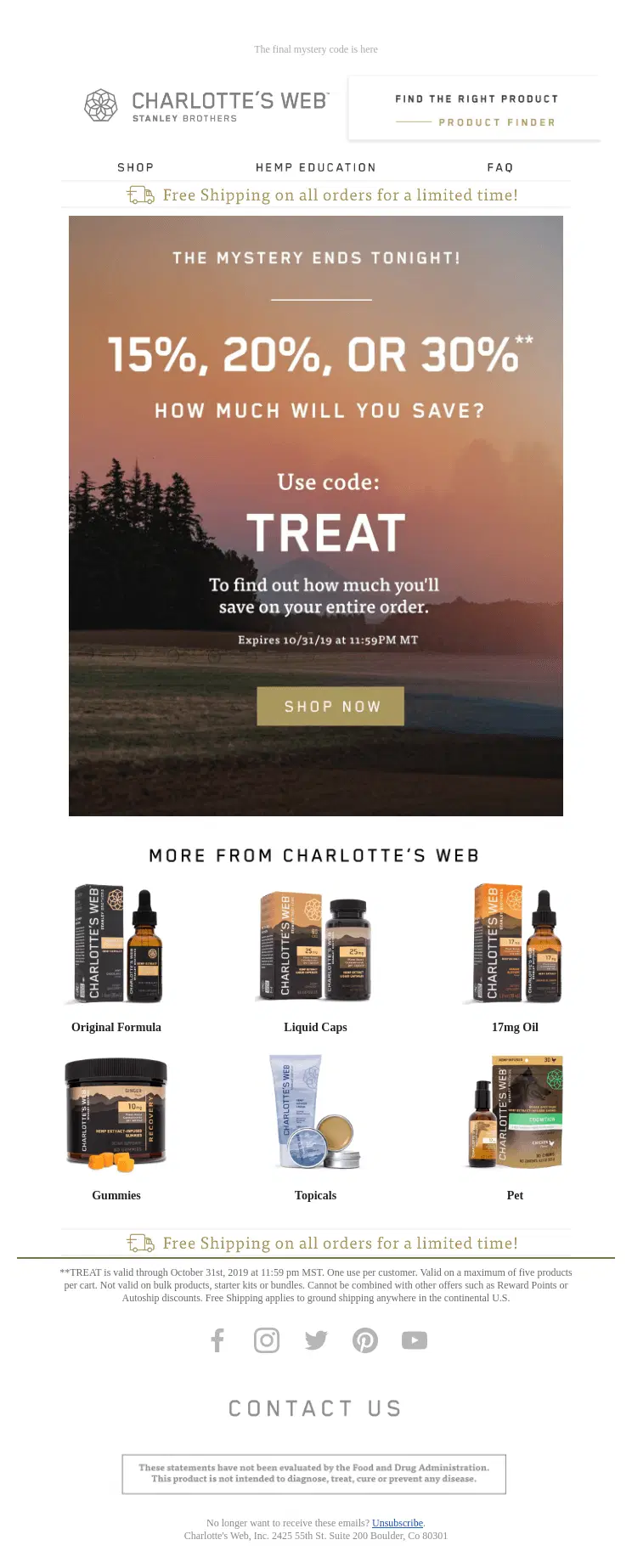
Charlotte’s Web uses a mystery discount offer that ranges from 15% to 30% using the code “TREAT”. The user will only find out the amount once they’re at the checkout page, which is a perfect way to have the “trick-or-treat” experience while shopping. Although it’s possible that people will just take the code, go to the checkout page, enter the code, and quit if the discount is anything less than the maximum amount.
Why this Halloween email works
- It plays into the curiosity of human nature, which is why chances are high that your CTR will skyrocket
- If it’s truly a trick and the discount is the maximum amount for everyone, you may see a rise in sales due to people thinking they got an amazing deal
- Alongside excitement to win, there’s also the urgency factor that makes them compelled to do it now
How to adapt this idea
Set up a friendly trick: make the discount code always land on the maximum amount, so everybody wins. You can do the same with a wheel of fortune rigged to always hit the highest prize. Just make sure the prize actually feels like one, not another 5% or 10% discount subscribers already see weekly.
7. Food and drinks Halloween email
A food and drinks Halloween email highlights seasonal treats, meal/cocktail recipes, catering options, or bundles of Halloween-themed snacks. You should send this campaign in mid-October to give customers enough time to plan for and receive the goods.

Fortnum & Mason uses this campaign to promote hampers made for the occasion and themed sweets like eyeball chocolates. It also uses strong seasonal product positioning by entangling a Halloween story within the email and selling the book alongside the food options.
Why this Halloween email works
- It follows a visual narrative where the excerpts are the food options, which makes up an interesting and coherent email layout
- The food and drinks are all tailored for the Halloween theme, and if you don’t want the singles, you can go for the hampers
- The delivery options at the bottom of the email serve as an assuring touch that your order will make it in time
How to adapt this idea
Curate your store’s existing snacks and beverages into a Halloween-themed menu. Group the items by category, like “For cocktail parties,” “For the kids’ table,” or “For trick-or-treating.” Just make sure you include clear shipping timelines within the email.
8. Halloween pet supplies email
A Halloween pet supplies email promotes seasonal toys, costumes, and treats for animals. You should send this campaign in early-to-mid October so the pet owners aren’t already caught up in organizing the Halloweenparty and can spare some time for extras.
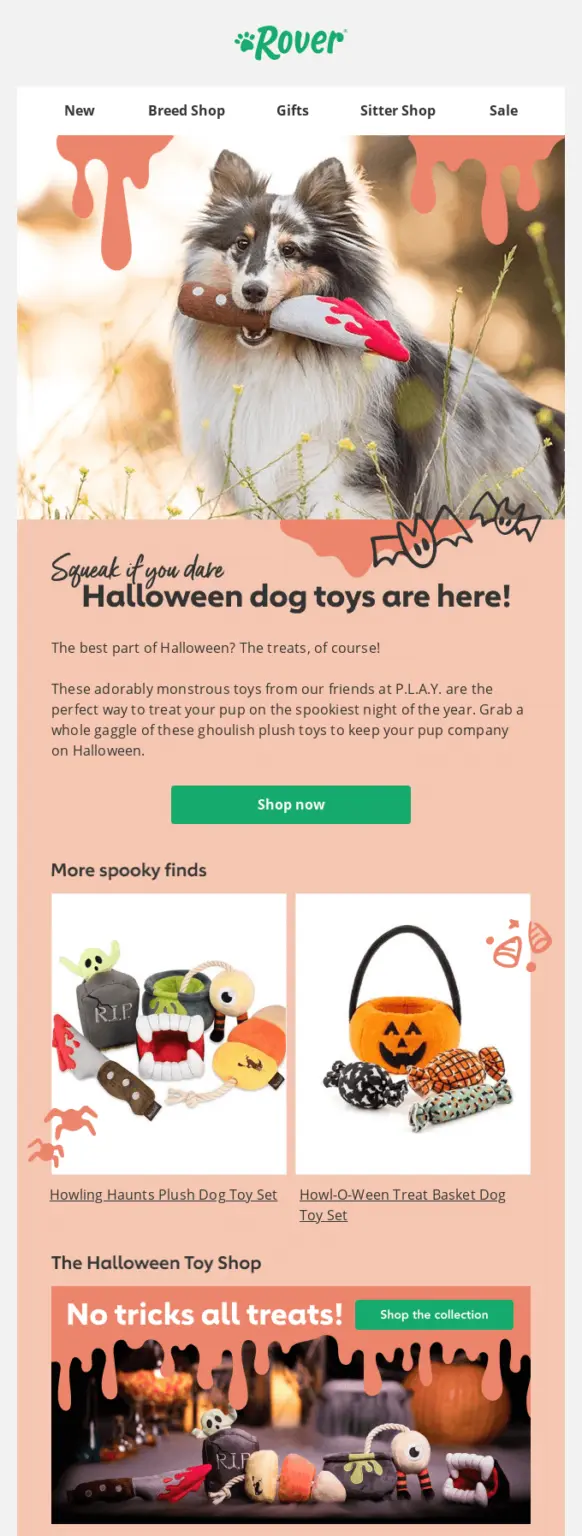
Rover uses this email to promote a collection of Halloween-themed plush dog toys. Instead of listing all the toys in a grid, it features a real-world image of the toy being used by a dog, which allows the subscriber to imagine what it would look like if they bought it.
Why this Halloween email works
- It uses a real-world photograph up top to show the product’s scale and how it looks like in action
- The design focuses more on Autumn rather than Halloween in terms of color, which may alleviate some of the inbox fatigue
- The email is short and simple so the reader doesn’t need to scroll much or try to understand what’s happening
How to adapt this idea
Use a real-world photograph of the item at the very top of your email. If it’s a dog costume, put it on your dog and showcase it in action for readers. Costumes rarely look good in plain product shots, so this approach works far better.
9. Halloween bundle email
A Halloween bundle email groups multiple themed products together and focuses on discounted prices when buying in higher volumes to increase the average order value. You should send this campaign in mid-October when people are looking to stock up for parties.
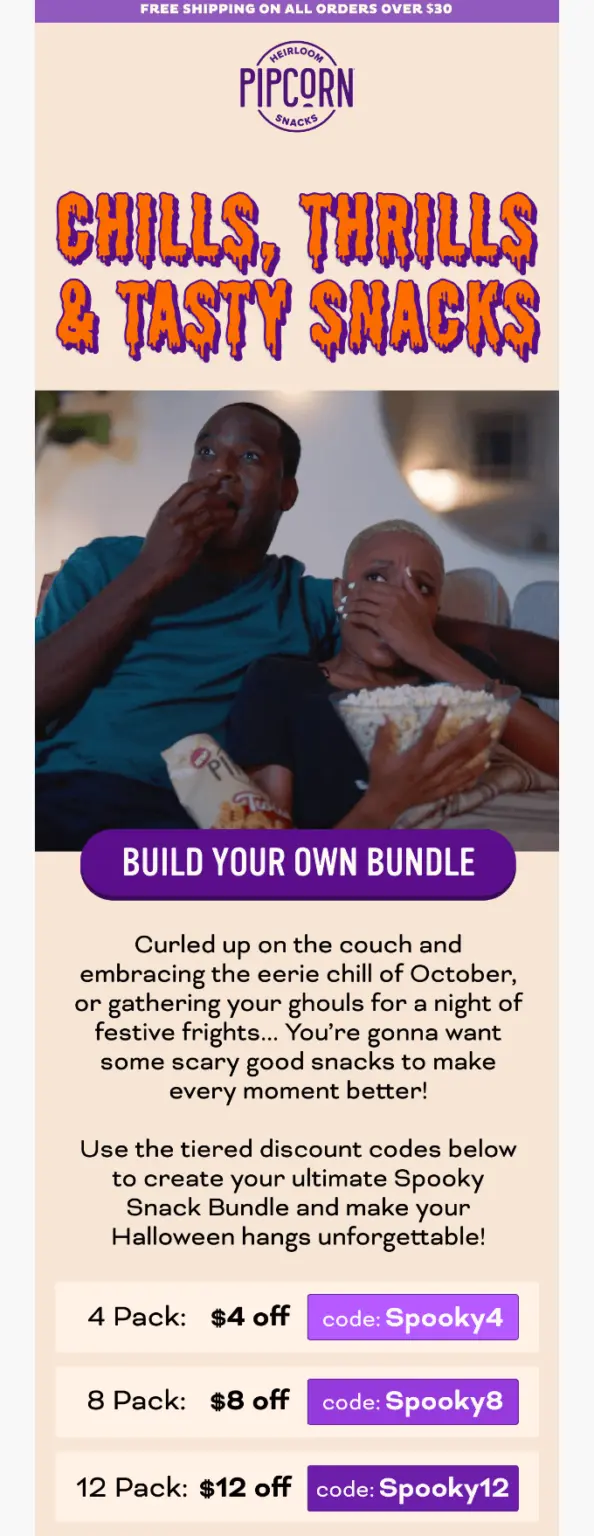
Pipcorn uses this campaign to sell tiered snack multi-packs. Depending on how much you buy, a discount code lets you to save on your purchase. It also gives subscribers the flexibility to customize their own treats.
Why this Halloween email works
- It uses tiered discounts to reward higher spending and drive up the overall order value
- The header image with a couple watching a movie fits well with the Halloween theme
- The discount codes are clearly visible and easy to use
How to adapt this idea
Group your products into specific seasonal packages. If you have a large product selection, offer a “build-your-own” option with tiered discounts based on volume. Show the savings clearly at each threshold so the reader knows exactly how much they can save.
10. Post-Halloween clearance email
A post-Halloween clearance email offers significant discounts on leftover seasonal inventory once the holiday is over. You should send this campaign starting November 1st to clear out Halloween stock that no longer appeals to regular shoppers.
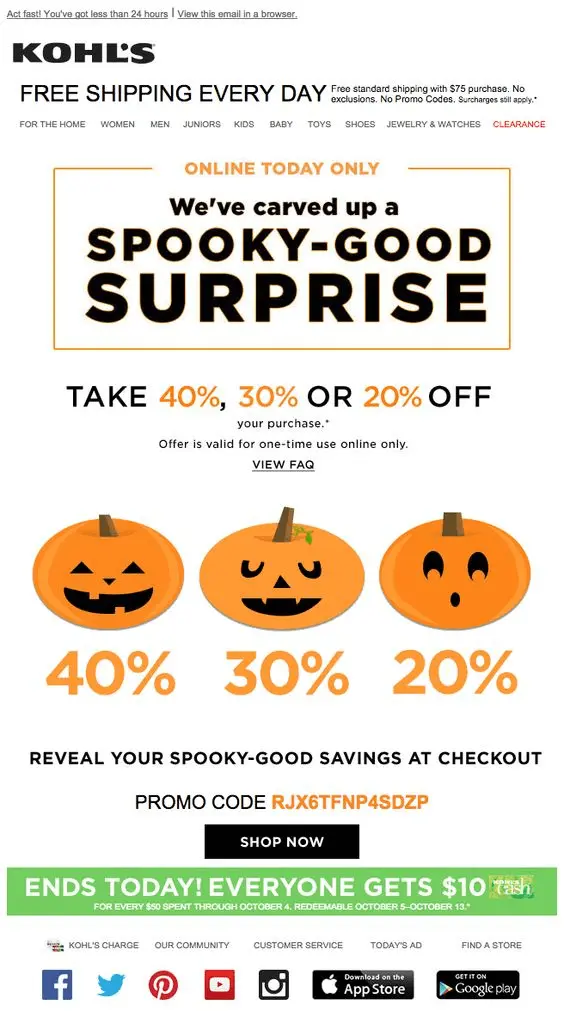
Kohl’s uses this post-Halloween email to offer a “spooky-good surprise” with 40%, 30%, or 20% discounts. It’s a single-day clearance event with large discounts that gives customers an opportunity and an incentive to, for example, prepare for next year early with good prices.
Why this Halloween email works
- It provides good deals so people can prepare for next year and save a fortune
- It’s a very simple design that shows the discounts and links to the store
- It places strict limits by stating that the deal is eligible for today only
How to adapt this idea
Send a dedicated email after Halloween to clear your remaining inventory at better prices. You don’t need the mystery-discount format; a flat 40% off on all Halloween-related items works too, as long as you state this is the final chance to buy at a discount.
Tips on how to create engaging Halloween emails
To create engaging Halloween emails, you need to follow best practices: think about proper subject lines, the clarity of the promotion, visuals that don’t hide the message, urgency, personalization, and post-Halloween follow-ups.
Use Halloween subject lines that match the offer
The subject line needs to have synergy with the season, but also be clear enough so the reader knows what they’re going to find inside the email. While using ghost and pumpkin emojis is great, the reader still needs to know if they’re opening a discount, a mysterious gift, a new release, or a last-chance reminder.
Here are 10 short examples of effective Halloween subject lines:
- 🎃 No tricks, just 20% off your entire order!
- Open if you dare: 30% off our spooky new collection
- Final hours! Don’t let this BOO-nus discount ghost you 👻
- Your Halloween party survival kit is here
- Sweet treats inside: Pick your mystery discount
- A wickedly good deal ends tonight at midnight
- Limited edition: Get our pumpkin spice bundle before it vanishes
- Scary-good savings on last-minute costumes 🦇
- Trick or treat? Open to reveal your surprise gift!
- 🕸️ Creep it real with our new fall arrivals
For more inspiration, explore our complete list of Halloween email subject lines.
Make the Halloween promotion clear right away
Place the discount, limited-edition product, mystery offer, or countdown timer at the very top of the email so it’s clear right away what the purpose is. Subscribers often scan through the email quickly to see if it warrants a longer read, so make sure your most important messages are prominent and highly visible.
Use spooky visuals without hiding the message
Only use seasonal design elements if they elevate your message instead of obscuring it. The most important part is keeping your CTAs visible, which means using contrasting colors. If you’re using a custom font for the occasion, keep it to headers only, as mobile devices may struggle to render it properly in simple text.
Add urgency before October 31
Make use of deadlines and put them in visible places so readers can clearly see when the offer expires. Use countdown timers and FOMO labels for the best effect. If you’re selling physical items, put down clear shipping timelines so your customers are assured that the items will arrive on time.
Match the campaign to Halloween shopping behavior
Tailor the campaign to your industry, your product, or your audience segments. For example, beauty brands can focus on providing makeup tutorials using their products; a hardware store can emphasize decorations and lighting; a food store can make Halloween-themed snacks and drinks.
Plan a post-Halloween follow-up
Send follow-up campaigns starting November 1st to transition your audience into the next shopping season. Use post-Halloween clearance sales to remove leftover inventory at a steep discount, send automated thank-you emails to make the customer feel noticed, conduct customer surveys, or even try an early Black Friday teaser to keep the subscribers engaged.
Mistakes to avoid in Halloween emails
The worst Halloween email mistake you can make is to force a theme that contradicts your brand identity and tone of voice. Avoid these mistakes to protect your brand and maintain a cohesive customer experience throughout the holiday:
- Forcing a mismatched aesthetic: Applying gory or overly cartoonish graphics to luxury goods, professional services, or minimalist brands won’t strengthen your presence. If heavy Halloween themes clash with your brand identity, go for more subtle elements. That could be an Autumnal color palette or playful (to an extent) copywriting.
- Ignoring active automated flows: The inbox is already a fatigued place during holidays, and if you’re running both a manual holiday campaign and an automated workflow from earlier, there’s a risk you will burn out a part of your email list to the point of unsubscribing.
- Relying on single-image designs: If you build your entire Halloween campaign as one massive image with text, it may damage your deliverability since spam filters frequently block image-heavy emails. They also often fail to load properly on mobile devices, which means you’ll punish your deliverability scores and the recipients won’t see the offer properly at the same time.
- Leaving themed assets live in November: Make sure you cut off all the Halloween-themed offers, pop-ups, automations, and discount codes once the holiday is over. Otherwise, your store will seem unmanaged, which is not a good look regardless of the business you’re running.
Conclusion
Strong Halloween email marketing starts with a clear campaign idea, a seasonal offer, a strong subject line, and a design that supports the message without overwhelming it. Regardless of the campaign you’re launching, your success depends on presenting a direct incentive right at the start.
Keep in mind that the efforts you put into your Halloween email campaigns can help you build momentum leading up to Black Friday and winter holidays. At the same time, it can also slow down your momentum if not done correctly, so make sure you keep your audience in mind when building Halloween campaigns and don’t abruptly change your entire brand personality just because it’s holiday season.
Quick sign up | No credit card required