Omnisend AI

 OFFER
OFFER









Did you know that 92% of consumers trust recommendations from family, friends, and people they know? Still, email referrals remain an underutilized channel for most brands.
While there’s powerful revenue potential in email referrals, there’s also an undeniable challenge. Even though 83% of happy customers say they would refer your product, only 29% of them actually go on to do it.
The gap between intent and action comes down to three things.
Most brands never ask at the right moment. Without a double-sided incentive, referring feels like selling to a friend. And without a system to track who referred whom, the whole program loses credibility and quietly dies.
Referral marketing emails solve all three and turn their goodwill into action.
This article helps you plan your next ecommerce referral email. You’ll find real brand examples, ready-to-use templates, and data-driven tips. Plus, learn how to automate your referral program.
Quick sign up | No credit card required
What is a referral email?
A refer-a-friend email asks one simple thing of your existing, happy customers: tell a friend. In exchange, you and your friend walk away with a reward. So, the referrer never feels like they’re selling to a friend.
Any successful referral email must have a unique link that identifies the referrer. Tracking codes attribute a successful conversion. So, if a referred person makes a purchase, the referrer gets flagged in the system.
Also, a double-sided reward gives both parties a reason to engage without hesitation.
According to DemandSage, 73% of marketers consider emails the most popular referral method. Referral emails are different from cold outreach, affiliate marketing, or newsletters. They target warm customers who have a specific request and care about the result.
Why referral emails matter for ecommerce brands
Ecommerce products are purchased repeatedly, shared on social media, and gifted to friends. This makes the customer base a natural referral engine. The only missing piece is the ask. Here’s what happens when brands send it:
- Referral emails have an average open rate of 48%, higher than most other email types
- Referral leads convert about 30% better than leads from other acquisition sources
- Referral marketing generates 3–5x revenue compared to other acquisition channels
These numbers align with broader email marketing statistics that consistently rank email as the top ROI digital channel in 2026.
How referral emails grow your ecommerce revenue
There are many benefits of using referral emails. Let’s check out a few.
Higher customer lifetime value
The customers you acquire through referrals tend to stay longer and spend more over time. Since someone they trust introduced them to your brand, their journey begins with high confidence and low skepticism.
Marketing LTB research shows referred customers have a 16% higher lifetime value and are 37% less likely to churn. So, nurturing referred customers should be a key part of your retention marketing strategy.
Lower acquisition costs
Paid ads are the default for most ecommerce brands chasing quick results. While ads can generate traffic more quickly, they often have high acquisition costs and declining results.
Referral traffic changes this equation. Instead of investing in converting strangers, brands leverage existing customer relationships. This reduces acquisition friction and cuts cost per acquisition (CPA) by 2.5x.
Simply put, referrals allow brands to scale acquisition without proportionally increasing marketing spend.
Built-in trust and social proof
Word of mouth influences 20%–50% of purchasing decisions. While ads are intrusive, referrals work at the point of influence. A personal recommendation builds trust right away. The incentive mechanism adds a small, valuable reason to take action.
When you integrate referral emails into a broader marketing strategy, the results compound. For example, Omnisend customers generate an average of $79 in revenue for every $1 spent on email marketing. Referral campaigns are a high-performing contributor to that return, turning happy customers into a scalable acquisition channel.
8 Referral email examples from successful ecommerce brands
Now that we’ve seen how referral emails drive ecommerce revenue, let’s look at how real ecommerce brands actually design them. The following examples break down what successful referral emails look like.
1. Rooted (DTC Plants) — The post-purchase referral email
Brand: Rooted is a one-stop shop for all plant needs.
Subject line: So you bought a plant… 🤷🌱
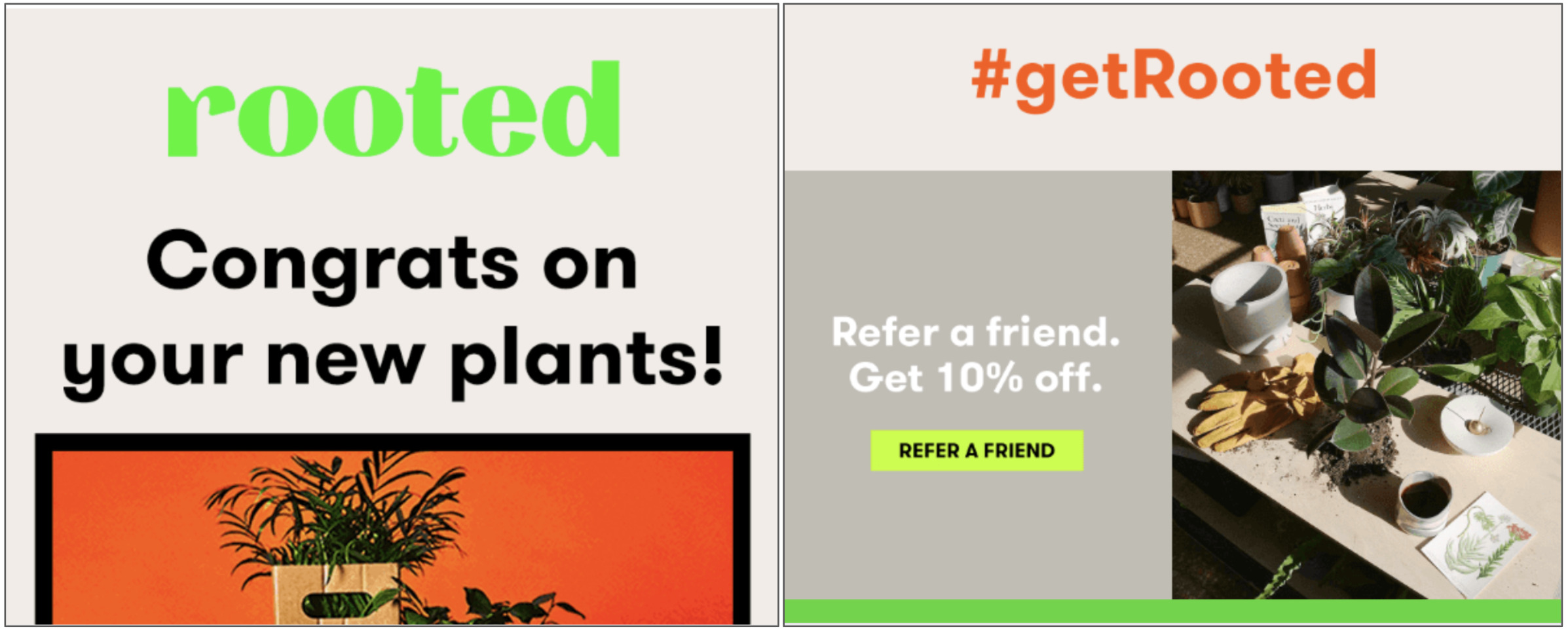
What makes it work:
- It targets the customer immediately after a positive experience
- It leads with a helpful unboxing guide before making the ask, thus reducing friction
- It positions the reward precisely, with no chances of confusion
- The CTA is placed right after the reward, which helps in quick decision-making
Steal this tactic: Trigger your referral request three to five days after delivery confirmation. This ensures the customer has experienced the product before you ask them to vouch for it.
2. Gametime — The double-sided incentive email
Brand: It’s a platform from which people can book tickets for games, events, and movies.
Subject line: Got Friends? Get Rewards! Refer Now!
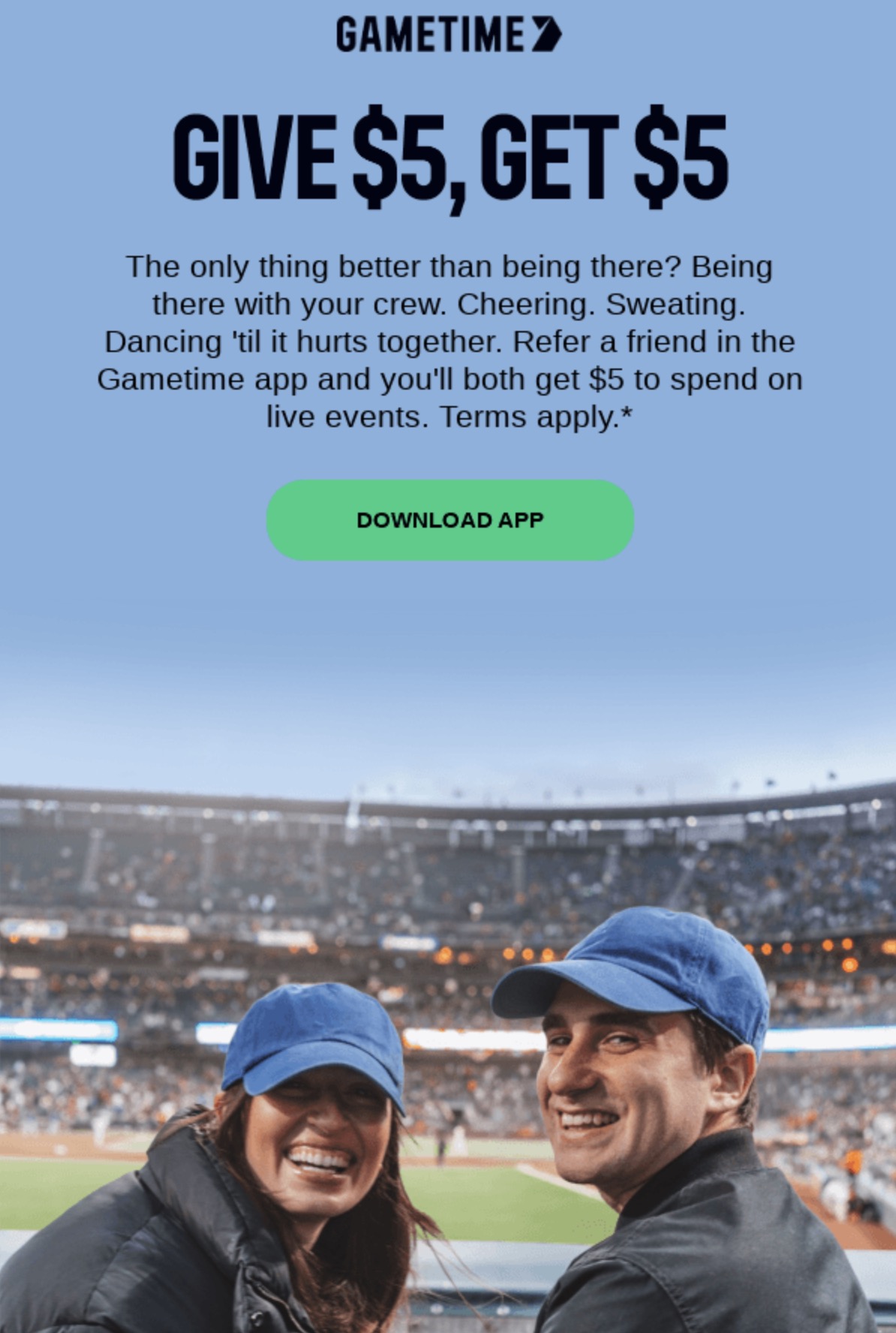
What makes it work:
- The headline communicates the offer clearly, eliminating confusion
- Both parties benefit, so it’s a win-win situation
- It uses an emotional and engaging copy to boost referrals
Steal this tactic: Use the first fold to highlight the benefit for both the referrer and their friend.
3. Lyka — The tiered rewards referral email
Brand: Lyka provides fresh, vet-formulated dog food tailored to their needs.
Subject line: Who are Leo’s BFFs?
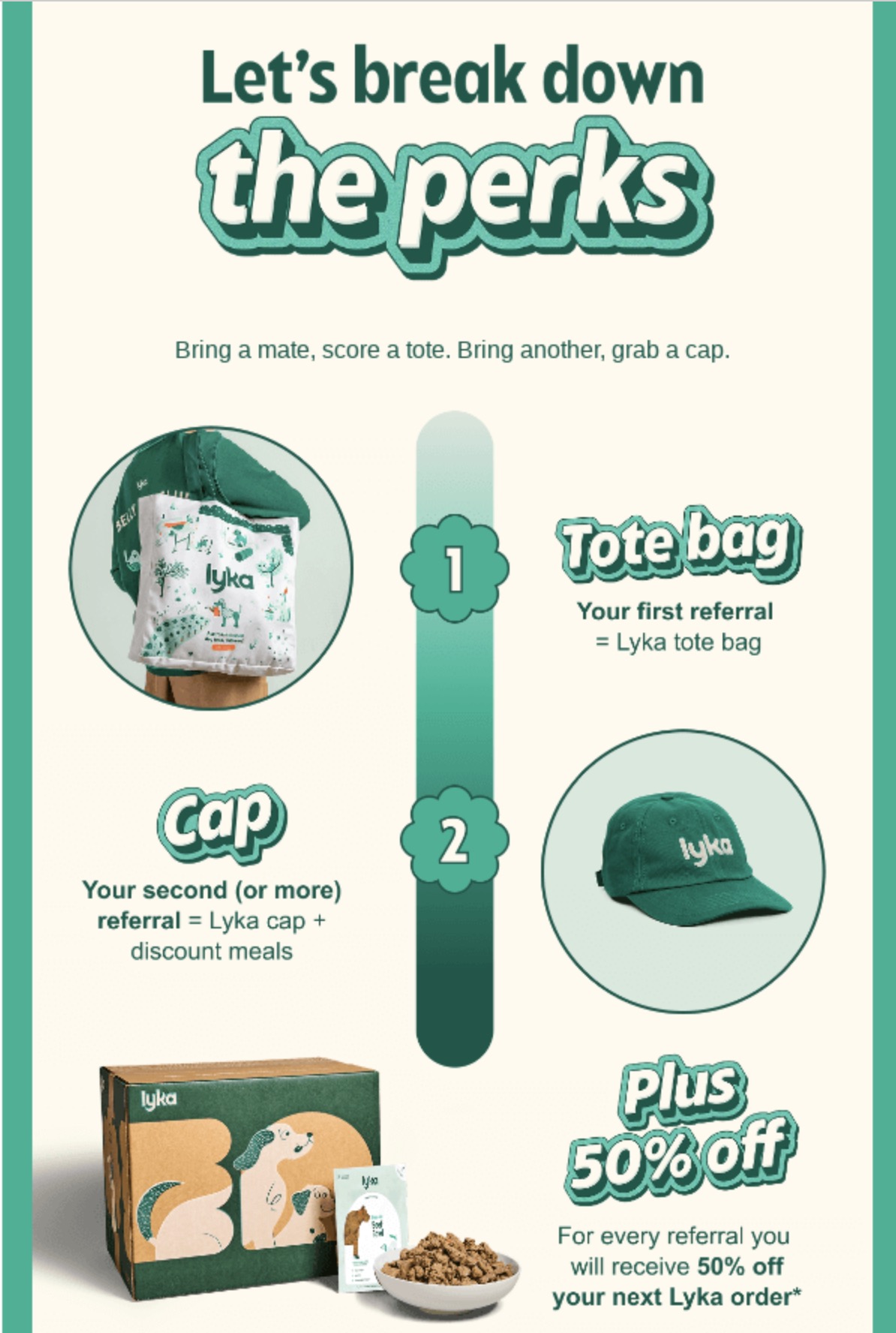
What makes it work:
- The tiered rewards make people want to refer more friends
- The double-sided incentive reduces friction because both parties get 50% off
- The email avoids extra promotional content, so the referral message stays focused
Steal this tactic: Offer better rewards at each higher tier to get multiple referrals from one customer.
👉Here’s your starting point to build email marketing campaigns that keep your audience engaged.
4. Wildfang — The seasonal referral campaign
Brand: Wildfang is a fashion brand selling gender-neutral clothing and accessories.
Offer: Give $20, Get $20
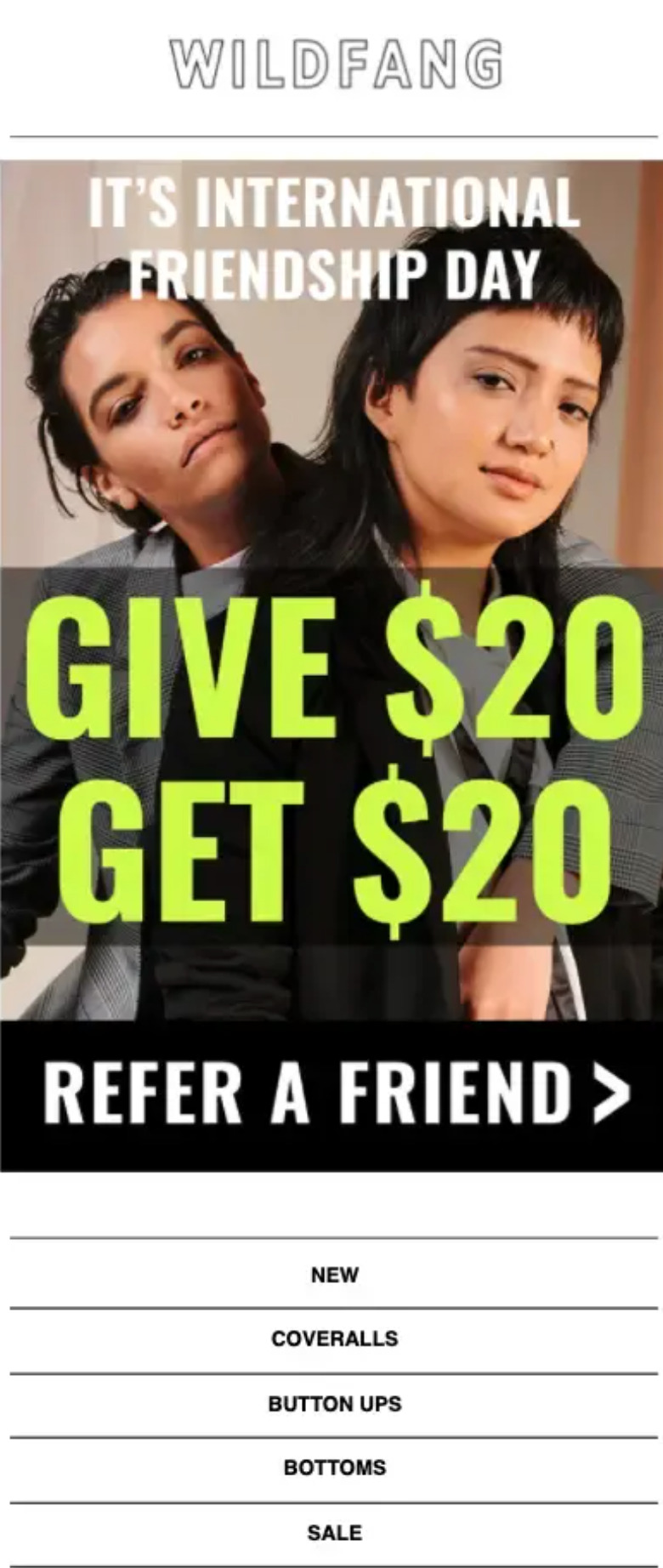
What makes it work:
- Anchoring the campaign to Friendship Day establishes relatability and encourages the customer to act
- A single-click image CTA removes friction between opening the email and taking action
- The dominating visuals reduce the internal friction to share the reward with a friend
Steal this tactic: Anchor your referral requests to seasonal events when sharing feels natural. Tapping into share-worthy moments like holidays or customer milestones gives them a reason to care and act.
5. Prima — The VIP-exclusive referral email
Brand: Prima is a wellness brand offering a range of body care products.
Subject line: Discover. Save. Feel Better Every Day.
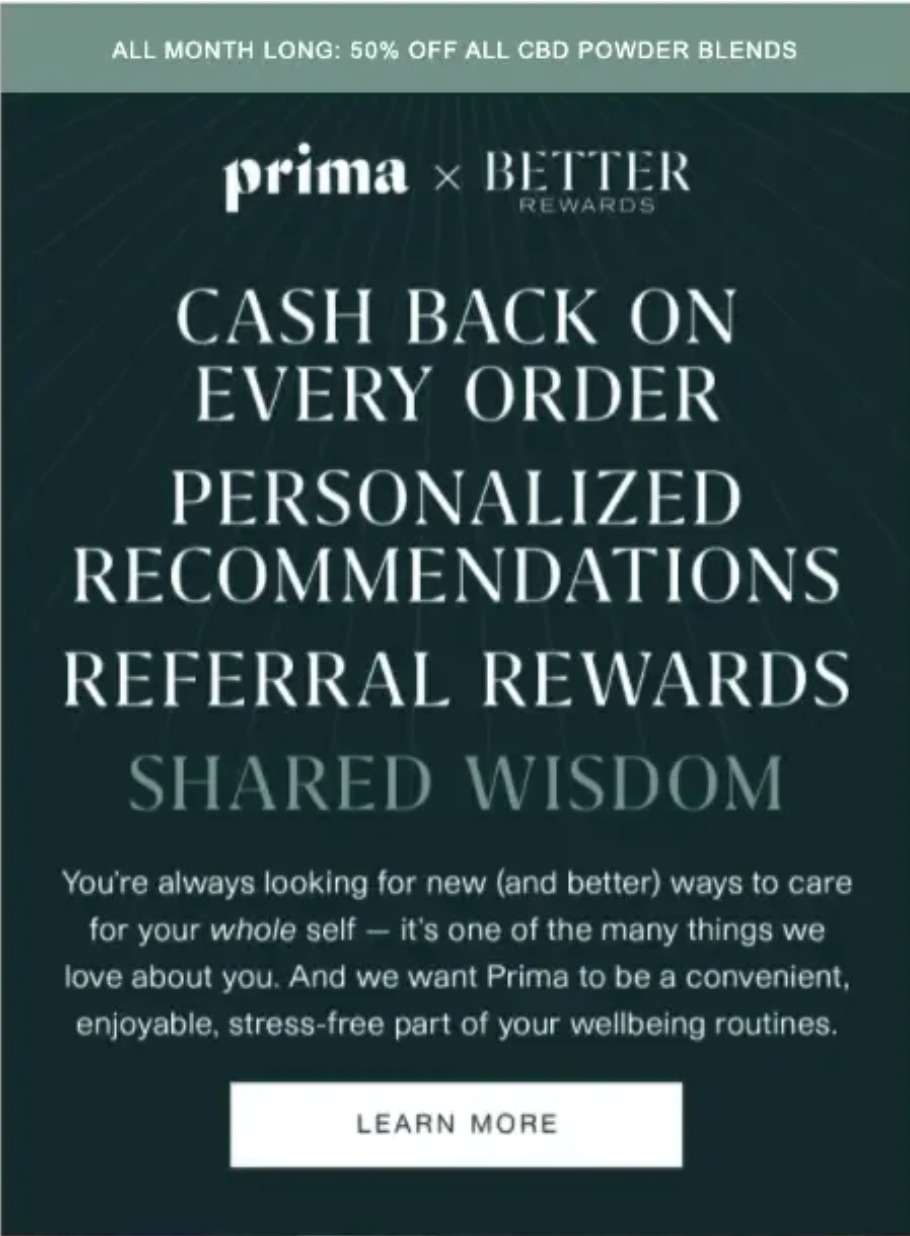
What makes it work:
- The community-focused messaging taps into the loyal customer sentiment
- The benefit is precisely stated to expedite decision-making
- The CTA placement immediately after the referral explanation reduces friction
Steal this tactic: Frame referral invitations for your loyal base as a perk and not a promotion.
6. Lulus — The minimalist referral email
Brand: Lulus is a fashion brand for women.
Subject line: Your Friends Will Want In On This…
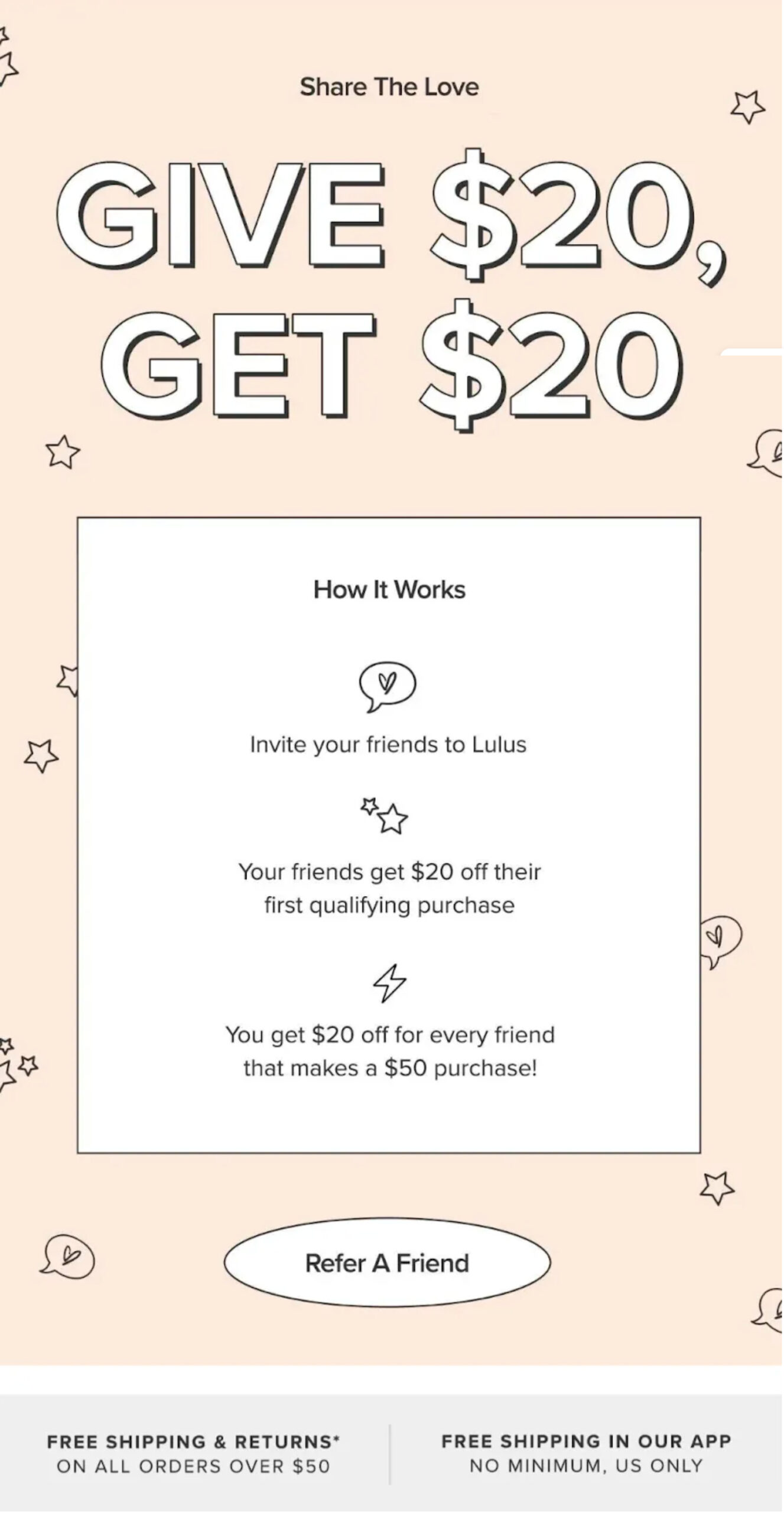
What makes it work:
- Minimal design converges the reader’s focus on the referral reward
- A bold headline instantly communicates the offer
- The 3-step instructions make the execution seamless
Steal this tactic: Less is more. Leverage content and design brevity to reduce the reader’s cognitive load.
7. Cometeer — The product-specific referral email
Brand: Cometeer is a specialty coffee company that delivers premium, flash-frozen coffee capsules for a premium experience.
Subject line: One week only: Share Cometeer, earn a free pack
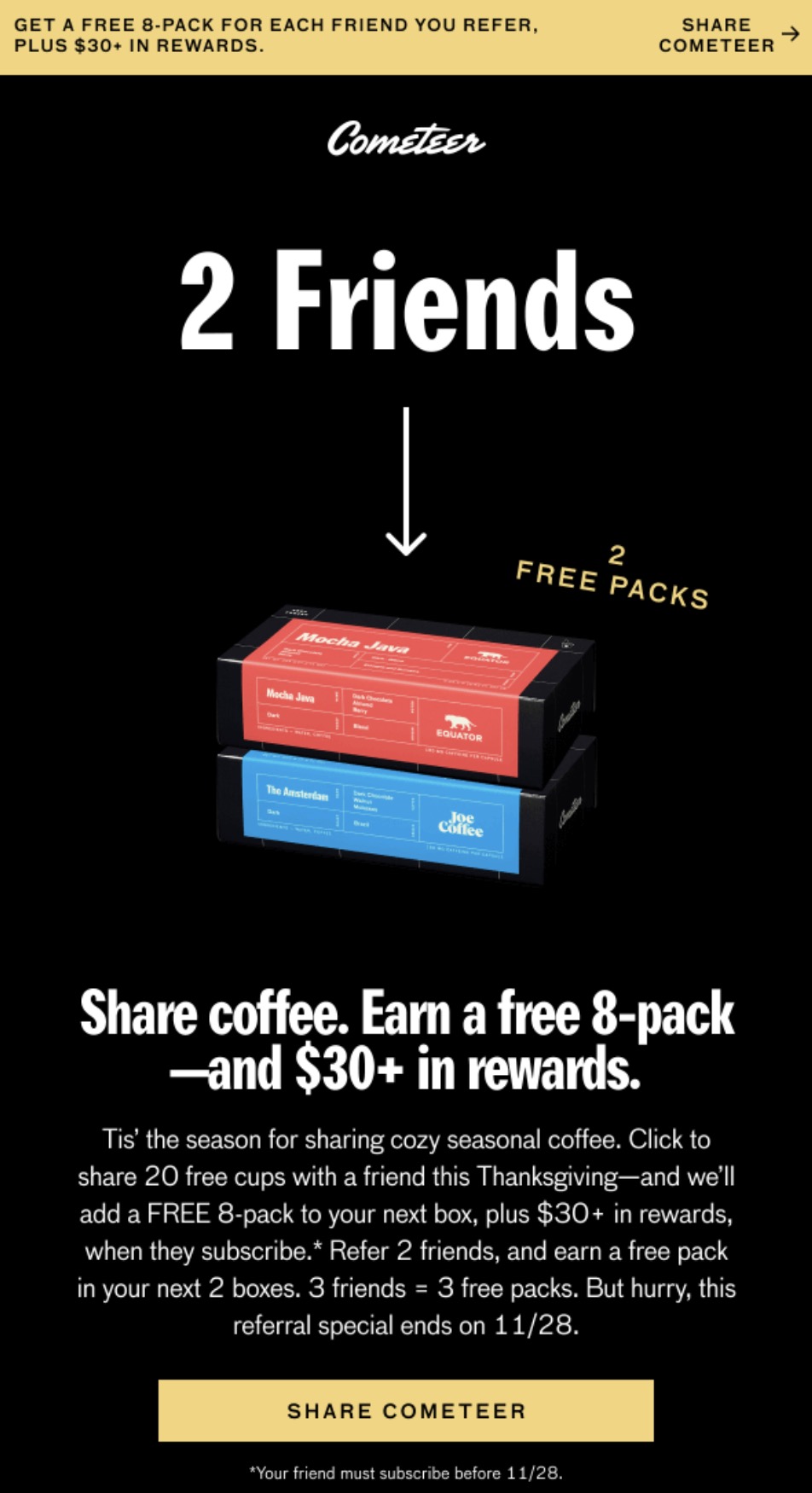
What makes it work:
- The subject line combines urgency (“one week only”) with a clear, product-specific reward
- The referral incentive (free coffee packs) is tightly tied to the core product, making the offer feel relevant and desirable
- The tiered reward ladder is spelled out simply and visually, so the scaling is easily understandable
Steal this tactic: Anchor the referral campaign around the specific product customers already love. Platforms like Omnisend make this scalable through product picker blocks and dynamic content. So, brands can easily populate emails with the purchase data to reflect what the customer bought.
8. Recess — The SMS and email referral combo
Brand: Recess promotes relaxation through its refreshing and healthy beverages.
Subject line: Tell a friend about Recess for $10
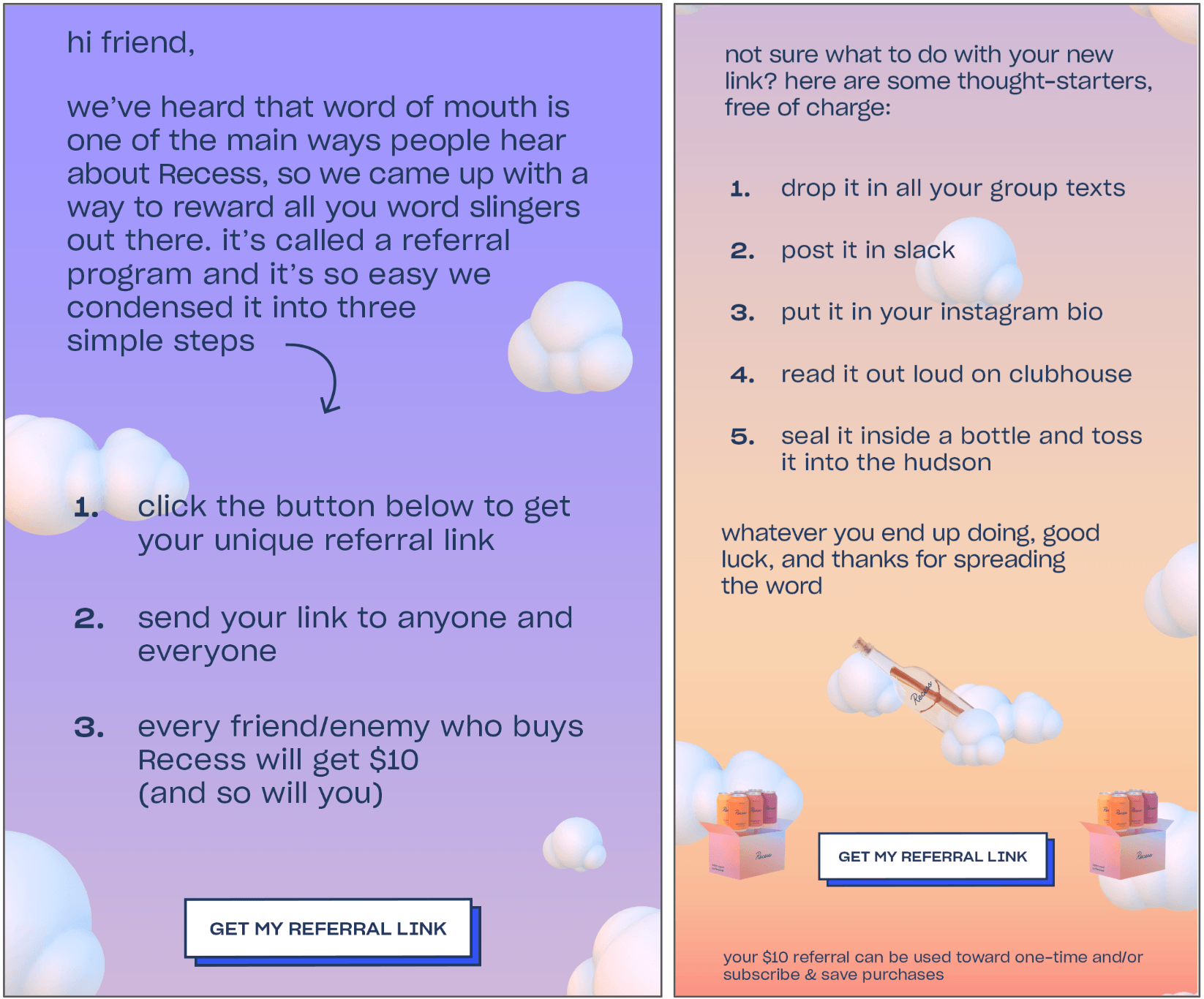
What makes it work:
- The email reads more like a personal note than a promotional broadcast
- The 3-step process uses humor to minimize social friction
- The CTAs are paced at peak moments of understanding and mental commitment
- The sharing suggestions list makes it omnichannel — group text, Slack, Insta bio
Steal this tactic: Instead of telling customers to “Share with friends,” tell them exactly where to share. “How do I share this?” is a bigger confusion than “Who do I send this to?” Use Omnisend’s email and SMS automation to combine multichannel sequences in a single workflow.
4 referral email templates for ecommerce
The hardest part of launching a referral program is staring at a blank document and not knowing where to start. Below are four ready-to-use referral templates designed for common ecommerce moments. Simply customize and send.
1. Post-purchase referral email template
Timing: 3–5 days after delivery
Subject line: [Customer Name], if they ask about your [Product Name]…
Hi [Customer Name],
Your [Product Name] landed safely, and we hope it’s already making your day better. If it is… why keep it a secret?
Invite a friend to try [Brand Name], and we’ll reward both of you:
- Your reward: [Reward 1]
- Your friend’s reward: [Reward 2]
Hit them with your referral link below.
CTA: Share My Link
Friends don’t let friends miss out on great finds.
Team [Brand Name]
Turning the post-purchase excitement into a referral opportunity can help you acquire customers at a low cost. If you’re designing a broader flow, Omnisend’s post-purchase email guide could help.
2. Welcome series referral email template
Timing: Email 3–4 in welcome sequence
Subject line: [Customer Name], grab your [Reward 1] for putting in a good word
Hi [Customer Name],
Since you just joined [Brand Name], here’s your little perk.
Send your referral link to friends who would love [Product Category]. They get [Reward 2], you get [Reward 1]. Genius insider move!
CTA: Start Referring
Share your link in a group chat, Instagram story, or wherever your friends hang out.
Team [Brand Name]
Looking for design inspiration before you hit send? Omnisend has an email template gallery with ready-to-use templates for different types of marketing campaigns. So, you don’t have to start from scratch.
3. Loyal customer referral email template
Timing: VIP status or after a specific number of purchases
Subject line: You’ve unlocked your VIP status, [Customer Name]
Hi [Customer Name],
You’ve shopped with us [X] times, and that officially makes you our favorite.
Your VIP status means bigger perks when you bring in friends. Here’s the deal:
- You get: [Reward 1]
- Your friend gets: [Reward 2]
CTA: Share Your VIP Link
Who better to recommend [Product Category] than someone who knows how good it is?
Team [Brand Name]
4. Winback referral email template
Timing: During the re-engagement sequence (after 45–60 days of inactivity)
Subject line: Earn [Reward 1] without shopping yet!
We’ve missed you, [Customer Name].
Not ready to shop? No pressure! But we’d like to reward you anyway.
Share your referral link with a friend, and if they buy, you both win [Reward].
CTA: Share And Win
It’s a zero-commitment win-win. Doesn’t get better!
Team [Brand Name]
When to use each referral template:
| Template | Best trigger moment | Marketing goal |
|---|---|---|
| Post-Purchase | 3–5 days after delivery | Convert satisfaction into referrals |
| Welcome Sequence | Email 3 or 4 in onboarding | Introduce the referral program early on |
| Loyal Customer | VIP status or X purchases | Reward advocacy and loyalty |
| Win-Back | Inactive 45+ days | Low-friction re-engagement |
Omnisend’s drag-and-drop email builder and 350+ customizable templates make it easy to design referral emails that match your brand. Use dynamic tags like [Customer Name], product pickers, and discount code blocks to personalize each template — then automate the send with pre-built workflows.
Start free
7 Referral email best practices for ecommerce
Referral campaigns drive 62% of ecommerce acquisitions, as per Marketing LTB. Imagine the potential of referral emails in converting intent into action when executed right.
The following are seven referral email best practices that focus on segmentation, incentive structure, promotional tactics, and timing to improve shares.
1. Segment customers to identify your best promoters
You will exhaust your low-engaged subscribers by sending email blasts to your entire customer base.
A better approach is to focus on your power users. These are customers who already like your brand. Look for people who gave you an NPS score of 8 or higher, have bought from you at least three times, or regularly open your emails. These are people most likely to recommend you to friends.
Omnisend’s dynamic, AI-based segmentation makes it easier to group subscribers based on parameters such as purchases, opens, clicks, or location.
A few tips to build your referral segment:
- The ‘recency’ parameter is a must when applying your first layer of segmentation. Filter customers who purchased something in the last 30 days.
- Then apply the ‘engagement’ parameter. Narrow the list of customers who have an average open rate of 40% or higher.
Now you have a healthy group of engaged customers for your referral email. Just be sure to exclude one-time buyers.
To further grow your list, learn how to build an email list from scratch. You can integrate Omnisend’s signup forms and popups to get started.
2. Offer double-sided referral incentives
A single-sided referral incentive, such as “Get $15,” is a selfish positioning that only rewards the person recommending. The friend they are sending the recommendation to gets nothing. Double-sided incentives, on the other hand, work better with less friction and more reciprocity.
Research from Marketing LTB indicates that referral offers that reward both the referrer and the friend can increase sharing rates by 41%. For ecommerce brands, the 10–20% rewards range is the most optimized. A higher range dilutes the value, and a lower range is not a strong motivation.
One framing tip: Lead with “Give” before “Get” because it positions the customer as generous, not transactional.
| Incentive type | Double-sided | Single-sided |
|---|---|---|
| How it works | Both referrer and friend receive a reward | Only the referrer receives a reward |
| Pros | Higher share rates | Lower cost |
| Cons | Higher cost per acquisition | 30% fewer shares |
| Use cases | Post-purchase, welcome sequences | Win-back campaigns |
3. Write subject lines that get opened
The Email Referral Insights from Marketing LTB show that referral emails have an average open rate of 48%. But this usually happens when the subject line clearly communicates to readers what they will get from opening the email.
If someone sees a subject like “Share with friends” or “Special offer inside,” it’s vague, so there’s no reason to click. However, more specific, short subject lines, ideally under 50 characters, underline an obvious benefit even before the customer opens the email.
The best subject lines do one of four things:
- Clearly mention the reward
- Use the customer’s name
- Create a sense of urgency
- Highlight a friend’s benefit
A few good examples that work are:
- [Name], give $15, get $15
- Unlock 20% off for you + 1
- Your referral reward expires in 24 hours
Check out Omnisend’s article on referral email subject lines. It has over 30 real campaign variations for you to test.
4. Keep the referral process clear and frictionless
Every additional step between “I want to refer” and “referral sent” costs you participation. If a customer has to copy a code, navigate to another page, or fill out a form, most won’t bother.
The process involves three simple steps:
- The customer clicks the “Share Link” button to generate their unique referral link
- They share it with a friend, who then uses it at checkout to redeem the offer
- Once the purchase goes through, the credits hit both accounts instantly
To reduce friction further, you can:
- Provide unique referral links rather than coupon codes to avoid copy-paste mistakes
- Add pre-written sharing text for social or messaging apps so customers don’t have to do it
- Display the reward clearly near the CTA so customers immediately understand what they’ll get
5. Time your referral emails to peak satisfaction moments
Reminders at high points boost participation by 42%, per Marketing LTB. Timing a referral ask matters as much as the ask itself. Sending it three months after a purchase gets very different results than sending it three days after delivery.
The highest-performing triggers are:
- After a delivery: This is when the customer experiences the product for the first time, and their excitement is at its highest
- After leaving a positive review: This is when the sentiment is positive, after publicly endorsing your product
- After repeat purchases: This is when a customer’s loyalty is established after coming back once or twice
- Seasonal shopping peaks: This is when customers are already looking for gift ideas and recommendations
6. Test and optimize with A/B testing
Referral email performance improves significantly with systematic testing.
You should experiment with:
- Subject line phrasing
- Reward amount ($10 vs. $20)
- Single-sided vs. double-sided incentives
- CTA button copy
- Send timing
Test one variable at a time and give each test enough volume to be statistically meaningful before drawing conclusions. Omnisend has a built-in A/B testing feature. You can use it to test subject lines, sender names, and complete email variations all in one workflow.
7. Promote your referral program beyond email
Email is the most natural channel for asking your customers for referrals, but it should also be discoverable at other customer touchpoints. The idea is not to leave any possibilities to get maximum conversions.
Add referral CTAs to:
- Your order confirmation page
- Website navigation
- Loyalty dashboard
- Social media profiles
Customers who received the referral email but didn’t click it can be reminded via a follow-up SMS. Something like, “Hey [Name], your referral link is still active” or “Share it, and you both save $10,” works as a gentle nudge without feeling pushy. The only catch here is to wait about 5 to 7 days after the email, so it feels like a genuine reminder.
How to set up an automated referral email sequence
Sending one referral email occasionally won’t drive acquisitions. The goal is to create an automated referral funnel.
This funnel will:
- Introduce the program
- Remind customers to join
- Reinforce their actions when a referral converts
The following three-email sequence covers the complete referral journey, right from introducing the program to reminding customers and successfully confirming the reward. There’s also an SMS touchpoint to nudge anyone who missed the emails.
Email 1 — The referral program announcement
This email introduces the program to satisfied customers. This includes recent buyers, repeat customers, and new VIPs. Its job is to make the process feel worth it and effortless.
Subject line examples:
- “Give $10, get $10. Your referral link is inside”
- “Share [Brand Name] with friends and earn rewards”
- “Your personal referral link is ready”
This announcement email should highlight three elements above the fold:
- Clear reward: Show both sides of the incentive (e.g., “Give friends 15% off and earn $15 credit”)
- Unique referral link: Make it obvious that the customer has a personal share link
- Simple 3-step process: Share your link → A friend makes their first purchase → You earn your reward
Email 2 — The reminder for non-converters
Send this to customers who received Email 1 but didn’t engage, but wait about five to seven days before sending. Don’t just resend the same email with the same subject line, because if it didn’t work the first time, it won’t work now. This email is your second chance to make your customers care, so keep it short, direct, and interesting.
Subject line examples:
- “Your $10 referral reward is still waiting”
- “Only 12 hrs to share and earn $10”
- “Last chance to grab your $10”
The email copy doesn’t need to explain the whole referral program again. At this point, just a simple nudge, paired with the reward reminder and an easy access to the referral link button, works best. This is often enough to bring the customers back into the funnel.
Email 3 — The success notification
This email is triggered when a referred friend makes a purchase. It confirms the reward, thanks the customer, and encourages them to refer again.
Beyond the transaction, this message taps into behavioral psychology. Completing a referral triggers a natural reward response. This email arrives at exactly that moment and reinforces the behavior by making the customer feel the effort was worth it. Done well, it turns a one-time referrer into a repeat advocate.
Using SMS alongside referral emails
There are chances your customers may not check marketing emails. In that case, SMS is a helpful follow-up channel where a short message, sent five to seven days after the first email, usually works.
For a deeper understanding of how to build SMS into your ecommerce marketing strategy, Omnisend’s SMS marketing guide covers the full setup.
Automating the referral sequence with Omnisend
Omnisend’s pre-built automation workflows make this entire sequence straightforward to implement. You can mix email, SMS, and push notifications in one workflow. Use branching logic to direct customers based on whether they opened, clicked, or converted.
Omnisend makes email referral campaigns easier by integrating with Smile. It’s a rewards platform that handles points, VIP tiers, and referral tracking.
Also, a seamless integration with Yotpo Loyalty & Referrals handles targeted emails when customers earn points, redeem rewards, or move between tiers.
It’s all a part of Omnisend’s wider ecosystem of 160+ integrations designed to drive more sales while building long-term customer loyalty.
Quick sign up | No credit card required
Measuring referral email performance
Launching a referral program without tracking it is guesswork. These are the metrics that tell you whether your program is working, and where to fix it when it isn’t.
Key metrics to track
Referral programs combine email performance metrics with customer acquisition and retention metrics. Looking at both levels provides a clearer picture of program impact.
| Metric | What it measures | Why it matters |
|---|---|---|
| Open rate | The percentage who open the email | Indicates the subject line and send time effectiveness |
| Click-through rate | The percentage who click the referral link | Measures email body and CTA strength |
| Referral conversion rate | The percentage of those who successfully refer someone | Core program health metric |
| Customer lifetime value | Long-term revenue generated by referred customers | Helps determine if referred customers are more valuable than regular acquisitions |
| Cost per acquisition | Cost of acquiring a new customer through referrals | Allows comparison with paid channels like ads or influencer marketing |
Optimizing based on results
Refining referral emails becomes a lot easier once you start seeing real performance data.
Start by testing incentive structures using different approaches. Some audiences prefer rewards for both sides, while others respond better to store credit or a simple exclusive discount.
Then look at your subject lines and the send timings. As discussed earlier, referral emails sent shortly after someone receives their order or has a positive experience lead to more recommendations.
Segmentation also improves insights. Compare results for VIP customers and new buyers to determine which group drives more referrals and revenue.
Finally, track revenue attribution per referral email campaign. Platforms like Omnisend make this easier with a real-time reporting dashboard. You can compare opens, clicks, conversions, and sales across campaigns and automations.
Launch referral emails that grow your brand
Referral emails work because people trust people more than they trust a brand.
But most of them fail because they ask for a referral at the wrong time, with the wrong incentive, and in the most careless way possible. The execution is what differentiates a good referral strategy from an unsuccessful one.
Start with one template. Pick the trigger that makes the most sense for your current customer base and test it before building the full sequence. The data will tell you what to optimize next.
Referral emails work hardest when they’re part of a broader lifecycle strategy, not a one-off campaign. The customers are already there. Give them a reason to share.
Omnisend brings together email, SMS, and automation on a single platform purpose-built for ecommerce. With pre-built workflows, dynamic segmentation, and integrations with referral program tools like Smile and Yotpo, you can launch your first referral email campaign in minutes.
Quick sign up | No credit card required
FAQ
What is a referral email?
How do you write a good referral email?
A good referral email leads with timing, clarity, and motivation. Send the email at peak satisfaction instances, such as product delivery, repeat purchase, or a positive review. Explain the process in three or four steps. Finally, frame the reward carefully so your customers care: “Give a friend $15” works better than “Earn $15 for yourself.”
What incentives work best for ecommerce referral emails?
For ecommerce, double-sided incentives perform best because both the referrer and their friend receive a reward. Most brands choose from common reward options like store credit, percentage discounts, or free products. They often go with “Give $15, get $15” or use tiered rewards that grow after several successful referrals.
How often should I send referral emails?
How do I announce a referral program?
Can I automate referral emails for my ecommerce store?
Yes, there are multiple ecommerce marketing platforms to automate your referral emails. These tools typically set auto-triggers after key events like order delivery, customer review, or even periods of inactivity. Automation keeps messaging consistent and personalizes referral links, reducing manual effort.
How effective are referral emails?
Referral emails average a 48% open rate, and referral leads convert 30% better than leads from other channels. Referred customers also have a 16% higher lifetime value and are 37% less likely to churn. Referral emails can bring in new customers. They work well in post-purchase flows, loyalty programs, and winback campaigns. Plus, they do this at a lower cost.