Omnisend AI


 OFFER
OFFER









Sender’s generous send limits in free and low-tier plans come at the cost of multichannel capabilities and advanced automations. You could pay at least $20/month for the Professional plan for these, or get more value with Sender alternatives.
The initial reasons for using Sender still stand: sending large volumes of email, growing your list with forms, and running basic automations. It does these well, but as your customer journey becomes complex, you might find it limited and need a more ecommerce-focused tool.
Or perhaps you’re a creator; then what you need is an email tool that lets you send paid newsletters and subscriptions, and create courses and webinars, all linked to your campaigns.
We’ve prepared a list of the eight best alternatives to Sender software, covering all these use cases and several more, below. You’ll learn the differences between them, who they suit, and how to choose the right email tool for your business.
Quick sign up | No credit card required
Quick answer: What are the best Sender alternatives?
The three best Sender alternatives in 2026 are as follows:
- Omnisend. The best pick for ecommerce stores of all sizes. Provides more advanced automations and segments, multichannel email + SMS + web push flows, A/B testing, and AI features, including an AI segment builder.
- EmailOctopus. Suits bloggers, creators, and budget-conscious small businesses. Offers a generous free plan (2,500 contacts, 10,000 emails/month) and noticeably lower-cost paid plans than Sender, built on Amazon SES for affordable high-volume sending.
- Drip. Best for ecommerce stores wanting real-time behavioral segmentation and revenue attribution. Native integrations with Shopify, WooCommerce, and BigCommerce automatically sync customer data to power precise, behavior-driven automations.
Why look for a Sender alternative
Sender is a budget-friendly email marketing tool with a generous free plan, but it doesn’t support unlimited email and popup templates, SMS messaging, or A/B testing.
If you want those features, you can grab them for $10/month, but then you can’t create multichannel (email + SMS) flows or access unlimited email editor features. That requires the $20/month Professional plan. All of a sudden, you’re spending $20/month.
Limitations of Sender
- Free and Standard plans have feature restrictions limiting their ecommerce usefulness
- Fewer native integrations than other tools, such as Omnisend and Mailchimp
- Automations lack complexity for behavioral and engagement-based triggers
- SMS feels like an add-on rather than an integrated channel
- Its Shopify app has only a few reviews, rated 4.6/5 from nine reviews as of April 2026
Who should switch from Sender
Switch from Sender for more control over your customer experience with forms, advanced flow triggers, segments, and multichannel efforts.
A few use cases come to mind:
- You’re a growing ecommerce store: Sender doesn’t have browse or checkout abandonment triggers (only cart), which limits your ability to reach high-intent customers.
- You have a Shopify store: Sender isn’t well-known as a Shopify email marketing app and therefore lacks the proven experience of Brevo, Omnisend, and others.
- You want customer breakdowns: Including lifecycle stages, average order value, and the % of returning customers (Omnisend provides these for free).
Best Sender alternatives: Comparison
The table below provides a quick-fire comparison of our alternatives to Sender software:
| Tool | Best use case | Notable feature | Free plan | Price from |
|---|---|---|---|---|
| Omnisend | Ecommerce stores of all sizes | Multichannel email + SMS + web push flows in all plans | Yes | $16/month |
| EmailOctopus | Bloggers and budget-conscious small businesses | Amazon SES-based sending keeps costs low even at high volume | Yes | $9/month |
| Drip | Ecommerce stores wanting behavioral segmentation | Real-time behavioral segments with per-email revenue attribution | No | $39/month |
| Brevo | Mixed B2B/B2C businesses with longer sales cycles | CRM that separates contacts from companies, plus Aura AI | Yes | $9/month |
| ActiveCampaign | Complex sales cycles needing email + SMS + WhatsApp | Active Intelligence AI platform with predictive sending | No | $15/month |
| Klaviyo | Mid-to-large growing ecommerce stores | Predictive analytics for CLV, churn risk, and next order dates | Yes | $20/month |
| GetResponse | Content creators monetizing courses and webinars | Built-in course creator, webinars, and payment collection | No | $19/month |
| MailerLite | High-volume senders and creators selling digital products | 12,000 emails/month on free plan, plus digital product sales | Yes | $15/month |
8 best Sender alternatives
Here are our top-recommended Sender alternatives in 2026:
1. Omnisend
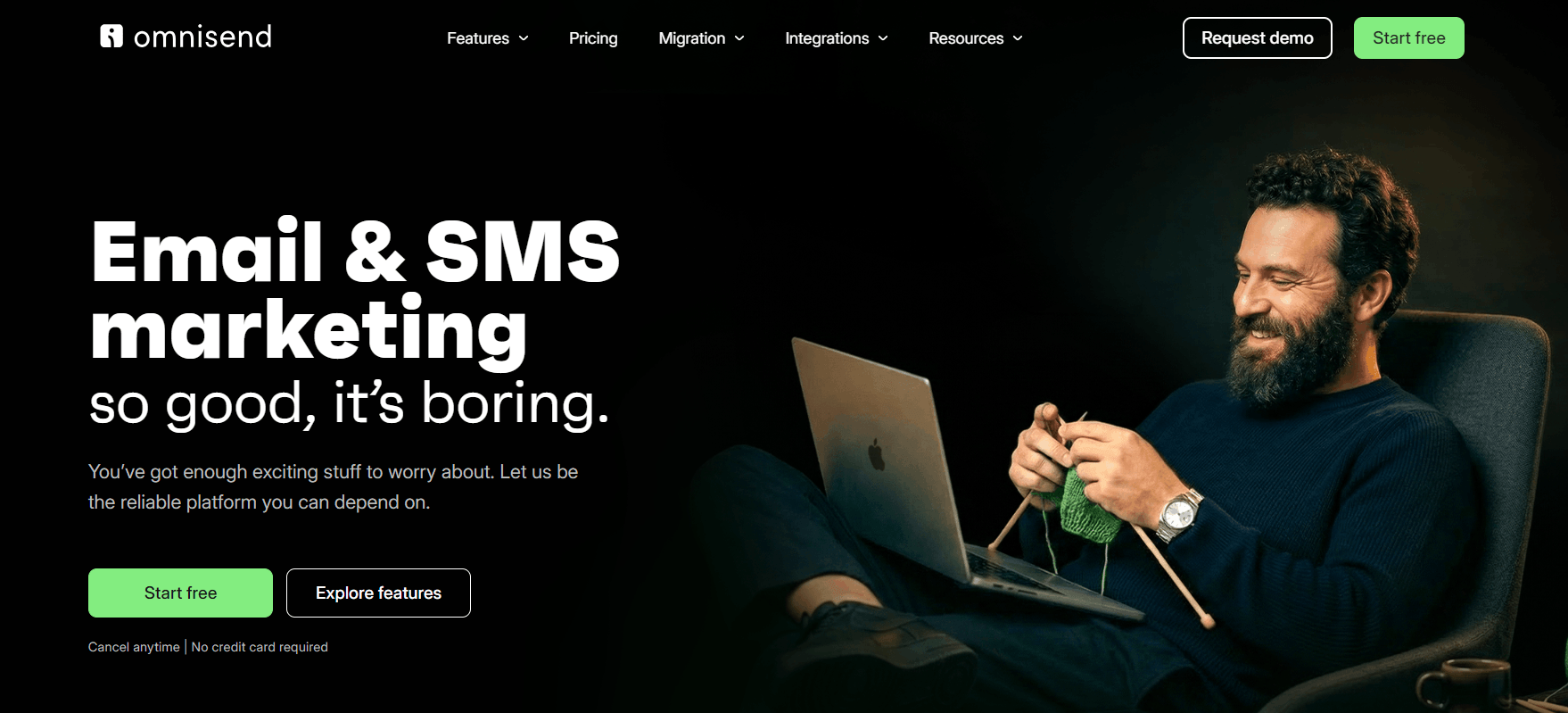
Omnisend is an ecommerce-first omnichannel marketing tool that gives you email, SMS, and web push notifications across all plans for campaigns and flows.
Its core purpose is maximizing retention and revenue from email and SMS, with behavior and engagement-based flows that get your messages in front of customers at high-intent moments.
Key strengths
- Low learning curve for all features
- 28 pre-built flows for common ecommerce scenarios
- Add unlimited SMS, emails, and web pushes into flows
- Standalone campaigns for all channels
- Gamified popups, plus embeddable forms and flyouts
- AI segment builder and AI content generation
- Provides customer lifecycle stage maps with retention tactics
- Reports for campaigns, automations, forms, email deliverability, and sales
Limitations
- No annual plan discounts
- Limited CRM functionality, although it integrates with popular CRMs
Plans
- Free: 250 contacts and 500 emails/month
- Standard: Costs $16/month for 500 subscribers and 6,000 emails, or to equal Sender’s base contacts, it’s $20/month for 1,000 contacts and 12,000 emails
- Pro: $59/month for 2,500 contacts, includes unlimited emails and bonus SMS credits equal to the price of your monthly plan
Versus Sender
Omnisend doesn’t restrict access to standard features. Its Free Forever plan includes multichannel, A/B testing, and unlimited email and popup templates. Additionally, Omnisend’s flows can do more, such as triggering for browse abandonment.
Good to know
Omnisend customers achieved a $79 ROI for every $1 spent in 2025 across email, SMS, and push, with email alone generating a 76x ROI.
Ideal use cases
Pick Omnisend if you’re an ecommerce store of any size that needs multichannel automation with more advanced triggers and filters than Sender provides. If you’re a small business or service provider, check out our next recommendation, Mailchimp.
2. EmailOctopus
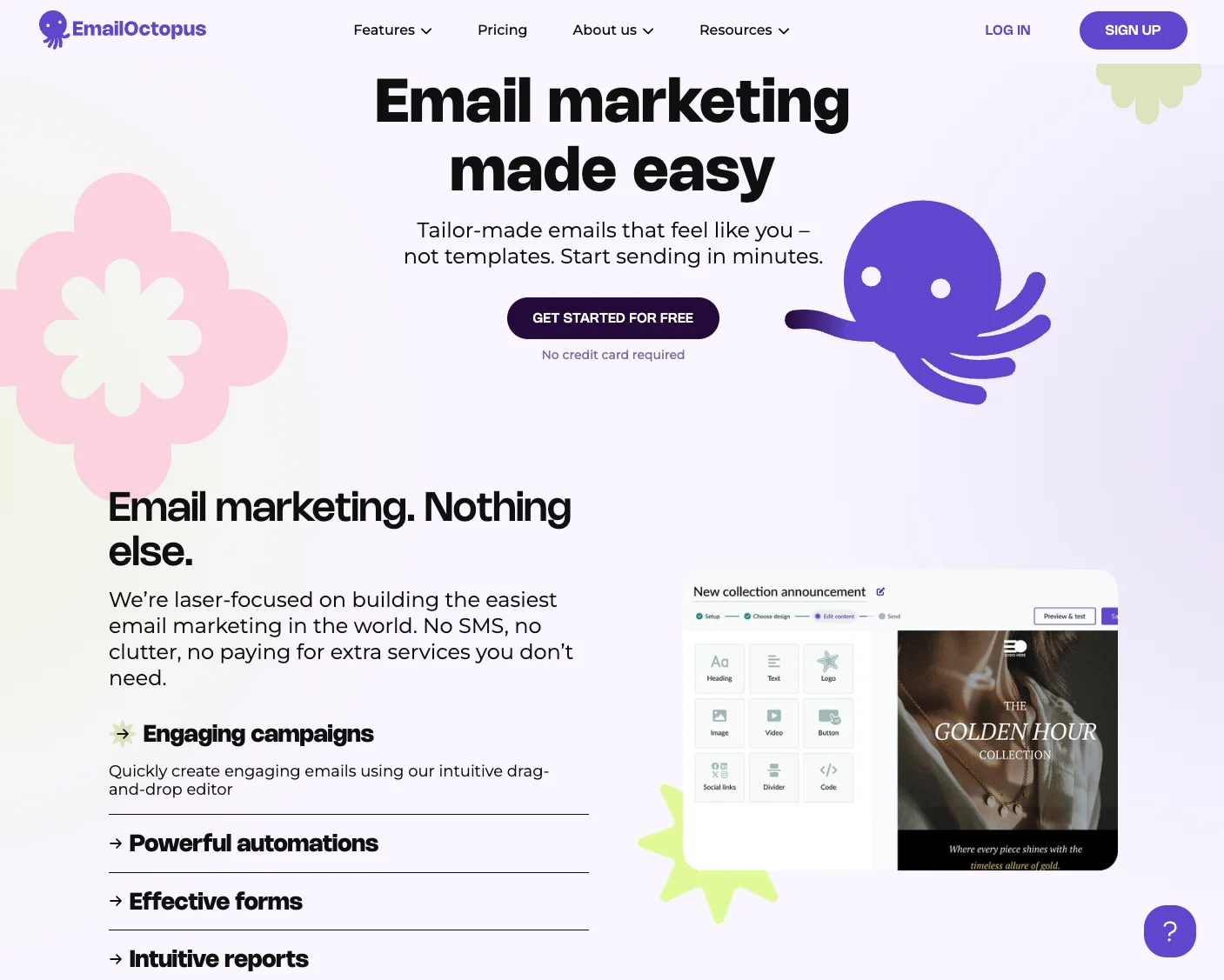
With EmailOctopus, you can sign up and start sending straight away. There’s no domain to set up first, no technical step to get through before you can use the platform. If you later want to connect your own domain for better deliverability, you can – it’s fully supported, but it’s your choice, not a requirement. Sender takes the opposite approach: you have to verify a domain before you’re able to send anything at all, which can be a frustrating first hurdle if you’re not used to managing domain settings.
Key strengths
- You can use every feature from the moment you sign up. Connecting your own domain is available if you want it, but it’s never required to get started, unlike Sender, which asks you to verify one before you can send or do anything at all in the platform (even test the email editor)
- Just two plans to choose from: Starter (free) and Pro (paid). Pricing scales only with your number of contacts, not by unlocking different feature tiers, so there’s no plan comparison chart to work through before signing up
- Branding is set up for you automatically: type your website’s URL and EmailOctopus pulls your logo, colours, fonts and links to socials, applying them across templates, forms, and landing pages so your first campaign already looks like you
- A clean, uncluttered interface that reviewers consistently describe as one of the easiest in the category, letting non-experts build a campaign or automation in minutes
- A guided onboarding checklist, in-app help and an award-winning customer support team available on live chat mean new users don’t need to leave the dashboard to figure out what to do next
- Affiliate marketing is allowed under EmailOctopus’s Acceptable Use Policy, where Sender’s Anti-Spam policy prohibits affiliate content outright
Limitations
- Lower free-plan send limit than Sender (10,000 emails/month vs 15,000)
- No SMS, WhatsApp, or push notifications – email only
- No built-in CRM for pipeline or deal management
- The drag-and-drop editor has fewer content blocks and layout controls than more feature-dense tools
Pricing
- Starter (free): 2,500 contacts and 10,000 emails/month, with most core features included
- Pro: From $9/month for 500 subscribers, scaling with your list – $18/month for 2,500 subscribers on the yearly plan. Every Pro feature is included at every contact tier – you’re only ever paying for list size
Versus Sender
Sender’s free plan allows more monthly sends, but you’ll need to verify a domain before your first campaign goes out, and content like affiliate marketing is off-limits under its policy, regardless of plan. Sender also splits its paid offering across several plans (Standard, Professional, Enterprise), each unlocking different features, so working out which tier you actually need takes some comparing. EmailOctopus keeps it to one free plan and one paid plan, with the only variable being the number of contacts you have.
Ideal use cases
Pick EmailOctopus if you want to get a newsletter or automation live today without any setup getting in the way of your first send, and if you’d rather not work out which pricing tier unlocks the feature you need. If SMS or a higher free-plan send volume matters more, Sender or one of the other alternatives on this list will fit better.
3. Drip

Drip is an ecommerce-focused email marketing automation platform built around behavior-based segmentation that updates in real time. Its visual workflow builder supports point-and-click product insertion, dynamic content, and A/B testing, making it straightforward to build automations that adapt to what each customer is actually doing.
Key strengths
- Behavior-based segmentation that updates in real time, so your audiences always reflect current customer actions
- Visual workflow builder with point-and-click product insertion, dynamic content, and A/B testing built in
- Native integrations with Shopify, WooCommerce, and BigCommerce that automatically sync purchase history, cart activity, and browsing data
- Revenue attribution on every email, giving you clear visibility into exactly what each send is driving in sales
- Onsite form builder to capture visitors before they leave your site
- Exceptional customer support to help you get the most out of the platform
Limitations
- No SMS or push notification channel, limiting you to email-only outreach
- Can be more expensive than alternatives like Omnisend and Brevo at comparable contact counts
Pricing
Drip uses a single plan with list-size-based pricing and no hidden fees:
- $39/month for up to 2,500 contacts, with unlimited email sends, dynamic segments, onsite campaigns, up to 50 workflows, unlimited sub-accounts, and open API access
- A 14-day free trial is available with no credit card required
Pricing scales up based on list size — check Drip’s pricing page for your contact count.
Versus Sender
Drip’s real-time behavioral segmentation and native ecommerce data sync go well beyond what Sender offers, giving you a much clearer picture of what your customers are doing and what revenue your emails are generating. Sender is simpler and more affordable, but Drip is the stronger pick if detailed segmentation and sales attribution matter to your business.
Ideal use cases
Pick Drip if you run an ecommerce store on Shopify, WooCommerce, or BigCommerce and want behavior-driven automations backed by real-time customer data and transparent revenue reporting.
4. Brevo
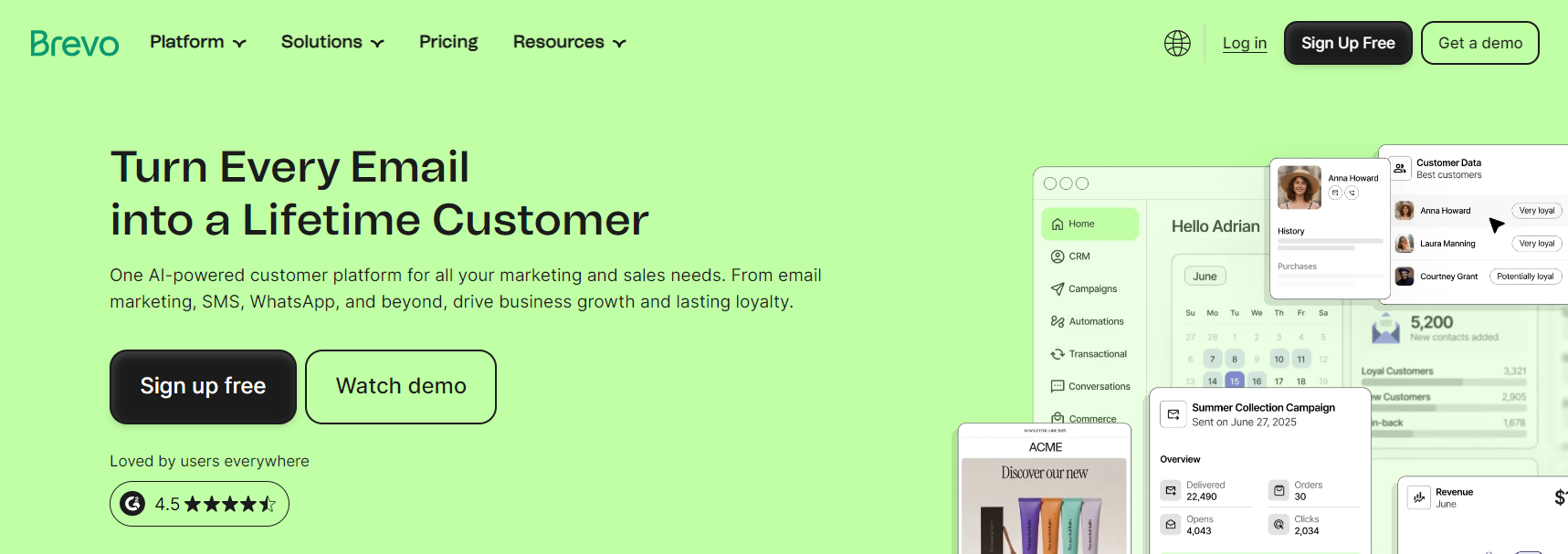
Brevo’s sales features, such as open deals, pipelines, and an online meeting scheduler, suit service businesses and ecommerce stores with lengthy sales cycles. Its channels span email and SMS, with multichannel automations in all plans.
Key strengths
- Its CRM separates contacts from companies for appropriate targeting in your flows
- Builds your list with full-page, embedded, and popup forms with drag-and-drop builders
- Covers your most common customer scenarios, with pre-built flows for welcome, abandoned cart, purchase, and anniversary emails
- Handles email and SMS campaigns, plus email and SMS automations
- Aura AI is included in all plans, helping you start and complete tasks with prompts
Limitations
- The send-based pricing doesn’t always work out to be of good value
- Working example: The Standard plan is $35/month for 10,000 emails and a 1,500-contact limit, which is more than Omnisend’s Standard plan at $25/month for the same number of contacts, a larger 18,000-email limit, and access to more features.
- Only the expensive Professional plan lets you send back-in-stock alerts, use dynamic coupons in emails, and use AI product recommendations
Pricing
- Free: For 300 emails/day to 2,000 contacts
- Starter: $9/month for 5,000 emails/month to 500 contacts
- Standard: $18/month for 5,000 emails/month to 500 contacts
- Professional: $499/month for 150,000 emails to two million contacts
Versus Sender
Sender doesn’t cover Brevo’s CRM and sales pipeline features, so if you need those, Brevo is your pick. Another thing to consider is that Brevo syncs contacts to Google and Meta for retargeting in all plans, which Sender doesn’t support.
Ideal use cases
Pick Brevo if your customers are a mix of businesses and consumers, and you need a single tool that separates them for targeting across sales, pipelines, and deals.
5. ActiveCampaign
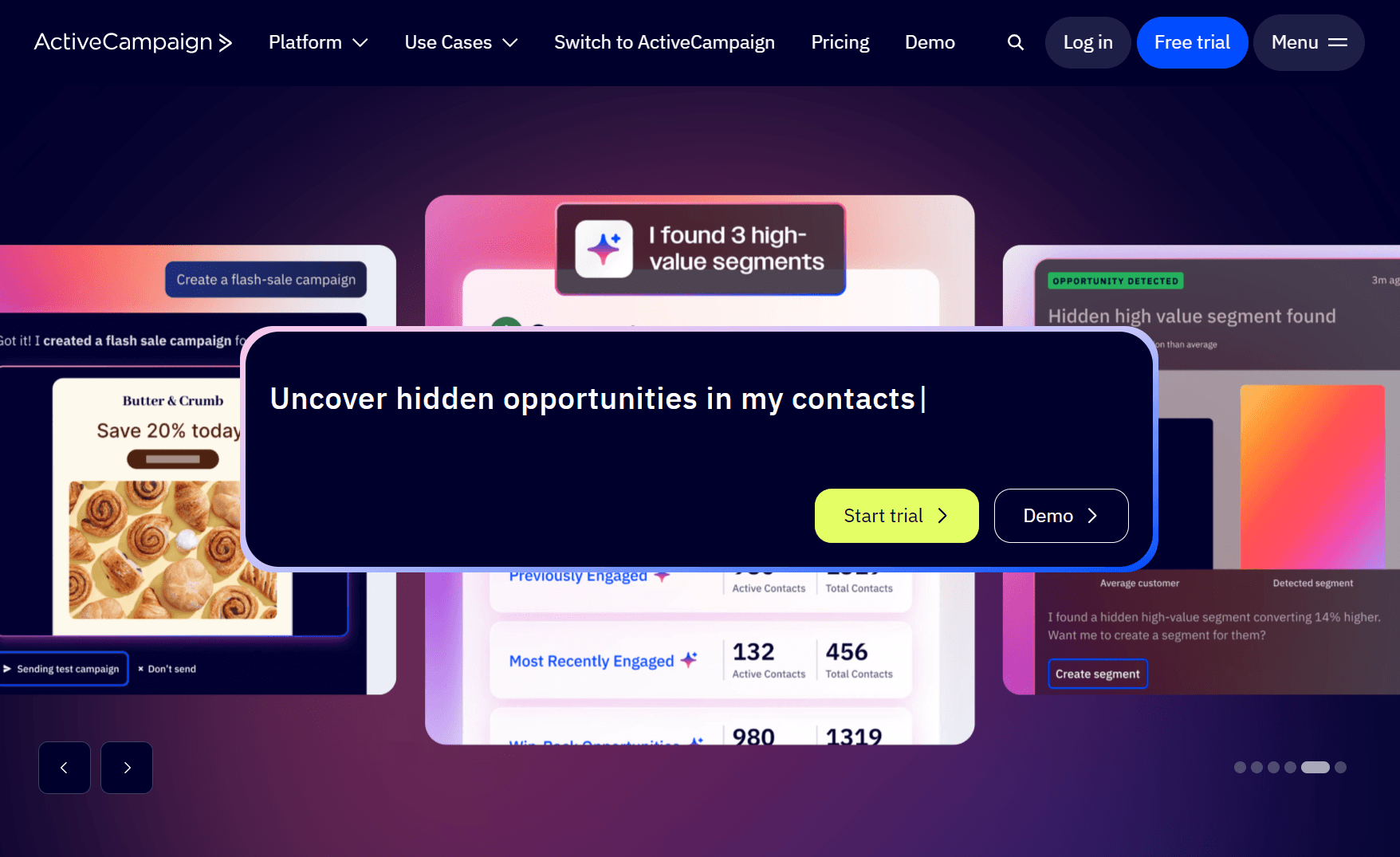
ActiveCampaign is heavy on email automation, AI features, and CRM capabilities, all three of which Sender doesn’t specialize in. It’s a much more complex tool for ecommerce, offering you new ways to reach customers with flows and WhatsApp.
Key strengths
- Built-in CRM linked to contact profiles
- Its Active Intelligence platform has more AI features than any other tool, including an AI campaign builder, brand kit, suggested segments, and campaign calendar
- Cross-channel flows combining email, SMS, and WhatsApp in the same workflow
- Predictive sending figures out the best time to send each contact their email
- Conditional content swaps out email sections based on segment, location, or behavior
- 1,000+ integrations, plus deep Salesforce and Microsoft Dynamics CRM integrations for Enterprise plan customers
Pricing
- Starter: It’s $15/month for 1,000 contacts, and 10x sends
- Plus: $49/month for the same contact and send quota as Starter, but adds Generative AI, multichannel, and landing pages
- Pro: A more capable plan for ecommerce, costing you $79/month for 1,000 contacts in return for predictive sending and conditional content
- Enterprise: Increases your costs to $145/month for 1,000 contacts, premium segmentation, SSO, and custom objects
Limitations
- No free plan, which Sender, Omnisend, Mailchimp, Klaviyo, and MailerLite provide
- Five actions per flow on the Starter plan restrict your automation capabilities
- No multichannel marketing (email + SMS) below the Plus plan
Versus Sender
ActiveCampaign’s flows are much more granular than Sender’s, with more behavioral and engagement-based triggers. It has a steeper learning curve and leans heavily on AI/automation to piece together your marketing. Sender is easier to use but has less scope.
Ideal use cases
You have complex sales cycles and customer journeys, and you need to reach people across email, WhatsApp, and SMS. Data is crucial to your business, and you need a way to bring everything from purchases and interactions together, which the Enhanced CRM add-on provides.
6. Klaviyo
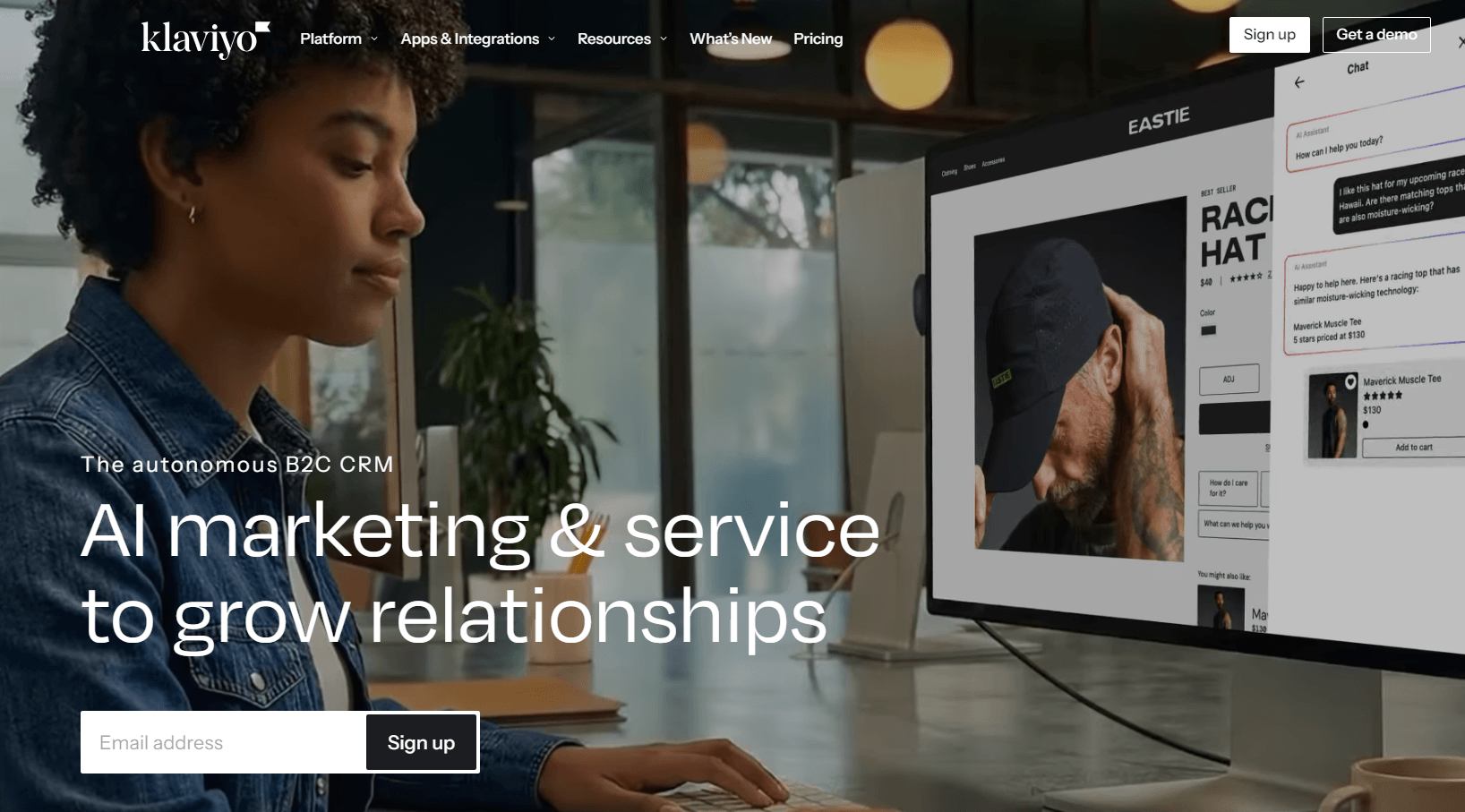
Klaviyo is for growing ecommerce stores needing flows for multiple customer actions, from viewing products and abandoning checkouts to becoming a churn risk. It offers more pre-built flows than Sender and helps you cover more of your customer journey.
Key strengths
- B2C CRM features unify your customer data and marketing campaigns
- Predictive analytics in paid plans estimates your customer lifetime value, churn risk, and expected next order dates
- Has a Marketing Agent (AI) to help you launch forms, campaigns, and flows
- All plans allow personalized product recommendations in emails
- 350+ native app integrations
- Peer group benchmarks based on Klaviyo customers provide insights into how well your marketing efforts compare to others
Pricing
- Free: For 250 contacts and 500 emails/month, plus 150 mobile credits
- Email: From $20/month for 500 active profiles and 5,000 emails/month
- Email + mobile messages: Costs a minimum of $35/month, adds $15/month to your Email plan in return for 700 mobile credits
Limitations
- Steeper learning curve than Sender, Omnisend, and MailerLite, but about on par with ActiveCampaign
- More expensive than Sender, MailerLite, Omnisend, and others
Versus Sender
Klaviyo lets you build much more complex segments, flows, and customer experiences than Sender, or even Omnisend and ActiveCampaign. Its CRM is one of its best features, letting you access detailed customer profiles. Plus, it has predictive analytics.
Ideal use cases
Pick Klaviyo if you’re a mid to large or growing ecommerce store collecting significant customer data for use in your sales and marketing. Check out top-rated Klaviyo alternatives if it looks too complex for your needs.
7. GetResponse
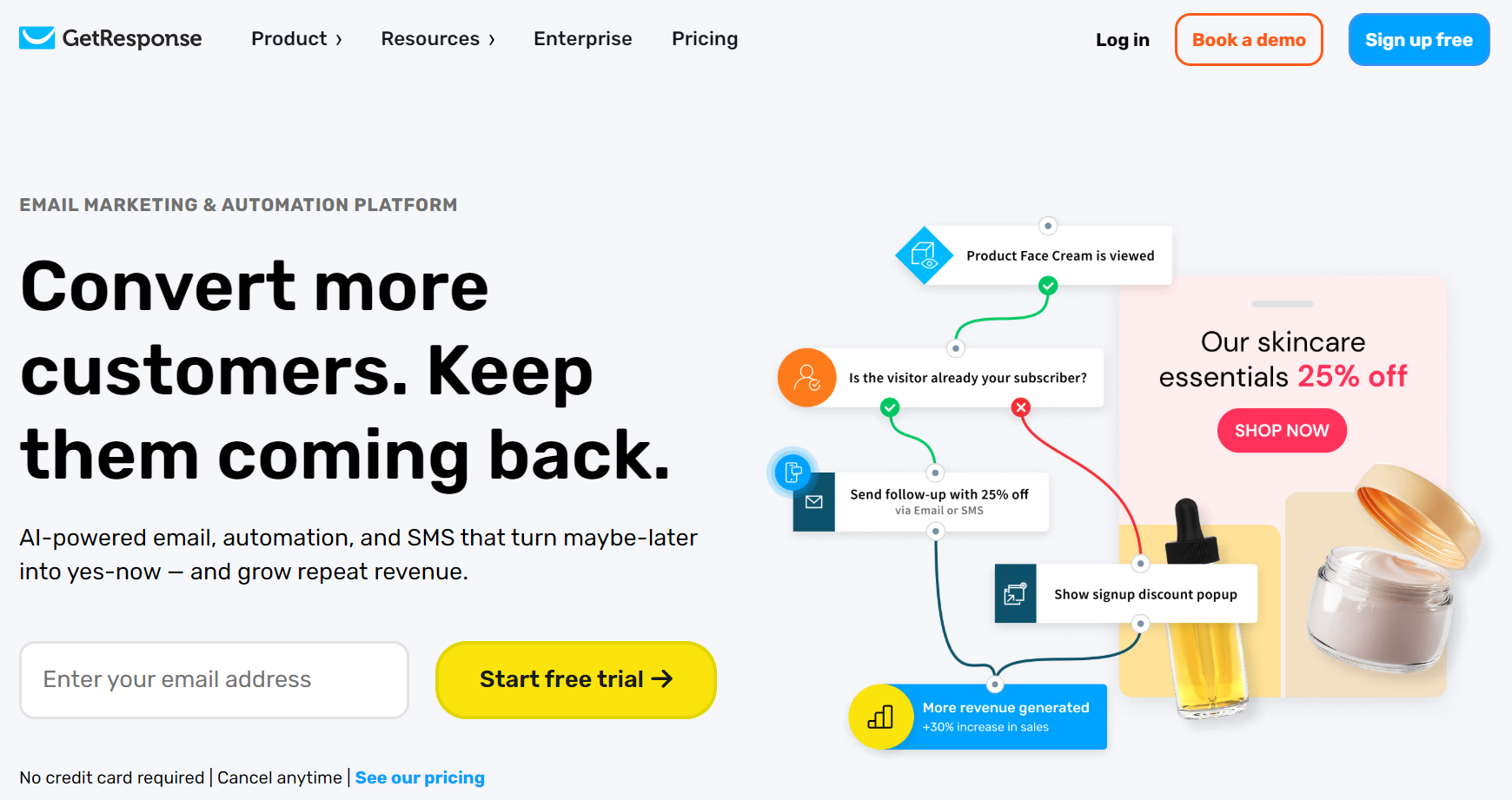
GetResponse brings content monetization features to your arsenal alongside email automation and sales funnels. You can build a website, grow your list, market, sell, and collect payments with one tool, and potentially save money in the process.
Key strengths
- Website and landing page builders with AI creators
- The Creator plan has PayPal and Stripe integrations, letting you collect one-time and recurring payments for content
- Conversion funnels in the Marketer plan for leads, magnets, and sales, with webinar funnels in the Creator plan
- Integrates with Salesforce in all plans
- Autoresponders and email automations, with event-based and purchase automations in the Marketer plan
Pricing
- Starter: $19/month for unlimited email sends to 1,000 contacts
- Marketer: $59/month with more features added to your kit, including advanced segmentation, abandoned cart recovery, sales funnels, and web push notifications
- Creator: A $69/month starting price gives you a course creator, webinars for 100 attendees, a website builder, premium newsletter subscriptions, and more monetization features
Limitations
- Significantly more expensive than Sender
- The all-in-one tool positioning works both ways, meaning you could end up paying a premium for features you don’t need, such as sales funnels
Versus Sender
GetResponse’s paid plans have unlimited send limits, beating Sender’s quotas, but they also cost more. Its Creator plan is a unique offering for content monetization, letting you sell and market courses, webinars, newsletters, and more in one tool, which Sender can’t compete with.
Ideal use cases
The only reason to pick GetResponse as your Sender alternative is if you’re a blogger, podcaster, YouTuber, or other content creator. It’s one of the few email marketing tools that lets you collect payments and automate your customer experience.
8. MailerLite
MailerLite is a direct Sender alternative for high-volume sends, but it also has several unique features if you’re a creator or small business.
These features include letting you build websites, sell digital products and take bookings, sell recurring subscriptions, send paid newsletters, and collect payments. Email campaigns and automations then underpin your customer experience.
Key strengths
- Enormous 12,000 emails/month with the free plan and unlimited emails in paid plans
- Doubles as a digital product and paid content platform
- Good list-building features, including forms, popups, and landing pages with templates
- Built-in surveys and quizzes, which you can embed into your emails
- Reports span email campaigns, automations, and revenue from your platform sales
Limitations
- No SMS capabilities
- Only the Advanced plan allows Facebook custom audiences, promotion popups, smart sending, and multiple automation triggers
- Heavy focus on its own creator tools makes it less suitable if you operate an ecommerce store on Shopify or WooCommerce
Pricing
- Free: 500 subscribers, 12,000 emails/month
- Growing Business: $15/month for three user seats, 1000 subscribers, unlimited sends
- Advanced: $30/month for unlimited user seats, 1,000 subscribers
Versus Sender
MailerLite puts quizzes and surveys right into your emails and lets you sell digital products, subscriptions, and newsletters, with email marketing on the side. It’s an all-in-one alternative for content creators, but it’s less suited for your store if it sells products.
Ideal use cases
Consider MailerLite if you send mass campaigns or create content and want one tool to sell to, market to, and nurture your audience.
How to choose the right Sender alternative
You’ll probably have a list of things you want from Sender alternatives, such as multichannel flows for free or detailed customer breakdowns. We’ve prepared insights and advice below to help you choose the right email tool for your business and budget.
Based on business type
If you’re an ecommerce store, your Sender alternative needs to cover your pre- and post-purchase customer journey with forms, segments, and flows.
Appearing at high-intent moments, such as on browse abandonment and after purchase with a cross-sell, helps you maximize ROI. Consider Omnisend, Klaviyo, and ActiveCampaign.
For SaaS, forms that trigger on exit-intent and automations for a welcome series, upsells, and renewal reminders are what you need from your Sender alternative. Customer breakdowns are also helpful to know who is at risk or receptive to nurturing. Check out Omnisend and Klaviyo.
Creating content requires high-quality campaigns and newsletters, with Brevo and Mailchimp offering decent entry points. However, if you intend to sell courses and provide paid access to newsletters and subscriptions, GetResponse and MailerLite are your top picks.
Based on budget
Sender’s free plan is extremely generous, with only MailerLite’s free plan coming close to matching its send limits (12,000 emails/month versus Sender’s 15,000 emails/month). Yet, those free plans come at the cost of features.
Should your send requirements be more modest, Omnisend’s free plan offers a 500-email/month quota but provides full access to automations, multichannel, segments, and A/B testing.
When you’re ready to spend, remember that the cheapest tools save you money on subscription fees, but often leave features on the table that would improve your ROI.
Klaviyo, Omnisend, ActiveCampaign, and GetResponse are more expensive than Sender on paper, but have additional advanced features your business might need.
There’s also price parity to consider. Only Sender’s Professional plan provides access to all standard features for $20/month, for 1,000 subscribers and 24,000 emails.
Omnisend’s Standard plan costs the same for 1,000 contacts and 12,000 emails, plus it provides additional ecommerce features such as Forms AI and customer breakdowns.
Ready to switch from Sender?
Sender’s basic automations and multichannel capabilities make it a good fit for small ecommerce stores with predictable customer journeys, but less so for growing stores looking to cover all high-intent moments.
Here’s a recap of our top four Sender alternatives:
- Omnisend suits you best if you’re an ecommerce store wanting to communicate with customers via email and SMS. Its multichannel flows are available in all plans, and you can use segment-, engagement-, and behavior-based triggers to reach them.
- Mailchimp is your top pick as a small business or service provider seeking basic automations, high-quality campaigns, and a single solution for surveys and social posting.
- Drip is the pick for ecommerce stores on Shopify, WooCommerce, or BigCommerce that want real-time behavioral segmentation and clear revenue attribution tied to every email they send.
- Brevo’s a decent choice for large send limits and multichannel marketing in all plans. It lacks Omnisend’s ecommerce focus but suits small businesses well enough.
- ActiveCampaign provides advanced AI features and add-ons for sales pipelines, leads, sales engagement, and WhatsApp, should your sales cycles require them.
Quick sign up | No credit card required
Sender alternatives FAQs
What is the best Sender alternative?
Omnisend is best for ecommerce automation and multichannel capabilities across all plans, with a low learning curve. But if you’re a content creator, GetResponse and MailerLite are your top picks for their monetization features.
Are there free Sender alternatives?
MailerLite, Brevo, Mailchimp, and Omnisend have free plans and are direct alternatives to Sender software. The most generous send limits are MailerLite’s 12,000 emails/month and Brevo’s 300 emails/day. However, only Omnisend’s free plan offers all standard features.
Is Sender good for beginners?
Yes, it’s great for beginners, and that’s what attracts most people to it. Creating your first campaign or automation takes less than five minutes after adding your contacts. However, it restricts multichannel features to its Professional plan, so if you switch your plan from Free or Standard to Professional, there’s an additional learning curve later on.