
 Omnisend AI


 OFFER
OFFER







Drive sales on autopilot with ecommerce-focused features
See FeaturesKey takeaways 
SMS segmentation enhances targeting by grouping subscribers based on behaviors, preferences, and demographics, leading to more effective campaigns.
Personalized messaging at high-intent moments results in significantly higher ROI, with Omnisend users averaging $79 earned for every $1 spent in 2025.
Implementing automated SMS flows based on segmented lists boosts engagement and conversion rates while reducing list fatigue and opt-outs.
Start with core segments like all subscribers, engaged subscribers, and VIPs to maximize your SMS marketing effectiveness before adding complexity.
Reveal key takeaways
You’ll wipe out your SMS credits in no time and struggle to see a return with generic blasts and untargeted campaigns. SMS segmentation brings targeting under your control via lists built on behavior, preferences, purchase history, and demographics.
Sending to targeted groups and creating flows that trigger for them isn’t just about ensuring subscribers receive the right messages, either. It lets you cater to them with personalized messaging at their high-intent moments.
The result is more revenue per message and a fantastic ROI, with Omnisend customers seeing an average ROI of $79 for every $1 spent across SMS, email, and web push in 2025. SMS automations earned $0.74/send, versus $0.15 for campaigns.
Want similarly good results in your SMS marketing strategy? This article covers the why, how, and optimization steps needed to master SMS subscribers in 2026.
Join Omnisend to master SMS segmentation and send your customers messages that generate revenue
Quick sign up | No credit card required
What is SMS segmentation?
SMS segmentation is the automated and manual grouping of your subscribers into lists based on lifecycle stages and characteristics that are appropriate for targeting in your marketing.
These characteristics include:
- Subscribed or unsubscribed
- Behavior, such as browsing history
- Location
- Purchase history
- Engagement level
- Opted in to marketing or informational texts only
The table below shows how different segments correspond to lifecycle stages, and the strategies you can then use to target them:
| Lifecycle stage | Segment | Strategy |
|---|---|---|
| New subscriber | New opt-ins | Welcome series |
| Browsing | Product viewers who didn't add to the cart | Browse abandonment |
| Cart | Cart abandoners | Abandoned cart recovery |
| First purchase | Recent buyers | Post-purchase follow-up and cross-sell |
| Repeat purchase | Frequent buyers, loyalty members | Loyalty and repeat purchase programs |
| High value | Top spenders, VIPs | VIP and high-value customer segments |
| Inactive | No engagement in 90-150 days | Winback campaigns |
You segment your subscribers so they receive automated, targeted messages at high-intent moments rather than only one-time blasts and scheduled campaigns.
Why spend the effort? In 2026, automated SMS earned an average of $0.74 per send, compared to $0.15 for campaigns, a fivefold difference in value.
It’s the same principle as email segmentation, which groups your email subscribers. In either case, segments are smaller, defined lists that improve your targeting and ROI.
Note that in the context of character limits, an ‘SMS segment’ also refers to each chunk a text message is split into when it exceeds the character limit. For this article, we’re referring to SMS segments as audience groups.
Why SMS segmentation matters for ecommerce
The thing about your SMS subscribers is that their preferences, activity, and behavior determine which messages they are receptive to.
Audience segmentation groups them into lists you can target with automations, and the difference between targeted and untargeted sends shows up directly in your revenue.
Here’s why segments are crucial to your SMS marketing efforts:
Higher engagement and click-through rates
SMS click-through rates more than doubled from 2024 to 2025, from an overall SMS volume increase of 40% during the period.
Key to this increased engagement is brands’ use of Omnisend’s pre-built segments and AI segment builder to create highly targeted lists for personalized messaging.
The more relevant, contextual, and timely your SMS messages are, the more likely they are to win click-throughs and see engagement.
Better conversions with less list fatigue
One-time, scheduled, and bulk sends have a place in your SMS marketing when you’re promoting products and offers. However, their irrelevance can lead to opt-outs and spam complaints, which hurt your deliverability.
Segments let you create and target the right audience in automated texts based on their behavior and preferences. Your conversion rates are higher because fewer people unsubscribe, complain, and pause before opening your next message.
Stronger ROI from every message sent
In 2025, Omnisend customers earned $79 for every $1 spent across email, SMS, and push notifications, largely from automations that use customer segmentation as triggers.
SMS automations alone earned five times as much revenue per send as SMS campaigns, so it makes sense to build them into your customer journey.
Types of SMS segmentation
The most basic segment is active and inactive contacts, or those who engaged with previous messages over a period you define, such as 90 days.
That active/inactive segment helps reduce wasted sends (you’d only send to the active list), but it can’t trigger flows that deliver personalized content across your customer journey.
To appear at multiple high-intent moments, these are the segments to set up:
Behavioral segmentation
Behavioral segments and created for subscribers based on their actions, including what they browse, click, purchase, and abandon. These actions are tied directly to buying intent and feed automations that generate and recover revenue, such as welcome texts.
Example
Customers who abandon carts are added to the abandoned cart segment. They exit the segment when they complete their purchase or after a set period.
Demographic segmentation
Your demographic segments group customers by attributes such as age, gender, and so on. They lack the intent of behavioral segmentation, but are helpful for list management and for targeting people based on who they are rather than what they’ve done.
Example
You have male and female segments. Those segments let you trigger appropriate gender-based content and offers per SMS.
Geographic and time-zone segmentation
These are your location-based segments. Either you organize them by physical location, such as New York, or by time zone. You can then send your customers messages at optimal times, no matter where they are in the world.
Example
You have segments for all standard time zones in the USA. Your automations send texts at optimal times for these zones.
Purchase history segmentation
Segmenting by purchase history looks behavioral at first glance, but uses confirmed transactional history rather than intent signals. Your customers enter segments based on what they buy, their average order value (AOV), purchase frequency, and more.
Example
You have a segment for customers who purchased X. Your automation uses that segment as a trigger for a cross-sell email selling an accessory.
Engagement-level segmentation
Engagement segmentation lets you organize your SMS subscribers based on their click-through and conversion rates. For instance, create a dormant and an active segment, suppress the contacts who don’t engage, and reward those who do.
Example
Your segments automatically filter contacts who haven’t clicked through from an SMS message within the last 90 days.
The table below clarifies when and where to use these segmentation types:
| Segmentation type | What it's based on | Best used for |
|---|---|---|
| Behavioral | Actions like browsing, clicking, and abandoning carts | Triggering revenue automations at high-intent moments |
| Demographic | Attributes like age and gender | Targeting content and offers to specific audience profiles |
| Geographic and time-zone | Physical location or time zone | Sending messages at optimal times across regions |
| Purchase history | Confirmed transactions, AOV, and purchase frequency | Upsell and cross-sell automations |
| Engagement-level | Click-through and conversion activity | Suppressing dormant contacts and rewarding active ones |
8 SMS segmentation strategies for ecommerce brands
Your ecommerce store will maximize SMS marketing ROI by segmenting customers into high-intent, contextual groups. The segmentation strategies below will help you generate more revenue per send across your customer journey:
Welcome series for new subscribers
New opt-ins are your high-intent subscribers. After all, they just signed up, and that makes them your optimal audience for immediate engagement and sales.
Create a new subscriber segment and an SMS automation that triggers a two to three-message welcome sequence, such as this one:
- SMS one, deliver what they signed up for within 30 minutes
- Message two, introduce your brand and story, set it to trigger two to three days later
- Message three, a soft nudge up to one week later for those who haven’t purchased yet
Abandoned cart recovery
Cart abandoners got so close to purchase that they left their email address at checkout. They may have been distracted and will purchase if reminded. However, your window to keep them engaged and recover them is only around 24 hours via SMS.
Your SMS automation tool will automatically track cart abandoners via ecommerce integration, so you don’t necessarily need to build the segment. But you do need to build the abandoned cart flow that targets it. A good structure to follow:
- SMS one, send it within one hour of abandonment
- Message two, send it 24 hours later
- Message three, sent it 48 hours later with a discount offer
Pro tip
Omnisend provides deep Shopify and WooCommerce integrations, letting you automatically trigger high-quality abandoned-cart SMS messages to customers. Plus, you can combine these with cart recovery emails for even greater message visibility.
VIP and high-value customer segments
Create customer segments by spend level, purchase frequency, and loyalty tier (if you have a rewards scheme) to enable appropriate targeting.
You can then send your VIPs unique text messages, such as:
- Private sales
- Early access
- Exclusive offers
High-value spenders are central to retention marketing because they have shown interest and intent to interact with your brand. Reward the behavior you want to see more of.
Winback campaigns for inactive subscribers
Inactive subscribers are those who haven’t engaged with your SMS messages over, say, 120 days. A lack of clicks means they are eating into your list with no ROI to show for it. A winback campaign will re-engage them and generate revenue.
Another reason for sending win-backs to inactive subscribers is list hygiene. If they don’t even respond to your winback, then remove them from your list for good.
Post-purchase follow-up and cross-sell
Create segments for recent purchasers and send them contextual follow-ups. Your follow-up SMS could contain feedback and review requests, thank-yous, or cross-sells, depending on your customers’ purchase history and preferences.
You could also create a series:
- SMS one, a thank-you text sent 24 hours post-delivery
- Message two, a review request sent four days post-delivery
- Message three, a cross-sell text sent one week post-delivery
Post-purchase texts typically have decent response rates because they follow on from a positive interaction (purchase). Use that trust to your advantage.
Location-based promotions
Segment customers by city or region and send them SMS marketing messages for any in-store events, regional promotions, and shows.
You can also create time zone segments and define them in your flows, so your messages land at optimal times regardless of location.
Location-based segments are most relevant if you have physical stores or global audiences who require location-specific targeted messaging and delivery.
Browse abandonment
Browse abandoners are those who viewed one or more products and left without reaching the cart. Provided they have opted in to SMS marketing, you can send recovery texts that encourage them to continue shopping and make a purchase.
Create a segment for subscribers who browsed products but didn’t purchase, and then create a flow that targets them with an exclusive discount.
However, be careful with fatigue here. Browsers are not customers yet, so they are less receptive to receiving your messages at this stage.
Loyalty and repeat purchase programs
Create customer segments based on purchase frequency, loyalty status, AOV, and customer lifetime value (CLV). These segments work well:
- VIPs, those who purchased products over a certain value or quantity
- Long-term customers, those who have been subscribed for over 90 days and have at least two purchases in that time
- Loyalty program members, any customers who collect points, refer friends, or are subscribed to your paid newsletter or subscription
In our experience, segments of existing, high-value customers yield excellent increases in lifetime value at a relatively low cost per send.
SMS segmentation best practices
Follow these SMS segmentation pointers to organize your lists properly:
Start with core segments, then layer complexity
Three segments are enough to get started
- All subscribers
- Engaged subscribers
- VIPs
Prove the value of these before adding behavioral and demographic layers.
Micro-segmentation sounds impressive, but it creates management overhead without meaningful lift if your list isn’t large enough to support it.
The video below provides a primer on the seven segments your brand will eventually need:
Keep opt-in quality high
Use these tactics to build a high-quality SMS list:
- Explain what subscribers can expect from opting in, such as marketing texts or something more detailed, such as back-in-stock alerts
- Get subscribers to check the marketing SMS box; do not pre-check it
- Segment those who opt-in and those who provide their phone number but don’t opt-in (you should only send to opt-ins)
Respect frequency and timing
Two to four SMS sends per month per segment is a reasonable starting point. You can adjust your sending frequency based on engagement signals, such as dialing down messages for the customers who aren’t clicking.
For timing, send between 9 AM and 2 PM and 5 PM and 9 PM local time for the best results. If you’re unsure, check out our guide on the best time to send SMS for more details.
Stay compliant (TCPA, GDPR)
You can legally send SMS marketing messages under the TCPA and GDPR only to customers who have opted in.
There are opt-out rules, too, with your texts requiring opt-out language in every message, such as “STOP to unsubscribe.” You should honor those requests immediately.
Compliance isn’t just legal protection. It keeps your list clean and your segments accurate, because the people on them want to be there.
Combine SMS segmentation with email for omnichannel reach
SMS segmentation is crucial for effective text targeting, but the channel is most effective when it also includes email automation.
An email provides a different touchpoint from a text message and lets you deliver more information, images, and context. Omnisend brings omnichannel marketing to your SMS strategy, letting you combine channels in flows.
The table below provides the dos and don’ts for SMS segments:
| Do | Don't |
|---|---|
| Start with three core segments and build from there | Create 15+ micro-segments before proving value on the basics |
| Collect accurate data through compliant opt-in methods | Pre-check the marketing SMS box for subscribers |
| Send two to four SMS per month per segment | Blast your entire list with the same frequency |
| Send at optimal send times | Ignore time zones and send at a single time for everyone |
| Include opt-out language in every message | Assume compliance only matters at opt-in |
| Combine SMS with email for omnichannel reach | Treat SMS and email as completely separate channels |
| Suppress unresponsive contacts to protect deliverability | Keep sending to contacts who haven't engaged in months |
Related reading
What is omnichannel marketing? Examples, tips & tools
How to implement SMS segmentation in Omnisend
Omnisend lets you build dynamic segments based on real-time behavior, purchase history, location, engagement level, and custom properties.
Segments update automatically as customer data changes, so there’s no manual list maintenance. It also combines email and SMS into one tool, letting you create segments to master your targeting across both channels.
Omnichannel marketing is Omnisend’s biggest plus point. Customers who combined email, SMS, and web push notifications achieved a $79 ROI for every $ spent in 2025.
Your store data powers segmentation natively via integrations with Shopify, WooCommerce, BigCommerce, Wix, and other leading ecommerce platforms.
There are 32 pre-built segments, including:
- Inactive contacts
- Window shoppers
- Deal hunters
- At risk of churn
- Frequent store visitors
- Recent high-value buyers
Additionally, all Omnisend plans include the AI segment builder, which lets you build complex SMS segments with prompts:
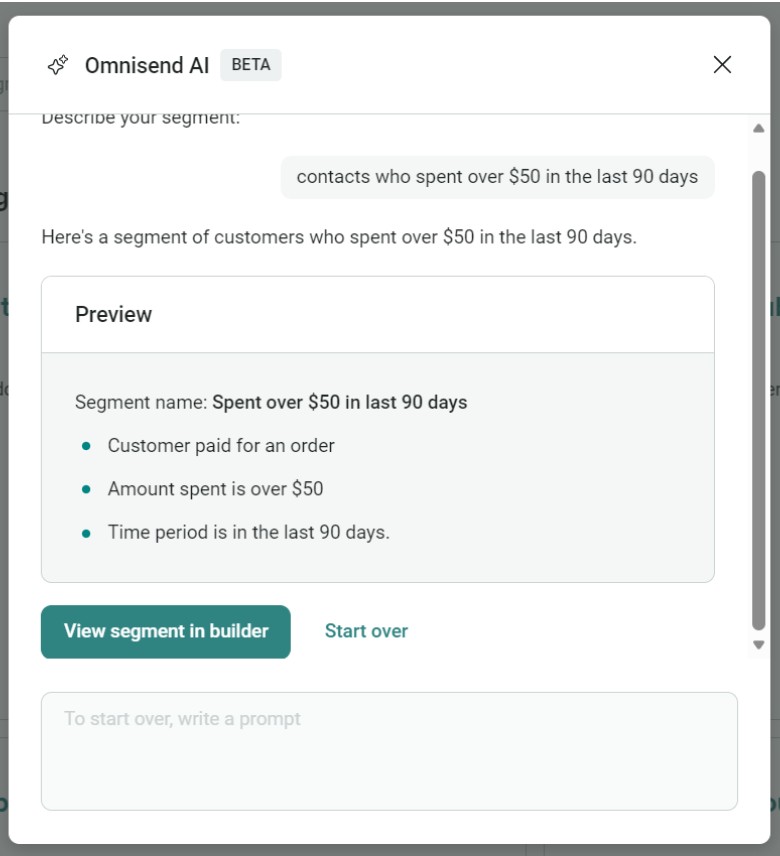
Global SMS coverage is another Omnisend differentiator. It covers SMS worldwide, and all you need to do to start sending it is add credits to your plan, or use any bonus SMS credits your plan already comes with.
Wrap up
SMS segmentation is crucial to maintaining healthy lists, organizing your customers by low and high-intent, and reaching them with timely messages that generate revenue.
Start with these SMS segments:
- All subscribers
- Engaged subscribers
- VIPs (or your high-spenders)
These segments are usable in your flows and scheduled SMS campaigns immediately to start targeting customers with relevant messages.
Now that you have the SMS segmentation steps, strategies, and best practices you need, you can go ahead and start implementing them with Omnisend.
Join Omnisend to segment your SMS subscribers and reach them at high-intent moments with targeted messages
Quick sign up | No credit card required
FAQs
What is SMS segmentation?
SMS segmentation is the grouping of your SMS subscribers into lists based on attributes that help target your marketing. Those include behavioral attributes such as browsing products, abandoning carts, and making purchases. They can also use non-behavioral data, such as demographics and preferences.
What are the four main types of segmentation in SMS marketing?
1. Behavioral segmentation, based on what subscribers do
2. Demographic segmentation, based on who the subscribers are
3. Geographic and time-zone segmentation, based on where subscribers are
4. Purchase history segmentation, based on what customers buy
How is SMS segmentation different from email segmentation?
SMS segments contain subscribers who have provided their phone numbers. Refinement then lets you create segments for those who have also opted in to receiving marketing texts. Email segments contain those who have provided their email only.
How many segments should I start with?
Start with all subscribers, active subscribers, who are those who click the links in your texts or otherwise interact with your brand over 30 to 90 days, and VIPs. That three-strong segmentation strategy will help you target your most engaged customers first.
Do I need a special platform to run SMS segmentation?
Yes, because some SMS tools are merely mass-senders or bulk-text enablers. Audience segmentation is a more specialized feature that Omnisend offers. You can build behavioral segments in Omnisend and let your ecommerce data update them.

TABLE OF CONTENTS
TABLE OF CONTENTS


Subscribe and don’t miss any updates!
No fluff, no spam, no corporate filler. Just a friendly letter, twice a month.