Omnisend AI

 OFFER




The top Shopify stores in 2026 include FIGS, Gymshark, Kylie Cosmetics, Fashion Nova, and Alo Yoga, each with 2025 online sales above $450 million.
In this article, we’ve compiled a list of 70+ of the best Shopify stores, all verified on Shopify in November 2026 and grouped by category. For every store, you’ll learn what it sells, which part of the business runs on Shopify, and one tactic you can copy, so these Shopify store examples give you something to act on.
Quick sign up | No credit card required
How we chose and verified these 70+ Shopify stores
Every store on this list sells to consumers and was checked on Shopify in November 2026. For each one, we loaded the store and read its myshopify.com domain from the page source. Headless builds often hide that domain, so, in that case, we used Shopify Storefront’s application programming interface (API) calls and Shopify-hosted assets instead.
If only part of a business uses the platform, the entry says which part, as with Supreme’s online shop, Mattel Shop, and Netflix Shop.
The 73 stores cover seven categories and mix household names with smaller standouts. While most are American, the list also has brands from Canada, the UK, Australia, Belgium, the Netherlands, and Germany.
Revenue figures are ECDB’s estimates of 2025 online sales (GMV), taken from its public sample-data pages. Each figure covers the brand’s own online stores, and ECDB publishes one for 40 of the 73 stores. For FIGS, a public company, and Allbirds, a public company until the brand’s June 2026 sale, we use 2025 net revenue from their annual reports instead.
In the table, stores are ranked by that figure inside each category, and those without one come last. Because they cover online sales only, ECDB’s estimates can sit well below the company-wide revenue some brands report.
If you’d like to run the same check on other stores, our guide explains how to find Shopify stores.
What do the top Shopify stores have in common?
The top Shopify stores guide the shopper’s choice, sell in bundles, offer subscriptions or memberships, release products on a schedule, and put proof where the shopper is likely to make a decision. For example, Huel preselects the subscription on its product page, while Magic Spoon’s savings rise from up to 20% on a four-box bundle to up to 26% on eight boxes.
| Pattern | What it looks like | Stores on this list |
|---|---|---|
| A quiz or finder that guides the choice | A few questions lead to one recommended product, size, or delivery schedule | Rare Beauty, Bondi Sands, Saje Natural Wellness, The Beauty Chef, Ekster, Loop Earplugs, Snag, Rad Power Bikes, Who Gives A Crap |
| Bundles with a visible saving | Shoppers build their own set, and the page shows what the next item or size is worth | Hismile, Bushbalm, Magic Spoon, Pip & Nut, HexClad, Pura Vida |
| Subscriptions and memberships | A recurring plan or a loyalty tier is offered on the product page, in the menu, or on a page of its own | Huel, Death Wish Coffee, Absolute Collagen, Lovevery, Frank Body, Gymshark, Our Place |
| Releases on a schedule | A fixed drop time, a sold-out waitlist, or a sign-up for the next release | Kith, Supreme, Kylie Cosmetics, SKIMS, LSKD, Heatonist |
| Proof and guarantees where the shopper decides | Reviews, test results, a trial period, or other trust signals sit on the product card or next to the buy button | Ridge, MVMT, Glossier, Partake Foods, The Honey Pot Co., Endy |
| A cause reported in numbers | The store publishes a running total of donations or impact, or what each order adds | Bombas, Tentree, BLK & Bold, Beauty Bakerie |
Page speed is one more aspect successful Shopify stores work on, although it doesn’t show in a screenshot. Google’s Core Web Vitals documentation says a page’s main content should load within 2.5 seconds. It also asks for a response to a tap or click within 200 milliseconds and a layout shift score of 0.1 or less, so run site speed audits regularly.
Many of these patterns end in a sign-up, such as the notify me button at Kylie Cosmetics or the drop alerts at LSKD, and a sign-up is only worth as much as the message that follows it. According to Omnisend’s 2026 ecommerce marketing report, automations made up just 2% of all email sends in 2025, yet generated 30% of total email-driven revenue.
SMS follows the same pattern in that report. Automated SMS messages earned an average of $0.74 per send, compared to $0.15 for campaigns.
Biggest brands that use Shopify
The biggest brands that use Shopify on this list, by company size and name recognition, are Barnes & Noble, Gymshark, Mattel, Netflix, SKIMS, Stanley, and Supreme. For companies that use Shopify for one shop only, the description says which shop.
- Barnes & Noble: Books, with an online storefront built on Shopify’s Hydrogen framework.
- Gymshark: Gym clothing, sold through a headless Shopify storefront.
- Mattel: Toys such as Barbie and Hot Wheels. Only its direct-to-consumer shops, such as Mattel Shop, run on Shopify.
- Netflix: Series merchandise. Only Netflix Shop is on Shopify, and we checked its U.S. store.
- SKIMS: Underwear and shapewear, with the whole store on Shopify.
- Stanley: Insulated drinkware. Its U.S. store runs on Shopify.
- Supreme: Skate and streetwear. Only the online shop runs on Shopify.
70+ top Shopify stores at a glance
FIGS, Gymshark, and Kylie Cosmetics lead the 73 top Shopify stores in 2025 online sales. The table below lists all 73 by category, with each store’s country, its estimated 2025 online sales where ECDB publishes them, and what the store does well.
| # | Store | Category | Country | 2025 sales (ECDB est.) | What it does well |
|---|---|---|---|---|---|
| 1 | Kylie Cosmetics | Beauty and personal care | US | $496M | Limited drops built for sell-outs |
| 2 | Glossier | Beauty and personal care | US | $56M | A community-built beauty brand |
| 3 | ColourPop | Beauty and personal care | US | $46M | Fast in-house product launches |
| 4 | Rare Beauty | Beauty and personal care | US | $46M | A shade finder that guides each purchase |
| 5 | Fenty Beauty | Beauty and personal care | US | $35M | 50 shades sorted by depth and undertone |
| 6 | Manscaped | Beauty and personal care | US | $30M | Kits and subscriptions for repeat orders |
| 7 | Hismile | Beauty and personal care | Australia | $25M | Mix-and-match bundles with tiered free products |
| 8 | Frank Body | Beauty and personal care | Australia | $4M | A hotel-themed loyalty program |
| 9 | Beauty Bakerie | Beauty and personal care | US | – | Mission-led storytelling |
| 10 | Bondi Sands | Beauty and personal care | Australia | – | A quiz for first-time self-tanners |
| 11 | Bushbalm | Beauty and personal care | Canada | – | A bundle builder that starts with delivery frequency |
| 12 | FIGS | Fashion and apparel | US | $631M* | Core colors for repeat uniform orders |
| 13 | Gymshark | Fashion and apparel | UK | $548M | A creator partner's range on its own page |
| 14 | Fashion Nova | Fashion and apparel | US | $459M | Constant new arrivals with fast discovery |
| 15 | Alo Yoga | Fashion and apparel | US | $454M | Shoppable lifestyle content |
| 16 | SKIMS | Fashion and apparel | US | $358M | Limited-edition colors with a waitlist when sold out |
| 17 | Allbirds | Fashion and apparel | US | $153M* | Sustainability listed for each part of the shoe |
| 18 | Bombas | Fashion and apparel | US | $130M | A donation model shown on every order |
| 19 | Kith | Fashion and apparel | US | $129M | Limited drops with cinematic campaigns |
| 20 | Supreme | Fashion and apparel | US | $109M | A fixed shop update time with email alerts |
| 21 | Spanx | Fashion and apparel | US | $97M | Inseam options and a fit finder |
| 22 | Fear of God | Fashion and apparel | US | $90M | A shop and campaign switch on every collection |
| 23 | Tentree | Fashion and apparel | Canada | $10M | Impact tracking on every order |
| 24 | Frank And Oak | Fashion and apparel | Canada | – | Fit guidance beside the size picker |
| 25 | Lounge | Fashion and apparel | UK | – | A matching-piece prompt under the bag button |
| 26 | Represent | Fashion and apparel | UK | – | A workout app that leads to activewear |
| 27 | Snag | Fashion and apparel | UK | – | A two-question size finder on the homepage |
| 28 | Away | Accessories and jewelry | US | $107M | A comparison page for carry-on sizes |
| 29 | Herschel Supply | Accessories and jewelry | Canada | $44M | Size comparisons inside the product page |
| 30 | MVMT | Accessories and jewelry | US | $13M | Brand proof beside a sticky add-to-cart bar |
| 31 | Ana Luisa | Accessories and jewelry | US | – | Recycled content stated for most materials |
| 32 | Ekster | Accessories and jewelry | Netherlands | – | A one-minute quiz that picks a wallet |
| 33 | Loop Earplugs | Accessories and jewelry | Belgium | – | A functional product sold as lifestyle |
| 34 | Pela | Accessories and jewelry | Canada | – | A take-back program for old cases |
| 35 | Pura Vida | Accessories and jewelry | US | – | Bundle pricing at one fixed price |
| 36 | Ridge | Accessories and jewelry | US | – | Reviews and limited drops that speed up decisions |
| 37 | WP Standard | Accessories and jewelry | US | – | Premium leather with minimal navigation |
| 38 | Huel | Food and beverage | UK | $239M | Subscriptions built into the store |
| 39 | Liquid Death | Food and beverage | US | $16M | A brand voice that sells water |
| 40 | Heatonist | Food and beverage | US | $12M | Season drops with a media partner |
| 41 | BLK & Bold | Food and beverage | US | – | An impact report promoted on the homepage |
| 42 | Death Wish Coffee | Food and beverage | US | – | Urgency plus subscriptions |
| 43 | Fly By Jing | Food and beverage | US | – | Heritage-led storytelling |
| 44 | Magic Spoon | Food and beverage | US | – | Build-your-own bundles |
| 45 | Partake Foods | Food and beverage | US | – | Allergy-friendly trust signals |
| 46 | Pip & Nut | Food and beverage | UK | – | A bundle builder with spend thresholds |
| 47 | Therabody | Health and wellness | US | $44M | HSA and FSA payment at checkout |
| 48 | Saje Natural Wellness | Health and wellness | Canada | $3M | A product finder that asks who it's for |
| 49 | Absolute Collagen | Health and wellness | UK | – | Proof-led subscriptions |
| 50 | The Beauty Chef | Health and wellness | Australia | – | Education plus subscriptions |
| 51 | The Honey Pot Co. | Health and wellness | US | – | Education-led product pages |
| 52 | Ruggable | Home and lifestyle | US | $359M | Room photos that cut buying hesitation |
| 53 | HexClad | Home and lifestyle | US | $200M | Set bundles priced against a value anchor |
| 54 | Caraway | Home and lifestyle | US | $131M | Public lab reports behind a non-toxic claim |
| 55 | Koala | Home and lifestyle | Australia | $129M | A 120-day home trial across the site |
| 56 | Barnes & Noble | Home and lifestyle | US | $114M** | Exclusive and signed editions |
| 57 | Lovevery | Home and lifestyle | US | $96M | An age-based picker that starts a subscription |
| 58 | Endy | Home and lifestyle | Canada | $34M | A 365-night trial in the buy box |
| 59 | Mattel Shop | Home and lifestyle | US | – | Shop-by-age navigation for gift buyers |
| 60 | Netflix Shop | Home and lifestyle | US | – | Navigation by show title |
| 61 | Our Place | Home and lifestyle | US | – | A tiered loyalty club in the brand's voice |
| 62 | Tonies | Home and lifestyle | Germany | – | A four-step bundle builder |
| 63 | Who Gives A Crap | Home and lifestyle | Australia | – | A quiz that sets the subscription schedule |
| 64 | Wild One | Home and lifestyle | US | – | Walk kits with colors picked piece by piece |
| 65 | Stanley | Sports, outdoors and tech | US | $401M | An engraving customizer on bestsellers |
| 66 | Vuori | Sports, outdoors and tech | US | $213M | Free workout classes that lead to outfits |
| 67 | Rad Power Bikes | Sports, outdoors and tech | US | $90M | A nine-question e-bike finder quiz |
| 68 | Cotopaxi | Sports, outdoors and tech | US | $50M | One guarantee for returns, repairs, and trade-ins |
| 69 | Peak Design | Sports, outdoors and tech | US | $28M | Colors sold only on its own store |
| 70 | Condor Cycles | Sports, outdoors and tech | UK | – | A build-your-own-bike configurator |
| 71 | Cowboy | Sports, outdoors and tech | Belgium | – | Scroll-driven product storytelling |
| 72 | Ember | Sports, outdoors and tech | US | – | Use-case labels on a product shelf |
| 73 | LSKD | Sports, outdoors and tech | Australia | – | Pre-launch drop pages with a countdown |
Every store in the table was verified on Shopify in November 2026.
Revenue is ECDB’s estimate of 2025 GMV on the brand’s own online stores, and a dash means ECDB has no figure. *FIGS and Allbirds show 2025 net revenue from their annual reports. ** Barnes & Noble moved to Shopify in June 2026, so the ECDB estimate predates the migration.
For more Shopify store examples, see our lists of Shopify dropshipping stores, one-product Shopify stores, and Shopify hardware stores.
Beauty and personal care
The beauty stores on this list take the guesswork out of buying products a shopper can’t test online. Rare Beauty and Bondi Sands do it with short quizzes, while Hismile and Bushbalm let buyers build their own bundles.
Beauty Bakerie: mission-led storytelling
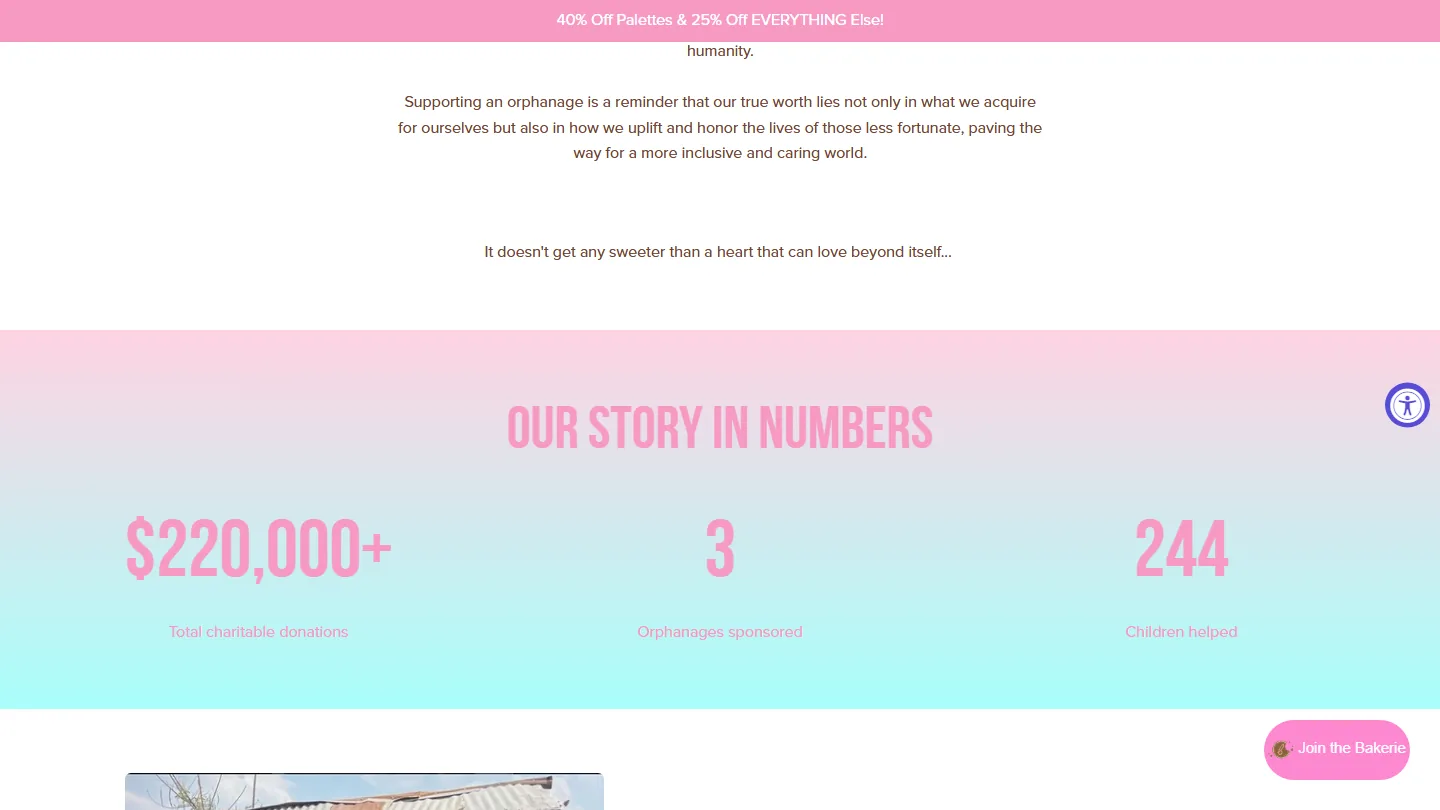
Beauty Bakerie tells its mission story with numbers, on a dedicated Sugar Homes page of its Shopify store. The brand was founded by Cashmere Nicole in 2011 and sells bakery-themed makeup and skincare products that are vegan-friendly and cruelty-free.
The page has a counter showing $220,000+ in charitable donations and 244 children helped across three sponsored orphanages. For a values-driven buyer, that’s a reason to choose this brand, and the cause stays one click from the shop thanks to a main navigation link.
What you can learn: Put your own totals on a page like it and update them as they change.
Bondi Sands: a quiz for first-time self-tanners
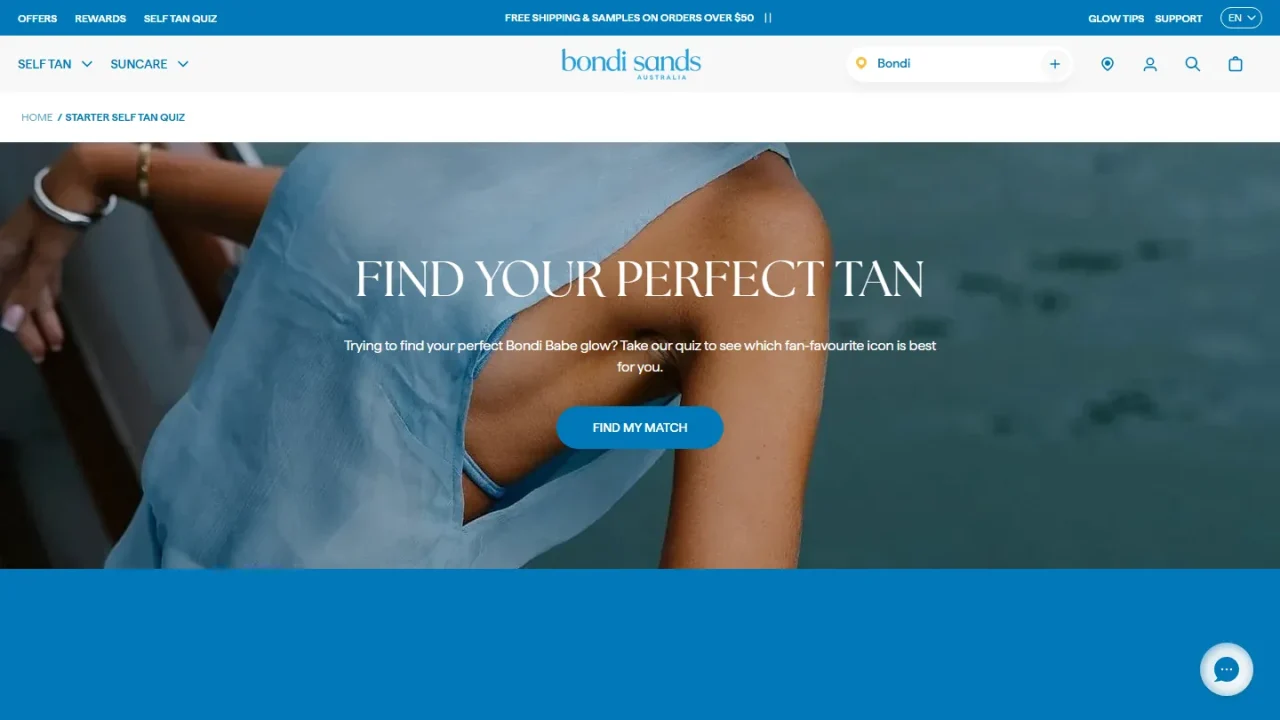
A quiz pays off most where a wrong first pick puts a buyer off the product, and self-tan is one of those categories. Image via Bondi Sands.
First-time self-tanners get a starter quiz at Bondi Sands, linked from the top bar of every page. The Australian brand sells self-tan and suncare in more than 30 countries. Its U.S., Australian, and UK sites each run as a separate Shopify store.
Before it recommends anything, the quiz sorts beginners from regular tanners with its first question, which asks whether you have self-tanned before. Asking about experience up front lets the quiz speak to a first-timer’s doubts right away.
What you can learn: Link your quiz from the header so a hesitant shopper can reach it on any page.
Bushbalm: a bundle builder that starts with delivery frequency
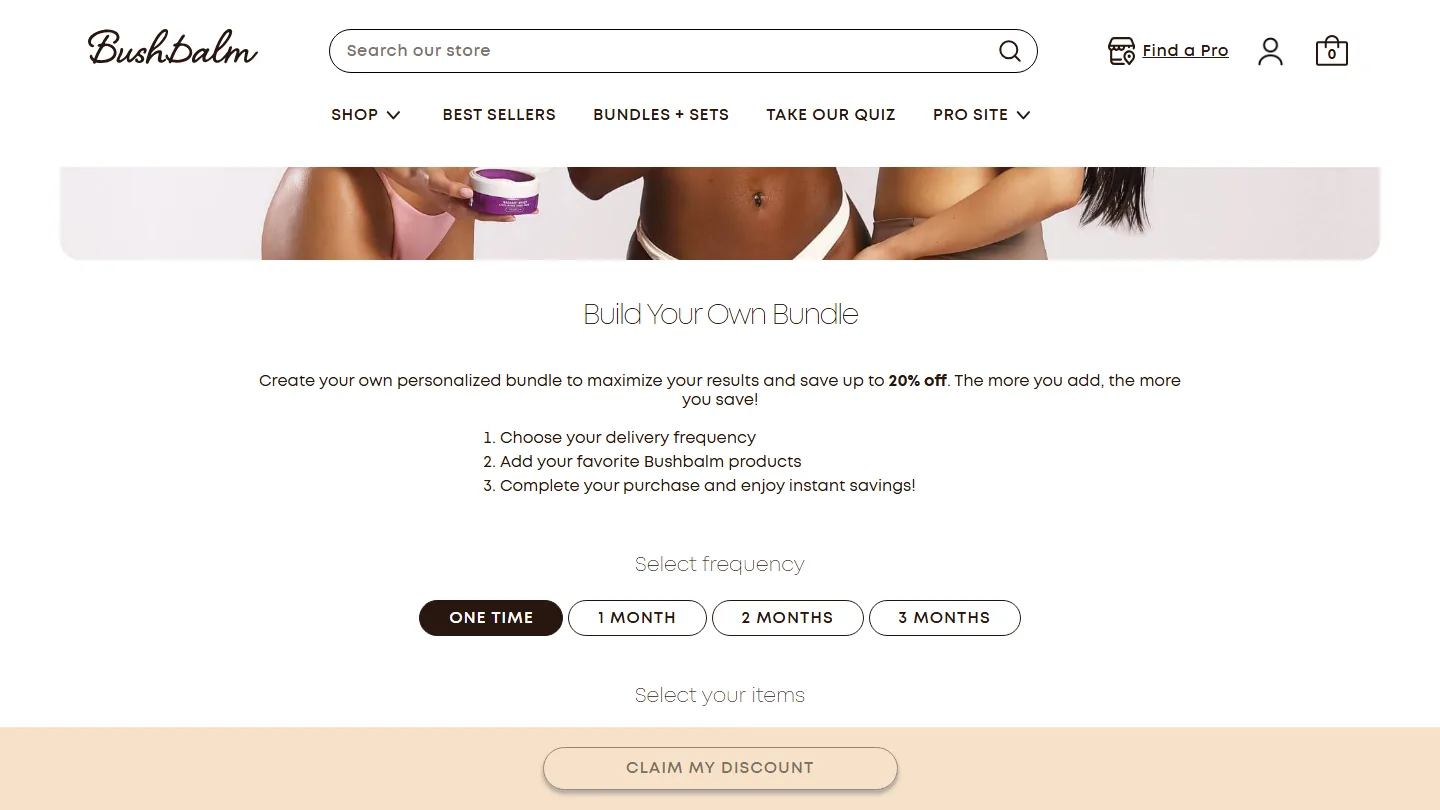
Shoppers at Bushbalm choose a delivery frequency before they add a single product to its bundle builder. The Ottawa company sells skincare for the bikini line, with products for ingrown hairs and razor burn, and its entire store is built on Shopify.
Frequency options run from a one-time order to delivery every one to three months, and the savings grow with each product added. That way, someone who came for a single oil product can leave with a routine and a schedule.
What you can learn: If you sell products people use up quickly, add the frequency choice to the bundle page itself.
ColourPop: fast in-house product launches
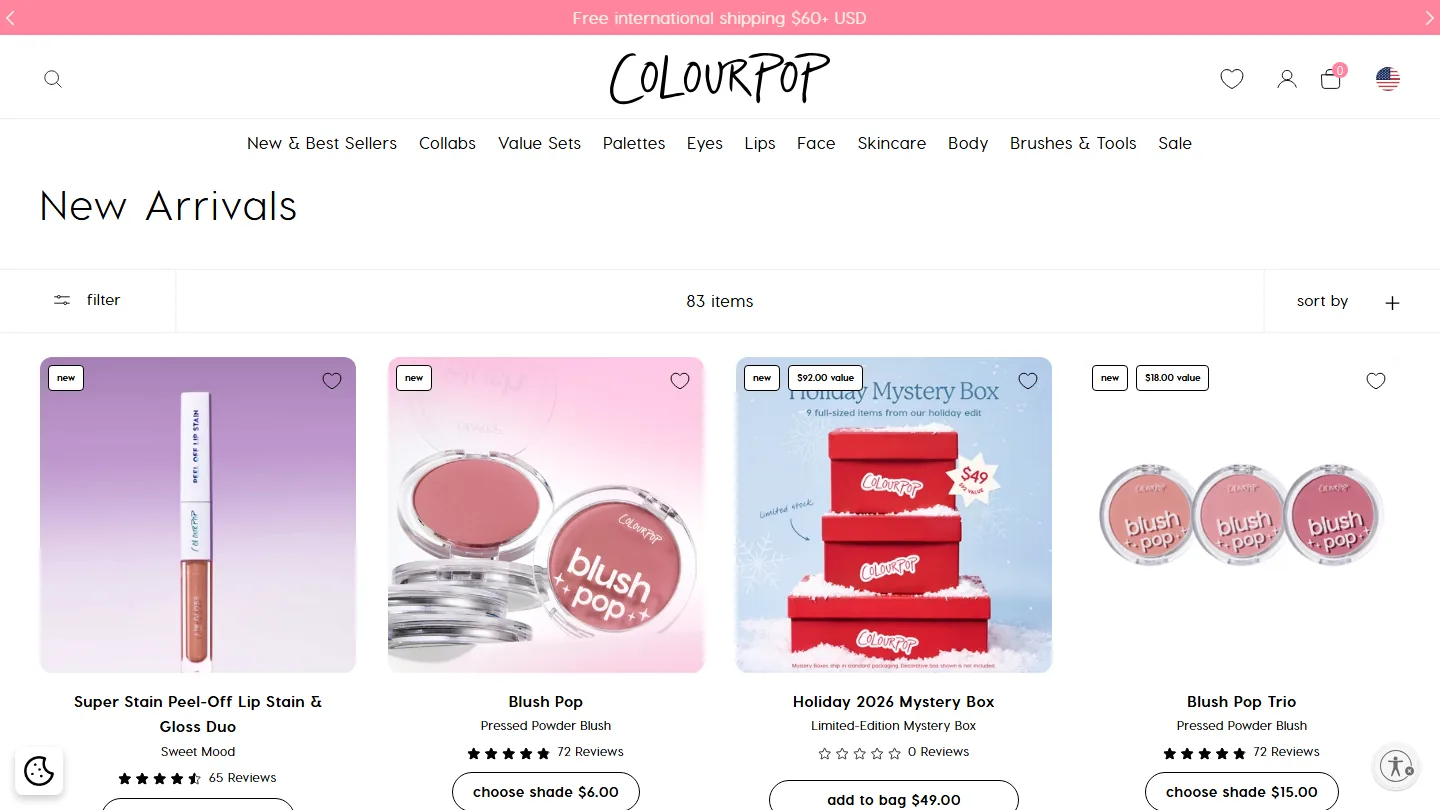
ColourPop creates and tests its products under one roof, and it launches them often enough to fill a New Arrivals collection. The brand started in 2014 with 31 eyeshadow shades and sells makeup and skincare to budget-minded shoppers. Its store runs on Shopify, and ECDB puts its 2025 online sales at an estimated $46 million.
When checked in November 2026, New Arrivals held dozens of items and sat under the first menu item. Repeat visitors can find products they haven’t seen, while value badges on the sets nudge them from a single item toward a bundle.
What you can learn: Give new products their own collection and link it first in your menu.
Fenty Beauty: 50 foundation shades sorted by depth and undertone
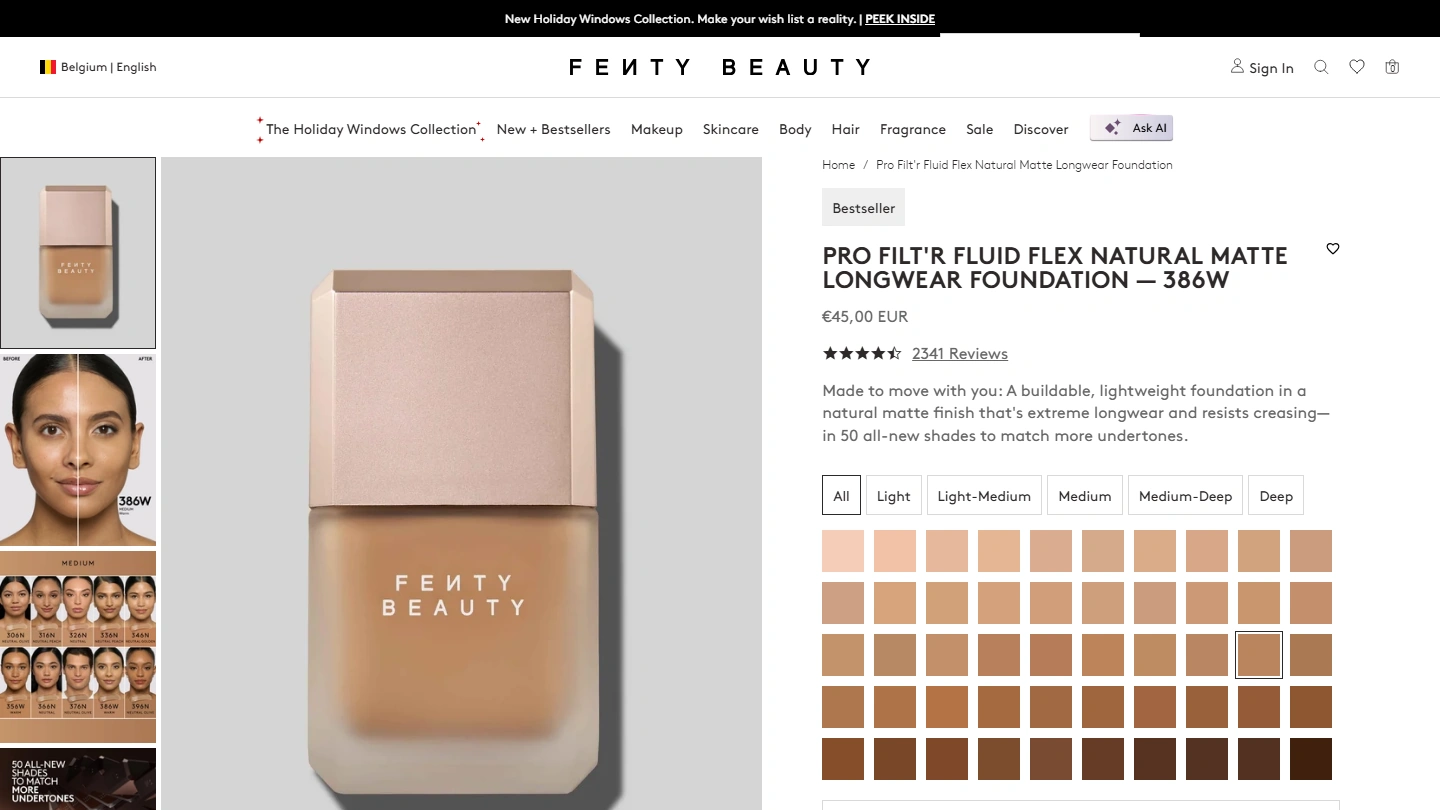
Fenty Beauty sorts its 50 foundation shades by depth and undertone, and sells its whole range from a single Shopify store, so a launch goes live in every market at once. Rihanna’s brand has four lines, from makeup to fragrance, made to perform across skin tones and hair textures. ECDB estimates Fenty Beauty took about $35 million in online sales in 2025.
On the product page of its bestselling Pro Filt’r Fluid Flex foundation, the shades sit in five depth groups from Light to Deep. Each shade code adds an undertone letter, such as W for warm.
What you can learn: If your range covers customers other brands overlook, make it quick to browse: group it into a few steps and label each option with what sets it apart.
Frank Body: a hotel-themed loyalty program
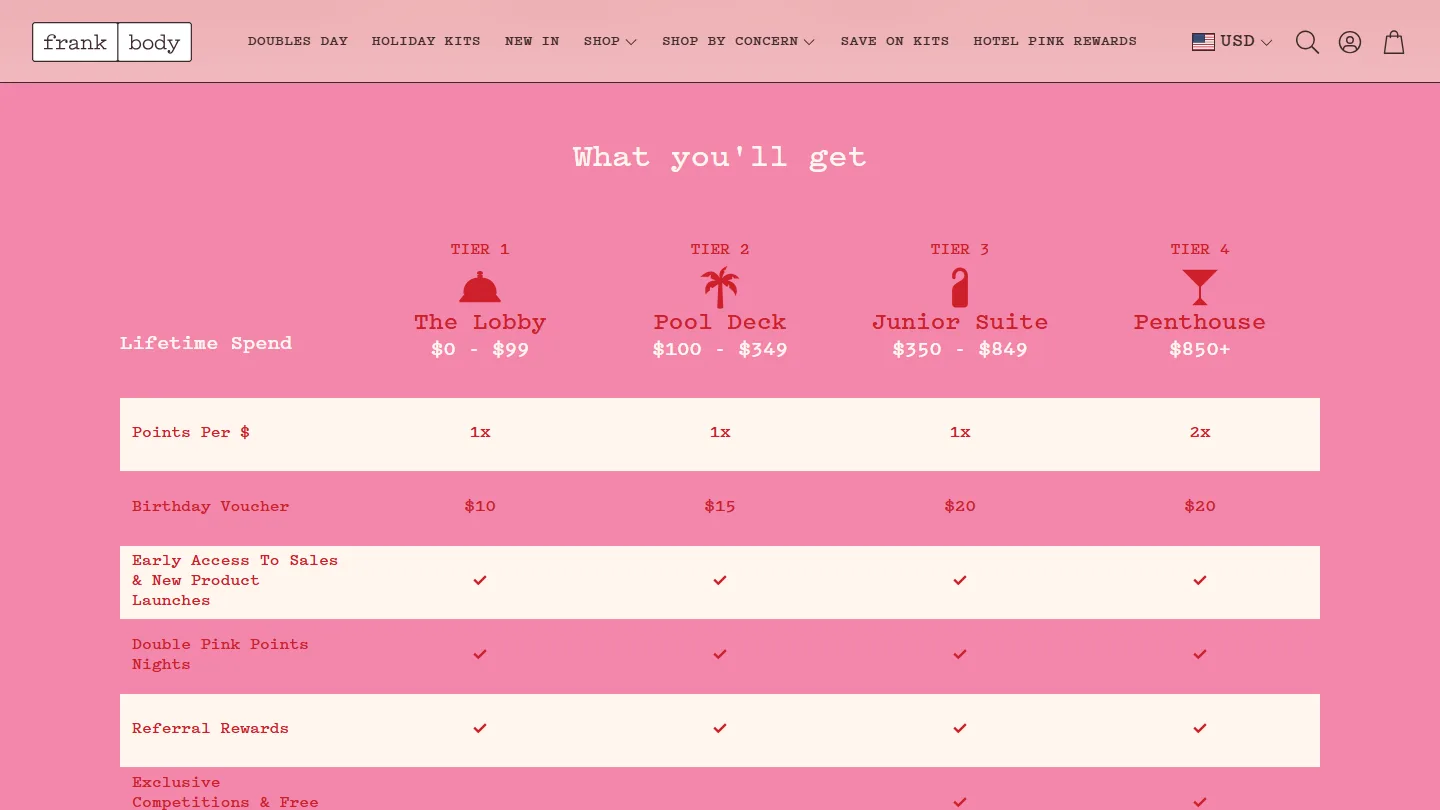
Frank Body themes its loyalty program as a hotel, with members going from The Lobby up to the Penthouse as lifetime spend grows. It started in Melbourne in 2013 with a coffee scrub and sells body care today. The Australian and U.S. sites are separate Shopify stores, and the Australian one made about $4 million online in 2025 by ECDB’s estimate.
Hotel Pink has four tiers, and the top one earns double points. While the mechanics are standard, the theme fits the brand’s voice, and points for photo reviews bring customer pictures to the product pages.
What you can learn: Name your tiers in your brand’s own language and show what each takes to reach.
Glossier: a community-built beauty brand
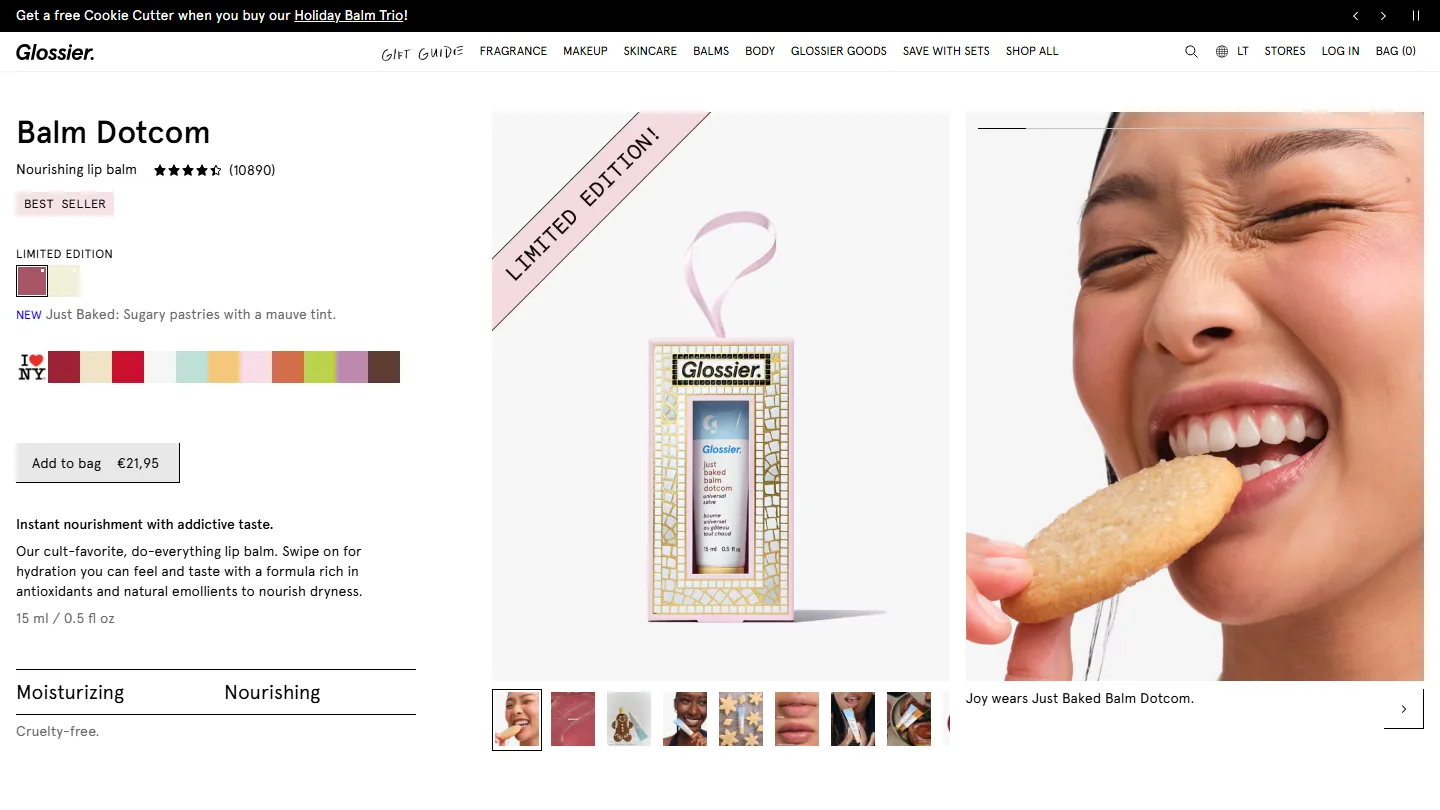
Glossier grew out of Into The Gloss, a beauty website and community, and its product pages still lean on personal connection. The company launched in 2014 and sells makeup and skincare alongside body care and fragrance. Its store runs on Shopify, and ECDB’s estimate for its 2025 online sales is $56 million.
On the Balm Dotcom page, a photo caption names the person wearing the shade, and reviewers are tagged with their skin type and skin shade. A shopper can look for someone like them before choosing a tint.
What you can learn: Ask reviewers for one or two attributes that matter for your product and display them beside each review.
Hismile: mix-and-match bundles with tiered free products
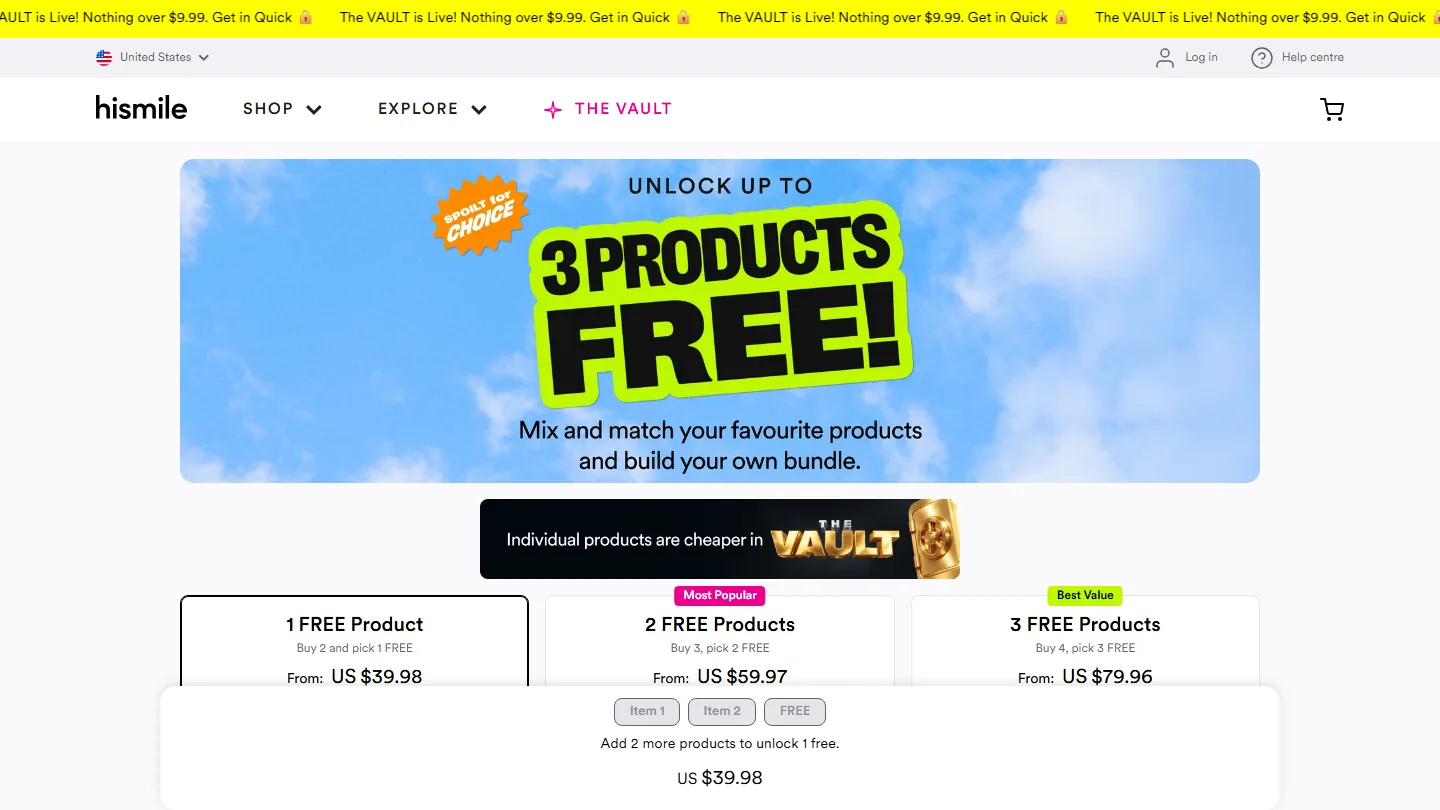
Hismile lets shoppers build their own bundle and adds free products as the bundle grows. The Australian company sells at-home oral care, from whitening strips to flavored toothpaste. Every region has a Shopify store of its own. ECDB estimates Hismile’s 2025 online sales at around $25 million.
The offer is to buy two products and get one free, with benefits climbing to three free products when four are bought. A tracker on the page says how many more items it takes to reach the next tier, so the shopper always knows what one more product is worth.
What you can learn: Show progress toward the next reward on the bundle page, where the choice is made.
Kylie Cosmetics: limited drops built for sell-outs
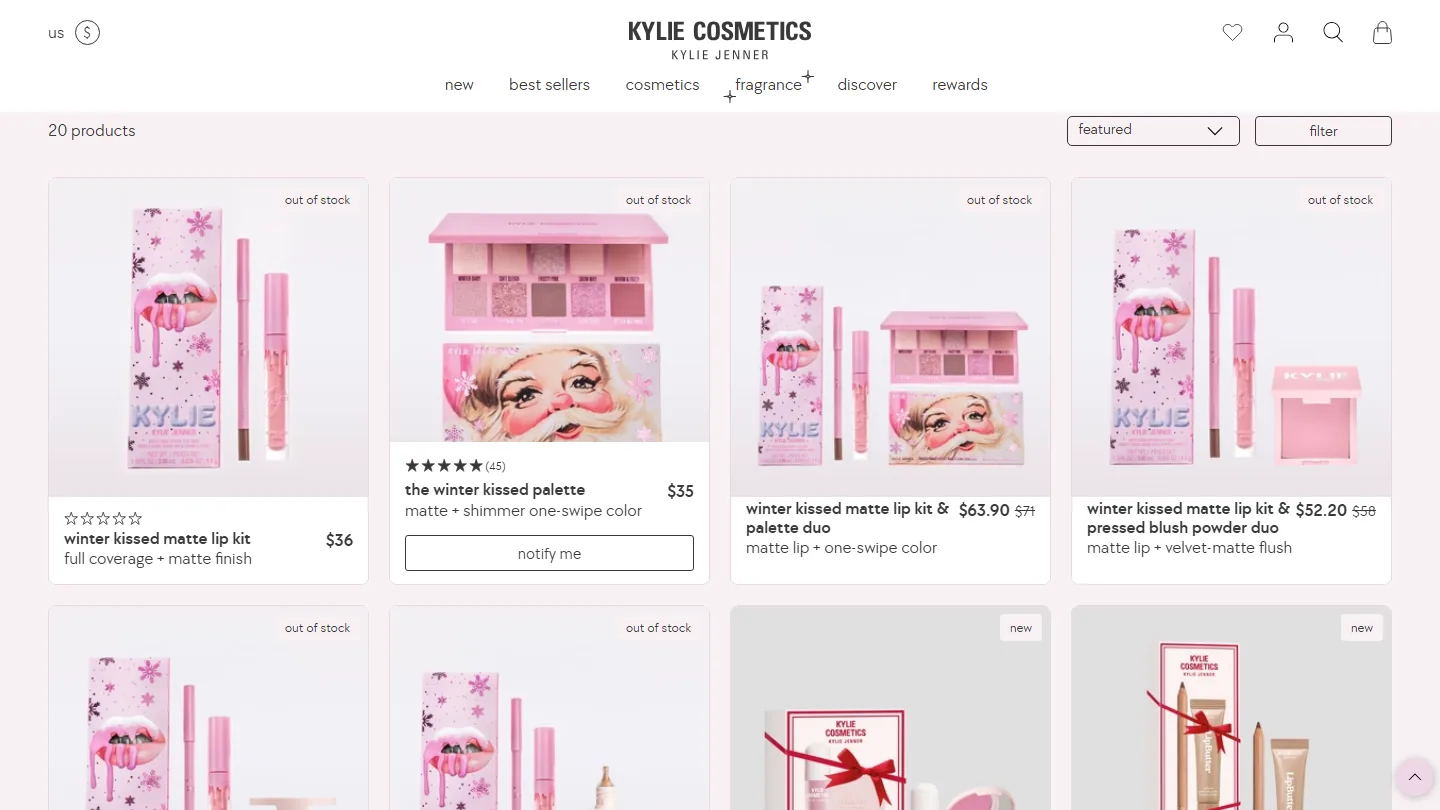
Kylie Cosmetics releases seasonal collections as limited drops, and its store is set up for the sell-outs that follow. Kylie Jenner created the brand to give her fans the makeup she uses, and it also sells fragrance and skincare. The U.S. storefront runs on Shopify, and ECDB estimates the brand’s online sales reached about $496 million in 2025.
On our visit, the first row of the Winter Kissed drop was out of stock, and every sold-out card offered a notify me button. Visible sell-outs signal demand, and the button collects a contact for the restock, so a missed sale can come back.
What you can learn: Add a back-in-stock sign-up to every sold-out product before your next launch.
Manscaped: kits and subscriptions for repeat orders
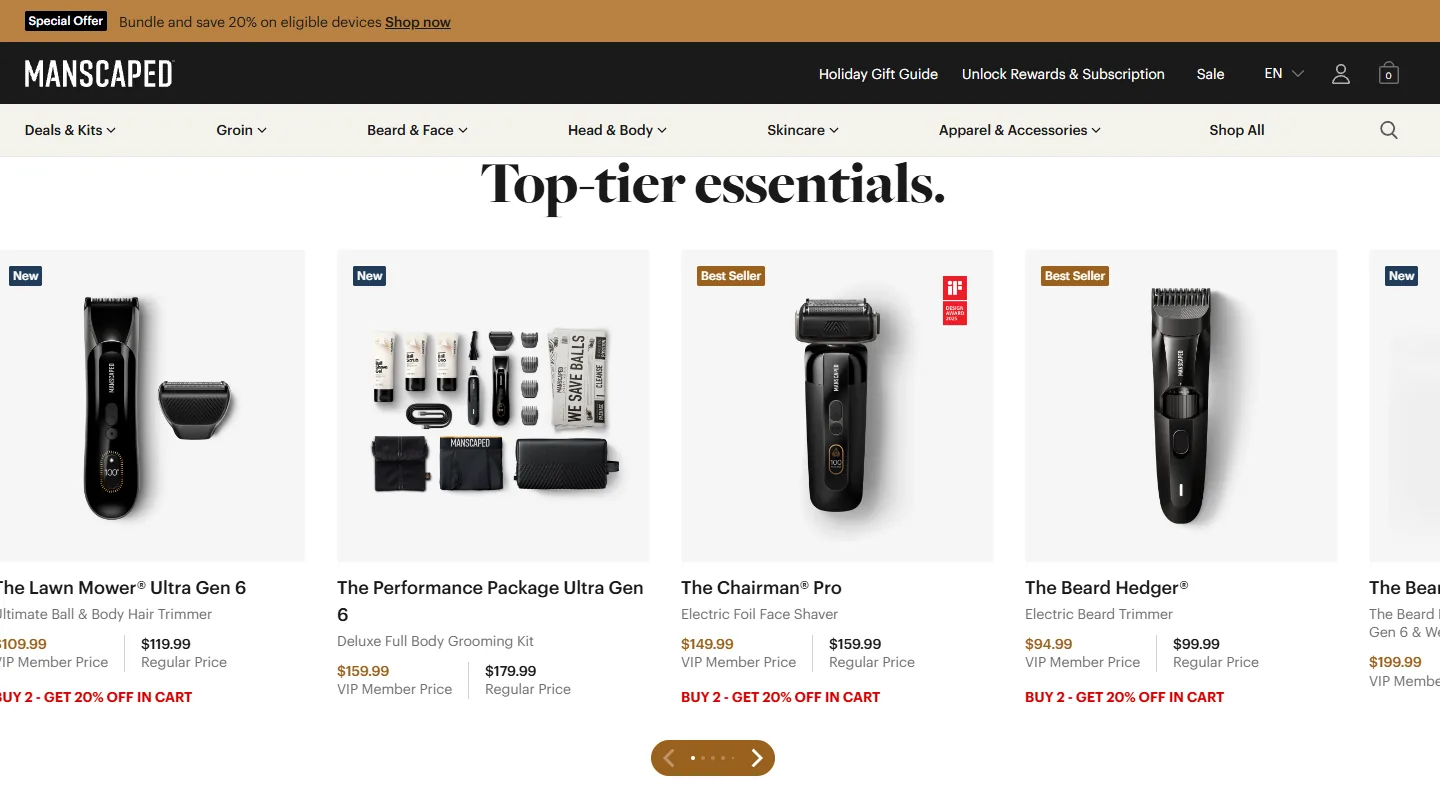
Manscaped sells its trimmers in kits and promotes a rewards and subscription program in its header, both aimed at the next order. Launched in 2016, the men’s grooming brand is also stocked at Target and Walmart. Its headless storefront uses Shopify for the backend and checkout. By ECDB’s estimate, 2025 online sales were about $30 million.
Product cards show a VIP member price next to the regular price, so the savings are visible before a shopper opens a product. Kits such as The Performance Package put several products into one order.
What you can learn: If you run a membership, print the member price on the card itself.
Rare Beauty: a shade finder that guides each purchase
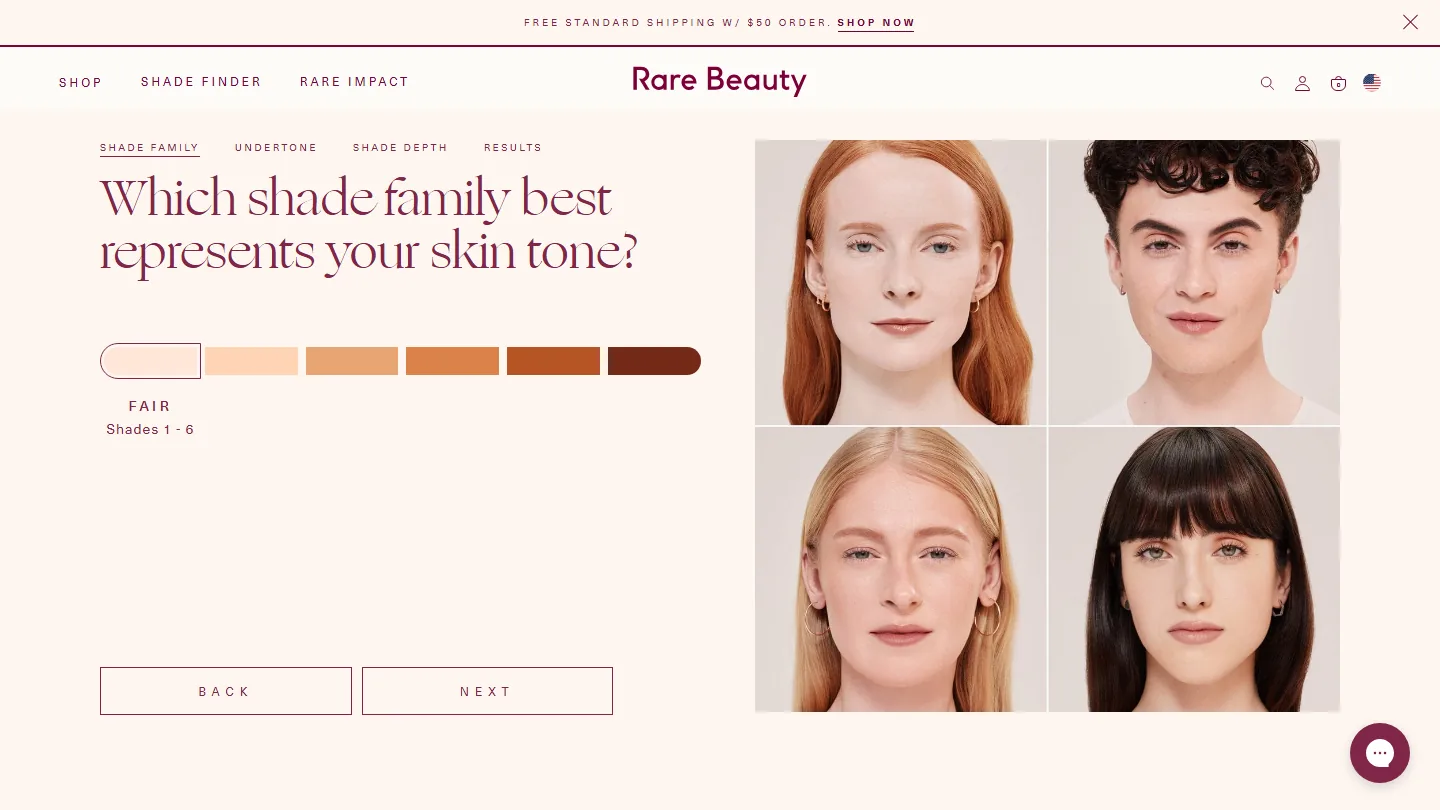
Rare Beauty guides foundation buyers to a shade with a four-step finder linked in its main navigation. Selena Gomez’s makeup brand is vegan and cruelty-free, and its whole storefront is a Shopify store. ECDB’s estimate for Rare Beauty is $46 million in online sales for 2025.
A shade family comes first in the finder, followed by undertone and depth, and a match appears at the end. That guided result replaces the guess a buyer would otherwise make on a foundation shade they can’t try on, which is where online shoppers hesitate.
What you can learn: Any product with many variants can get a short finder like this, linked from the main menu.
For more examples in this category, see our list of Shopify beauty stores.
Fashion and apparel
The fashion and apparel stores on this list answer the fit question early and give shoppers a reason to return. Snag and Spanx put size finders in front of the shopper, while Kith and Gymshark bring people back with a weekly drop day and a loyalty program.
Allbirds: sustainability listed part by part on product pages
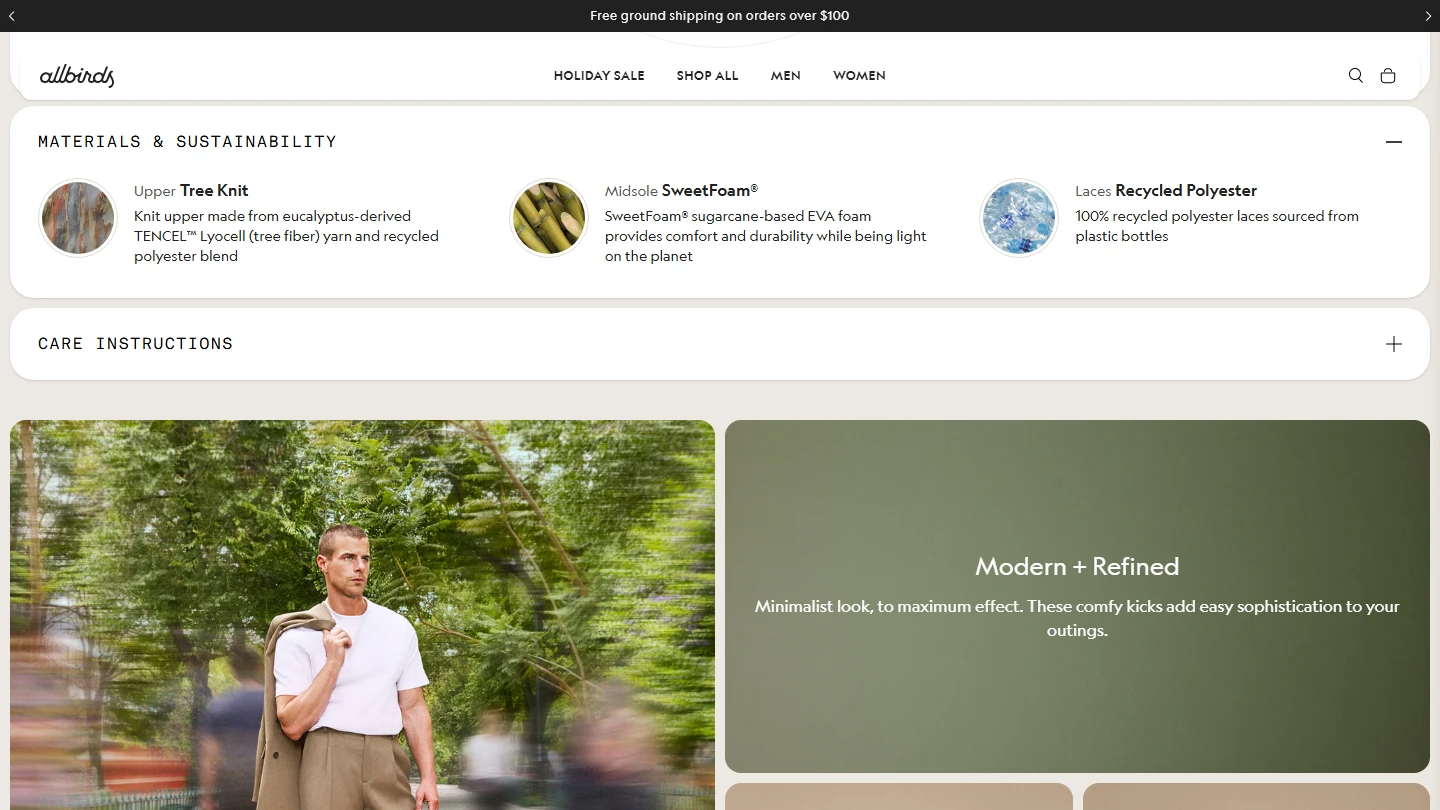
Allbirds lists the material behind each part of a shoe in a panel on product pages such as the Tree Runner NZ. The brand sells shoes and apparel, and it started in 2016 with a single shoe, the Wool Runner. Its U.S. storefront runs on Shopify, and Allbirds reported 2025 net revenue of $152.5 million across all channels.
The panel names what each part comes from: eucalyptus tree fiber blended with recycled polyester for the upper, sugarcane for the midsole, and plastic bottles for the laces. Shoppers paying for natural materials can check the claim part by part.
What you can learn: If shoppers buy for sustainability, list each part’s material and its source, like a spec.
Alo Yoga: shoppable lifestyle content
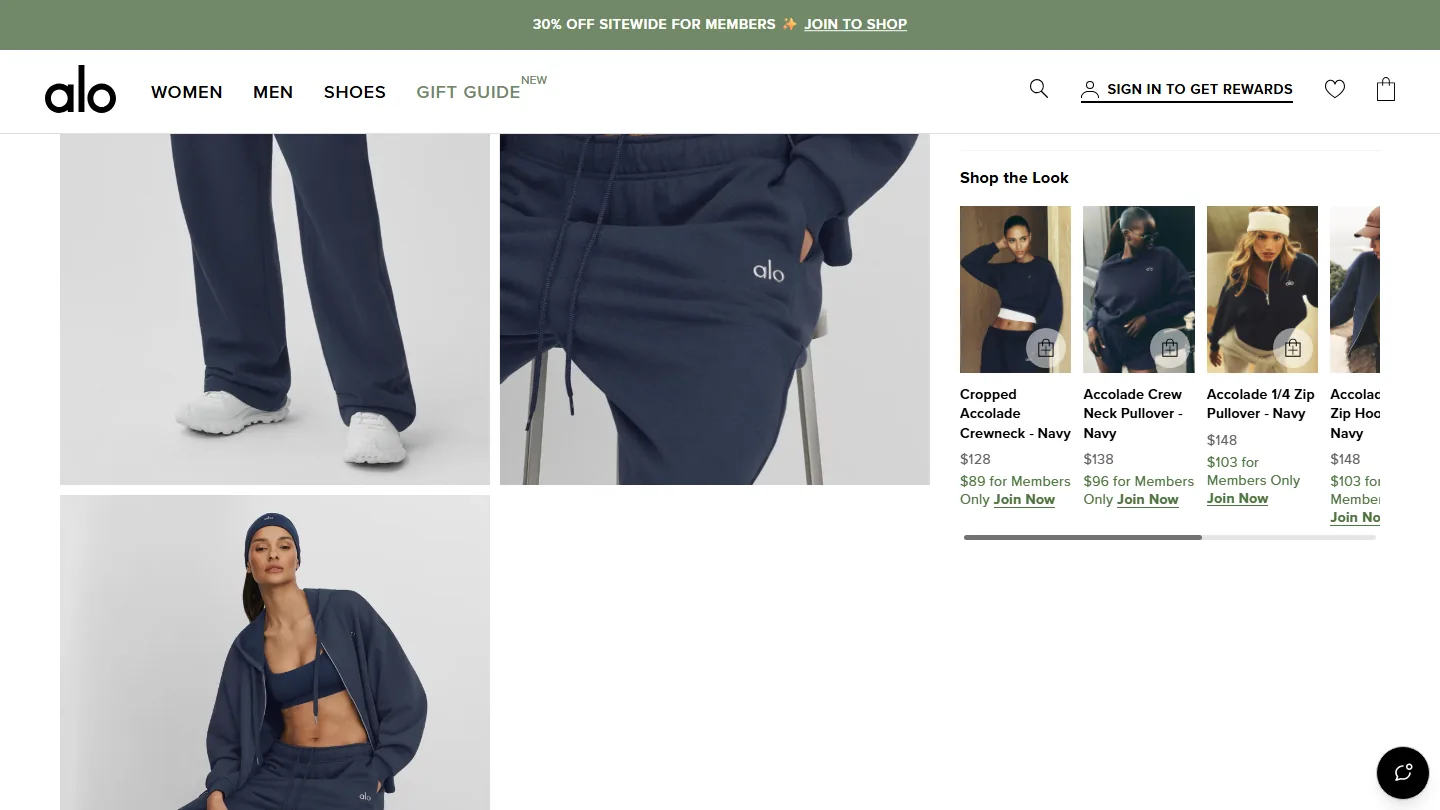
Alo Yoga makes its lifestyle photos shoppable with a Shop the Look carousel on product pages. The store sells yoga and athleisure clothing for women and men, and the whole storefront runs on Shopify. ECDB estimates its 2025 online sales at about $454 million.
A shopper looking at one pair of sweatpants sees the matching tops worn as an outfit, each with a quick-add icon. Every tile also lists the ALO Access member price, so the carousel keeps promoting the free loyalty program.
What you can learn: Show products that are worn together on the same product page, with a way to add each piece.
Bombas: a donation model shown on every order
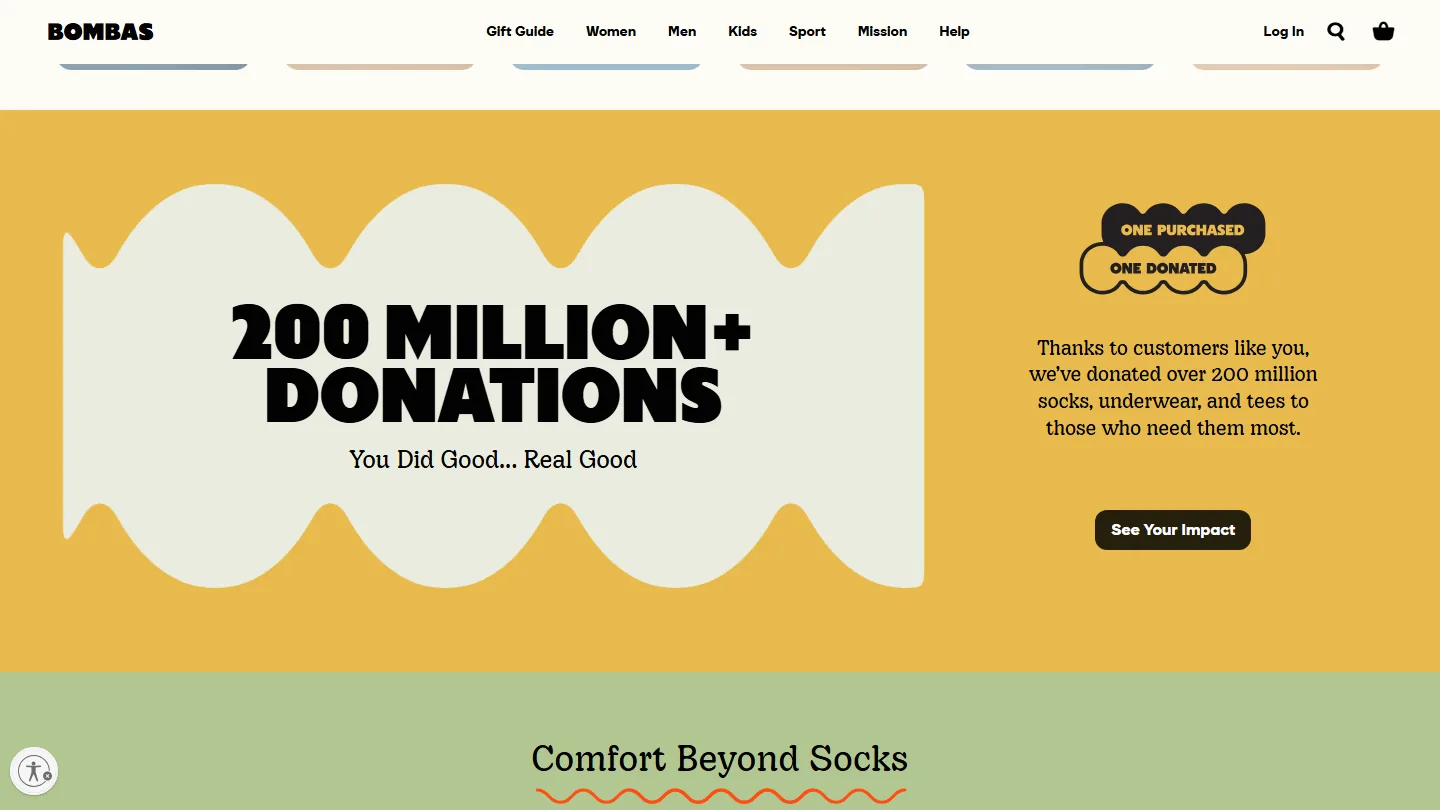
Bombas ties a donation to every order and shows the running total on its homepage. Founded in 2013, the brand sells socks and underwear, plus T-shirts and slippers, through a headless storefront built on Shopify. ECDB’s estimate for its 2025 online sales is $130 million.
The banner promises one item donated for each one purchased. Further down the page, a block counts more than 200 million donations and thanks customers for them, so shoppers read the total as something they helped build.
What you can learn: A store with a giving model can do the same by publishing its running number and what each order adds to it.
Fashion Nova: constant new arrivals with fast discovery
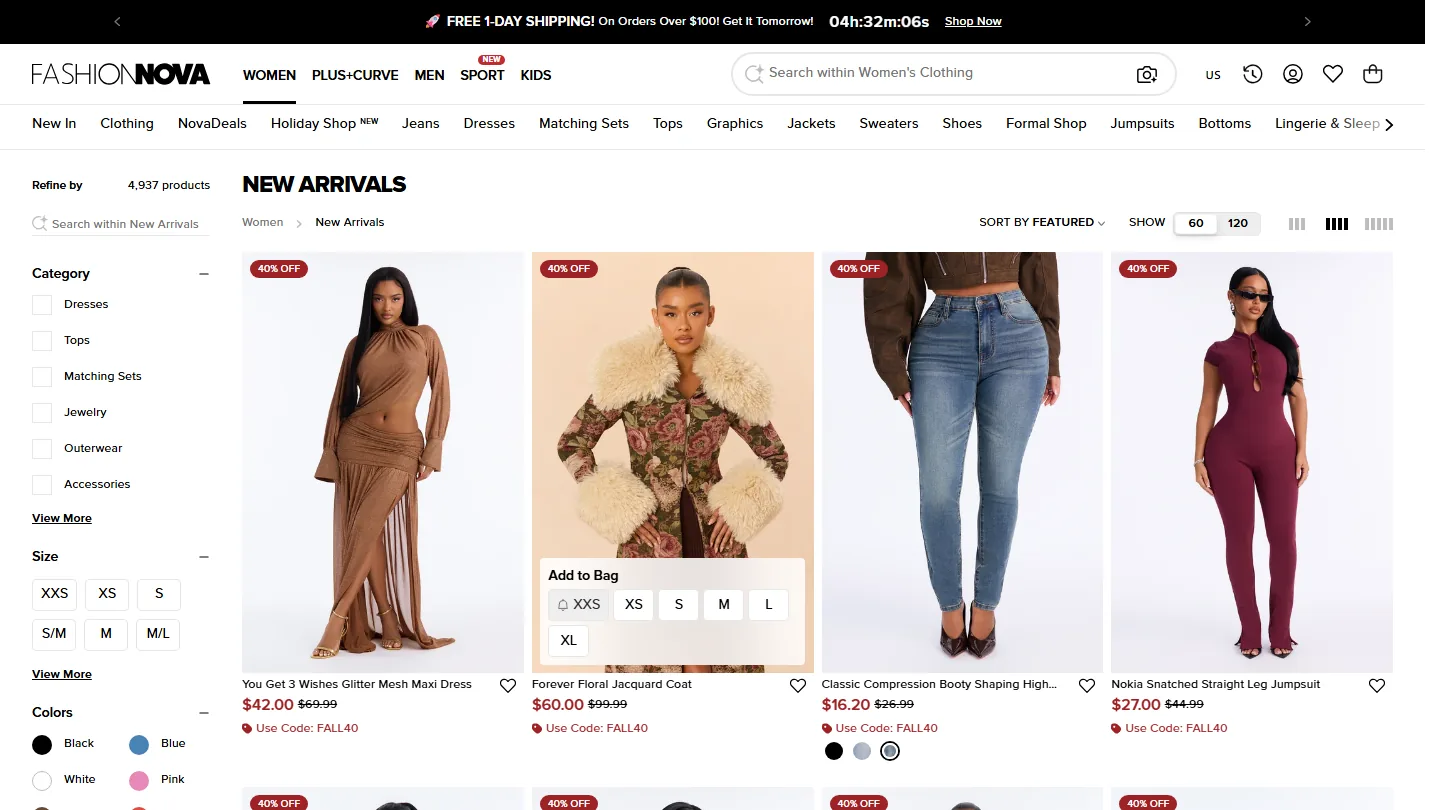
Fashion Nova adds over 1,000 new arrivals a week, according to its own About page, and makes them quick to sort through. The brand started in 2006 as one LA store and now sells trendy clothes for women and men online. Its storefront is a headless build on Shopify, and ECDB estimates 2025 online sales of about $459 million.
The New Arrivals feed listed close to 5,000 products when we checked in November 2026, with filters for occasion and fabric alongside size and color. Hovering over a card opens size buttons, so an item goes into the bag straight from the grid.
What you can learn: For a catalog that grows this fast, add filters for how customers shop and put add-to-bag on the card.
Fear of God: a shop and campaign switch on every collection
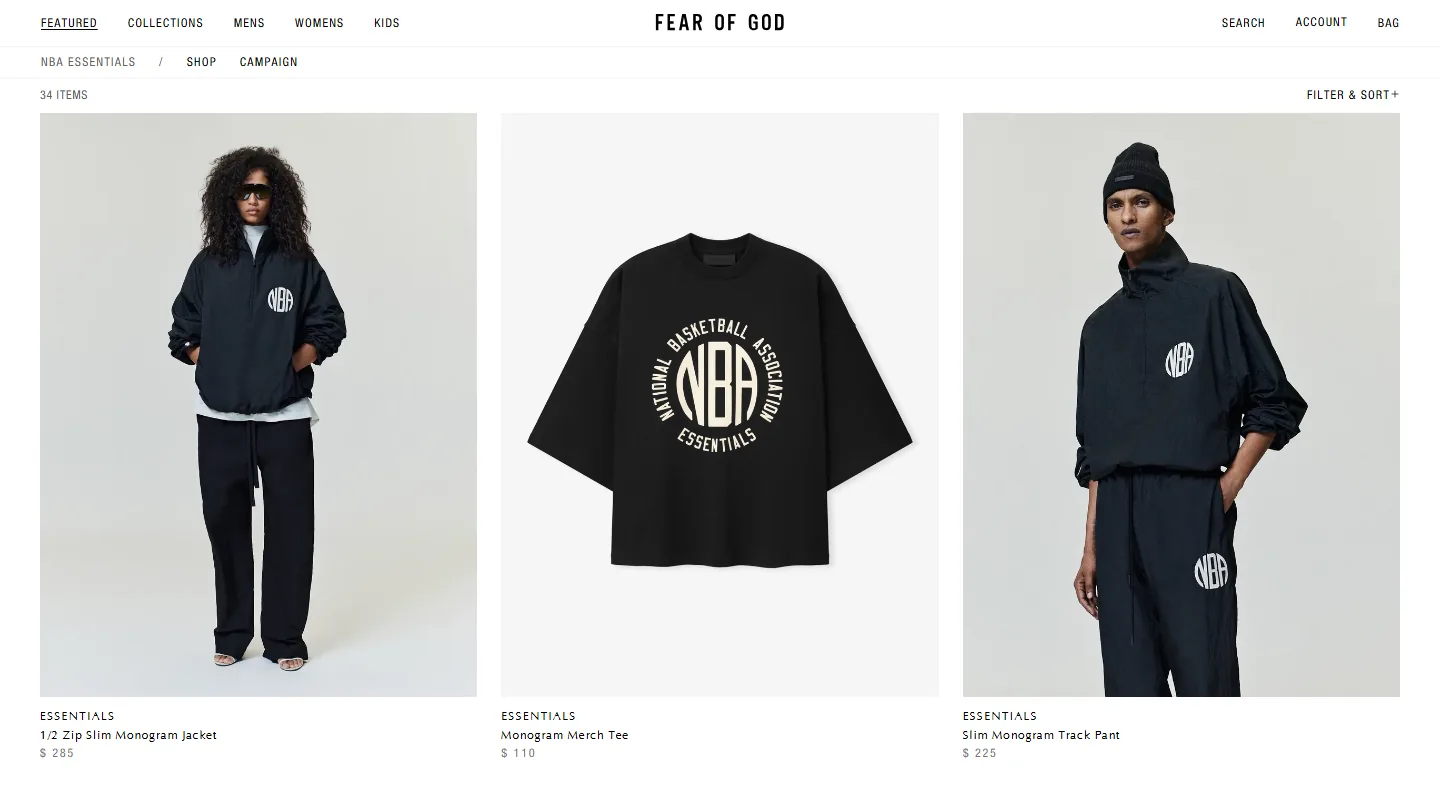
Fear of God gives each collection a bar with two links, Shop and Campaign. The label sells luxury clothing for adults and kids, including team lines such as NBA Essentials. Its whole store runs on Shopify, with 2025 online sales of about $90 million by ECDB’s estimate.
Fear of God’s shop opens on the product grid, and Campaign opens an editorial page with its own Shop button. Both the buyer who wants the styling and the one who already knows the product stay inside the same collection.
What you can learn: If you produce lookbooks or campaign shoots, link them from the collection page and end each one with a way back to the products.
FIGS: core colors for repeat uniform orders
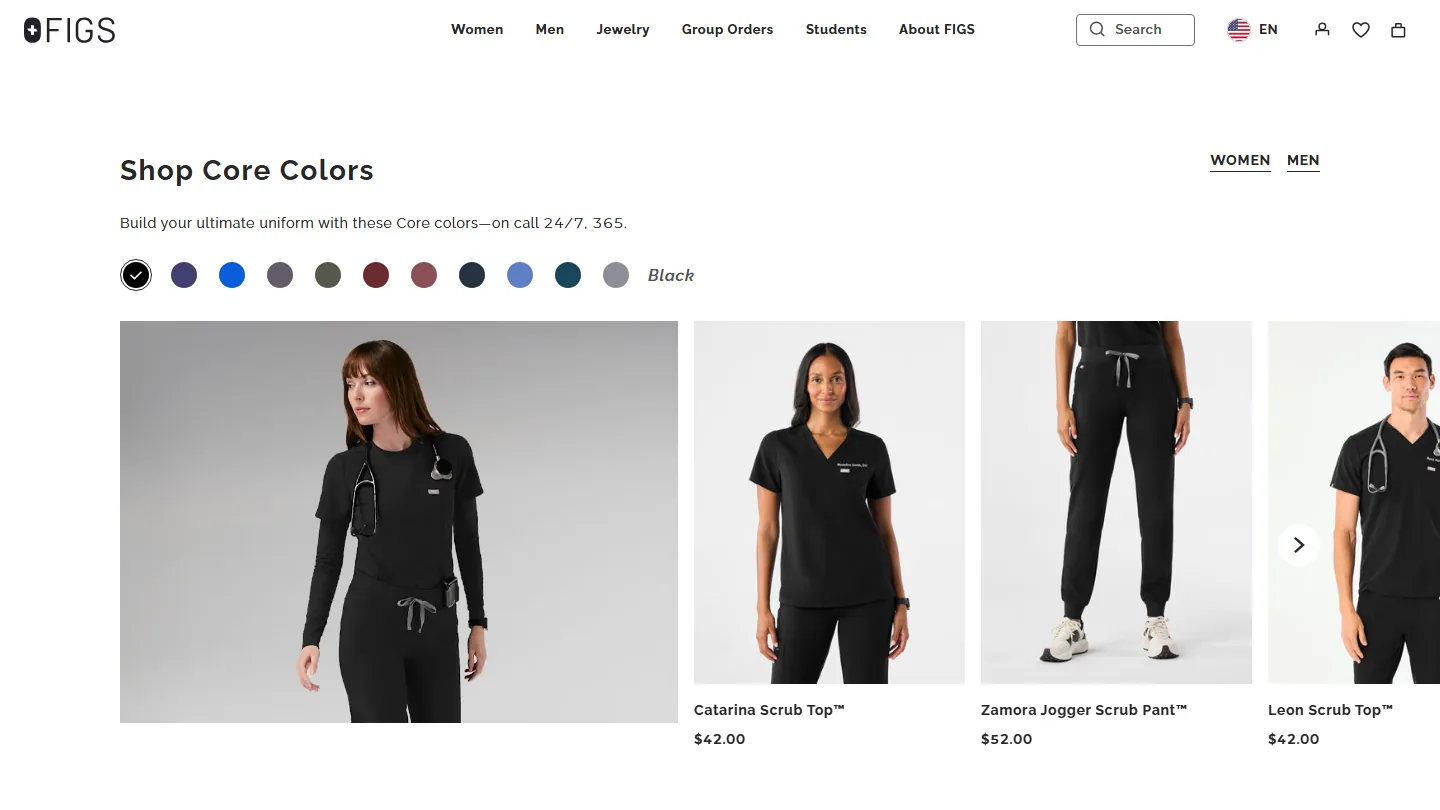
FIGS keeps a set of 11 core colors on its homepage, so a uniform can be reordered in the same shade. The company sells medical scrubs and other apparel to healthcare professionals. Its site is a headless front end on a Shopify backend, and FIGS reported 2025 net revenue of $631.1 million across all channels.
Healthcare workers often have to match a hospital’s color code, so a discontinued shade is a problem for them. FIGS describes its core colors as on call 24/7, 365, and it adds new seasonal shades on top for regulars who want a change.
What you can learn: For products people rebuy, name the versions you will always carry and show them as their own section.
Frank And Oak: fit guidance beside the size picker
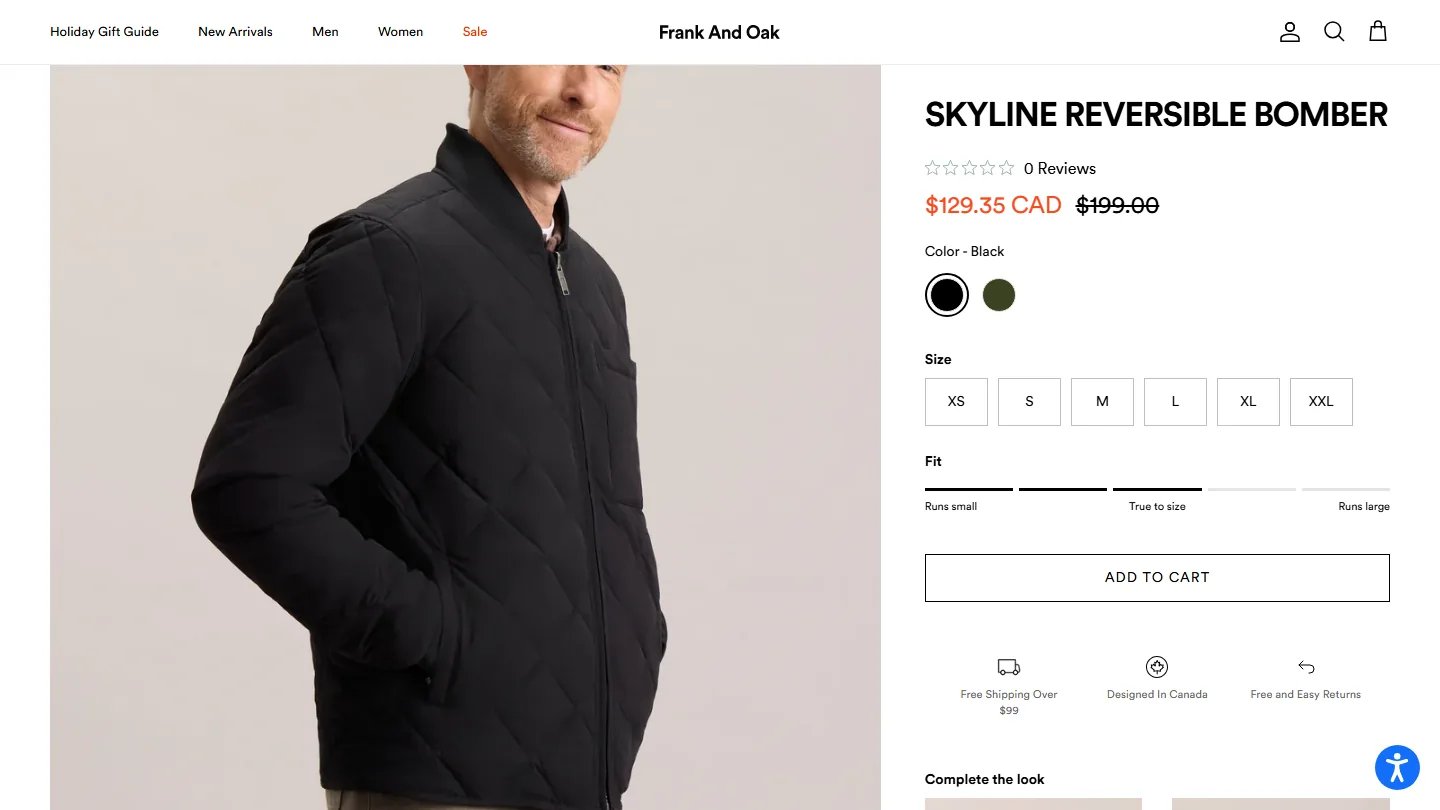
Frank And Oak shows a fit scale directly under the size buttons on its product pages. Founded in Montreal in 2012, the brand sells clothing essentials for men and women from a store that runs entirely on Shopify. It came back in 2026 after a pause, and the range is still small.
The scale goes from runs small to runs large, with a marker showing where the item sits. Icons for free shipping and free returns sit below the add-to-cart button, so a wrong guess on size is easy to send back.
What you can learn: Add the same scale to a new product before it has a single review.
Gymshark: a creator partner’s range with its own collection page
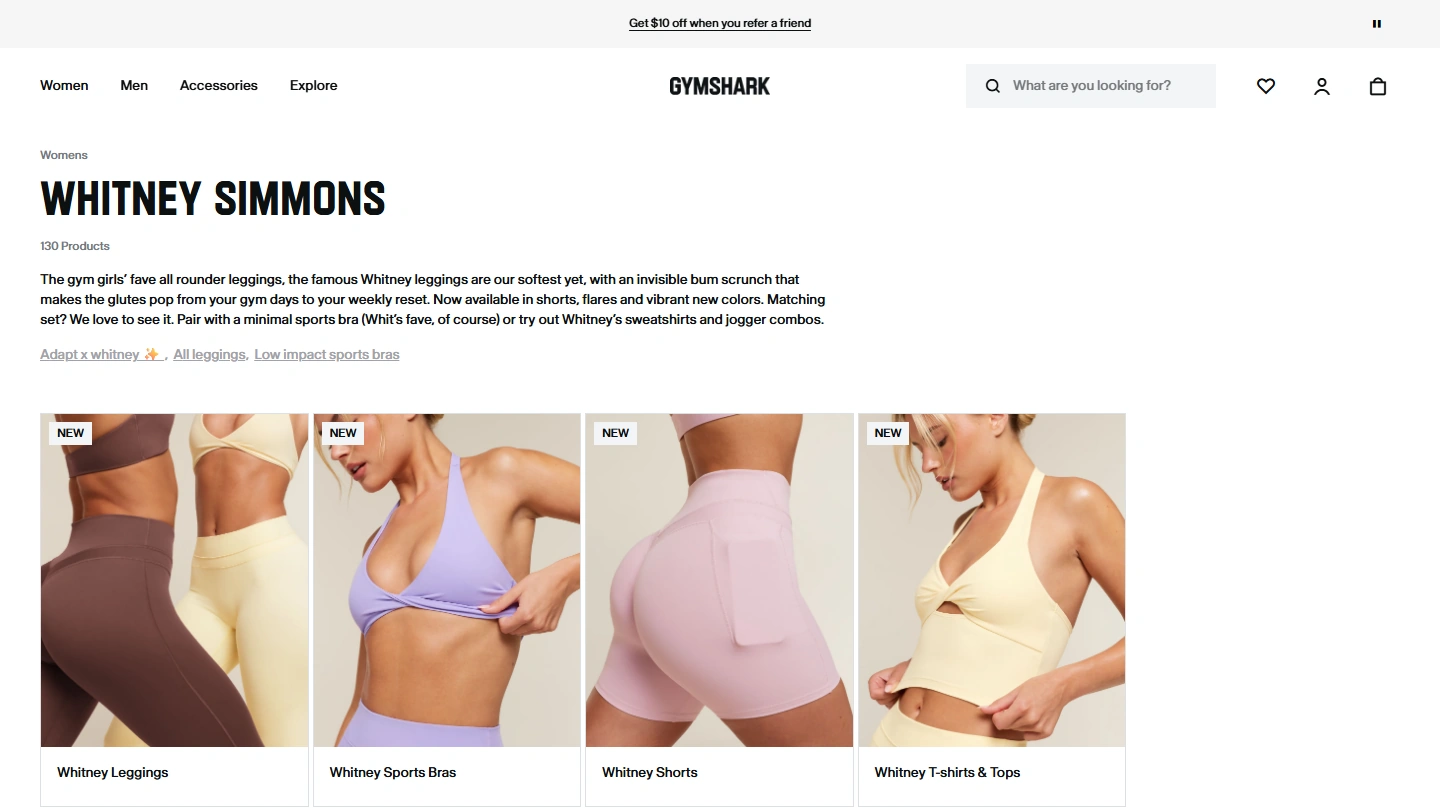
Gymshark builds its community on athlete and creator partnerships, and a partner like Whitney Simmons gets a collection page of her own. Ben Francis founded the brand in 2012, and it now sells gym clothing and accessories through 14 online stores.
Its storefront is a headless build on Shopify, and ECDB puts 2025 online sales at about $548 million.
That page lists leggings, sports bras, shorts, and tops named after Simmons, a fitness creator who has designed for Gymshark’s Adapt line. Loyalty members earn experience points (XP) for every dollar spent and for signing up for emails or coming to free LIFT events. Tiers convert the XP into rewards, which gives people who train with the brand a reason to buy direct.
What you can learn: If your customers follow a creator, give them a named collection page so fans can shop the range in one place.
Kith: limited drops with cinematic campaigns
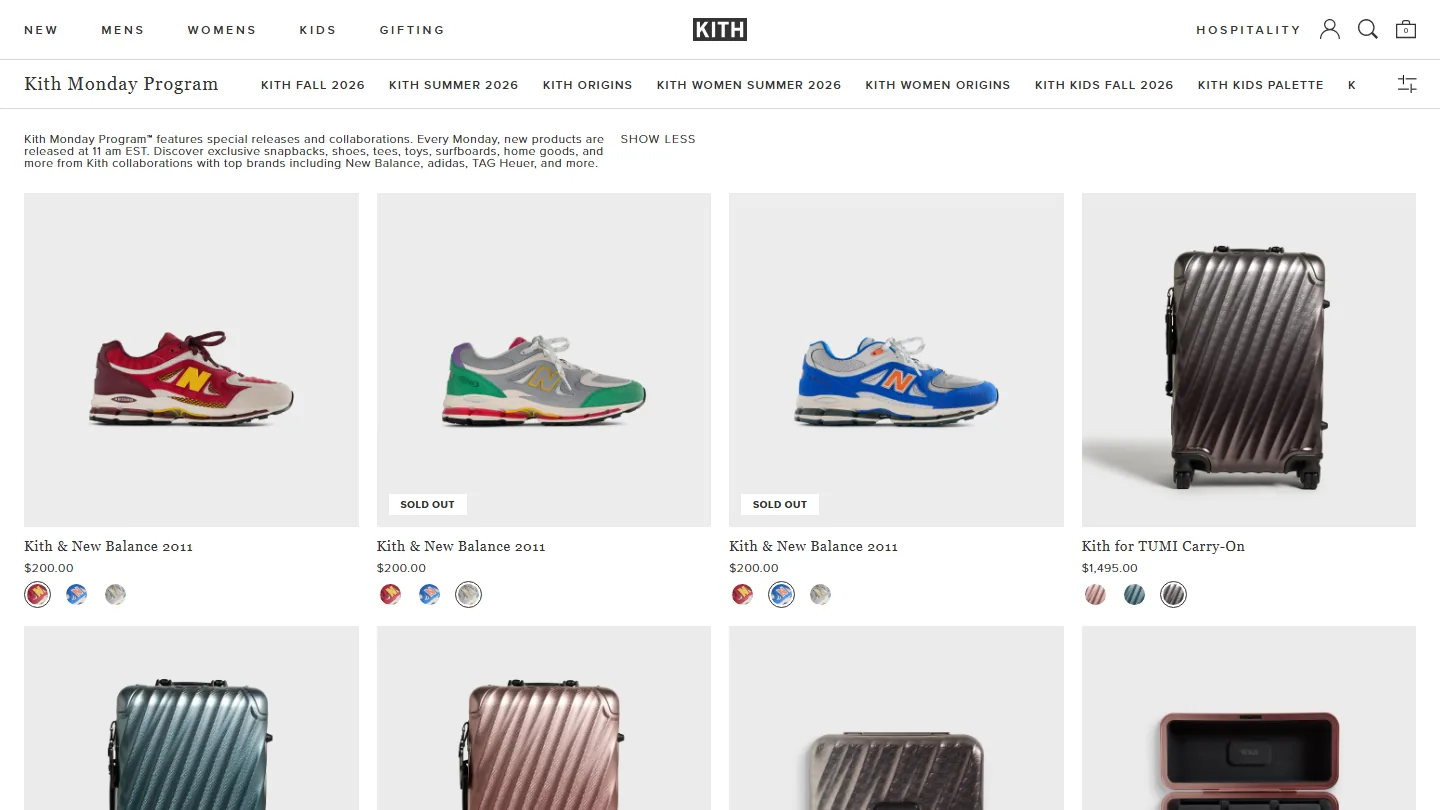
Kith releases special products every Monday at 11 am EST and backs its collections with lookbooks and runway films. Established in New York City in 2011, it sells in-house apparel and footwear alongside collaborations. The whole online store runs on Shopify, and ECDB estimates its 2025 online sales at $129 million.
Sold-out badges on products in the Kith Monday Program grid show a visitor that the items won’t last. On the homepage, collections are paired with A Closer Look stories or a Watch Now runway video, which gives each release its own campaign.
What you can learn: Pick one day and hour for new releases and keep to it, so customers learn when to return.
Lounge: a matching-piece prompt under the bag button
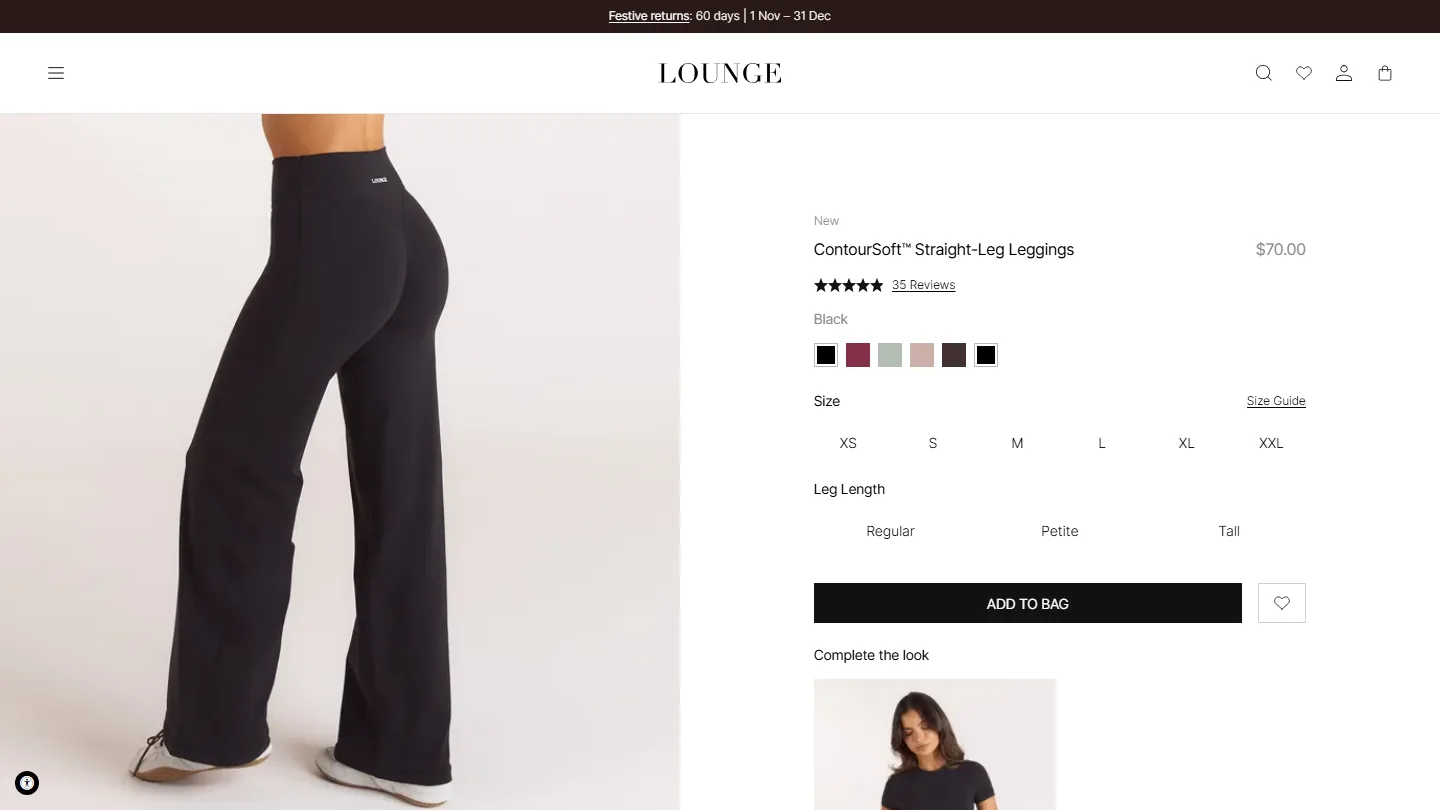
Lounge places a Complete the look prompt under the add-to-bag button on its product pages, and on bra pages it reads Complete the set. Founded in 2016, the British brand started with underwear and now also sells lingerie and clothing for women. Its business runs on Shopify with a separate store for each region.
On the leggings page, the prompt pairs the leggings with a matching top, so the second piece is one tap away. Other pages do the same sequence: the top is matched, and you can buy the other piece in a single click.
What you can learn: For products designed as pairs, put the second piece directly under the main button.
Represent: a workout app that leads to activewear
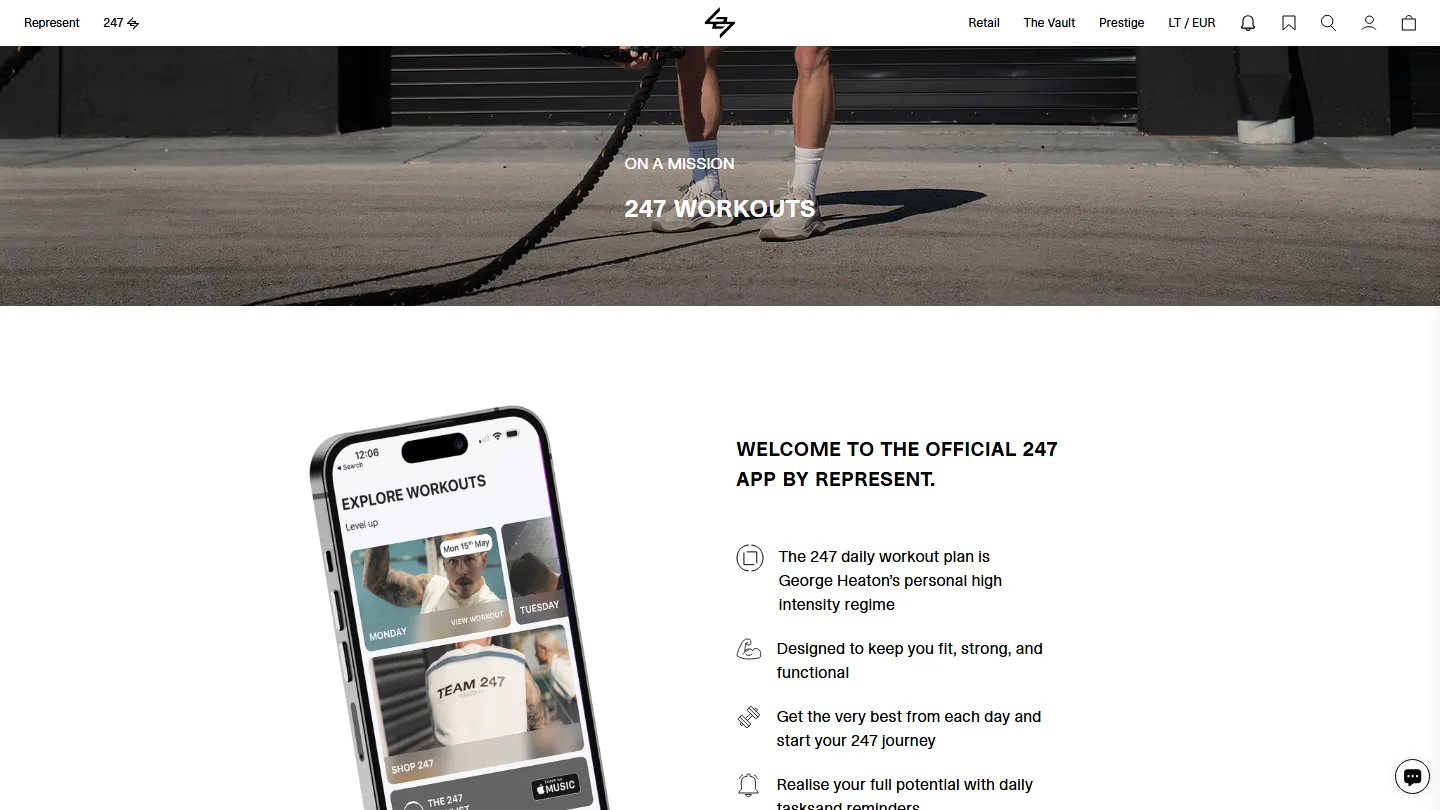
Represent promotes its 247 performance line through a workout app that links back to the store. The British luxury streetwear brand was founded in Manchester in 2011 by brothers George and Mike Heaton. It runs on Shopify with a separate store for each region.
The app carries George Heaton’s own high-intensity training plan, with daily tasks and reminders. Daily workouts give customers a reason to open it on days when they aren’t shopping, and its workout screen includes a Shop 247 tile.
What you can learn: A founder with expertise customers want can package it as daily content and link products from inside it.
SKIMS: a waitlist on sold-out limited-edition colors
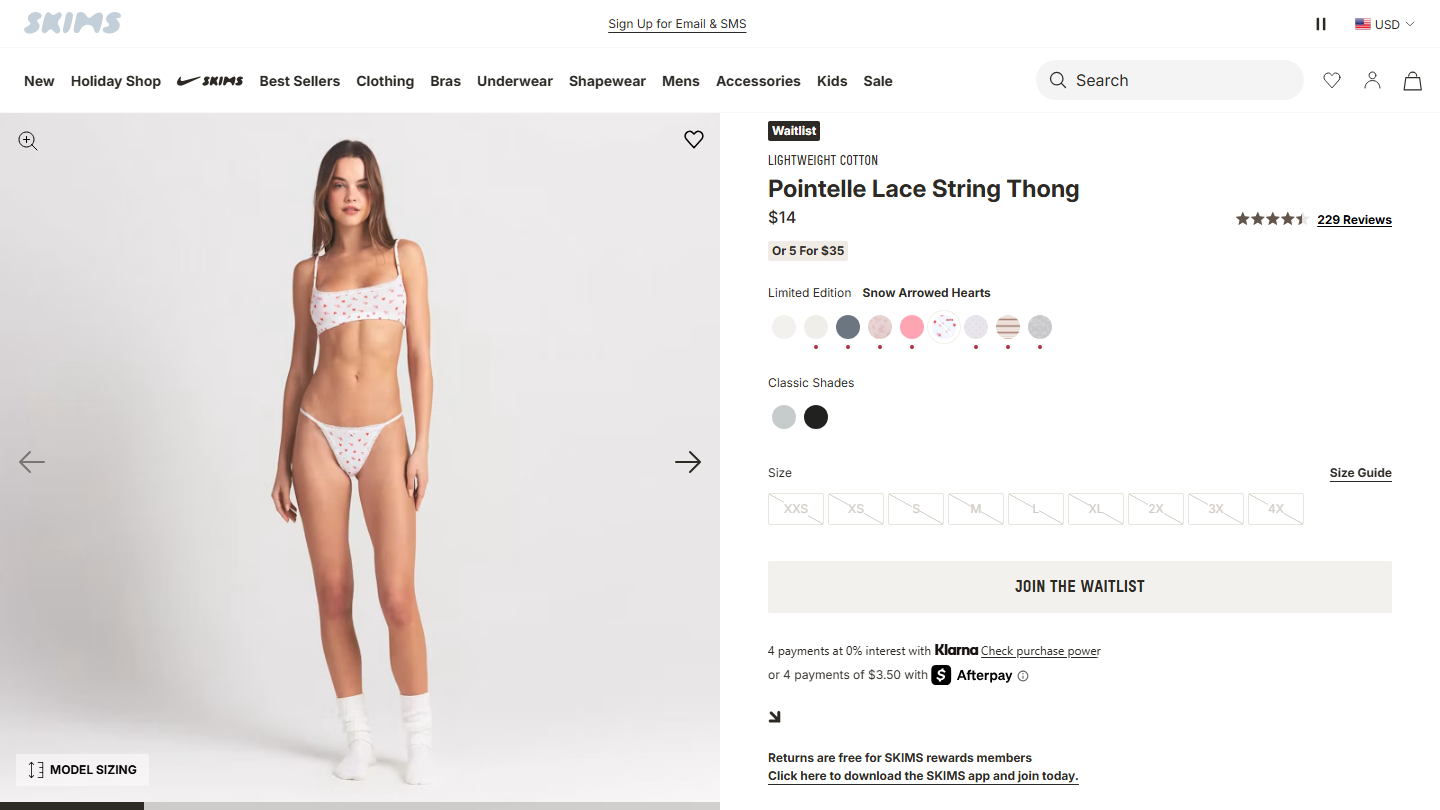
SKIMS sells limited-edition colors next to its classic shades and puts a waitlist on those that sell out. Co-founded in 2019 by Kim Kardashian and Jens Grede, the brand sells underwear, loungewear, and shapewear. The whole store is a headless build on Shopify, and ECDB estimates its 2025 online sales at about $358 million.
When checked, the Snow Arrowed Hearts print had sold out in the smaller sizes and was tagged Waitlist, while both classic shades were in stock. The tag signals demand, and SKIMS Rewards members get to the product first when it returns.
What you can learn: Add a few limited colors to your core range, and give sold-out ones a waitlist that tells loyal customers first.
Snag: a two-question size finder on the homepage
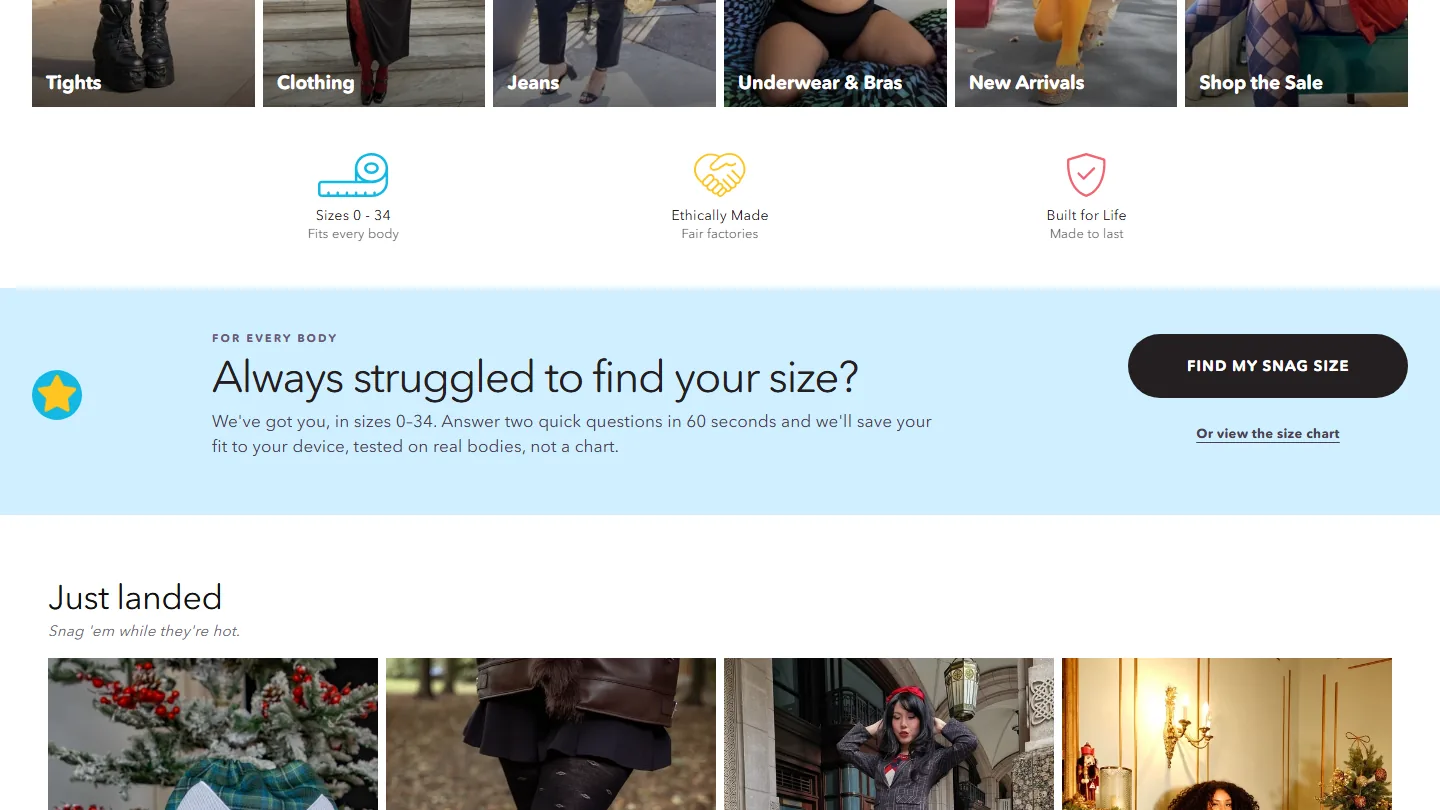
Snag puts a size finder on its homepage that asks two questions and takes 60 seconds. The UK brand sells tights and clothing, with sizes 0 to 34 on its U.S. store. Its business runs on Shopify, with separate stores for regions such as the UK and the U.S.
Fit is the main worry when buying tights online. But the finder helps get the correct size and saves the answer to the shopper’s device for later visits. A link to the regular size chart sits next to the button for anyone who prefers it.
What you can learn: Where sizing is the top reason customers hesitate, ask for the two details that decide it and remember the result.
Spanx: inseam options and a fit finder on product pages
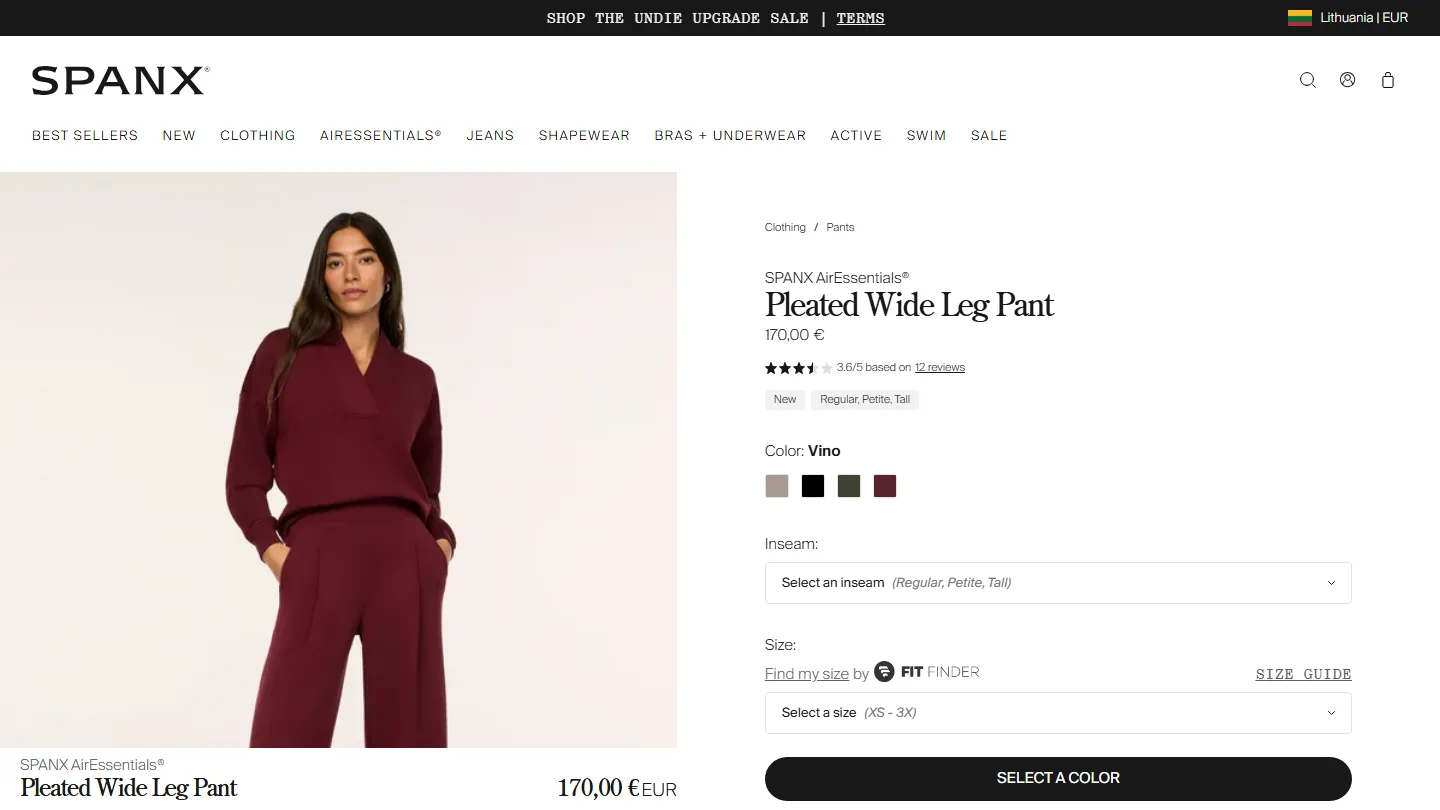
Spanx offers three inseam lengths and a Fit Finder link next to the size selector on product pages such as its AirEssentials pant. Sara Blakely created the brand, which sells shapewear and clothing for women. The store is a headless build on Shopify, and ECDB estimates it took about $97 million online in 2025.
A shopper picks an inseam from Regular, Petite, or Tall, then uses the finder or the size guide. Further down, a summary of customer reviews says if the item runs slightly large or if the length is true to size, so the shopper hears about fit from people who have worn it.
What you can learn: Add a fit summary from your reviews to the product page, since it backs up what the size chart says.
Supreme: a fixed shop update time with email alerts
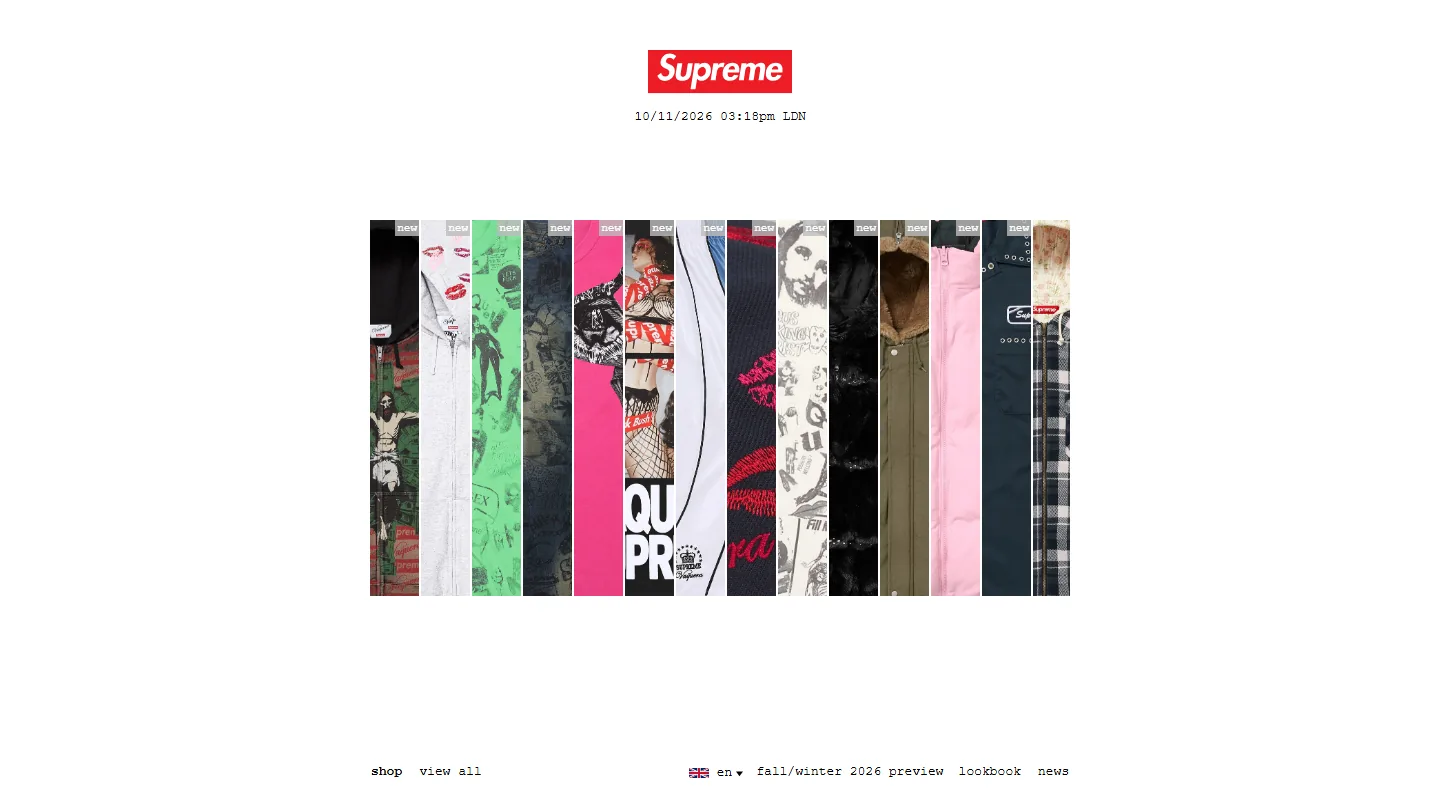
Supreme generally updates its online shop at 11 am local time and offers email alerts for each release. The skate and streetwear brand opened in Manhattan in 1994. Only its online shop runs on Shopify (the brand site with news and lookbooks is separate), and ECDB estimates 2025 online sales of $109 million.
Since most items come without a set release date, fans sign up for the newsletter and get alerts for new products. Because the update time is known, they come back at that hour, and the newest items are tagged as New on the shop page.
What you can learn: Publish an update hour for your drops and offer an alert for every release.
Tentree: impact tracking on every order
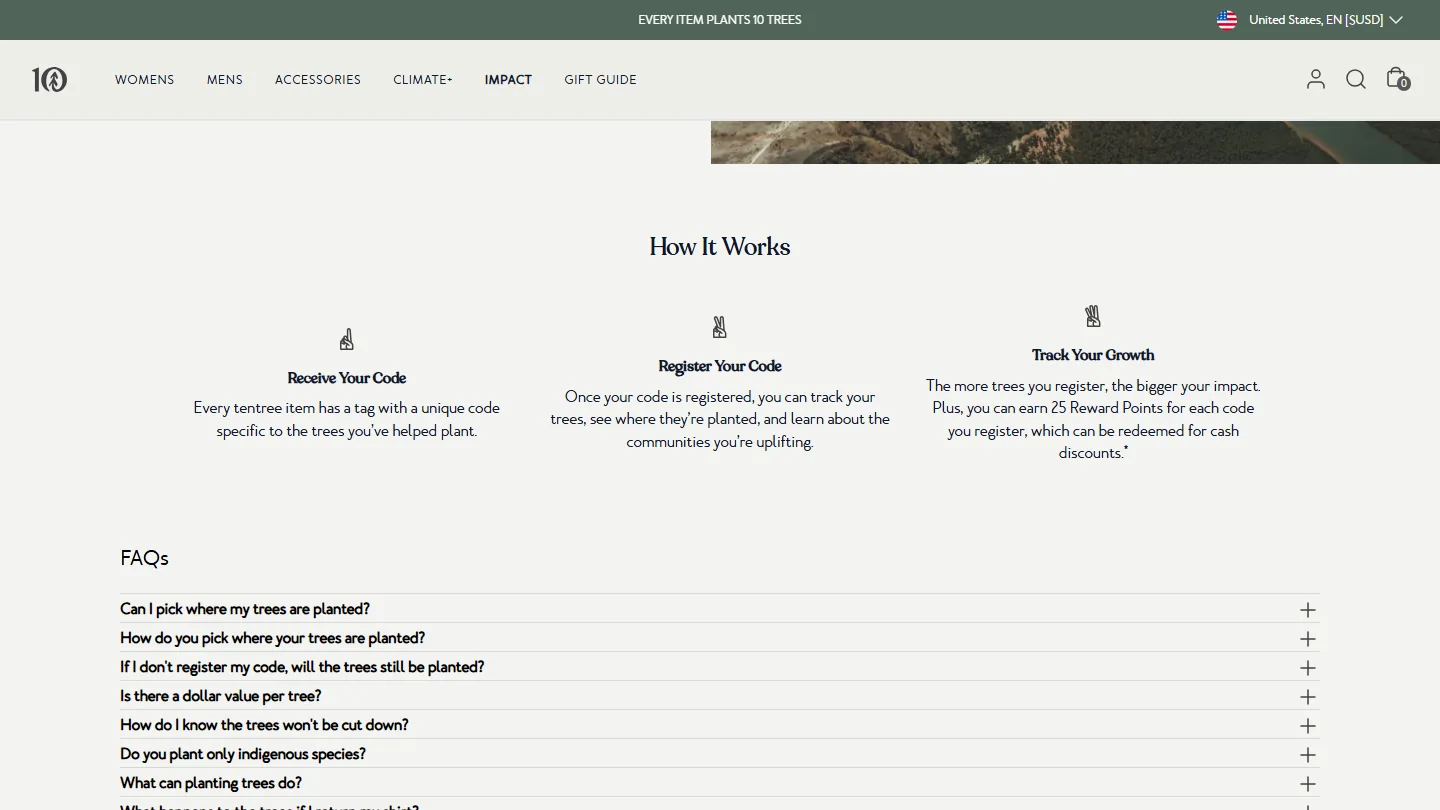
Tentree puts a unique code on the tag of every item, which customers register to track the trees their order planted. The store sells sustainable clothing and accessories for women and men, and every item plants 10 trees. Its whole store runs on Shopify, with 2025 online sales of roughly $10 million, per ECDB’s estimate.
Registering a code shows where the trees are being planted and earns 25 reward points toward discounts. The purchase gets a visible, personal result, and the points bring the customer back to the site after delivery.
What you can learn: Give each customer a way to see their own share of any promise you make per order.
For more examples from this category, see our lists of Shopify clothing stores and the best Shopify themes for clothing stores.
Accessories and jewelry
Accessory and jewelry stores on Shopify do well at helping shoppers choose between products that look alike. Away compares its carry-ons by trip length, Loop Earplugs sorts its range with a one-minute quiz, and Ridge prints review counts on its product cards.
Ana Luisa: recycled content stated for most materials
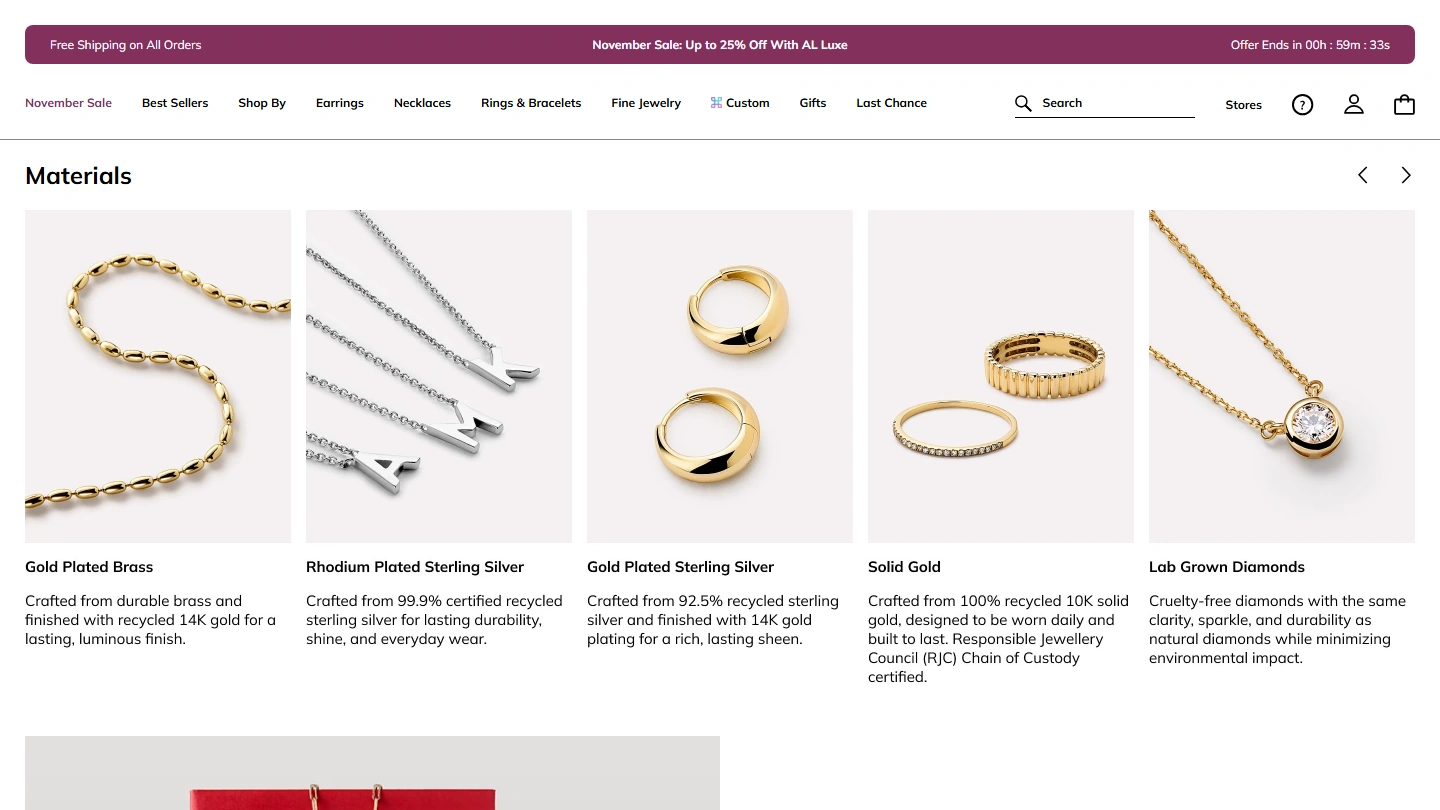
Ana Luisa lists what its jewelry is made of, material by material, on a page of its own. The brand launched in 2018 and sells everyday gold and silver jewelry, along with solid gold and custom pieces. Its whole online store is a headless build on Shopify, with a Gatsby front end.
The Materials section pairs a photo of each material with one line on what it’s made of. For example, solid gold is said to be 100% recycled 10K gold with a Responsible Jewellery Council Chain of Custody certification, and the rhodium-plated silver is 99.9% certified recycled.
What you can learn: Back a sustainability claim with specifics for each material you can document, such as the recycled share and any certification.
Away: a comparison page for carry-on sizes
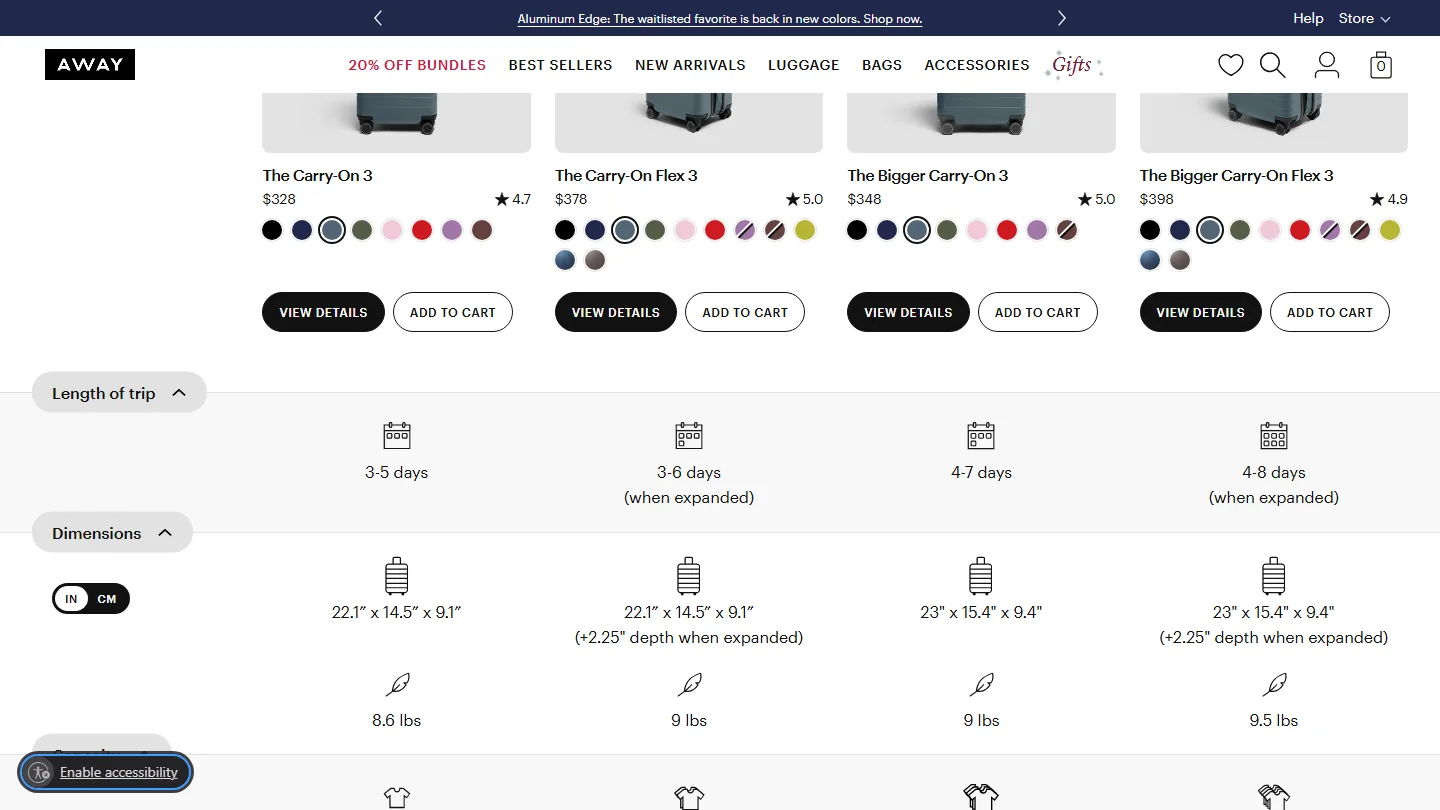
Away puts its four carry-on suitcases side by side on one comparison page. The store sells luggage, bags, and travel accessories, and all of it runs on Shopify. ECDB estimates that its online sales reached about $107 million in 2025.
Next to the usual dimensions and weight, each column lists the length of trip the suitcase suits and how many outfits it holds. A shopper with no feel for volume and liters still knows how long the trip is, and each column has its own add-to-cart button.
What you can learn: When your products differ mostly by size, describe each size by the situation it fits.
Ekster: a one-minute quiz that picks a wallet
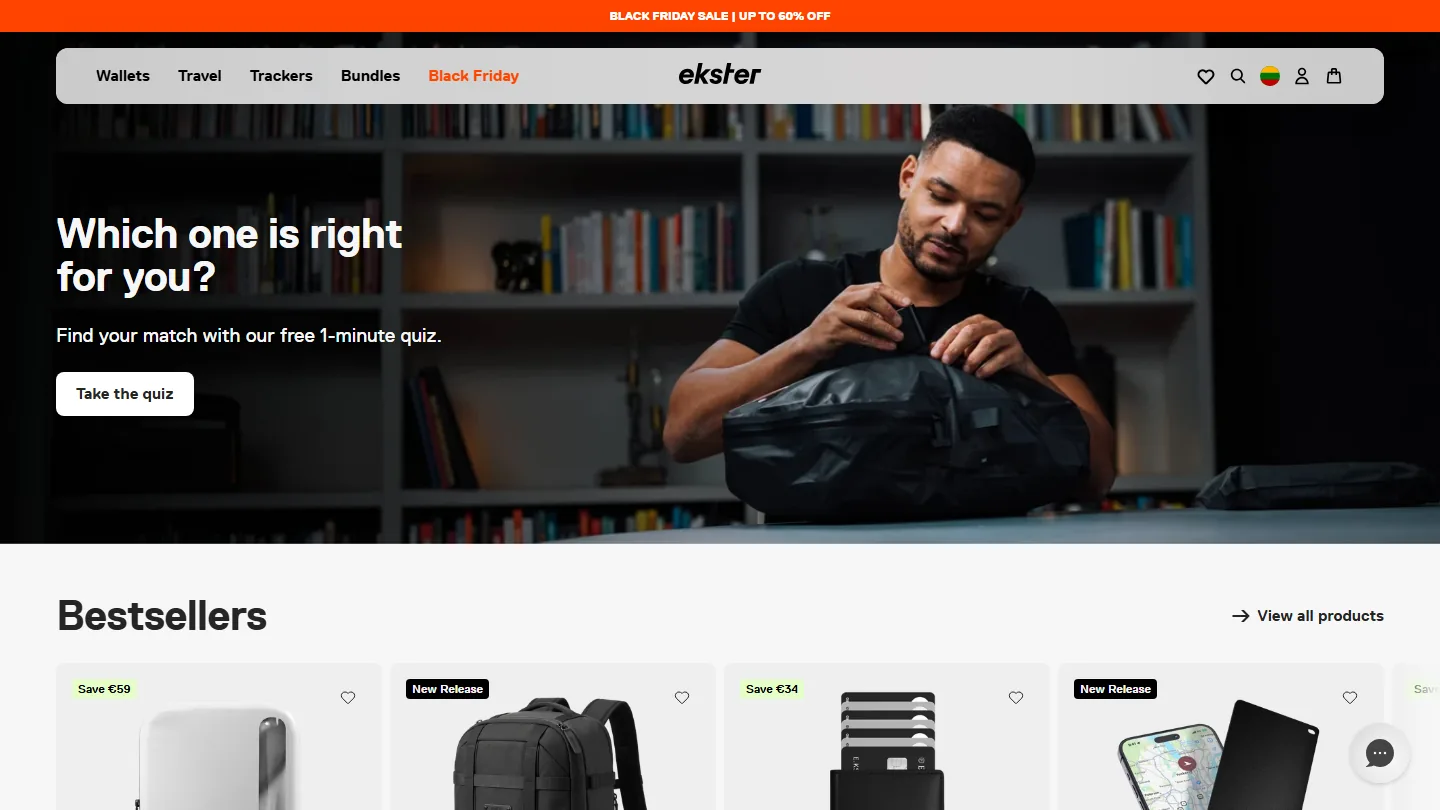
Ekster offers a free one-minute quiz that matches each shopper with one of its products. The Dutch brand sells trackable wallets, cardholders, and travel gear. Two students started it with a Kickstarter campaign, and its whole store now runs on Shopify.
Many of the wallets and cardholders in the range are similar, so comparing their specs takes time. A quiz narrows the choice to a single pick, and the one-minute promise tells shoppers it won’t be a chore.
What you can learn: Ekster links the quiz from its menu as well, so place yours where undecided shoppers already look.
Herschel Supply: size comparisons inside the product page
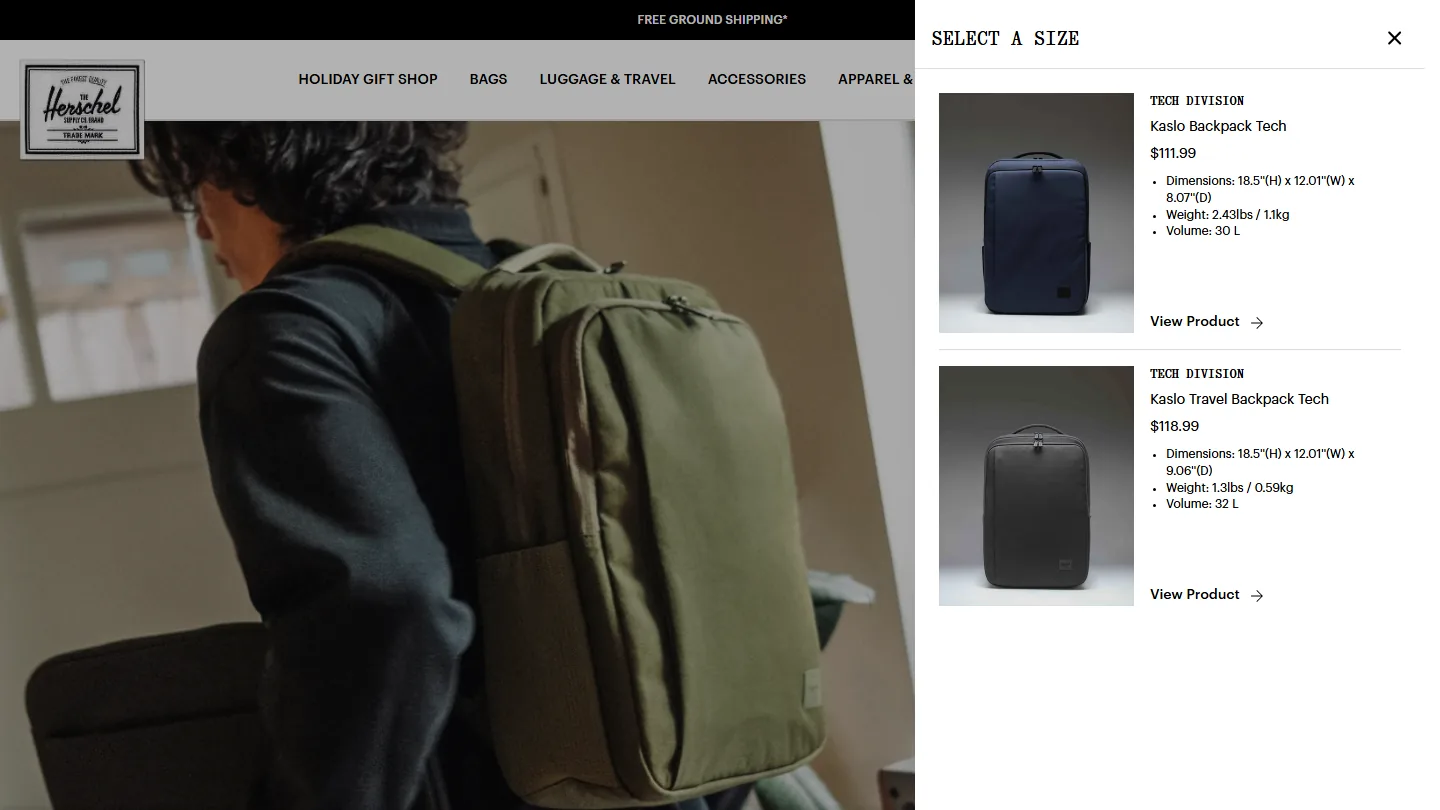
Herschel Supply lets shoppers compare a bag’s other sizes in a drawer on the product page. The Vancouver-based brand sells backpacks, luggage, and apparel, and its U.S. store runs on Shopify. Online sales came to roughly $44 million in 2025, according to an ECDB estimate.
A link called See Other Size Options opens the drawer, which lists each sibling bag with its measurements and its volume in liters. Someone who doubts that 30 liters is enough gets the answer without opening a second tab.
What you can learn: Link the sizes to each other on every product page for any design you sell in several sizes.
Loop Earplugs: a functional product sold as lifestyle
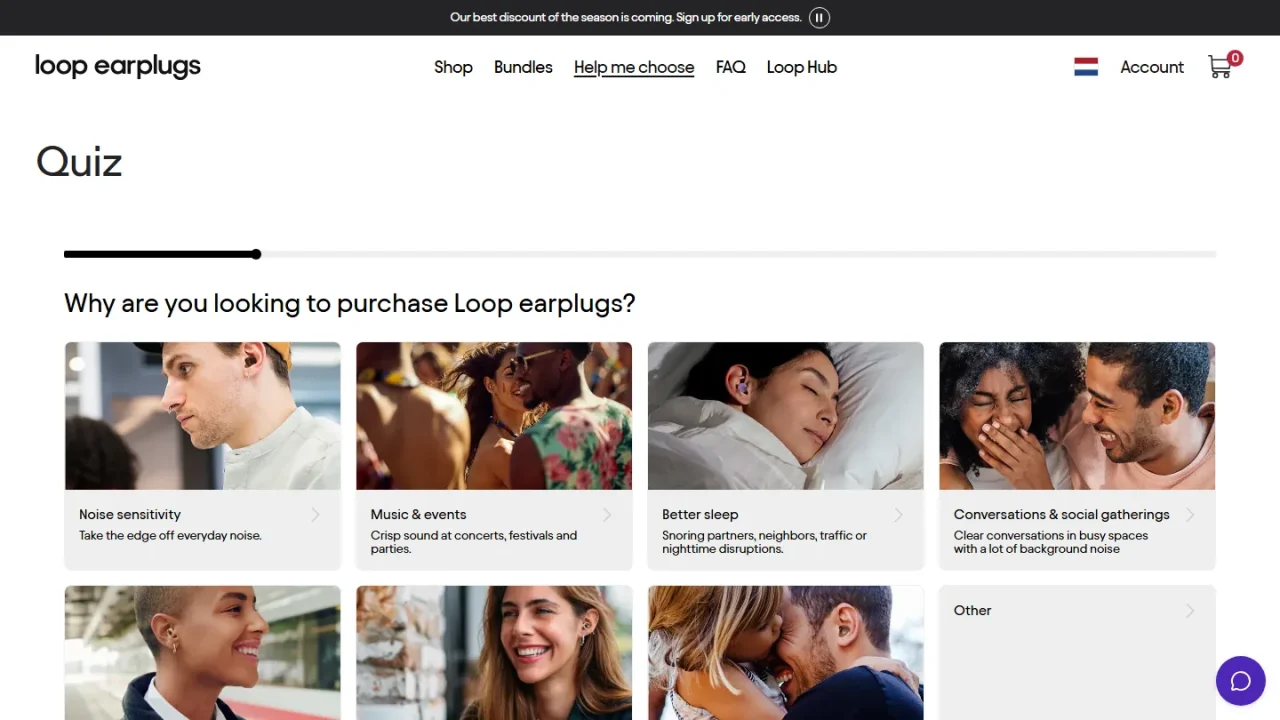
Asking about the occasion first lets a shopper choose earplugs without reading a single technical rating. Image via Loop Earplugs.
Loop Earplugs sells hearing protection by the moment it’s for, such as a concert or a night next to a snoring partner. Two childhood friends started the Belgian brand in 2016, and its homepage now counts 14 million customers. The whole store runs on Shopify.
Its one-minute quiz opens by asking why you want earplugs, with answers that range from noise sensitivity to better sleep. Starting from the shopper’s situation makes a technical product feel personal and narrows a large range to one pair.
What you can learn: If you sell on specs, build your quiz around occasions and keep the numbers for the product page.
MVMT: brand proof beside a sticky add-to-cart bar
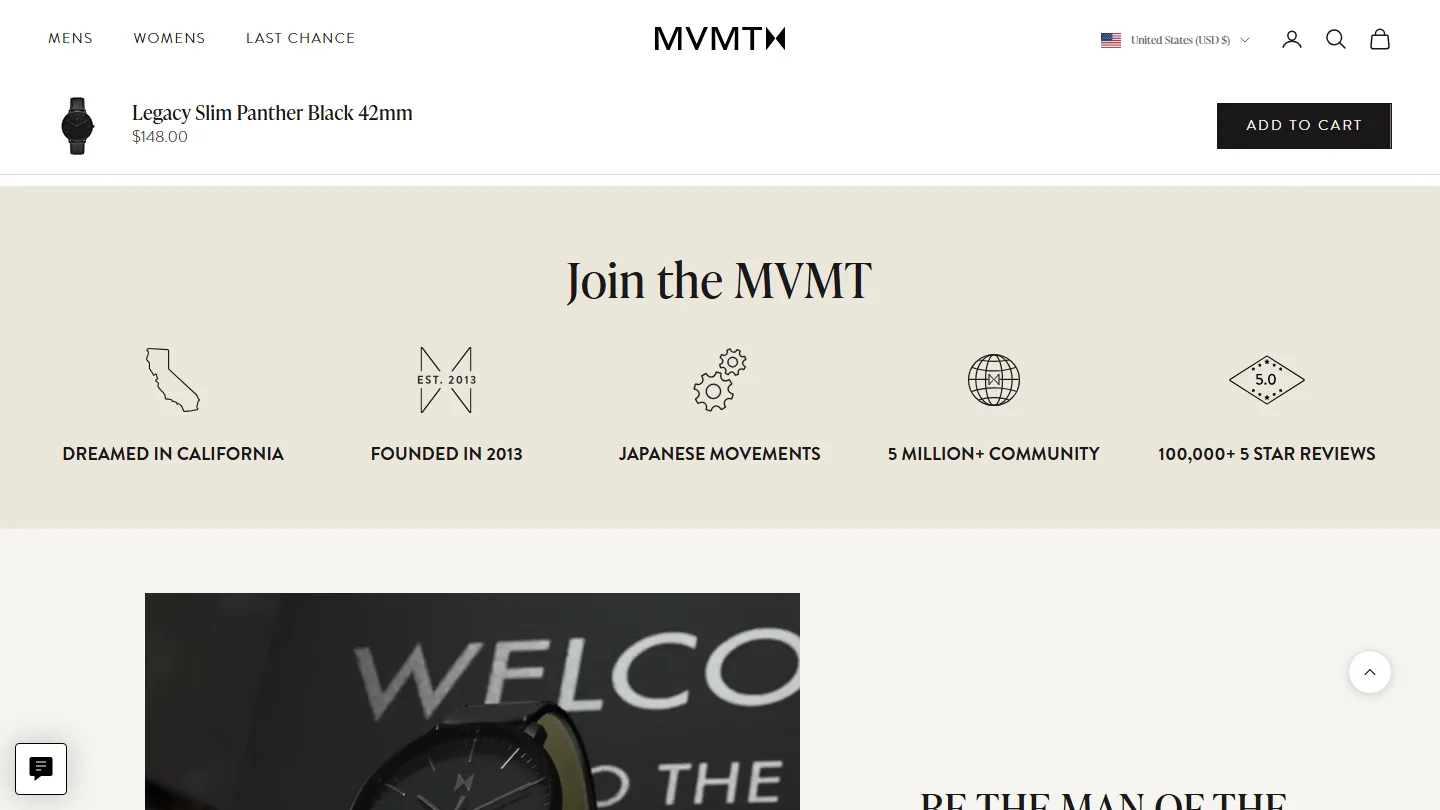
MVMT places a strip of brand proof on its product pages and keeps an add-to-cart bar in view while the shopper scrolls. Established in Venice Beach, California, in 2013, the brand sells watches and eyewear. ECDB puts its 2025 online sales at an estimated $13 million, and its whole store runs on Shopify.
Among the five badges in the strip are a community of more than five million and over 100,000 five-star reviews. A first-time visitor sees social proof right away, with checkout one click away.
What you can learn: Try the same pairing on your own product pages, with your strongest numbers near the buy button.
Pela: a take-back program for old cases
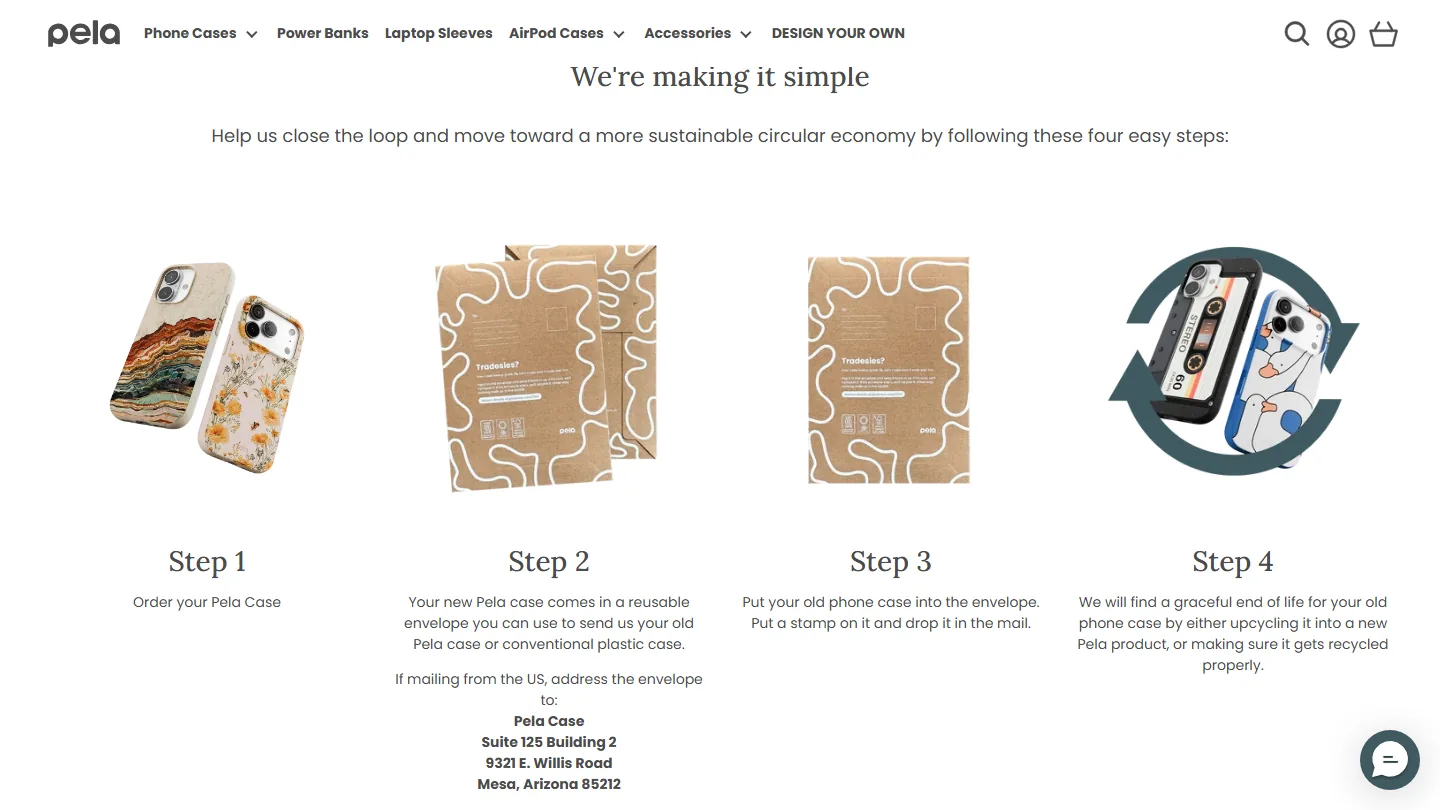
Pela takes back old phone cases through Pela 360, a program that ships every new case in a reusable return envelope. The brand sells compostable phone cases, plus accessories such as grips and AirPods cases. Everything it sells online goes through Shopify.
The customer has to mail the old case back in Pela’s envelope, and the company accepts conventional plastic cases as well as its own. It then upcycles the case into a new product or has it recycled, so the eco promise is something the buyer acts on.
What you can learn: If sustainability is part of your pitch, build one concrete action into the packaging.
Pura Vida: bundle pricing at one fixed price
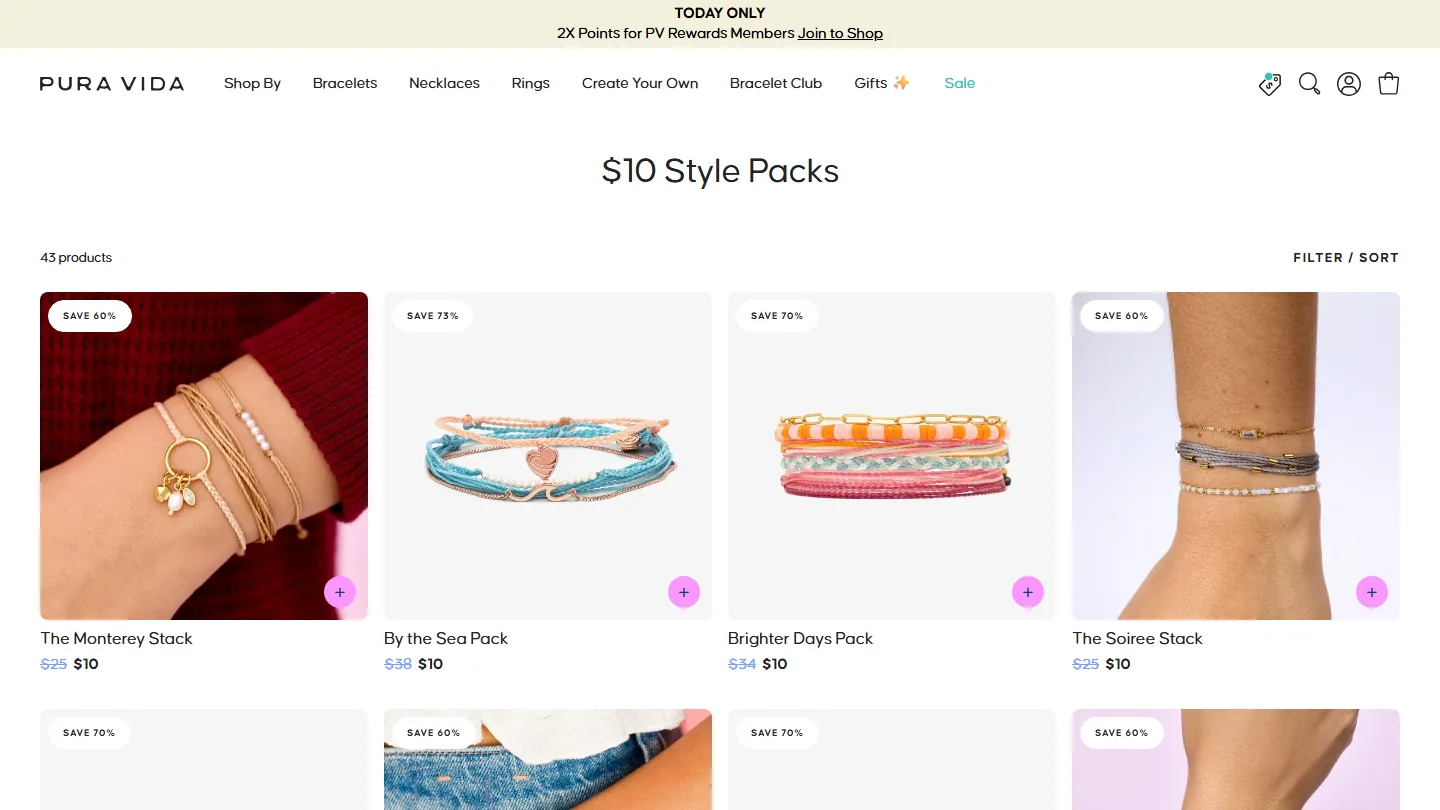
Pura Vida sells bracelet bundles at one fixed price in a collection called $10 Style Packs. The brand’s story began in 2010 on a surf trip to Costa Rica, and it still works with the artisans it met there. Shopify powers the entire store.
The collection holds dozens of packs, each a styled stack at $10, with the saving marked on its card. With the price settled, the only decision left is which stack to take, and the order comes out larger than a single bracelet.
What you can learn: A fixed-price bundle collection is worth testing if your products are small and often bought in sets.
Ridge: reviews and limited drops that speed up decisions
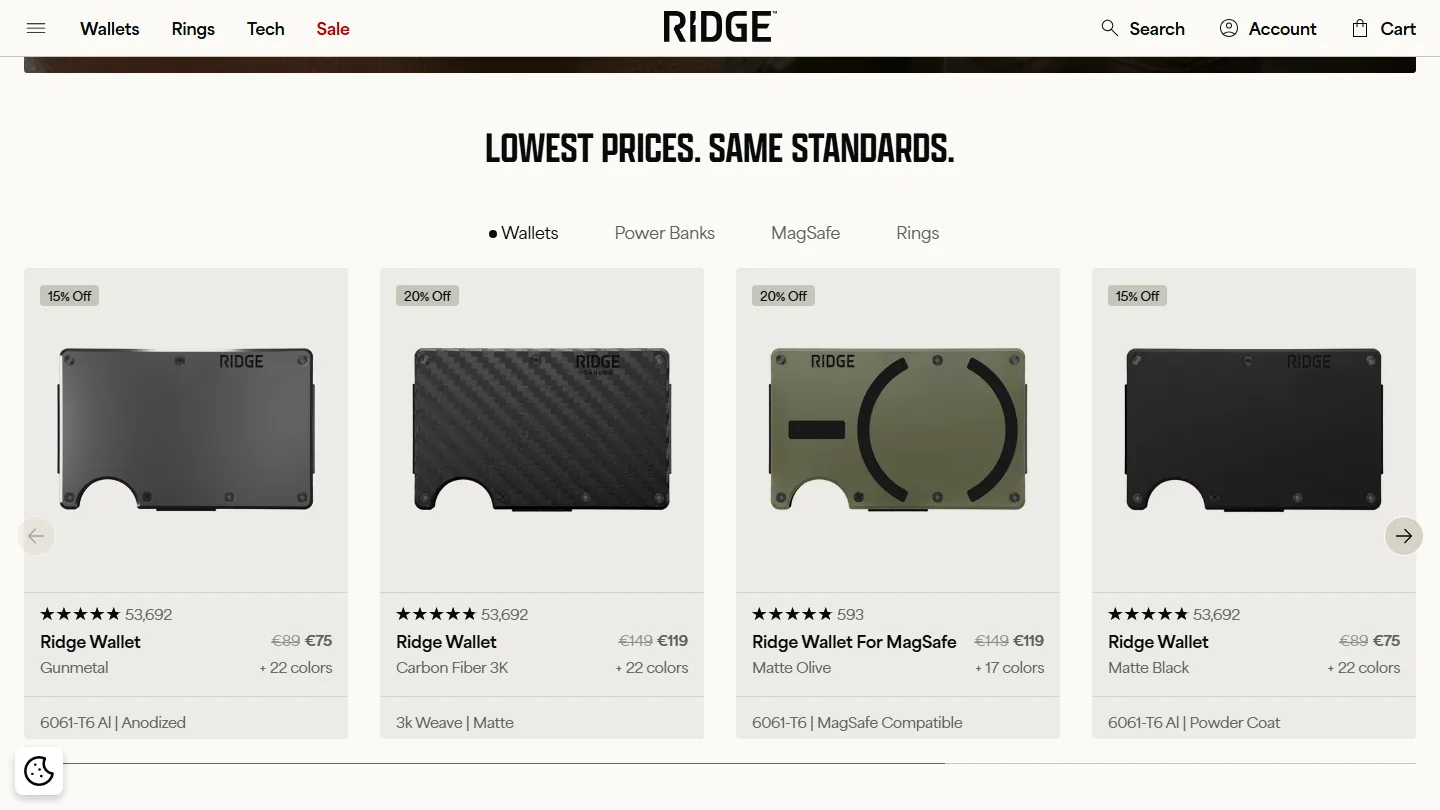
Ridge shows a star rating and a review count on its product cards and keeps a collection of new and limited editions. The brand sells metal wallets, rings, and tech accessories such as power banks. It launched through two Kickstarter campaigns and has sold over five million wallets since, and its online stores run on Shopify.
A large review count does its work on the collection page, where shoppers are still choosing between models. Limited editions then add another reason to buy.
What you can learn: Show your ratings one level earlier than the product page, on the cards themselves, and give returning customers something new to look at.
WP Standard: premium leather with minimal navigation
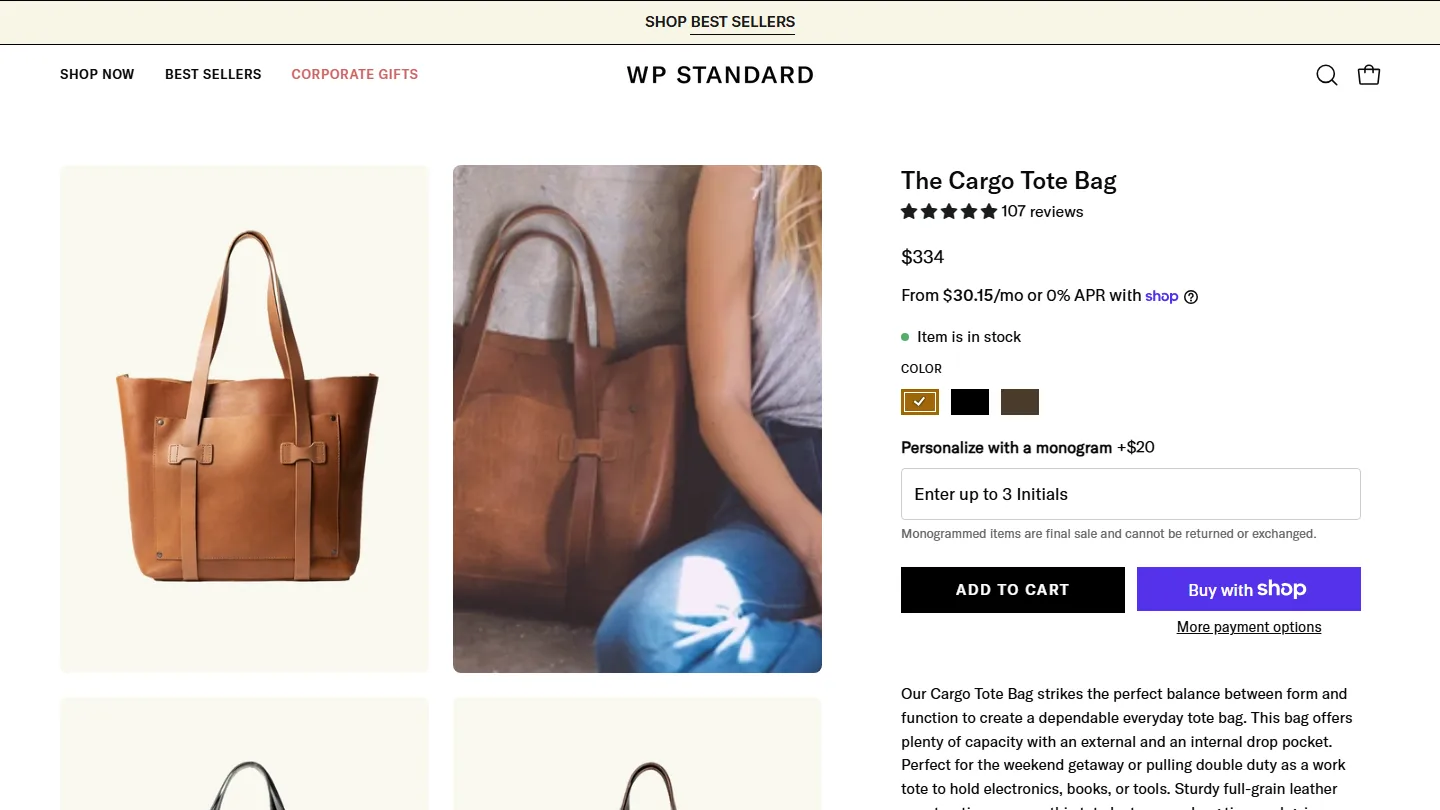
WP Standard sells premium leather goods through a header with only three links, which are Shop Now, Best Sellers, and Corporate Gifts. The small-batch maker produces totes, duffle bags, and wallets in its workshop in Leon, Mexico, and sells them through a store built entirely on Shopify.
With so little navigation, the product page does the selling, and that’s where the store offers a +$20 monogram under the color swatches. A note next to the initials field says monogrammed items are final sale, which minimizes return disputes.
What you can learn: Cut the menu to the links shoppers use and offer the paid extra on the product page.
Food and beverage
Food and beverage stores on Shopify do well at earning the second order, mostly through subscriptions and bundles. Huel preselects the subscription on its product pages, Magic Spoon lets shoppers build a bundle with savings tiers, and Heatonist gives fans a new pack with every season of Hot Ones.
BLK & Bold: an impact report promoted on the homepage
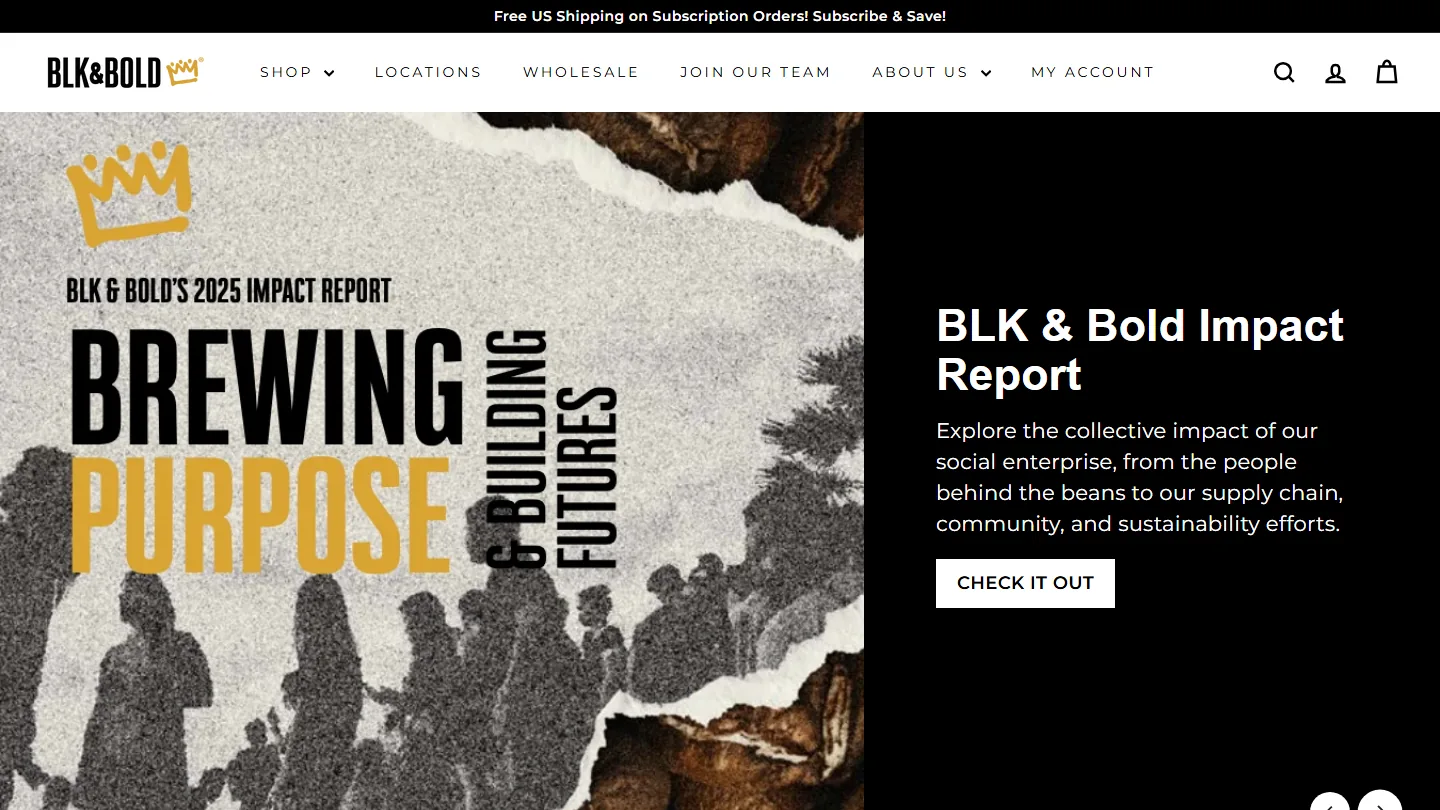
BLK & Bold promotes its impact report in its homepage slideshow. Pernell Cezar and Rod Johnson founded the coffee and tea brand in 2018, and it pledges 5% of its gross profits to youth nonprofits. The whole store runs on Shopify, while the report sits on a separate site.
As long as the pledge is believable, a cause is a reason to pick this coffee over a lower-priced bag. The report says the brand has contributed more than $675,000 so far, which gives the 5% claim a figure anyone can check.
What you can learn: Publish the running donation total and link it from the homepage if your brand gives away a share of its profits.
Death Wish Coffee: urgency plus subscriptions
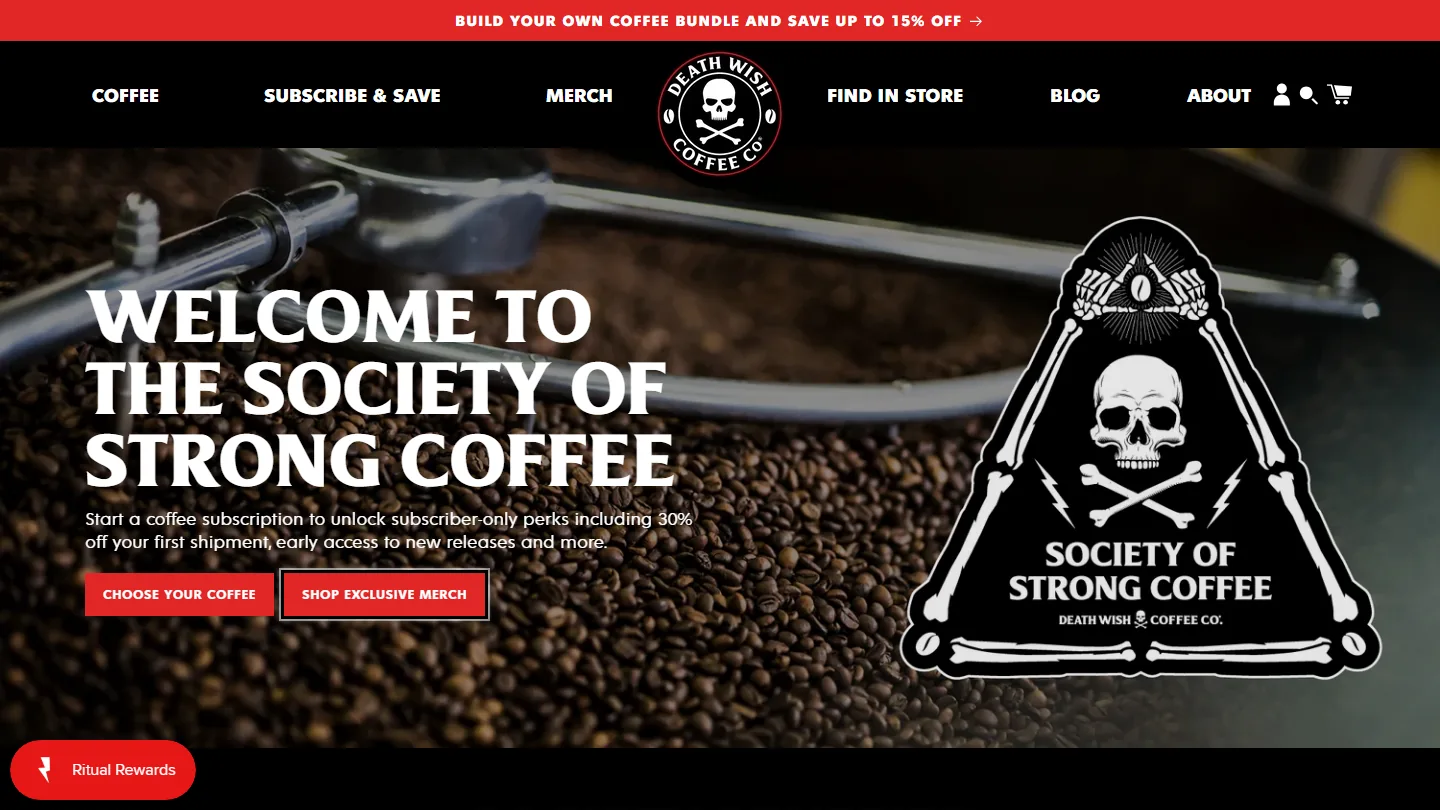
Death Wish Coffee pairs limited-time flavors with a subscription club that gets early access to new releases. Mike Brown founded the brand in 2012 in Saratoga Springs, New York, and it sells strong coffee in forms from whole beans to canned lattes. Shopify runs the entire store.
Called the Society of Strong Coffee, the club gives members free shipping along with merch that only subscribers can buy. A seasonal flavor nudges a shopper to buy now, and the perks point that urgency toward a subscription.
What you can learn: For limited releases of your own, let subscribers buy them first.
Fly By Jing: heritage-led storytelling
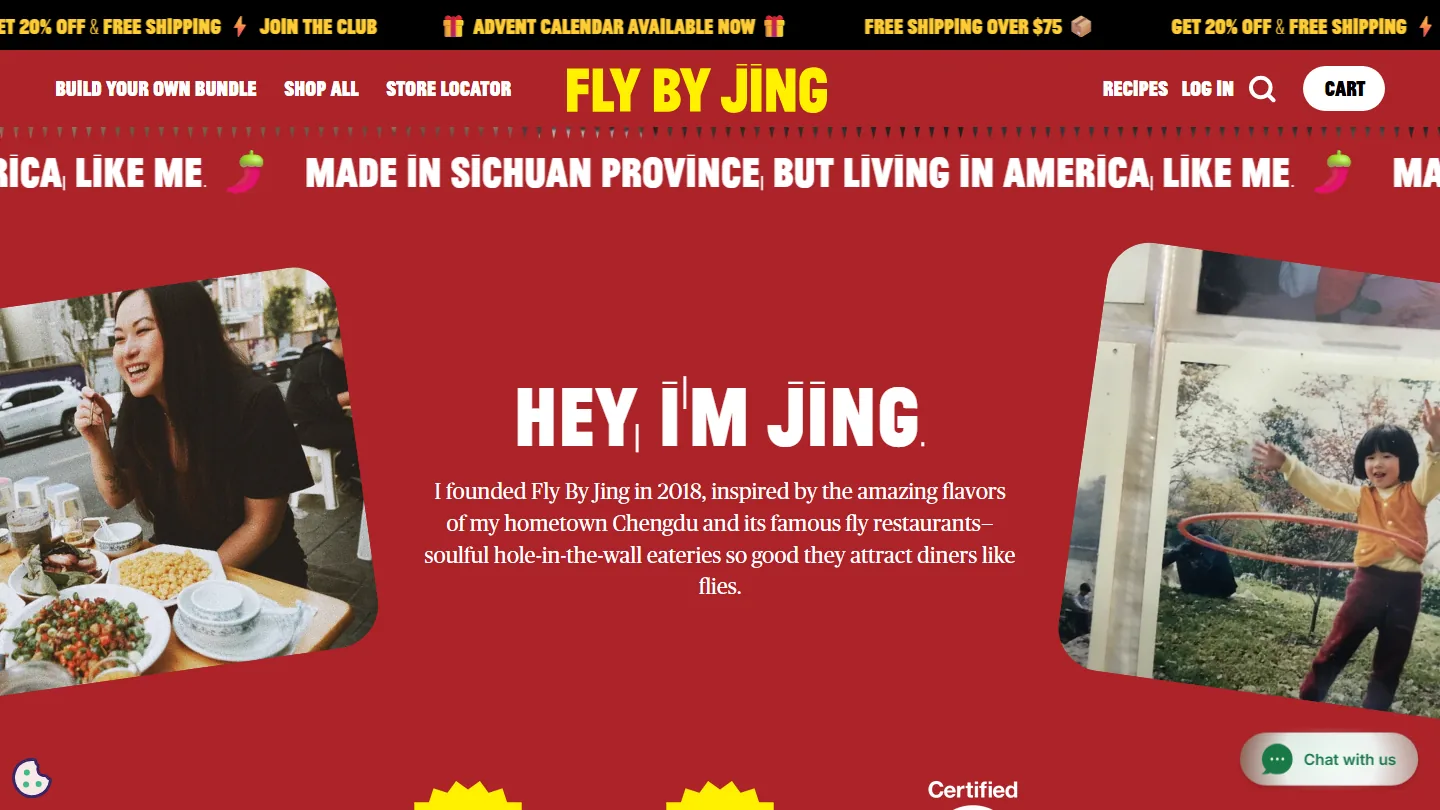
Fly By Jing tells its heritage story through its founder, Jing, who writes the About page in the first person. She founded the brand in 2018, inspired by the flavors of her hometown Chengdu and its fly restaurants. The store sells Sichuan chili crisp and sauces, and all of it runs on Shopify.
The page is built around photos of Jing, including one from her childhood, and mentions her James Beard Award-winning book. A shopper weighing a premium chili sauce against a supermarket jar gets a reason for the price.
What you can learn: If your product costs more than the alternatives, have the founder explain where it comes from in their own words and build a story around the creation of the product.
Heatonist: season drops with a media partner
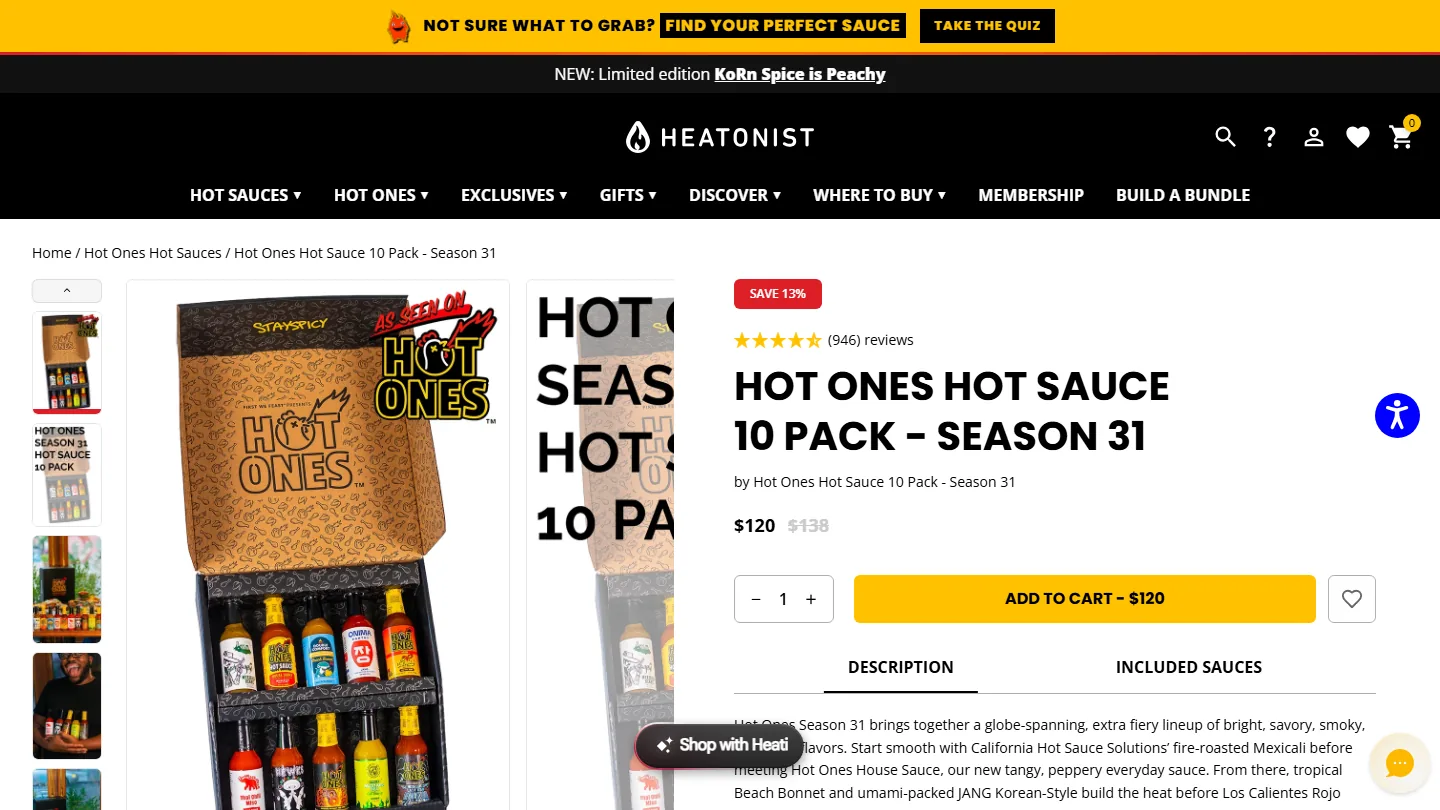
Heatonist releases a hot sauce pack for each season of Hot Ones, the show whose official hot sauce partner it has been since 2015. Founder Noah Chaimberg began by selling sauces from a push cart at Brooklyn markets in 2013. Heatonist’s store is fully on Shopify, and ECDB’s estimate of its 2025 online sales is about $12 million.
The Season 31 pack bundles 10 sauces, so a fan can buy the lineup with one add-to-cart. Every new season then gives past buyers a new pack to come back for.
What you can learn: A partnership with a show or a creator works the same way if you release a product each time they release something.
Huel: subscriptions built into the store
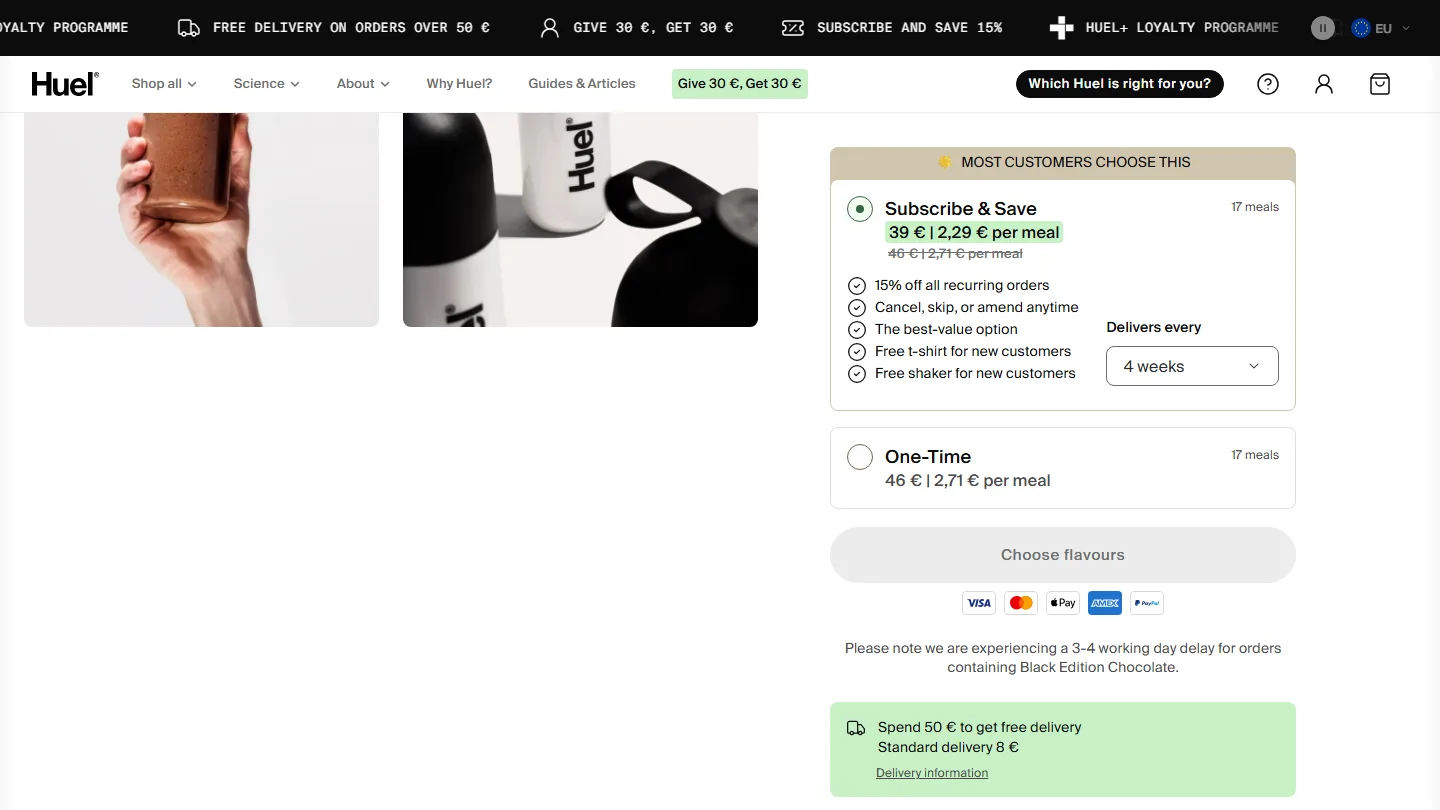
Huel builds its subscription into the product page, where Subscribe & Save is the preselected plan. The company, started by Julian Hearn in June 2015, sells nutritionally complete food as powders and ready-to-drink meals. The storefront is a headless build on Shopify, and ECDB estimates Huel’s 2025 online sales at about $239 million.
The plan picker labels the subscription as the one most customers choose and as the best-value option. The same card says the plan can be canceled, skipped, or amended anytime, which removes the main reason to hesitate.
What you can learn: If repeat orders suit your product, make the subscription the default choice and print the exit terms beside the price.
Liquid Death: a brand voice that sells water
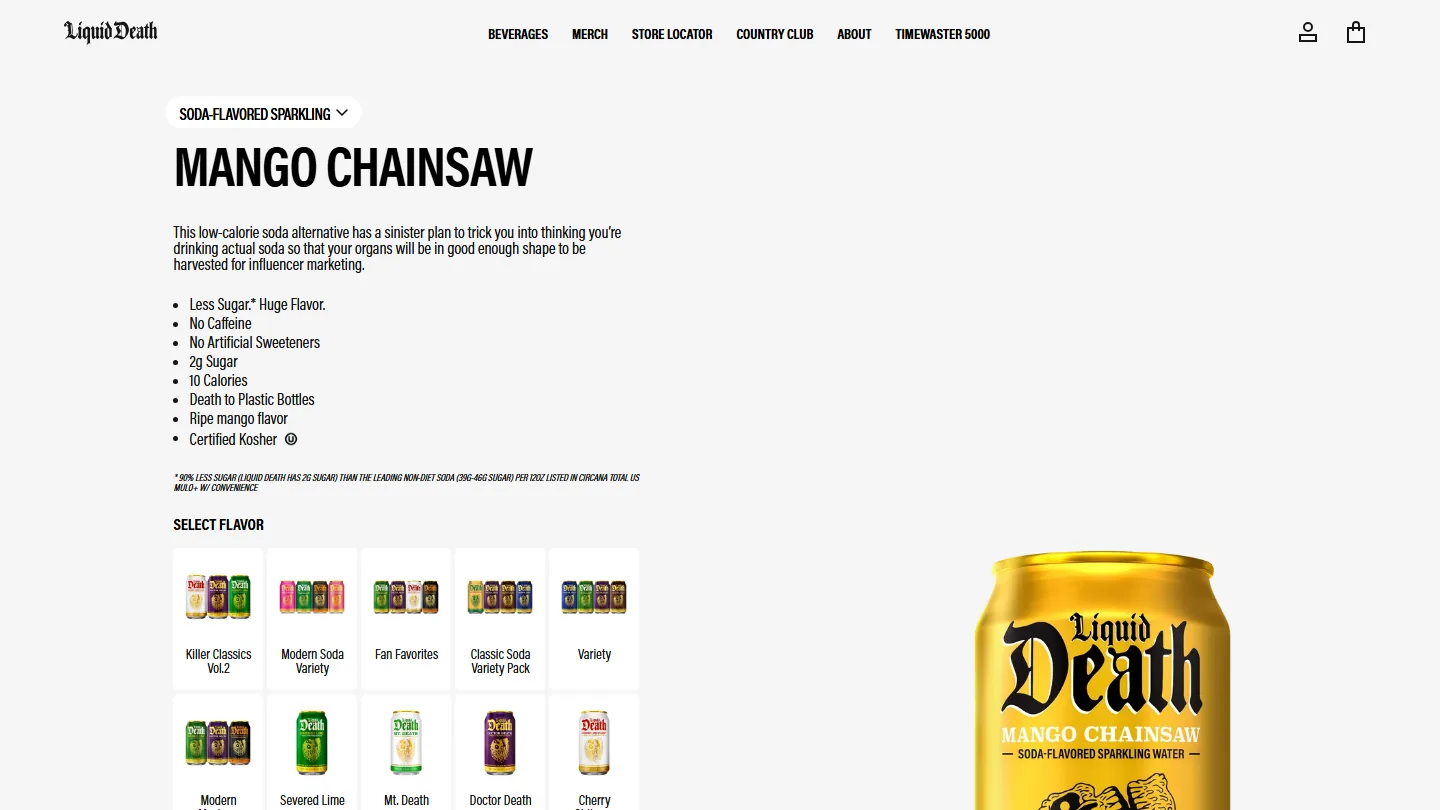
Liquid Death sells canned water with product copy written as dark comedy. Its Shopify store runs the brand site, the drinks catalog with a store locator, and the merch shop, while the drinks themselves sell through Amazon and retail stores. ECDB estimates the site’s online sales at about $16 million for 2025.
The page for Mango Chainsaw claims the drink has a sinister plan to keep your organs in good enough shape to be harvested for influencer marketing. Plain bullets below it still give the caffeine and calorie facts.
What you can learn: Give a commodity product’s copy a voice people will repeat and keep the facts in a list.
Magic Spoon: build-your-own bundles
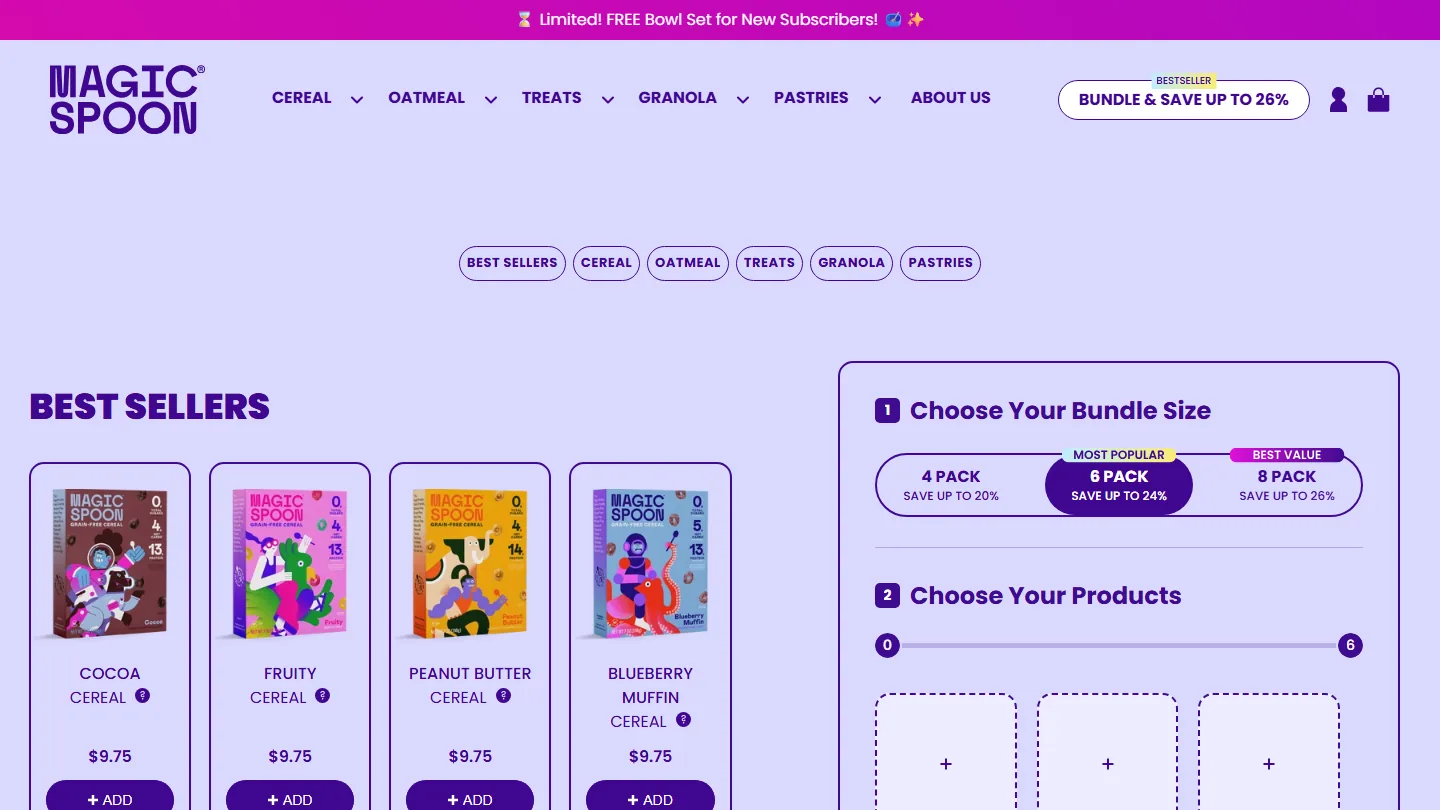
Magic Spoon lets shoppers build their own bundle of four, six, or eight boxes and pick the products that go in it. Co-founders Greg and Gabi sell high-protein, low-sugar cereal, along with granola and treats. Their store is built entirely on Shopify.
A buyer who mixes flavors is less likely to be stuck with a whole case of one taste they don’t like. Each size saves more than the last, up to 20% on the four-pack and up to 26% on the eight-pack, so the bigger order looks like the better deal.
What you can learn: Let buyers fill your bundles themselves, and show the savings on the next size up.
Partake Foods: allergy-friendly trust signals
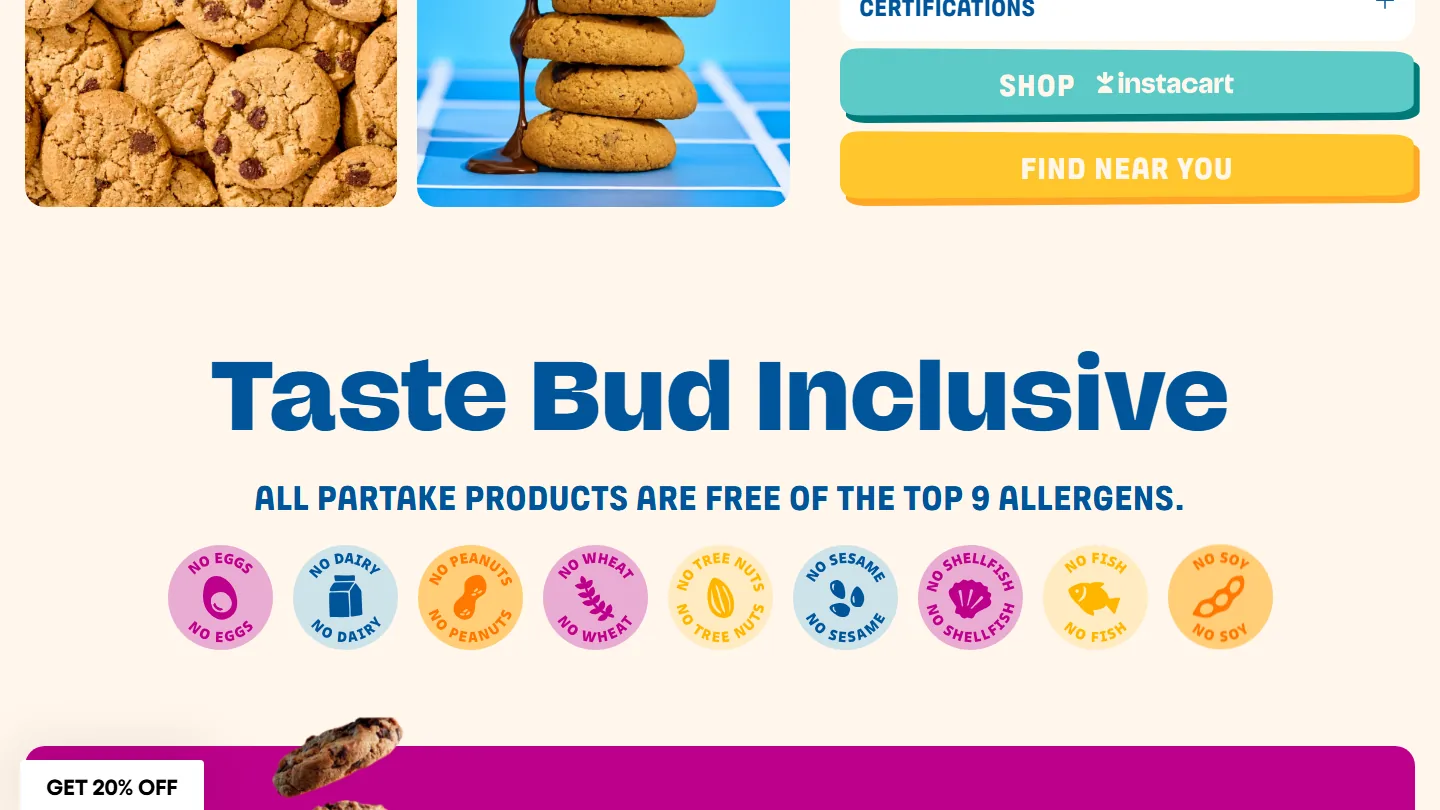
Partake Foods states on every product page that its cookies are free of the top nine allergens, with one icon per allergen. Its founder, Denise, started the brand in 2016, after her daughter was diagnosed with life-threatening food allergies. The store runs on Shopify and sells most products by the case.
Parents of children with allergies check every label before they buy, and the nine icons answer that check at a glance. Buttons for Instacart and a store finder sit just above, for shoppers who need the cookies today.
What you can learn: Work out the one question your buyers always ask, then answer it visually near the buy box.
Pip & Nut: a bundle builder with spend thresholds
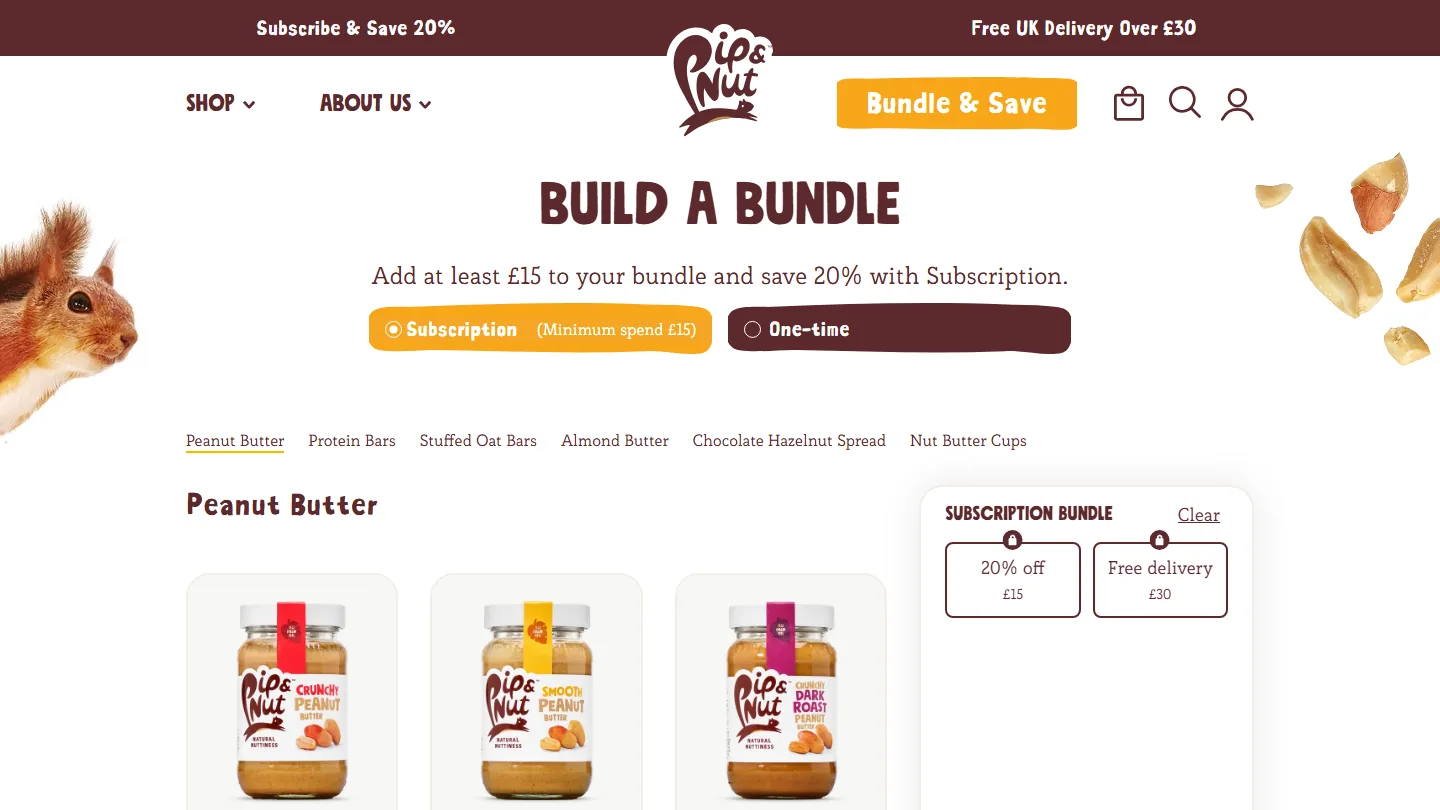
Pip & Nut runs a bundle builder with two spend thresholds, a 20% subscription discount from £15 and free delivery from £30. The UK brand sells nut butters and snack bars. Its founder, Pip, began making her own nut butter in 2013 while training for a marathon, and the whole store runs on Shopify.
By default, the builder is set to a subscription, and a side panel shows both milestones as locked until the basket reaches them. A shopper who’s a jar short of free delivery sees the gap, and one more jar closes it.
What you can learn: Show your own thresholds as progress inside the cart, where the shopper is still adding products.
More stores like these are in our roundup of Shopify food and beverage stores.
Health and wellness
Health and wellness stores do well when they explain a product before asking for a commitment. Absolute Collagen backs its subscription plans with trial results, and The Honey Pot Co. answers ingredient questions on the product page itself.
Absolute Collagen: proof-led subscriptions
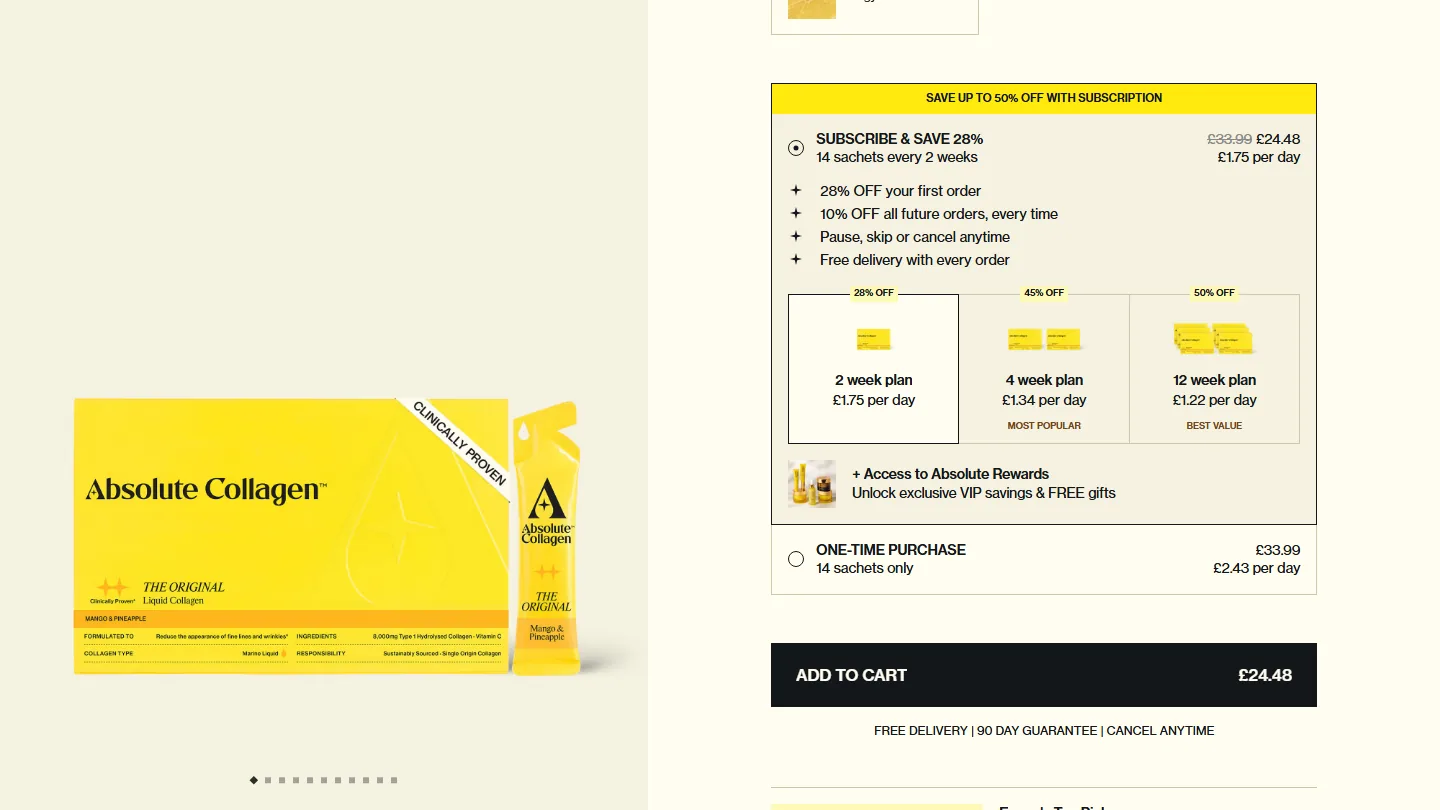
Absolute Collagen sells its subscriptions on clinical proof, and its longest plan matches the length of its trial. Maxine Laceby and her daughter Darcy launched the UK brand in 2017, and it sells marine collagen supplements for women on a headless Shopify build.
A 12-week clinical trial with 130 women is cited on the homepage. On the product page, plans run from two to 12 weeks and each is priced per day, with the best value label on the 12-week option and a 90-day guarantee to cover the wait for results.
What you can learn: Where results take time, make your longest plan as long as the trial you cite.
Saje Natural Wellness: a product finder that asks who it’s for
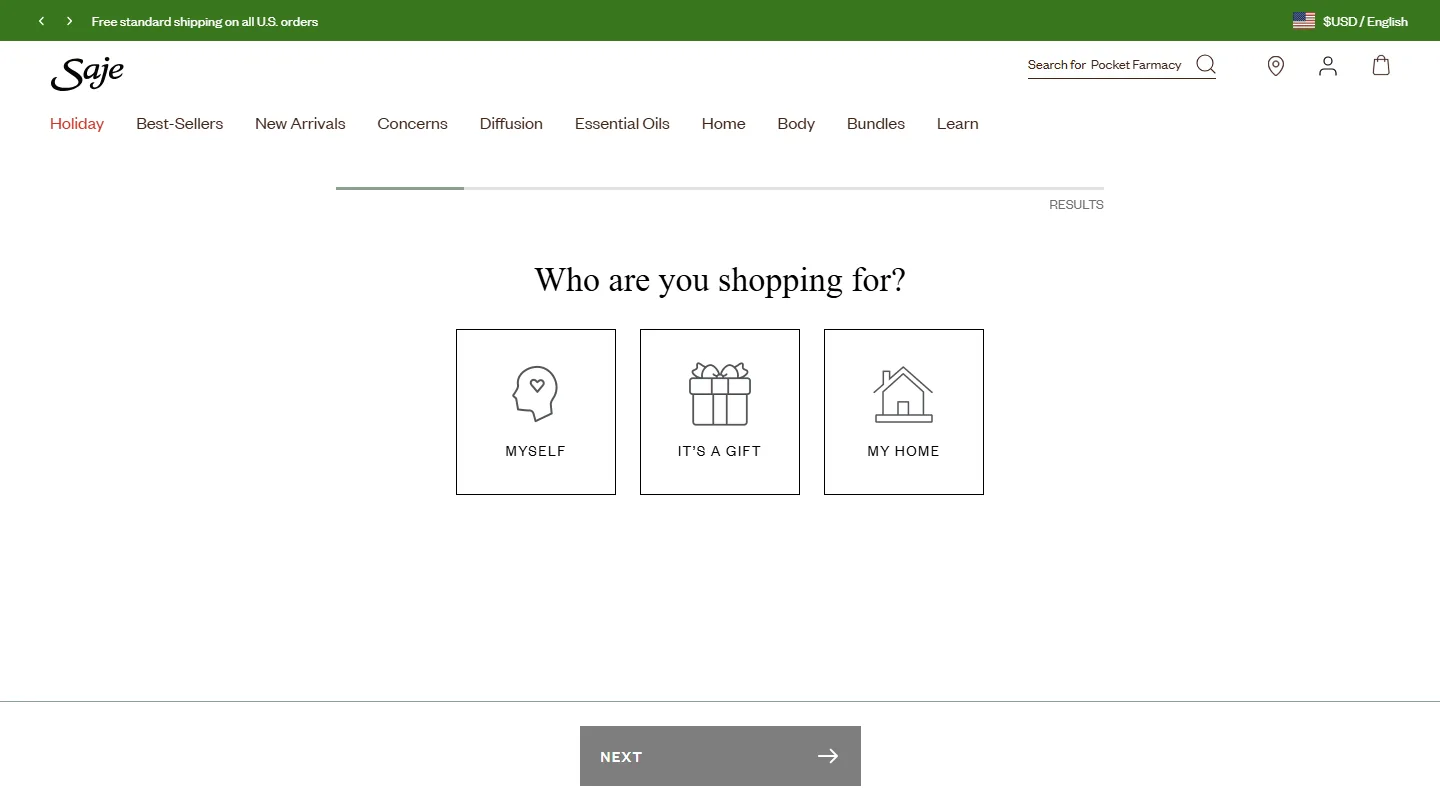
Saje Natural Wellness opens its product-finder quiz by asking who you’re shopping for. The Canadian brand began at a single kiosk in Vancouver and sells essential oil blends and diffusers. Both of its sites run on Shopify, and ECDB estimates its U.S. and international stores at about $3 million in 2025 online sales.
Shoppers pick one of three tiles, such as a gift or my home, and a progress bar shows how far along the results are. Wellness buyers often know the problem, whether it’s sleep or stress, but not the product that fits it.
What you can learn: Start your own quiz with the question that takes the least thought.
The Beauty Chef: education plus subscriptions
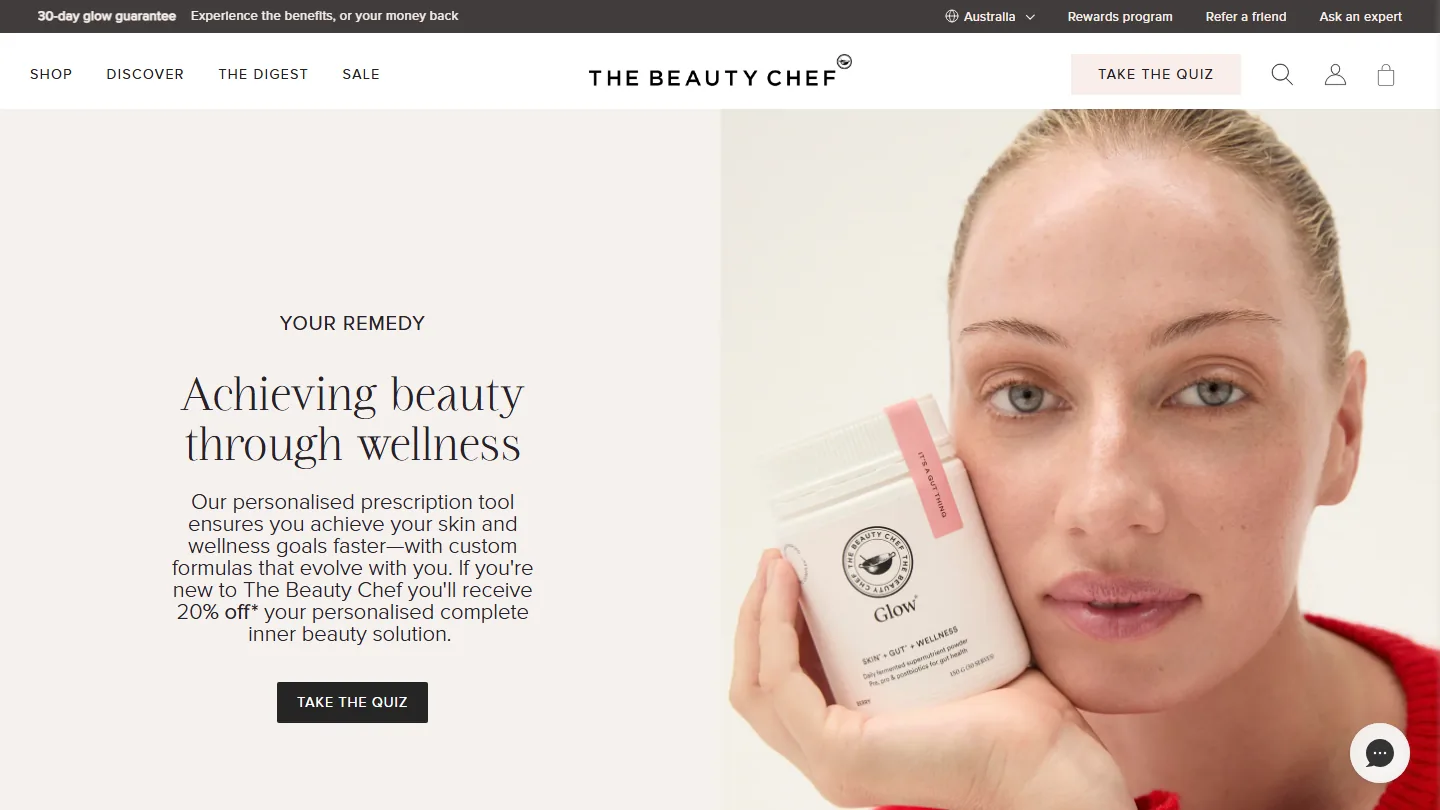
The Beauty Chef educates shoppers with a regimen quiz and offers subscriptions on the products they settle on. Carla Oates founded the brand in Bondi Beach in 2009. Its Australian Shopify store sells fermented inner-beauty powders and elixirs for skin and gut health.
Called Your Remedy, the quiz sits in the site header and ends in a personalized set of formulas. A shopper who doesn’t know the range gets a routine without reading every product page, and subscribers choose delivery every 30, 60, or 90 days.
What you can learn: Let a quiz do the teaching, then offer the subscription once the shopper knows what suits them.
The Honey Pot Co.: education-led product pages
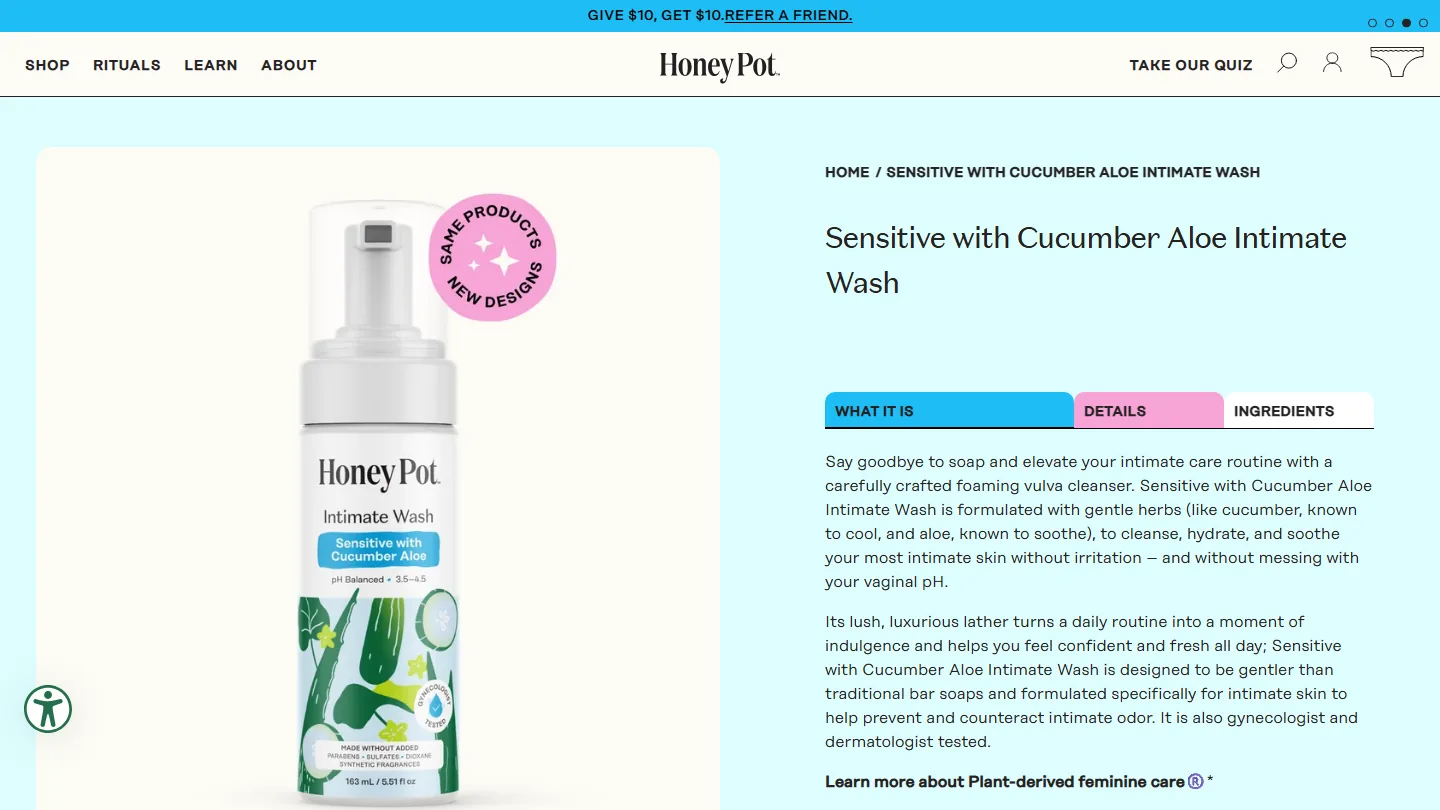
The Honey Pot Co. explains its ingredients on the product page itself, so shoppers learn what a wash does before they buy it. Led by CEO and co-founder Bea Dixon, the brand sells plant-derived feminine care, from intimate washes to organic cotton pads, and its whole store runs on Shopify.
Tabs on the page cover what the product is and what’s in it, with a line on each herb and on pH balance. Further down, the brand reports results from a clinical study of 33 women after one week of use.
What you can learn: Move the answers to your shoppers’ most common worry onto the product page.
Therabody: HSA and FSA payment at checkout
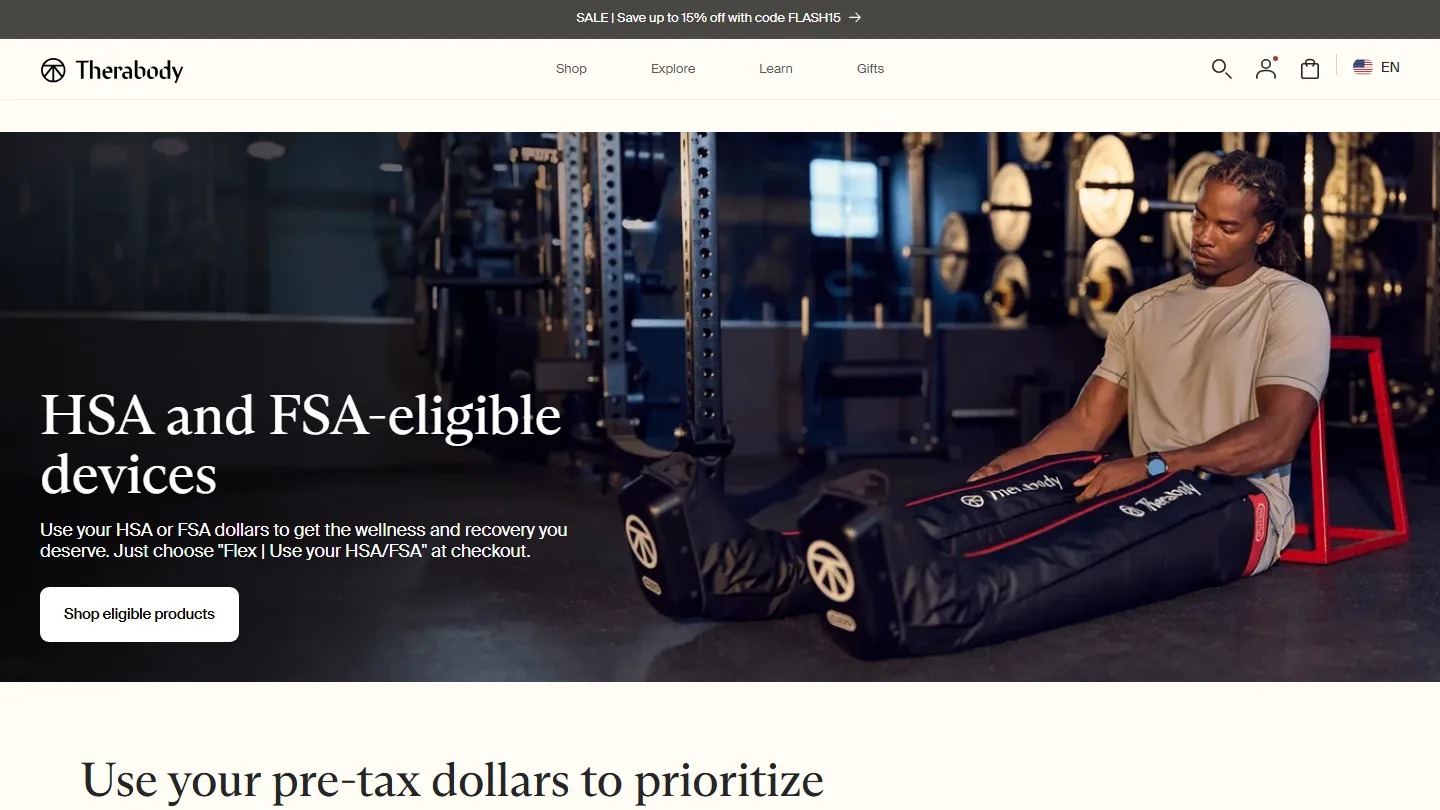
Therabody lets U.S. shoppers pay for eligible devices with HSA or FSA funds by choosing Flex at checkout. Dr. Jason Wersland founded the company in 2016, and it sells recovery devices such as Theragun massage guns and JetBoots compression boots. The U.S. store runs on Shopify, and ECDB estimates its 2025 online sales at about $44 million.
Paying with pre-tax health-account money makes a large purchase easier to justify, and the page lists the eligible products along with answers to payment questions.
What you can learn: If your products qualify for a payment program, give it a page of its own and name the exact option to pick at checkout.
Home and lifestyle
The top home and lifestyle stores on Shopify remove the doubt that comes with buying for the home without seeing the product first. Koala and Endy give shoppers a long trial at home, while Ruggable shows its rugs in furnished rooms at specific sizes and Lovevery picks the right kit for a child’s age.
Barnes & Noble: exclusive and signed editions
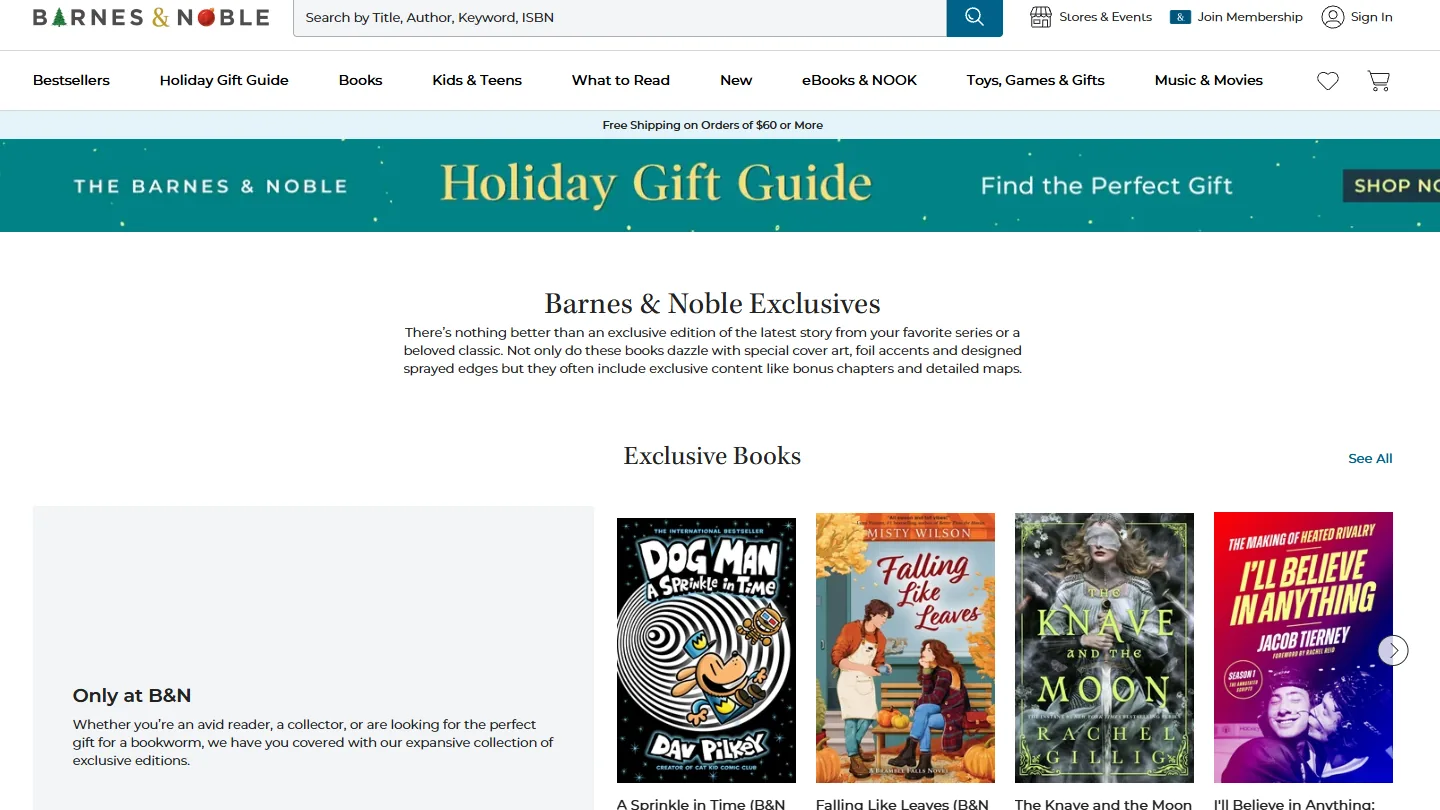
Barnes & Noble gives readers editions they can’t buy anywhere else, marked on its homepage with B&N Exclusive and Signed Exclusive badges. The bookseller moved its online store to Shopify in June 2026. Everything from its homepage to the cart now runs on Shopify’s headless Hydrogen framework. ECDB estimates the site’s 2025 online sales, before the migration, at $114 million.
Shoppers can find nearly every title on the site at other retailers with one click. A signed copy or an edition with extra content is what makes them order here instead.
What you can learn: Where your catalog overlaps with bigger sellers, get a version of a popular product they can’t list, and badge it everywhere it shows up.
Caraway: public lab reports behind a non-toxic claim
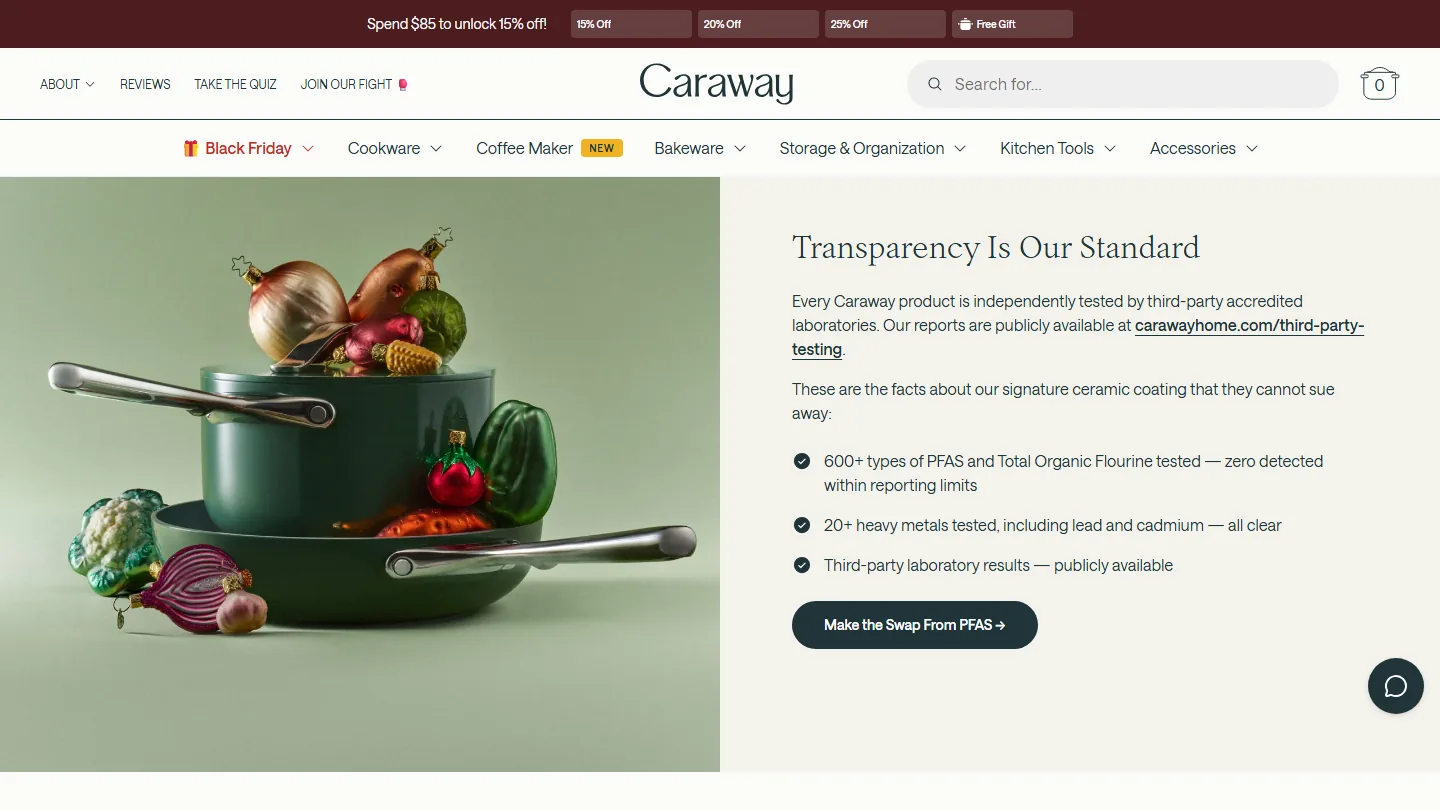
Caraway backs its non-toxic claim with third-party lab reports that anyone can open from the homepage. The brand launched in 2019 with a ceramic-coated cookware set and has since added bakeware and food storage. Its whole store is a headless Shopify build, and ECDB puts its 2025 online sales at an estimated $131 million.
A homepage block says accredited outside laboratories test every product and lists what they looked for, including more than 600 types of PFAS. For a premium-priced pan, a downloadable report does more work than another badge.
What you can learn: If your product rests on a safety claim, link the test results right beside it.
Endy: a 365-night trial in the buy box
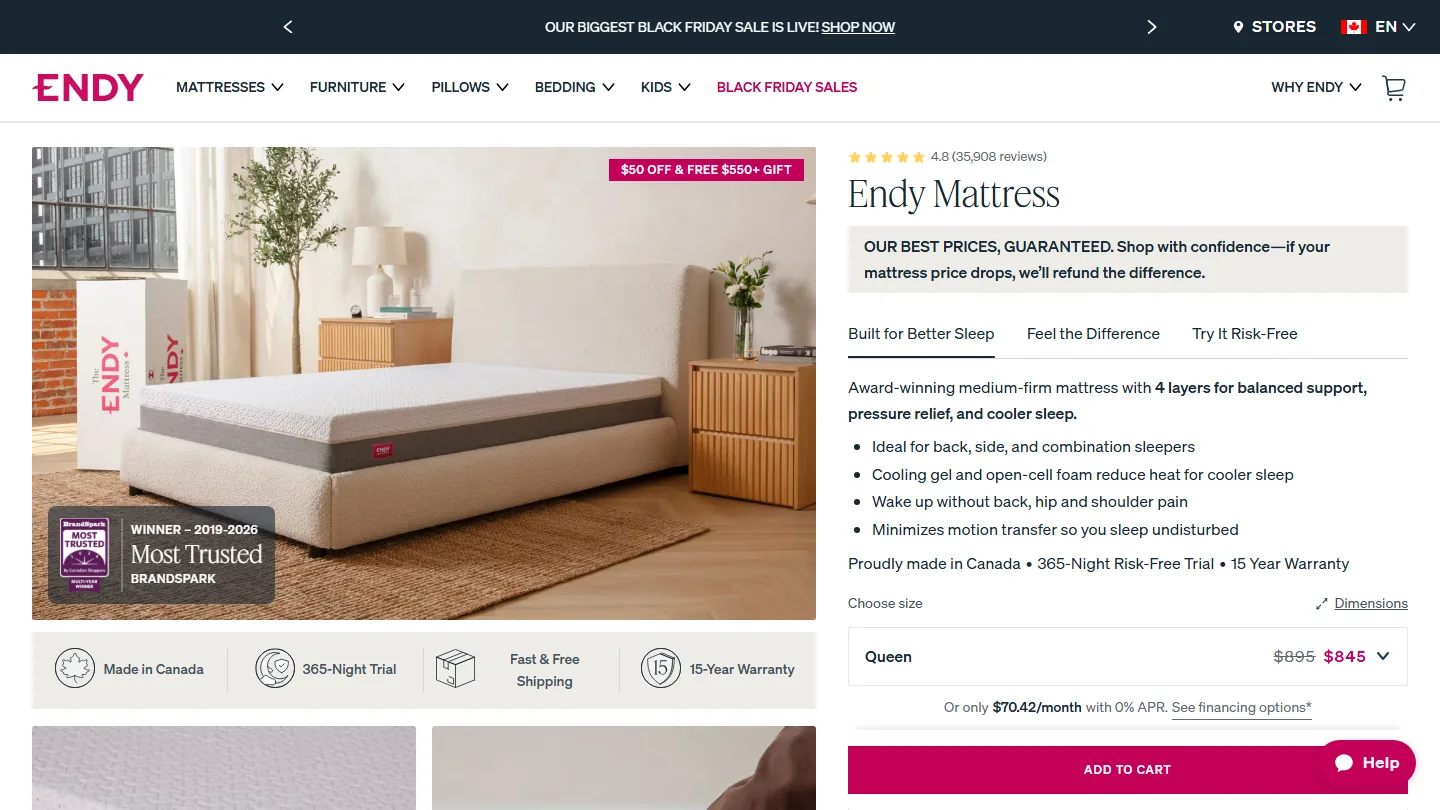
Endy states its 365-night risk-free trial and 15-year warranty directly in the buy box of its mattress page. The Canadian brand launched in 2015 and makes its mattresses in Canada. Its headless storefront sits on a Shopify backend, and ECDB estimates it brought in about $34 million online in 2025.
A mattress can’t be tested through a screen, which leaves the trial to stand in for the showroom. The same page carries a best-price guarantee that refunds the difference if the price drops later.
What you can learn: Put your strongest guarantee right beside the Add to cart button, because that’s the spot where people hesitate.
HexClad: set bundles priced against a value anchor
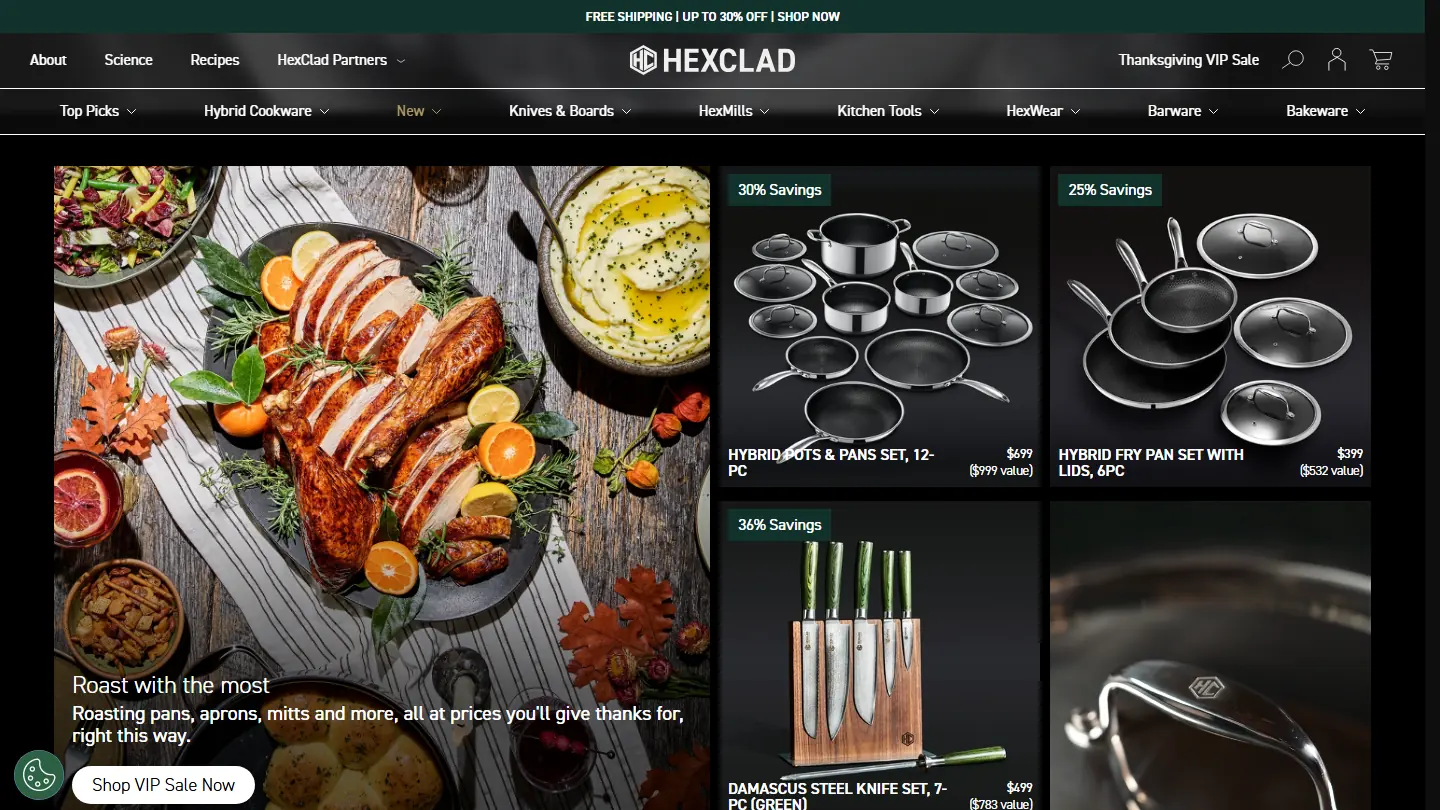
HexClad prices its cookware sets against the value of the pieces bought one by one, with a savings badge on every set card. The store sells hybrid cookware and Damascus steel knives, and the whole U.S. site runs on Shopify. According to ECDB’s estimate, HexClad made about $200 million in online sales in 2025.
Most buyers only need one or two pans, so the anchor is what moves them up to a full set. The same pattern repeats in the best sellers row and in the cart drawer’s set suggestions.
What you can learn: When you sell bundles, print the separate-item value beside the bundle price so the saving needs no math.
Koala: a 120-day home trial across the site
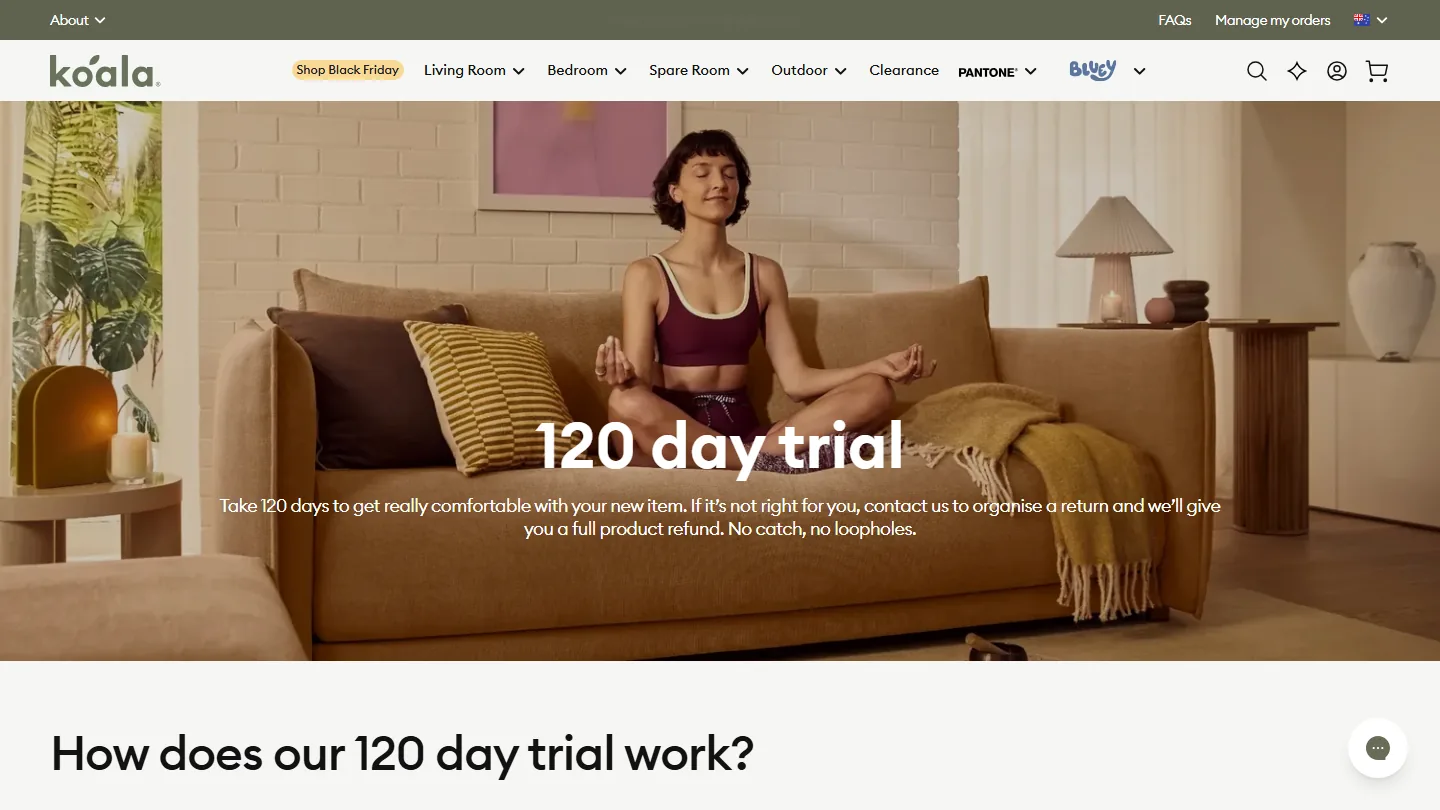
Koala promotes a 120-day home trial on every page of its store, starting with the announcement bar. The Australian brand sells sofa beds and mattresses among other furniture for the home. Its Australian store runs on Shopify, and ECDB estimates that the store’s 2025 online sales were about $129 million.
Sofas and mattresses are hard to judge from photos, so the trial moves the risk from the shopper to the store. A dedicated page promises a full product refund if the item isn’t right.
What you can learn: Give your returns promise its own page and explain the trial period, refund conditions, and return process, with no catch left for the reader to find.
Lovevery: an age-based picker that starts a subscription
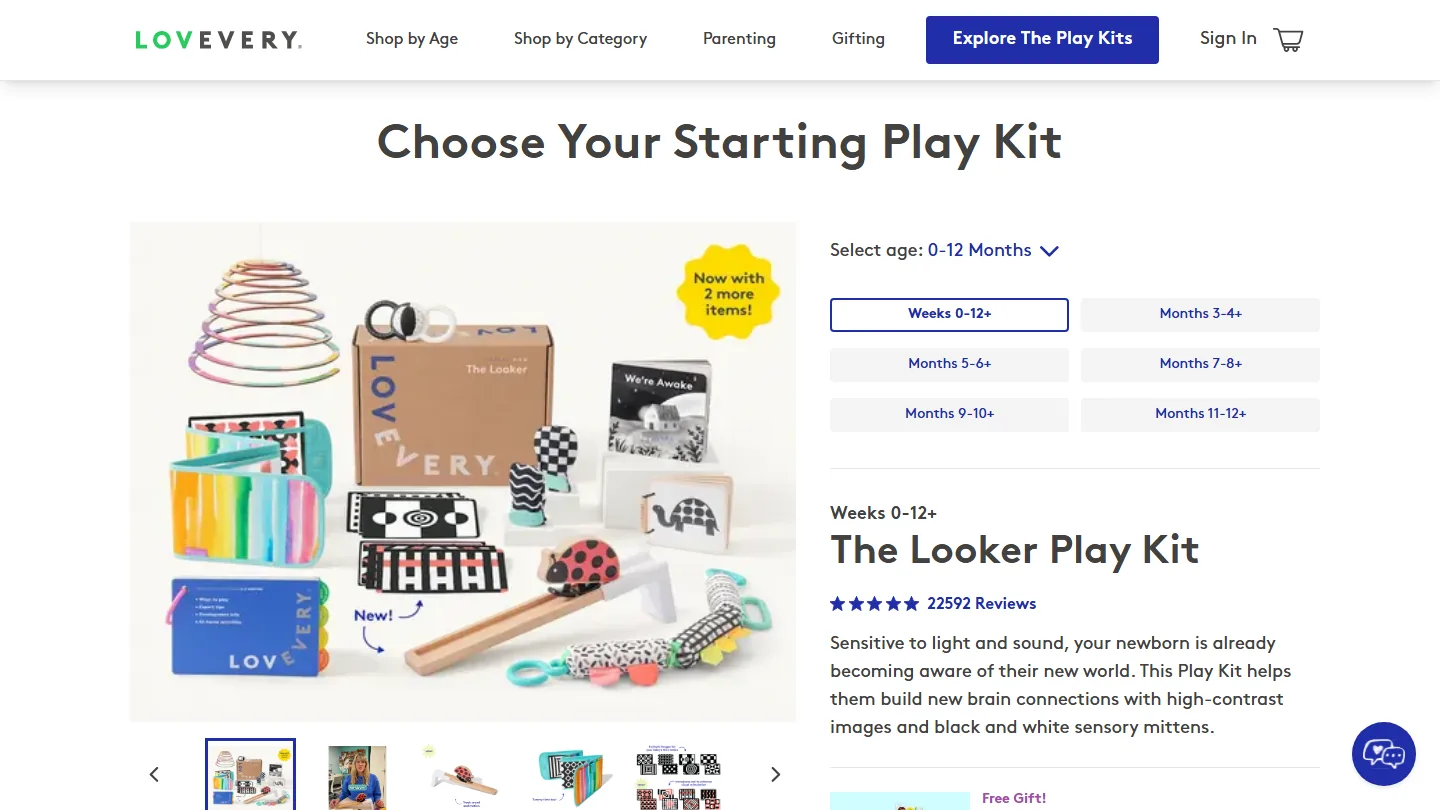
Lovevery starts its Play Kits subscription with a picker that asks for a child’s age and returns the matching kit. The kits hold stage-based playthings and books, delivered every two to three months. Lovevery runs a headless storefront on Shopify, and ECDB’s estimate for its 2025 online sales is about $96 million.
Parents pick an age range and a stage, and the store swaps in the kit built for it. As the next kit arrives when the child grows into it, the first choice sets up every later order.
What you can learn: If your products fit a life stage, ask for that one detail first and let the store do the matching.
Mattel Shop: shop-by-age navigation for gift buyers
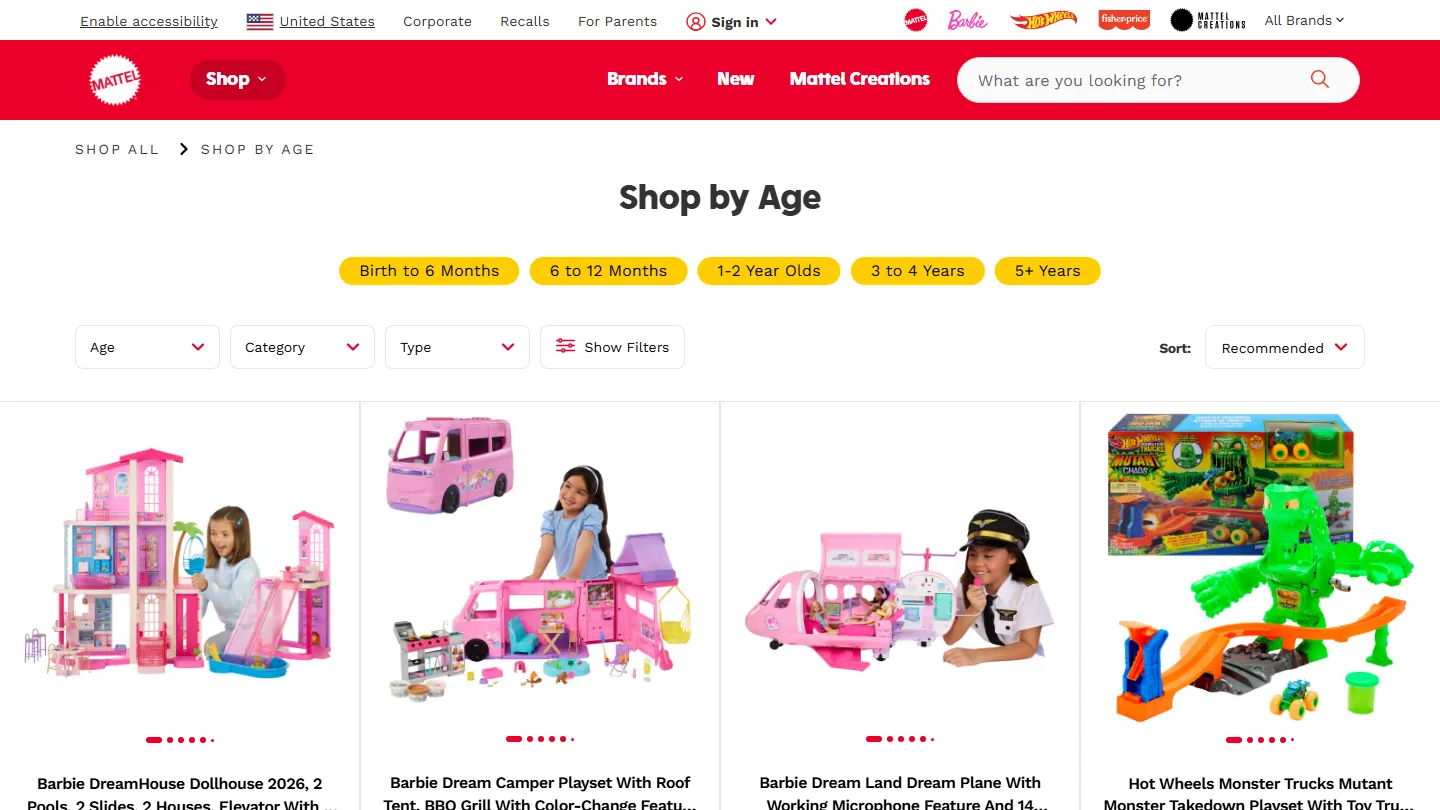
Mattel Shop lets gift buyers narrow a multi-brand toy catalog to a child’s age with one click. The shop is Mattel’s direct-to-consumer store for brands such as Barbie and Hot Wheels. Only this online shop runs on Shopify, while the toy company as a whole sells its products together with retail partners.
The five buttons on the Shop by Age page start at birth to six months and end at five years and older. A grandparent who knows only the child’s age gets to toys that fit without learning the brands first.
What you can learn: When people often buy your products for someone else, build the navigation around what the buyer knows about the recipient.
Netflix Shop: navigation by show title
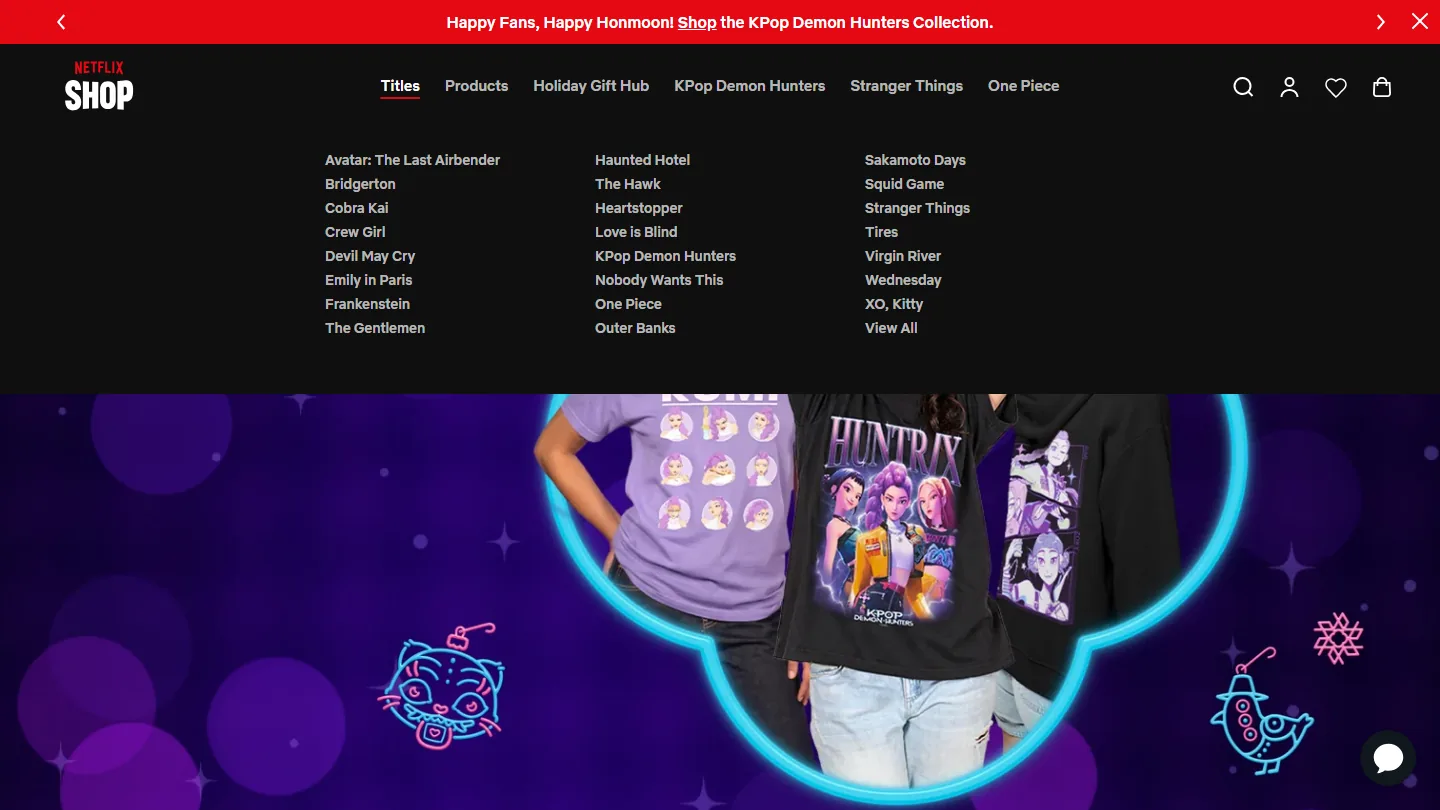
Netflix Shop organizes its merchandise by show, with a Titles menu as the first item in the navigation. Launched in June 2021, it’s Netflix’s official store for apparel and collectibles tied to series such as Stranger Things. The U.S. shop runs on Shopify, and the streaming service itself is a separate business.
Several titles, KPop Demon Hunters among them, also get their own tabs beside the menu, which puts the store in front of fans while a release is being talked about.
What you can learn: Stores with a fan audience should name collections after what fans search for and move the trending one into the main menu.
Our Place: a tiered loyalty club in the brand’s voice
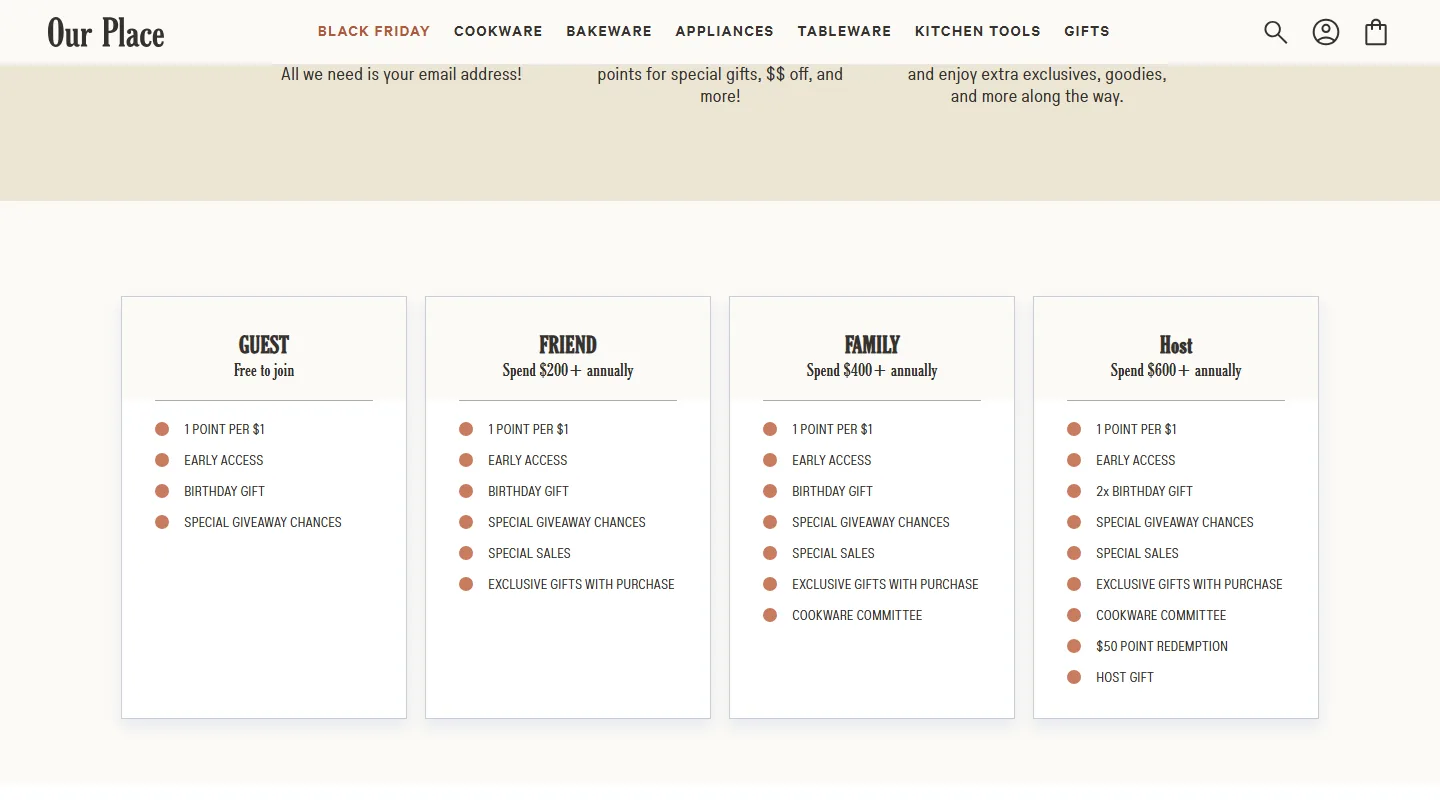
Our Place runs a four-tier loyalty program called the Dirty Dishes Club, with tiers that climb from Guest to Host. The brand’s U.S. store runs on Shopify and sells non-toxic cookware, such as its Always Pan, next to tableware and small appliances.
Cookware is bought rarely, so the program rewards annual spend, with Friend status starting at $200 a year and Host at $600. Each level adds perks such as special sales and exclusive gifts with purchase.
What you can learn: If your main product is a once-in-a-while purchase, tie the tiers to yearly spend so that add-on orders count toward the next level.
Ruggable: room photos that cut buying hesitation
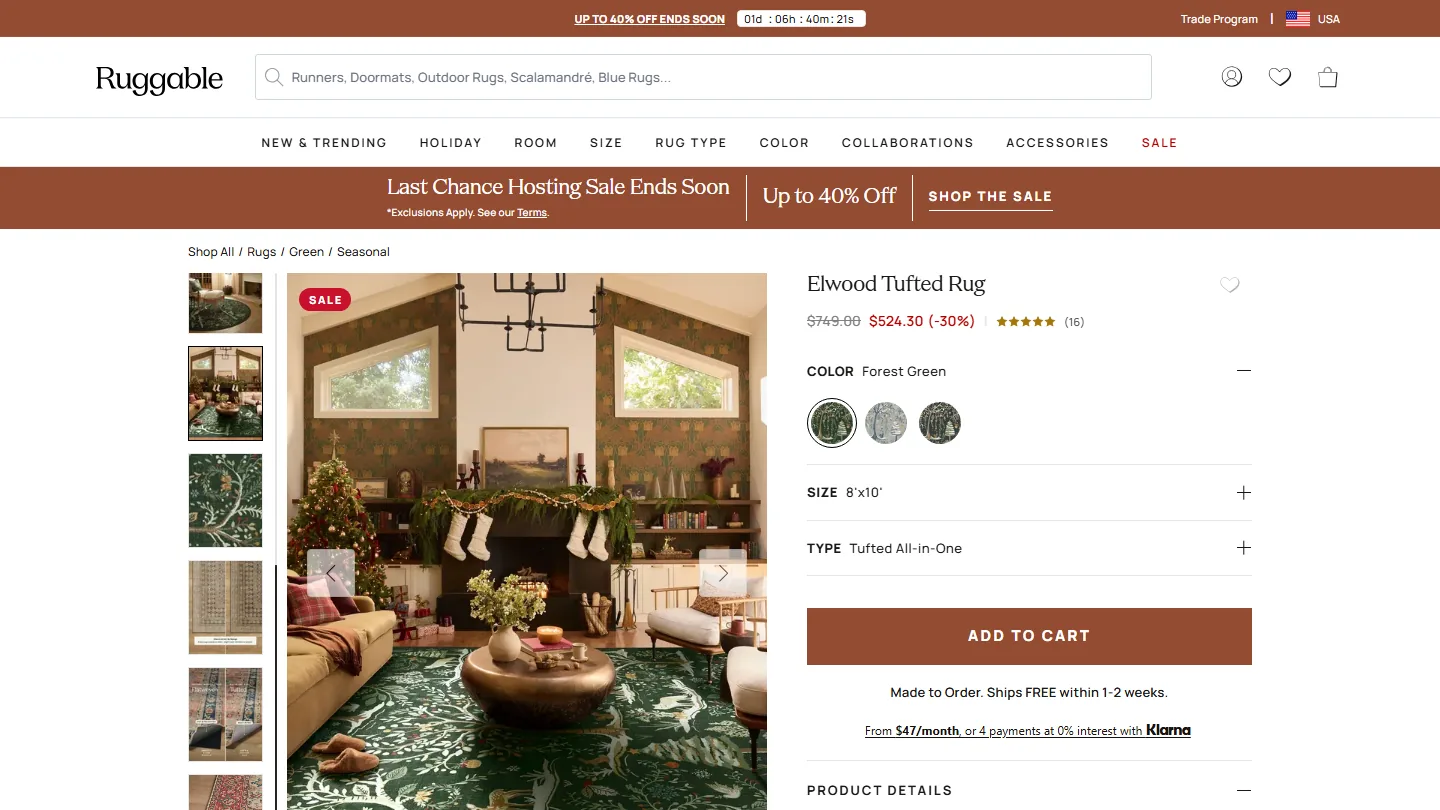
Ruggable cuts a shopper’s hesitation by showing each rug in furnished rooms at specific sizes, right in the product gallery. Founder Jeneva Bell’s patented design pairs a machine-washable cover with a separate rug pad. The store has been a headless Shopify build since 2023, and ECDB estimates that it took about $359 million online in 2025.
The gallery mixes the flat product shot with photos of the same rug in use, such as an 8×10 in a living room or a 2×3 in a kitchen. A shopper sees whether the size they have in mind fills the space, which a flat image can’t show.
What you can learn: Photograph your product in a room at the sizes you sell most and put those shots beside the plain one.
Tonies: a four-step bundle builder
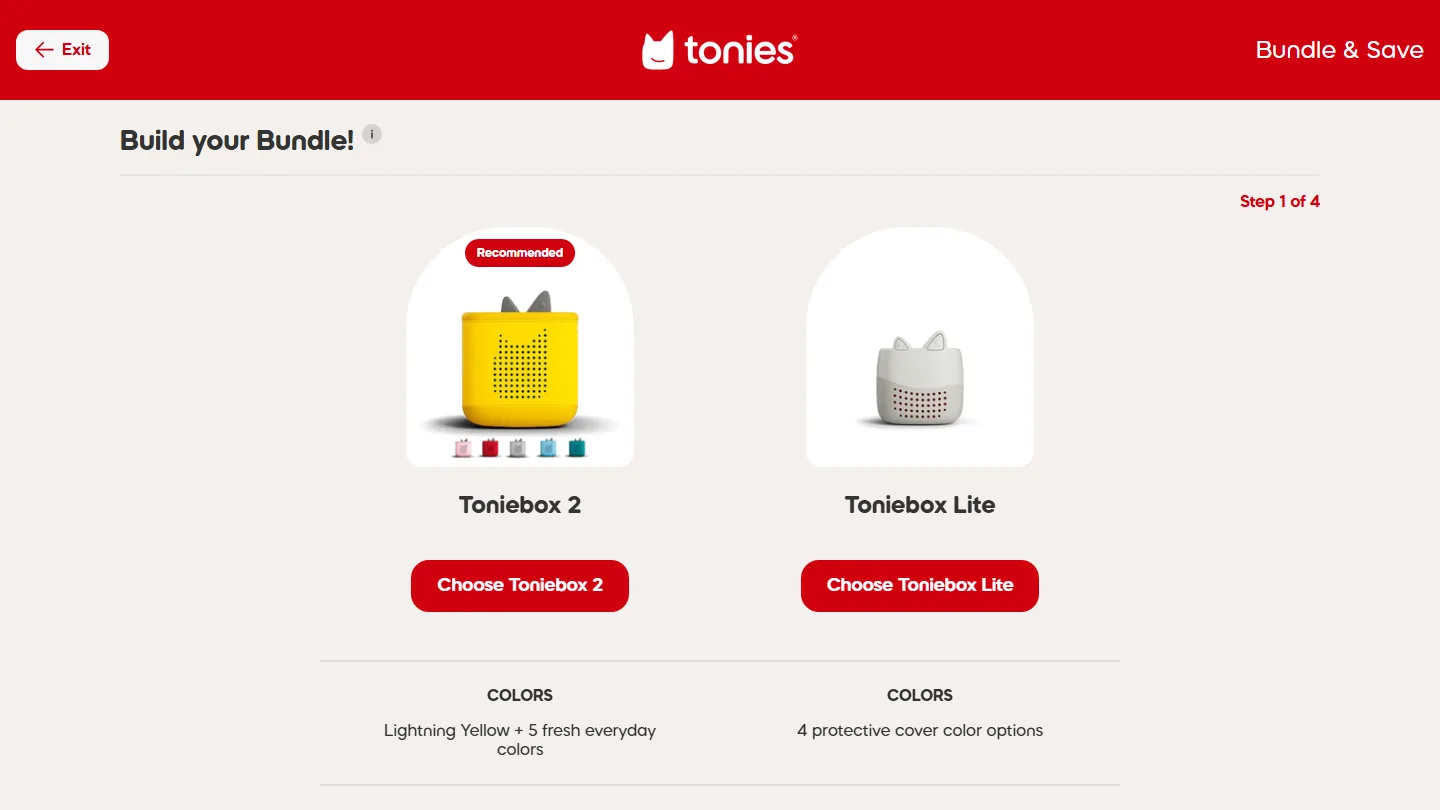
Tonies sells its starter sets through a four-step bundle builder that begins with a choice of two Toniebox players. The Toniebox is a screen-free audio player for kids that works with collectible figurines. Tonies is a German company whose U.S. store runs on Shopify.
A player has nothing to play without the figurines, so the builder leads from the box to the Tonies, then to extras such as headphones. Step one puts the two players in a comparison table, with Toniebox 2 marked as recommended.
What you can learn: When one of your products needs another to work, sell them through a guided builder that starts with the main item.
Who Gives A Crap: a quiz that sets the subscription schedule
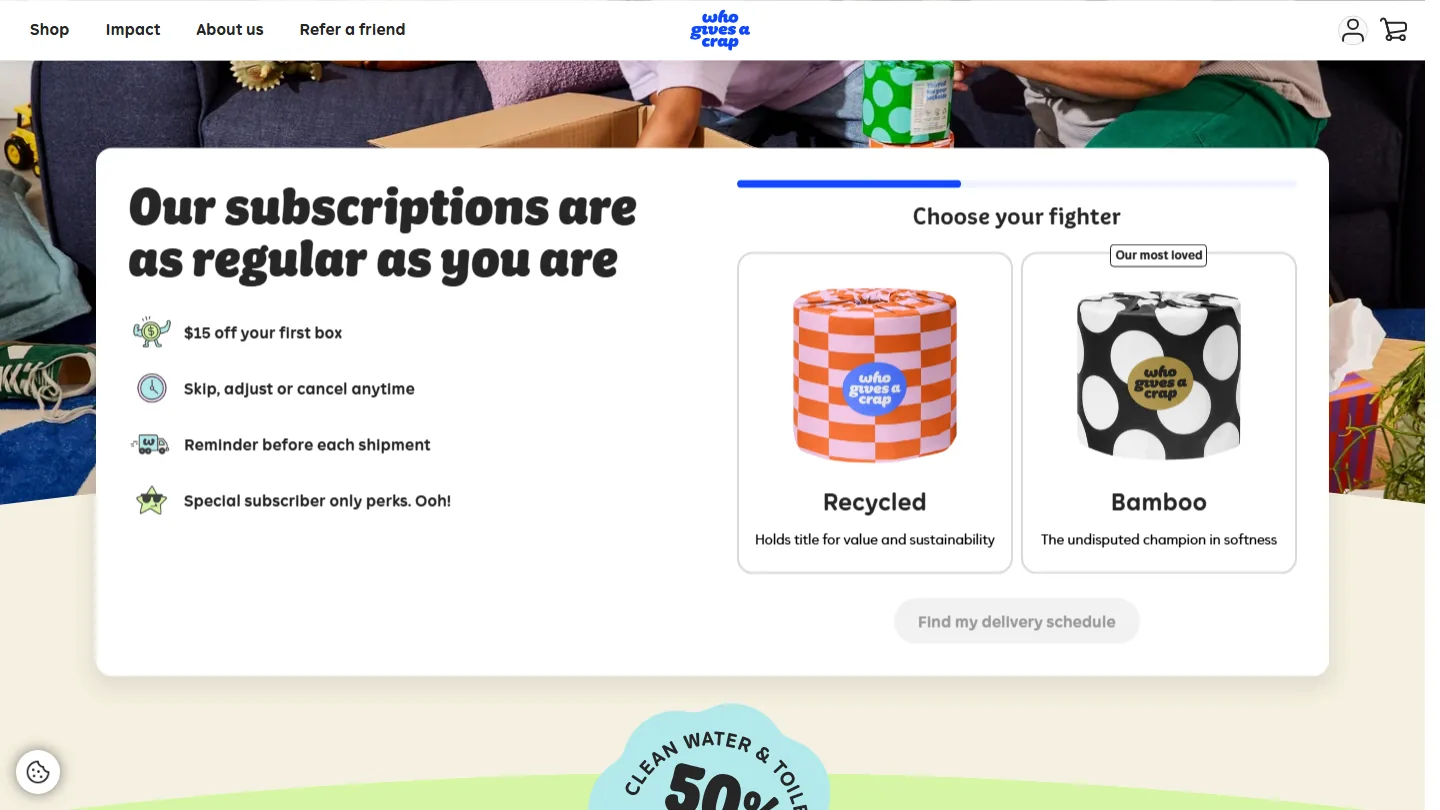
Who Gives A Crap uses a three-question quiz to work out how often a subscriber needs a delivery. The Australian company sells recycled and bamboo toilet paper and donates 50% of its profits. Its U.S., Australian, and EU stores each run on Shopify.
After a choice between recycled and bamboo paper, the quiz asks how many people live in the home and how much storage space there is. The answers become a delivery schedule based on similar homes, so the subscriber neither runs out nor overstocks.
What you can learn: If you sell a consumable, ask about the household before you ask for the subscription.
Wild One: walk kits with colors picked piece by piece
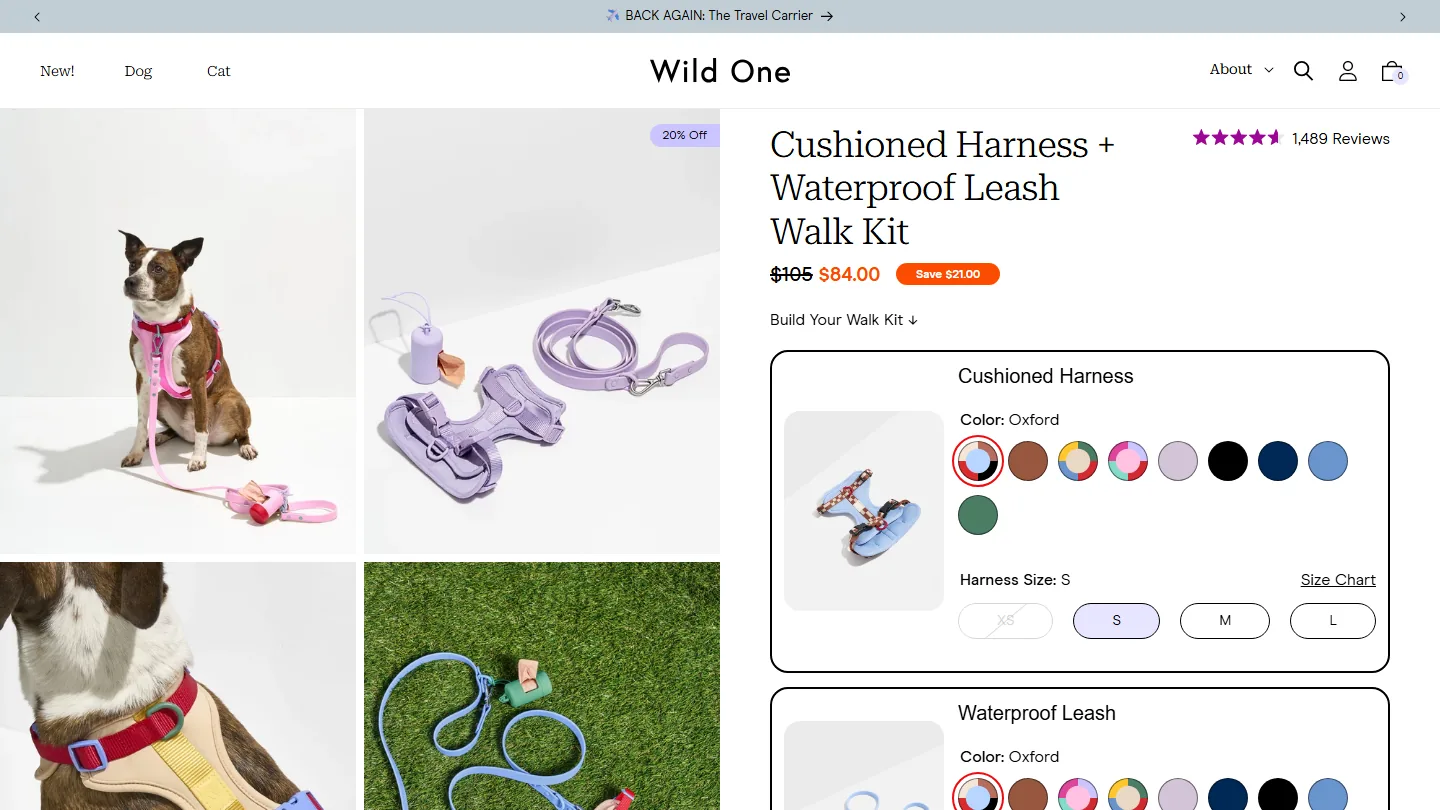
Wild One sells its dog walking gear as Walk Kits, and shoppers pick the color of each piece on the product page. The New York brand makes harnesses, collars, leashes, toys, and carriers for dogs and cats, and its terms of service say the store is hosted on Shopify.
A harness or collar comes with a leash and a Poop Bag Carrier in each kit, and every piece has its own color picker. Since the saving is printed next to the price on the kit page, the bundle looks like a deal instead of a set someone else decided on.
What you can learn: Let shoppers build sets of products used together and pick each piece themselves.
For more stores in this category, see our lists of home decor Shopify stores and Shopify pet stores.
Sports, outdoors and tech
The top sports, outdoor, and tech stores on Shopify help shoppers choose between expensive, similar-looking products before they commit. Condor Cycles does it with a bike configurator and Rad Power Bikes with a nine-question quiz, while Stanley offers engraving that’s available only on its own store.
Condor Cycles: a build-your-own-bike configurator
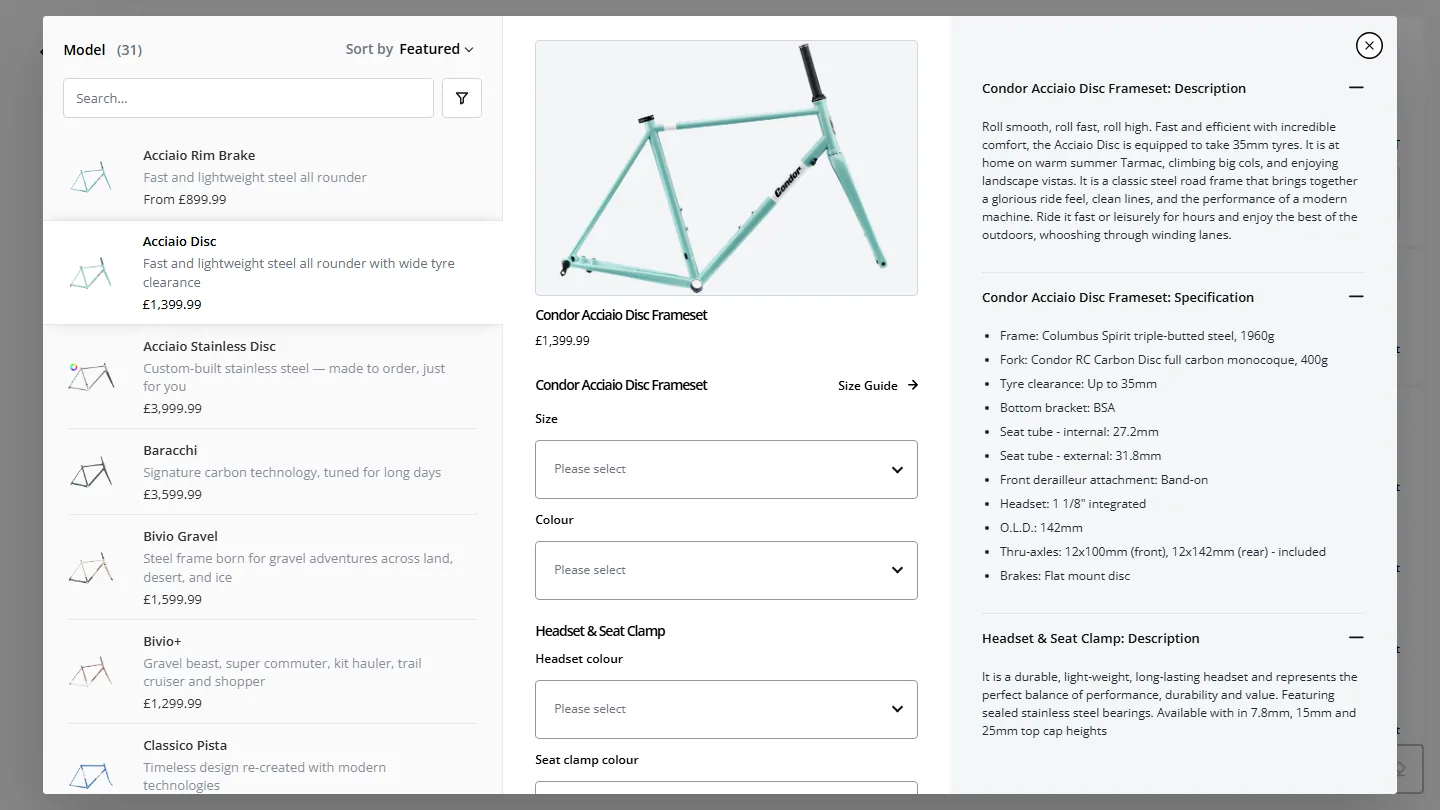
Condor Cycles lets riders put a bike together part by part in an online configurator called Build Your Bike. Monty Young opened the shop in London in 1948, and its Shopify store sells Condor’s own frames, which are designed in London and handmade in Italy.
The builder starts with the frame and then works through groups such as the drivetrain and the wheels, with a running total on screen. A hand-built bike is a considered purchase, and the total lets a rider swap parts until the build fits the budget.
What you can learn: For any product with many options, show the price changing as each choice is made.
Cotopaxi: one guarantee for returns, repairs, and trade-ins
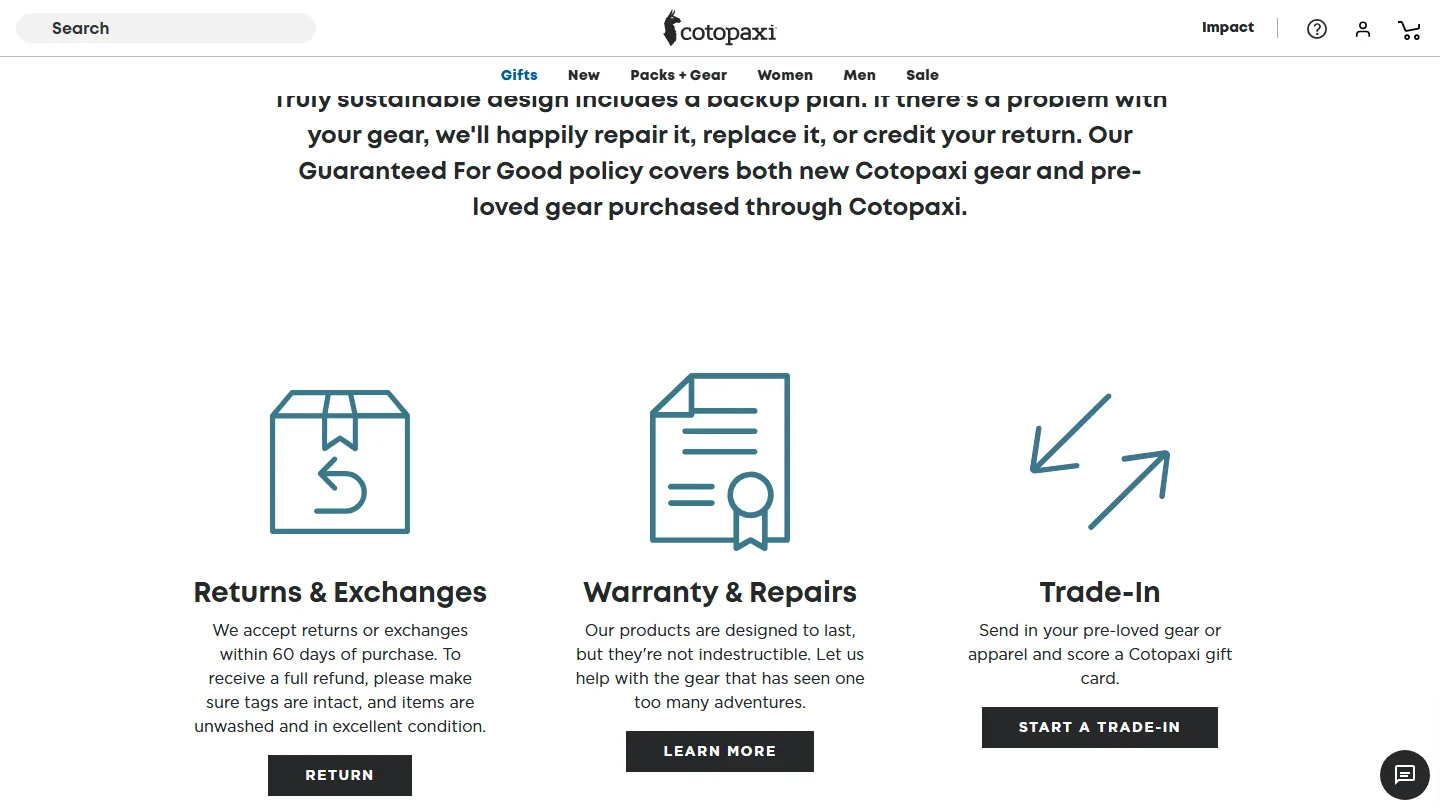
Cotopaxi puts returns and repairs under one promise called Guaranteed for Good and adds a trade-in option to it. The brand sells outdoor gear such as travel packs and down jackets. Its store runs on Shopify, with online sales that ECDB estimates at about $50 million for 2025.
Anyone weighing an expensive jacket wants to know what happens if it breaks, and the policy promises to repair or replace it, for new and pre-loved gear alike. Trade-ins are paid in gift cards, which brings the customer back to the store.
What you can learn: Group your after-sale policies under one name and link to it from every product page.
Cowboy: scroll-driven product storytelling
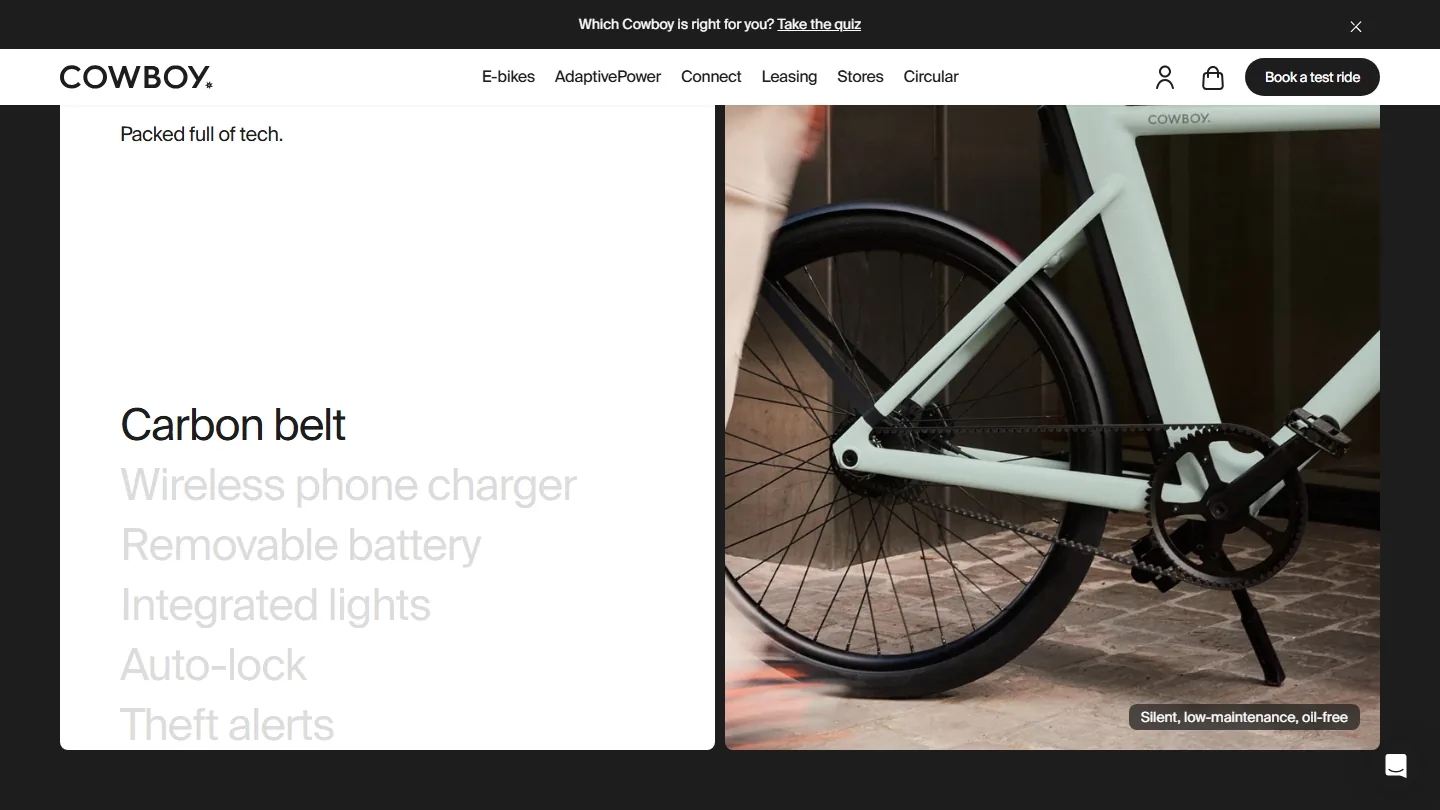
Cowboy tells the story of its e-bikes through sections that play as the visitor scrolls down the homepage. Founded in 2017 and headquartered in Brussels, the company sells connected e-bikes with GPS tracking and theft alerts. Its storefront is built on Hydrogen, Shopify’s headless framework.
One sticky section steps through the bike’s tech, highlighting a single feature while the photo and its caption change with it. A shopper can’t feel a carbon belt or an auto-lock online, so each one gets a short benefit line.
What you can learn: Present a feature-heavy product one feature at a time and attach a benefit to each.
Ember: use-case labels on a product shelf
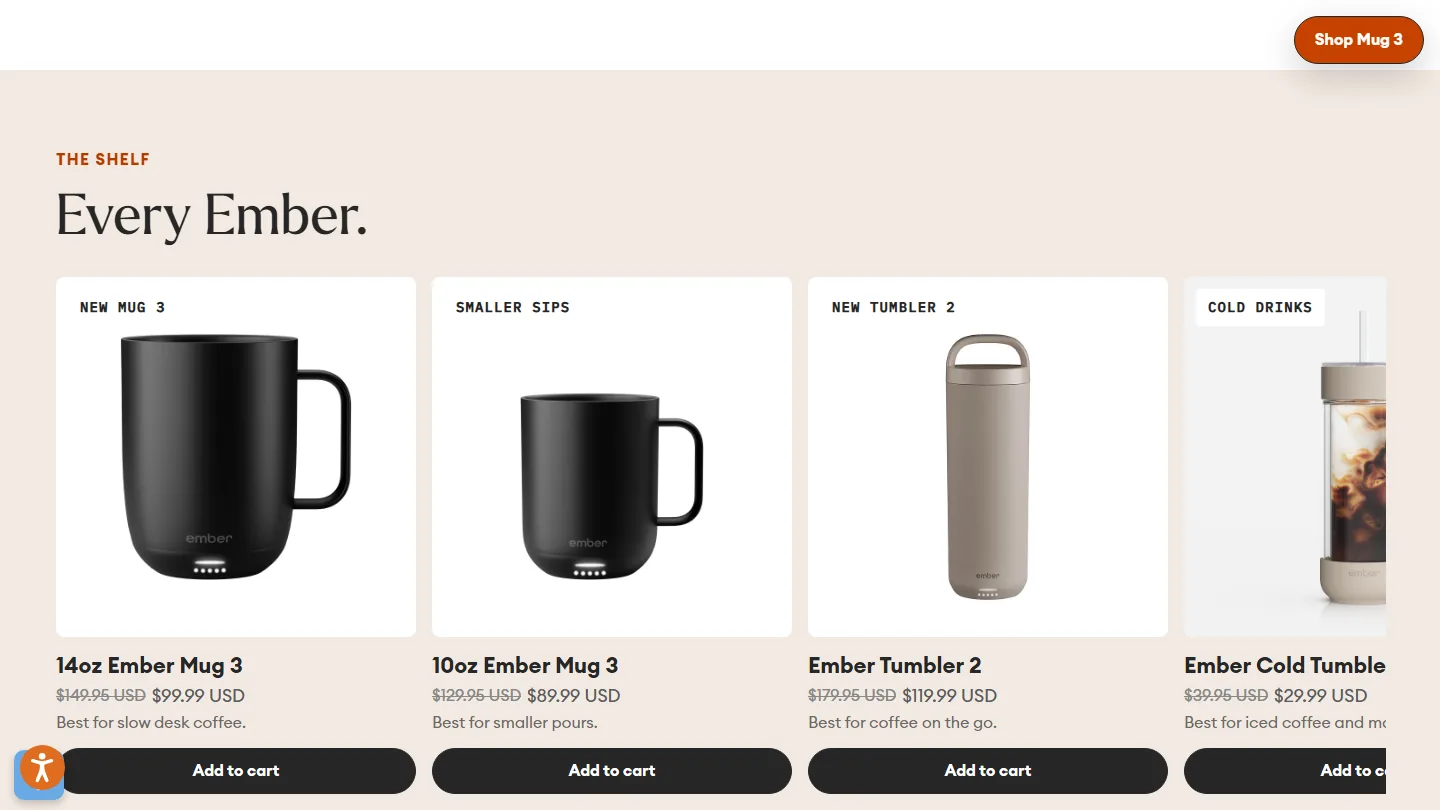
Ember labels every product on its homepage shelf with the situation it’s best for. The brand’s whole U.S. store runs on Shopify and sells temperature-control drinkware, led by a self-heating mug.
Each card on the shelf carries a line such as best for slow desk coffee or best for iced coffee and matcha, with an Add to cart button. With several similar-looking products, the line maps each one to a moment the shopper recognizes.
What you can learn: If your range looks alike at a glance, write a best-for line for each item and show them side by side.
LSKD: pre-launch drop pages with a countdown
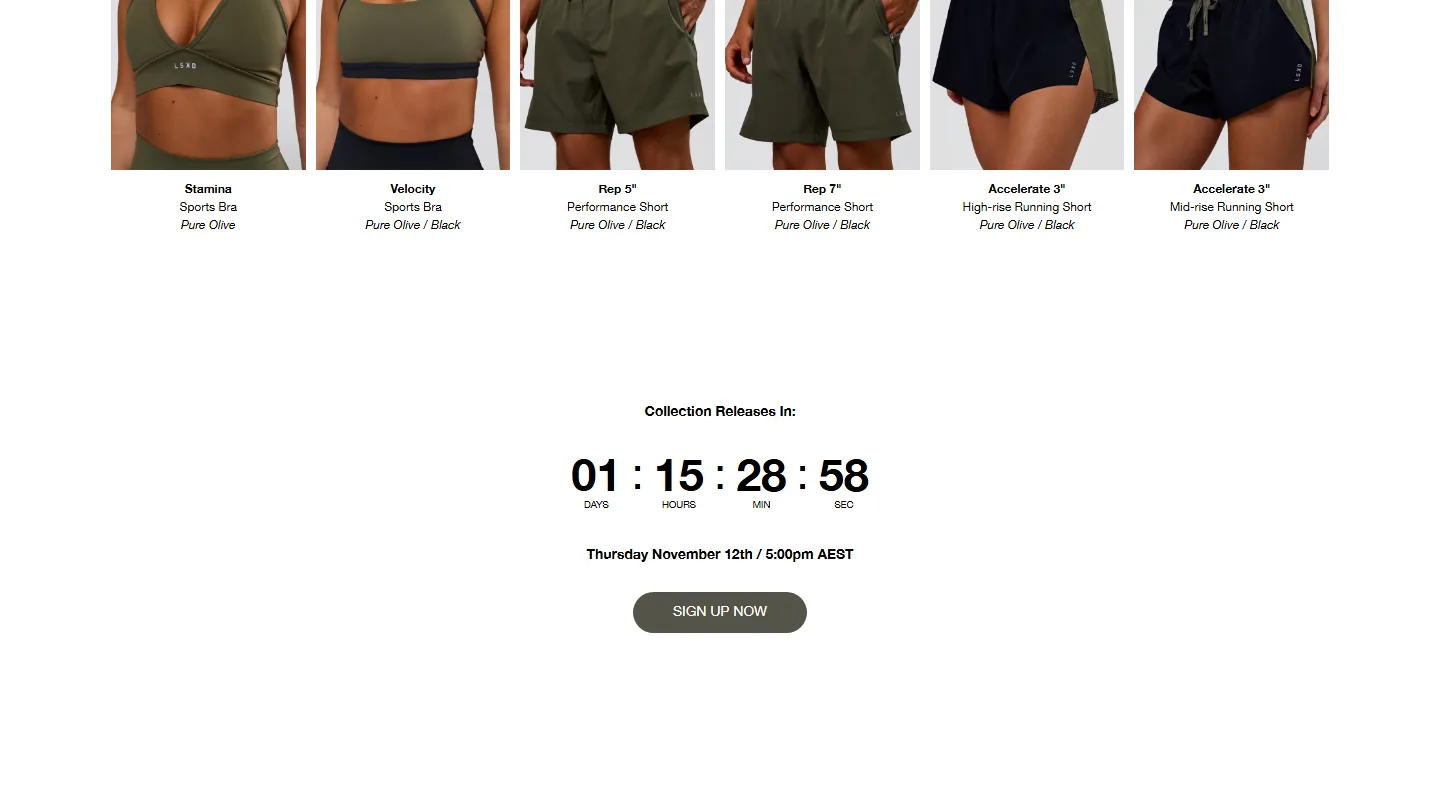
LSKD launches new collections through drop pages that preview the products and count down to the release while collecting email sign-ups. The Australian brand sells gym and running apparel for women and men, and its main Australian store runs on Shopify.
Each drop page shows the upcoming collection in a product grid and states the day and time it goes on sale. Shoppers who sign up are promised the collection first, so the store has an audience to notify the moment the drop goes live.
What you can learn: Before your next launch, publish the preview page first and message the sign-ups when sales open.
Peak Design: colors sold only on its own store
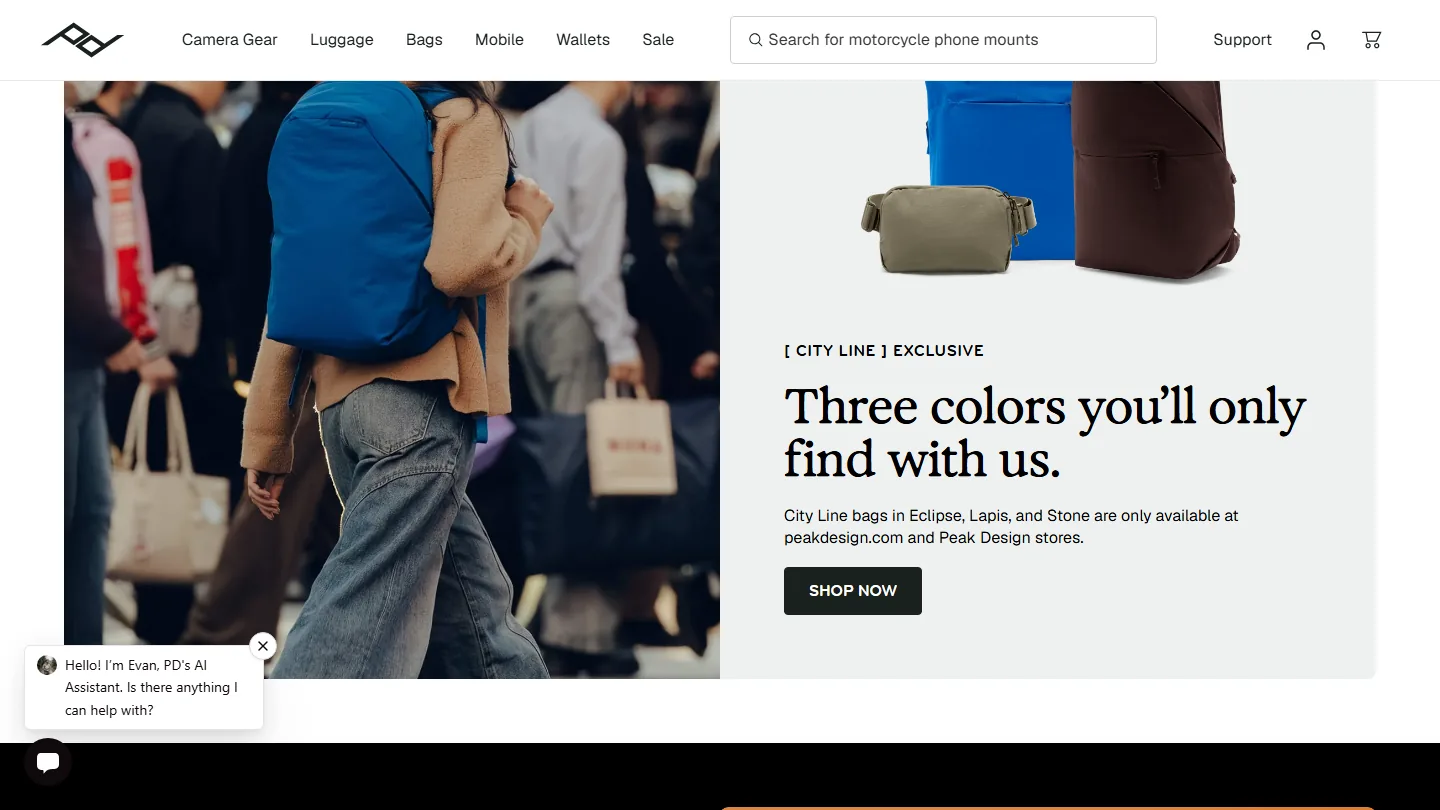
Peak Design keeps three colors of its City Line bags for its website and stores. The company sells camera gear and travel bags and began with a Kickstarter campaign by founder Peter Dering. ECDB estimates its 2025 online sales at about $28 million, and its storefront runs on Shopify’s Hydrogen framework.
Retailers stock Peak Design too, so a shopper has several places to buy the same bag. Three colors, Eclipse among them, exist only on Peak Design’s own site and in the brand’s stores, which sends buyers who want them to Peak Design itself.
What you can learn: If retailers carry your products, hold back a color or an edition for your own store.
Rad Power Bikes: a nine-question e-bike finder quiz
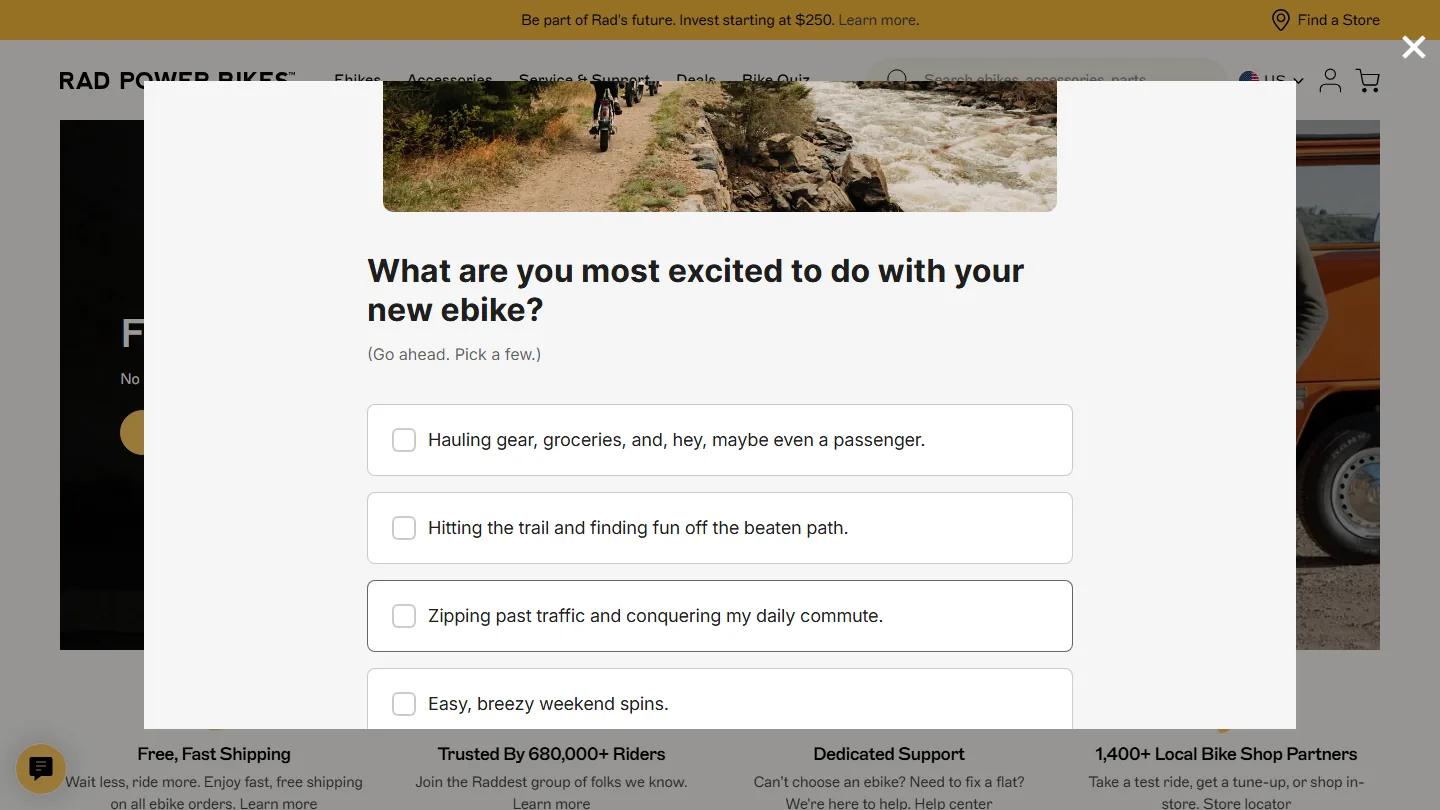
Rad Power Bikes matches buyers to an e-bike with a nine-question quiz that opens from the homepage. The range runs from city commuters to cargo models, and founder Mike Radenbaugh built his first e-bike in 2005. Its U.S. store runs on Shopify, and ECDB estimates the brand’s online sales at about $90 million in 2025. It was sold after a 2025 bankruptcy.
The first question asks what the rider most wants to do, with answers like hauling groceries or zipping past traffic. Bike categories with close specs are hard for a new buyer to compare, and plain-language answers do the sorting.
What you can learn: Write your quiz around how the product will be used and leave the specifications to a comparison page.
Stanley: an engraving customizer on bestsellers
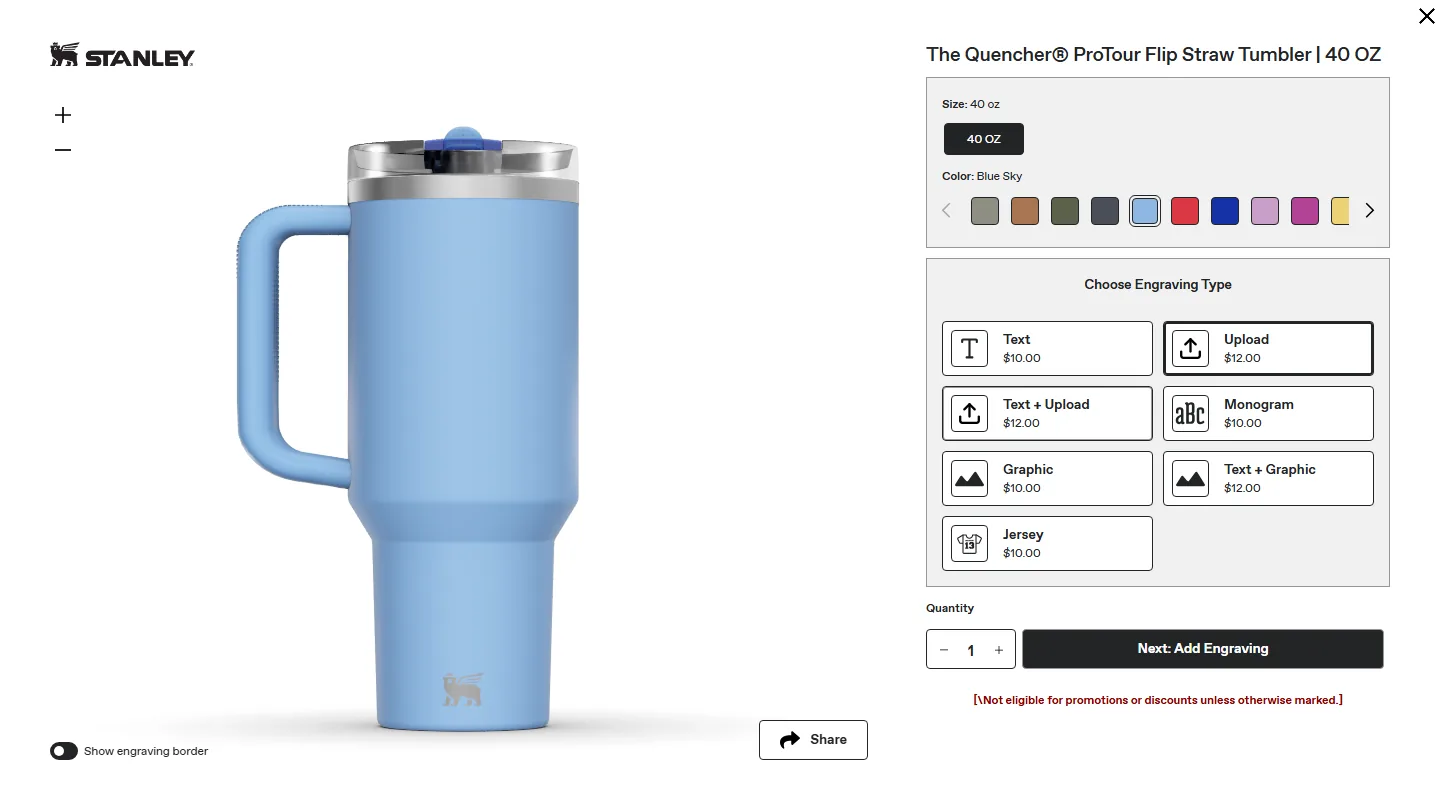
Stanley adds an engraving customizer to its bestselling tumblers, opened from a Customize button on the product page. The brand traces its origin to 1913 and sells insulated drinkware such as the Quencher. Its U.S. store runs on Shopify, and Stanley made about $401 million in online sales in 2025, according to ECDB’s estimate.
Inside the designer, shoppers choose an engraving type, with text or a monogram at $10 and an uploaded design at $12. A tumbler sold everywhere becomes a one-off gift that only Stanley’s own store can make.
What you can learn: Offer a paid personalization that exists only on your site if retailers sell your products as well.
Vuori: free workout classes that lead to outfits
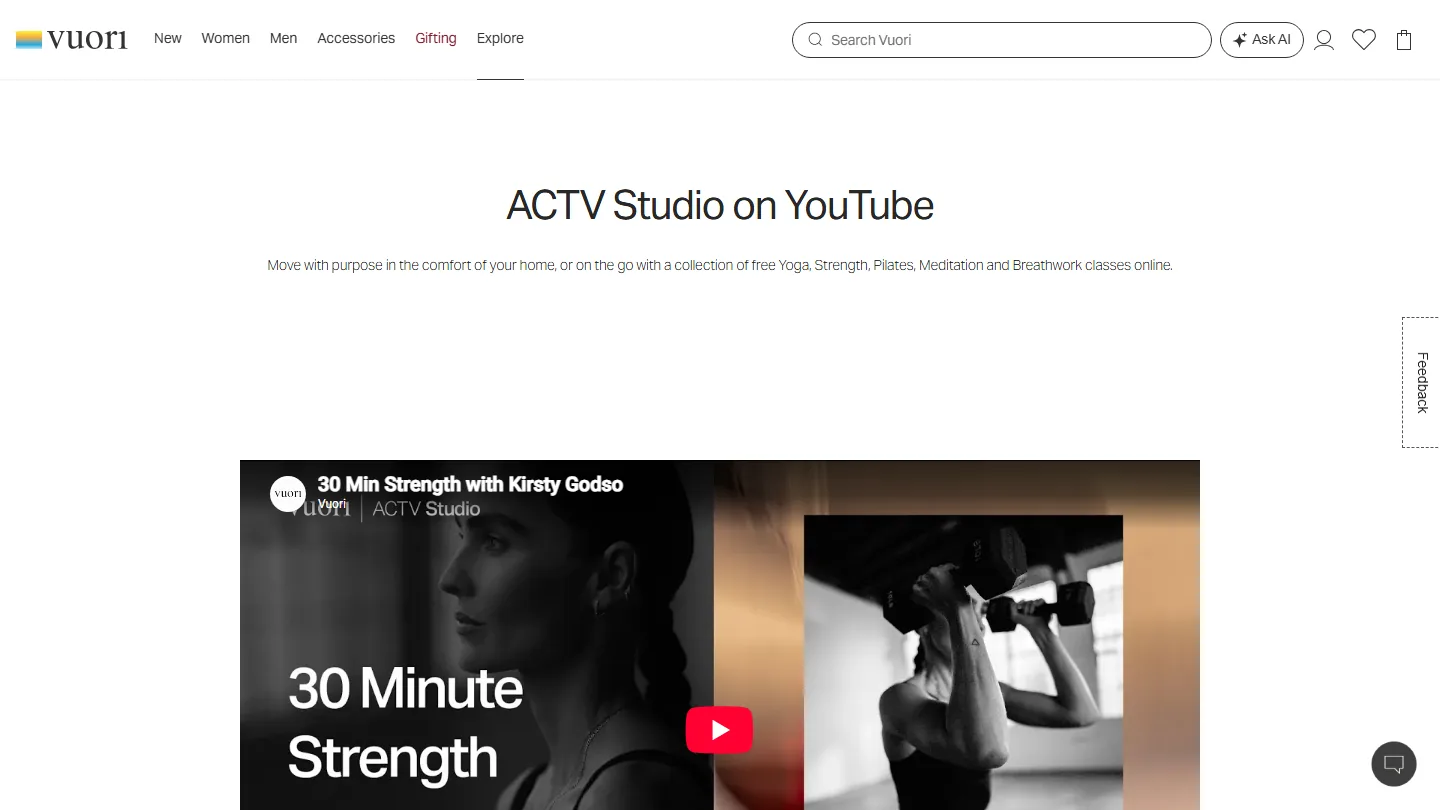
Vuori brings shoppers back with free workout classes on its ACTV Studio page, followed by the outfits the instructor wears. The brand sells performance apparel for women and men, and its headless storefront runs on Shopify. Vuori sold about $213 million online in 2025, according to an ECDB estimate.
The page embeds a strength session led by instructor Kirsty Godso and points to free yoga and Pilates classes on YouTube. Below, a Shop Kirsty’s Looks row lists what she wears, so the class works as a product page too.
What you can learn: Publish free content for the activity your product is used in, and show the products in use.
Shopify stores growing with Omnisend
Dukier, Coogee Bikes, Empress Athleticus, and MUSS are four Shopify stores growing with Omnisend, and each has published its numbers in a customer story. All four run on Shopify, which we checked the same way as the stores above.
Dukier is a Madrid-based dog accessories brand that sells harnesses, leashes, collars, and apparel in five countries. Its welcome, abandoned cart, and lead capture automations run in five languages. Revenue attributed to Omnisend grew 525% between 2022 and 2025, from €82,857 to €518,860, and automations delivered 55% of the 2025 figure. Read Dukier’s full story.
Coogee Bikes, a Sydney e-bike brand founded in 2025, sells road-legal electric bikes across Australia and New Zealand. Buyer questions about legality, range, delivery, and support are answered in its welcome series. According to the Coogee Bikes story, that series brings in 58% of the brand’s Omnisend-attributed revenue, and automations as a whole account for 94%.
Empress Athleticus is a size-inclusive activewear brand from Australia’s Sunshine Coast with a new drop every Wednesday. It pairs a segmented weekly drop sequence with welcome, abandoned cart, and post-purchase flows. The Empress Athleticus story reports 165% email revenue growth in 2025 and 2,092 orders from the welcome series in 2026.
MUSS is a Latvian wellness brand that makes fruit snacks, chanterelle products, and superberry extracts. It sends SMS as a follow-up only to people who didn’t open an email. As the MUSS story explains, its open rate averaged 24.7% in March and April 2025, before the move to Omnisend, and 34.8% in the same months of 2026.
Almost 50% of our revenue comes from Omnisend, and more than half of that success is thanks to intelligent email automations that convert more and better
Turn inspiration into action for your Shopify store
Start with one of the six patterns in this article, such as a quiz or a bundle builder, and add it to the page where your shoppers hesitate most. These 73 Shopify stores show that while industries vary, the patterns behind successful stores are consistent, which makes them a practical starting point for anyone learning how to make money on Shopify.
Then set up the emails and SMS that follow each sign-up, which you can do with Omnisend for Shopify. If you want help with the rest of the store’s routine work, see our list of Shopify AI tools.
Quick sign up | No credit card required