
 Omnisend AI


 OFFER
OFFER







Research
Drive sales on autopilot with ecommerce-focused features
See FeaturesKey takeaways 
AI is now utilized by 88% of organizations, highlighting its critical role in modern business functions and marketing strategies.
A significant 65% of CMOs anticipate that AI will drastically alter their roles by 2026, indicating a shift in marketing leadership dynamics.
Companies are increasingly investing in AI, with 92% planning to boost their AI budgets over the next three years to enhance marketing efficiency and personalization.
AI-driven personalization can lead to a revenue increase of up to 41%, showcasing its importance in enhancing customer engagement and conversion rates.
Reveal key takeaways
AI marketing statistics are reshaping how ecommerce brands strategize and grow in 2026, as AI adoption across core business functions continues to accelerate.
Understanding the latest AI marketing statistics is now crucial for staying competitive, with the advantage increasingly tied to how well brands interpret data and turn insights into actionable steps.
This data-backed guide covers up-to-date AI adoption trends, measurable benefits, key use cases, and channel-specific insights across email, SMS, and omnichannel marketing. Each statistic is accompanied by clear context and practical takeaways.
All data are sourced from studies published between 2023 and 2025 and are updated quarterly. If you want to make data-driven decisions in 2026, make this guide your go-to resource.
Let’s get started!
Turn AI marketing statistics into results by using Omnisend’s AI features for ecommerce growth today
Quick sign up | No credit card required
Key AI marketing statistics for 2026 at a glance
Here are the most critical AI marketing statistics from 2025 to bookmark:
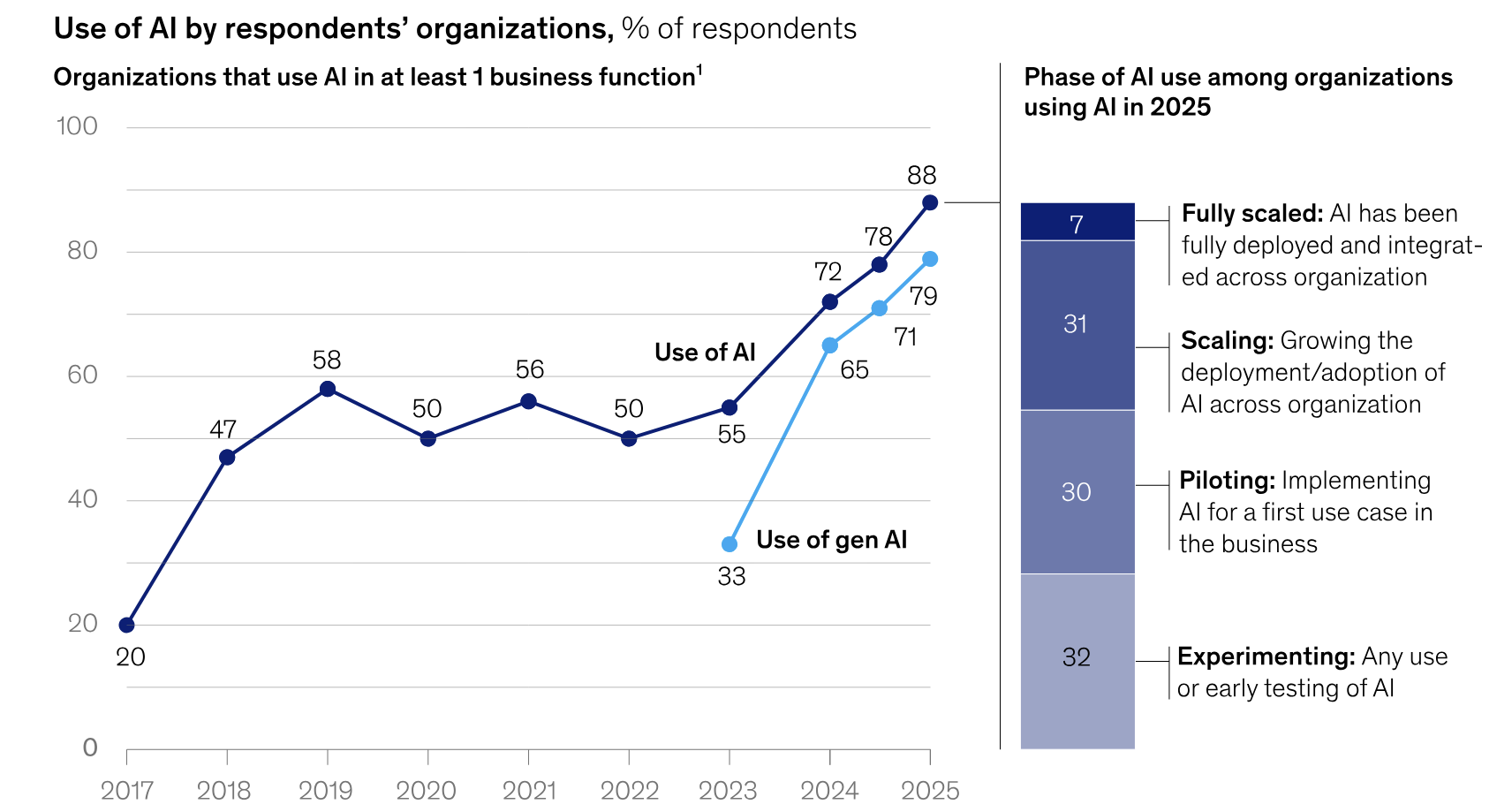
- Stat #1 – 88% of organizations now use AI in at least one business function.
According to recent research, nearly nine in ten organizations report regular use of AI. The image below shows the use of AI in organizations from 2017 to 2025:
- Stat #2 – 65% of CMOs say AI will significantly change their role in 2026.
This signals a significant shift in how marketing leaders expect AI to impact strategy, budget allocation, and performance measurement.
- Stat #3 – 73% say AI plays a role in creating personalized customer experiences.
The stats indicate that AI personalization has become essential for improving customer engagement and driving conversions.
- Stat #4 – 92% of firms plan to increase AI budgets in the next three years.
Companies are allocating more budget to AI to improve growth in automation, personalization, and marketing efficiency.
- Stat #5 – 43% of marketing professionals automate repetitive processes with AI.
AI is streamlining routine marketing tasks in ecommerce, thereby allowing teams to focus on higher-value work and growth.
- Stat #6 – 50% of companies are already using AI in marketing.
Half of organizations have integrated AI into marketing, making it a core component of their ecommerce strategy.
- Stat #7 – 78% of companies plan to increase AI spending in the next fiscal year.
For ecommerce, this indicates a clear shift in which AI is becoming an integral part of everyday operations.
- Stat #8 – The AI marketing industry is valued at $47.32 billion in 2025.
This growth reflects increased investment confidence and the rapid expansion of tools. The image below shows a projection of up to $107.5Bn in AI marketing growth by 2028:
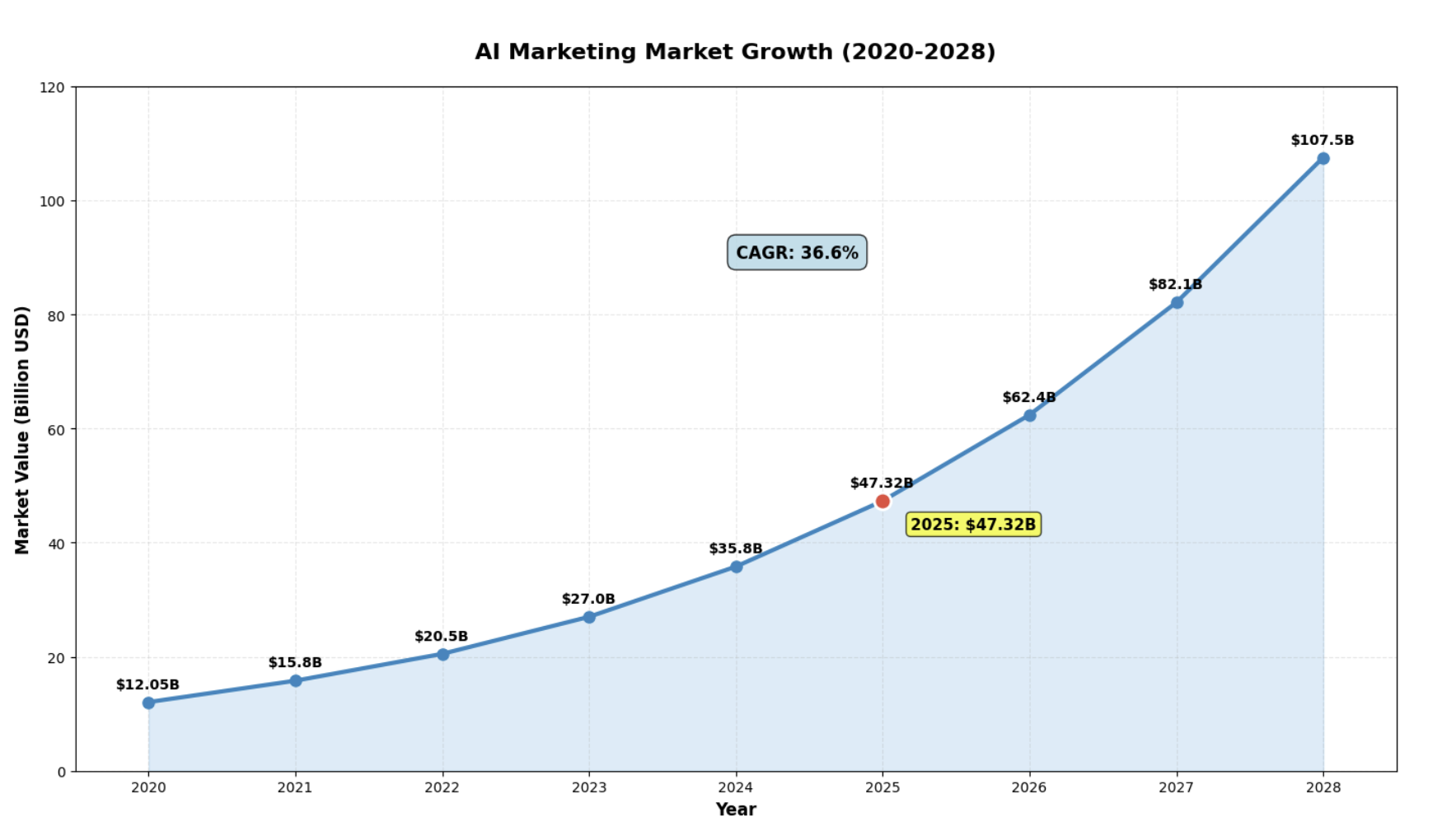
The trend is clear: companies and organizations using AI strategically see measurable performance advantages.
Top AI marketing statistics from 2025
| Stat | Stat |
|---|---|
| $47.32B | AI marketing industry size |
| 90% | Firms plan to increase AI budgets in the next three years |
| 88% | Organizations use AI in at least one business function |
| 65% | CMOs say AI will significantly change their role by 2026 |
| 50% | Companies are already using AI in marketing |
AI adoption in marketing: Who’s using it and how fast it’s growing
AI adoption in marketing and ecommerce has grown rapidly from 2023 to 2025 as tools have matured and ROI has become easier to track.
Today, brands use AI in email marketing, chatbots, and on-site experiences, with adoption continuing to accelerate.
Here are some stats:
- In 2023, roughly 55–60% of marketers used AI in some form
- By 2024, adoption crossed 70%, driven by generative AI
- In 2025, data shows usage approaching 90%, especially among digital-first teams
This shows how deeply AI is now embedded into daily workflows. Here’s a breakdown of AI adoption across company size and industries:
AI adoption by company size
- For enterprise teams (10,000+ employees)
- For mid-market companies (250 – 999 employees)
- 75% adoption
- 53% feel only somewhat prepared to adopt and implement generative AI
- For small and medium-sized businesses (50-249 employees)
- 34% adoption
- 75% of SMBs are experimenting with AI
AI adoption by industry
- Ecommerce and retail
- 70–75% adoption among digital brands
- Common in email marketing, product recommendations, and lifecycle automation
- B2B services and SaaS
- 70–75% use
- Focus on analytics, lead scoring, and content generation
- Traditional industries
- 50–60% adoption
- Usage limited to isolated experiments
Marketing teams now clearly distinguish between AI experimentation and full integration. Fully integrated teams utilize AI across multiple channels and workflows, rather than isolated tasks.
Barriers to AI adoption
Despite rapid growth in AI usage, the following barriers remain:
- Budget constraints: 34% of marketers cite budget constraints as a barrier to adopting AI
- Skills gaps: 67% of marketers say a lack of education and training is a top barrier to adopting AI in marketing
- Data quality issues: Data privacy or security concerns and integration challenges also rank among the top hesitation factors for marketers exploring AI
- Change management resistance: Teams often resist new AI workflows because they fear disruption
“We’re seeing AI move from a competitive advantage to table stakes for ecommerce marketing. Now, it is an essential component of the toolkit.”
— Bernard Meyer, AI Operations Manager at Omnisend
What this means for ecommerce marketers
- If you’re not using AI yet, many of your competitors already are
- Early adopters gain compounding advantages through data and optimization
- Modern platforms now make it possible for SMB ecommerce brands to compete with larger teams without enterprise-level budgets
AI adoption isn’t about the size of your company anymore. It’s now about choosing tools built for your business performance and measurable ROI.
Benefits and ROI of AI in marketing
The benefits of AI are measurable across performance, revenue, and efficiency. In ecommerce, these gains translate directly into sales growth and operational efficiency.
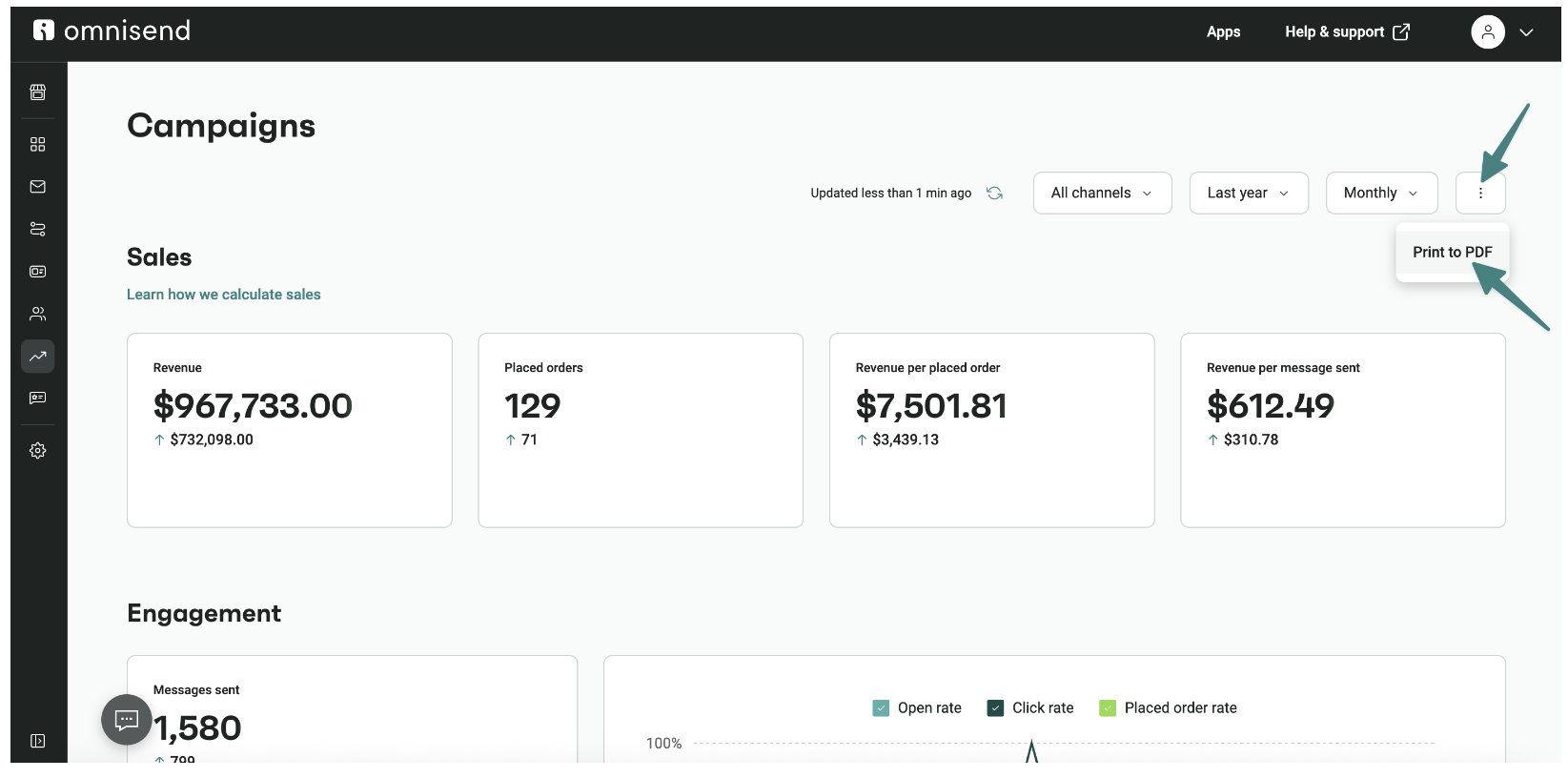
The Omnisend analytics dashboard shows tracking revenue, engagement, and ROI:
The AI marketing statistics below show the impact of AI from various angles:
Performance improvements across channels
AI enhances the timing, personalization, and delivery of messages — brands that use AI report higher engagement across email, SMS, and on-site messaging.
Let’s look at some stats:
- AI-powered personalization can increase revenue by up to 41% and lift click-through rates by over 13%
- 81% of businesses say AI has improved their SMS marketing success
What this means for online stores:
- Your campaigns reach inboxes at the right moment
- You deliver content based on customer intent and improve conversion
Revenue and ROI impact
AI-driven personalization and automation have a direct impact on revenue growth, with ecommerce brands seeing clear lifts from AI-powered recommendations and lifecycle messaging.
Omnisend reports that its U.S. clients generate an average of $79 in revenue for every $1 spent, reflecting the combined ROI of AI-powered automation and real-time personalization across email and SMS, positioning AI as a growth investment, not just a cost saver.
External research supports this pattern. According to McKinsey, companies that invest in AI are seeing a revenue uplift of three to 15% and a sales ROI uplift of 10–20%.
What this means for online stores
- AI directly drives revenue through automation and personalization
- AI automations deliver strong ROI
Efficiency and productivity gains
AI marketing statistics show that marketing teams save significant time by automating repetitive and manual tasks.
Typical efficiency gains include:
- Automated segmentation and audience updates
- Faster campaign setup and testing
- Reduced manual analysis through predictive insights
What this means for online stores:
- AI improves efficiency and productivity
- Small brands can compete with larger brands by using AI to do more with less
Omnisend benchmark at a glance
$79 ROI for every $1 spent
Powered by AI-driven automation, personalization, and ecommerce-first workflows.
– Omnisend proprietary performance data
AI use cases across the marketing funnel
AI now powers every stage of the ecommerce funnel, from awareness to retention. Below are key AI marketing use cases, along with practical ecommerce examples, that you can apply immediately.
Awareness: Reaching the right audience
At the top of the funnel, AI improves targeting and focuses on reach. It helps you attract higher-quality traffic, not just ‘more’ traffic.
Common AI use cases include:
- Ad targeting and lookalike audiences: AI improves audience matching, increasing ad engagement by up to 30%
- Content ideation and creative testing: It speeds up content creation and improves message-market fit
- Predictive channel optimization: AI identifies which channels drive the highest first-touch conversions
For example:
Nike uses AI to target lookalike audiences and serve personalized ads to new potential customers. This helps the brand reach shoppers who have never previously engaged with it.
Quick win: Test AI-generated ad headlines on your highest-traffic product category
Consideration: Personalizing the shopping experience
During the consideration stage, AI focuses on relevance. The goal is to show the right product to the right shopper. When shoppers feel understood during this phase, the decision to purchase becomes much easier.
Key AI use cases include:
- Product recommendation engines based on browsing and purchase behavior
- On-site personalization, adjusting content by visitor segment
- AI chat and product discovery tools to reduce bounce rates and speed up buying decisions
For example:
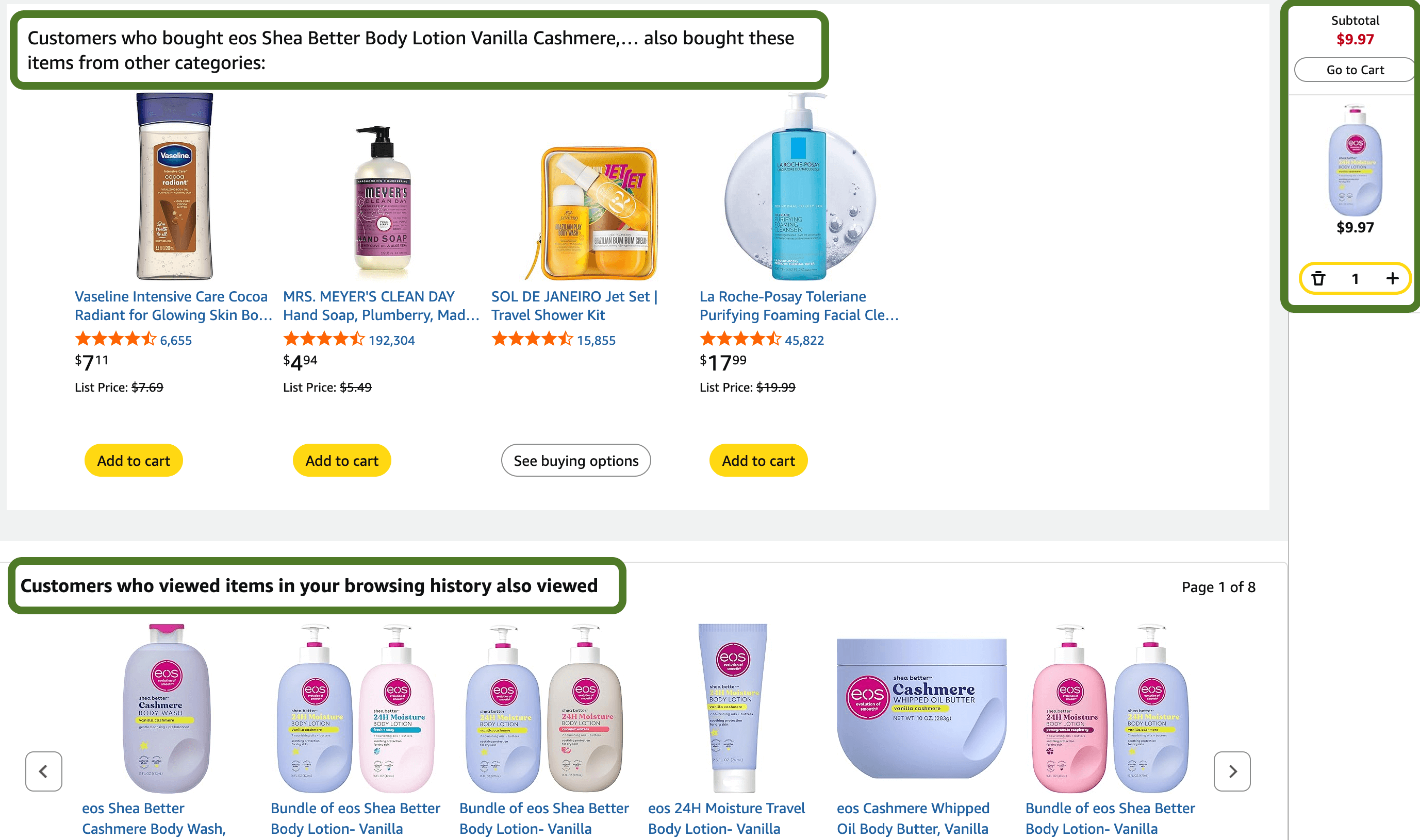
A powerful AI in marketing example for consideration is how Amazon uses AI product recommendations to show related items and drive cross-sell and upsell revenue:
Quick win: Add product suggestions to key landing pages
Conversion: Removing friction at checkout
At the conversion stage, AI removes friction and increases urgency.
Below are some essential conversion-focused use cases from AI landing page optimization to optimized email and SMS timing:
- Landing page optimization: AI tests layouts, headlines, and CTAs to increase conversion rates
- Dynamic offers and incentives: Discounts adjust based on behavior and purchase likelihood
- AI-optimized email and SMS timing: Messages are sent when shoppers are most likely to convert
For example:
ASOS utilized AI to personalize offers, urgency banners, and checkout messaging in real-time. As a result, the brand reduced cart abandonment by 18% and increased checkout conversion rates by 23%.
Quick win: Use AI to A/B test checkout page copy or CTA buttons
Retention: Increasing lifetime value
Retention is where AI compounds value over time. It enables proactive, personalized lifecycle marketing.
Key retention use cases include:
- AI-powered lifecycle automation, from welcome to winback
- Churn prediction by identifying at-risk customers early
- Personalized product replenishment and cross-sell messaging
For example:
Sephora utilizes AI-powered personalization to send targeted reactivation emails that re-engage inactive customers and encourage repeat purchases.
Quick win: Automate a simple winback email for customers inactive for over 90 days
Platforms like Omnisend orchestrate these AI-driven marketing use cases across email, SMS, and automation.
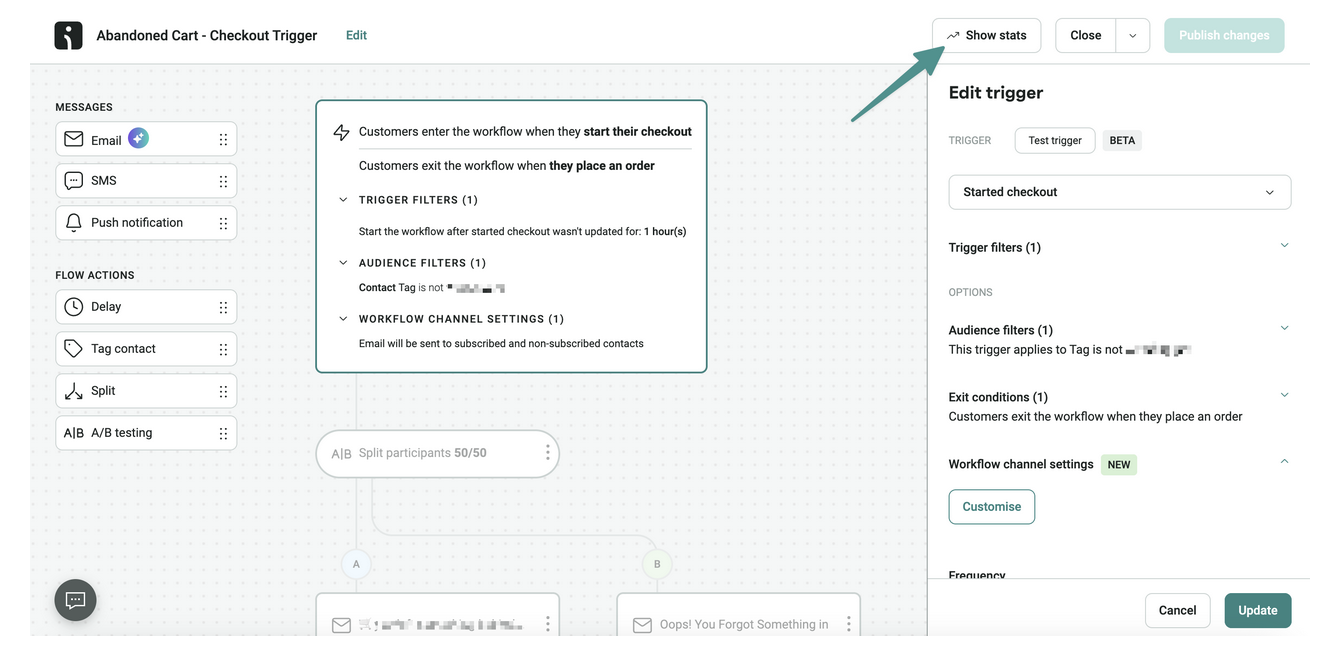
Omnisend’s automation builder visualizes AI-powered customer journeys across email and SMS, from triggers to conversion. This is what AI-driven lifecycle automation looks like in practice:
AI in ecommerce marketing: Statistics that matter for online stores
AI marketing research indicates that personalization, retargeting, and predictive analytics drive significant revenue gains. Tracking AI marketing statistics enables brands to make data-driven decisions throughout the customer journey.
Here are some essential ecommerce-specific AI marketing statistics:
AI-driven personalization in ecommerce
These AI marketing research highlights the power of tailored experiences in ecommerce:
- AOV increase: Personalized experiences increase average order value
- Conversion rates: Shoppers engaging with AI-driven recommendations convert three to five times more than those seeing generic content
- Repeat purchases: Personalization increases repeat purchase rates by 15–20%, which improves your customer LTV
Recovery and retargeting
Cart and browse abandonment remain some of ecommerce’s most significant revenue leaks. AI helps recover lost revenue efficiently at scale.
Cart recovery data shows that:
- 10–20% of abandoned carts can be recovered through automated email and SMS
- Abandonment campaigns see 5–10% conversion rates
- Personalized incentives outperform generic discounts
With platforms like Omnisend, AI triggers abandoned cart and winback flows based on real-time behavior, intent, and timing. This ensures messages reach customers when they are most likely to convert.
The email below is an example of a cart abandonment message designed to encourage the customer to complete their purchase:

Analytics and forecasting
AI is also valuable in marketing analytics. It improves decision-making behind the scenes.
Here are a few benefits:
- More accurate demand forecasting and inventory planning
- Better campaign attribution across channels
- Faster optimization cycles with less manual analysis
This impacts long-term KPIs, such as LTV and margin, not just short-term sales.
If you own an online store, prioritize these AI tactics first:
- Deploy personalized product recommendations in emails and on-site
- Activate AI-driven abandoned cart and browse abandonment flows
- Use predictive analytics for pricing, inventory, and promotions
- Track AI performance metrics (conversion, revenue per visitor, LTV)
Here’s how AI personalization can impact key ecommerce metrics at a glance:
| Metric | Without AI | With AI |
|---|---|---|
| Conversion rate | Baseline | +10–30% |
| AOV | Baseline | +5–15% |
| Repeat purchases | Baseline | +20–25% |
If you run an ecommerce business, these numbers point to clear priorities:
- Use AI-powered personalization to increase AOV and revenue per visitor
- Automate cart and browse recovery with predictive triggers
- Apply AI insights to lifecycle messaging, not one-off campaigns
In ecommerce, AI works best when it’s revenue-first and fully integrated.
AI in email marketing: Statistics and Omnisend benchmarks
Ecommerce brands use AI across welcome, abandoned cart, and post-purchase emails, driving higher open rates, clicks, and revenue for Shopify and ecommerce stores.
For example, an online store utilizing AI-powered subject lines and product recommendations can generate over $ 100,000 in revenue and increase total revenue by up to 70% within a year.
Here are some email marketing trends to know, from adoption to performance metrics:
AI adoption in email marketing
Here’s what to know about AI adoption in email marketing:
- 34% of marketers use AI specifically to write email copy
- SMBs are catching up by using AI for personalization without enterprise-scale resources
- AI is applied across welcome series, abandoned cart flows, and post-purchase campaigns, not just standalone emails
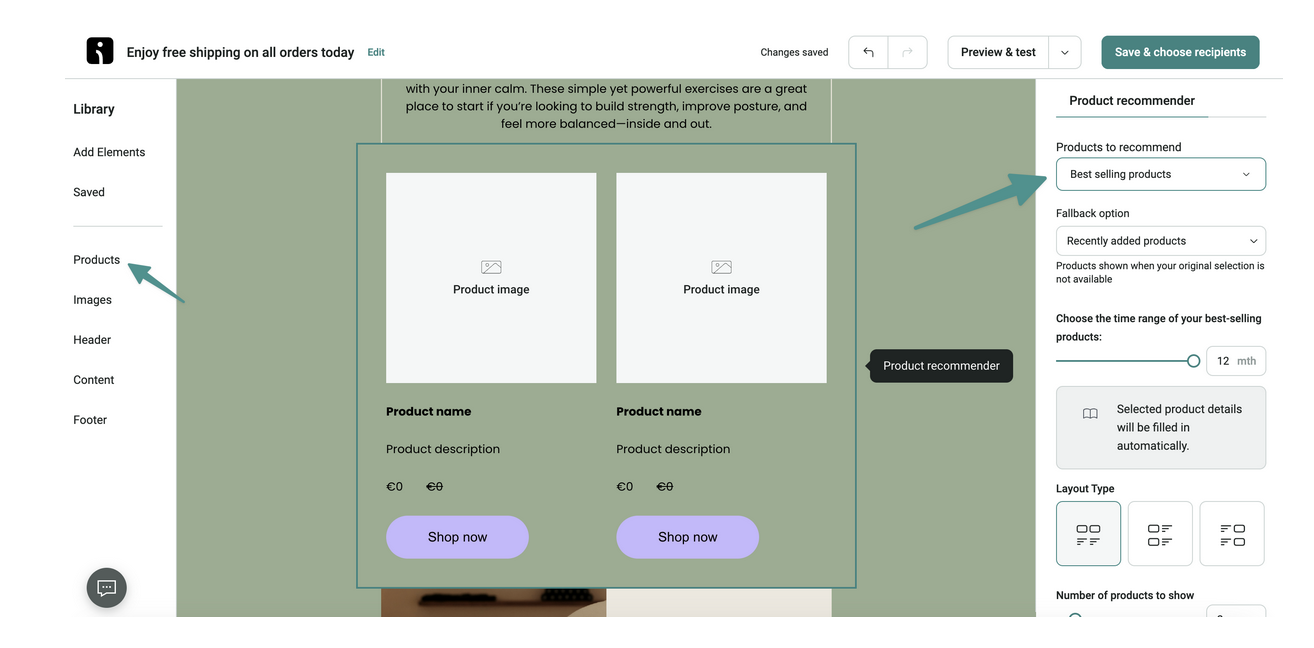
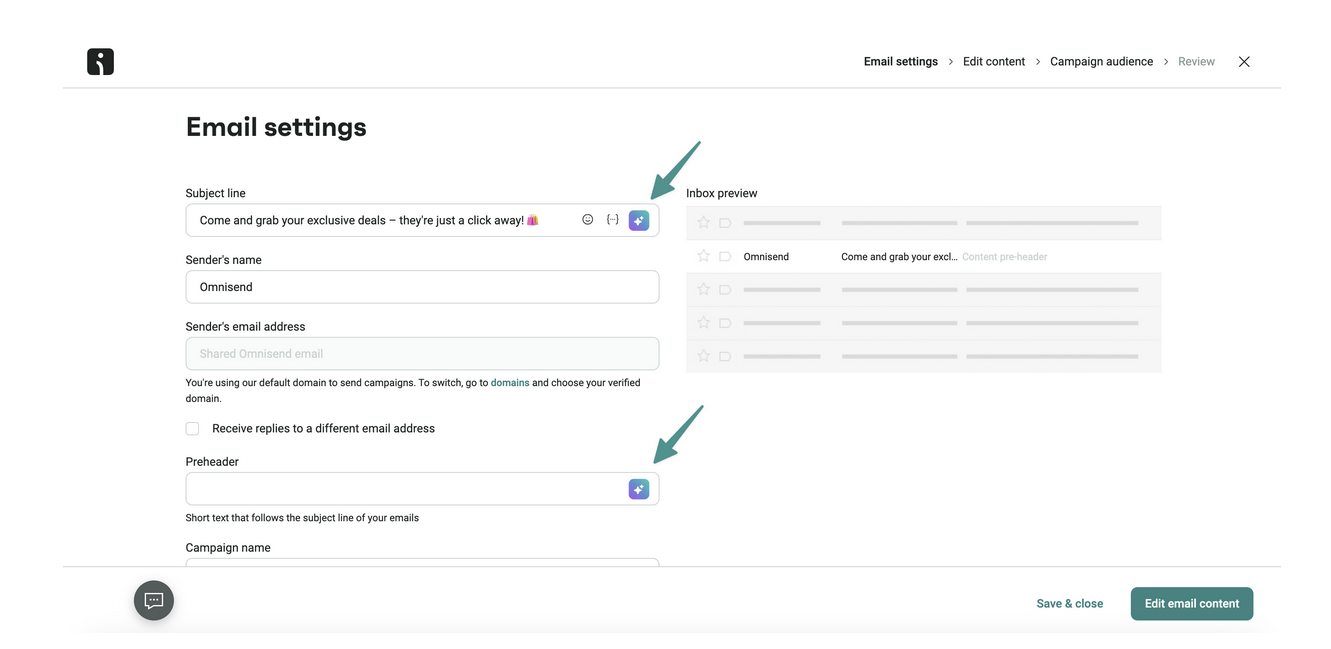
Omnisend’s UX is intuitive and designed for ecommerce marketers to allow for powerful email marketing backed by AI. The screenshot below shows some of Omnisend’s AI email features, including product recommendations and subject line tools:
Performance metrics
AI greatly improves key email metrics such as:
- Open rates: Automated emails achieve 52% higher open rates compared to standard campaigns
- Click-through rates: AI-driven flows see 332% higher click rates, thanks to dynamic content and personalized recommendations
- Revenue per email: Automated AI flows, such as abandoned cart and product recommendations, account for up to 37% of total email revenue
- Unsubscribe/spam complaints: AI-driven personalization reduces irrelevant emails, lowering unsubscribe rates by five to seven percent
Omnisend benchmarks + examples
Omnisend’s proprietary data highlights the tangible impact of AI:
- $79 in revenue for every $1 spent for its US clients on AI-powered email and SMS automation
- Automated flows generate 50%+ of email revenue, outperforming one-off campaigns
- AI personalization increases repeat purchases and AOV, especially with Omnisend’s email + SMS workflows
“What I appreciate most about Omnisend is how it brings together email, SMS, and push notifications seamlessly, allowing me to handle all my customer communications from a single dashboard.”
– Lisa G, via G2 reviews
Here’s a comparison of key email metrics with AI automation versus standard campaigns:
| Metric | Standard campaign | Automated flows |
|---|---|---|
| Open rate | Baseline | +52% higher |
| Click-through rate | Baseline | +332% higher |
| Revenue contribution | Two percent of email revenue | 37% of email revenue |
| ROI | Baseline | $76 per $1 spent |
AI in SMS and omnichannel marketing
AI is transforming ecommerce SMS and omnichannel marketing by optimizing timing, content, and channel selection across the customer journey.
On average, SMS marketing campaigns achieve:
- 27.7% click-through rate
- 3.09% opt-out rate
- ROI of $16.70 for every $1 spent
AI in SMS
SMS is one of the most immediate channels in ecommerce, and AI makes it smarter, not noisier.
Recent data shows that AI-optimized SMS campaigns deliver:
- Higher engagement
- Stronger response rates
- Better conversion
Common AI-driven SMS use cases include:
- Cart abandonment reminders: Triggered only if the email remains unopened
- Browse abandonment messages: Personalized based on products viewed
- Back-in-stock alerts: Sent when purchase intent is highest
To power these AI-driven SMS flows, Omnisend offers global SMS coverage, helping ecommerce brands coordinate SMS and email across regions from a single platform.
AI determines when SMS should complement email, ensuring each message adds value while protecting deliverability and maximizing revenue impact.
AI in omnichannel journeys
Omnichannel marketing reaches its full potential when channels collaborate intelligently, and AI acts as the decision engine behind that coordination.
When email and SMS are connected through AI, brands consistently see higher conversion rates than with email-only campaigns. Automated, behavior-triggered journeys also consistently outperform scheduled campaigns.
To support this level of coordination, Omnisend enables omnichannel journeys with global SMS coverage, ensuring seamless communication across all channels. This helps your brands reach customers across regions from a single platform.
Practical omnichannel examples include:
- Email first, SMS follow-up if the initial message is unopened or ignored
- SMS nudge paired with abandoned cart email for mobile shoppers
- Reinforced product recommendations across email and SMS within the same automated flow
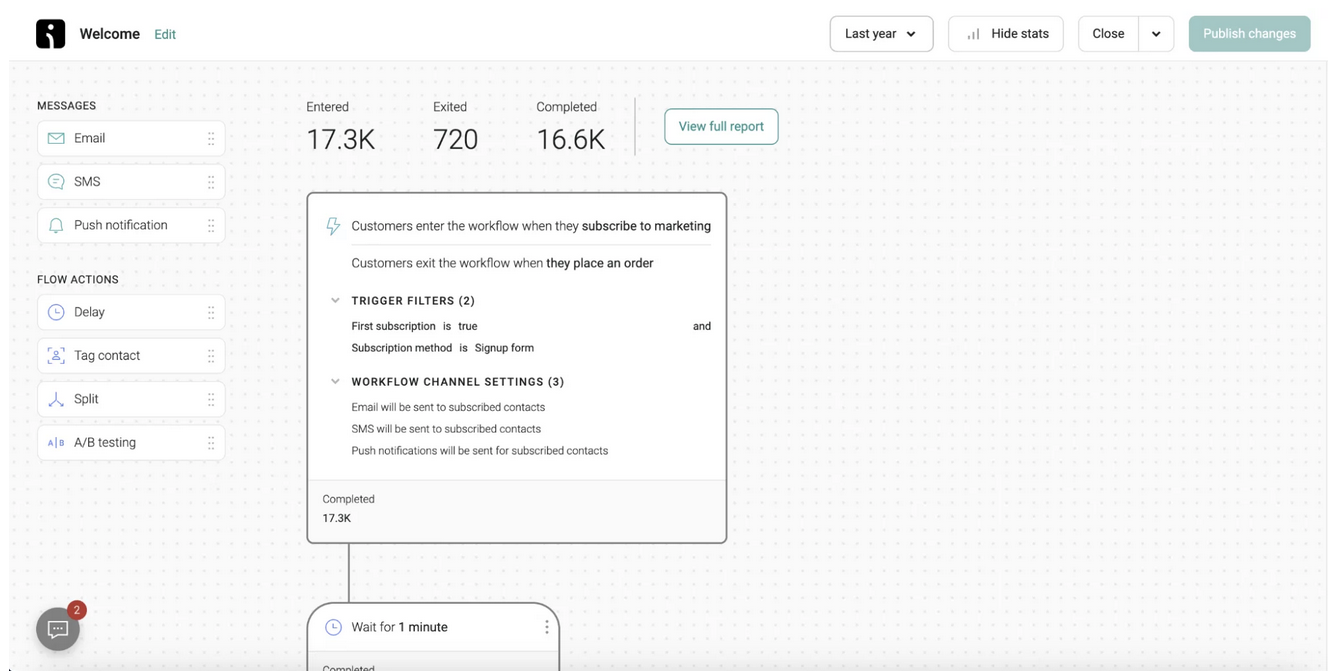
The screenshot below is an example of Omnisend’s omnichannel workflow for Katie’s Backdrop. It shows how email, SMS, and push notifications work within a single automated journey:
AI in attribution and analytics
AI also improves how you measure performance. Instead of guessing which channel drove the sale, AI in marketing analytics examines cross-channel behavior. This reveals what truly drives conversions.
This helps your team:
- Understand how SMS contributes to email-driven conversions
- Optimize channel mix based on revenue, not just clicks
- Allocate budget toward flows that increase LTV
AI for small and mid-sized ecommerce businesses
In different industries, SMBs are quickly adopting different AI tools for small businesses and seeing great results. From using AI in marketing analytics to predictive analysis, here’s what that looks like:
Adoption and ROI for SMBs
A recent survey shows a rise in AI adoption among SMBs from 47% to 68% in at least one marketing function. While many perceive AI as costly or complex, actual implementation is increasingly accessible.
Key performance insights for SMBs:
- AI-powered automation improves email and SMS engagement
- Personalized campaigns lift conversion rates
- AI-driven abandoned cart flows can help you recover lost revenue
For SMBs, this means
- AI can deliver measurable ROI without large teams or technical resources
- Every interaction is relevant in increasing revenue per customer
As a small or medium-sized business, AI can help you do more with the team you already have.
Tools and budgets
No-code and low-code AI tools allow SMBs to implement marketing automation and personalization efficiently. Many SMBs still hesitate because of perceived barriers like:
- High costs
- Complex setup
- Technical expertise requirements
In practice, most ecommerce AI tools today are no-code or low-code. They also integrate directly into platforms like Shopify and WooCommerce.
For instance, when you use Omnisend, you can access:
- AI-assisted subject lines and content
- Predictive send-time optimization
- Automated email and SMS flows
- Ecommerce-focused segmentation and recommendations
Additionally, Omnisend’s free plan provides access to these ecommerce-focused AI features, supported by 24/7 guidance.
Implementation path for SMBs
Your brand can use AI without disruption if you implement this path:
This week
- Enable AI-assisted subject lines
- Turn on send-time optimization for campaigns
This month
- Launch abandoned cart and welcome automations
- Add product recommendations to emails
This quarter
- Expand into SMS automation
- Optimize flows using performance data
“Omnisend has proven to be an ideal solution for the types of ecommerce brands we work with — especially those in the early to mid-growth stage. It offers the right balance of powerful automation features, user-friendly design, and accessible pricing.”
— Omar Juman, Co-Founder, Blue Drop Studio
The table below shows how AI adoption now compares between enterprise brands and SMBs:
| Area | Enterprise ecommerce | SMB ecommerce today |
|---|---|---|
| AI adoption | Custom-built or heavily engineered systems | Plug-and-play tools built into ecommerce platforms |
| Cost | High upfront and ongoing investment | Free or affordable monthly plans |
| Setup | Requires data teams and lengthy onboarding | No-code or low-code setup |
| ROI | Months to see impact | Weeks, sometimes days |
| Use cases | Advanced modeling and custom workflows | Email, SMS, automation, personalization |
| Results | Scaled efficiency across large volumes | Measurable increase in conversion, revenue, and retention |
Challenges, risks, and ethical considerations in AI marketing
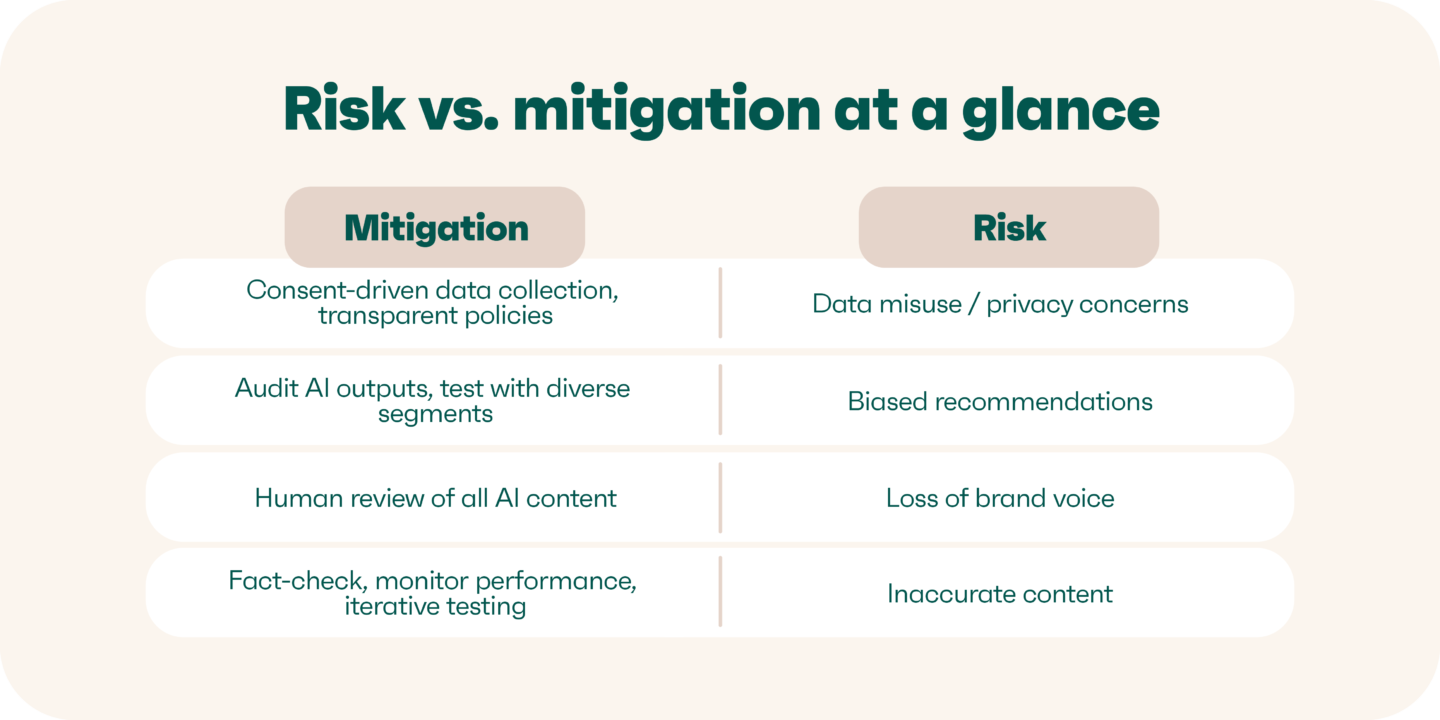
AI offers enormous potential in ecommerce marketing, but it also introduces real risks and ethical concerns. Responsible adoption requires understanding these challenges and knowing when human oversight is essential:
Privacy and trust
Consumer trust remains a significant barrier. A recent survey found that 71% of consumers are concerned about how brands use AI and personal data.
Key privacy and trust risks include:
- Unauthorized data usage or breaches
- Lack of transparency in AI-driven recommendations
- Non-compliance with regulations such as GDPR or CCPA
Mitigation tips
- Always collect and store data with consent
- Clearly disclose when personalization or recommendations are AI-driven
- Regularly audit data usage and security protocols
Accuracy and bias
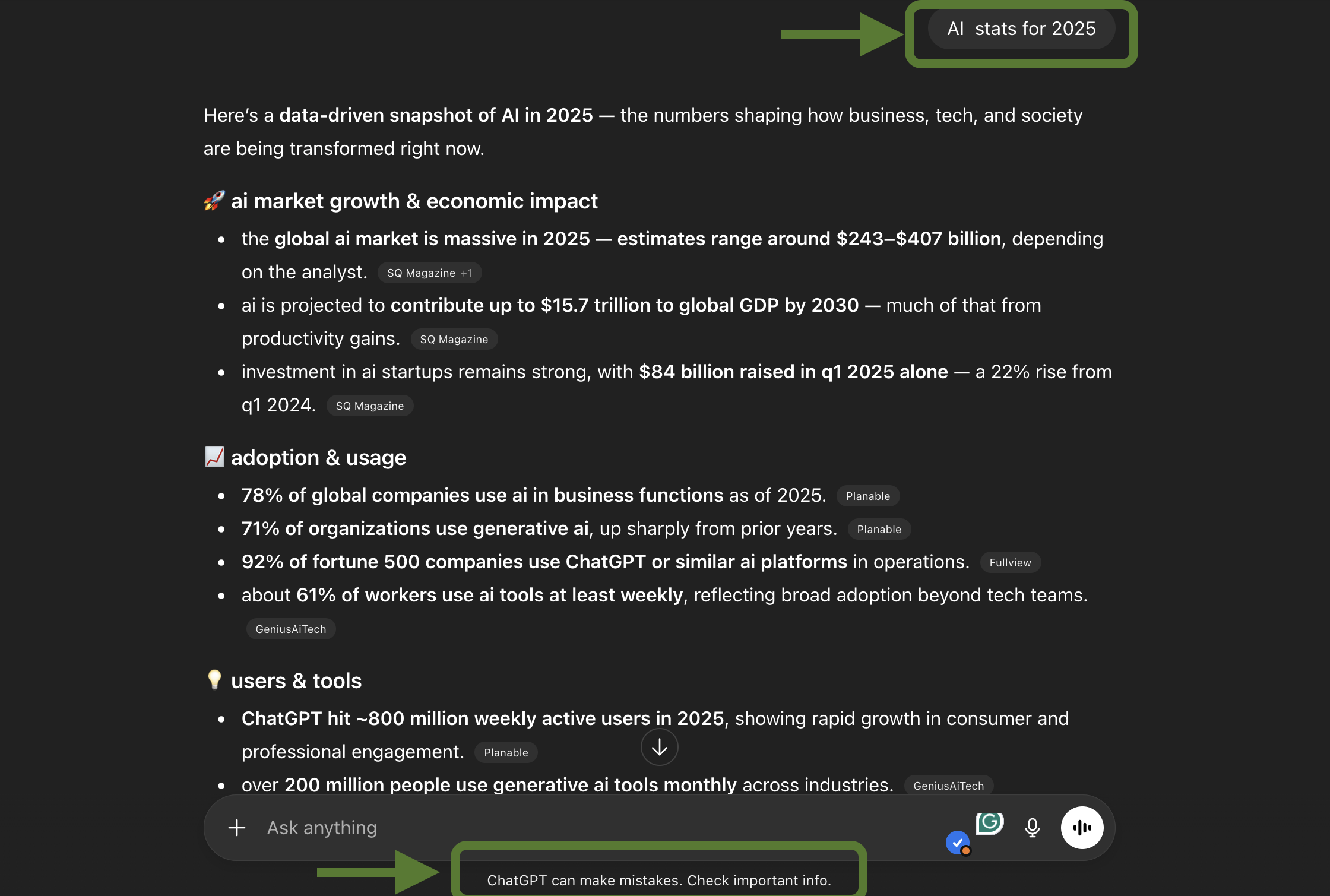
AI can produce inaccurate outputs, which may misrepresent products or customers. The result of a prompt “AI stats in 2025” on ChatGPT shows how the AI informs users that it can make mistakes:
Common accuracy risks include:
- Incorrect or misleading AI-generated content in emails, SMS, or ads
- Biased targeting that excludes specific audiences, reducing inclusivity
- Over-automation leading to impersonal messaging
Mitigation tips
- Review AI-generated content before sending
- Test campaigns for fairness and accuracy
- Combine AI insights with human judgment
When not to use AI
AI is not suitable or appropriate for every single type of messaging.
Avoid using AI in situations where these are involved:
- Highly sensitive content (for example, complaints, refunds, legal notices)
- Legal or regulatory statements requiring precise language
- Messaging requiring nuanced human empathy
What this means for ecommerce brands
- Use AI as a tool, not a replacement for human oversight
- Maintain your brand voice and ethical standards in all campaigns
Responsible AI usage improves performance while protecting trust. Platforms like Omnisend combine AI-powered automation with secure data practices to ensure you scale campaigns ethically and effectively.
Methodology, sources, and how often this page is updated
This hub is designed to provide reliable, up-to-date insights on AI marketing statistics in ecommerce. Transparency in sourcing and methodology ensures that you can trust the data and apply it confidently.
External research
All external statistics and trends are sourced from credible and recent sources. This means:
- Only sources from the past three years are included to ensure relevance
- Types of sources:
- Industry reports from organizations like McKinsey, Gartner, and PwC
- Surveys of marketers and ecommerce brands
- Academic research on AI and digital marketing trends
- Verified third-party benchmarks from platforms like G2, Capterra, and Statista
This approach ensures that:
- Our data reflects the current state of AI adoption and performance
- You can cite these studies confidently in reports or presentations
Omnisend proprietary data
Omnisend’s benchmarks, such as the $79 ROI per $1 spent, are collected directly from our ecommerce customer base. They are:
- Aggregated and anonymized to protect individual business data
- Calculated across thousands of campaigns and flows
- Reflected performance from automated email, SMS, and AI-powered personalization
This means:
- Omnisend data provides actionable insights grounded in real ecommerce results
- You can benchmark your own campaigns against verified performance
Update cadence
This hub is a living resource, updated quarterly to reflect AI in marketing statistics, new AI trends, adoption data, and ecommerce insights.
- Last updated: January 2026
- Updates include new external research, fresh Omnisend benchmarks, and revised best practices
You can also bookmark this page for ongoing reference
How to cite this page
- Include the page title, Omnisend as the publisher, and the last updated date.
- Example: “AI in Ecommerce Marketing Hub,” Omnisend, Last updated January 2026.
Regular updates and transparent sourcing make this hub a trusted resource for any marketer seeking to utilize AI responsibly and effectively.
Conclusion: Applying AI marketing statistics to your ecommerce strategy
AI is now ubiquitous in ecommerce marketing, with email, SMS, and omnichannel automation delivering the most measurable impact.
The most significant opportunities arise from fully integrated campaigns, where AI-driven personalization and automation are leveraged across the entire customer journey.
Intuitive yet powerful platforms like Omnisend enable companies of any size to achieve a substantial ROI without requiring enterprise-scale resources.
This hub is a living resource, updated quarterly, offering the latest AI marketing statistics to guide your decisions.
To make these stats on AI count, test AI-powered workflows, monitor performance, and iterate on campaigns. Your 2025 ecommerce strategy will only deliver results if you put these insights into practice.
Sign up with Omnisend today and get $79 back for every $1 spent
Quick sign up | No credit card required
FAQs
How widely is AI used in marketing in 2025?
In 2025, approximately 75–80% of marketers utilize AI in some capacity, ranging from email personalization to automated SMS campaigns, across both enterprise and SMB ecommerce brands.
What are the biggest benefits of AI in ecommerce marketing?
Benefits of AI in ecommerce marketing include:
— Improved efficiency
— Higher productivity
— Stronger personalization
— Better ROI
What channels benefit most from AI in marketing — email or SMS?
Both channels benefit, but combining them in omnichannel flows maximizes engagement, conversions, and revenue per customer.
How often are these AI marketing statistics updated?
These AI marketing statistics are updated quarterly, and only sources within the past three years are included. This ensures accurate and actionable insights for ecommerce teams.
Can small and mid-sized ecommerce brands achieve meaningful results with AI?
Yes! SMBs that utilize AI for email, SMS, and automation can achieve measurable ROI, higher repeat purchase rates, and enhanced customer engagement.

TABLE OF CONTENTS
TABLE OF CONTENTS


Subscribe and don’t miss any updates!
No fluff, no spam, no corporate filler. Just a friendly letter, twice a month.