Omnisend AI
 OFFER
OFFER



Customer lifecycle management is a key practice for tracking where all your customers sit in their journey and assigning them to relevant stages.
Knowing their stage and setting up the systems that automatically send the right messages at the right moments is how you cover their complete journey. You then maximize opportunities to turn one-time buyers into repeat customers and loyalists.
Covering acquisition to advocacy stages helps you grow your revenue and customer lifetime value, and reduce acquisition costs.
This article is a complete guide to customer lifecycle management for your store, covering what it is, the stages, models, processes, best practices, and how AI is shaping it.
Quick sign up | No credit card required
What is customer lifecycle management?
Customer lifecycle management (CLM) is the practice of managing how you engage with customers at every stage of their relationship with your brand, from the first time they hear about you through to long-term loyalty.
The lifecycle isn’t a straight line, with your customers skipping stages and hopping between them. A loyal repeat buyer can lapse into inactivity, and a first-time customer can become a champion within weeks; there’s no stopping those movements.
You can account for them, though, with CLM.
Customer lifecycle management definition
CLM is the ongoing management of customer relationships across each lifecycle stage, using data to decide what each customer needs next and acting on it.
It covers your complete customer arc from acquisition to retention and reactivation, treating the relationship as something to be guided rather than a series of one-off transactions.
It’s worth separating CLM from customer lifecycle marketing. Lifecycle marketing is the messaging you send at each stage, the welcome email, and the winback offer.
CLM is the wider discipline that decides which customers are at which stage and what should happen to move them forward. Marketing is one of the tools CLM uses, not the whole thing.
CLM vs. CRM: what’s the difference?
A CRM (customer relationship management) is software that lets you manage and collect customer data. It stores customer records, tracks interactions, and gives you a single view of who your customers are and what they’ve done. CLM is what you do with that information.
Put simply, CRM tells you a customer bought twice in the last year and hasn’t opened an email in 60 days. CLM is the decision to move them into a reactivation flow because of it.
One holds the data, the other acts on it. Your ecommerce store might need both, with the CRM feeding the lifecycle decisions CLM makes.
Customer lifecycle management stages
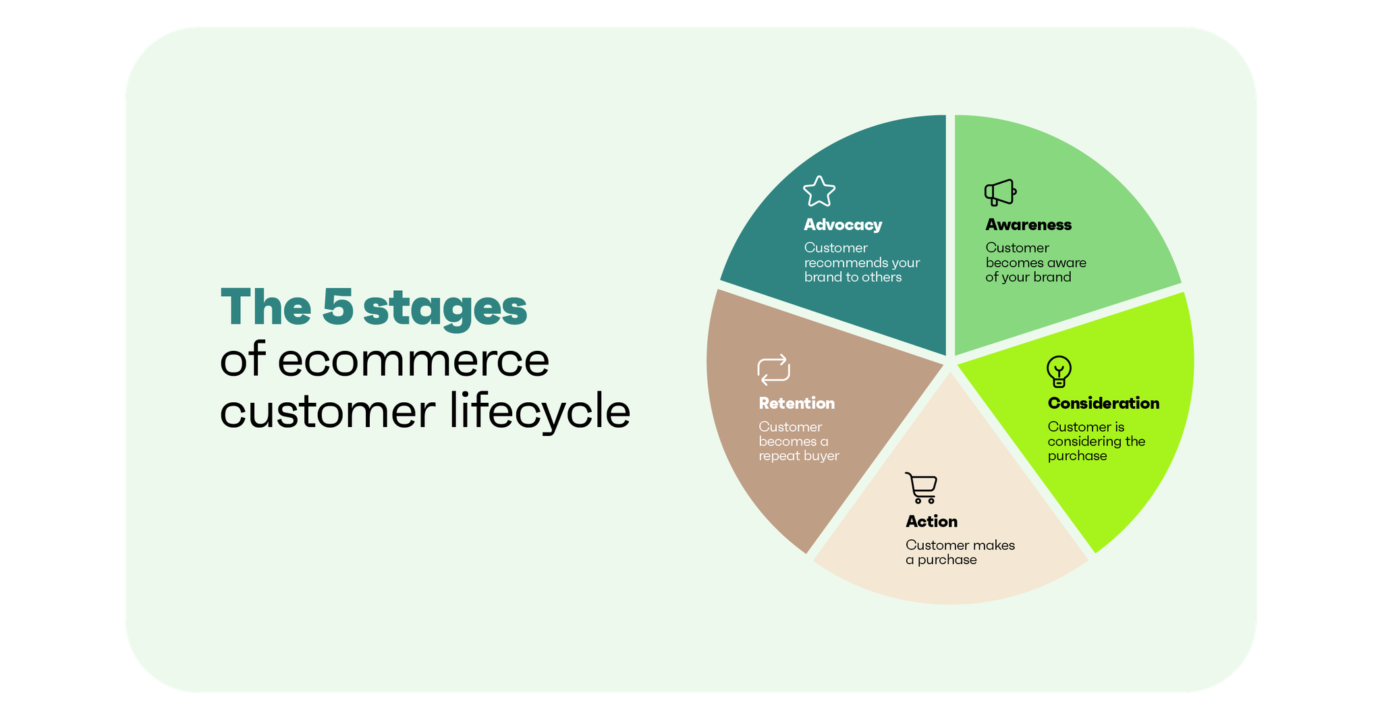
There are five lifecycle stages a customer moves through from being a stranger to a regular or repeat buyer. Those stages are as follows:
- Awareness is the first contact, when someone finds you through search, an ad, a social post, or a recommendation
- Acquisition is when they sign up, handing over an email or phone number you can use
- Conversion is the first purchase, the point at which a subscriber turns into a customer
- Retention is everything after that first order, where you’re working toward a second and third one
- Loyalty and advocacy is where your regular customers buy often and recommend you to others
Now, when we talk about CLM, it’s easy to fix on what it is and neglect how we measure the stages. Each has its own KPIs, channels, and automation triggers, with some overlap, such as email reaching customers across all stages.
Additional reading:
Top 7 customer lifecycle software: How to choose
Customer lifecycle management models explained
There are three customer lifecycle management models you’ll use in your ecommerce business, with some overlap between them. The traditional five-stage model is a decent fit in most cases, as you can act on it without any purchase history or automation already in place.
The traditional five-stage model
Awareness, acquisition, conversion, retention, and loyalty. It’s the framework from the last section. Customers loop back through it rather than exiting after one purchase, which is why it’s a cycle. You assign your flows to each stage to see where you’re covered and where you aren’t.
A gap example: you have a welcome flow and a cart recovery flow for your homeware ecommerce store. Both sit under acquisition and conversion, but your retention stage is empty, so there’s no flow earning that second order.
The metric to watch is customer retention rate, the percentage of customers who buy again over a set period. It tells you whether the model is moving people past their first order.
The RFM segmentation model
RFM ranks customers by recency, frequency, and monetary value, the three behaviors that predict who’ll buy again. Recent, frequent, high-spending customers score highest and land in your top tier.
It’s useful for catching churn. When a regular customer stops buying, their score drops, and you can send a winback before they’re gone. You need an established customer base for the scores to mean anything.
Each customer’s tier is the metric: the group their RFM score places them in, like top, mid, or at-risk. It shows you who your highest-value customers are and who is dropping toward churn. You can then use customer lifecycle segmentation to group them.
Behavioral/event-driven CLM models
Behavioral models skip stages and react to what a customer does, effectively reaching customers based on the interactions they have with your store.
Should they abandon a cart, your tool sends out a cart recovery email. They buy, then the reorder window passes, so a winback follows.
The benefit is timing, reaching customers when they’re already engaged rather than on a fixed schedule. You need automation running for the triggers to activate and the flow to go ahead.
Automation conversion rate is the metric to watch, the share of triggered messages that lead to a purchase. Omnisend handles this model with pre-built triggers for browse abandonment, cart recovery, and lapsed customers, each able to send across email, SMS, or push.
| Model | Best for | Metric to watch |
|---|---|---|
| Traditional five-stage | Stores with no purchase history or automation needed | Customer retention rate |
| RFM segmentation | Stores with an established customer base worth segmenting | Each customer's RFM tier |
| Behavioral/event-driven | Stores already running marketing automation | Automation conversion rate |
The customer lifecycle management process
The five steps below run in order, taking you from raw customer data to a lifecycle that manages itself with automation.
Step 1: Map your customer data and touchpoints
Customers are already buying and jumping in and out of lifecycle stages. But your tools are collecting different data and not sharing it, let alone helping you make sense of it. Bringing it together is your first crucial step for adequate CLM.
Here’s what to do next:
- Write down all the tools you use that hold your customer data
- Look into how you can share data between those tools with integrations or APIs; are there native apps that can sync them, or can you import/export via CSV?
- Pick the marketing tool you’ll consolidate that data into, ideally one with built-in CLM features like segmentation and reporting
- Create a customer touchpoint map that shows where your customers discover, sign up, place their first orders, abandon carts, and engage with you
- Match those touchpoints to their lifecycle stages, so your signup popup sits within the acquisition stage, your abandoned cart email in conversion, and so on
You will now have a list of the tools you use that hold data, ways to share that data, and a clear understanding of where that data feeds into lifecycles.
Step 2: Segment your audience by lifecycle stage
Your email tool should let you build segments. It might not categorize segments into lifecycle stages, but that’s fine, provided you can create them for the stages.
Omnisend takes things further than standard segments with RFM analysis (recency, frequency, monetary). It scores customers on how they recently ordered, how often they buy, and what they spend to automate their placement into lifecycle stages.
Customers then land in groups like Recent, Needs Nurturing, At risk, and About to lose, and they automatically move between them via their activity.
Your steps for segmentation are as follows:
- Build a segment for each lifecycle stage that you identified in step one
- Layer in RFM analysis, via Omnisend or another tool, to rank customers by their value
- Set your segments to update automatically if possible, ideally using data from your store, such as Shopify or WooCommerce
Step 3: Activate the right channels at each stage
Customers expect certain types of communication, such as a welcome email after subscribing, or a text alert after giving you their phone number via a back-in-stock page. Your channels should reflect the best way to deliver information and work together when appropriate.
There are three core channels you’ll use:
- Email is best for acquisition, conversion, and retention flows with a higher level of personalization, such as product recommendations based on previous purchases.
- SMS is a complementary channel to email, but also works well standalone for time-sensitive campaigns. Your multichannel flows with an SMS and an email might use SMS as a reminder system, or as a notification for customers to check their email.
- Push notifications are interruption-based, meaning they appear as your customers browse and engage with your brand. A push notification could provide a back-in-stock alert alongside an email with detailed product information.
How crucial is multichannel for customer lifecycle management?
Your customers have contact preferences. Offering opt-ins for SMS and web push notifications is expected and satisfies those who want to receive them. In 2025, Omnisend customers achieved a $79 ROI for every $1 spent across all three channels.
Step 4: Automate lifecycle triggers
You can’t possibly manually send emails and texts when your customers enter and exit their lifecycle stages. Automation is necessary with a lifecycle email marketing tool, with behavioral triggers that start flows when customers do something worth responding to.
Set up these automations with appropriate triggers, as described:
- A welcome email or series containing two, three, or four messages, the trigger is when someone signs up. You can create a different flow for multiple forms, so different groups receive messaging appropriate to them.
- An abandoned cart email, the trigger in this case is when a customer leaves their checkout unfinished, but enters their email address.
- A post-purchase flow containing at least a thank-you email, triggered when they place an order, with a time delay to give your confirmation emails space.
- A winback flow for customers who don’t engage after 90 days. You can attempt to bring them back into the conversion stage and rebuild your retention.
- A loyalty reward automation triggered when customers spend over X amount, purchase X quantity, or have been with you for X years.
Step 5: Measure, test, and optimize
CLM is necessary because your customers aren’t static. If they were, you could set your flows and forget about them. Your automations need to adapt and move with what your customers do, and the most reliable way to make those changes is with KPIs.
These are the KPIs you should follow across your customer lifecycle:
- Repeat purchase rate. It’s a retention KPI, showing the share of customers who buy more than once, helping you determine whether your first orders turn into second ones.
- Customer retention rate. Tells you the % of customers you keep over a period, such as one year or 90 days. Necessary to determine how well you’re holding onto them.
- Average order value (AOV). Relates to the conversion and retention stage. Helps you determine customer value across spend per order and the effectiveness of cross-sells and upsells.
- Email open rate by segment. A crucial KPI for every customer lifecycle management stage. Open rate drops mean that the messaging is no longer effective and needs updating before it impacts revenue.
- Reactivation rate. For measuring the share of lapsed customers that your winback flows manage to bring back into conversion and retention.
Those KPIs are also optimizable. For text and content, A/B testing produces additional metrics for comparison across email and SMS.
Omnisend has built-in A/B tests for subject lines, content, delays, and channels for automations and standalone campaigns. You can split your contacts into two paths, and for campaigns, automatically send winning versions to customers.
Customer lifecycle management best practices
There’s plenty to consider with your customer lifecycle management, not least where to start and ensuring the early steps you take don’t lead to mountains of additional work later. Follow these customer lifecycle management best practices to approach it the right way:
- Bring all your customer data (or as much of it as you can) into your email tool. Integrate your ecommerce store so that purchase history and customer behavior sync, and use the built-in reports to make sense of everything. The same goes for CRMs and other tools you use. Sync them and let the data flow into your email tool, so your customer lifecycle management runs from one place.
- Segment customers before you send anything else. Create those groups for new subscribers, new customers, repeat ones, and lapsed shoppers. You need segments for each to create messaging that reflects their lifecycle stage.
- Personalize experiences for all customer lifecycle stages. Be that with product recommendations, referencing previous interactions, mentioning them by name, or with the flows you create, such as for birthdays.
- Acquire, but also weigh your effort toward retention. Acquiring new customers keeps your business generating revenue, but it’s more cost-effective to sell to existing buyers. You can then work on improving your CLV and repeat purchase rate.
- Determine which channels suit your lifecycle stages. You can’t practically send everyone an email, SMS, and web push notification without opt-ins, but what you can do is match those channels to the moments they suit best, and then build your list and plan your flows accordingly.
- Automate your high-frequency touchpoints. These are your welcome messages, abandoned cart emails, follow-ups, loyalty communications, and win-backs, which cover all the CLM stages we’ve discussed so far.
- Monitor and react accordingly to lifecycle stage shifts. Your customers will enter and exit multiple lifecycle stages. Your segments should update automatically, but you might also need to amend and create new segments.
- Test and iterate for your customer lifecycle. Create new emails and text messages and see which ones get the highest clicks and conversions. Use engagement metrics to decide how best to iterate for your customer lifecycle. For instance, a winback email with a low open rate might need a better subject line.
How AI is changing ecommerce customer lifecycle management
Ask ChatGPT or another AI chatbot what customer lifecycle management is, and it’ll give you a reasonable definition and throw you all the information you want.
But it can’t see your customers and doesn’t know who’s about to lapse, who’s ready for a second order, or who isn’t opening their emails. Acting on your own customer data is where AI for customer lifecycle management comes in, built into a marketing tool like Omnisend.
Here’s how AI is improving CLM for ecommerce stores:
- Predictive churn scoring. An automatic flagging of customers who are likely to slip away, which you can then act on with winback flows.
- Send-time optimization. Your email tool collects open times and adjusts the send time to coincide with that. In practical terms, it helps your email appear at the top of the inbox when your customer is likely to look.
- Automated re-segmentation. Customers enter and exit segments based on the data your ecommerce store and email tool collect. It keeps your segments current.
- Product recommendations. AI picks products it believes your customers are likely to purchase based on what they already bought, browsed, or liked.
- Content personalization. Subject lines, headings, and other content receive personalization tags that change the messaging based on preferences and activity.
Start managing your customer lifecycle today
Managing your customer lifecycle means assigning customers to and moving them through stages in their journey from awareness to loyalty.
If you didn’t have a customer lifecycle management plan in place, your customers would drift and move around without you knowing about it.
Your flows couldn’t target them properly with that knowledge gap, and your customer lifetime value, revenue, retention, and growth would all suffer.
How it works is like so:
- Audit your tools that contain and collect data
- Pick a CLM or marketing tool with CLM features to consolidate that data
- Integrate those tools and share the data
- Segment and map your customers to lifecycle stages
- Create multichannel flows that reach those customers across their lifecycle
- Monitor and update your flows and segments as time progresses to reflect change
Omnisend is a logical next step for your customer lifecycle management. Its RFM-based segmentation maps your customers to lifecycle stages, and it has flows to ensure coverage of your most high-intent customer moments.
Quick sign up | No credit card required