Omnisend AI


 OFFER
OFFER










Your 7-year-old headphones just gave up on you, and you’re in desperate need of a new pair. You can’t work from home without new music keeping you focused, and the closest store is hours away.
If you’re like most U.S. consumers, though, you’re probably searching for information online — two-thirds turn to a search engine to research a company or product before buying. The global electronics ecommerce market generated $234,874m in 2025 — and for good reasons. Consumers can view the best deals, scour reviews from other buyers, and get quick delivery straight to their doorstep.
With other brands like Walmart, Amazon, and Newegg competing for the same attention, an email must hit all the right marks to catch your prospect’s attention. Here are ten electronics email examples to get your creative juices flowing.
Why email marketing works for electronics stores
Audience preferences and defining traits matter, especially for electronics shoppers. Typically, people looking for electronic gadgets and devices research what they need and rarely buy on impulse, which provides a uniquely attractive opportunity for electronics businesses to use email marketing campaigns.
Emails can become a powerful tool for attracting and educating prospective customers over time. Moreover, email marketing also supports the entire customer journey:
- Product launch emails build excitement for new releases
- Educational emails inform buyers and give value, allowing customers to choose between your products and competitor products
- Cart and browse abandonment emails help recover lost sales
- Promotional campaign emails support seasonal and holiday revenue
- Post-purchase emails maintain conversations with customers, leading to repeat purchases
It’s important to note that, as with any action, the right application of strategy and the allocation of resources matter. But when email marketing focuses on key campaigns and chooses the right tools to automate customer journeys, this can deliver significant, highly quantifiable results.
How to build an electronics email marketing strategy
Operating an electronics business is becoming increasingly competitive. Frequent electronics shoppers are now more likely to seek information, such as watching unboxing review videos, to learn more about products and compare them with others, extending the average path-to-purchase to about 20 days.
This trend now shows not just a significant change in consumer electronics marketing. It also means that electronics businesses need to invest in product development and effective marketing strategies, such as email marketing.
Know your audience and build buyer personas
Marketing high-quality products is a great start, but understanding who your target audience is is equally important. Before you start your next email marketing campaign, consider conducting an in-depth data analysis to gather accurate email subscriber data and narrow down their preferences, needs, and purchasing behaviors.
Once you have sufficient reliable data, you can start creating your buyer personas.
Segment your email list
After you define ideal buyer personas, you can then move on to segmenting your audiences. Segmenting makes it easier to sell individual products to specific customers because list segmentation allows brands to send emails based on shared characteristics or the same buyer persona.
Our Ecommerce digital marketing statistics for 2026 found that 90% of email marketers report that subscriber segmentation increases performance.
Personalize the message
Modern consumers expect personalized emails; that’s just the way consumer behavior is evolving. To support this, Litmus shows that 80% of consumers are more likely to purchase from brands that offer personalized experiences throughout their communications and shopping journey.
And the best way to start writing personalized messages is to include recipient names, recommend products based on their preferences, and highlight location-specific deals.
Optimize timing and use automation
Email automation is the biggest emerging trend in the ecommerce industry, helping to expand brand reach and connect with wider audiences worldwide. According to our research, automated emails converted 2,361% better than campaign emails, resulting in 52% higher open rates and 332% higher click rates.
For example, cart abandonment emails are particularly time-sensitive, with general guidelines suggesting sending the first email one hour after customers abandon their carts, and then ending a follow-up email 12-24 hours later. This only shows how important it is to communicate with consumers at the right time.
Besides that, marketing automation helps brands maintain their position in highly competitive markets by sending key emails to the right customers at the right time.
Write compelling subject lines
Subject lines are arguably the most important factor that can either increase email open and engagement rates or unsubscribe rates. We found that 69% of email recipients mark emails as spam after reading the subject line, underscoring how crucial subject lines are to your email marketing strategies.
But it’s not just about getting the right subject line — it’s about continuously testing your subject lines to ensure your emails adapt to evolving trends, including in consumer electronics marketing.
Here are some example subject lines for electronics businesses:
- Upgrade your home office setup today
- Exclusive deals on wireless audio devices
- Complete your purchase before it’s gone
- Recommended accessories for your new laptop
Track the right metrics
One-time wins are great, but every brand needs to base its business on performance and customer data. Monitoring key metrics such as open rates, click-through (CTR) rates, conversion rates, revenue per email, bounce rates, unsubscribe rates, cart recovery rates, and return on investment (ROI) enables ecommerce businesses to identify what’s working and what needs adjustment.
Measuring performance is essential for improving your email marketing strategy over time. Monitoring key metrics helps identify what’s working and where adjustments are needed.
10 best electronics email examples to spark your creativity
1. Samsung: Go all out with the product announcement

Over 79% of companies state that product launches have a significant effect on revenue. A product announcement is the perfect opportunity to share all the best features of your latest release.
Samsung made a splash with its announcement of the new Galaxy Tab S10+. Bold statements like “Built for productivity,” “Powered by AI,” and “Powerful performance” build excitement, while images of the device entice prospects to click.
Samsung also offers multiple deals on other devices, instilling FOMO and sparking interest. The red promotion box increases the likelihood of impulse purchases.
Check our professional-looking, responsive, and customizable newsletter templates to make your Electronics store emails stand out!
2. Beats: Offer a flash sale
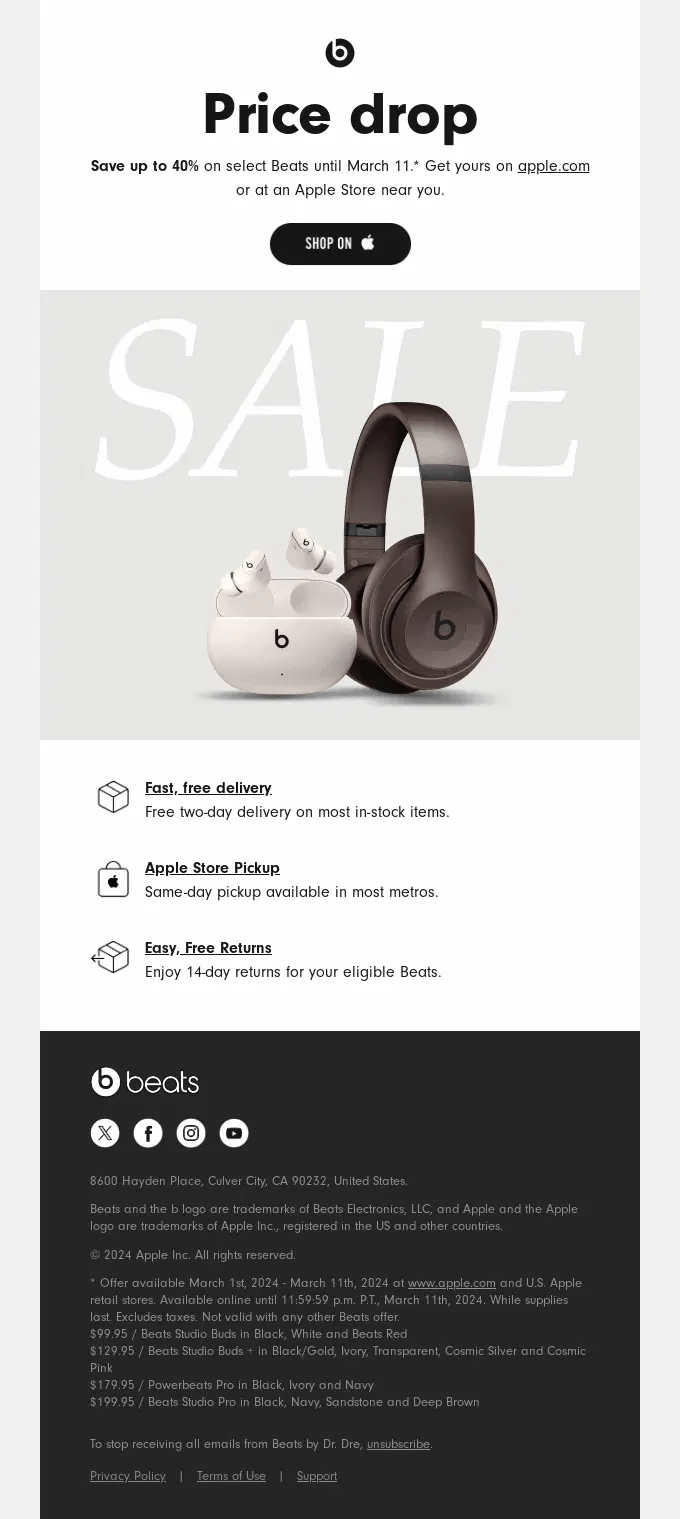
Flash sales — sales that last a few hours or days — are perfect for creating urgency, scarcity, and FOMO among prospects. Omnisend’s 2025 Ecommerce marketing report shows that 53% of consumers who opened ecommerce emails converted faster, so using urgency and pairing it with a flash sale can bring great results. When not overdone and used at the right moment, flash sales are a great way to raise conversion rates.
Beats illustrates this perfectly with their price-drop sale email, which offers 40% off select Beats, but only until a predefined date. This makes the discount promotion straightforward, peaks interest, creates urgency, and the minimalistic but clear CTA drives action. Consider the flash sale in the subject line, as Beats did, to increase open rates.
3. Target: Group multiple discounts together
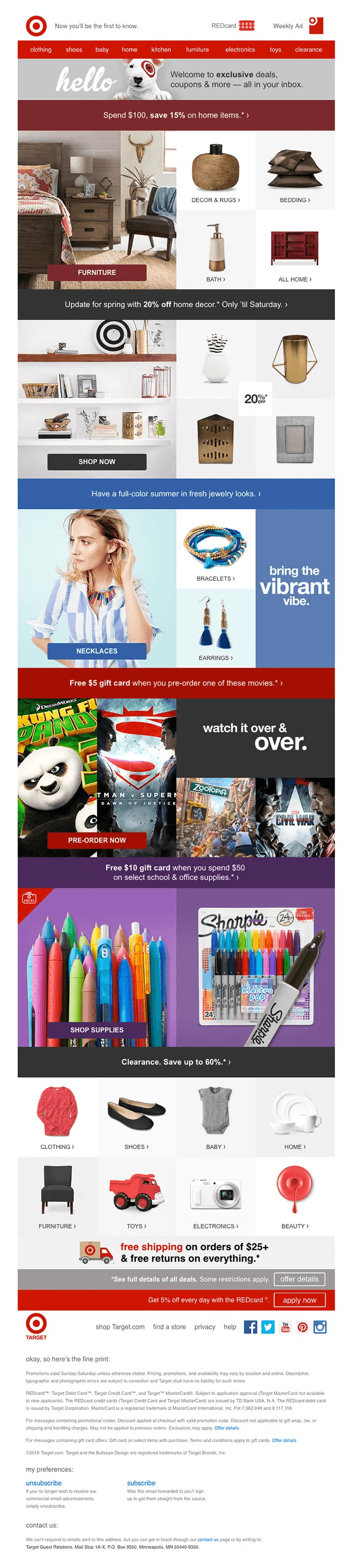
Many electronics stores also sell other items, such as home and kitchen appliances. While electronics might be the biggest sellers, stores can showcase a variety of products in a single email to create an enticing offer.
Target does this with its weekly ad deals email. The major retail business groups offer multiple products and discounts together, such as electronics, furniture, lawn and garden, and sun care. To increase consumer interest, Target offers free shipping on orders over $25 and free returns on all orders.
4. Apple: Make the features talk

Sometimes, you don’t need to build too much hype. If your product speaks for itself, simply highlight its best features and let your prospects decide whether to buy it.
Apple can pull this off with its launch email for the Apple Watch Series 9 and Apple Watch Ultra 2. As the most valuable brand in the world, it has the brand recognition to back it up. Apple uses a sleek design and simple language to convey the features of its latest release. No bold claims, no sweeping statements —just simple facts.
It ends the email with exclusive benefits buyers can get when they purchase directly with Apple — trade-in, daily 3% cash back with Apple Card, and free engraving.
5. Sonos: Draw cart abandoners back

The average cart abandonment rate in ecommerce is 70.22%, which is, honestly, a missed opportunity. Most of the time, people don’t abandon carts because they don’t want to buy, but because they may not have their card, are comparing prices with other stores, or want someone else’s opinion.
That doesn’t mean you should leave money on the table, though. 76% of people who clicked on an abandoned cart email in 2025 made a purchase. Sonos keeps its abandoned cart email simple, featuring product images to help customers remember what they wanted and the promotion, making it more enticing.
But what really makes this email a successful email marketing campaign for Sonos is the 45-day trial period paired with a clear CTA that leads straight to Sonos’ support. The email copy is brief but packs a real punch in communicating the right message.
6. Fitbit: Lead with real-life benefits

In a study of 1,000 USA adults, 39% cited improved fitness as a top New Year’s resolution. Fitbit leverages this to its advantage by tackling a crucial factor — children’s activity levels. The famous brand not only targets adults but also their kids with a straightforward message that seeks to gamify activities and make them more fun.
Fitbit introduces the Fitbit Ace LTE with simple but effective features, with the sole purpose of attracting the attention of consumers who are parents and already part of the Fitbit community.
7. Westwing: Offer exclusive access to sales

The modern consumer doesn’t just want to purchase and forget — they want to be part of a community. Making consumers feel special and offering exclusive access to sales are excellent ways to build customer loyalty and retention.
In this email campaign, Westwing promotes an exclusive deal on a range of KitchenAid products, a major brand in the home appliance space. The email breaks down the categories by discount, product images, and titles, helping customers understand which products they can purchase.
8. Google Store: Don’t miss Black Friday

According to Adobe’s research, in 2025, Cyber Week generated $44.2 billion, with $11.8 billion attributable to Black Friday. Consumers always hold out for deals on this day, and Google Store takes advantage of this in its email.
This email from the Google Store is one of the best examples of promoting a group of products for Black Friday and linking them all together. Google Store showcases unique deals like $300 off the Pixel 10 Pro and Pixel 10 Pro XL, $100 off the Pixel Watch 4, $60 off the Pixel Buds Pro 2, and other offers.
In short, all products can be used together to enhance user experience and thus see what benefits using different Google devices can bring.
9. Nura: Share customer reviews

Sharing customer reviews eliminates doubts and builds trust, which leads to more conversions.
Nura adds a helpful section with customer reviews about NuraNow, a monthly subscription that gives subscribers access to a product, exclusive discounts and offers, and giveaways. By eliminating doubt at the start, customers won’t need to chase someone to get their questions answered or Google the product.
The email also introduces new products and includes multiple CTAs that direct subscribers to the NuraNow page.
10. Aventon: Create anticipation in cart abandonment
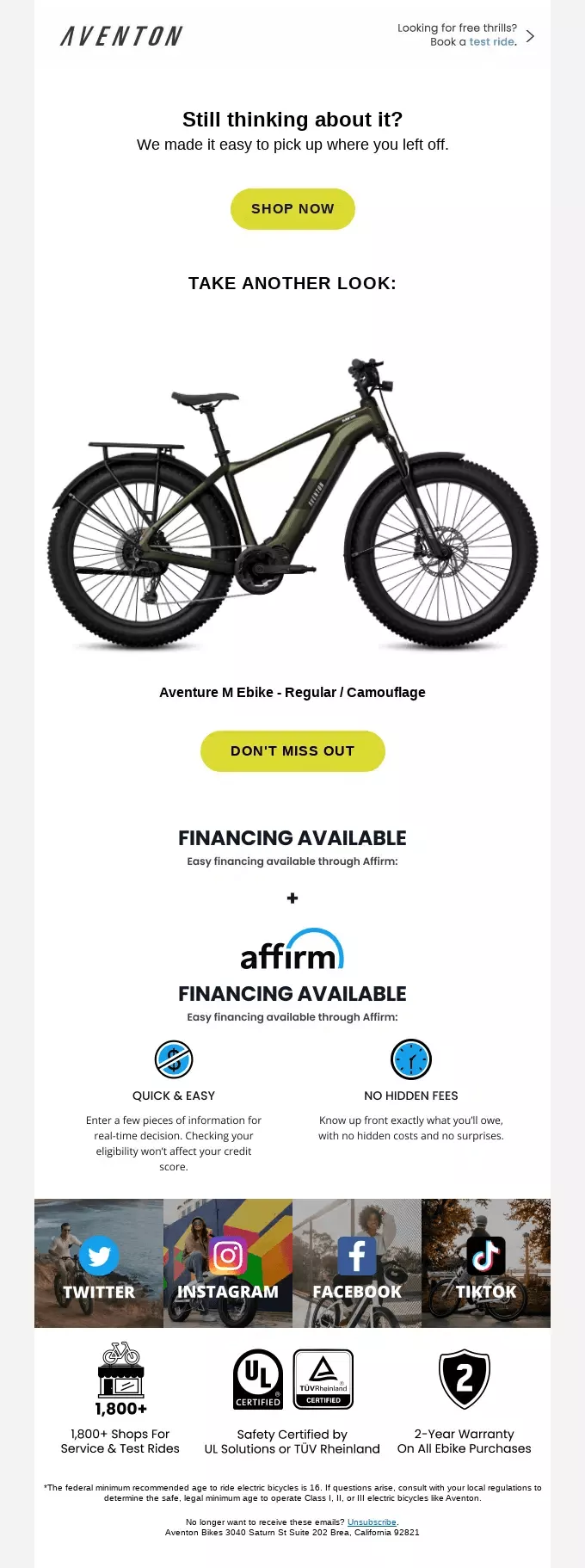
Urgency often motivates shoppers to complete their purchases, especially when carts are abandoned. The language and tone of the message are key in this type of email — you need to create anticipation that encourages customers to buy while remaining polite.
Aventon’s abandoned cart email example is designed to serve as both a reminder and an incentive. The brand does this by first showing what a consumer is interested in and then providing more background on comfortable buying options.
The email also reminds customers that this item isn’t reserved for them — it’s available to everyone. This creates a sense of urgency, which leads customers to complete their purchase before someone else takes the item.
Electronics email marketing best practices
- Focus on education, not just promotion. Electronics buyers are much more likely to do their own research before making a purchase.
- Showcase high-quality product images. Product images and videos help customers gauge product value, which is why 91% of them are more likely to buy a product with visual content.
- Optimize for mobile devices. According to 2024 data, around 50-60% of recipients open and read emails on their phones, underscoring the importance of optimizing for mobile devices.
- Use clear and compelling calls to action. Every email should have a clear objective. This could be to announce new product launches, showcase a product catalog, or include a useful buyer guide.
- Leverage customer reviews and social proof. Most successful electronics businesses include customer reviews, ratings, testimonials, and UGC to provide relevant information about their brand and products.
- Promote relevant accessories and cross-sells. This could look like recommending headphones for customers buying smartphones, or showcasing popular accessories with top gaming computers.
- Maintain a consistent sending schedule. According to HubSpot’s 2024 data, 78% of marketers reported increased email engagement over the previous 12 months after implementing a well-managed email program.
- Test and continuously optimize. Many ecommerce brands have to experiment with different subject lines, email layouts, product recommendations, CTA placement, email copy, send time, visual usage, and other factors to identify what works and what could be improved.
- Prioritize compliance and subscriber trust. As reported by Business Wire, 98% of consumers consider transparency to be one of the most important aspects of trusting a brand, and 97% expect brands to uphold security standards.
Create a spark in your emails
These email examples show how to use different techniques, from discounts and freebies to creating anticipation to spark conversions and improve sales. The key is to get creative, have fun, and use the right language to ensure your emails stand out. With a little bit of trial and error, you can find the perfect combination that resonates with your subscribers.
Quick sign up | No credit card required
Frequently asked questions
What types of emails should an electronics store send?
Generally, electronics stores should focus on promotional emails, new product announcements, abandoned cart reminders, welcome sequences, post-purchase follow-ups, product recommendations, educational content, and loyalty rewards emails.
When should I send an abandoned cart email?
The standard time to send your first abandoned cart email is between 1 and 3 hours after your shoppers leave their carts. If they still don’t respond, you can then send a follow-up reminder within 24 to 72 hours.
How do I write subject lines for electronics promotions?
The purpose of any subject line is to catch the attention of readers, leading them to open your emails. For businesses running electronics stores, standard practice shows that focusing on clear benefits, product highlights, or limited-time offers leads to the best results.
How often should I email my list?
The general rule of thumb for most electronics brands is to send one to three emails per week. However, this is just a general estimate. The actual frequency is highly individual and depends on your audience, product range, and your business strategy.
If you’re a new business, it’s often advisable to start by tracking data such as engagement metrics and unsubscribe rates to get an initial overview of your current email marketing performance.