Omnisend AI

 OFFER
OFFER








Email marketing for coaches offers a direct line to potential clients. No algorithm controls it. It returns $36 or more for every dollar spent, which beats most other marketing channels. A strong coaching email strategy combines lead magnets, welcome sequences, segmented lists, and automated funnels. These approaches work together to convert subscribers into paying clients for your coaching business.
Why email marketing matters for your coaching business
Due to the industry’s profitability, more coaches are entering the market every year. The global coaching industry was worth $5.34 billion in 2025, up from $4.56 billion in 2022.
To stand out, you need marketing channels you actually own and control. This is where email marketing for coaches displays its value.
Email is the channel you own
Social media is useful for brand discovery, but it’s built on borrowed ground. A platform can reduce your reach overnight with an algorithm update.
Your email list works differently because it’s an owned channel. No platform decides who sees your message. You write and send, and your subscribers receive it. This reliability is hard to replicate in a coaching business that depends on consistent client flow.
Moreover, email reaches more people than any social platform. According to a recent Statista report, there are 4.6 billion email users globally in 2025. That number is expected to hit 4.97 billion by 2028.
No single social network comes close, making email marketing for coaches the most stable foundation for client acquisition.
The ROI case for coaches
Engagement matters, but revenue is the real measure. The ROI of email marketing for coaches is hard to ignore. Email delivers $36 or more for every dollar spent, based on email marketing statistics compiled by Omnisend.
For coaches selling high-ticket services, a single email that books a $3,000 package makes that return even more impactful.
A 2026 Litmus study shows that sending at least one email per week yields the highest engagement across audiences.
Omnisend’s internal data show that automated emails drive 30% of all email-generated sales, despite comprising only 2% of total sends. A small number of well-timed emails can generate a large share of your revenue.
Social media builds awareness, but email marketing for coaches converts that awareness into paying clients.
How to build an email list as a coach
Building a high-quality list is essential in email marketing for coaches. Buying a list of contacts might feel like a shortcut, but those people never asked to hear from you, and they can damage your sender reputation fast.
You must build an email list organically — growing a list of people who genuinely want to hear from you.
An effective email marketing for coaches starts with a small, engaged audience rather than a bloated list of cold contacts. One hundred engaged subscribers will outperform 10,000 cold contacts every time.
According to Omnisend’s data, one in two people who click automated welcome or cart recovery emails convert. This shows that subscribers who consent are more likely to convert.
Create a lead magnet your audience wants
A lead magnet is what you offer in exchange for someone’s email address. It has to solve a specific, real problem — not just generic tips. The table below shows lead magnet ideas for common coaching niches:
| Coaching niche | Lead magnet ideas |
|---|---|
| Health coaching | Seven-day meal planning template, habit-tracking worksheet |
| Business coaching | Revenue audit spreadsheet, 90-day goal-setting framework |
| Life coaching | Morning routine planner, values-discovery workbook |
| Executive coaching | Leadership self-assessment quiz, team feedback template |
A specific and relevant lead magnet generates qualified subscribers. Keep this in mind when marketing to coaches.
Set up high-converting opt-in forms
Keep forms simple, asking for just an email address is enough in most cases.
There are several types of forms you can work with, including:
- Timed popups
- Exit-intent popups
- Embedded forms
- Dedicated landing pages
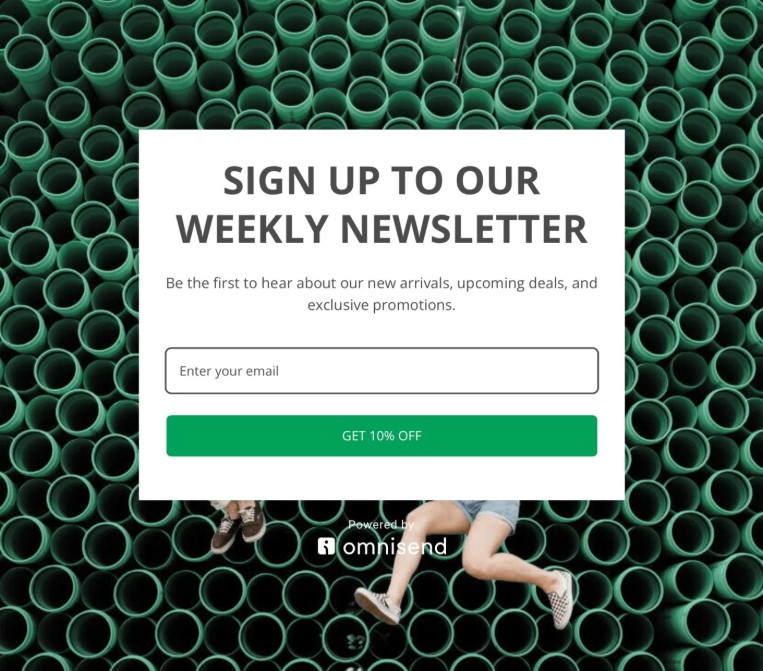
With Omnisend, you can access built-in signup forms for free. It includes gamified options like the Wheel of Fortune, which lets site visitors spin for a discount or free resource.
Here’s a great example of a landing page template from Omnisend that you can optimize for your coaching business:
Drive traffic from social media to your signup page
Your social media following is an audience you don’t own yet. Moving them to your email list is how you take control of that relationship.
A few approaches that work well include:
- Adding your signup link to your bio
- Pinning a post that highlights your lead magnet
- Running a giveaway that requires an email to enter
- Sharing content teasers that direct followers to your list for the full version
Email marketing strategies that turn subscribers into clients
Building a list is only half the job. What you send — and how you send it — determines whether subscribers become paying clients or unsubscribe. These four strategies build a coaching email marketing strategy that actually converts.
Welcome sequences that build trust fast
Your welcome email has the highest engagement as it is sent when a subscriber’s interest is at its peak.
According to Omnisend’s 2026 ecommerce marketing report, abandoned cart and welcome messages combined resulted in 76% of all automation-generated orders.
A strong welcome emails sequence runs three to five emails over seven to 10 days:
- Deliver the lead magnet and thank the subscriber for joining.
- Share your story — why you coach and who you help.
- Establish your expertise with a quick win or valuable insight.
- Set expectations for what subscribers will get from your emails.
- Include a soft call to action — a discovery call, a low-ticket offer, or an invitation to reply.
Coaches have an advantage here due to their personal brand. When your name is in the “From” line, and you write like a human, open rates can reach 30-50%, according to a report by Luisa Zhou.
Omnisend’s prebuilt automation workflows make it easy to set up and customize a welcome series. You don’t have to build it from scratch.
Segment your list for personalized messaging
Not everyone on your list is in the same place. Some subscribers just found you. Others have been reading your emails for months. You can’t send the same message to both groups.
Basic email segmentation lets you group subscribers by niche interest, engagement level, or buyer status. With behavioral segmentation, you can group people based on which lead magnet they downloaded or emails they clicked.
Segmented campaigns drastically outperform generic broadcasts because the message meets the reader where they are.
Importantly, Omnisend’s dynamic segmentation updates automatically as subscriber behavior changes, keeping your list accurate without manual work.
Email marketing for coaches must include proper segmentation. This can be the difference between a thriving list and a disengaged one.
Use storytelling and value-driven content
Coaches are natural storytellers, which is a real advantage in email marketing. Client transformation stories, personal lessons, and behind-the-scenes insights are topics people want to read.
A good newsletter strategy follows the 80/20 rule: 80% of your emails deliver value, and 20% promote your services.
According to ZeroBounce, 43% of people unsubscribe from email lists primarily because the sender emails them too often. Remember to balance frequency with value.
Promote your services without feeling salesy
If you believe your coaching changes lives, telling people about it is an act of service, not a sales pitch.
Follow this simple structure: hook, story, call to action. CTAs include booking a discovery call, purchasing a course, or registering for a webinar.
Include client results and testimonials strategically. Social proof does a lot of the heavy lifting in promotional emails. This organically moves email marketing for coaches from nurturing to closing.
Email automations every coach needs
Most coaches don’t have time to send the right email to the right person at the right moment. This is where email automation becomes necessary.
According to Omnisend’s ecommerce marketing report, automated emails accounted for just 2% of total sends but drove 30% of all email-generated revenue. It earned 16 times as much per send as scheduled campaigns.
For coaches selling digital products, the return from a small number of well-timed emails is significant. Here are the three automations worth setting up first.
Welcome and nurture series
Your welcome email series covers the first seven to 10 days after someone joins your list. A welcome email delivers your lead magnet, shares your story, and guides new subscribers toward their first action.
Your nurture series picks up from there. It’s a longer sequence of value-driven emails that keeps prospects warm over time. The trust you build here eventually leads to a sale.
With Omnisend’s prebuilt automation workflows, you don’t need to build these workflows from scratch.
You can launch a welcome series quickly and refine it as you learn what your audience responds to. This automation makes email marketing for coaches worth the investment from day one.
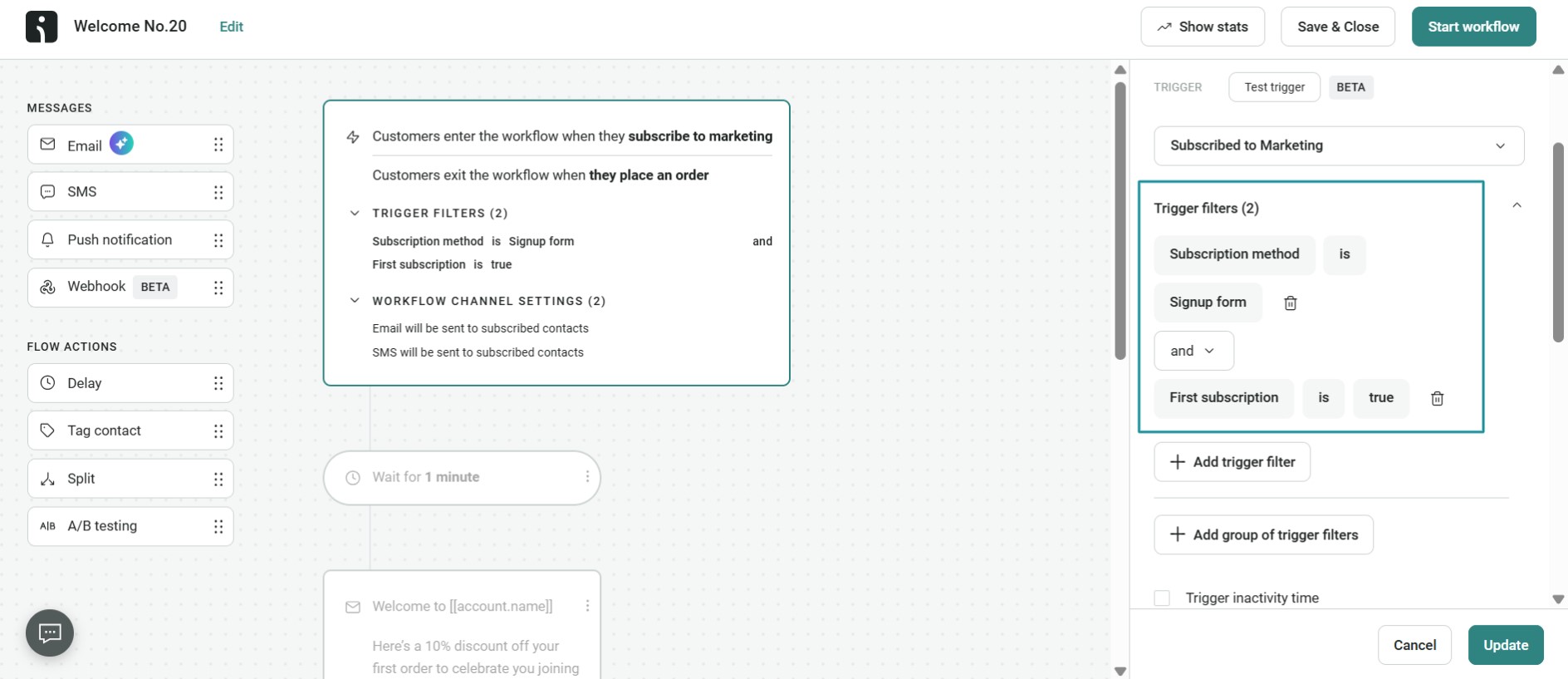
Here’s a look at what an Omnisend automation workflow might look like for a coaching welcome series:
Abandoned cart recovery for digital products
Many coaches now sell courses, templates, and memberships through online stores. If someone browses your course page and leaves without buying, an abandoned cart email automatically brings them back.
For coaches selling digital products through platforms like Shopify or WooCommerce, this is one of the highest-return automations you can set up. Omnisend integrates natively with both platforms, keeping your storefront and email marketing connected without manual work.
Post-purchase and upsell sequences
Selling a course or digital product is just the beginning. A post-purchase email sequence keeps the relationship going and opens the door to future sales:
- Thank the buyer and confirm their purchase.
- Show them how to get the most value from what they bought.
- Recommend a related product or next step.
- Ask for a testimonial or review.
These email sequences increase customer lifetime value. You only have to set them up once. A well-structured post-purchase messaging strategy can also reduce refund requests, since buyers who feel supported are more likely to stay engaged.
This shows the long-term value of email marketing for coaches beyond the first sale.
How to choose the right email marketing platform
Your chosen email marketing software will shape how much time you spend on campaigns, how well your automations perform, and how efficiently your list grows. Picking the right one from the start saves you a costly migration later.
Here’s what to look for.
Features coaches need most
Not every platform is designed for email marketing for coaches. The features below are the ones that matter most for a coaching business:
- Drag-and-drop email builder: Lets you design professional-looking email templates even without coding knowledge
- Pre-built automation workflows: Gives you ready-made email sequences for welcome series, cart recovery, and post-purchase flows, so you don’t have to start from scratch
- Segmentation: Helps you group subscribers by behavior, interest, or purchase history for more targeted messaging
- Signup forms and landing pages: Captures leads directly from your website or social media without needing a separate tool
- Performance reporting: Shows you open rates, clicks, and revenue so you know exactly what’s working
- Delivery infrastructure: Keeps your emails out of spam folders with strong inbox placement rates built into the platform
The table below compares how leading email marketing tools stack up on these features:
| Feature | Omnisend | Mailchimp | ActiveCampaign | Kit |
|---|---|---|---|---|
| Prebuilt automation workflows | ✅ | Paid plans only | ✅ | ✅ |
| Ecommerce integration (Shopify, WooCommerce) | ✅ Native | Via plugins | ✅ Native | Limited |
| Email and SMS in one platform | ✅ | Add-on only | Add-on only | ❌ |
| Free plan with all features | ✅ | Limited | ❌ | Limited |
| Abandoned cart recovery | ✅ | Basic | ✅ | ❌ |
| 24/7 support on all plans | ✅ | Paid plans only | Paid plans only | Limited |
Why coaches who sell online need an ecommerce-focused platform
If you’re a coach who sells digital products, a basic newsletter tool won’t be enough. You need a platform that connects your storefront with your email marketing. This includes syncing purchase history, product data, and browsing behavior to power smarter automations and segmentation.
Omnisend is built for this. It integrates with 305+ ecommerce and marketing tools.
Its prebuilt automations for welcome flows, cart recovery, and post-purchase email sequences are ready to launch from day one. Additionally, with 24/7 customer support on every plan, you won’t hit a wall when you need help.
Omnisend customers earn $79 for every dollar spent, which is well above the industry average. It’s free plan gives coaches full access to its core features so that you can get started without an upfront investment.
Email marketing best practices for coaches
Getting your email marketing strategy right is one thing. Keeping it performing well over time is another. Follow these three practices to see the biggest results.
Sending frequency and timing
Start with one email per week. It’s enough to keep your services top of mind without overwhelming your list. As your audience grows and your content rhythm improves, you can scale to two or three emails per week.
The best times to send are mid-morning, between 8 a.m. and 10 a.m., and early evening, between 5 p.m. and 7 p.m. These send times tend to catch subscribers before and after the workday, when they’re more likely to engage.
One thing coaches often overlook is setting expectations up front. Inform new subscribers how often they’ll hear from you. This reduces unsubscribes and builds trust. Frequency is one of the simplest levers in email marketing for coaches, and getting it right early saves you from list churn later.
Subject lines that get opened
Your subject line determines whether your email gets opened or ignored. According to the previously mentioned ZeroBounce report, 43% of people decide to open an email based on the subject line alone. That makes it one of the highest-leverage elements of any campaign.
Here are a few approaches that work well for coaches:
- Address the subscriber by their first name to make the email feel personal
- Lead with a specific number or result (“Land five dream clients in 30 days without cold DMs”)
- Keep subject lines concise — aim for six to 10 words
- Make a clear promise and deliver on it inside the email
With Omnisend’s built-in A/B testing tools, you can test subject lines across a portion of your list before sending to everyone. Lead with what’s already proven to perform.
Maintain list health and email delivery
A large list means nothing if your emails don’t reach your subscribers’ inboxes. Poor email deliverability stems from a list filled with inactive or invalid addresses, which can seriously damage your sender reputation over time.
Clean your list every 90 days by removing subscribers who haven’t opened or clicked in a set period. Also, monitor your bounce rates, spam complaints, and unsubscribe rates regularly.
Omnisend offers email list cleaning tools and delivery monitoring directly in its dashboard, so you can catch problems before they affect your email sequences.
Take your coaching business beyond the inbox with multichannel marketing
Most coaches stop at email. That’s a missed opportunity for clients and prospects of your coaching business who are also active in other marketing channels.
Email is where you nurture relationships and share detailed content. It works well for storytelling, longer reads, and educational sequences.
If you need a different angle, SMS is the key. It’s perfect for messages that need to be seen right away.
For coaches, SMS is a practical fit for appointment reminders, flash-sale alerts for digital products, and short tips that drive quick action. Texts land directly on someone’s phone screen and are read within minutes of being sent.
Using both channels together yields better results. According to Omnisend’s ecommerce marketing report, SMS click rates more than doubled year over year in 2025. For coaches selling digital products, this kind of reach adds an impactful second channel to your marketing arsenal.
You don’t need separate tools to manage both channels. Omnisend combines email, SMS marketing, and push notifications into a single platform, so coaches can run multichannel campaigns without juggling multiple subscriptions.
You can even collect SMS subscribers alongside email subscribers using a single signup form, ensuring a simple list-building process.
Quick sign up | No credit card required
FAQs
How often should coaches send marketing emails?
Start with one email per week. It keeps you present without overwhelming your subscribers. As your list grows and your content rhythm improves, you can expand to two or three emails per week. Remember that consistency matters more than volume.
What is the best email marketing platform for coaches who sell digital products?
Omnisend is a strong fit for coaches who sell courses, templates, or memberships on an online store. It integrates natively with Shopify and WooCommerce, includes prebuilt automation workflows, and offers 24/7 customer support on every plan. With its free plan, you can access core features from day one.
How do I grow my coaching email list without a website?
Email marketing for coaches doesn’t require a website to get started. Most email marketing platforms include built-in landing pages and signup forms you can share directly on social media. A compelling lead magnet, such as a free checklist or template, gives people a good reason to sign up.
What emails should a coach send to new subscribers?
Start with a welcome sequence of three to five emails. Use it to deliver your lead magnet, share your story, establish your expertise, and guide subscribers to take their first action. After this, transition into regular value-driven content.
What’s a good email open rate for coaches?
A healthy open rate for coaches sits between 30% and 50%, especially for automated flows like welcome emails. If your open rates are consistently below 20%, review your subject lines, sending frequency, and list quality.
Is email marketing still effective in 2026?
Yes. Email delivers $36 or more for every dollar spent, making it one of the highest-returning marketing channels today. Email marketing for coaches combines relationship-building with direct revenue generation in ways unmatched by other channels.