Omnisend AI


 OFFER
OFFER







Mother’s Day is a great opportunity to reach out to customers in a meaningful way and drive sales. But, while this day celebrates mothers around the world, when it comes to writing unique emails that balance genuine communication with marketing campaigns, many businesses struggle to land on a singular goal.
This guide offers 10 real examples of proven Mother’s Day emails that focus on diversity and audience expansion with holiday opt-out options. Every example is dedicated to forming a positive and lasting connection with customers without falling into generic, one-size-fits-all pitfalls.
Get 200+ Mother’s Day subject line ideas here.
Mother’s Day email templates
The right layout, spacing, and thoughtfully placed visuals can already do most of the heavy lifting for you. Once you have the right template singled out, all you have to do is swap the messaging and products.
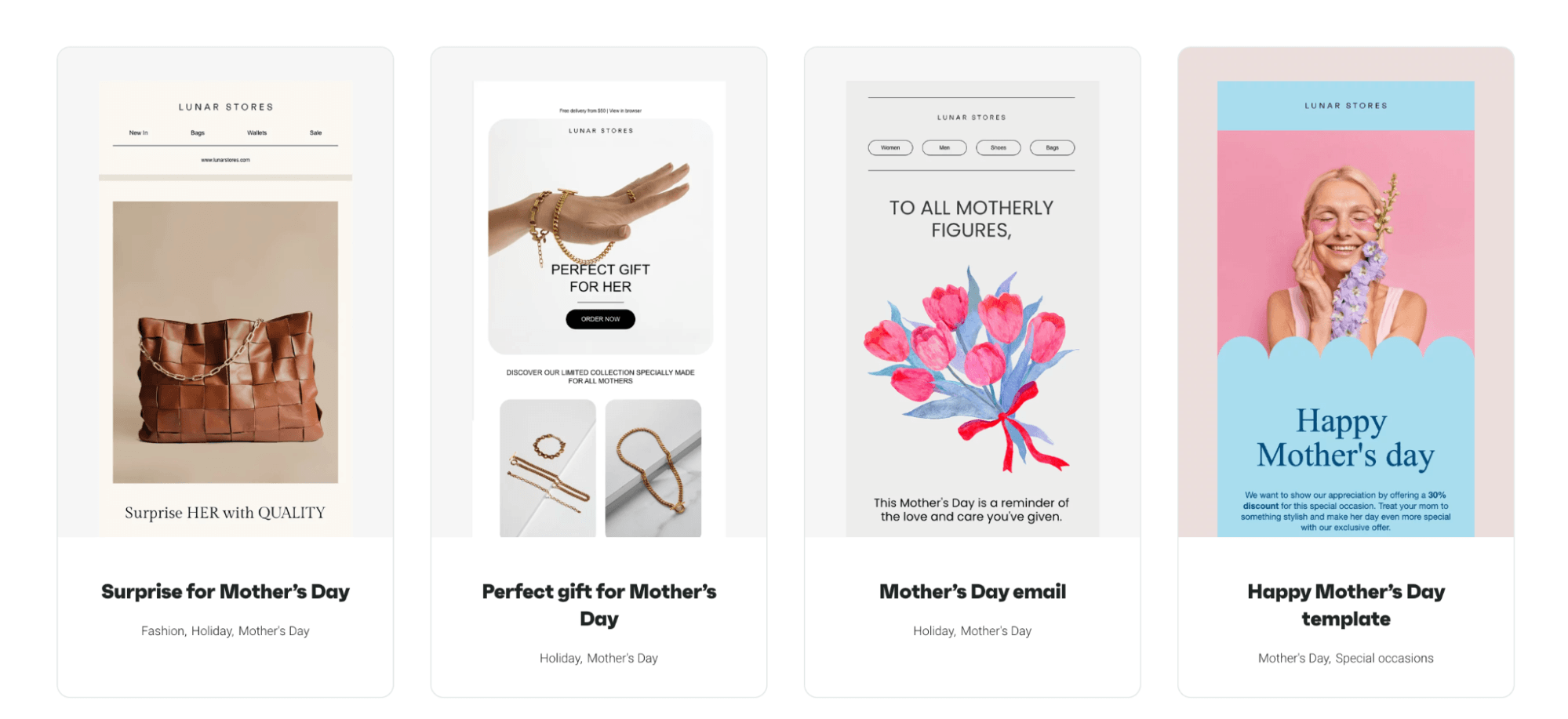
Check out our library of free Mother’s Day email templates you can use to create your own Mother’s Day email. You’ll find different examples for gift guides, gift card emails, appreciation sends, and last-minute campaigns.
Best Mother’s Day email examples
Before we jump into our selection of top 10 Mother’s Day emails, here’s a quick overview of all examples — the brand, the approach, and the key campaign idea.
| Brand | Approach | What it is |
|---|---|---|
| Rachel Riley | Dual-campaign structure | A Mother's Day discount and an Easter lookbook in the same email |
| Meow Meow Tweet | Giveaway/brand collab | A prize giveaway featuring six mom-owned brands |
| Sodashi | Multi-offer / last-minute | Five gift options in one email, from bundles to eGift cards |
| Cécred | Brand storytelling / no sell | A letter about the founder's mother with no products or offers |
| Studio Neat | Plain-text founder tone | A personal note from the founders with a free gift offer |
| Brooklinen | Social proof | A gift guide built from employee recommendations |
| Don't Buy Her Flowers | Gift guide | A curated gift guide with ready-made boxes |
| Intelligentsia | Experience-based gifting | Products, a virtual class, and a gift card in one email |
| Vessi | Appreciation/no sell | A thank-you letter to mothers with no ask |
| Beehive Cheese | Brand personality/humor | A pun-led gift guide with gift cards |
1. Rachel Riley: Dual-campaign structure
Subject line: Happy Mother’s Day!
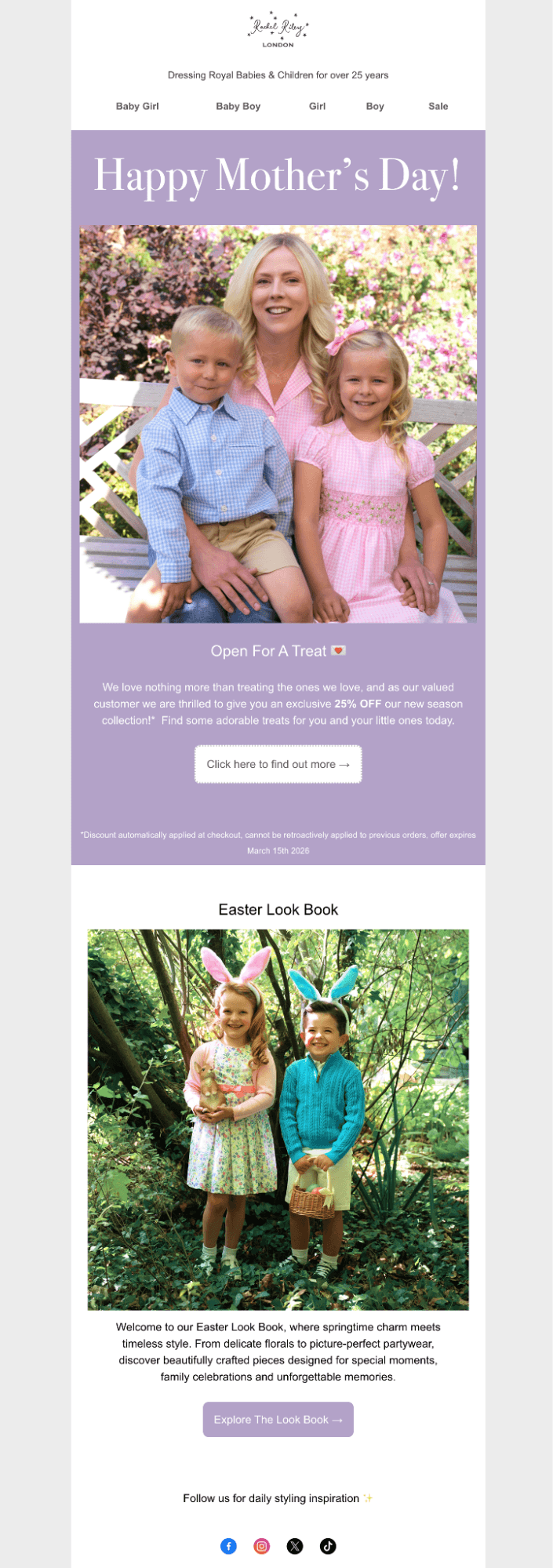
Campaigns often overlap, and while some companies choose to run separate email chains, Rachel Riley’s dual campaign combines two occasions into a single email: Mother’s Day discount and Easter Look Book. Riley displays the two campaigns in different, yet complementary colors, making it easier for customers to understand the email content.
Best practices:
- Experiment with a single well-structured email to avoid overcrowding your customers’ inboxes with multiple emails.
- Separate every section by using distinct colors and headers, but make sure both sections (or more) are on brand and easily scannable.
- Include an automatic discount application at checkout to reduce abandoned carts due to forgotten codes.
Expert tip: Combining two different campaigns can work well, but it’s not always the right choice. Riley’s dual-campaign approach works because the two sections are clearly separated without diluting each other.
Want to see how Rachel Riley approaches email marketing year-round?
Rachel Riley grew their email revenue by 27% after rethinking their seasonal campaign strategy. Read the full case study to see how they use automation, segmentation, and campaigns like this one throughout the year.
Read the Rachel Riley case study →
2. Meow Meow Tweet: Brand giveaway/collaboration
Subject line: Mommy issues 🦀🦹🌹📱
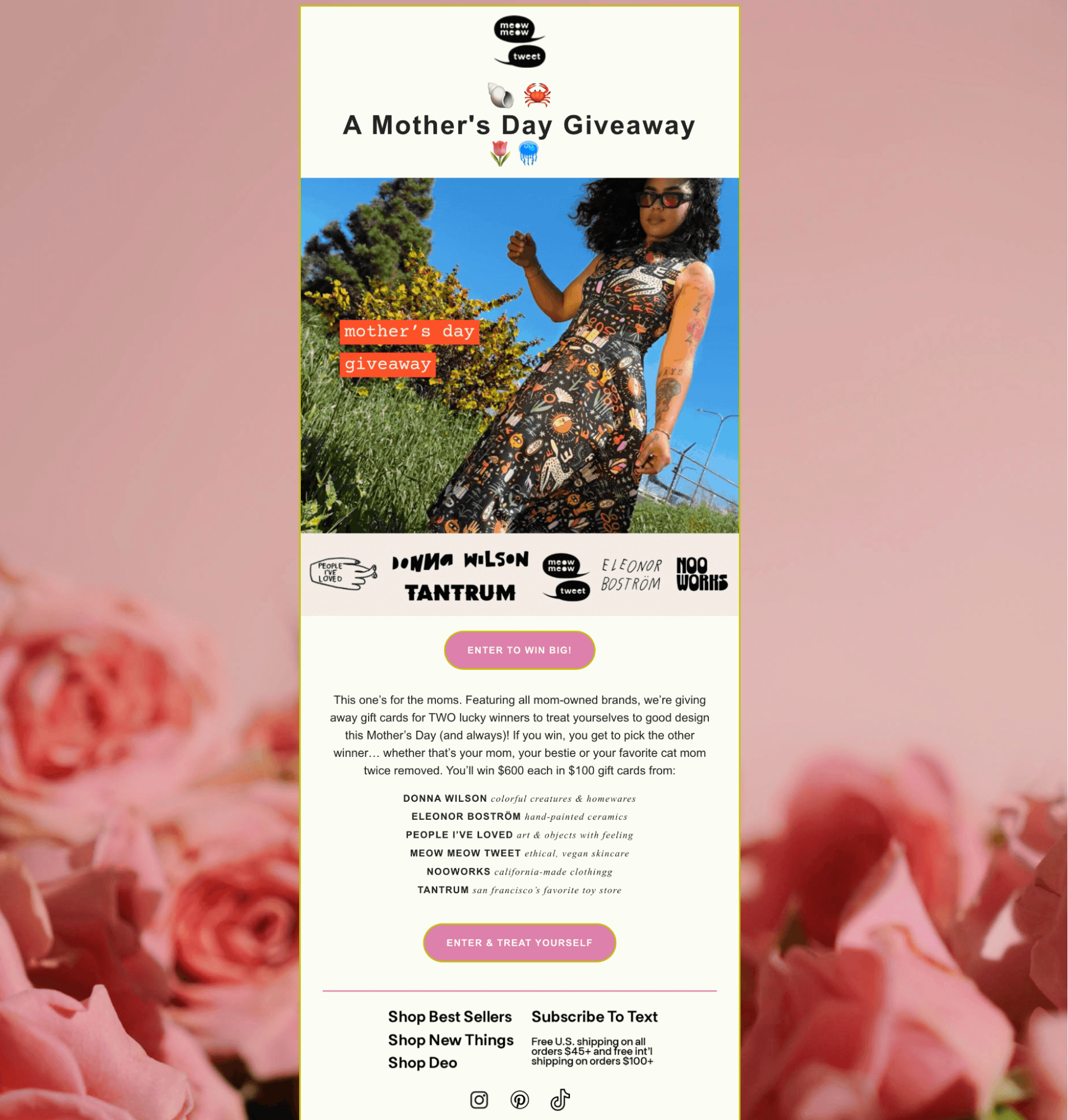
Meow Meow Tweet chose a straightforward Mother’s Day gift card email template by running a giveaway. Instead of leading customers with a discount or a promotion to buy something, Meow Meow Tweet launches a giveaway from six different mom-owned partner brands. Coupled with a catchy subject line, Meow Meow Tweet gets attention, higher email open rates, and promises two winners $600 worth of gift cards.
Best practices:
- Utilize the appeal of a giveaway to expand your reach and build goodwill by collaborating with brands without competition.
- Communicate the ‘what’s in it for me’ value in the first two sentences of the email before going into rules and brand explanations.
- Add an interesting, even provocative subject line, but make sure it communicates the same immediate value in the email body.
Expert tip: Meow Meow Tweet email does a great job of providing clear and condensed information about the giveaway and the six brands without bloating the email. Since the email is under a single Mother’s Day campaign, it has a strong editorial logic that other giveaways lack.
3. Sodachi: Multi-offer/last-minute gifting
Subject line: The Perfect Gift for the Mum Who’s Hard to Buy For! 🤩
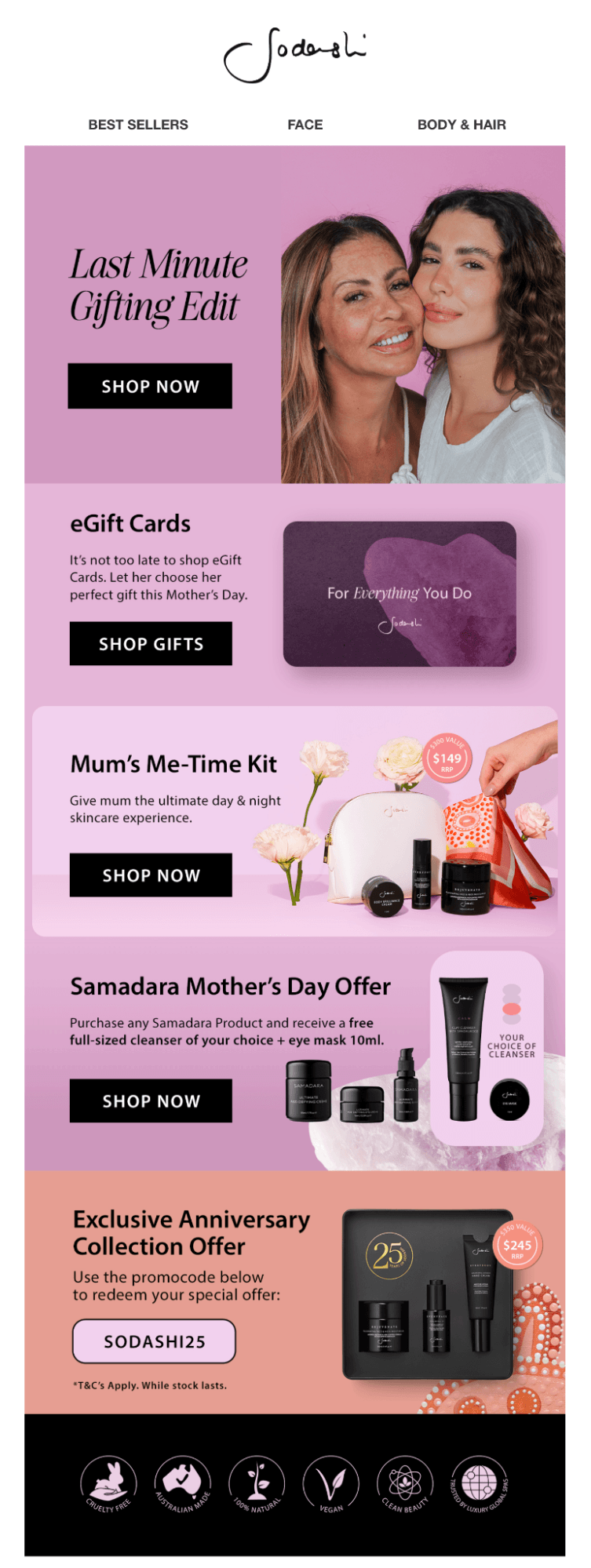
Sodashi targets a specific issue many face nearing Mother’s Day – gifts. The email starts with a straightforward subject line and includes a basic but highly effective structure where every section has different product offers and its own CTA. The first section provides the opportunity to get eGift cards for last-minute shoppers, and the bottom of the email displays trust signals to reduce buyer hesitation.
Best practices:
- Combine different offer sections so they don’t overshadow the others and communicate their value in the first seconds of reading.
- Place eGift cards or other digital options at the very beginning of your Mother’s Day email to conveniently segment last-minute buyers from clients looking for specific products.
- Add credibility proof at the footer of your email to improve trust and reduce purchase hesitation without coming on too strong.
Expert tip: More often than not, five offers in a single email can be chaotic. But just like in Meow Meow Tweet email, Sodashi provides five clear offers for Mother’s Day while also addressing different audience needs.
4. Cécred: Brand storytelling/pure appreciation, no sell
Subject line: Happy Mother’s Day from Cécred
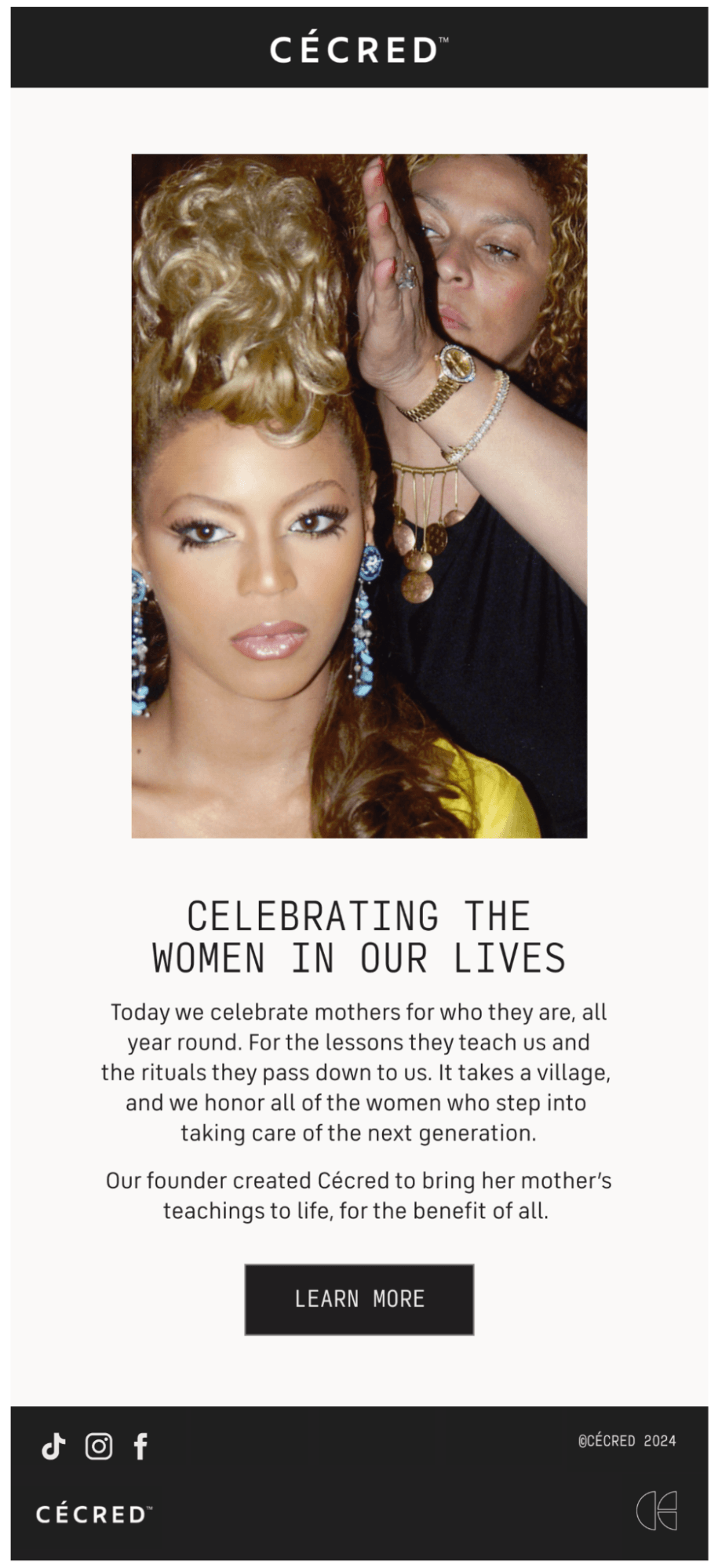
Unlike the first three Mother’s Day email designs, Cécred focuses on a different goal, and that’s celebrating women altogether. The layout is simple but powerful, telling the story of the brand’s founding in the words of the founder’s mother. In this email, the ‘Learn More’ CTA leads readers to the brand story, not a promotional product page.
Best practices:
- If your brand has a story that’s connected to Mother’s Day, lead your email with it to build a connection with your audience.
- Craft your Mother’s Day messaging to be more inclusive and center around gratitude so as not to separate and alienate readers.
- Be thoughtful about the kind of CTA you use when pairing with a story — using a ‘Shop Now’ CTA can confuse and deter readers.
Expert tip: Mother’s Day emails can be a great revenue opportunity for companies, so use a story-focused, heartfelt appreciation-type email purposefully. Building a connection with audiences is great, but most brands choose to use Mother’s Day to improve sales.
5. Studio Neat: Plain-text founder tone/gift-with-purchase
Subject line: 48 hours left to get something for Mom
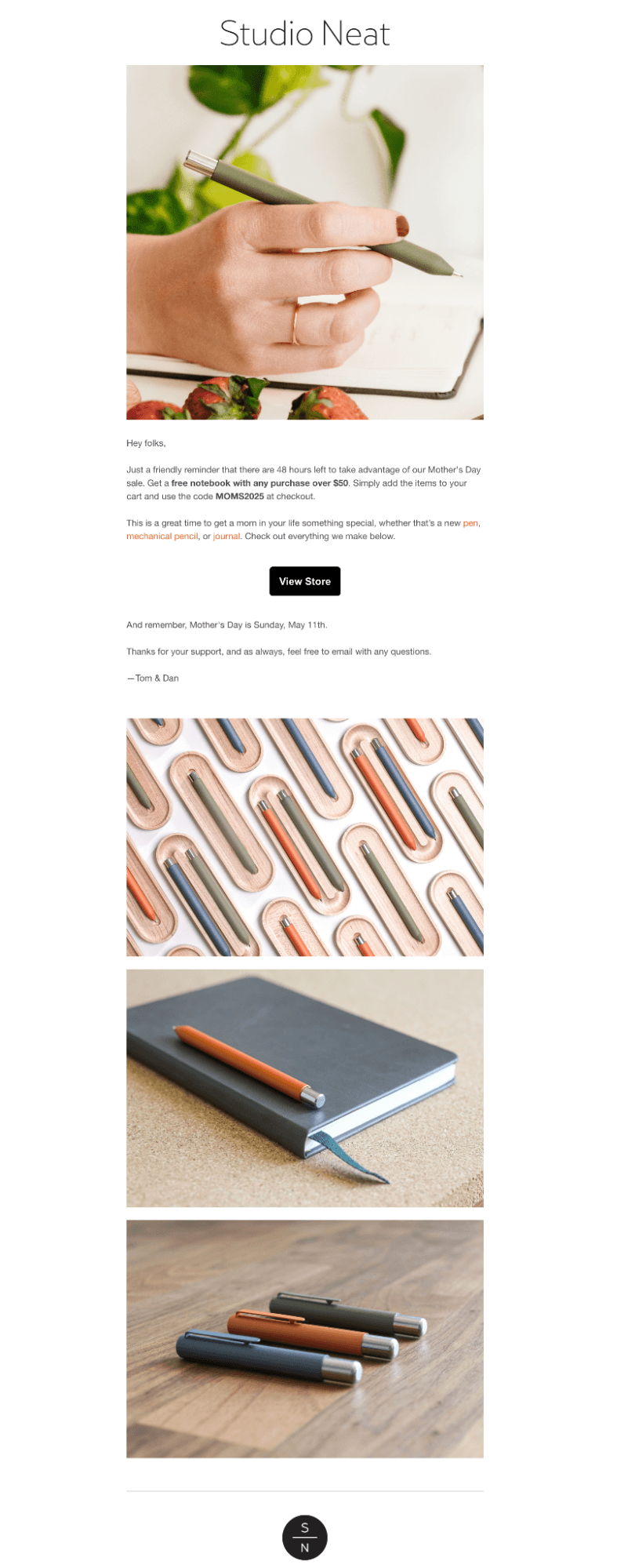
Studio Neat takes another new direction from other Mother’s Day examples we just discussed. This brand uses a first-person language to immediately address their audience, ‘Hey folks’, and signs off the email with Tom and Dan.
The entire email body is simple, and carries the tone of someone who understands how chaotic Mother’s Day can be, so they offer a free notebook with any purchase over $50, code MOMS2025 in the second paragraph, and a simple date reminder at the end.
Best practices:
- Use plain-text emails for founder-led brands to build immediate confidence with audiences that already have relationships with such brands.
- Focus on simple language and use a clear threshold-based gift, like a free item over $X.
- Include the actual Mother’s Day date in the email body to offer maximum information to readers looking for quick ideas.
Expert tip: Build your Mother’s Day email to reach an existing audience. Use a conversational tone to begin a conversation as soon as readers open your email.
6. Brooklinen: Social proof
Subject line: Celebrate and SAVE: Mother’s Day Gift Guide is Here!
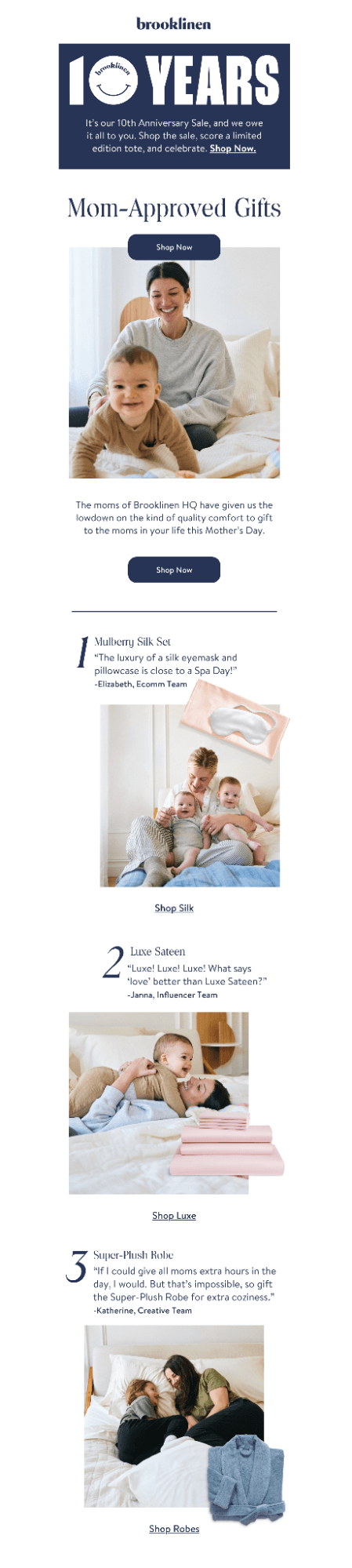
Brooklinen turns standard social proof by making it personal. Each offer presented in their Mother’s Day email includes an internal recommendation where Brooklinen employees share why they’d get a specific product for their moms. This strategy allows the brand to appear more genuine while also weaving in Brooklinen’s 10th anniversary sale.
Best practices:
- Consider including product recommendations from your employees rather than paid influencers to provide social proof.
- Include employee names and job titles like “Elizabeth, Ecomm Team” to make the recommendation feel more genuine.
- If you’re running a separate brand promotion at the same time as Mother’s Day, lead your email with the seasonal occasion and support it with the secondary offer as a bonus.
Expert tip: Paid influencers can improve brand awareness, but social proof emails can benefit from people within your team. If your employees genuinely like and would recommend your products, this could be the ultimate social proof builder.
7. Don’t Buy Her Flowers: Gift guide/decision simplification
Subject line: Our Mother’s Day Gift Guide is now ready
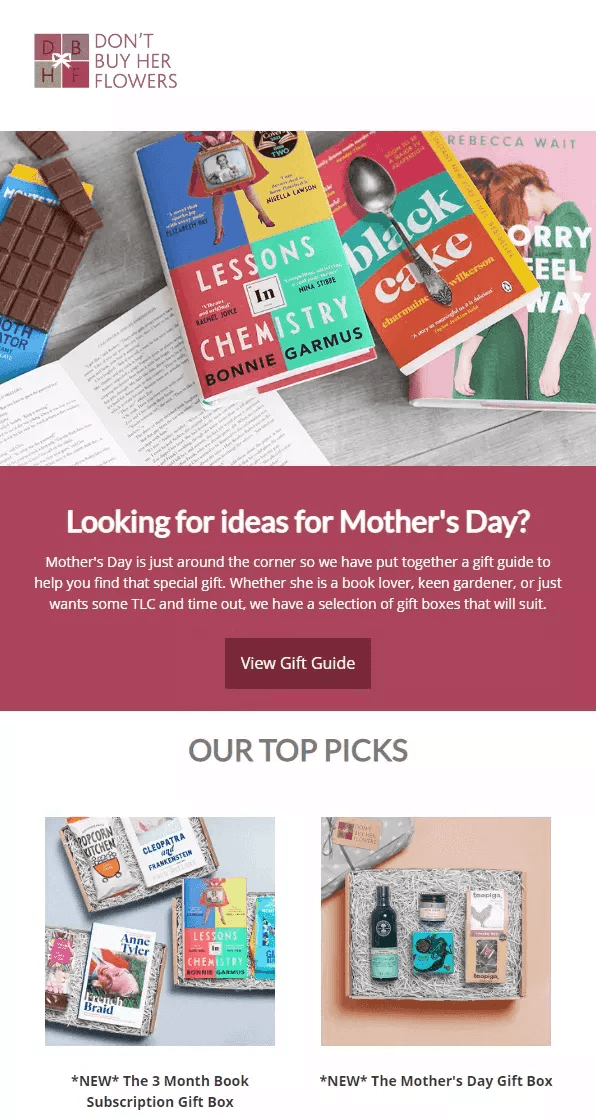
Mother’s Day may come only once a year, but many shoppers find it difficult to come up with new ideas. Don’t Buy Her Flowers takes advantage of this and offers a clear drop-a-hint approach to the problem — a gift guide with multiple gift ideas. By doing so, the brand provides value to buyers who are ready to act and those who are still looking.
Best practices:
- Structure your email content around different shopper states, browsers, and buyers.
- Offer ready-made gift box options dedicated to specific profiles to make it easier for buyers to choose quickly.
- Don’t use generic, ‘Shop Now’ CTAs — use informative leads like ‘View Gift Guide’.
Expert tip: Gift guides are especially great for targeting two major shopping stages, browsing and buying. This is because gift boxes effectively change the consideration tone of buyers from “do I want this?” to “which one is right for her?”
8. Intelligentsia: Experience-based gifting/three-intent structure
Subject line: Great Gifts for Mom | Celebrate the mothers in your life
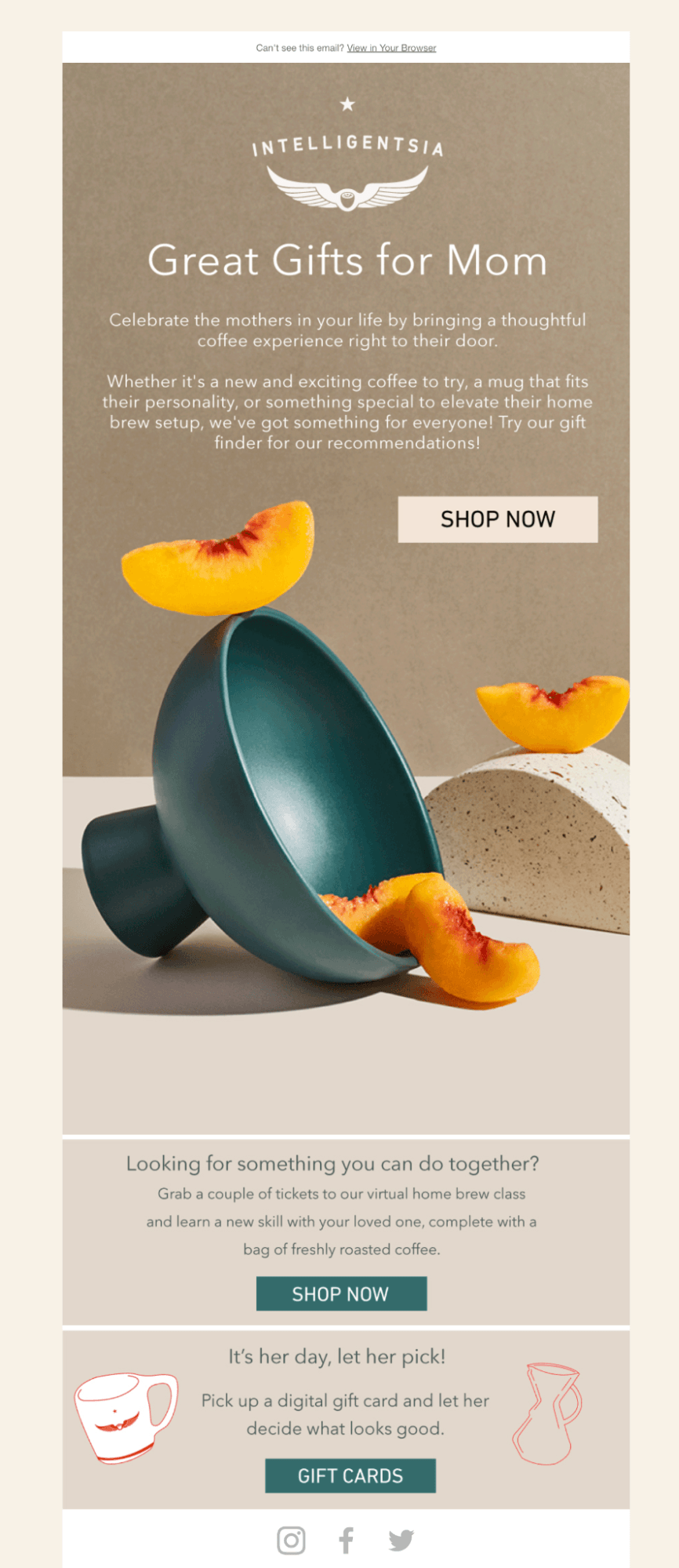
Similar to Don’t Buy Her Flowers, Intelligentsia structures its email around three different shopper intents: physical goods, shared experience, and flexible options in the form of a digital gift card. However, the key highlight of this email that draws most attention is the “something you can do together” section, but not so much that it overshadows other Mother’s Day gift ideas.
Best practices:
- Separate each gift offer by intent to follow the same logic shoppers use when looking for Mother’s Day gifts.
- Utilize the advantage of experience-based offers if your brand’s products or services require knowledge, turning the skill gap into a selling point.
- Reframe standard gift card offers as something moms can choose for themselves, making it feel more intentional rather than “I didn’t know what to get.”
Expert tip: Offering experiences like a virtual class together when possible gives a unique opportunity to appeal to shoppers looking for meaningful gifts. A particularly useful strategy that’s often underused, with the potential to open up new revenue streams.
9. Vessi: Team appreciation letter/no sell
Subject line: Happy Mother’s Day
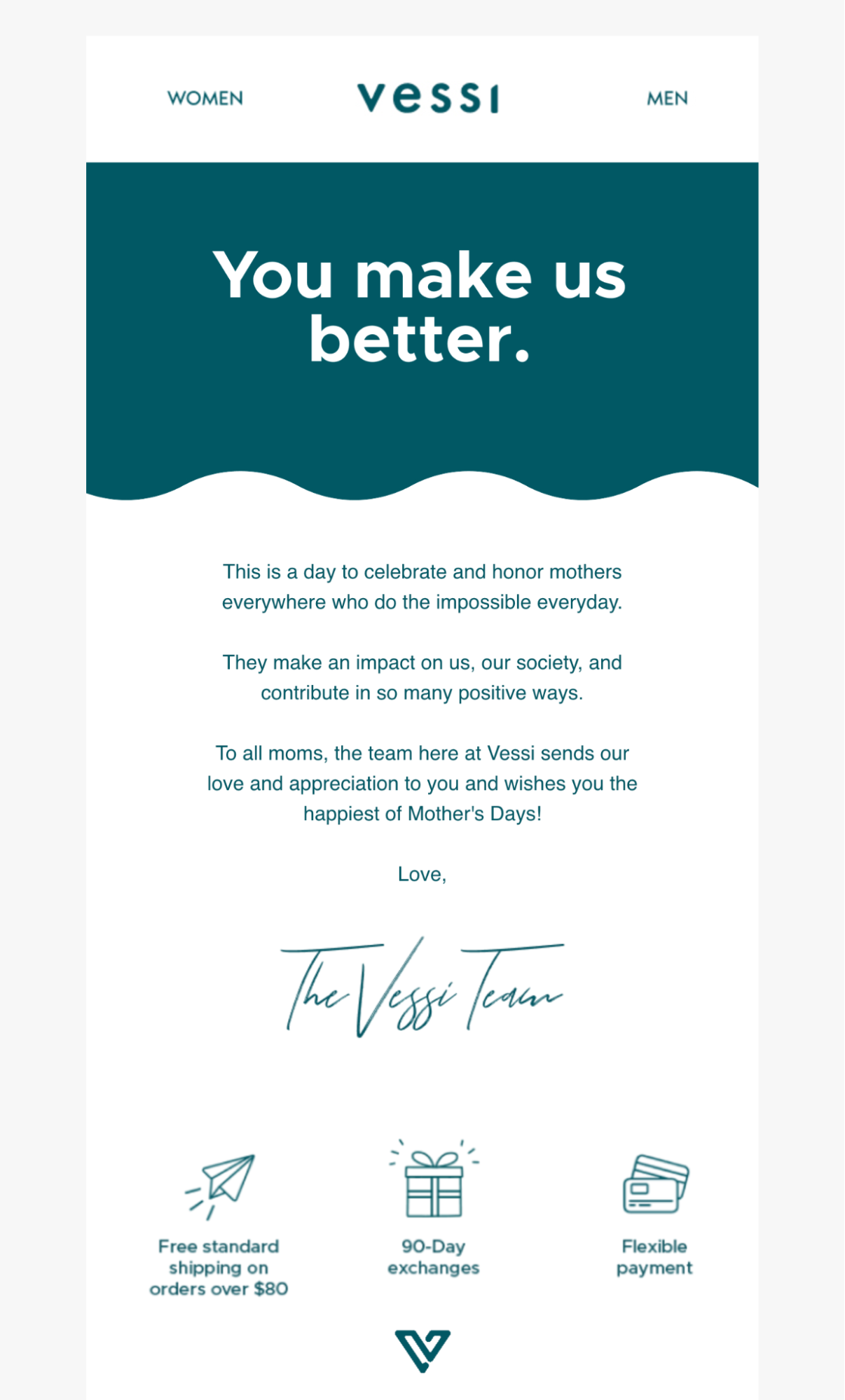
Like Cécred, Vessi uses Mother’s Day to share a heartfelt message of motherhood appreciation to their customers. The email comes with a simple and clear design and reads like a genuine letter without any mention of products or special promotions, not even a CTA.
Best practices:
- If you’re thinking about going with an email campaign that focuses on building a relationship with your audience, adding a handwritten script can make the email feel more personal.
- Keep the email centered around the initial message and only add your brand trust signals at the end of the email to maintain some commercial utility.
- Add a straightforward note that speaks directly to the audience, just like the “You make us better” line used by Vessi.
Expert tip: Email campaigns typically center around driving revenue, but careful planning and genuine conversation can bring a different kind of value to your brand — it can build trust. With all the promotional emails landing in customers’ inboxes, people take note of those that don’t center around purchasing.
10. Beehive Cheese: Brand personality/humor
Subject line: Your Mom deserves the best
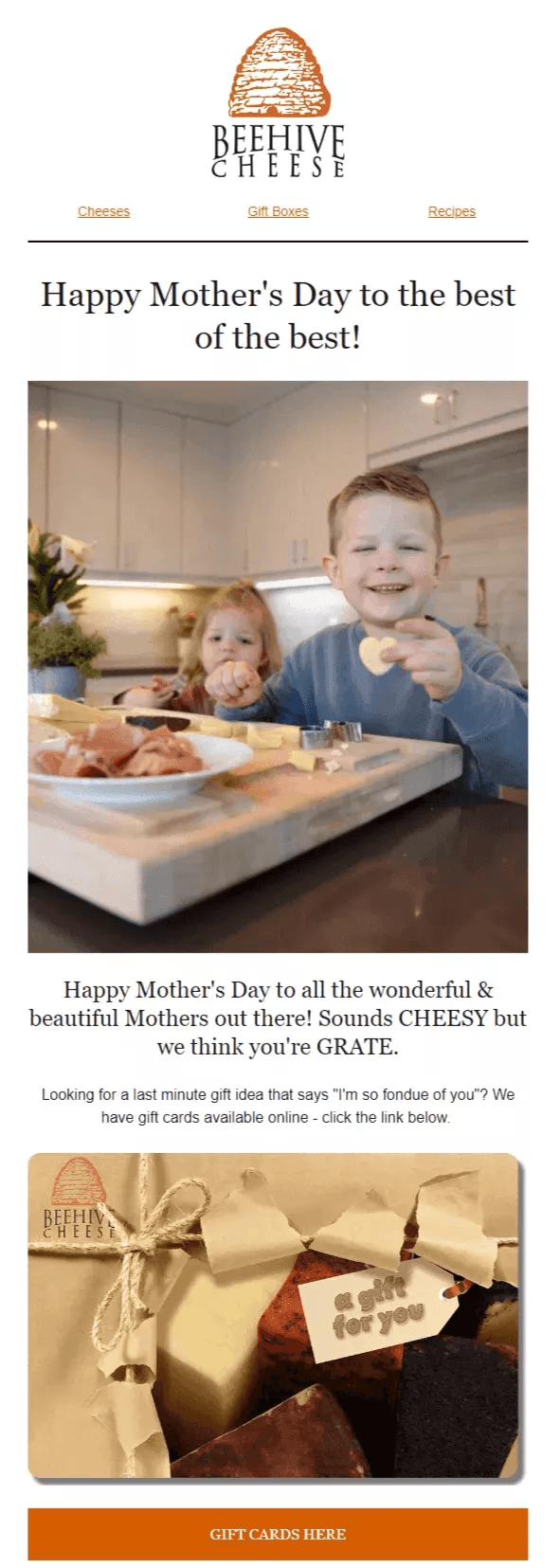
Beehive Cheese keeps it simple and light, leading with warm visuals, playful puns, and a single CTA. Using humor in this case works because the brand keeps it consistent with its usual tone and character, albeit amplified for occasions like Mother’s Day.
Best practices:
- Let your brand voice shine on special days to make email campaigns more unique, standing out from generic promotional emails.
- Combine the option of a gift guide and a gift card to appeal to decisive shoppers and those still in the consideration stage.
- Use a simple email structure with minimalistic designs, especially if you add creative copy, to keep readers’ attention on that copy.
Expert tip: No matter how specific your products may be, you can use puns and humor strategically to lower purchase hesitation while also adding personality to your emails.
How to segment your Mother’s Day emails
Automated emails may rely heavily on segmentation, making up just 2% of total email value, but they generate 37% of all email-driven sales. So, when it comes to Mother’s Day email campaigns, this statistic shows just how carefully targeted and segmented emails can outperform large email batches.
Additionally, segmenting your emails also allows you to send highly specific messages to different groups of people. This not only increases engagement rates but also builds trust and meaningful relationships with target audiences.
As a starting point, here’s a quick list of key segments that perform:
| Demographic | Behavioral | Campaign-specific |
|---|---|---|
| Gender, location (city, country, or region), age group, type of relationship (e.g., mother, grandmother, aunt) | Interests (fitness, travel, cooking, etc.), purchase histor, most loyal subscriber, last-minute shoppers | Gift-givers vs. mothers themselves, previous Mother’s Day purchasers, subscribers who celebrate differently |
| Best for mapping out initial audience types and defining broad audience groups | Best for targeting user actions and preferences to improve engagement and conversion | Best for targeting specific shoppers with highly personalized messaging |
How to personalize Mother’s Day emails
Using the right segmentation, or combining segments, is one of the best ways to set your Mother’s Day emails for success. But this is just one step of many – the top Mother’s Day email trends 2026 show several steps to improve engagement rates and trust with your target audience.
- Choose the right segmentation method. Start with cold, hard data and break your audience into different groups. Don’t just focus on new moms. Consider expecting moms, grandmothers, and even those who are looking for gifts for moms.
- Use customer-specific messaging. Personalization doesn’t just attract more attention; it can result in 20% higher click-through rates. Try to go beyond using individual names and additional information like past purchases (if applicable) to connect with your audience.
- Use genuine language. Nothing makes a person close an email sooner than spotting generic content, particularly for special occasions like Mother’s Day. Create copy that balances promotional offers with values specific to this occasion, like gratitude, affection, and warmth.
- Use urgency wisely. Add deadlines where they make sense, but avoid creating anxiety over a limited-time deal on your products. For Mother’s Day, it can be useful to mention the date to bring attention without being pushy.
For a deeper look at how to build and automate these segments, see our guide to email list segmentation.
FAQ
What makes a good Mother’s Day email campaign?
A good Mother’s Day email campaign includes several elements to avoid focusing on just one segment of your audience and alienating the rest. An email combining different segments and approaches could look like a last-minute email for late shoppers and a promotional send for gift-givers. In fact, HubSpot reports that segmented emails can improve opening rates by about 30%.
What are the best Mother’s Day email ideas that aren’t just discounts?
Some of the best Mother’s Day email ideas revolve around giving unique value, specifically by providing gift ideas as suggestions rather than straight product promotions. You can offer gift guides based on shopper intent, brand giveaways with partner brands, or experiences. Another idea could be to send no-sell appreciation emails to build relationships with your customer base.
How do you personalize Mother’s Day emails?
Personalize your Mother’s Day emails by separating your audience into mothers and gift-givers. Emails for mothers might focus on encouraging them to take the time to treat themselves, while copy for those celebrating mothers could emphasize how to make moms feel their best and appreciated.
When should you send Mother’s Day emails?
It’s best to launch your main Mother’s Day campaign 2 to 3 weeks before the actual date. After that, follow up with a last-minute email in the last 48 hours targeting the unsubscribed audience and last-minute buyers.