
 Omnisend AI


 OFFER
OFFER





Drive sales on autopilot with ecommerce-focused features
See FeaturesKey takeaways 
SMS marketing is essential for travel agencies, boasting a 98% open rate and enabling timely engagement with customers at critical moments in their journey.
Utilizing automated SMS can significantly reduce customer acquisition costs and enhance revenue, with an average return of $0.74 per send in 2025.
Travel agencies should leverage SMS for various purposes, including booking confirmations, pre-trip updates, flash sales, and real-time travel alerts to maximize customer satisfaction and retention.
Integrating SMS with email marketing creates a powerful multichannel strategy, improving visibility and driving higher ROI for travel businesses.
Reveal key takeaways
98% of people open text messages, and 90% do it within three minutes, according to Optimonk. Based on those points alone, SMS marketing for travel agencies is crucial to appear at high-intent moments and maximize engagement across your customer journey.
Another reason to use SMS marketing for travel is lowering your customer acquisition costs, which have grown by 35% from 2022 to 2025 in travel, per Adobe. Owned channels, such as SMS, don’t require you to pay per click or impression.
Of course, there’s more to SMS marketing than bulk and one-time campaigns. Automated SMS, such as welcome and abandoned cart texts, earned an average of $0.74 per send in 2025, a fivefold increase over campaigns, according to Omnisend. It basically pays to automate.
This article provides all you need to know about using SMS marketing for travel agencies, with the what, why, and how, plus templates and best practices.
Join Omnisend to master travel industry SMS marketing with campaigns and multichannel automations
Quick sign up | No credit card required
What is SMS marketing for travel agencies?
Travel agencies reach customers at high intent moments with SMS marketing, using its instantaneous delivery for urgent promotions, reminders, and confirmations. It can be manual or automated, and in either case, it’s the sending of text messages to opted-in subscribers.
Here are the ways travel agencies use SMS marketing:
| SMS marketing type | Use case |
|---|---|
| Promotional | Flash sales, limited-time offers, travel packages |
| Social proof | Customer success stories, testimonials |
| Recovery | Abandoned cart and checkout recovery |
| Transactional | Booking confirmations, real-time travel alerts |
| Retention | Re-engagement campaigns, anniversary reminders |
| Feedback | Post-trip reviews and satisfaction requests |
Notice how the table covers the complete customer journey from pre-booking > booking > pre-trip > during trip > post-trip. That’s because SMS has excellent engagement metrics across the board, working alongside email for time-sensitive messages.
The ROI potential of SMS marketing for travel agencies is significant. Omnisend customers achieved a $79 ROI for every $1 spent across SMS, email, and web push notifications in 2025.
In fact, the hospitality industry is one of the biggest SMS marketing adopters, with 80% uptake in 2025. We expect that to grow further in 2026.
Why SMS marketing works for travel businesses
SMS marketing for travel brings multiple benefits to your strategy, such as putting your messages in front of customers fast and lowering acquisition costs. The statistics below paint the picture of why you should adopt SMS:
Unmatched open and conversion rates
As reported per Optimonk, SMS has a 98% open rate and 90% of people read them within three minutes, outstripping email’s 30.7% open rate in 2025..
SMS click rates also more than doubled YoY in 2025 according to Omnisend, with automated messages earning an average of $0.74 per send, and campaigns earning $0.15 per send.
Text message marketing’s high visibility makes it best for time-sensitive and urgent messages, including revenue-generating and confirmation ones.
Travelers are mobile-first
Mobile is the device of choice for travel research and booking among consumers, with some 73% of people wanting to use their smartphones for it.
Another shift has occurred online in general, with 72% of travelers preferring to book online versus 12% who prefer going into physical agencies. 76% also look for travel apps, in addition to websites, for their research.
These stats underscore why SMS marketing for the travel industry has such high open and conversion rates, because travelers are mobile-first and receptive to the channel.
Rising customer acquisition costs demand owned channels
Acquiring customers is becoming more expensive across all channels, from Google and Microsoft Ads to Meta and TikTok. Costs rose by 35% between 2022 and 2025 for the travel industry and show no signs of slowing down.
SMS reduces customer acquisition costs because it’s an owned channel. You pay for the subscription, or the credits, and those are your only costs.
You can nurture, retain, and create a profitable marketing channel over time, with acquisition costs as low as $0.10 per message.
7 types of SMS messages every travel agency should send
Your automated SMS marketing for travel should include these messages:
Booking confirmations and reminders
Booking confirmations and reminder texts are always automated and will form a core part of your sending strategy if you handle transactions.
Your automation will run like so:
- SMS one, a confirmation text confirming booking and payment receipt
- Message two, a reminder within one week of the trip
- Message three, a final reminder about tickets and essentials, sent 24-48 hours before
Alternatively, you can build separate flows for bookings and reminders. A separate flow lets you assign different triggers and timing based on the trip type.
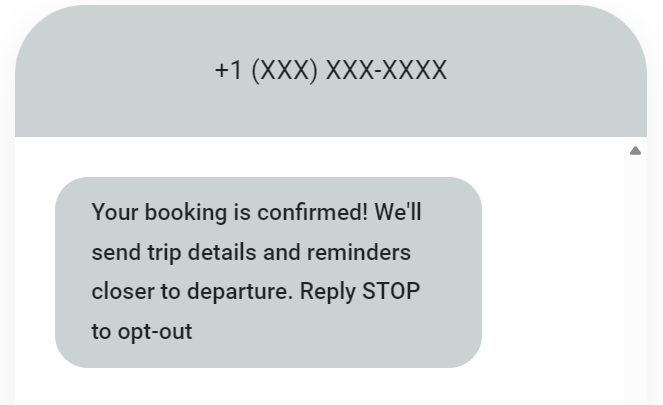
Check out the example text below. It confirms the customer’s booking and sets expectations for the next update:
Pre-trip preparation updates
Text marketing for tourism businesses often includes pre-trip messages as a tactic for customer retention and relationship building.
Your texts could include links to packing tips, visa and documentation steps, check-in instructions, and cross-sells if they’re appropriate. Your flow will contain two to three texts, depending on the type of trip your customer is taking.
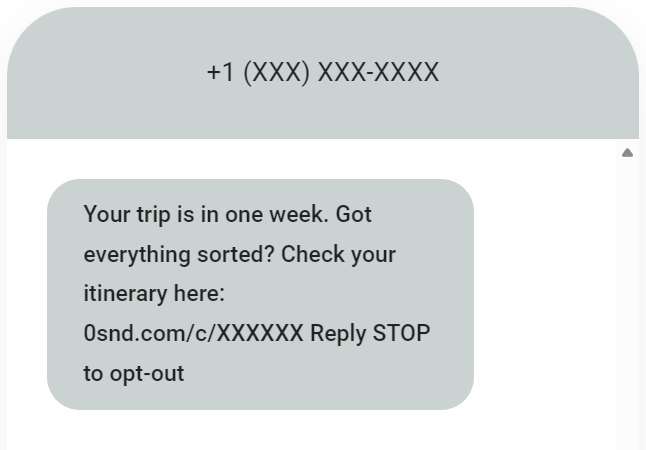
Check out the pre-trip SMS below pointing to an itinerary to help customers prepare:
Flash sales and limited-time offers
Promotional SMS is your best channel for flash sales because of its immediacy. A text with a 24-hour offer and a direct booking link will reach your customers faster than email or social, and generate quicker action, too.
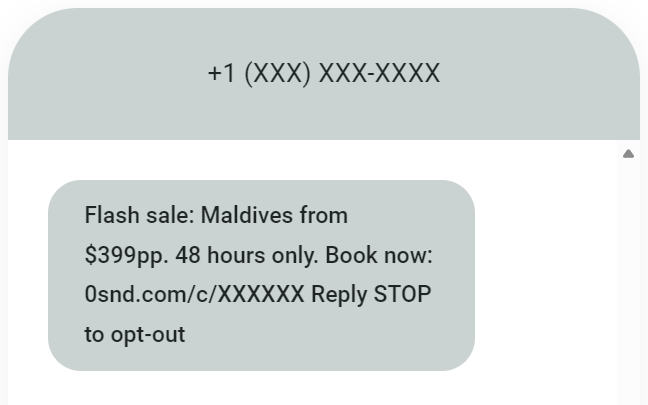
Use flash sale texts for last-minute deals, seasonal promotions, and early-bird pricing on upcoming departures. The example text message below pushes bookings for the Maldives and uses urgency (48 hours only) to encourage action:
Upsell and cross-sell messages
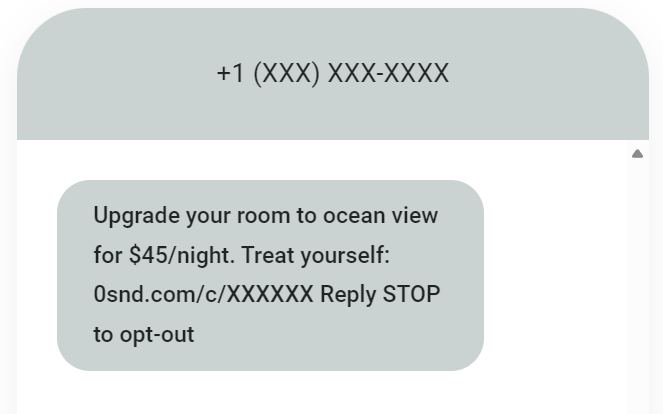
Between booking and departure, your customers are actively planning their trip. That makes it the best window to offer room upgrades, activity add-ons, travel insurance, and airport transfers:
Building a post-booking flow that sends one to two upsell texts based on the package your customer purchased is a decent way to increase your customer lifetime value.
Real-time travel alerts
Flight delays, gate changes, weather warnings, and itinerary changes are high-value texts that your customers appreciate. Hearing about disruptions from you before they find out at the airport builds trust that no promotional campaign can match.
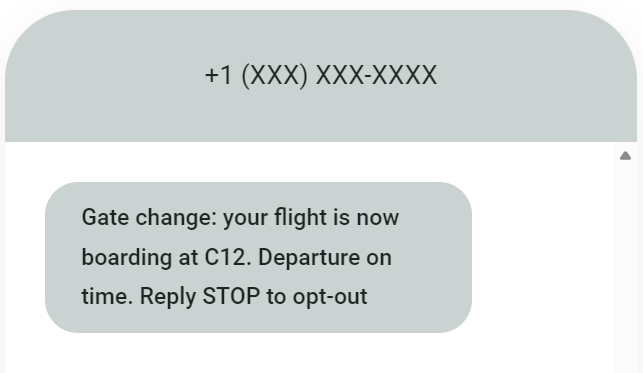
These are transactional texts rather than marketing messages, so they don’t require you to have collected a marketing opt-in to send. Here’s an SMS example for a flight update:
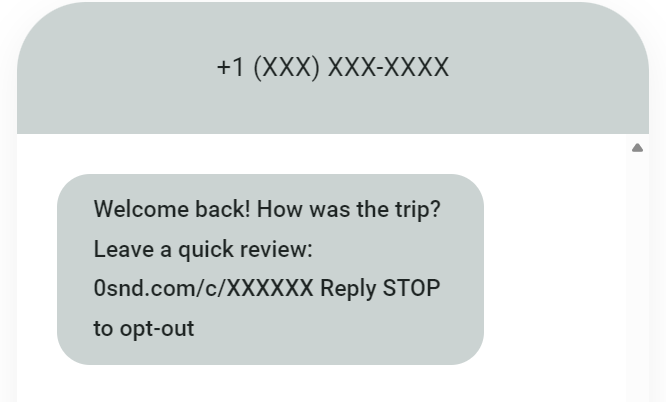
Post-trip feedback and review requests
Your post-trip flow should trigger 24 to 48 hours after your customer’s return date. Any sooner and they’re still settling in. Any later and the experience isn’t fresh enough for a response.
Add a link to your SMS pointing to your review tool, such as Judge.me, and keep the message short to avoid giving your customers fatigue.
Winback and re-engagement campaigns
Customers who haven’t booked in six to 12 months are drifting, but a well-timed text can pull them back. Personalize your offer based on their previous destinations or travel preferences to make it relevant, or provide a discount across your range:
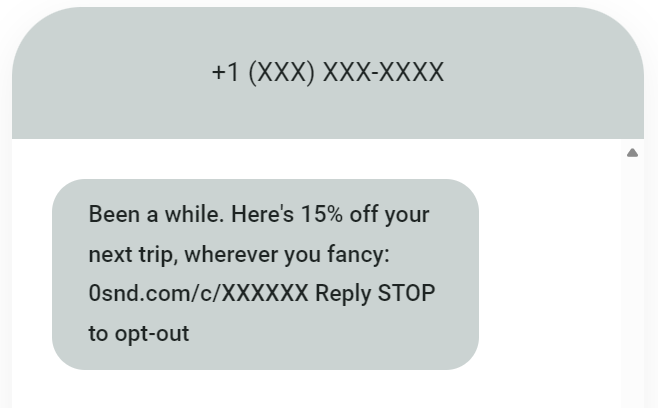
One or two attempts are enough. If they don’t respond, remove them from your active list and save your credits for subscribers who are engaging.
Omnisend lets you build standalone SMS campaigns for promotions and offers, plus multichannel flows that combine SMS and email to reach customers based on their behavior.
SMS templates for travel agencies
Steal these SMS templates and use them in your own messages:
Booking confirmation
Your booking is in. Thank you. You can manage your booking anytime at (link). Reply STOP to unsubscribe
Copy text
Pre-trip reminder
Your holiday is all set for (date), with your flight at (time). Don’t forget to pack all your stuff. Reply STOP to unsubscribe
Copy text
Flash sale promotion
Massive savings for trips to (location) now on. Circa 40%! Visit (link) today. Reply STOP to unsubscribe
Copy text
Upsell or add-on
Fly in luxury for 50% less. Save 20% on seat upgrades until (date). Visit (link). Reply STOP to unsubscribe
Copy text
Real-time travel alert
There has been a change to your (flight or travel type). Visit (link) for details. Thanks. Reply STOP to unsubscribe
Copy text
Post-trip review request
Hope you had a great time. Speaking of time, do you have a min to leave a review? Visit (link). Reply STOP to unsubscribe
Copy text
Winback offer
Been a while (FirstName). 10% off wherever you want to go next. Valid 7 days: (Link). Reply STOP to unsubscribe
Copy text
How to automate SMS marketing for your travel business
Automated text messages are customer experience improvers. They deliver on your promises with welcome messages, appear at high-intent moments following abandonment, and provide retention opportunities post-trip.
Here are the best ways you can use automated SMS marketing for travel:
Welcome series for new subscribers
Your welcome series triggers for new SMS subscribers to welcome them and deliver on whatever you promised, such as a discount or early access.
Building a series instead of one text encourages engagement, but there’s a fine line between being helpful and creating early fatigue.
Here’s a welcome series you can use:
- SMS one, a welcome message that delivers whatever you promised, sent 15 to 30 minutes after your customer signed up
- Message two, this one goes out 48 hours later, promoting popular destinations and offers
- Message three, a social proof message that builds trust, ideally sent after 72 hours
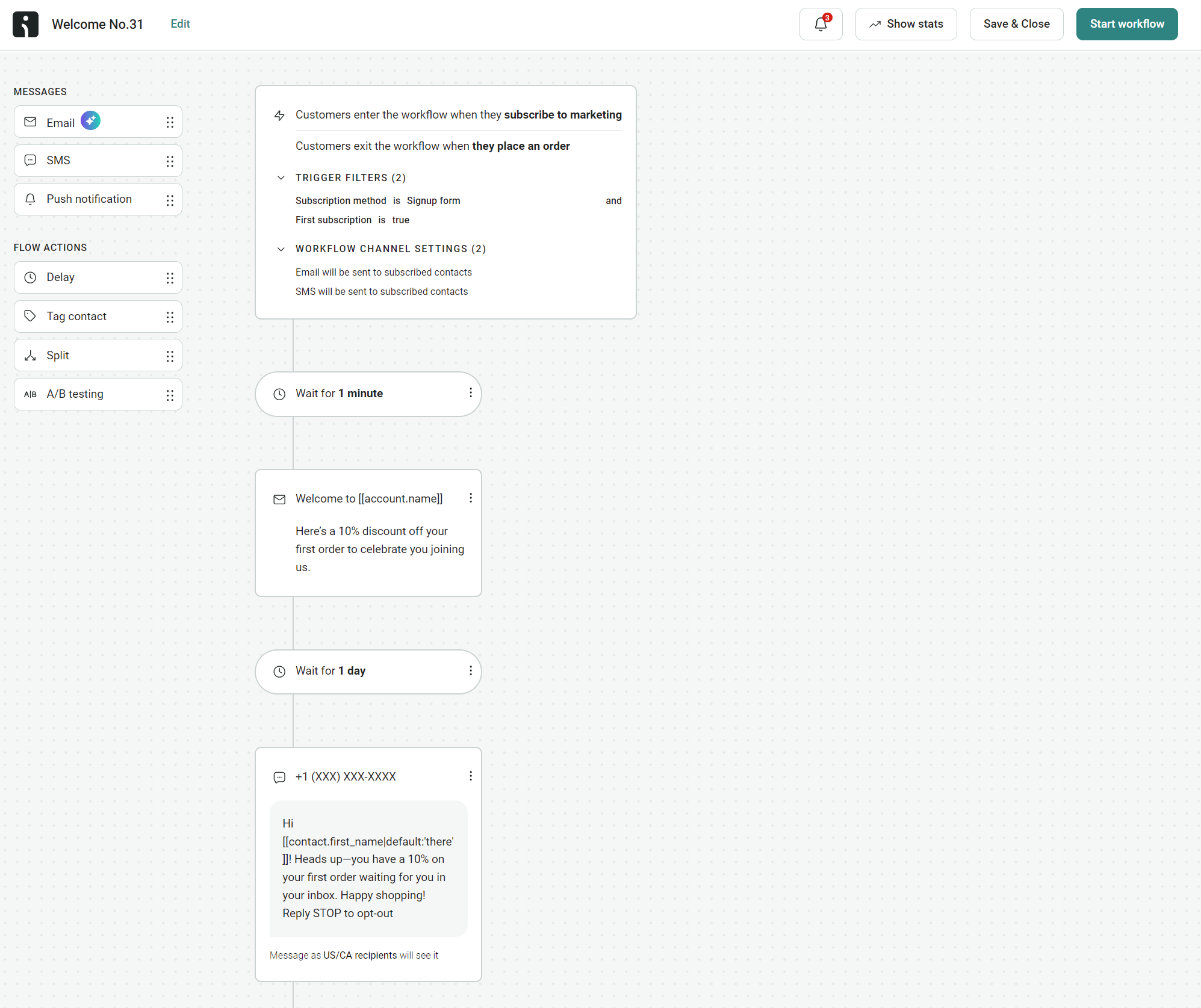
Omnisend gives you multiple pre-built welcome flows for email + SMS channels, which you can edit to contain three or more text messages with custom delays:
Pre-trip and post-trip automation flows
Pre- and post-trip flows are all about being helpful, nurturing, and retaining subscribers. Good customer experiences here significantly improve the chances of them booking again and recommending your travel brand to others.
A few flows you can use:
- Pre-trip flow:
- SMS one, sent seven days before your customer departs, you can build excitement into the trip and provide a link with tips.
- Message two, a 48-hour pre-trip send with local weather predictions, check-in details, or upsell add-ons.
- Message three, send this one 24 hours before they depart with any final travel advice and last-minute tips. A link to your customer support page is also helpful in case they need to contact you.
- Post-trip flow:
- SMS one, send 24 hours after their return, welcome them back.
- Message two, 72 hours after their return, ask them for feedback.
- Message three, sent seven days after their trip. Remind them to leave feedback or offer a discount on their next trip.
Omnisend’s flow builder lets you build these SMS sequences with pre-built automations for product reviews and follow-ups. New bookings can also have their own segment and trigger a flow with pre-trip tips and advice.
Abandoned booking recovery
Some customers will add travel packages and services to their cart and leave without completing their booking. Provided you have their phone number and they’re opted in to marketing messages, you can send them SMS cart reminders.
Booking abandonment reminders are one of your best revenue opportunities because you’re sending to customers who have already shown intent. All you’re doing is retargeting them and attempting to recover otherwise lost revenue.
Omnisend has a pre-built cart and checkout abandonment flow for bookings. The abandoned checkout flow with three emails and one text works well:
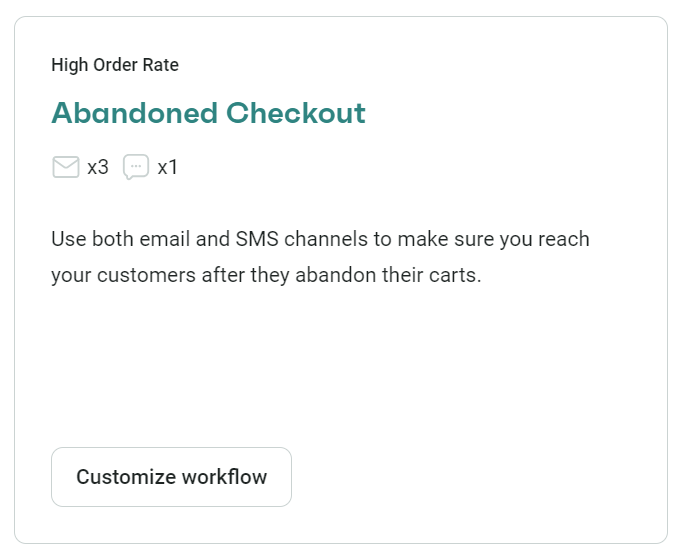
You should edit this flow to contain three text messages. A sequence you can use:
- SMS one, the first reminder sent within 30 minutes of abandonment
- Message two, send it 24 hours later
- Message three, send it 72 hours or four days later, and provide a small discount
Abandoned cart texts have conversion rates of 24.6% — 39.4% according to Optimonk , making them one of the most effective marketing automations to have in your strategy.
How to build an SMS subscriber list for your travel agency
Your SMS list is only valuable if the people on it opted in and want to hear from you. Every collection method should make it clear what subscribers will receive and give them a reason to sign up. Here are the best ways to collect SMS subscribers for your travel agency:
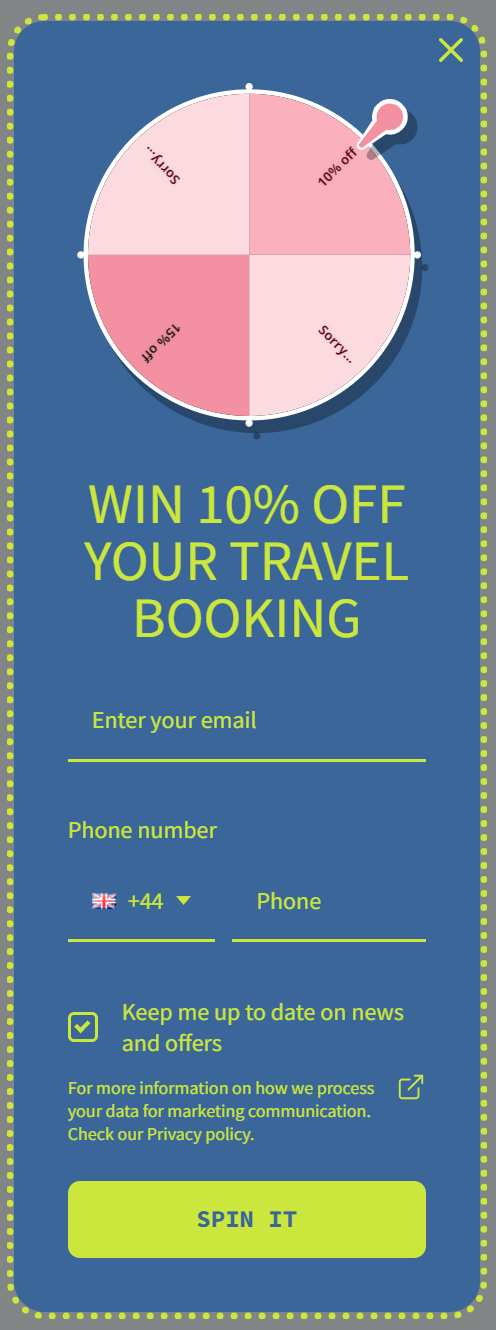
- Use website popups with a travel incentive, such as “Get exclusive travel deals via text. Join for 10% off your first trip.” Omnisend’s embedded, flyout, and popup forms help you collect phone numbers and build your list naturally. The Wheel of Fortune popup below is a proven winner for opt-ins:
- Build landing pages you can link to across social media. You can point your customers to these when running competitions and giveaways.
- Promote SMS to your email list with a dedicated send or footer CTA asking subscribers to add their number for flash sale alerts.
- Physical events are another opportunity if you generate QR codes. Get some stickers and attach them to gathering spots to get click-throughs.
Pro tip for opt-ins
Some SMS subscribers will opt-in by mistake and ultimately unsubscribe early or block your sender number. Double opt-in is worth considering if you want higher list quality and compliance. It adds a confirmation step, but the subscribers you get are more engaged and less likely to opt out early. Your forms need to contain an email field for double opt-in to work in Omnisend. Customers can then confirm their subscription by email.
SMS compliance for travel agencies: TCPA and GDPR rules
If you’re sending marketing texts to customers, you need to comply with the SMS regulations that govern your recipients’ locations to avoid fines and reputational damage.
The table below covers the basics:
| Requirement | TCPA (USA) | GDPR (EU/UK) |
|---|---|---|
| Consent type | Express written consent | Explicit consent with clear purpose |
| Opt-out mechanism | Required in every message | Required in every message |
| Opt-out processing | Within 10 business days | Without undue delay |
| Sending hours | 8 AM to 9 PM local time | No fixed rule, but reasonable hours expected |
| Business identification | Required | Required |
| Consent records | Must maintain | Must maintain |
| Fines for non-compliance | Up to $1,500 per message | Maximum of €20 million, or the equivalent of 4% of annual turnover |
The regulations in more detail:
TCPA (USA)
The Telephone Consumer Protection Act requires you to collect written consent to send marketing texts to USA contacts, something you can attain with a checkbox.
Your texts must also include opt-out instructions, such as “Reply STOP to unsubscribe,” and you must honor those requests within 10 business days.
It’s good practice to send only during reasonable hours, which we define as 8 AM and 9 PM local time, and identify your business in every message.
The TCPA’s fines are very steep, up to $1,500 per message. Your SMS tool should assist you in complying with good sending practices.
GDPR (EU/UK)
The General Data Protection Regulation covers the EU, and stretches to your USA business if it processes information for people in the EU and UK.
As with the TCPA, the GDPR requires explicit consent with a clear explanation of what subscribers are signing up for. Your customers have the right to withdraw consent at any time, and you must process those requests without delay.
Consent records are mandatory under both regulations. Keep a log of when and how each subscriber opted in, what language they agreed to, and when they opted out, if applicable.
How Omnisend handles compliance
Omnisend automatically adds opt-out language to your text messages and processes opt-out requests when customers use keywords like STOP or UNSUBSCRIBE. It also uses AI-powered intent detection to catch natural-language opt-outs like “please stop texting me.”
Opted-out contacts are flagged automatically to prevent resends, and their subscription status updates in real time.
How SMS fits into a multichannel travel marketing strategy
SMS is most effective when it’s part of a multichannel strategy also involving email. Email reaches customers with long-form content and information, whereas SMS delivers urgency and exclusivity for customers receptive to it.
You would use email for nurturing, education, and general promotions, with SMS for reminders, time-sensitive messages, and confirmations.
Here’s how they work together in practice:
- Campaigns. You create standalone SMS and email marketing campaigns for segments and schedule them for an appropriate time. They’re disconnected but part of the same strategy; you can measure the results and optimize from there.
- Automations. Omnisend lets you build omnichannel flows containing a series of SMS messages and emails. These can trigger via custom delays, reaching your customers at high-intent moments across their buying stages.
Automations are where multichannel works best. Here’s an example:
- Your flow triggers a welcome email for new subscribers with a travel guide
- 24 hours later, it triggers an SMS with a discount for new bookings
- After 72 hours, another email triggers with social proof and customer stories
That three-email series increases your reach and improves your customer experience. There isn’t any fatigue because each message is relevant to their journey.
The ROI factor for multichannel
Omnisend customers who use email + SMS + web push notifications see fantastic results from their spend. The 2025 headline is a $79 ROI for every $1 spent. There’s no reason why you can’t achieve similar results. Treat SMS and email as complementary channels, and your visibility will increase, leading to more revenue and greater retention.
How to choose an SMS marketing platform for your travel agency
Here’s what to look for in a tool for travel industry SMS marketing:
- Global SMS support. Your customers travel internationally, and your SMS tool needs to reach them wherever they’re. Omnisend supports global coverage. Avoid platforms that limit your SMS sending to the USA, Canada, UK, and Australia only.
- Email and SMS in one platform. Managing separate tools for email and SMS creates unnecessary complexity and makes omnichannel flows harder to build. A combined platform lets you trigger both channels from the same segments and automations.
- Automation capabilities. Welcome series, abandoned booking recovery, pre-trip reminders, and post-trip follow-ups all require automation features.
- Ecommerce platform compatibility. Your SMS tool should integrate with your booking system or ecommerce platform to pull in customer data for segmentation and automation triggers.
- Compliance features. Automated opt-out language, keyword detection, and consent record management should come built in, not bolted on.
- Transparent pricing. Some platforms charge separately for email and SMS or hide SMS credits behind higher tiers. Look for per-credit pricing with no surprises. Omnisend lets you purchase credits on all plans, and its Pro plan includes bonus SMS credits equal to the price of your monthly spend.
Additional reading
10 best SMS marketing software in 2026
Conclusion
SMS marketing for travel agencies is the best way to reach customers with urgent, time-sensitive promotional messages and confirmations.
Text messages work alongside email to deliver outsized results, with Omnisend letting you create multichannel flows across all plans. Your flows can contain any combination of emails and SMS to reach customers at optimal moments.
Treat SMS as another revenue channel, and you can’t go wrong. It’s owned, manageable, and offers greater visibility than any other openable channel.
Join Omnisend to create high-quality customer experiences for your travel business across SMS and email
Quick sign up | No credit card required
FAQs
Is SMS marketing legal for travel agencies?
It’s legal provided you have proper opt-in consent. Your subscribers need to have checked a box themselves. Also, you need to maintain records and honor opt-outs.
What is the best marketing strategy for a travel agency?
A multichannel strategy works best using email and SMS as owned channels, which you have complete control over. Build your list, refine its quality with segmentation, and trigger automated texts and emails that reach customers at high-intent moments.
How often should travel agencies send SMS messages?
Confirmation messages are reactive and can go out whenever your customers complete actions, such as changing their password or subscription status. Your marketing texts should be more sparse, sent every few days at most.
Does SMS marketing still work in 2026?
Works great, with automated texts earning $0.74 per send in 2025 according to Omnisend’s ecommerce marketing report. The fact that it reduces your customer acquisition costs and allows retention marketing also builds value into your efforts.
What types of SMS messages drive the most bookings for travel agencies?
Welcome, abandoned cart, and cross-sell SMS messages work well because they go out based on customer behavior. Any other texts that respond to customer actions are potential candidates as top performers for SMS marketing for tour operators.

TABLE OF CONTENTS
TABLE OF CONTENTS


Subscribe and don’t miss any updates!
No fluff, no spam, no corporate filler. Just a friendly letter, twice a month.