Omnisend AI


 OFFER
OFFER








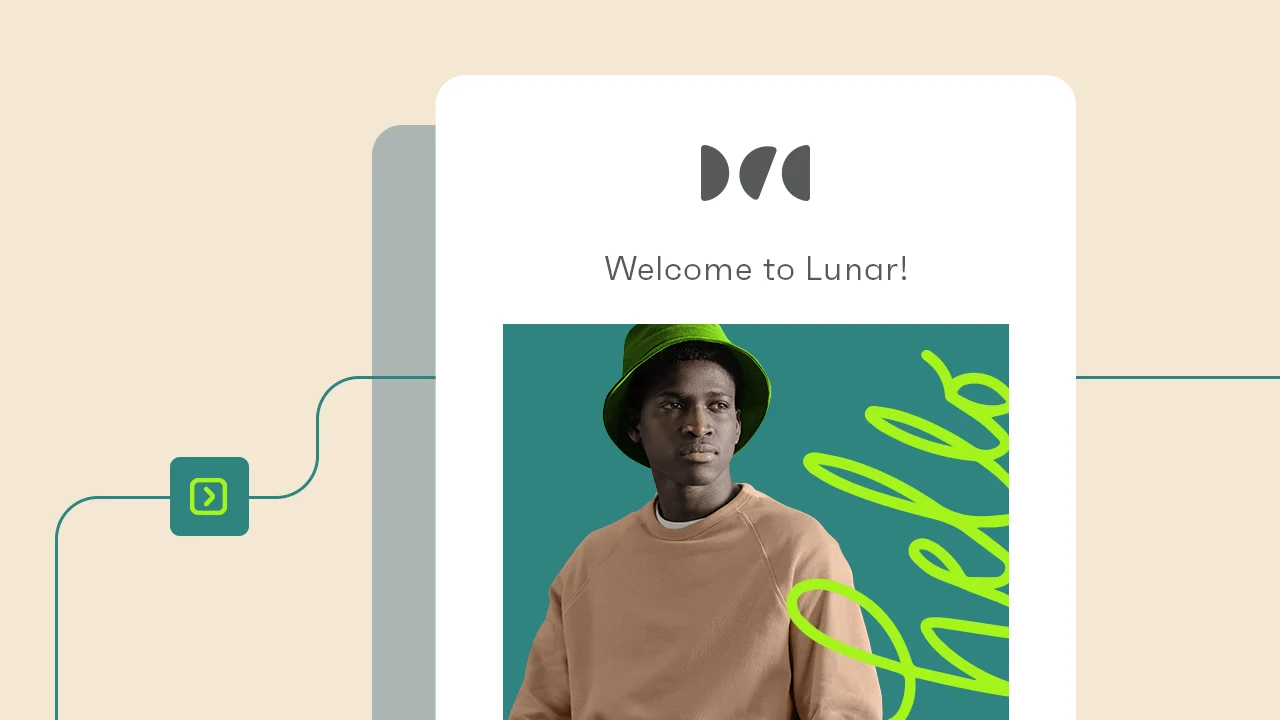

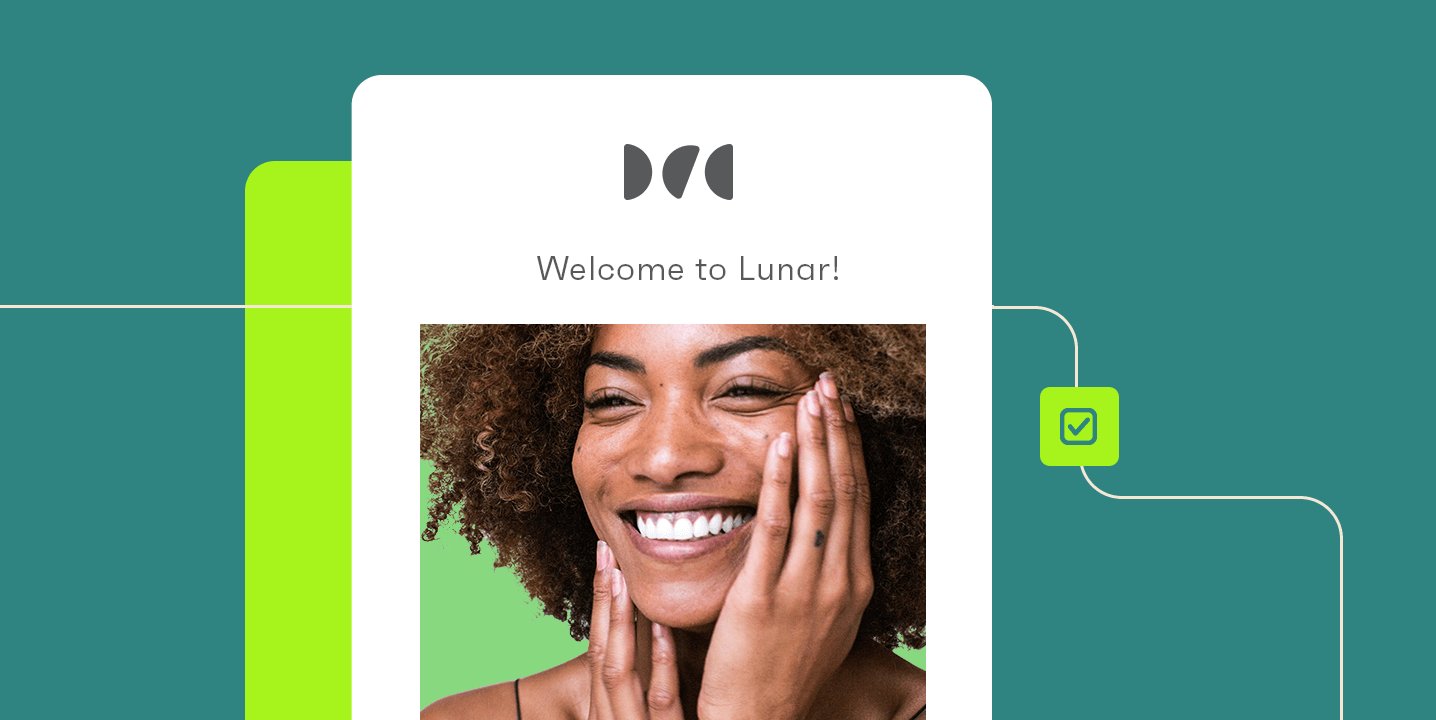
A welcome email template that personalizes your customer experience and delivers upfront value will help you maximize revenue and retention.
There’s no greater intent than customers filling in forms or completing purchases. Welcome emails sent by Omnisend customers had the second-highest revenue per email in 2026 at $6.30 per email, plus the highest click-to-conversion rates at an impressive 52.98%.
One of the reasons for this is the quality of the emails Omnisend lets you create, but also, your own customers being highly receptive to welcomes because they expect them after interacting.
However, if you only say “thank you, good day” in your welcome emails, then you’re letting slip a prime opportunity to capture early sales and increase revenue per customer.
This article provides six welcome email templates you can use in your flows, welcome email examples from real brands, tips and best practices to refine your efforts, and steps for ongoing optimization.
Quick sign up | No credit card required
What to include in a welcome email
These are the elements you need to add to and master in your welcome emails to encourage opens, engagement, and clicks:
- Subject line: Welcome emails have high open rates (33.79% in 2025) by default because they follow customer actions such as signing up, but don’t take that for granted. Lead with “Welcome to (your brand)” or “Thank you for joining (your brand)” so that subscribers know the purpose of your email:

- Preheader text: Briefly describe what your email’s about and write something new versus the subject line, such as “You’re in the club for exclusive offers.”
- Personalized greeting: Your welcome email should lead with a hello or a thank you note and mention your customer by name when possible:
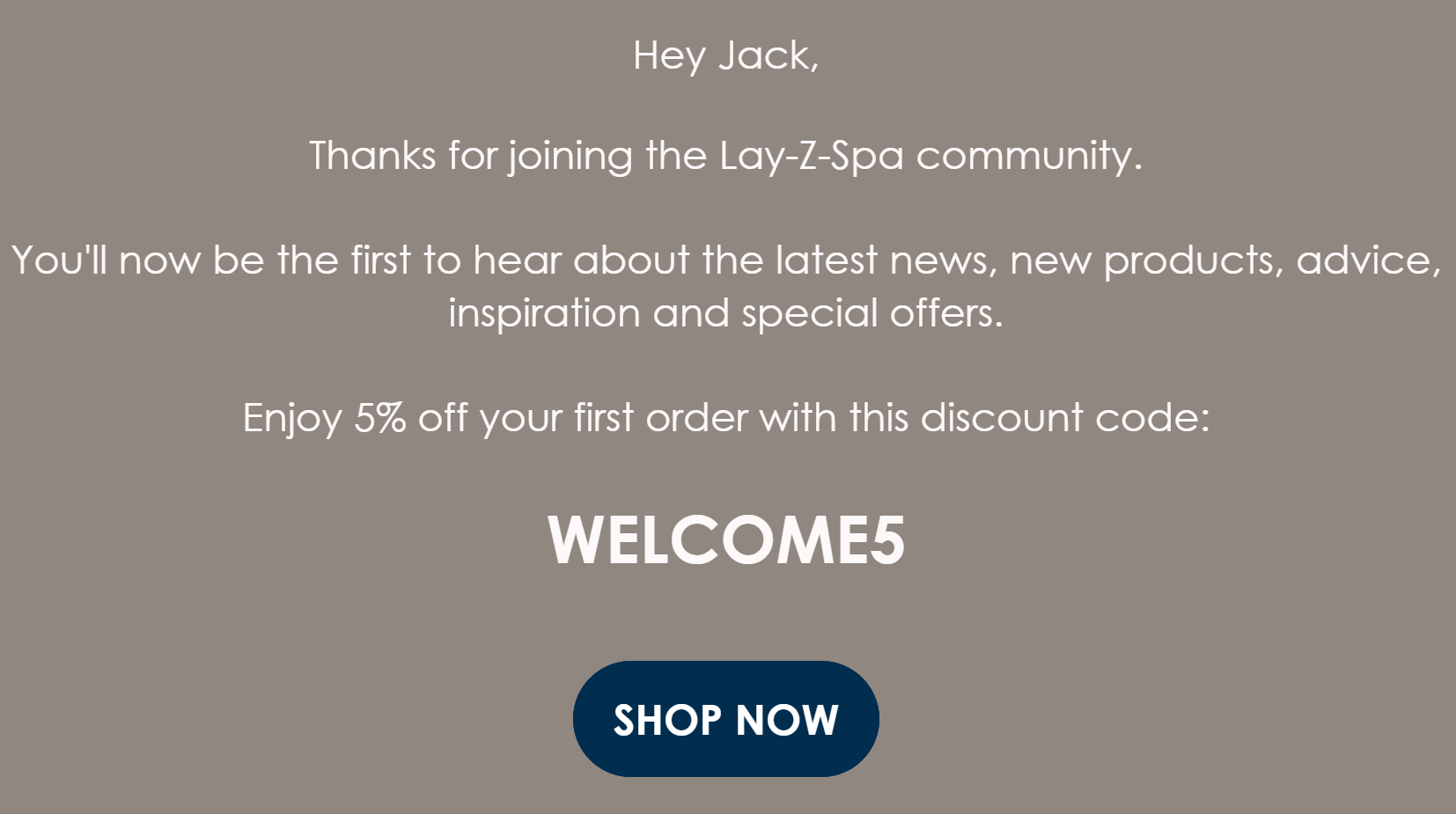
- Incentive: Provide any promised incentive, such as a discount, either in your greeting text or immediately below it. Customers who signed up because you offered something in return will appreciate being able to grab the code early.
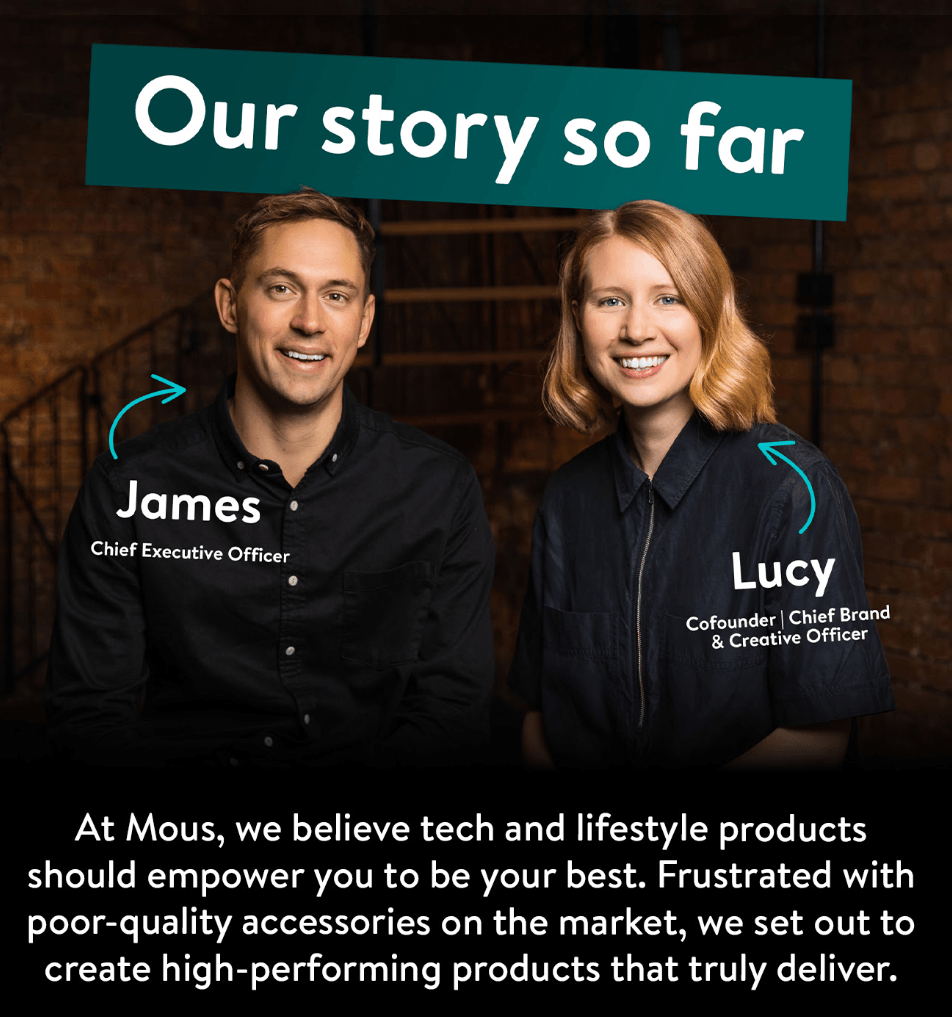
- Brand introduction or highlights: Your welcome email is as good a place as any to discuss what you sell, why you sell it, and how customers appreciate you:
- Call-to-action (CTA button): Not a text link, you want a proper button with a contrasting color so that it’s easy to find and click. Where it links to depends on your welcome email’s context. Safe choices include your homepage or most popular collection.
- Social proof: Most relevant if you’re an established brand or when you have enough reviews to shout about. Star ratings take up little space and work well.
- Unsubscribe link: It’s a legal requirement under the CAN-SPAM Act and GDPR. Omnisend and other reputable email marketing tools add them by default.
Welcome email subject line tips
A portion of your customers will open their welcome emails no matter what because they’re waiting for a discount. Your subject line is the big open rate factor in every other situation because it creates anticipation and previews the content.
However, despite the intent behind welcome emails, their open rates only reached 33.79% in 2025, behind cross-sells, back-in-stock alerts, and abandoned cart reminders. The reason is a simple one — most welcome subject lines are generic.
These tips will help you create good subject lines:
- 40-50 characters is your limit. Email providers truncate subject lines on mobile devices around that mark. There’s no point in adding more words that get cut off.
- Mention your customer’s name when possible. You can definitely do so for welcome emails following a purchase, but customers who sign up via forms might not enter their names. Add a name field to your welcome popups and other forms to personalize your welcome emails in the future.
- Add the incentive. Say if your customer gets 5% or 10% off, a gift, or exclusive access, especially if you promised it at sign-up.
- Avoid spammy phrases. Some inbox providers will move your emails to spam with certain words in subject lines, plus your customers might have fatigue already. A few to avoid:
- 100% free
- Don’t delay
- Act now
- Double your ‘X’
- Also avoid: ALL CAPS, excessive emojis, and excessive symbols ($$$$)
- A/B test two subject line versions. Change the order of your words to front-load the offer and name, or test no emojis versus with emojis, etc.
Here are some welcome email subject lines you can reuse for different customers:
- For your new customer welcome email template, use something like, “Welcome to (brand), (name).”
- Customers who sign up during sales events will appreciate a discount, so the subject line, “Hi, enjoy this fiery discount 🔥” is a good option.
- For new VIP members, get to the point immediately so you don’t build fatigue into your high-value flow. The subject line “Delivering your exclusive access” is decent.
- For post-purchase customers, use the subject line “Thanks for ordering. Welcome to (brand)” and send it after your order confirmation.
- Customers who upgrade plans or products will benefit from a more informative welcome email, so the subject line “You’re in. Here’s what to expect” is a good choice.
Pro tip
Test your subject lines with Omnisend’s free subject line tester >
Best practices for your welcome email template
Follow these best practices to optimize your welcome email templates for open rates, clicks, and revenue:
- Introduction. Welcome customers to your brand in the heading and add a subheading that describes what you do/sell.
- Gratitude and incentive. Say thank you within your first few words and provide the incentive early; don’t make your customers swipe for an age.
- Call-to-action. A button rather than a link, and it should stand out visually from the rest of your content with a contrasting color. Actionable text, such as “Get my discount” or “Start shopping,” is better than anything generic.
- Social proof. Reviews in your welcome emails are fantastic for establishing early trust in your brand. Customers already showed some faith in signing up or purchasing. An extra bout of positivity can encourage additional engagement.
- Key links and information. Hyperlink descriptive text in your email body to let your customers click through to the appropriate pages.
- Opt-out option. An unsubscribe link is non-optional to comply with the CAN-SPAM Act and GDPR. Include the option in your footer.
- Branding and design. Your logo should always sit at the top or directly below any small announcement banner. Website colors and close font matches can port over to your welcome email template design, too.
- Mobile optimization. Most email tools have responsive email templates that resize for different screen sizes. The crucial bits include a single-column layout, 14px to 16px text, and CTA buttons that are tap-friendly (44 x 44px is a good benchmark).
- Footer. Include your physical address, email address, and other contact information, plus social media icons and your logo.
- Personalization. Subject lines and greetings are most effective when they mention customers by name. Additionally, your Omnisend emails can recommend products based on what your customers recently viewed or purchased.
- Plain text vs. HTML. Plain text emails are appropriate for one-to-one emails, such as when you’re personally welcoming VIPs and new high-value buyers. HTML templates suit automated welcome emails.
- Timing. Your welcome email should arrive within five minutes of customers signing up if you’re offering an incentive, so that they can go ahead and purchase asap. If there isn’t an incentive, within 30 minutes is typical, or you can target the best times of the day for open rates in general, 8 PM and 2 PM.
FiGPiN’s welcome email success
Hand-crafted enamel character pin retailer FiGPiN has nailed its welcome email templates. Its three-part series has a 63% open rate and a 22% conversion rate, with automated emails accounting for 24% of total email revenue from only 9% of sends.
Read the case study >
Welcome email series template
A welcome series contains multiple emails to widen your visibility in inboxes. Each triggers based on the delays you set in your email tool. You can automate your welcome emails with Omnisend’s pre-built welcome flow, which sends three emails after one minute, one day, and four days:
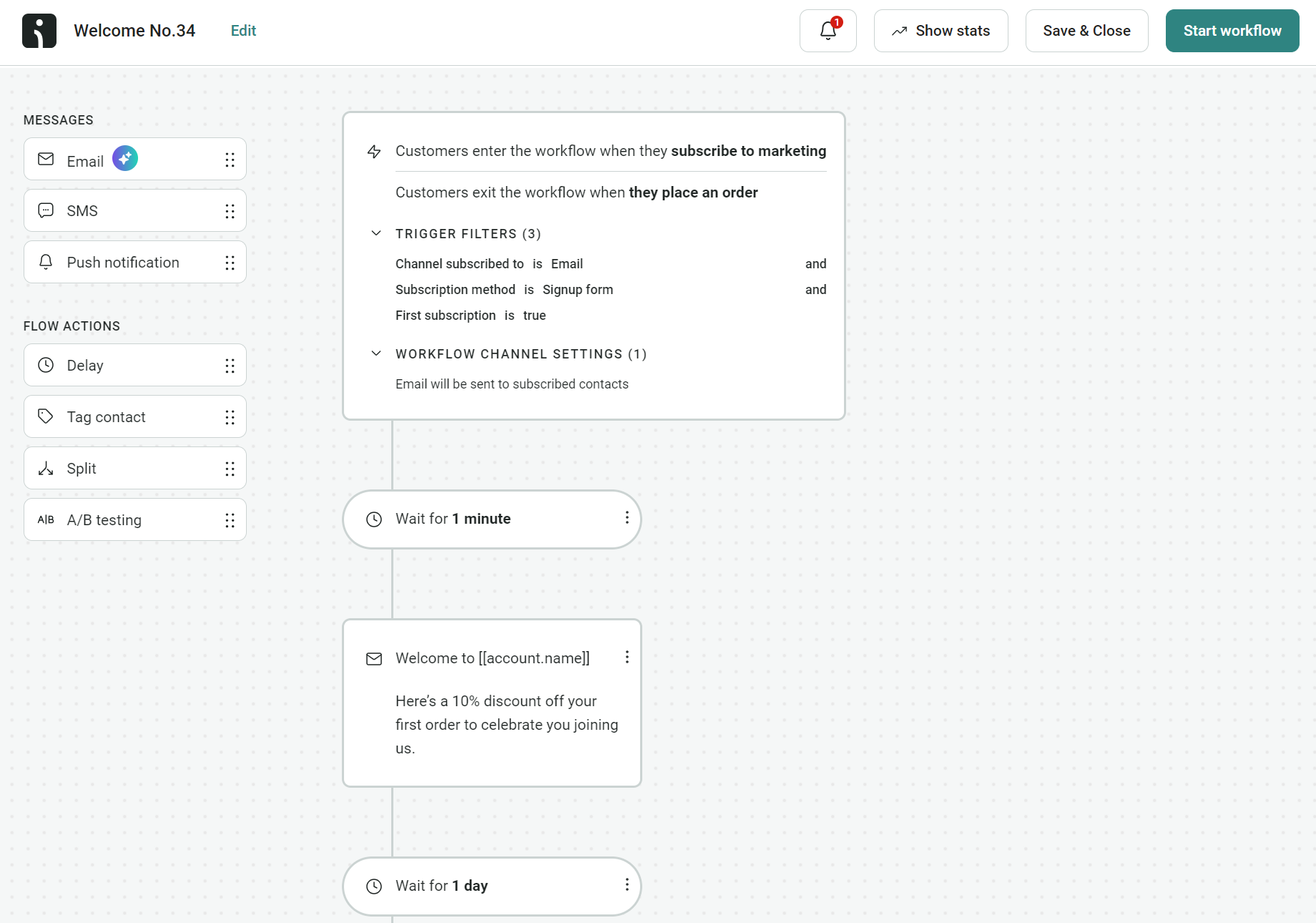
Your welcome email sequence template will look something like this:
- Email one. An immediate send or within five minutes of sign up. Welcome your customer and thank them for subscribing or purchasing. You can introduce your brand and provide any incentive you promised at sign-up.
- Email two. Sent after one or two days. Provide a more in-depth brand story with social proof. Establish rapport without the hard sell.
- Email three. Your final email will follow three or four days later. Remind customers of their incentive and any limitations around it, such as expiration dates. Recommend some best-sellers and link out to popular collections.
Pro tip
Emails in a series can sometimes fall into the trap of feeling manufactured and impersonal due to landing in sequence, leading to unsubscribes. You can combat this by mentioning customers by name and referencing past purchases and browsing activity. Omnisend lets you add customer names to subject lines and content and add product recommendations to welcome email series templates.
Welcome email templates
The welcome email template examples below are free to use. Copy and paste their text into your email editor and update the placeholders.
Omnisend has 250+ pre-built email templates you can use, including ready-made welcome email templates, and your brand assets, such as your logo and colors, will auto-apply to them once set.
Thank you for subscribing/signing up
An initial welcome email that thanks your subscriber within minutes should reach those who opt in via forms only. Purchasers should enter a separate flow to avoid inbox overload, since their order confirmation via Shopify or whichever other platform you use already thanks them.
Subject line: Hi (name), welcome to (brand)
You have successfully subscribed to our newsletter.
Thanks for subscribing to (brand), (name). Here’s what to expect from us:
- Exclusive offers and discounts
- Notifications for product launches
About us
(Add some of your brand story here up to around 60 words; any more, and you risk losing your customer’s attention. Cover your background, what you sell, and your values)
We’re delighted to have you with us!
Regards,
(your team name)
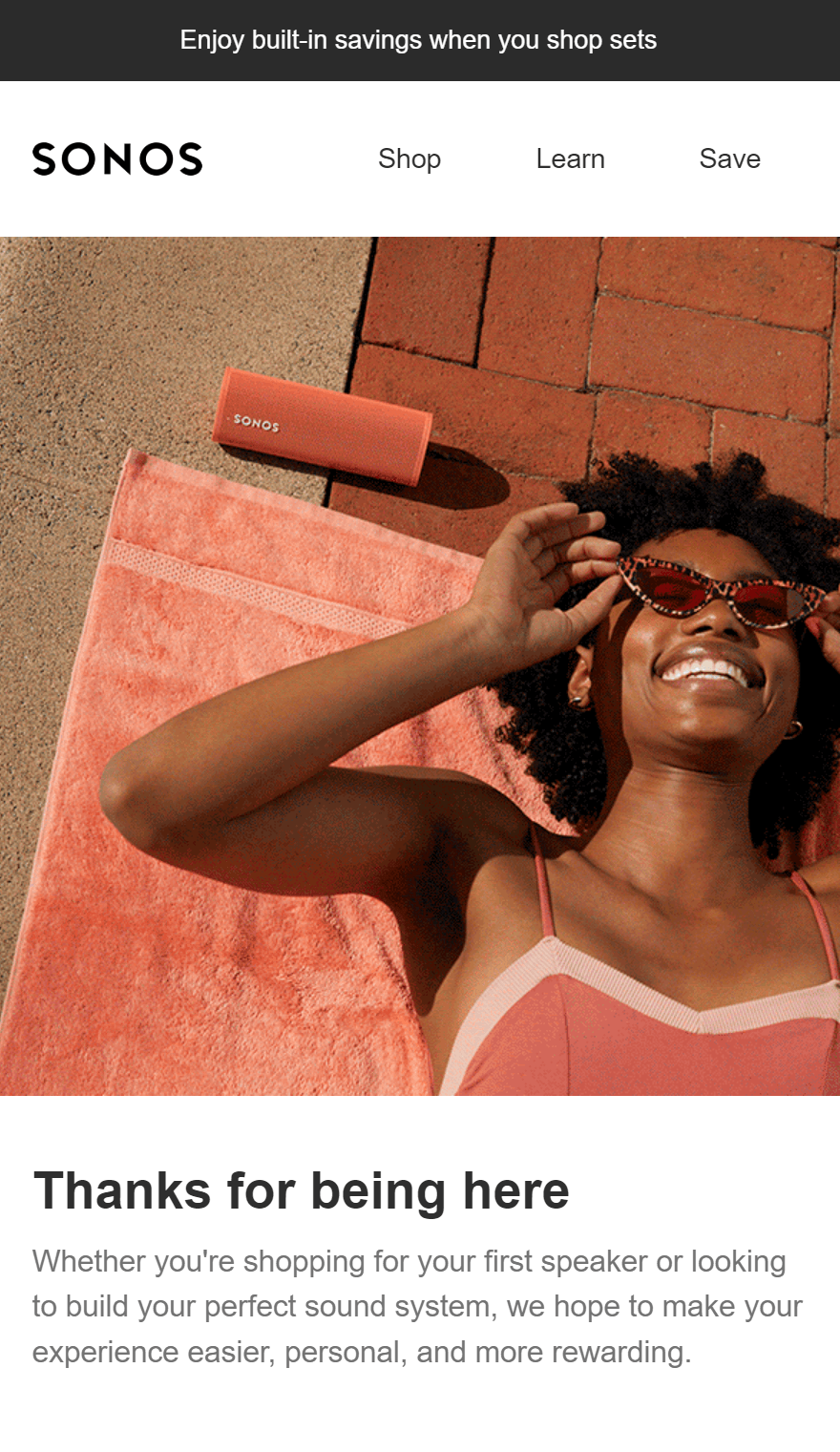
The welcome email template for new subscribers from Sonos, below, sets a good standard. Its heading says “Thanks” immediately, and the paragraph after sets expectations for the customer’s brand experience:
The discount welcome email template
Discount codes are effective at increasing signup rates, and those who subscribe to them will almost always open your email. But the wrong language and discount placement in your ecommerce welcome email template can cause friction and reduce purchase likelihood.
Here’s a template you can use to satisfy your customer and encourage action:
Subject line: Welcome to (brand), here’s 10% off
Grab 10% off as a thank you for signing up.
Hi,
We’re stoked to have you. Your 10% discount code is below. You can start shopping anytime and use that code within 30 days to save big.
(code)
Here are some of our most popular products:
(insert one or two product recommendation blocks)
(CTA button, consider using “SHOP NOW”)
If you need any help, email us at (your email address)
Thanks!
(your brand name)
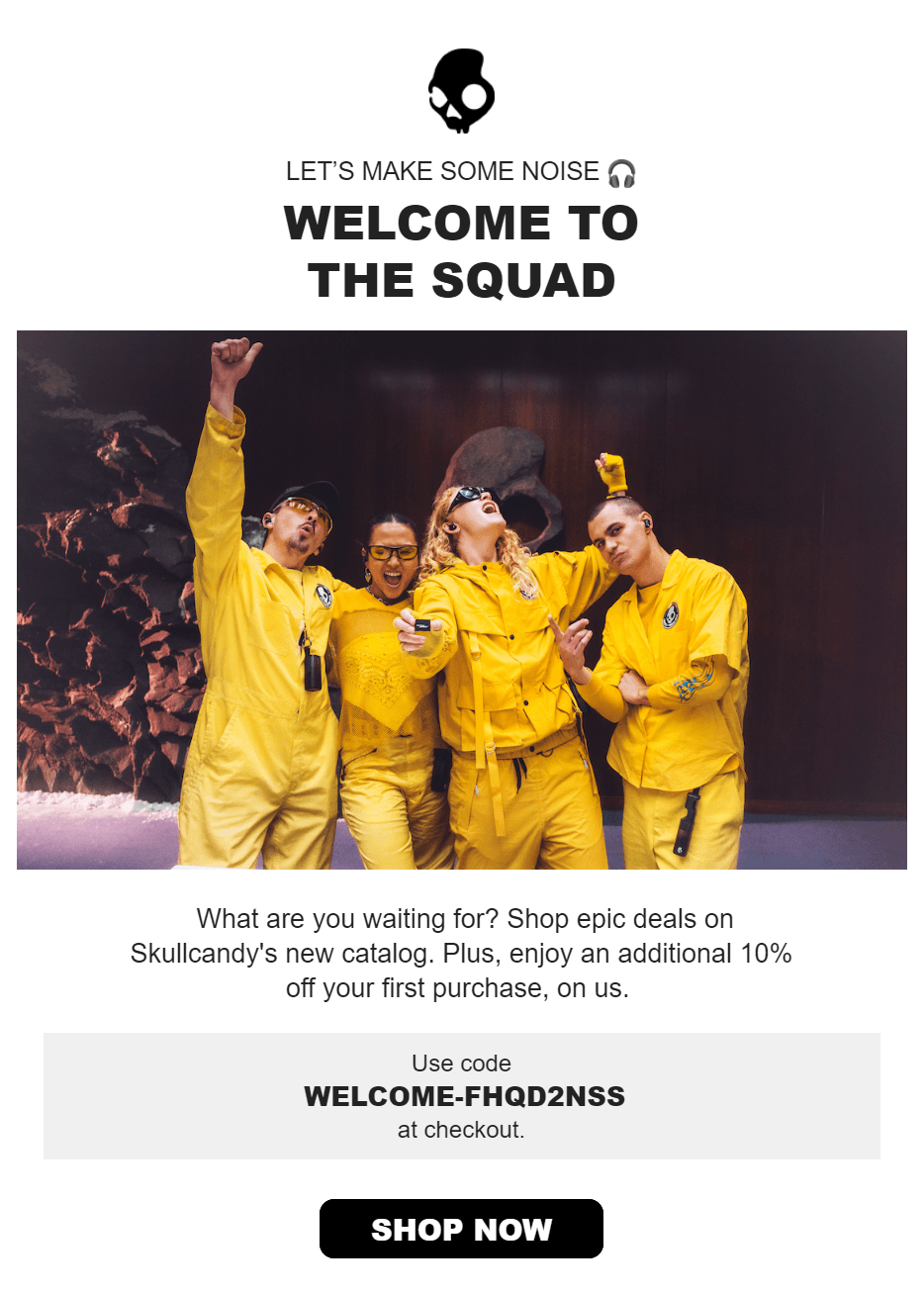
The sign-up welcome email template by Skullcandy, below, uses a similar template to the above but with custom branding and text, such as “WELCOME TO THE SQUAD”:
The brand story email template
Rather than covering random selling points and facts about your brand, why not make your newsletter welcome email template unashamedly about you? A brand story could be the information your customers need to decide if you’re the right brand for them.
Subject line: Welcome to the (brand) newsletter
Welcome to a world of (your value, such as luxury)
Hi (name),
You recently subscribed to our newsletter. Thank you for that. You’ve joined a long list of discerning customers who value high-quality products and services.
Our story begins in (name the country or city you started in, and then detail what you started selling first, and why. Branch into what you value and your products.)
What to expect
Our newsletter runs (weekly, bi-weekly, add your schedule) and provides personalized (shopping advice, tips, industry news) to keep you updated with our latest happenings.
All our products have or come with:
(bullet list free delivery, 30-day returns, etc.)
We look forward to you shopping with us.
Regards
(your team)
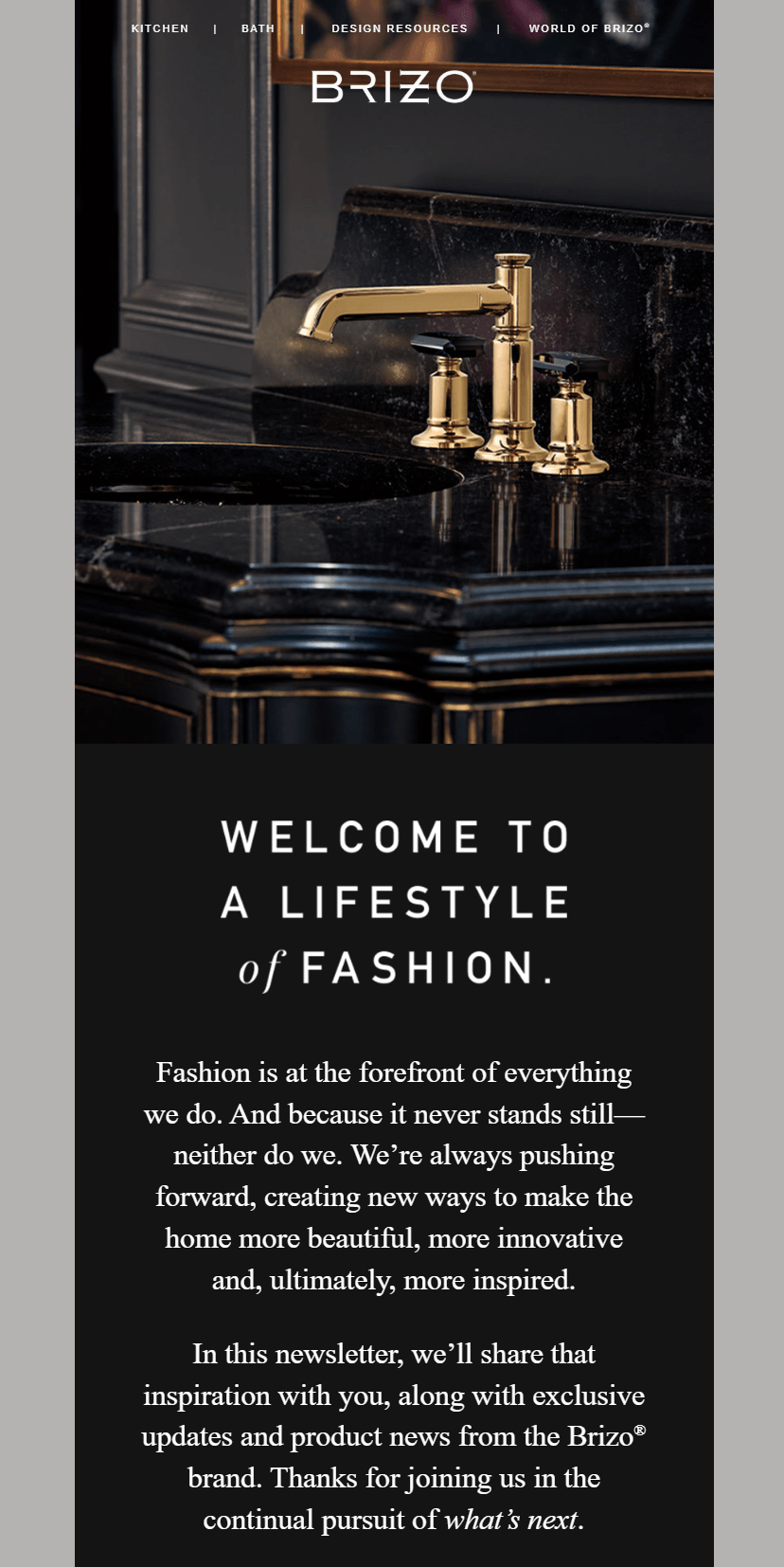
Luxury faucet brand Brizo dedicates its entire welcome email to brand storytelling with 70 or so words about its positioning, vision, and what makes it unique:
The social proof email template
Social proof in your welcome emails can include star ratings, reviews, quotes, and photos to establish credibility in your brand. You wouldn’t ordinarily lead with social proof, but you can add these elements below your initial welcome message.
Subject line: Welcome, you’re in for a treat
Thank you for joining us
Hi (name),
We got your request to subscribe to our newsletter, so you’re on the list now. We’ll email you (weekly/bi-weekly/monthly) with offers and exclusives.
So many of our customers find happiness at (your brand name). Here are some of our most recent reviewers:
(Insert two or three reviews in quote boxes with star signs. These can be text or images, depending on how you’re building your template.)
Don’t forget to follow us on social media. If you have any questions about our brand, reply to this email, and we’ll get right on it.
All the best,
(your brand)
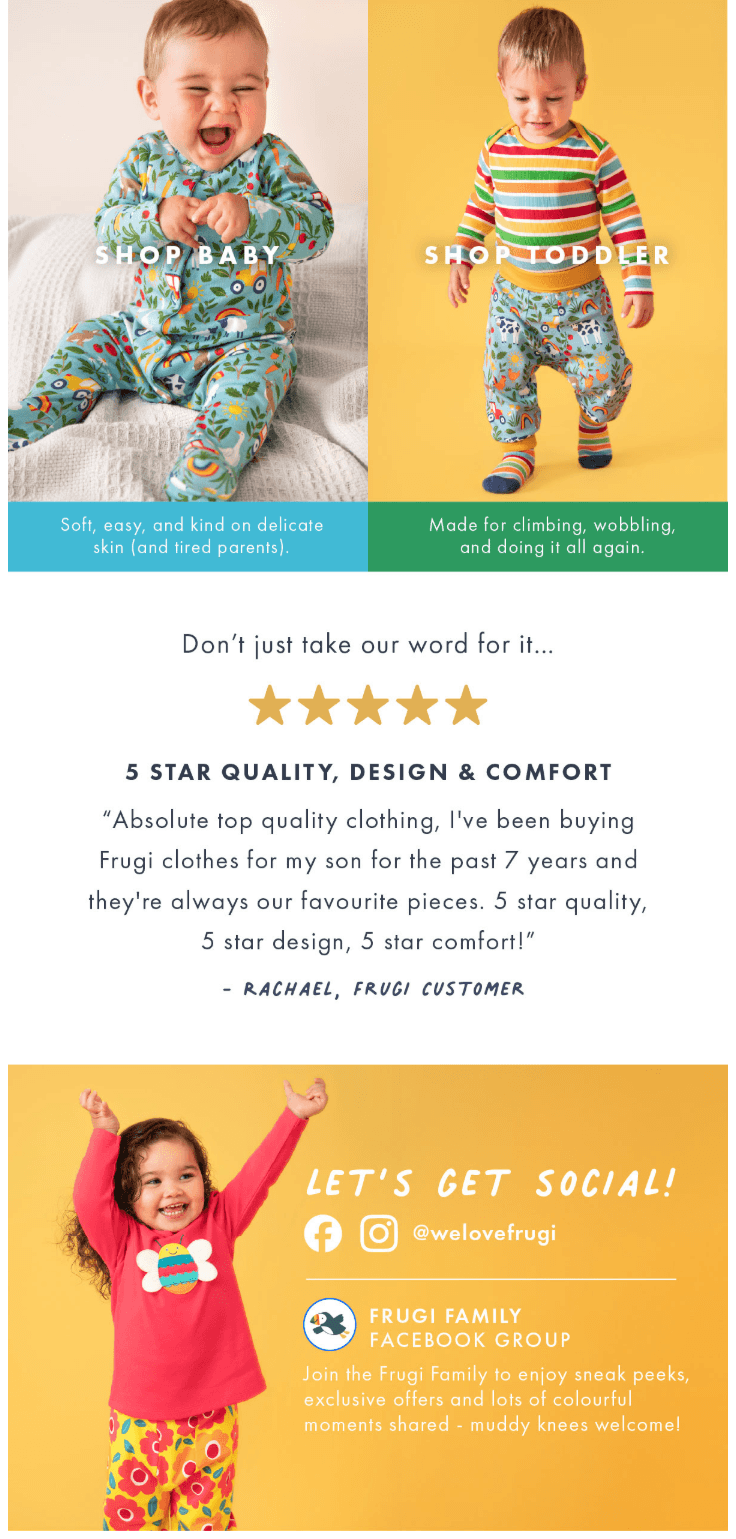
Frugi, a retailer of children’s clothing and apparel, uses social proof in its welcome email with a star rating, review quote, and images of happy kids:
The brand differentiation email template
Talking about yourself is a perfectly fine strategy for your welcome email, especially if there’s a knowledge gap between what you sell and what customers know, or if your customers appreciate personality and values like organic or Fair Trade credentials.
Subject line: Welcome, let’s discover (brand)
You’re in, we’re in. Ready for the journey?
Hi (name),
Thank you for becoming a (brand) member. We’ve got so many exciting products for you to discover, but first, we’d like to explain what we’re all about.
Our values
(Provided a bullet list here if you’re using a plain text block, or create individual sections with icons/colored backgrounds for your values)
Our history
(Write 30 words, a short enough paragraph to skim)
Your journey
(Describe how you’re going to improve your customers’ lifestyle in some way)
(Product recommendations – add two or three products to encourage customers to explore your shop)
Thank you for your time. We’ll let you take it from here,
(your brand name)
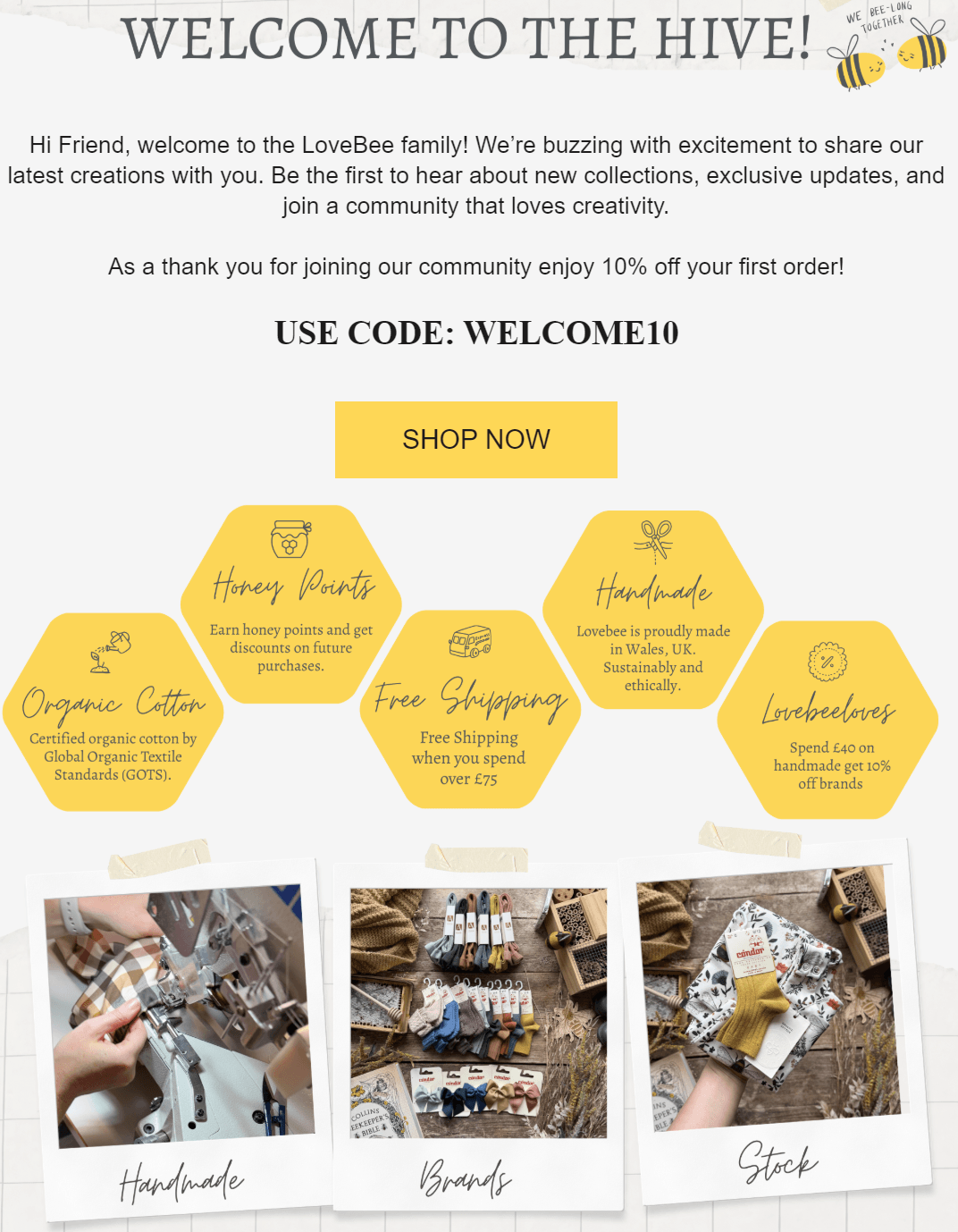
Sustainable kids’ clothing retailer LoveBeeBaby uses a branded welcome email template with hexagonal, honeycomb-style brand facts and selling points:
The “personal letter from the founder” welcome email template
We’ve added exclamation marks to this one because it’s still an automated email. It’s the tone and personalization that make it feel like a personal email, perfect for your high-value customers and VIPs.
Subject line: Hi (name), a personal thank you
Thank you for joining us, (name).
My name’s (your name), I’m the (founder/position) of (brand). I saw that you recently subscribed/purchased and wanted to welcome you personally.
I appreciate having you with us. We’re an (independent/small/leading) retailer of (your product), but it’s our customers who make us special.
If you ever need anything, give me a shout.
Regards,
(your name)
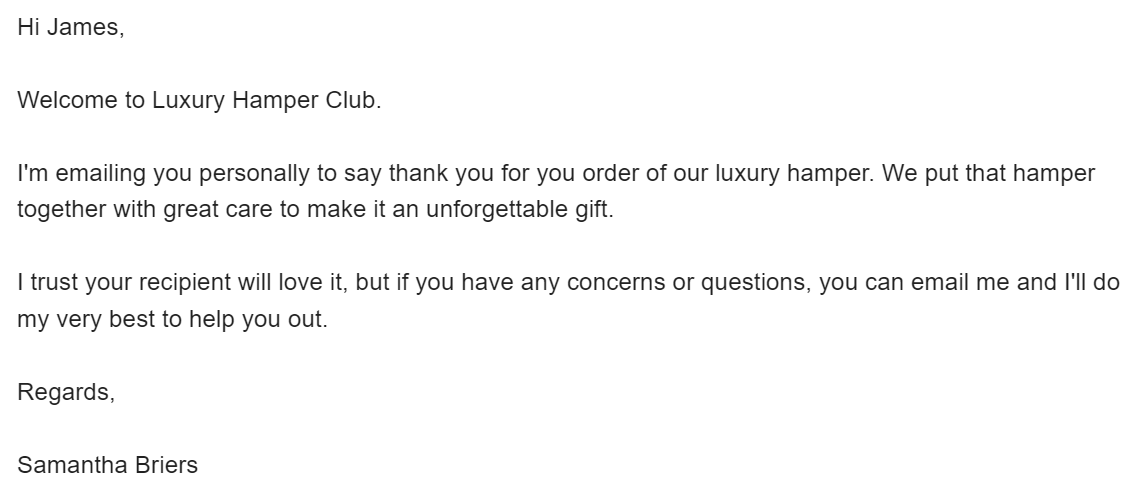
The simple welcome email template below uses plain text instead of an HTML template to give it more of an authentic, personal feel:
Pro tip
Multiple templates above can go into your flow as a welcome series. You could include the thank you template, brand story template, and social proof template in a three-part series to move your customers closer to purchase.
Improve your welcome email template
Your email marketing tool will collect open, click, and conversion rates for your welcome messages, but those baseline stats aren’t necessarily the best you can do. A bit of testing and optimization will provide greater ROI. A few pointers:
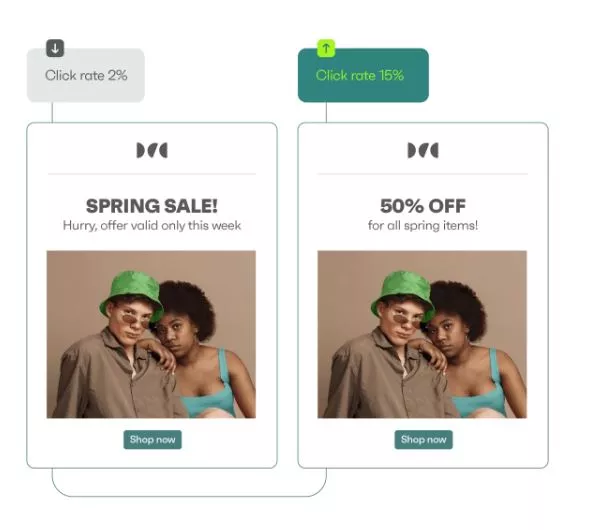
- A/B test your subject lines. Swap customer names from the beginning to the end, change, add, or strip emojis, and replace “Welcome to (your brand)” with “Thanks for joining (your brand)”. The image below shows how these tests work in practice:
- Track click-throughs. Use campaign links for your CTA buttons so that you know which links get clicks. Then optimize those buttons to see if you can increase click-throughs.
- Monitor unsubscribe rates. Anything up to 1% is typical for a welcome email template for ecommerce, especially in the first week of your welcome series.
- Test templates on mobile. Don’t assume pre-built email templates will render properly in Gmail and other mobile apps. Send test emails to multiple addresses and check them for real rather than relying on built-in email tool previews.
- Test send timing. It’s generally best to send your first welcome email within five minutes of your customer subscribing or purchasing. The other emails in your series can come one or two days later, or even after one week. It’s definitely worth testing different delays and seeing how they affect opens and clicks.
Start sending welcome emails that convert
Customers who subscribe to your newsletter need a high-quality welcome email to move them closer to purchase. And for those who purchase and opt into marketing that way, your welcome email doubles as an onboarding email, improving retention and revenue with cross-sells.
The welcome email templates we’ve provided are a start. Take them and adapt them to your brand and audience, and use our optimization tips to refine them over time.
A few final points:
- Your subject line is the biggest determiner for open rates, except for welcome emails that deliver the discounts customers signed up for (they’ll open them anyway)
- Personalization in your subject line and preheader helps your welcome email stand out, and again, contributes to open rates
- Click-throughs in your welcome email depend on the quality of your content, CTA buttons, and product recommendations
Omnisend provides the tools you need to master welcome emails. You can use pre-built flows, make them multichannel with SMS and web push notifications, A/B test, and monitor standard metrics with revenue attribution linked to your ecommerce store.
Quick sign up | No credit card required