Omnisend AI


 OFFER
OFFER










The jump from $19/month to $59/month to access GetResponse’s unlimited workflows, segmentation, promo codes, and revenue reports is steep. Several GetResponse alternatives offer those features for less and additional capabilities to boot.
You’ll get multichannel capabilities for free with Omnisend, CRM features with HubSpot, and similar email campaign features for less with Mailchimp.
GetResponse’s appeal lies in its unlimited monthly email sends across paid plans and the Creator plan, along with built-in courses and webinars. Those niche use cases don’t suit everyone, and you might find the flows too basic for your customer journey anyway.
This article reveals the six best GetResponse alternatives, their differences, and how to pick the right email tool for your use case.
Quick sign up | No credit card required
Quick answer: What are the best GetResponse alternatives?
The three best GetResponse competitors are as follows:
- Omnisend for ecommerce stores. Its Free Forever plan doesn’t restrict standard features, and its Standard plan is only $1 more than GetResponse’s cheapest, feature-restricted Starter plan for 1,000 subscribers. You get complete multichannel capabilities and deep integration with Shopify and WooCommerce.
- Klaviyo for data-first and large stores. More expensive than GetResponse but with more ecommerce flows, segments, and reports, plus some CRM functionality for B2C. Integrates perfectly with Shopify and also offers email + SMS via a dedicated plan.
- Mailchimp for small businesses. Lacks Omnisend and Klaviyo’s ecommerce specialism, but is a good choice for businesses with basic customer journeys and service providers that also sell products online.
Why look for a GetResponse alternative
There are more cost-effective and feature-rich ecommerce email tools than GetResponse, regardless of your list size or growth. You might run into limitations on its free and cheapest plans and miss out on revenue and ROI.
Here’s why you should consider GetResponse alternatives:
Feature-to-value ratio
GetResponse’s cheapest paid plan is $19/month, yet that Starter plan doesn’t include ecommerce essentials such as unlimited automation workflows, welcome email series, abandoned cart recovery, or what it calls advanced segmentation.
You must pay at least $59/month for the Starter plan to access those features, making it significantly more expensive than Omnisend and Klaviyo.
Need for omnichannel marketing (email + SMS)
SMS marketing with GetResponse is only available with one of its custom Enterprise plans, which require a demo and a sales call. It then bundles in 5,000 SMS credits, and you can create text message automations and campaigns.
The trouble is that Omnisend offers multichannel capabilities in its Free Forever plan, including flows, segments, reports, revenue attribution, and global SMS coverage. Klaviyo also offers an email + SMS plan with transparent pricing.
You’re not a content creator
One of GetResponse’s biggest draws is its Creator plan’s creator features, including a course creator, premium newsletters, live and paid webinars, and PayPal and Stripe integrations for collecting one-time and recurring payments.
Those creator features feed into conversion funnels for leads, lead magnets, sales, and webinars, helping you nurture customers. But if you’re not selling content, then most of what makes GetResponse unique will go unused.
Best GetResponse alternatives to consider
Each of the GetResponse alternatives on our list earns its place with compelling value and features. Here are the tools we recommend you try:
1. Omnisend for ecommerce automation and stores of all sizes
Your complete customer journey is your big revenue opportunity, not just what you send before and after purchase. Omnisend is best at covering those pre- and post-purchase moments, plus the bits in between, to maximize customer lifetime value and retention.
What it does
Omnisend brings email, SMS, and web push notifications to your customer journey with proper omnichannel flows and an intuitive flow builder:
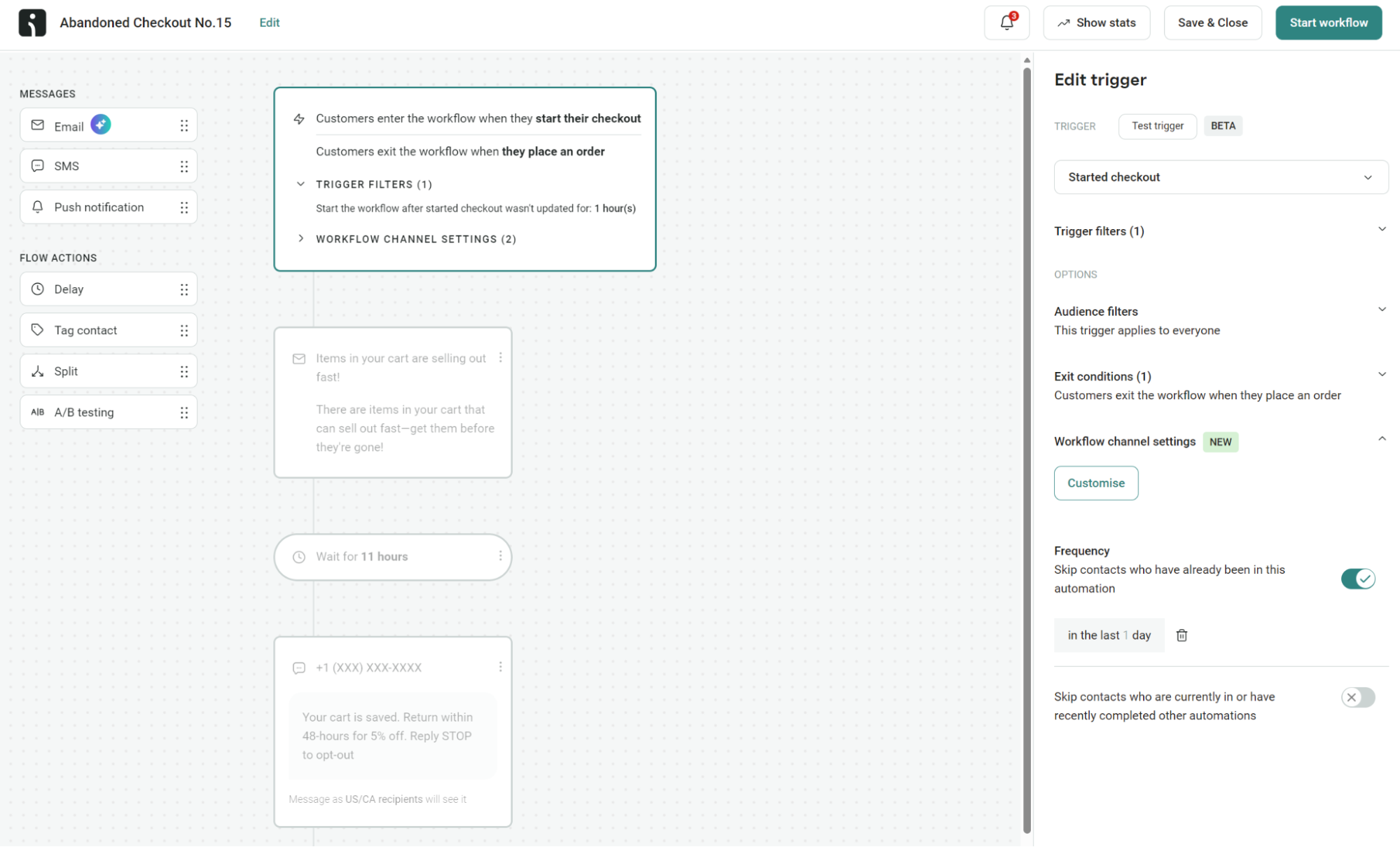
Its pre-built email automations, segments, email templates, and standalone campaigns make it accessible for all to build high-quality customer experiences.
Key strengths
- Top-rated Shopify and WooCommerce apps with deep integrations
- 250+ email templates versus GetResponse’s 150+
- Free AI features, including a segment builder and brand assets
- Add any number of emails, text messages, and push notifications to your series
- Collects GDPR/TCPA compliant opt-ins for all channels via forms
- A/B testing for flows and campaigns
- Unlimited segments with customer lifecycle stages and contact profiles
- Attributes sales and revenue to your channels
- Built for retention and ROI, helps you create high-quality customer experiences
Limitations
- No discounts for annual plans
- Limited CRM capabilities (if you want those, check out HubSpot)
Versus GetResponse
Omnisend offers more ecommerce features than GetResponse for free and in its lowest-cost paid plan. Its unrestricted flows, segments, promo codes in emails, contact scoring, and contact forms are all features that GetResponse restricts.
With Omnisend, you get:
- Omnichannel marketing
- More features for less or similar prices
- More advanced ecommerce capabilities at all plan levels
- Proven results, with customers achieving a $79 ROI for every $1 spent in 2025
Paid plan starts from
- The Standard plan is $16/month for 500 subscribers. Matching it to GetResponse’s initial 1,000 contact limit costs $20/month, just $1/month more.
Ideal use case and best fits
- Shopify stores: Make use of its pre-built flows, segments, and reports to grow your Shopify revenue and replace Shopify’s Messaging and Flows apps, which lack advanced behavioral triggers and multichannel capabilities.
- Ecommerce stores: Irrespective of your Shopify use. Omnisend also integrates deeply with Wix, BigCommerce, and many more platforms.
If you want predictive analytics and even deeper insights into your audience, albeit at a higher cost, consider our next GetResponse alternative: Klaviyo.
2. Klaviyo for data-first email and SMS marketing
Klaviyo brings email and SMS marketing to your store with more granular behavioral data than Omnisend and GetResponse, which feeds into its predictive analytics. Its segments and flows go deep enough to cover the most complex journeys. If you’re considering Klaviyo specifically, it’s worth lining it up against every major Klaviyo competitor first.
What it does
It provides the ecommerce basics such as forms, welcome flows, abandoned cart emails, and revenue attribution for small stores, but also scales with marketing analytics and a CRM, social media auto-replies, and RCS in addition to SMS.
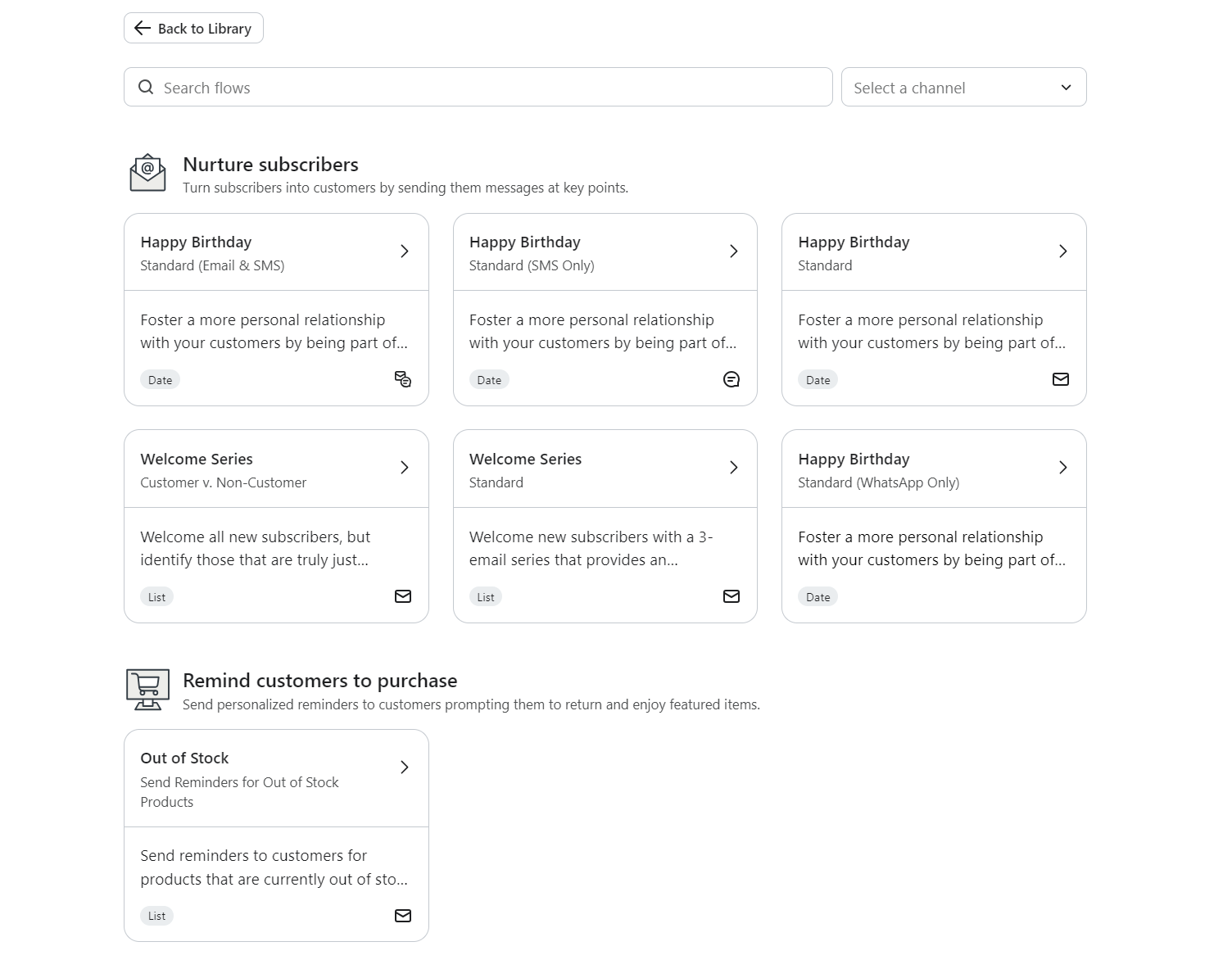
The pre-built flow library covers all crucial ecommerce scenarios, with the flows themselves offering more triggers and filters than GetResponse provides:
Key strengths
- Handles automations and campaigns
- Covers email, SMS, and RCS channels
- Includes forms and landing pages
- Impressive email template library with 160+ options
- Klaviyo Reviews supports Google Shopping
- The growth strategies tab in the dashboard recommends tasks to keep you productive
Limitations
- More expensive than Omnisend and GetResponse’s cheapest plans
- Steep learning curve for most features
Versus GetResponse
Klaviyo is a more advanced multichannel marketing tool than GetResponse, offering email, SMS, and RCS support, whereas GetResponse is email-only. The data it collects about customers is in-depth and helps you build flows that maximize revenue.
Paid plan starts from
- $20/month for 500 subscribers. 1,000 subscribers is $30/month, $11/month more than GetResponse and $10/month more than Omnisend.
Ideal use case and best fits
- You’re a mid-to-large store: Your customers will take multiple paths pre- and post-purchase, with Klaviyo’s more advanced flow rules helping you reach them at more high-intent moments than GetResponse.
- Your tech stack needs to integrate: Your Shopify or WooCommerce apps need to feed into your email marketing tool. Klaviyo has 350+ integrations, compared to GetResponse’s 250+.
3. Mailchimp for small businesses and service providers
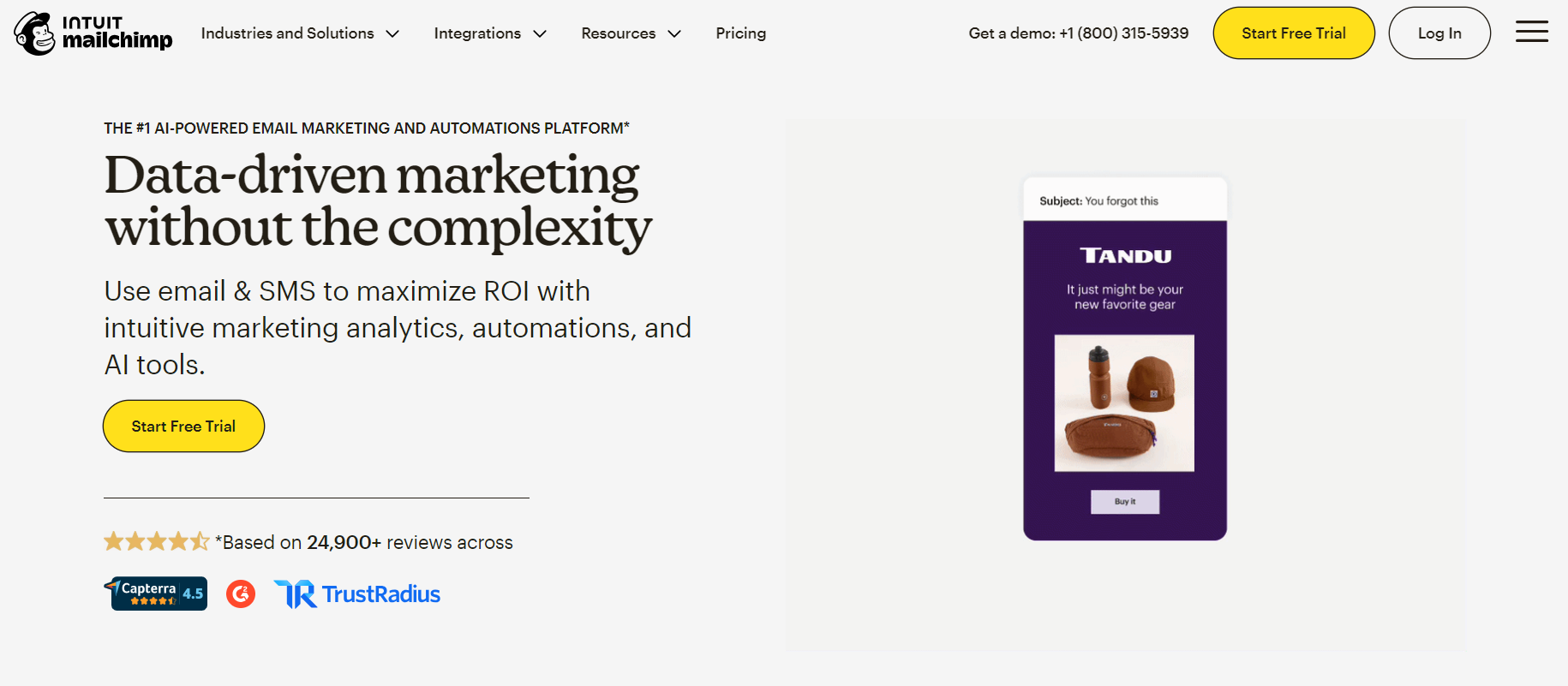
Mailchimp is an email tool that covers a bit of everything. Flows, campaigns, forms, reports, audience management, and so on. It doesn’t specialize, so it suits small businesses and service providers best. Also works well for start-ups.
What it does
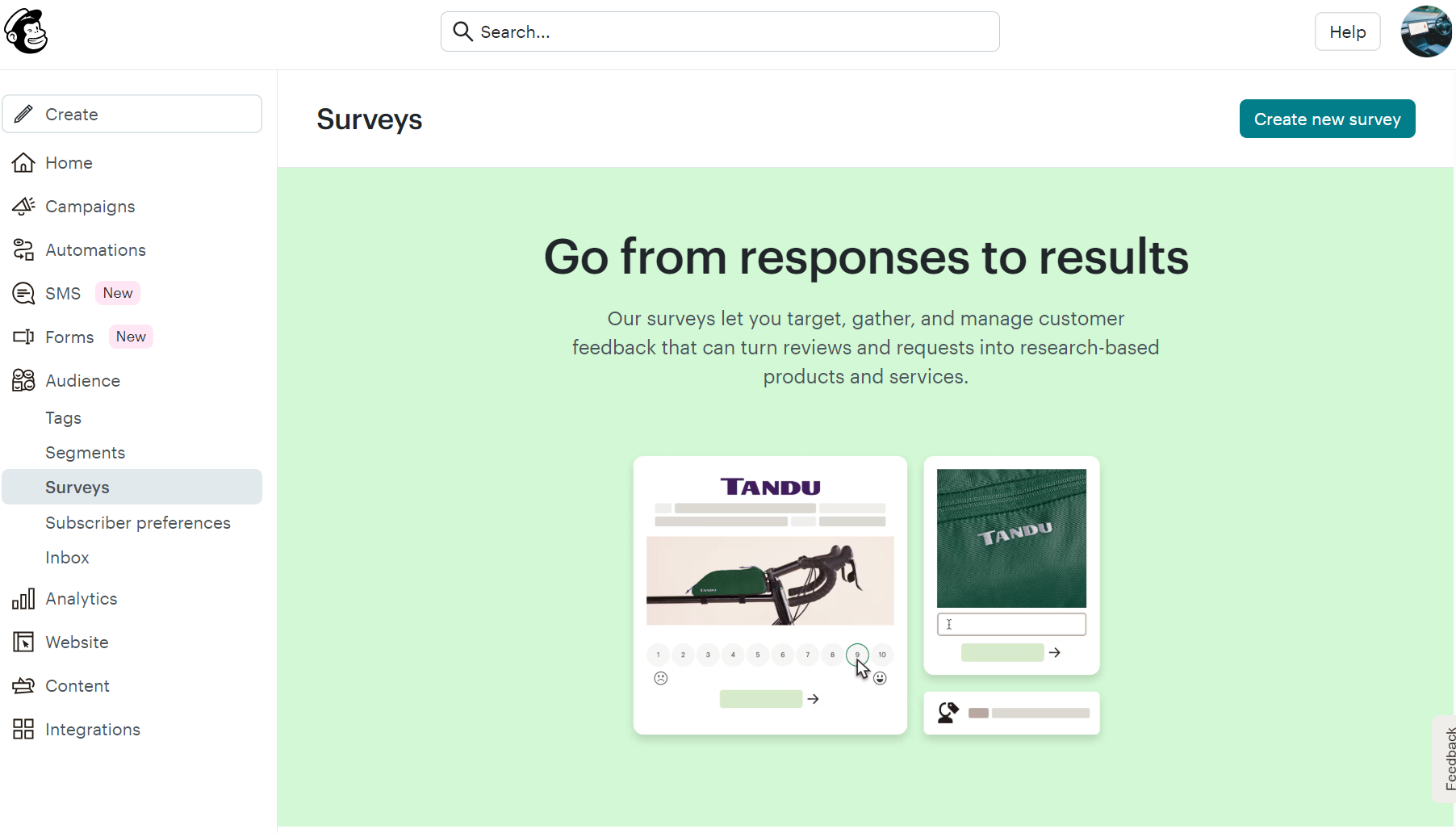
Integrates with most ecommerce and CMS’s via native apps for starters, and provides an intuitive dashboard for flows and campaigns. You can send SMS in all but the free plan, and it has built-in surveys to collect feedback in emails:
Key strengths
- All plans include contact profiles and an audience dashboard
- Predictive segmentation saves time and is available from the Standard plan
- Landing pages and popups in all plans
- It lets you schedule and generate social media posts with AI
- The customer lifetime value and purchase likelihood features (Standard and Premium plans) help you target customers with the right offers
Limitations
- Heavy feature restrictions in the free and Essentials plans
- Several automations require additional apps, such as Eventbrite
- Lacks Omnisend and Klaviyo’s ecommerce and revenue growth focus
Versus GetResponse
GetResponse doesn’t have a built-in surveys feature like Mailchimp, and it also lacks Mailchimp’s recommended products unless you’re on the Marketer plan. You basically get more features with Mailchimp, at the expense of unlimited sends.
Paid plan starts from
- $13/month for 500 subscribers and $26.50/month for 1,500 (there isn’t the option for 1,000). More expensive than Omnisend and GetResponse for 1,000 contacts.
Ideal use case and best fits
- Small businesses: Mailchimp’s free plan covers small campaign lists. Its low-cost $13/month Essentials plan also covers marketing automations.
- Service providers: It lets you create forms, a welcome series, and automations to reach and nurture customers over time.
4. ActiveCampaign for maximum automation and add-ons
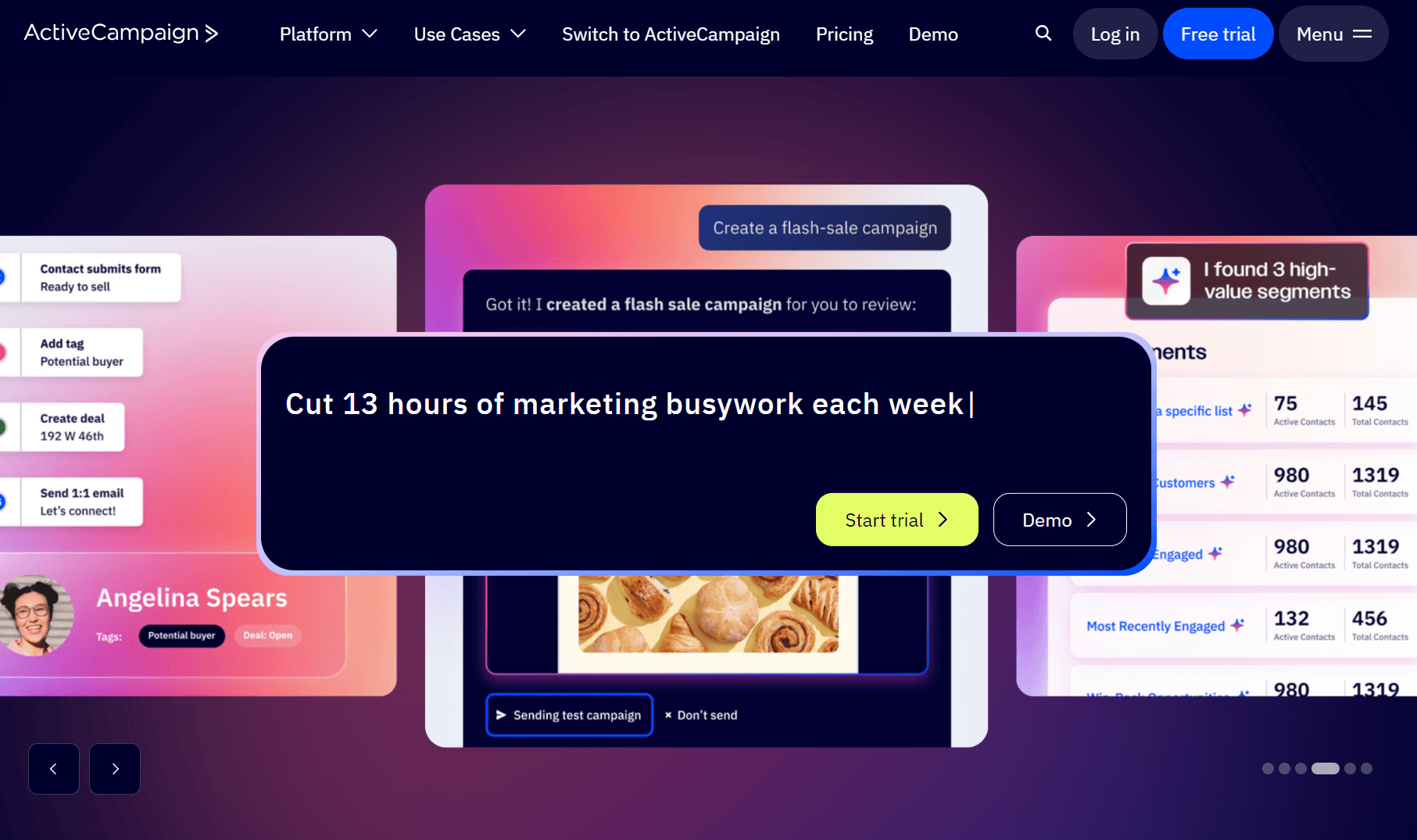
ActiveCampaign’s $15/month starting price for multi-step flows, CRM features, and 950+ automation recipes is extremely competitive and suited to growing stores. It undercuts GetResponse’s price by $4/month for the same 1,000-contact limit.
What it does
Brings automation and AI to your email and SMS marketing in several layers via its Active Intelligence workspace and sidebar, AI campaign builder, AI suggested segments, AI brand kit, and AI content generation. Also, it lets you stack features, such as AI actions, with add-ons.
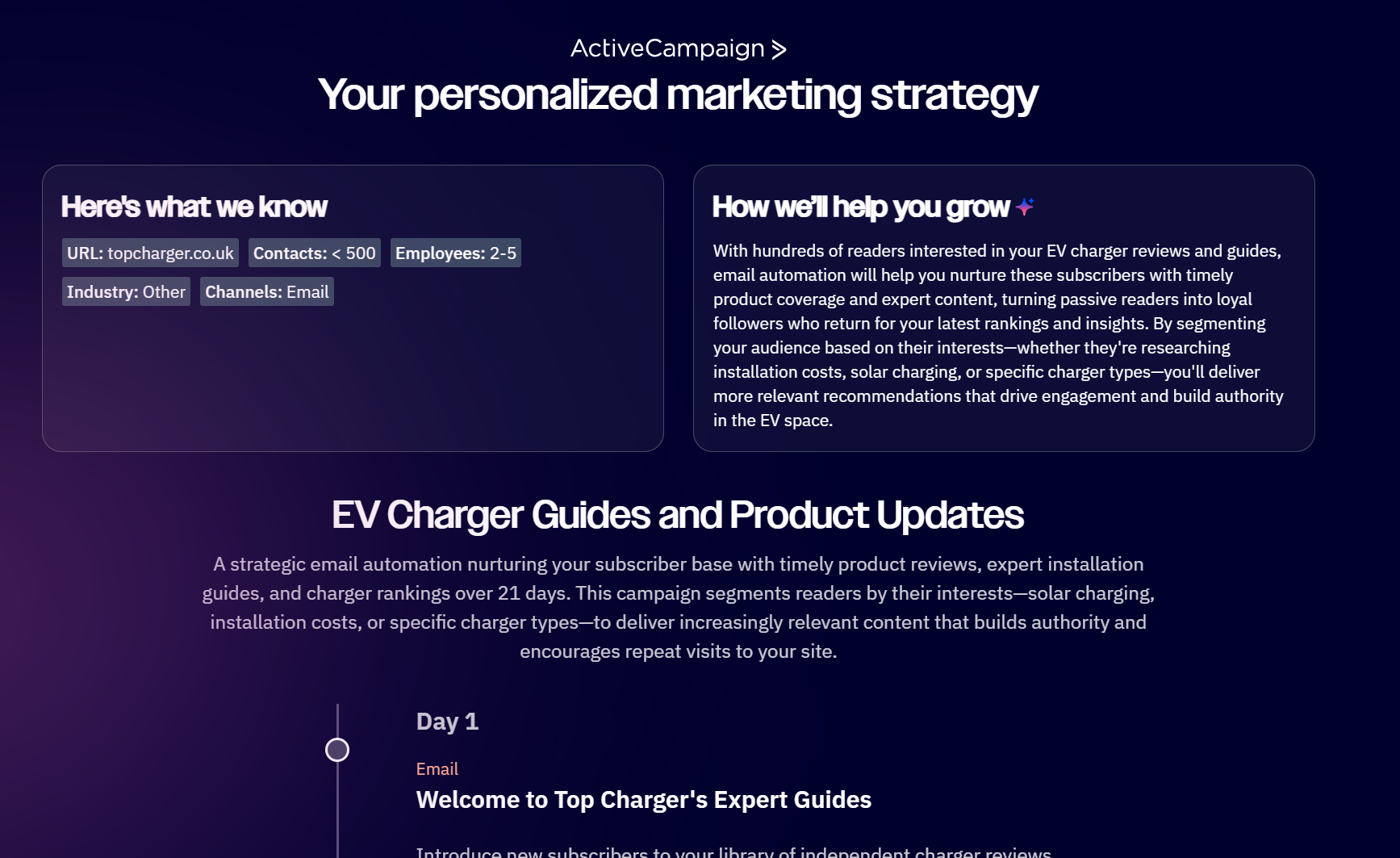
You’re introduced to the AI immediately during onboarding. Enter your website, and it reviews the whole lot to grab your logos and create an initial email series:
Key strengths
- Has more AI features than any other tool in our list
- Email A/B testing in all plans
- Provides a helpful automation map, letting you visualize how they work together
- 250+ email templates
- The segment builder has suggested actions to help you group customers properly
- 1,000+ integrations surpass GetResponse, Omnisend, Klaviyo, and others
Limitations
- Cross-channel marketing is not available in the Starter plan
- Add-ons get expensive fast for SMS, AI Activities, and the Enhanced CRM
Versus GetResponse
ActiveCampaign offers superior AI features and looks and feels like a modern email tool. Its flows and segments are granular and can cover more of your customer journey. However, only the Pro and Enterprise plans have predictive and conditional content, arguably its best feature.
Paid plan starts from
- $15/month for 1,000 subscribers, so it costs less than GetResponse, Omnisend, Klaviyo, and Mailchimp, but watch out for those feature restrictions.
Ideal use case and best fits
- You have mountains of workflows and need maximum automation: ActiveCampaign’s AI workflows and capabilities will create content and images, add campaigns to calendars, and adjust send times based on historical patterns.
- Ecommerce stores with sales pipelines: Contact profiles, tags, and lists are available across all plans. You can add pipelines and sales engagement as add-ons.
5. Brevo for budget-friendly email marketing
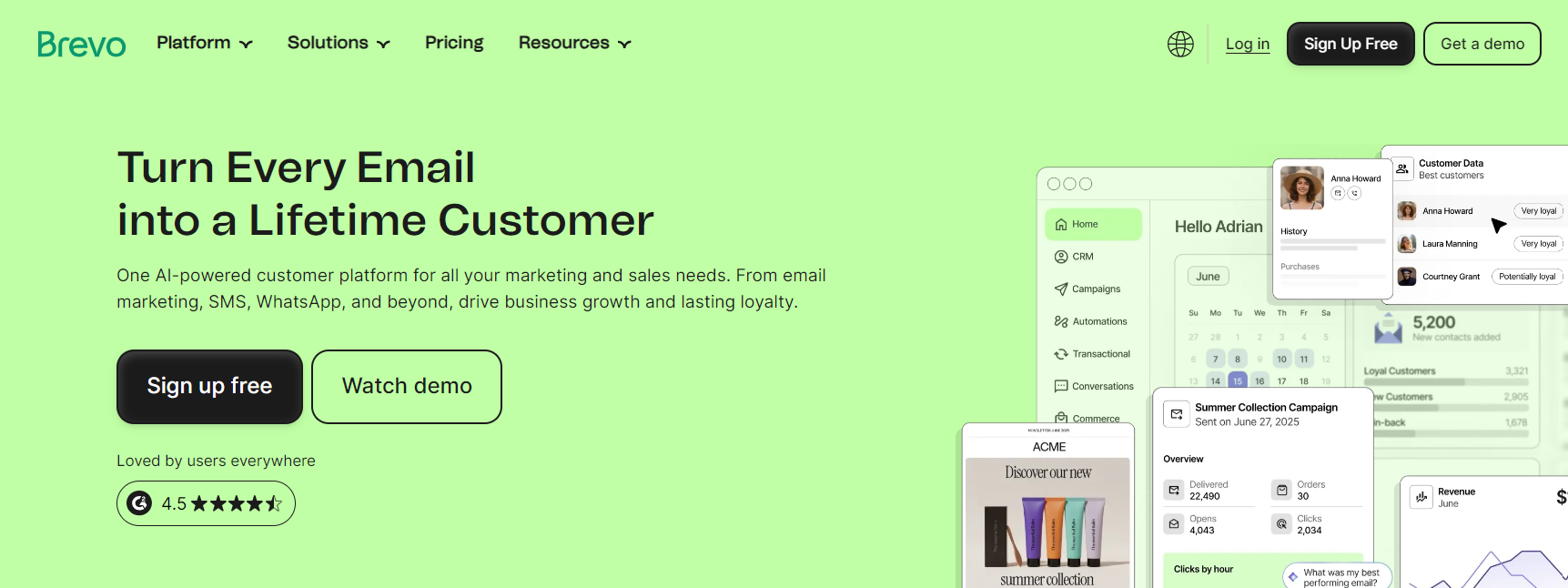
Brevo is a top GetResponse alternative for budget-conscious stores. You can send 300 emails/day to 2,000 contacts for free, or 100,000 emails/month for $9/month with the Starter plan. That’s $10 less than GetResponse for double the contact limit.
What it does
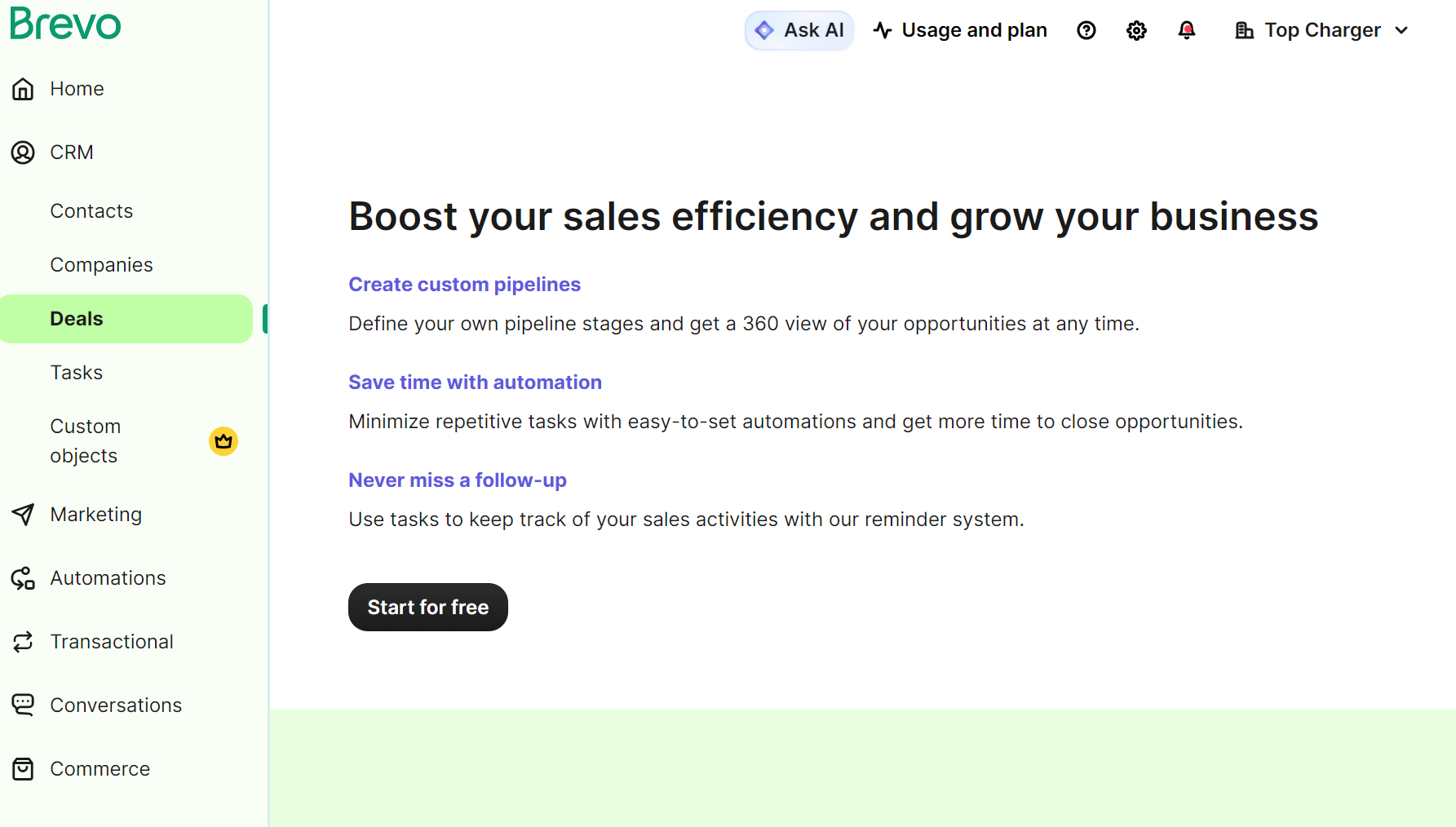
It lets you send SMS campaigns across all tiers for starters, and supports transactional email and SMS by API/SMTP by default, neither of which GetResponse offers below its Enterprise plan. All plans also have a built-in CRM, and you can buy sales packages for pipelines and deals:
Key strengths
- Suitable for B2C and B2B contact management thanks to its CRM
- Pipeline management via a Sales add-on includes forecasting, revenue, and sales cycle reports, perfect for complex sales
- Pre-built automations for transactional activity, page visits, and website events
- AI automation builder lets you describe what you want, and Brevo builds it
Limitations
- No landing pages below the Standard plan, which only lets you build one
- No popups below the Professional plan
- Frequency caps, which limit how often contacts receive marketing emails, are only available in Professional and custom plans
Versus GetResponse
Brevo costs less than GetResponse and offers more for your money, with automation and SMS available on all plans. Its CRM is good enough for B2C and B2B, but its sales pipelines are not as suitable as GetResponse’s sales funnels for creators.
Paid plan starts from
- $9/month for 2,000 contacts. If you need more, you’ll pay $18/month for the Standard plan, which has unlimited contacts.
Ideal use case and best fits
- You want to send emails but spend barely anything to do it: 300 emails/day for free or 100,000/month for $9. Both are extremely generous compared to Klaviyo, ActiveCampaign, and Mailchimp, and both exceed GetResponse’s 1,000-contact limit with a 2,000 cap.
- Mixed customer groups: If you sell to consumers and businesses, or have overlapping audiences, Brevo helps you segment them and assign them to different groups for appropriate targeting.
6. HubSpot for an all-in-one CRM and email platform
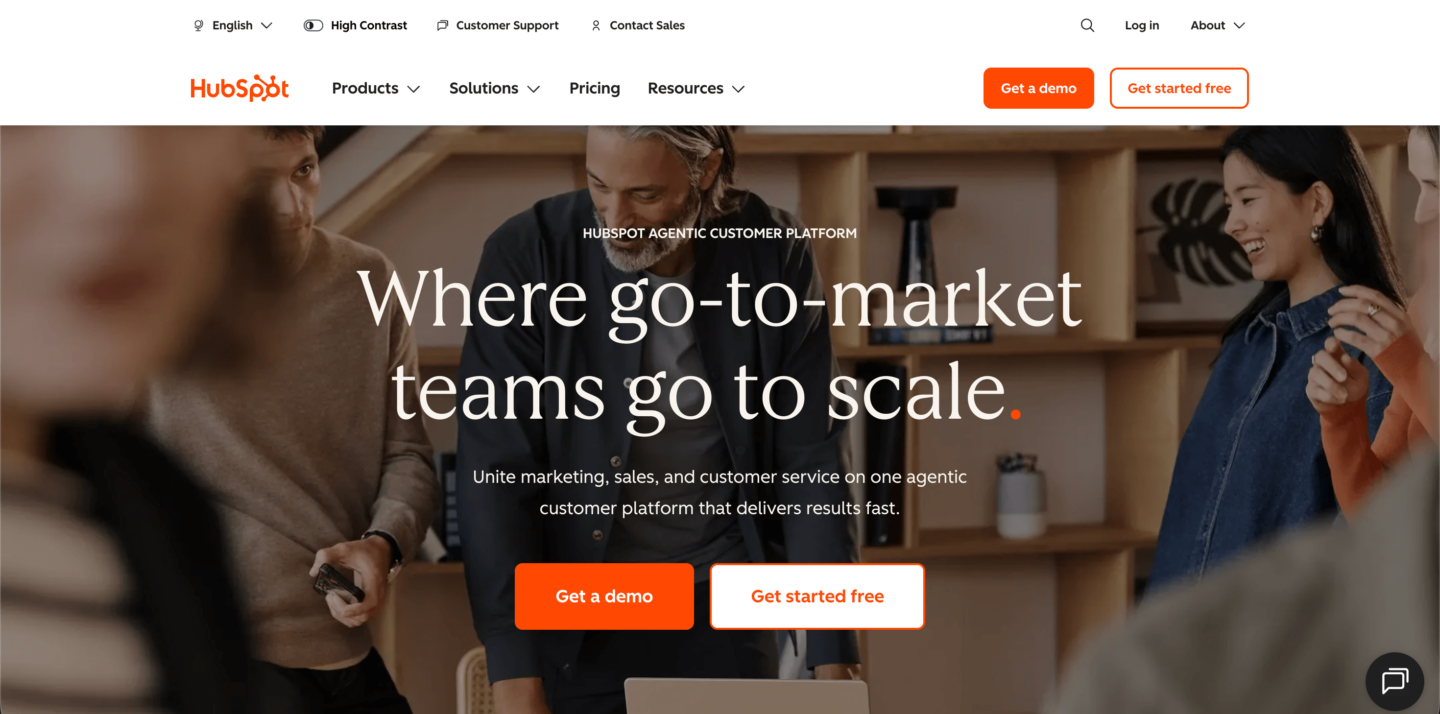
HubSpot combines CRM and email marketing features into a single tool for teams who don’t want multiple subscriptions and integrations. It’s effectively a full-stack platform covering marketing, sales pipelines, and customer service, with features you can pick and choose.
What it does
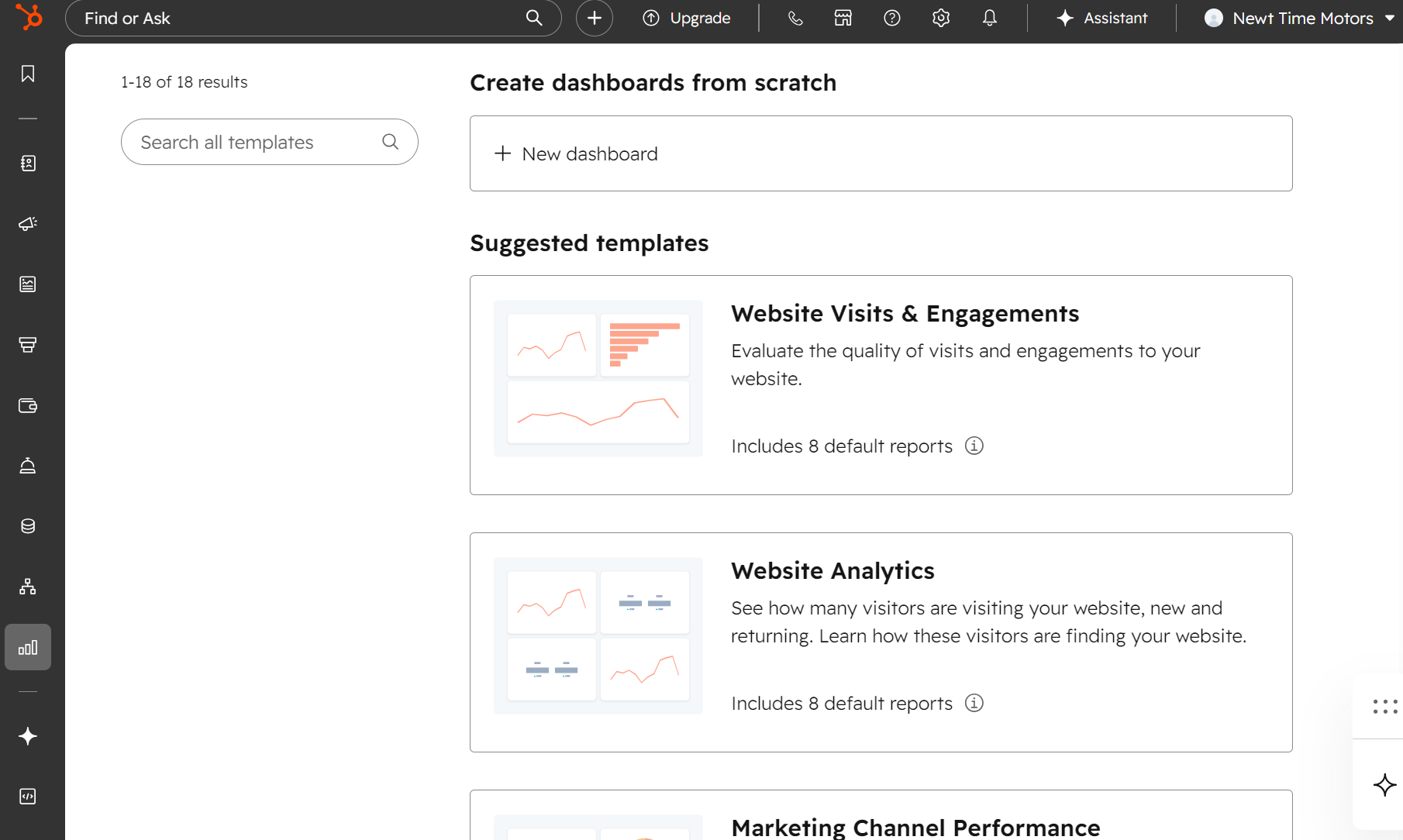
For free, it lets you build your list and send up to 300 emails/month, with storage for 3,000 contacts in the CRM. You also get basic deal and ticket pipelines and a reporting dashboard with the ability to create multiple dashboards with templates:
Key strengths
- The CRM is best-in-class for connecting contacts, companies, deals, tickets, and orders
- Includes 33 pre-built email campaign templates
- Forms and landing pages for list-building
- Manage email, social media, and ad automations if you’re on one of the expensive Enterprise or Professional plans
- AI tools that help you automate outreach, CRM data management, and support requests
Limitations
- Not email-first, primarily focused on CRM
- Steep learning curve for all features
- Allocated credits can quickly run out across workflow actions
Versus GetResponse
GetResponse has several advantages over HubSpot, such as unlimited email sends and creator features, but HubSpot’s CRM depth and channel scope make it the better choice if your business uses customer data to drive growth.
Paid plan starts from
- The Starter plan is €15/seat/month and includes 25,000 contacts.
Ideal use case and best fits
- You’re primarily looking for a CRM: HubSpot’s CRM features are better than any other tool on our list of GetResponse alternatives. ActiveCampaign is a more capable email marketing tool, but its CRM isn’t as suitable for sales teams.
How to choose the right GetResponse alternative
Most email tools appear suitable for all businesses at first glance, with campaigns, automations, and segments. But as you review their features, pricing, and capabilities, it’s apparent that some are better for ecommerce, retention, and other use cases, such as B2B.
Here’s how to refine your choices and land on a GetResponse alternative that works for you:
Define your business needs and goals
GetResponse suits you if you’re a creator, a small business with basic customer journeys, or a business that sells services and products. If your goal is growth in these use cases, it’s a decent tool you can use with confidence. If not, align your tool choice to another goal.
Other GetResponse alternatives suit these goals and business needs better:
- Retention: Omnisend, Klaviyo
- Campaigns and newsletters: Mailchimp and Brevo
- CRM features: HubSpot, Brevo, and Klaviyo
- Customer lifetime value: Omnisend, Klaviyo, and ActiveCampaign
- Multichannel (email + SMS) marketing: Omnisend, Klaviyo, and Brevo
Evaluate features and scalability
You need to know the costs for plans as your list grows (say from 1,000 to 5,000 subscribers) and what limitations you might face with flows, segments, and email deliverability.
Review all the latest plan information for our top GetResponse competitors, and answer these questions to narrow down your shortlist:
- What feature restrictions do free and low-tier plans have?
- Does the email tool allow multichannel? And can you build flows with email and SMS?
- What is the price jump per 500/1,000 subscribers? Or, if it uses send volume pricing, then what are the extra costs per additional message?
Consider ease of use and support
Some support requirements are a given, no matter how well-versed you are in email marketing, and the very last thing you need is to have to wait days for a response. You might also need onboarding assistance if you’re switching over.
The minimum support is email support, and ideally, the tool should say whether it’s 24/5, 24/7, or within a certain number of hours. Live chat is even better. Omnisend provides 24/7 live chat and email support across all plans.
Ready to switch from GetResponse?
Now that you’ve made it this far, you know that GetResponse suits creators and solo marketers more so than ecommerce stores and service businesses. It is more expensive than several tools, and doesn’t offer any SMS functionality below its Enterprise plan.
So, with that in mind, here are our top picks for GetResponse alternatives:
- Omnisend. The pick for most ecommerce stores with a low learning curve for advanced flows, segments, and multichannel marketing.
- Klaviyo. Similar scope to Omnisend, but with higher costs in return for predictive analytics and additional data-first tools.
- Mailchimp. Works well for campaigns and basic ecommerce scenarios, but suits service businesses that occasionally sell products best.
- ActiveCampaign. An interesting ecommerce email tool with a built-in CRM, AI-first tools, and optional pipelines, but with feature restrictions in low tiers.
Of these, only Omnisend provides omnichannel capabilities across all plans and has no standard feature restrictions.
Quick sign up | No credit card required
FAQs
Omnisend, Klaviyo, ActiveCampaign, Brevo, and HubSpot offer either better value-to-feature ratios, unique features, or a bit of both, although none replace GetResponse’s creator features.
GetResponse costs more than several other tools for similar or fewer features. Omnisend, for instance, is $20/month for 1,000 subscribers, compared to $19/month for GetResponse’s Starter plan, but that plan doesn’t include unlimited flows or advanced segmentation. If you want those, then you have to pay $59/month for 1,000 contacts.
Omnisend is best if you want multichannel capabilities, revenue attribution, contact scoring, and advanced segmentation without the learning curve. It gets your store marketing up and running quickly and has the features necessary to handle complex customer journeys.
Mailchimp, Brevo, and ActiveCampaign have lower prices for their entry-level email marketing plans. Brevo takes the top spot for savings with a $9/month plan for 2,000 contacts, double GetResponse’s $10/month limit.
Your ecommerce store needs a welcome, abandoned cart, and post-purchase flow to cover initial revenue and retention scenarios. Pre-built flows and segments are helpful, and some tools now have AI features to build elements for you. Omnisend offers an AI segment builder and Forms AI in its paid plans to support your list-building efforts.