Omnisend AI

 OFFER
OFFER







Lifecycle email marketing makes use of what’s most effective about email communication – reaching the right customer at the right time with the right message. If done well, lifecycle marketing replaces the outdated batch-sending approach with intentional, behavior-driven message positioning.
The benefits are many because lifecycle communication not only drives conversions but also builds long-term trust for your brand. We’ll cover 20 proven lifecycle email marketing examples for all stages, so you can start building unique relationships with your customers faster.
Lifecycle email examples at a glance
Every email you send essentially covers one of the four lifecycle stages mentioned in the table below. Other stages, such as onboarding or loyalty, can be useful, but they are considered sub-stages of the main four. Once you master the four main ones, you can tweak them to suit your needs.
| Lifecycle stage | Email types covered |
|---|---|
| Acquisition | Welcome series, lead magnet follow-up |
| Conversion | Abandoned cart, browse abandonment, back-in-stock |
| Retention | Post-purchase, replenishment, loyalty milestone |
| Reactivation | Win-back, sunset |
Acquisition stage lifecycle email marketing examples
The main function of acquisition emails is to earn the right to stay in the customer’s inbox. A newly opted-in subscriber might be curious but not committed yet. Acquisition emails must deliver immediate value to justify remaining on the mailing list.
Welcome email examples
Example 1 – The brand story welcome
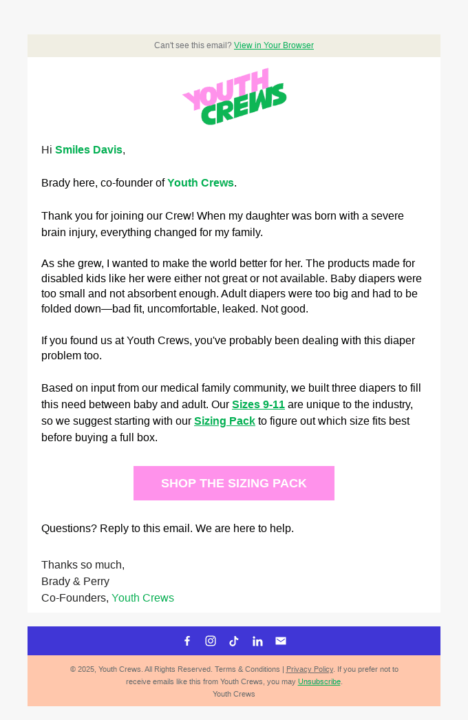
Brand story welcome emails, such as the Youth Crews one, lead with the story of how the brand came to be. Such emails don’t jump straight to selling but pull in new subscribers with the founding moment instead. It’s best for brands with a strong founding narrative or mission-driven identity.
Here are a few subject lines for a brand story welcome email:
- Here’s why we built [Brand]
- A letter from our founder ❤️
Example 2 – The discount welcome
Discount welcome emails deliver an instant benefit to subscribers joining the list, creating a twofold effect. There’s a feeling that you’ve joined something worth staying in, and that the brand is reliable to follow up on its promises. Most effective for ecommerce brands that have a clear product catalog, such as Huha.
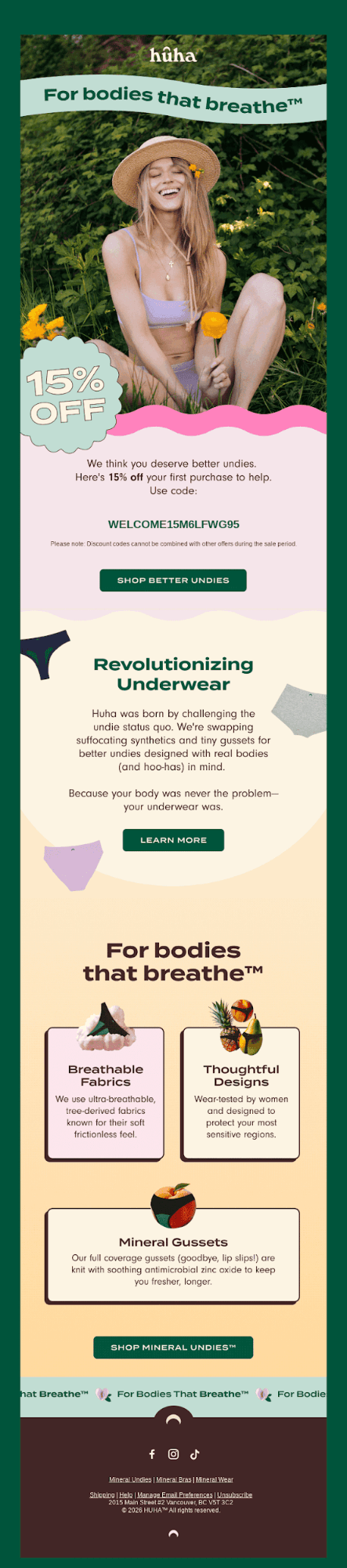
Below are a few subject lines for discount welcome emails:
- Welcome! Here’s the discount we promised
- Welcome to the [Brand] club – here’s 10% off
Example 3 – The education-first welcome

Most welcome emails don’t go straight for a hard sales pitch. In fact, an education-first welcome email avoids it entirely. Instead, like Lyka, it opens with some genuinely useful information – a guide, a framework, or a key insight. Such tactics are best for brands that create value not just from their products but also from their expertise.
Here are a few subject lines for an education-first welcome:
- Your 5-minute guide to [topic]
- The science behind [benefit] made simple
Welcome follow-up email examples
Example 1 – The expiring gift reminder
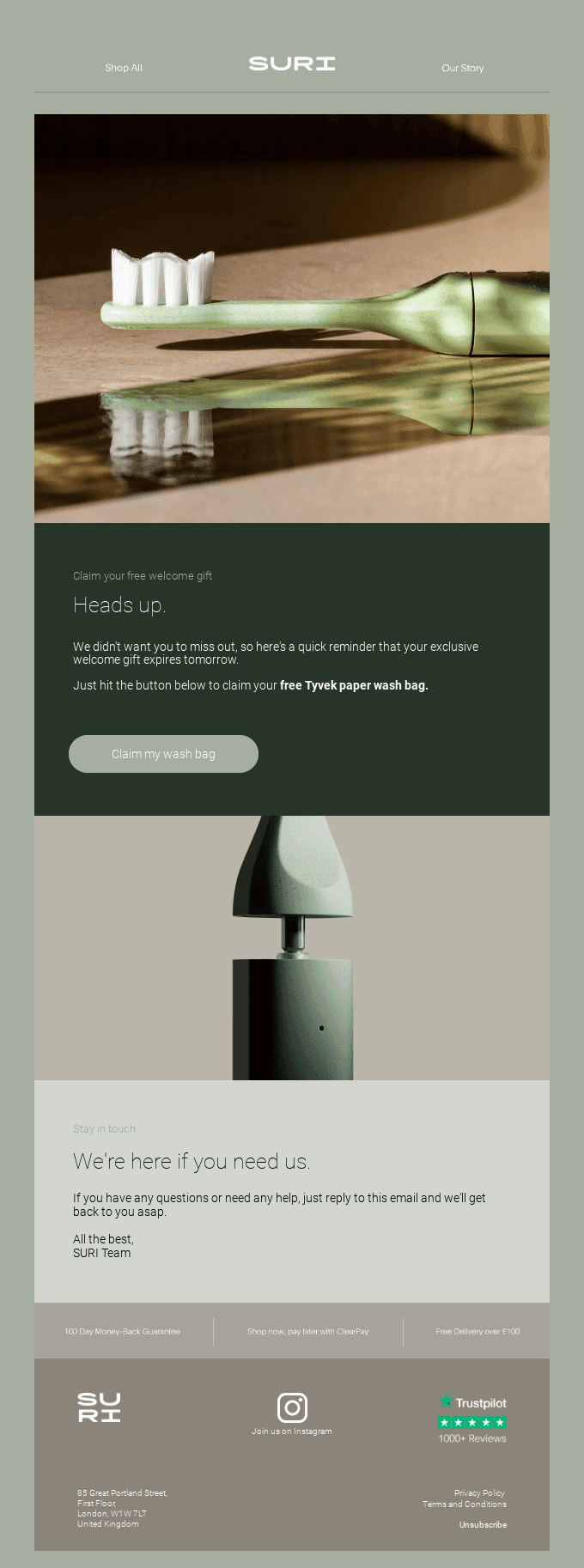
Expiring gift reminders are meant to create urgency around an incentive the subscriber already has but isn’t keen on using. Just as SURI, it’s important not to come off as a pushy salesman, but give a friendly nudge that’s doing the subscriber a favor. Best for brands that already use a discount-based acquisition strategy.
Below are a few subject lines for the expiring gift reminders:
- Your welcome gift expires in 48 hours
- Don’t leave your welcome gift on the table
Example 2 – The expiring discount reminder
Largely the same as an expiring gift email, but leads not only with a deadline but can create a more concrete discount benefit, most often in percentages. Loeffler Randall is straightforward and unapologetic about their attempt to convert, and the messaging follows a subject line creating urgency.
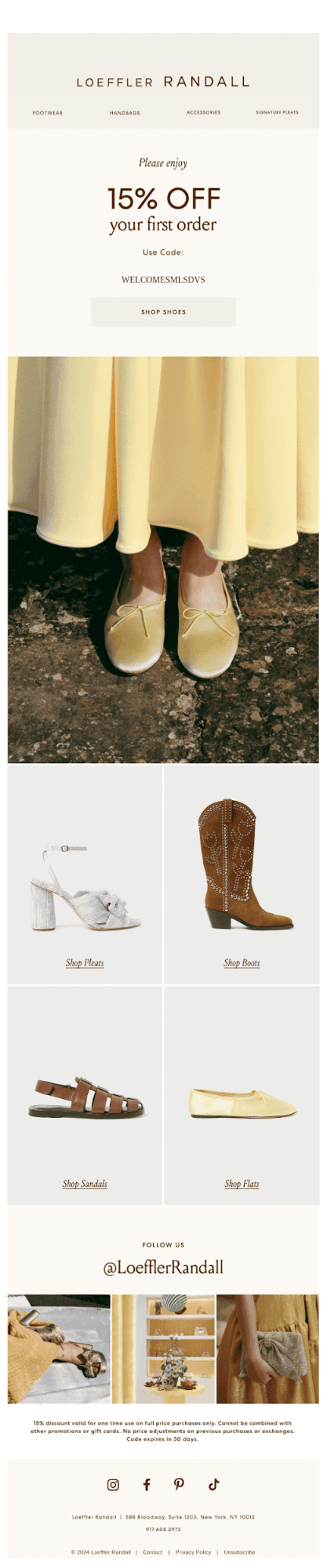
Here are a few subject lines for the expiring discount emails:
- Last chance — your 15% discount expires tonight
- 24 hours left to use your 20% off
Conversion stage lifecycle email examples
The conversion stage plays a crucial role in customer lifecycle segmentation, as it closes the gap between interest and action. Effective emails at this stage remove whatever objections stand in the way of purchase. Discounts are the most straightforward strategy, but they’re not always the only answer.
Abandoned cart email examples
Example 1 – The simple reminder
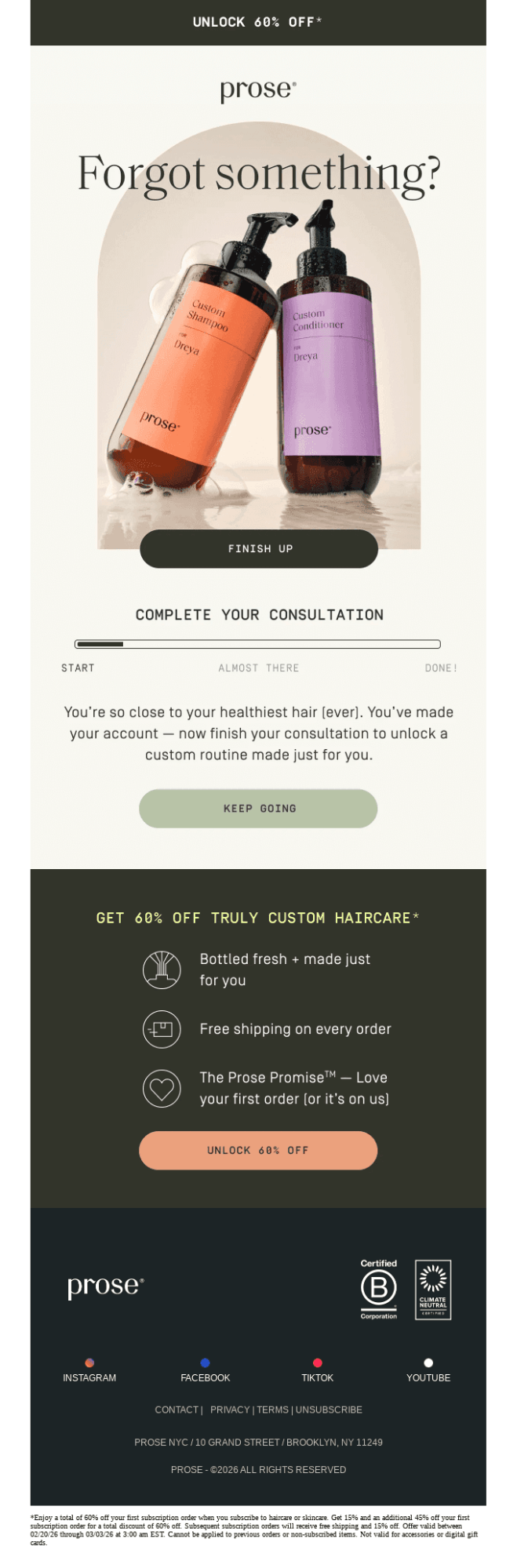
Just as the name suggests, reminder emails, such as the one from Prose, inform the reader that she left something behind. No overcomplicating the offer, just a simple nudge that makes returning mentally effortless. Works well for products with a strong reputation and audiences genuinely close to buying again.
Below are a few subject line examples for simple reminders:
- You left something behind
- Your welcome gift is getting lonely
Example 2 – The social proof nudge
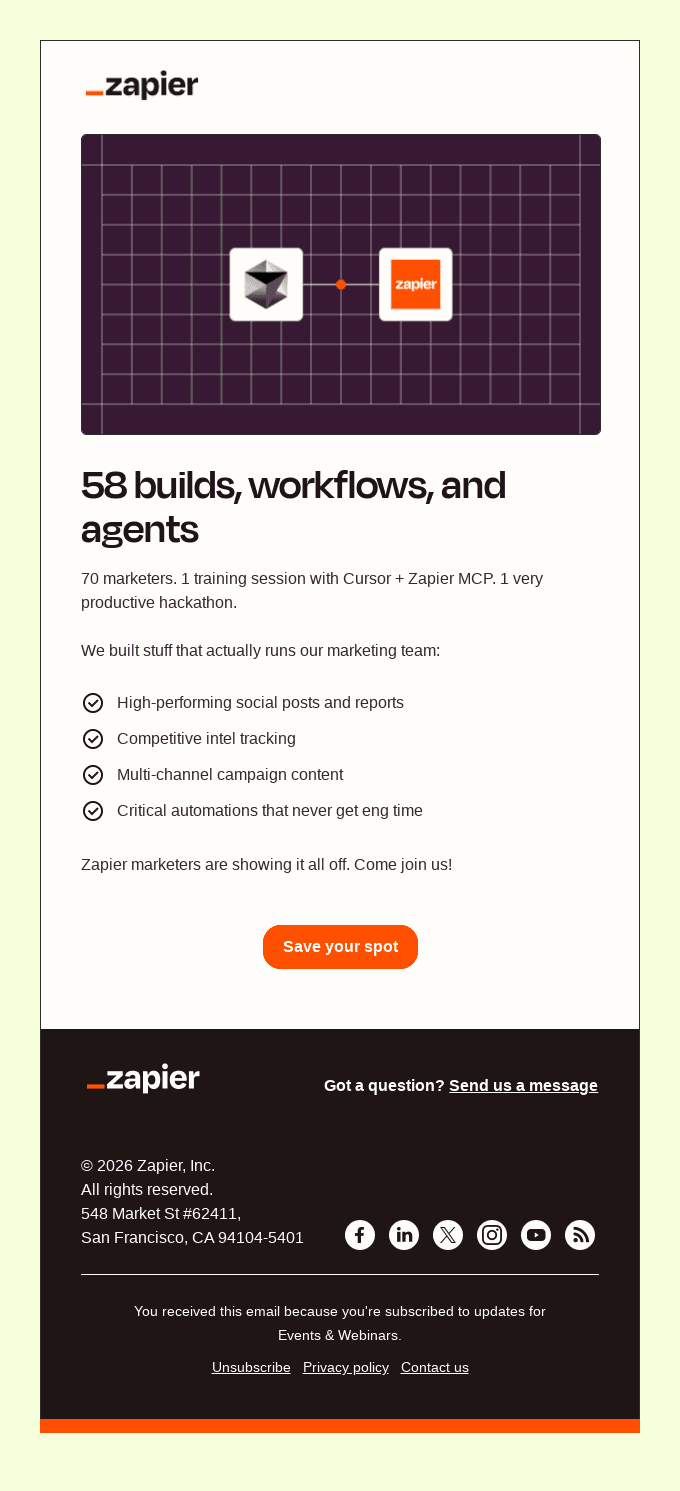
Such emails return to abandoned carts with evidence in case the customer still thinks your offer isn’t worth it. It can be positive reviews, 5-star ratings, reader feedback, or, as in the case of Zapier, a relatable statistic. Social proof strategies work for brands that actually have strong feedback data to back it up.
Here are a few subject line examples for the social proof nudge:
- 500+ people already love this
- Don’t just take our word for it
Example 3 – The discount close
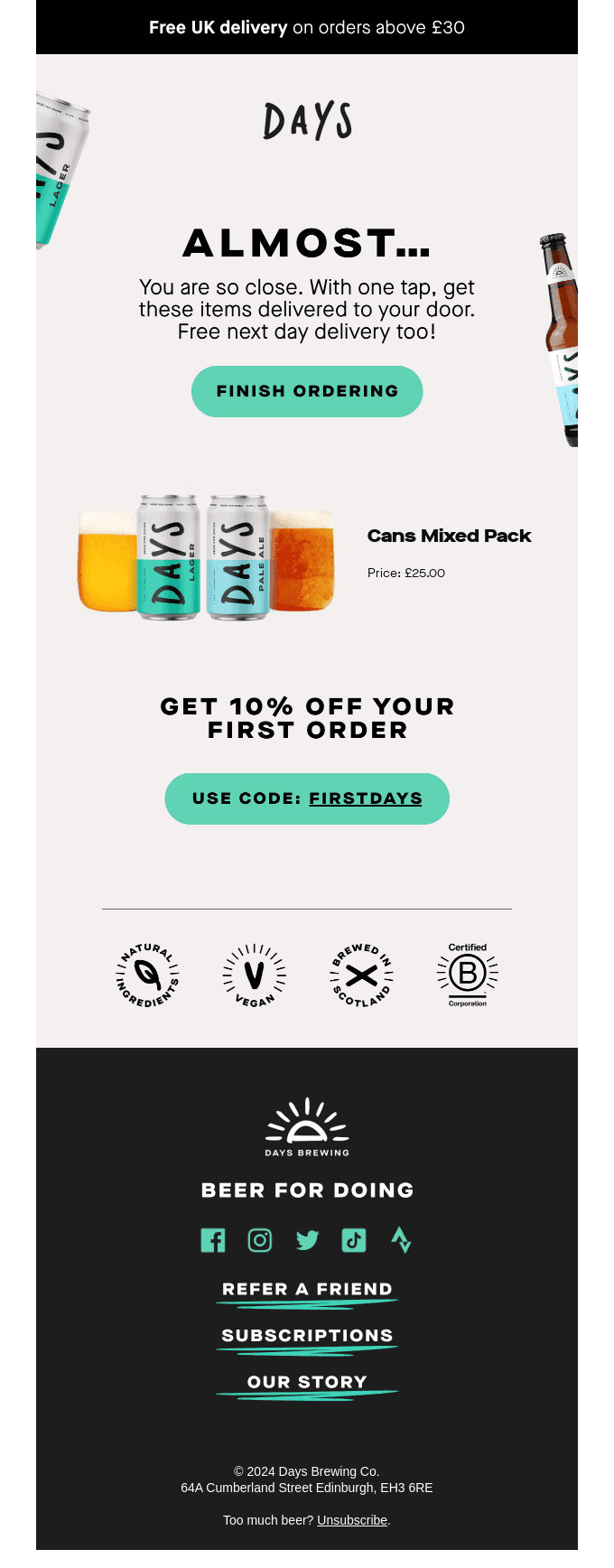
Discounts are often the last in the abandoned cart sequence once you’ve already tried everything else. Emails such as from Days Brewing Co offer a straightforward, calculated discount to recover a sale that would otherwise be lost. Consider whether your ecommerce brand or the profit margins for a specific product can absorb the price decrease.
Below are a few examples of discount close subject lines:
- One last thing before you go
- [Name], your discount ends today
Browse abandonment email examples
Example 1 – The category browse follow-up
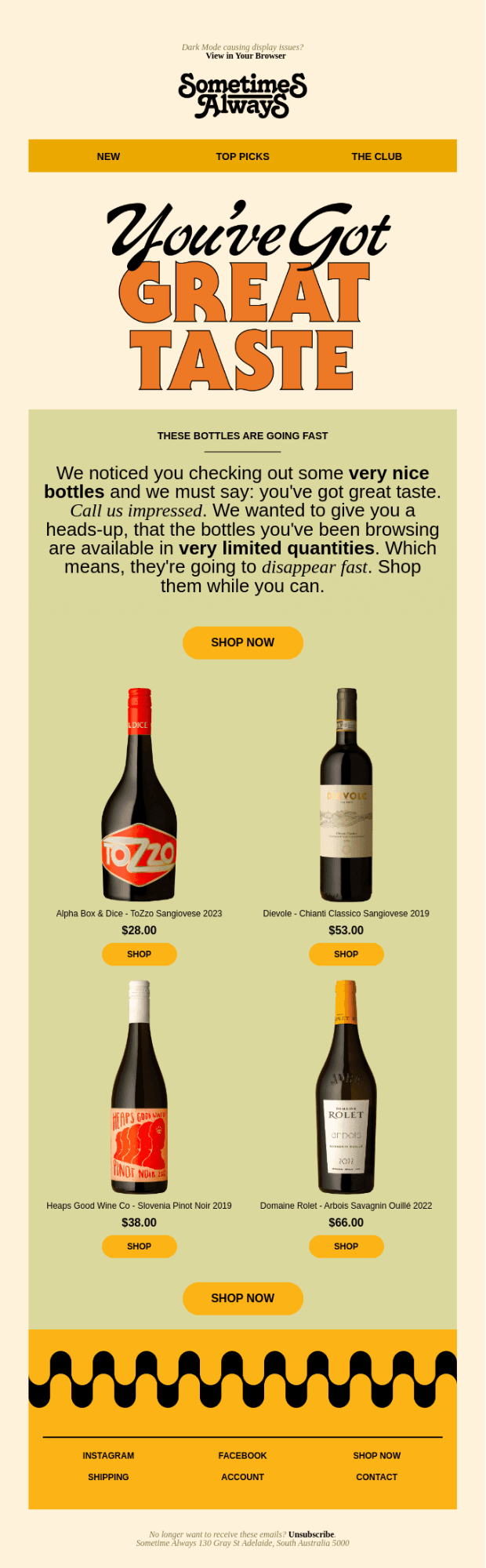
The browse follow-up aims to broaden the scope from a single product to suggest the whole category. The shopper browsed wines, so the email for Sometimes Always met them with a nudge into bestsellers of that category. It works for this brand because they actually have a deep product catalog with clear top picks.
Here are a few relevant subject line examples:
- Still exploring? Here are our most loved [category]
- Let’s find you a perfect [product type]
Example 2 – The product browse follow-up
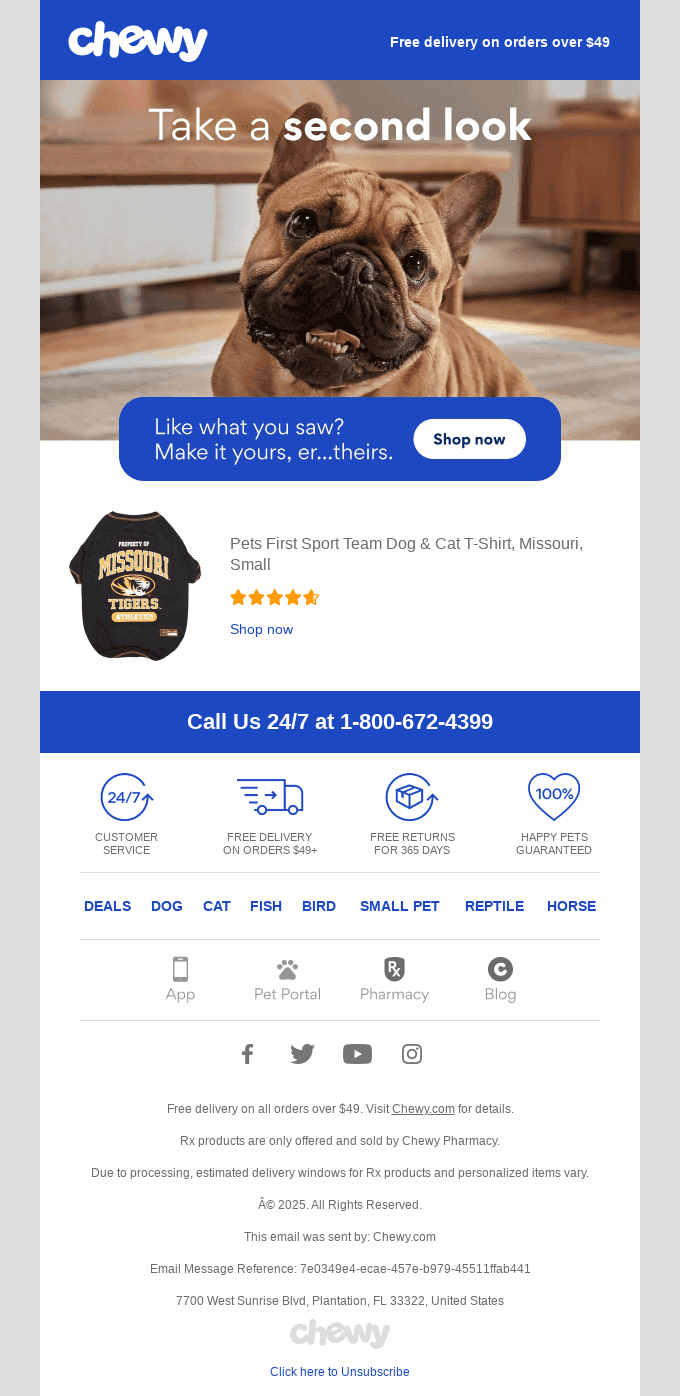
If your ecommerce analytics allows you to define the purchase intent precisely, you can respond directly. Unlike the category browse follow-up, this email has a single product to work with, which makes it sharper and more personal. Chewy nudges the shopper with a specific item he browsed.
Below are some product browse follow-up subject lines to try:
- You kept coming back to this one
- We saved [product] just for you
Back-in-stock email examples
Example 1 – The simple notification
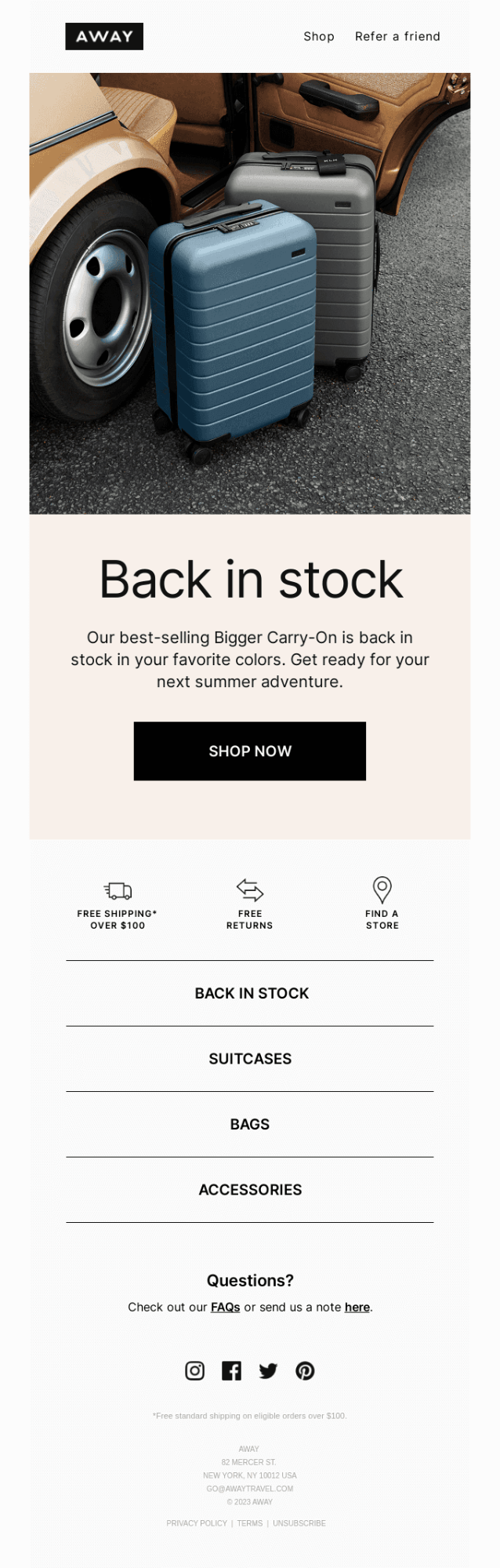
No storytelling or complicated detours, just a reminder that something the shopper actually needs is available. AWAY nails it with their simple “Back in Stock” headline that gets everything out of the way and makes purchasing it immediate and effortless. Any brand with high-demand, low-inventory products can learn something from such examples.
Here are a few subject line examples of simple notification emails:
- [Product] is back — don’t miss it again
- Good news: [product] is here again
Example 2 – The urgency notification
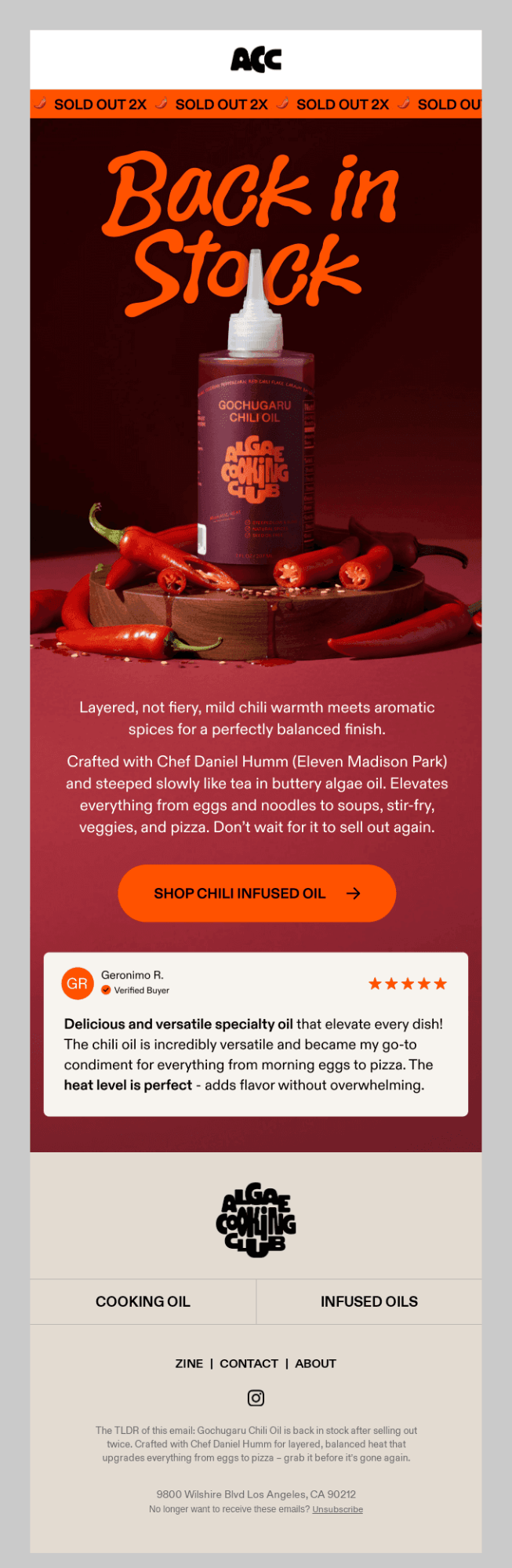
When you need to add a little pressure to a simple reminder, adding urgency with stock limitations is one of the ways to go. Importantly, the urgency must be justified in the product’s history, as in the case of Algae. Urgency works only for brands known for frequent sellouts and limited supply.
Below are a few subject lines you can try:
- Hurry – [product] is selling out fast
- It’s back, but not for long
Retention stage lifecycle email marketing examples
Retention emails reach already loyal customers and aim to ensure lasting relationships with them. Many of them are post-purchase emails, delivering important updates or additional value between transactions. Such emails need to earn their place in the customer’s inbox by being genuinely useful.
It’s proven how Omnisend helps to build customer relationships. Wholesaler and packaging supplier Verpakgigant’s post-purchase Google reviews grew by 1,500% — from 15 to 240+, after implementing our review automation tools
Read their full story.
Post-purchase email examples
Example 1 – The order confirmation
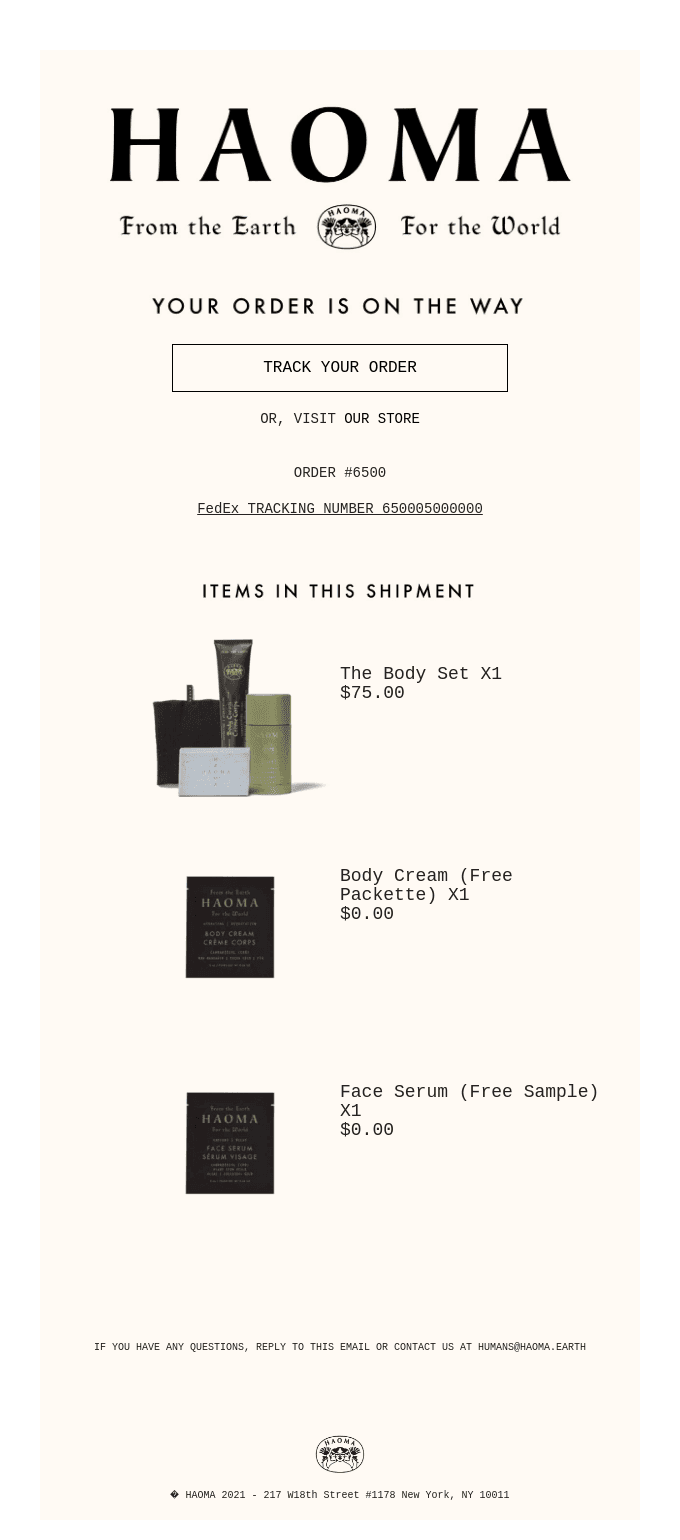
Order confirmations are a seemingly basic communication that must, first and foremost, be timely and accurate. Once that’s secured, follow the steps of brands that leave no opportunity unused. Companies like HAOMA retain an exclusive experience through their unique style, even in transactional emails.
Here are a few subject lines of order confirmation emails you can try:
- Your order is confirmed — here’s what happens next
- We’ve got your order — thank you for choosing [Brand]
Example 2 – The review request
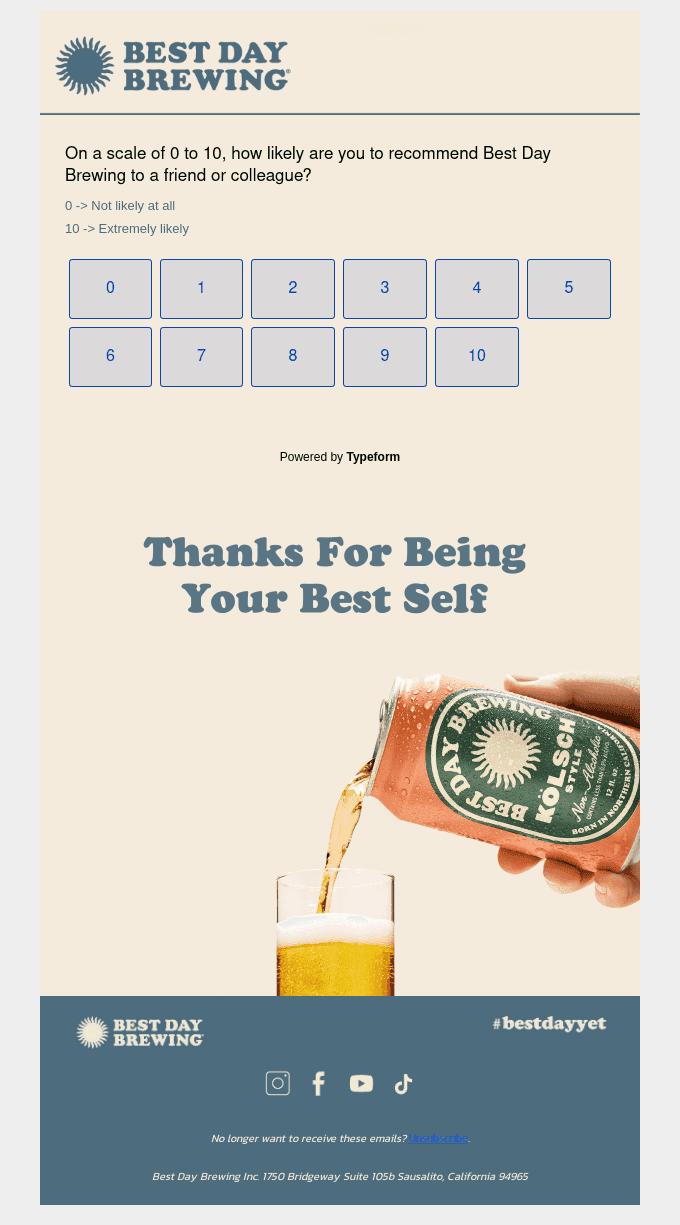
Going to the point with your request is what works for brands like Best Day Brewing. However, review and similar requests require earning that favor. You must time your request, segment subscribers willing to answer, and sometimes even ensure compensation. Best for niches where building the social proof is worth the trouble.
You can try some of the following subject lines for review request emails:
- How’s the fit of [product]?
- Help others shop smarter – share your experience
Replenishment email examples
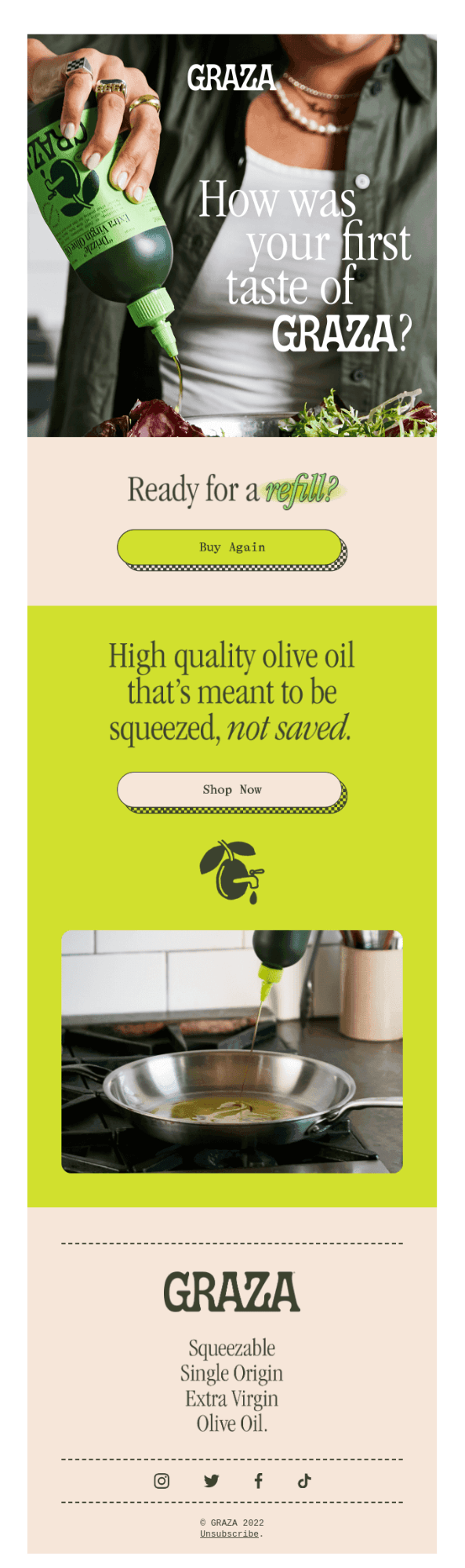
Example 1 – The predictive replenishment
With email marketing tools like Omnisend, you can measure usage rates or time since purchase to predict subscriber needs. Accurate targeting is what makes it feel considerate rather than intrusive. Predictive replenishment is best for brands like Graza, which know their customers will need a refill.
Here are a few subject lines to try:
- Running low on [product]? Restock now
- Don’t let your [product] run out
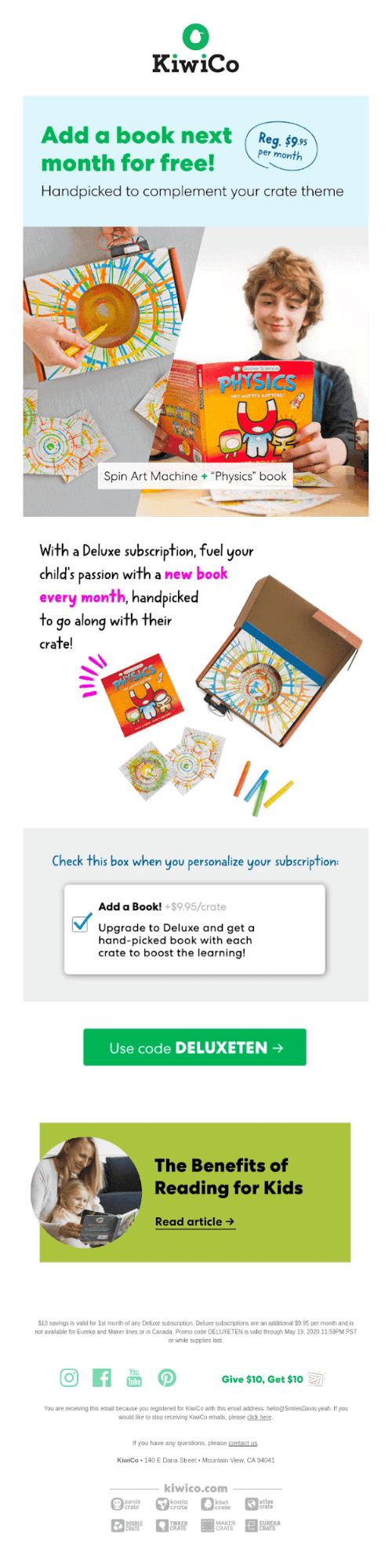
Example 2 – The subscription upsell
The subscription pitch is not only about savings, but also consistency and the convenience of a recurring relationship. Successful examples, like the one from KiwiCo, take what the customer already likes and transform it into a natural next step with extra benefits. Keep in mind, the strategy only works for consumable and replenishable products.
Below are a few subject lines for the subscription upsell:
- Become a subscriber (it’s worth it)
- Why buy once when you can subscribe?
Reactivation stage lifecycle email examples
Subscribers who stopped opening, customers who haven’t purchased in months, or readers who quietly drifted away – these are the targets of reactivation emails. The goal is to break the silence with a message worth responding to. Sometimes an honest acknowledgment is all it takes, but you might also need more creative messaging.
Win-back email example
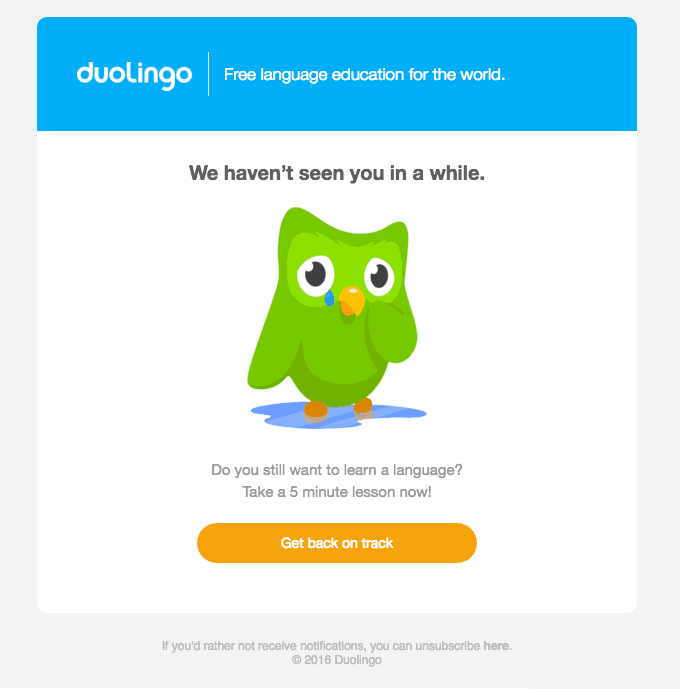
Example 1 – The “we miss you” email
A direct and humane declaration of absence is enough for Duolingo to remind subscribers about themselves. It’s personal without being too desperate, because they can project some of the blame onto the subscriber. Most brands with a strong identity and real stakes can make such emails work to some extent.
Here are a few subject line examples for “we miss you” emails:
- We miss you, [name] ❤️
- We miss you. Here’s 15% to prove it
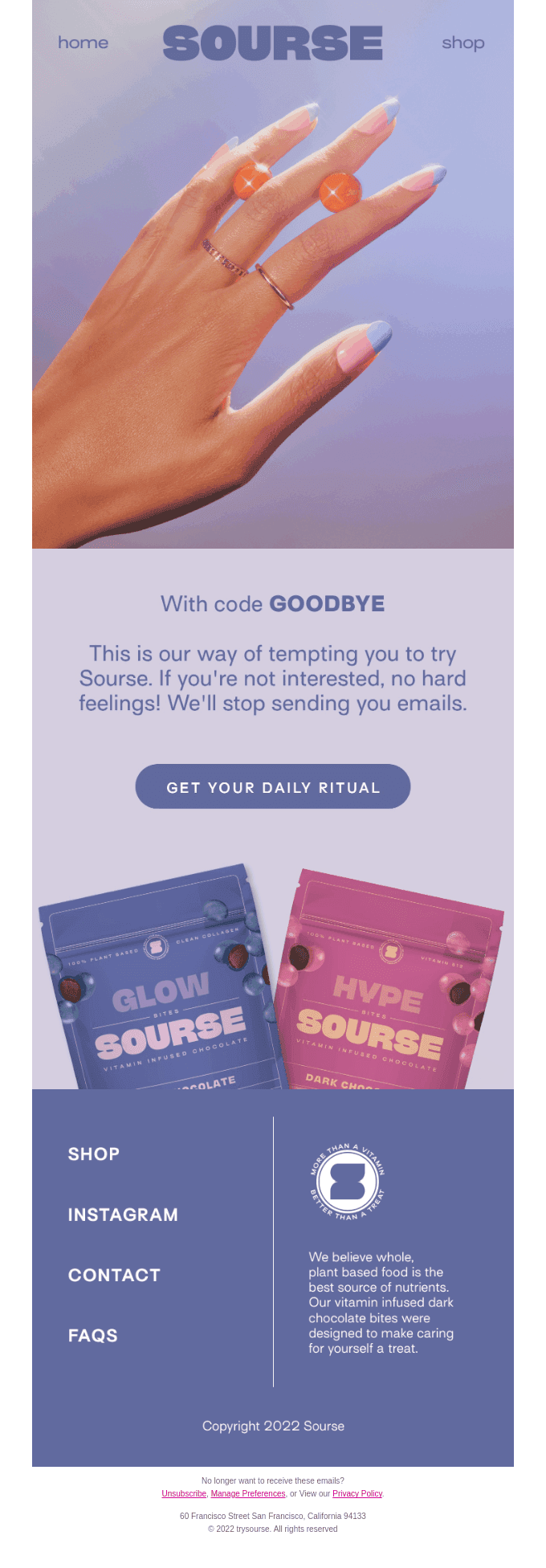
Example 2 – The incentive win-back
Unlike the previous example, Source leads with a clear financial incentive. Besides a discount code, it can be anything from free gifts and shipping to bonus points or an exclusive offer. Successful examples are honest about the practical implications of the exchange, so the brand must ensure it can follow through.
Here are some other incentive-oriented subject lines:
- We saved our best offer for you (30% off)
- We want you back — here’s 20% off to prove it
Sunset email examples
Let Omnisend improve your deliverability before saying goodbye to subscribers. Our sunset automation reactivated ~10% of inactive contacts for AcreValue.
Learn from their success.
Example 1 – The preference check
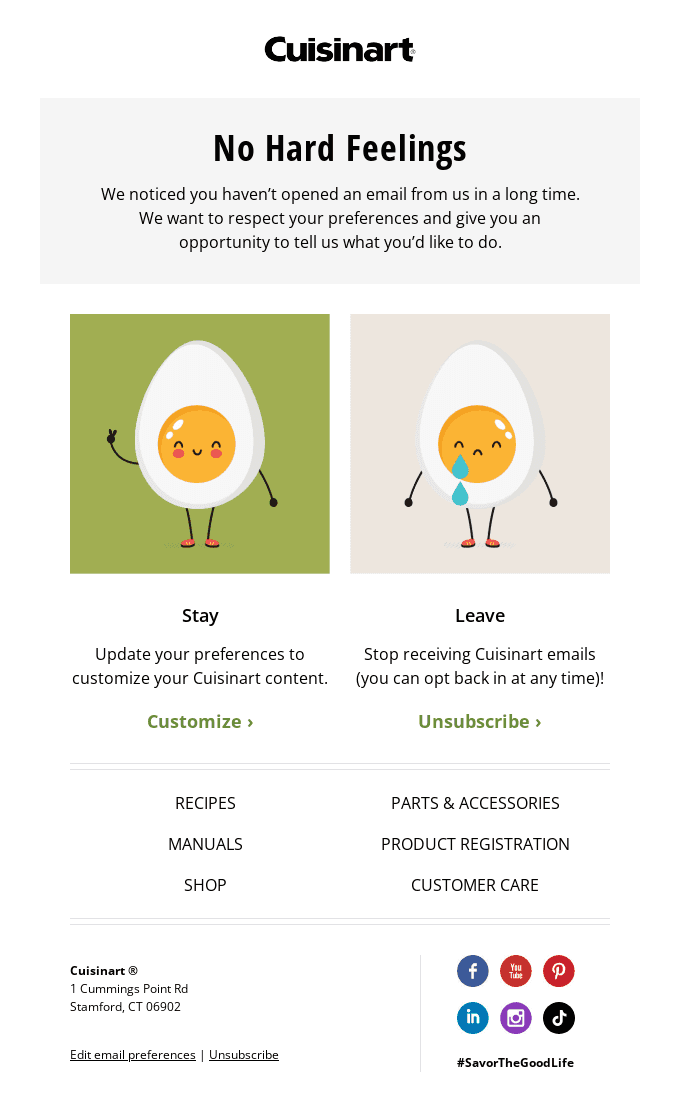
Instead of pushing for an immediate return with incentives, emotional triggers, or other tactics, you can hand the control back to the subscriber. Cuisinart manages to ask for preferences while maintaining an emotional yet humorous tone. Preference checks are highly valuable for frequent senders who want to reduce churn.
Below are a few subject lines with the preference check angle:
- Let us know whether you still wanna hear from us
- Are we sending you the right things?
Example 2 – The clean unsubscribe
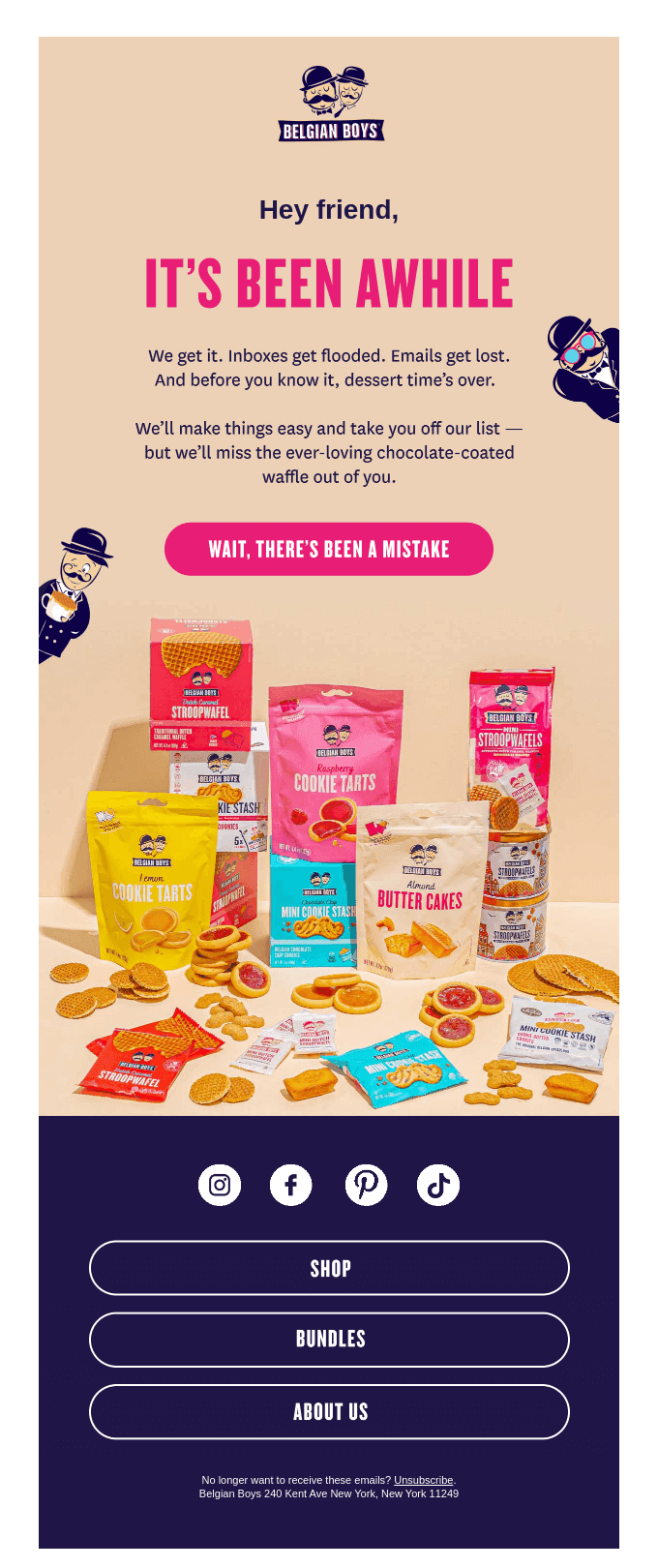
Giving someone permission to leave often makes them less likely to go. Coupled with one last offer or a tempting one, as in the case of Belgian Boys, this strategy can be highly effective. However, it’s crucial to stay true to your brand’s tone and remain respectful. Best for brands with a large mailing list.
Here are two relevant subject line examples:
- It’s okay to say goodbye — but we’d love you to stay
- We won’t take it personally if you leave
What all strong lifecycle email examples have in common
Regardless of the stage, each lifecycle email example in our list follows the same underlying logic, which makes it successful:
- Every email has one function and doesn’t try to achieve two things at once.
- The subject line matches the email’s emotion without mixing its type. For example, a win-back email doesn’t sound like a sale email.
- Timing is part of the example: when the email lands is as important as the message it sends.
- Real results come from sequences, so the final performance of the email must be evaluated in the context of the whole flow.
- Personalization is structural, not cosmetic. Leveraging customers’ names, purchase history, order data, and other details measurably improves results.
These are the bare bones of an effective lifecycle email. A deeper analysis of your customer lifecycle stages, available data, mailing list size, email marketing goals, and other factors might reveal a more strategic context.
Build your own lifecycle emails with Omnisend
Your lifecycle marketing can only be as effective as the infrastructure behind it. Every strategy requires considerable data on purchases, browsing behavior, finding lapsed customers, or at least triggering the right email at the right time.
The fastest way to kick-start your campaigns is to use pre-built lifecycle automation templates. Omnisends workflows can help you get the needed flows up and running in no time, and the more you use them, the better they get.
Lifecycle email marketing examples FAQs
What are lifecycle email marketing examples?
Lifecycle email marketing involves sending targeted and automated messages based on where the customer is in their relationship with your brand. Common examples include welcome emails, abandoned cart reminders, post-purchase follow-ups, replenishment nudges, win-back offers, and sunset emails. Each targets a specific moment in the customer’s journey.
What lifecycle emails should I set up first?
The answer depends on what has the greatest impact on your conversions. Usually ecommerce stores benefit the most from welcome and abandoned cart email automations. In some cases, post-purchase follow-ups and win-back flows might be more important. Omnisend offers prebuilt automations, so you can test them easily.
How are lifecycle emails different from regular campaigns?
Regular email campaigns, such as newsletters, promotions, or announcements, are scheduled and fine-tuned to reach the whole list or a specific subscriber segment. Lifecycle emails are triggered automatically by customer actions, behavior, purchases, timing, or other factors. In short, one is calendar-driven and the other behavior-driven.
How do I measure whether my lifecycle emails are working?
Conversion rates and revenue are the most straightforward measures for commercial impact, although open and click rates are also important. Lifecycle sequences specifically benefit from monitoring drop-off points, as they show where the timing or messaging needs a fix.