Omnisend AI

 OFFER
OFFER









A highly detailed lifecycle marketing strategy is only half of the battle — you need to have an effective system to make it all work. Most marketers can define what acquisition, activation/conversion, retention, and reactivation stages require, but applying the right action to each one is another thing entirely.
The key concept here is to understand how every message, campaign, and automation works together to turn lifecycle marketing strategies into action. In this guide, we’ll cover how to apply customer data and segmentation logic, apply the right campaign type to individual lifecycle stages, and build an interconnected automation infrastructure.
Quick sign up | No credit card required
What makes a lifecycle marketing strategy different from just sending campaigns
Campaigns drive traffic and revenue — that’s why Black Friday, Christmas, and other occasions have become global marketing events. However, while sending a welcome email is a tactic, sending the right message to the right customer at the right moment is a strategy.
It might seem like a subtle comparison, but to explain it further — a customer lifecycle marketing strategy combines several campaigns dedicated to every lifecycle stage and customer behavior using accurate data to pinpoint where a customer is in their journey.
In contrast, campaign tactics are mostly individual email chains that usually announce sales, send newsletters, or launch promotional, one-off campaigns.
| Lifecycle strategy | Campaign tactics |
|---|---|
| Trigger-based to activate when a certain action happens | Broadcast-based to be sent on a fixed date |
| Behavior-driven to respond to what a customer does | Date-driven to respond to a specific marketing event |
| Connected flows to transition from one stage to another | Isolated sends for individual campaigns |
| Automation-focused without manual input | Requires repeated effort for every campaign |
| Measured by stage-specific KPIs | Measured by campaign-level metrics |
Beyond this comparison, it’s important to emphasize that well-planned campaigns do a great job at attracting new subscribers, but lifecycle strategies focus on turning one-time buyers into repeat customers.
How to build your customer lifecycle marketing strategy
Most ecommerce businesses think that they need to start planning their lifecycle marketing strategies by choosing the right tools first. Software is certainly crucial, but it’s not the first step — you need to start by laying down your business goals first, comparing them against current results, identifying problematic areas, and then mapping out a cohesive strategy that connects every lifecycle stage.
Step 1 — Map your customer data and segmentation logic
Before you start a conversation with a potential customer, you need to know who you’re actually trying to connect with. This is where RFM modeling comes into action — it’s a strategic foundation representing the basis of lifecycle segmentation.
Recency, frequency, and monetary modeling uses purchase history and behavioral data to assign every customer a specific lifecycle position. RFM can tell you both who your customers are and where they are in their relationship with your brand at the moment.
In simpler terms, a customer who’s purchased products from the same brand six times is in a completely different category than a one-time buyer.
- Recency (R): Shows how recently a customer bought a product or service from you. Following the recency metric alone, brands can segment highly engaged customers with recent purchases of up to 30 days into an upsell category, and push inactive subscribers for 180 days into your reactivation flows.
- Frequency (F): Calculates the exact number of times a customer has purchased from you. High-frequency buyers become candidates for loyalty programs and exclusive perks, while first-time buyers are strategically encouraged to make their second purchase.
- Monetary value (M): Displays how much customers have spent on your products in total. The more customers spend, the more attention they receive from brands, receiving individual deals and promotions, as losing high-value customers can be devastating to companies.
Step 2 — Assign campaign types to each lifecycle stage
Audience segmentation is the first real step towards a well-planned and data-based lifecycle management strategy. Real work often begins, however, when businesses need to craft tailored content for every segment at different lifecycle stages, and connect it all to relevant campaign types.
Now, this can quickly become an overly complicated possibility map, but it doesn’t have to be. Here’s a table showing how every lifecycle stage works in relation to triggers and campaign types.
| Lifecycle stage | Campaign type | Trigger |
|---|---|---|
| Acquisition | Lead capture, pop-up opt-in, abandoned signup flow | First site visit, exit intent, form submission |
| Activation | Welcome series (3-5 emails), first-purchase incentive | Email signup, account creation |
| Engagement | Browse abandonment, cart recovery, and post-purchase upsell | Product page view, cart add, order confirmation |
| Retention | Loyalty program flow, VIP tier upgrade, replenishment reminder | Multiple purchase milestones, high RFM score, product lifecycle |
| Reactivation | Winback sequence (2-3 emails), sunset flow | No purchase in 90-180 days, decline in email engagement |
As a side note, keep in mind that the end goal isn’t to run all stage automations and strategies at the same time from day one. Mapping out a clear lifecycle email marketing strategy plan is the basis for long-term growth and success.
Step 3 — Build your automation architecture
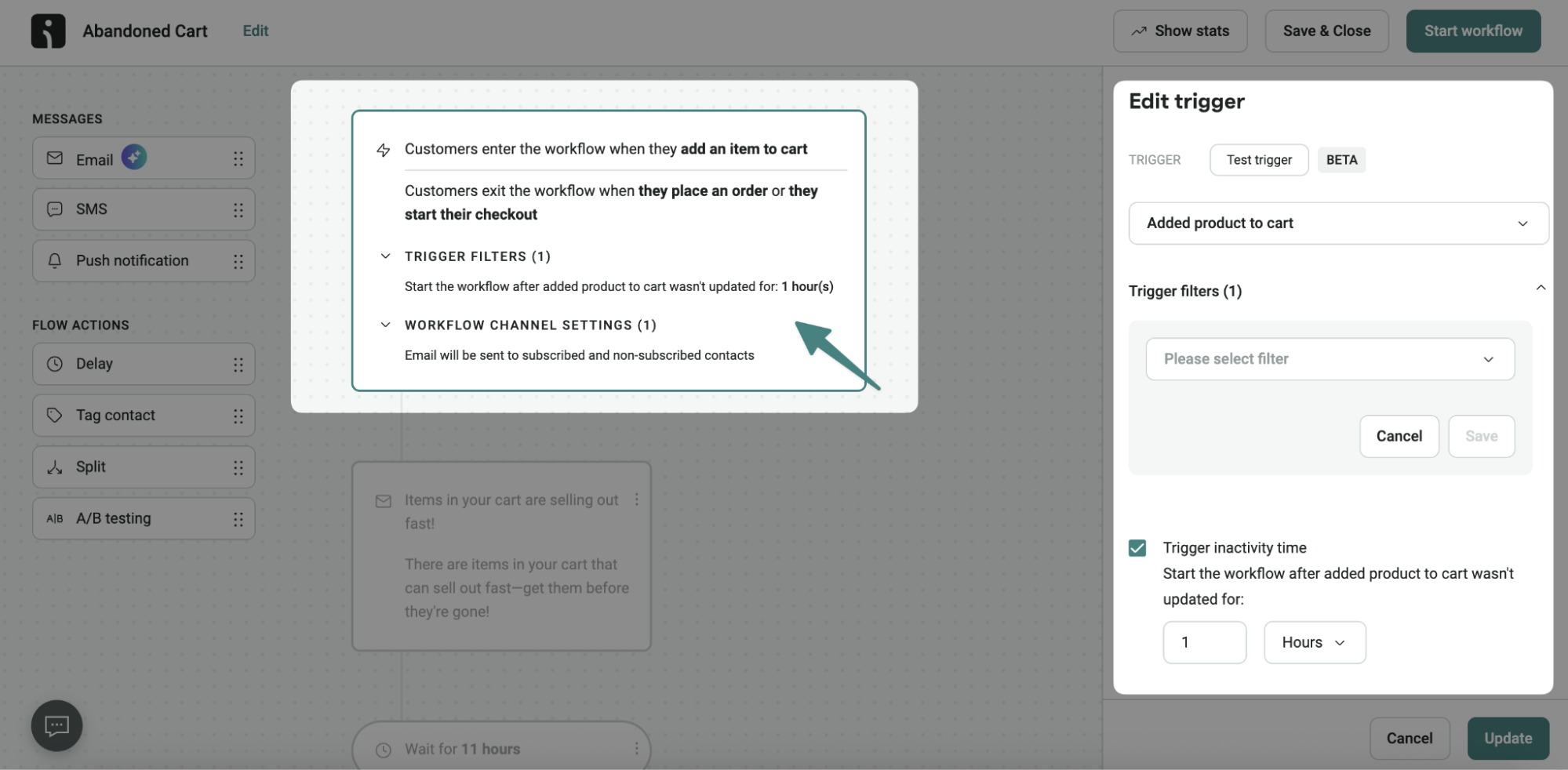
Automation is all about connections, not just improving individual email campaigns, regardless of how successful they can be. Your automation architecture needs to have a unifying logic that directly reflects how your customers move from one lifecycle stage to another based on their behavior.
To make it easier to imagine, it’s helpful to view connected automations as a pipeline. Every automation guides customers to the next stage when a specific condition, unique to that customer segment, is met.
For example, a customer who goes through your welcome series and completes their first purchase should then be automatically removed from the activation flow and moved to the engagement flow.
Conversely, if a customer goes silent for more than 90 days and doesn’t interact with your brand, much less buy from you, they should be moved into the reactivation flow.
In other words, building an automation architecture with the right customer lifecycle software that includes different audience segments and behaviors will help minimize lost subscribers in the long run.
Step 4 — Define your metrics at each stage
Data is the new gold, and it can’t be truer for lifecycle marketing strategies. Using the right metrics can tell you whether a strategy is working or failing. Using generic email marketing metrics like open or click rates can point you in the right direction, but they won’t help you identify areas of improvement, which can be devastating in today’s digital ecommerce field.
To get better insight into your lifecycle marketing performance, consider tracking these metrics to build meaningful and actionable benchmarks:
- List growth rate at the acquisition stage: Shows the rate at which new subscribers become part of your lists. Understandably, slow growth may point to a weak or incomplete opt-in strategy, or insufficient traffic.
- Welcome series conversion rate at the activation stage: Reviews the percentage of new subscribers who make the first purchase. Low conversions typically suggest that welcome series aren’t doing a good job at creating urgency or relevance.
- Repeat purchase rate at the engagement stage: Displays the number of customers who make a second purchase within a pre-defined window, usually around 60 to 90 days.
- Customer lifetime value (CLTV) and churn rate at the retention stage: Tells businesses whether their retained customers are actually growing in value, or just sitting as ambiguous subscribers in email lists. Churn rate shows how quickly customers are choosing to end their relationship with your company altogether.
- Winback rate at the reactivation stage: Displays the percentage of lapsed customers who have purchased again after entering your winback email sequence.
How to prioritize which lifecycle stage to fix first
A lot of marketers find it challenging to identify exactly where the problems are with their customer lifecycle strategies.
In reality, the answer is much simpler than you’d think, and it really depends on the kind of data you have access to. Let’s review four of the most common scenarios and how to address them:
- Your activation rate is low, showing that fewer than 20% of new subscribers make the first purchase. One of the most prevalent situations, which in turn has several ways to fix it. To start off, analyze your welcome series, as they are the highest-leverage stage for most ecommerce brands. The best practice here is to structure your welcome series around time-limited incentives, which can significantly improve activation rates.
- Your repeat purchase rate is low, leading to fewer than 30% of your customers buying a second time. Another widely encountered problem that requires brands to look at their post-purchase flows. The gap between the first and second purchase is where many customer relationships become stronger, or wither. To combat this, focus on creating post-purchase flows that educate, cross-sell, and provide value within 60 days.
- Your churn rate is climbing, or CLTV has plateaued. The first thing to do here is to start with your retention marketing stage. Analyze your existing loyalty flows, VIP tier triggers, and product replenishment reminders. Customers at this stage are already acquainted with your brand; they just need more benefit/value-based reasons to stay.
- You’re building a customer lifecycle management strategy from the ground up. This could be overwhelming, but consider starting with acquisition and activation exactly in that order. You need to flesh out a well-structured opt-in flow before you can test a welcome series, and then consistently move your way through stages, testing and adjusting along the way.
Common lifecycle strategy mistakes (and how to avoid them)
Even the best and well-oiled machines malfunction, so lifecycle strategy mistakes aren’t just common — they should be expected and eliminated one by one:
- Treating all lifecycle stages the same. Despite the consequences, it’s probably the most common mistake. All stages are drastically different, require unique approaches, and often have separate audience segments. The best way to fix this issue is to return to the basics of analyzing stage-specific metrics to identify gaps.
- Neglecting the reactivation stage. This mistake could also be framed as giving up too early, when really, reengaging lapsed customers is much cheaper than acquiring new ones. The best part is that you don’t even have to spend significant resources — creating two to three basic email sequences with compelling offers can already make a difference.
- Over-communicating to existing and engaged customers. The risk of becoming spammy is one thing, but trying to connect with already engaged subscribers can make them jump to other businesses. High engagement doesn’t equal more emails; it actually shows your current strategy is working.
- Skipping segmentation and sending broad, generic emails to your entire list. Ignoring different audience stages and behaviors is the fastest way to lose subscribers and increase your spam rate. Once that happens, climbing out of it becomes troublesome. It’s true that not all businesses can spend resources on high-level audience segmentation, but simply defining new subscribers, active shoppers, and lapsed customers can have a hugely positive impact.
- Creating campaigns separately. This mistake can seem like a tricky one since many ecommerce businesses achieve great results with isolated campaigns, but any kind of business scaling requires fluidity to cover all gaps and ensure all emails nudge subscribers toward purchases and loyalty.
How Omnisend supports your lifecycle strategy
Strategy brings value only when it’s put to action effectively — and this equation also includes choosing the right tools for the job. Omnisend is a reliable and widely used marketing automation platform designed to support ecommerce-specific nuances, turning lifecycle marketing strategies into working automations. Our customers get $79 back for every dollar they spend on email marketing automation.
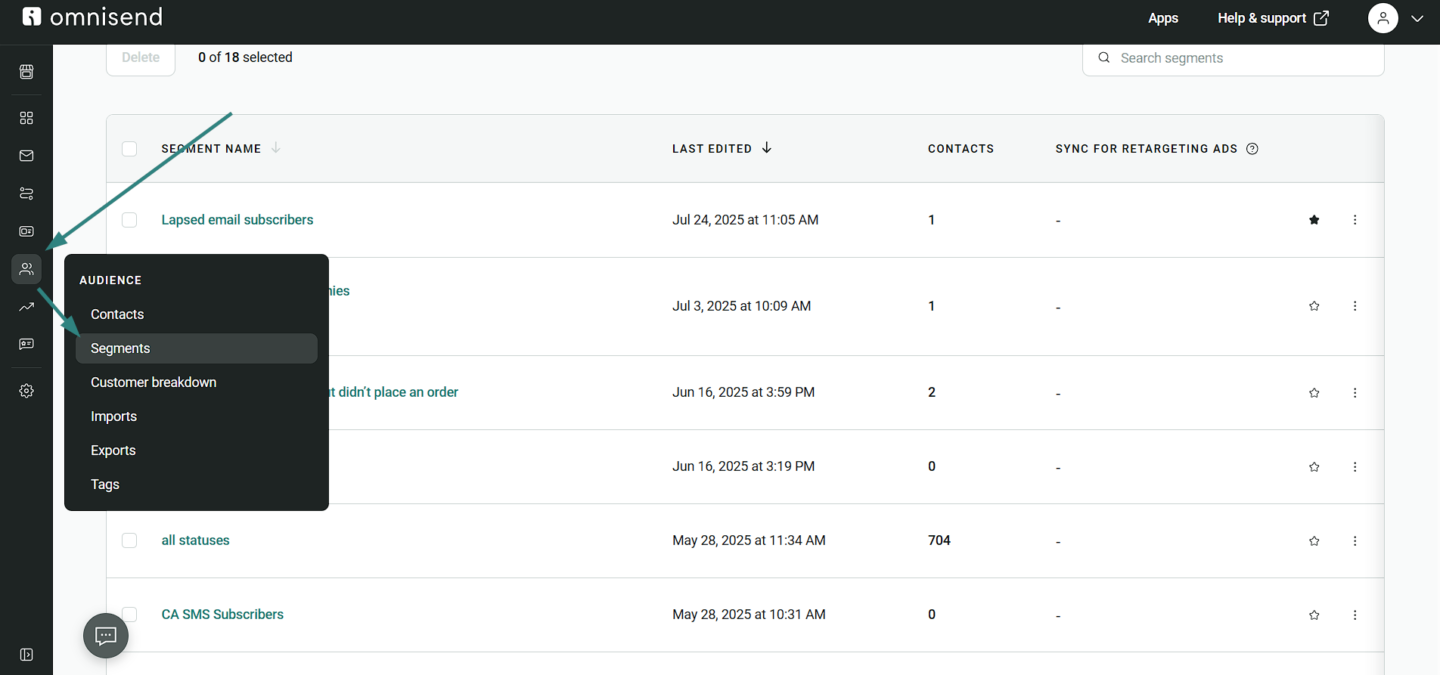
- Automation workflow builder: Create fully connected and multi-step lifecycle flows that move customers from one stage to another automatically. We support native integrations with Shopify, WooCommerce, BigCommerce, and Wix.
- RFM-based segmentation: Omnisend’s segmentation tools allow customers to build lifecycle audiences using the RFM framework without any manual data work. Plus, RFM segments update dynamically in relation to customer behavior changes.
- Email & SMS orchestration: Our services support international SMS together with emails, making it easier for ecommerce brands to build cross-channel sequences and reach more segments.
- Free plan with full access to advanced features: We offer free plans that provide access to all of our ecommerce-focused features to set up lifecycle automations from day one.
Conclusion
The short answer is that no lifecycle marketing strategy is built all at once, or in one day for that matter. Rather, a strong and high-performance strategy is realized layer by layer over time, which also involves metric tracking for benchmarking and adjusting.
At the heart of it all, the businesses that generate more revenue from email marketing automations are the ones that send intentional sequences based on behavioral segmentation and stage-specific metrics.
The best way to get started is to choose a stage that’s already giving you problems, gather data, analyze it, and choose the right campaign type to build your first automated email flow. Once you see results that show growth, move to the next stage.
Quick sign up | No credit card required