
 Omnisend AI


 OFFER
OFFER







Drive sales on autopilot with ecommerce-focused features
See FeaturesKey takeaways 
Mailchimp is facing stiff competition as multiple alternatives provide more features at lower prices, making it less appealing for businesses with complex marketing needs.
For small businesses needing basic email marketing, Mailchimp remains a viable option, but it struggles with advanced customer journeys and analytics.
Omnisend stands out as a top alternative, offering unrestricted features, multichannel automation, and a proven ROI of $79 for every $1 spent.
Alternatives like Sender and MailerLite provide generous free plans and high send limits, making them attractive options for budget-conscious users.
Reveal key takeaways
Mailchimp’s pitch over the last 25 years has been that it’s well-known, trusted, and good value for money. Trusted and known it is, but multiple Mailchimp alternatives now offer more features for less and have better capabilities even when you pay top dollar.
There’s still a place for Mailchimp if you’re a small business needing email basics or a legacy customer contending with migrating. But you will hit its limits when you have complex customer journeys and need segments, flows, and data to match.
Omnisend, for instance, doesn’t restrict any standard features, lets you create multichannel flows in any plan, and has a proven $79 ROI for every $1 spent across all channels.
Plenty of other tools offer features Mailchimp doesn’t. Our personal testing has narrowed it down to 10, which we’ve listed below with insights into features and pricing.
Join 150,000+ ecommerce businesses averaging $79 ROI for every $1 spent with Omnisend
Quick sign up | No credit card required
Best Mailchimp alternatives compared
The table below includes all our top Mailchimp alternatives with columns to help you quickly identify what’s suitable based on use cases and price. You can click any of the links to jump to the tools that interest you:
| Tool | Best for | Pricing from | Free plan | G2 rating |
|---|---|---|---|---|
| Omnisend | Ecommerce stores of all sizes | $16/month | Yes | 4.6/5 |
| Brevo | B2C + B2B email marketing and CRM | $9/month | Yes | 4.5/5 |
| Sender | Basic automations and high-volume sends | $10/month | Yes | 4.7/5 |
| MailerLite | High-volume, low-cost sends | $10/month | Yes | 4.6/5 |
| HubSpot | Free campaign tools and CRM features | €15/month | Yes | 4.4/5 |
| AWeber | Email marketing with built-in ecommerce | $15/month | Yes | 4.2/5 |
| Constant Contact | Events, email, and social media management | $12/month | No | 4.1/5 |
| Campaign Monitor | AI-first email automation | $12/month | No | 4.1/5 |
| Moosend | Most features per dollar | $9/month | No | 4.7/5 |
| Kit | Content and newsletter monetization | $33/month | Yes | 4.4/5 |
Editorial note: Our comparison table has accurate ratings and pricing as of March 2026.
Why and how we selected these tools
Our basic criteria spanned these three points:
- Customer ratings: We’ve only included Mailchimp competitors with excellent ratings on G2. Plus, their positive recent reviews (spanning 2026 and the end of 2025) had to outweigh the negative ones.
- Features: Mailchimp offers a decent selection of email marketing tools. Our alternatives offer a similar or superior feature set per tier.
- Pricing: Our alternatives to Mailchimp aren’t significantly more expensive than it. We’ve included contact and send-based alternatives to match your needs.
Why people are leaving Mailchimp
The primary reason for low-cost customers is that Mailchimp has “stripped the free plan to the bone,” in their own words. Starting February 2026, it cuts the contact allowance from 500 to 250, and sends from 1,000 to 500 emails/month.
That contact allowance and email send limit are about the norm for free email tools that charge based on contacts. However, Mailchimp restricts so many features in its free plan that it isn’t providing enough value anymore.
A similar story is playing out for its entry-level Essentials plan. It’s $26.50/month to get a 1,500 contact limit. And yet, it doesn’t let you use generative AI, create custom reports, see customer lifetime value (CLV), or build flows with more than four steps.
Multiple tools offer better value. For instance, Omnisend Standard is $25/month, with the same contact allowance and access to all those features.
Other reasons people are looking for Mailchimp alternatives include:
- A lack of analytics depth: One reviewer on G2 said that the “reporting is solid for standard campaigns but could offer deeper behavioral analytics.” Rajat M adds, “I love the features, but the analytics are inconsistent and frequently show inaccurate spikes.”
- Slow customer support: There’s a running theme for inconsistent support quality. Some say it’s exceptional, others say it’s slow and unhelpful. A frequent frustration is that live chat is only available for paying customers.
- Steep learning curve: Mailchimp’s UI has seen improvements in recent years, such as guided initial setups. However, people struggle to make sense of its advanced features. G2 reviewer Isabel says, “The learning curve at the beginning was a bit confusing for me. Some options are hidden in menus and take time to find.”
- Expensive at scale: Building on our points about pricing, multiple Mailchimp customers think it costs too much as lists grow. “Pricing can scale up quickly,” says Diego M, adding that ”sometimes it feels like key features are locked behind higher tiers.”
Baking Steel made the switch
Baking Steel switched from Mailchimp after hitting the limits of its reporting and support. On Omnisend, it found real-time revenue tracking per email, a native Shopify integration, and automated workflows that now generate 33% of its email revenue from 2.3% of sends.
Read the case study.
Which Mailchimp alternative is right for you?
With email marketing expected to hit $18.9B by 2028 according to Statista, it’s clear this marketing channel isn’t slowing down — and only the right tool can shape how fast you scale.
However, before chasing features from companies like Mailchimp, think of what your store needs to grow:
- Your customers have multiple high-intent moments, and you need to reach them on the most appropriate channels. Omnisend is your best option because it lets you create multichannel flows without restrictions in all plans.
- You have significant sending requirements and basic automation needs. Sender is a decent pick, its free plan offers up 15,000 email sends/month.
- You’re primarily a creator and want to sell digital products and subscriptions. Pick Kit, it even lets you earn money promoting other publishers.
- Your ecommerce model would benefit from one tool to handle email and sales. AWeber has built in ecommerce with 0.6% to 1% transaction fees.
- You need a CRM and sales engagement features. Brevo and HubSpot work well.
- You want the lowest-cost email tool and aren’t bothered about flow complexity. Sender, MailerLite, and EmailOctopus all have free plans and paid plans under $11/month.
You can compare most of these tools with Omnisend’s pricing comparison tool. It has Omnisend preselected, so all you need to do is add Mailchimp and others to discover the most cost-effective ones based on your number of contacts.
Top 10 Mailchimp alternatives
Our alternatives to Mailchimp are similar to other lists, but only because the pool of top-tier email marketing tools is relatively small. What we have done differently is personally test each of them with the following process:
- Onboarding with them via a free account, signing up for the free trial, or purchasing the entry-level plan to access backends
- Building at least one email campaign or flow
- Reviewing pricing per tier up to 5,000 contacts or an equivalent send limit
- Reviewing G2 for customer reviewers, filtered by the most recent
- Directly comparing competitors of Mailchimp with a side-by-side, assessing how easy they are to use, and any downsides
Here’s our list of Mailchimp competitors in all its glory:
1. Omnisend — Best for ecommerce automation
G2 rating: 4.6/5 (1,166 reviews)
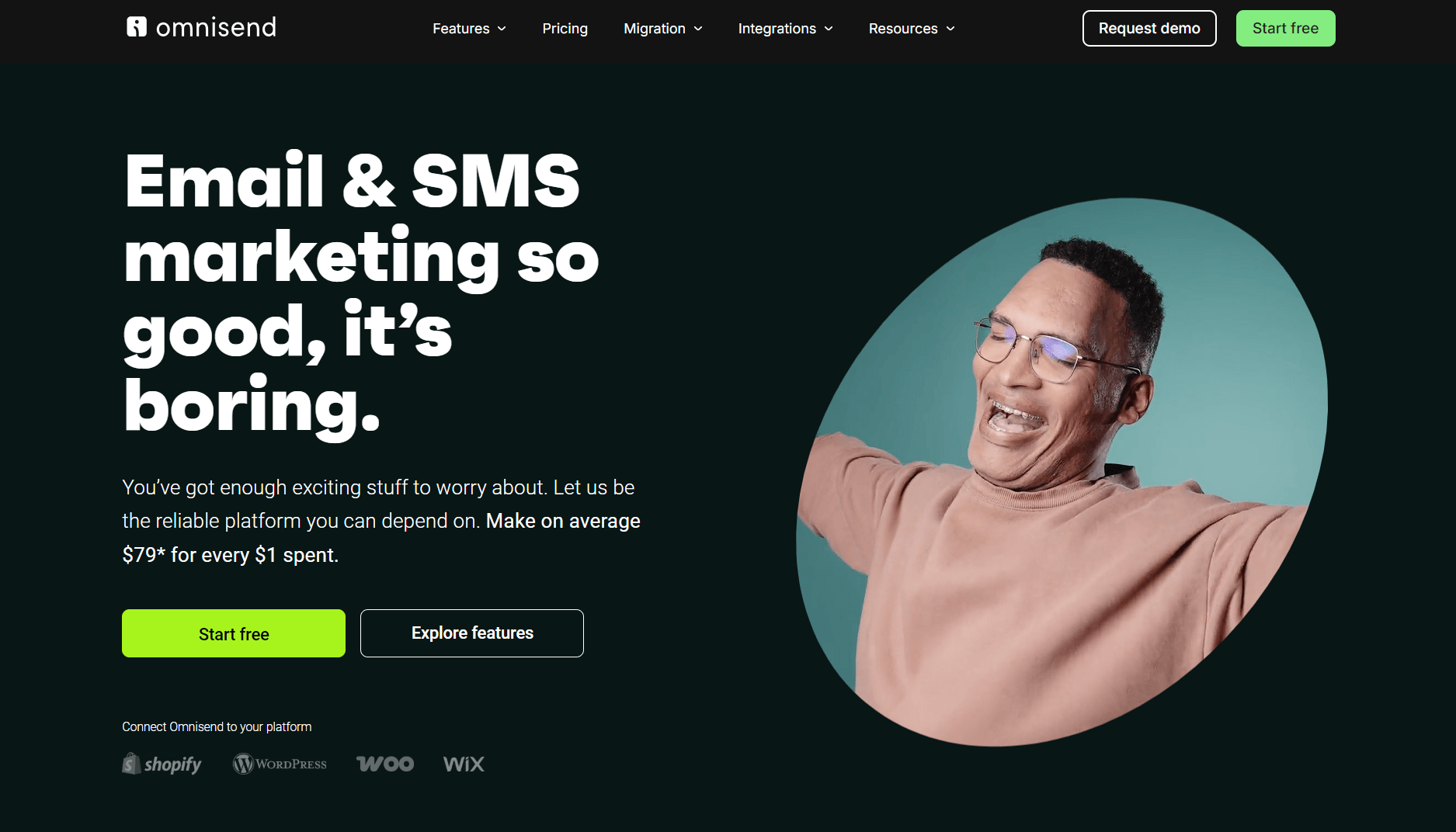
Omnisend is the best Mailchimp alternative if you sell online and want to create personalized customer experiences that generate revenue.
There are no standard feature restrictions (unlike with Mailchimp), and using email + SMS + web push notifications together is possible in every plan.
Ecommerce automation depth and multichannel marketing are Omnisend’s biggest advantages over Mailchimp. You can target people at more high-intent moments, and let their behavior, such as what they browse, trigger emails with appropriate offers.
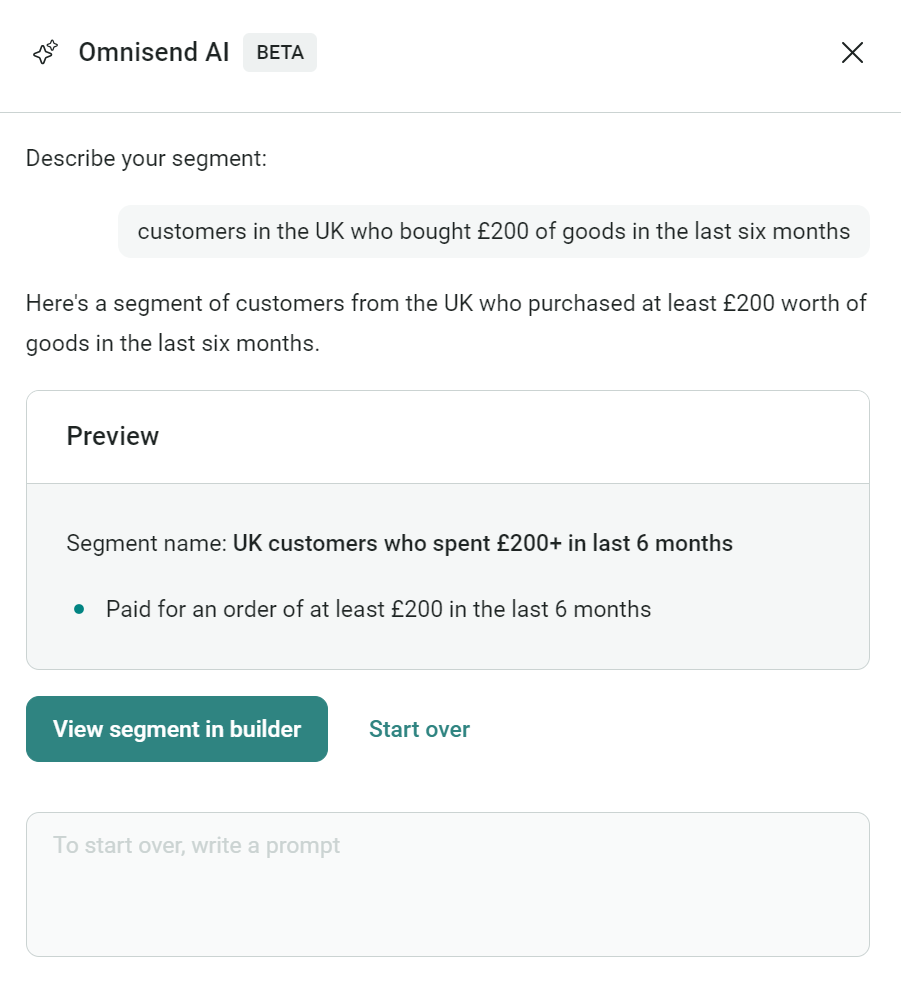
Also helpful are Omnisend’s built-in AI features. It’s crucial to say here that Mailchimp lags behind big time for AI. Not only does Omnisend let you generate subject lines and email content with AI, but its AI segment builder simplifies creating groups:
Key features
- Multichannel automations: Drag a text message and a web push notification into your email flows to reach your customers on their preferred channels or whichever is most appropriate at the time.
- Pre-built flows: There are 28 pre-built flows covering the most effective ecommerce automations, including back-in-stock, browse abandonment, welcome emails, and cart abandonment. In 2025, abandoned cart and welcome messages alone generated 76% of all orders from automations.
- Automation depth: It supports five trigger filters per workflow with event and segment-based triggers, split conditions, and paths.
- Standalone campaigns: Of course, automations aren’t the only messages you’ll send when BFCM and other events call for larger promotions. Omnisend lets you schedule or immediately send an email, SMS, or web push notification campaign.
- Segmentation: Customers who sign up will automatically enter segments, and those whose behavior and activities change will enter and exit segments without manual work. Use the 20+ pre-built segments or the AI segment builder to create them with prompts.
- A/B testing: Mailchimp doesn’t let you A/B test for free, Omnisend does. Plus, Omnisend’s A/B testing feature covers subject lines, email and SMS versions, and forms.
- Personalized content: Across all channels with your customer’s name. The email editor has a Products item to show best-selling, recently added, and most viewed products in your templates. If you’re a Pro plan customer, you can also show recently viewed and similar to past purchases products.
- Award-winning customer support: Via 24/7 live chat and email. It isn’t gated, it’s yours no matter your plan. Mailchimp restricts access to both after 30 days in its free plan.
Pricing
- Free Forever: Matches Mailchimp’s 250 contacts and 500 emails/month send limit, doesn’t restrict access to standard features
- Standard: $16/month for 500 contacts, a 6,000 emails/month send quota, unlimited web push notifications, and Forms AI (builds forms for you)
- Pro: $59/month for 2,500 contacts, unlimited email sends, bonus SMS credits equal to the price of your monthly plan, advanced reporting, and the personalized content add-on
Omnisend vs. Mailchimp
Omnisend is the best Mailchimp alternative if you’re an ecommerce store. It helps you reach customers at more high-intent moments across email and SMS and assists you in improving their experience and maximizing revenue and retention.
Mailchimp remains a good fit for small ecommerce stores and businesses that don’t intend to optimize and create highly personalized journeys.
The video below compares Mailchimp and Omnisend’s SMS marketing features:
Want to try Omnisend? Sign up for free here.
2. Brevo — best for B2C + B2B email marketing and CRM
G2 rating: 4.5/5 (2,599 reviews)
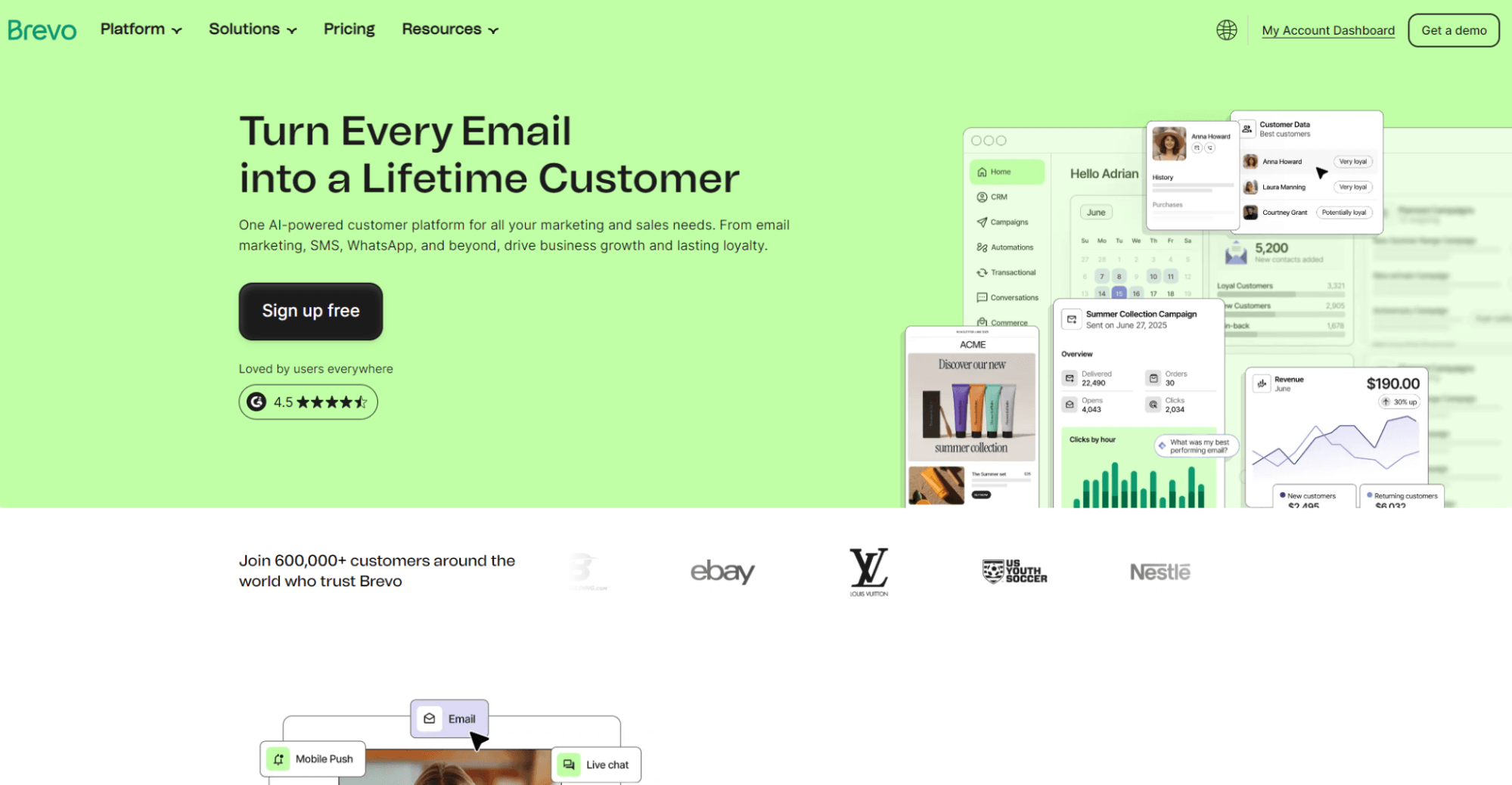
Put Brevo on your shortlist of Mailchimp alternatives if you sell to consumers and businesses and need a multichannel marketing and CRM tool.
Brevo’s standard CRM features include contact profiles with statistics for opens and clicks, company profiles, and deal pipelines. Pipelines are crucial if you have complex sales processes and need to see where each prospect sits in your marketing:
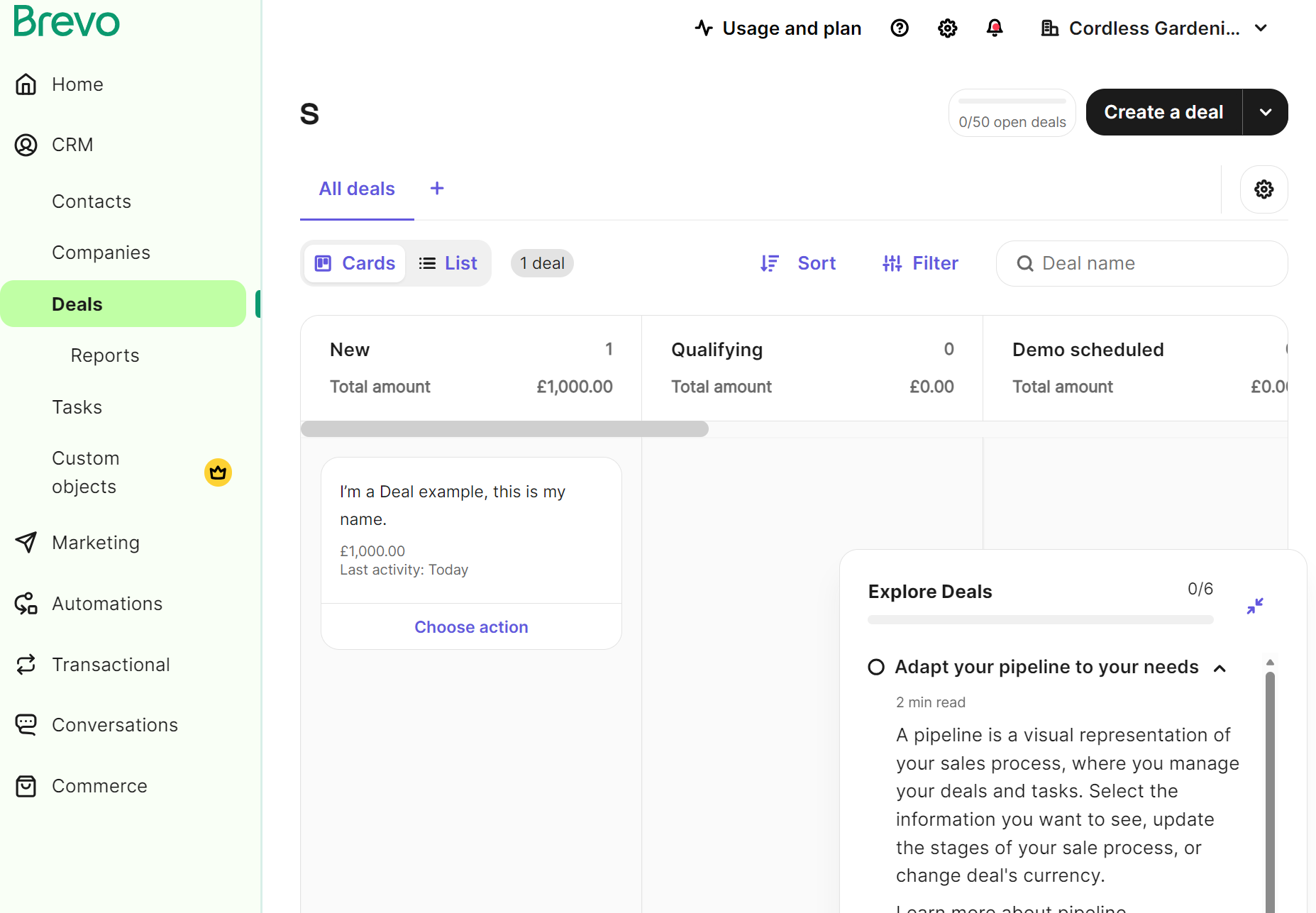
Of course, using Brevo’s CRM is entirely optional. Without it, it’s still a decent alternative to Mailchimp for email marketing with access to campaigns and Aura AI to draft content.
Key features
- More advanced automations: Brevo lets you add multiple entry points to flows and assign real-time event triggers to them. You can build more advanced automations than in Mailchimp, but not as granular as you can in Omnisend.
- SMS campaigns: A feature you can use in any Brevo plan. Remember, Mailchimp doesn’t include SMS unless you have a paid plan.
- AI and dynamic content: Brevo’s AI content generator and dynamic content features are available in all plans.
- Ads retargeting: Mailchimp restricts retargeting and lookalike audiences to its Standard plans and above. Brevo lets you use them for free.
- Transactional emails: Like Omnisend, Brevo lets you send transactional emails in all plans, whereas Mailchimp restricts them to its Standard plan.
Pricing
- Free: 300 emails/day, limited to 2,000 contacts
- Starter: $9/month, 100,000 emails/month to 2,000 contacts
- Standard: $18/month, send up to one million emails/month to unlimited contacts
- Professional: $499/month, for 10 million emails/month, adds phone support, and the analytics studio for enterprise
Brevo vs. Mailchimp
Brevo is one of our favorite cheaper alternatives to Mailchimp because it provides access to SMS and AI for free. However, there are some limitations, such as no popups unless you buy the expensive Professional plan (Mailchimp’s popups are available in all plans).
Mailchimp is less complicated than Brevo, and it handles the basics well, such as welcome emails and abandoned carts. Brevo’s CRM is something it can’t compete with, but again, it adds complexity. Weigh up if you need basic email, or more advanced email and CRM.
3. Sender — best for basic automations and high-volume sends
G2 rating: 4.7/5 (247 reviews)
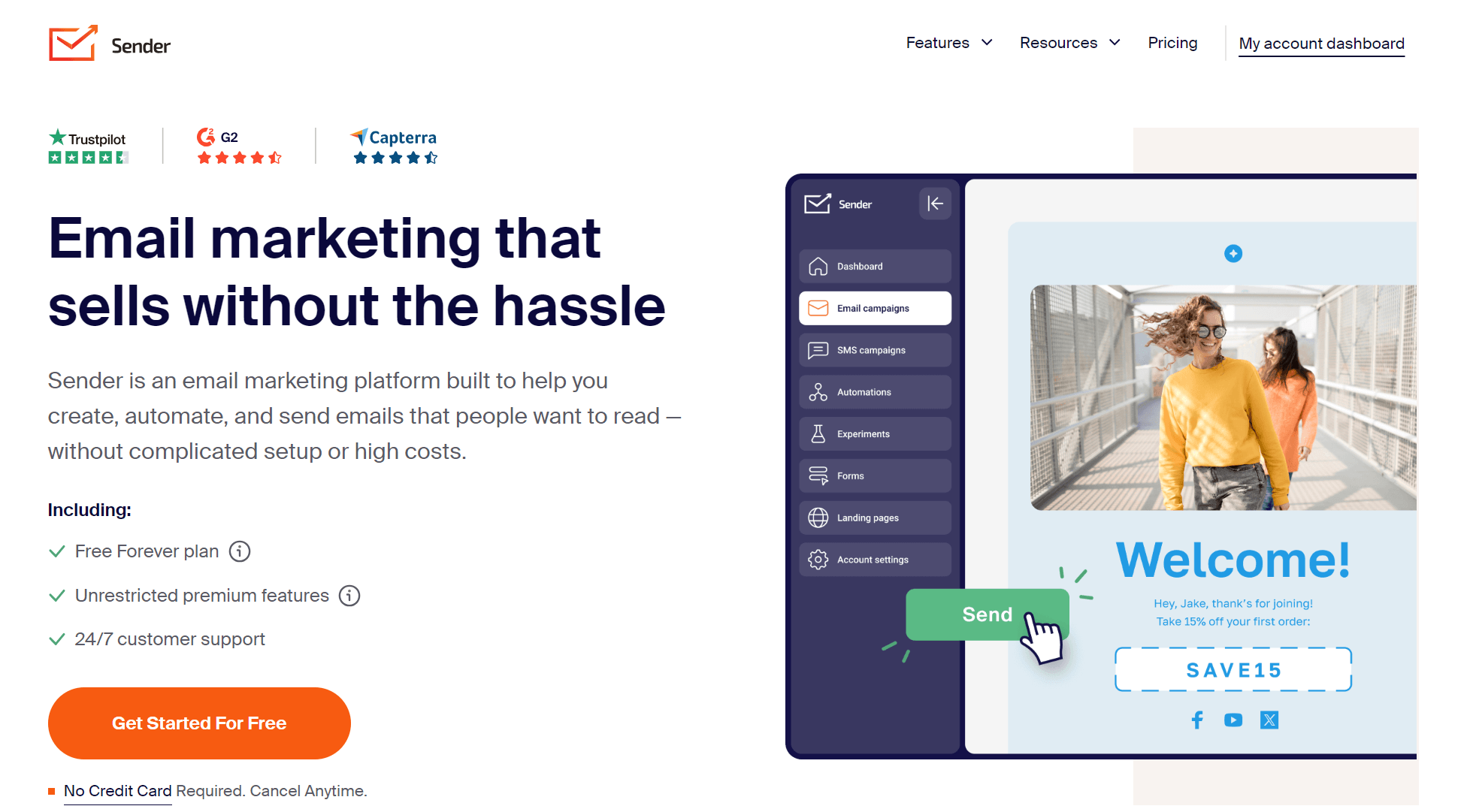
Sender is your top Mailchimp alternative if you want a lot for very little, thanks to its generous send and contact limits.
Where most tools either cap your sends or strip the features, Sender lets you send 15,000 emails a month to 2,500 contacts at $0. That’s not a trial. That’s its free plan, permanently, and it’s the most generous on our list.
What we like most is the lack of a learning curve. The dashboard is fantastic if you’re new to email marketing because it walks you through the next steps:
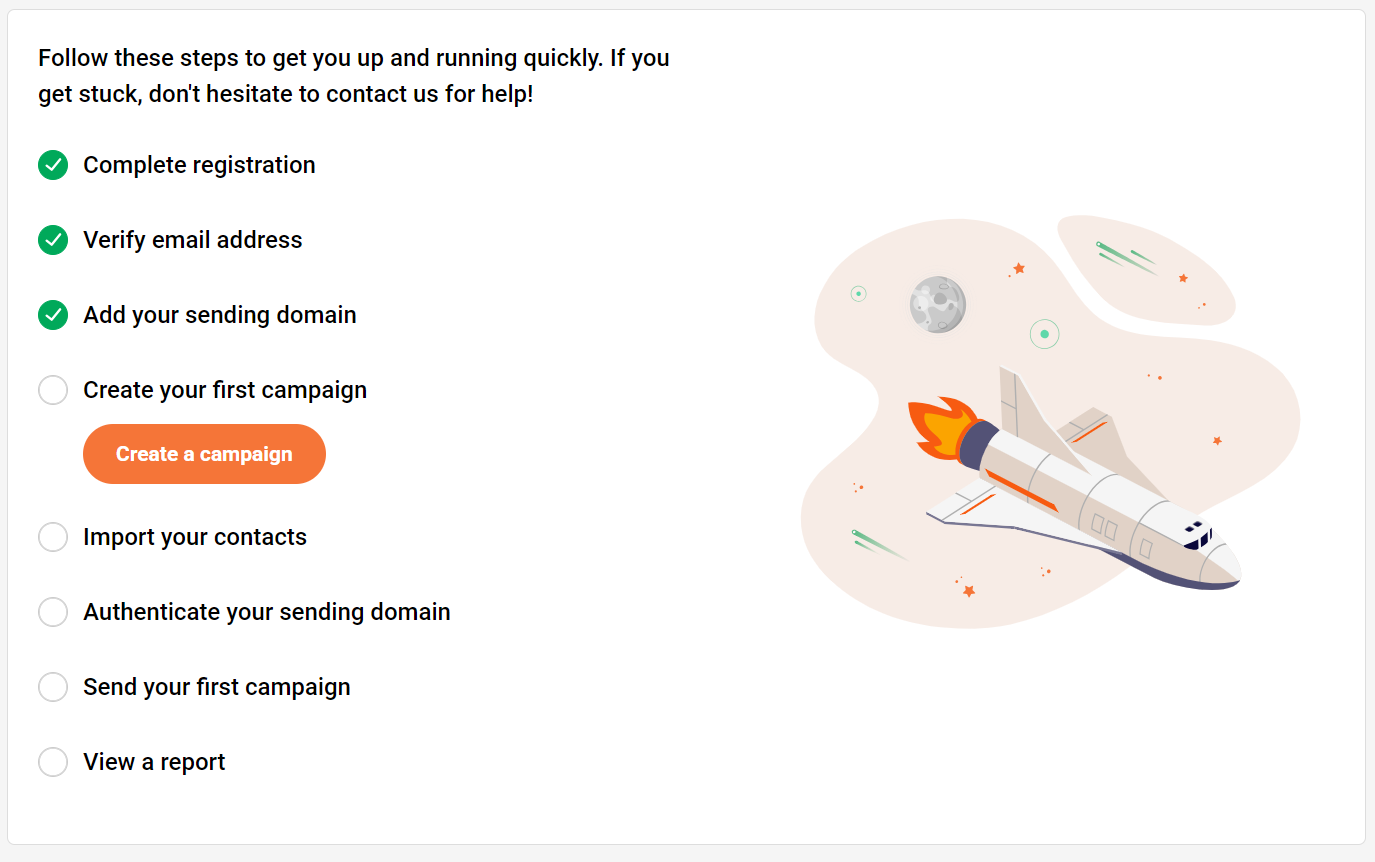
The sacrifice is no A/B testing or SMS unless you pay, and when you do pay, it doesn’t provide the same automation complexity as Omnisend. However, its pre-built flows and segments are a decent starting point if you’re a new store.
Key features
- Conditional branching in automations: Adding conditional branches with subscriber details and campaign activities ensures your flows trigger different messages for different customers.
- A/B splits inside workflows: If you’re not sure which subject line or email version to deliver, you can test them and find the winner.
- Automatic list management: Action steps let workflows move, copy, or remove subscribers between groups and update custom fields without any manual intervention after the trigger fires.
- Plain text and HTML email steps: Each email step in the builder lets you choose between drag-and-drop, plain text, or custom HTML.
- SMS steps in the same workflow: Text messages slot into automations alongside email steps, no separate SMS tool or duplicate setup required.
Pricing
- Free Forever: As above, 15,000 email quota/month for 2,500 subscribers
- Standard: $10/month, reduces the email send limit to 12,000/month and the contact limit to 1,000 in return for more features (it’s $19/month to get that 2,500 contact limit back)
- Professional: $20/month for 1,000 contacts and a 24,000 send limit, supports 10 user seats, and bundles in SMS credits equal to the price of your plan
Sender vs. Mailchimp
Sender changes the value game with significantly higher send and contact limits than Mailchimp for less. You could spend nothing and still automate your customer journey, build your list, and monitor performance without as steep a learning curve.
Mailchimp’s value here is in its more advanced features at higher plan levels, such as purchase likelihood and premium migration services.
4. MailerLite — best for high-volume, low-cost sends
G2 rating: 4.6/5 (1,092 reviews)
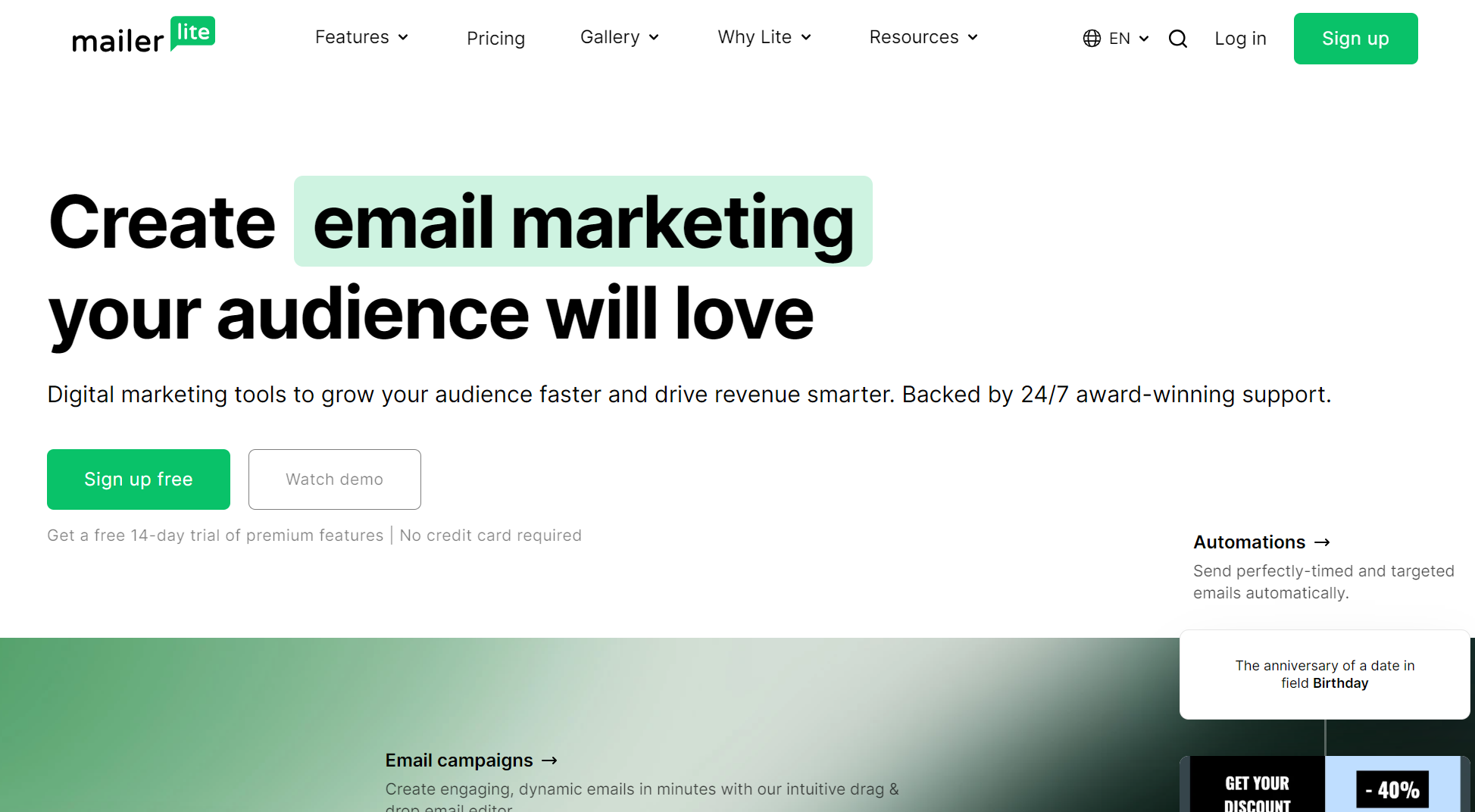
MailerLite’s value ratio is fantastic if you want to send in bulk or handle thousands of campaigns. For the same $10/month as Sender, you get unlimited emails versus 12,000.
Mailchimp lacks value in comparison, and although MailerLite lacks SMS marketing capabilities, it brings the ability to sell digital products to your arsenal.
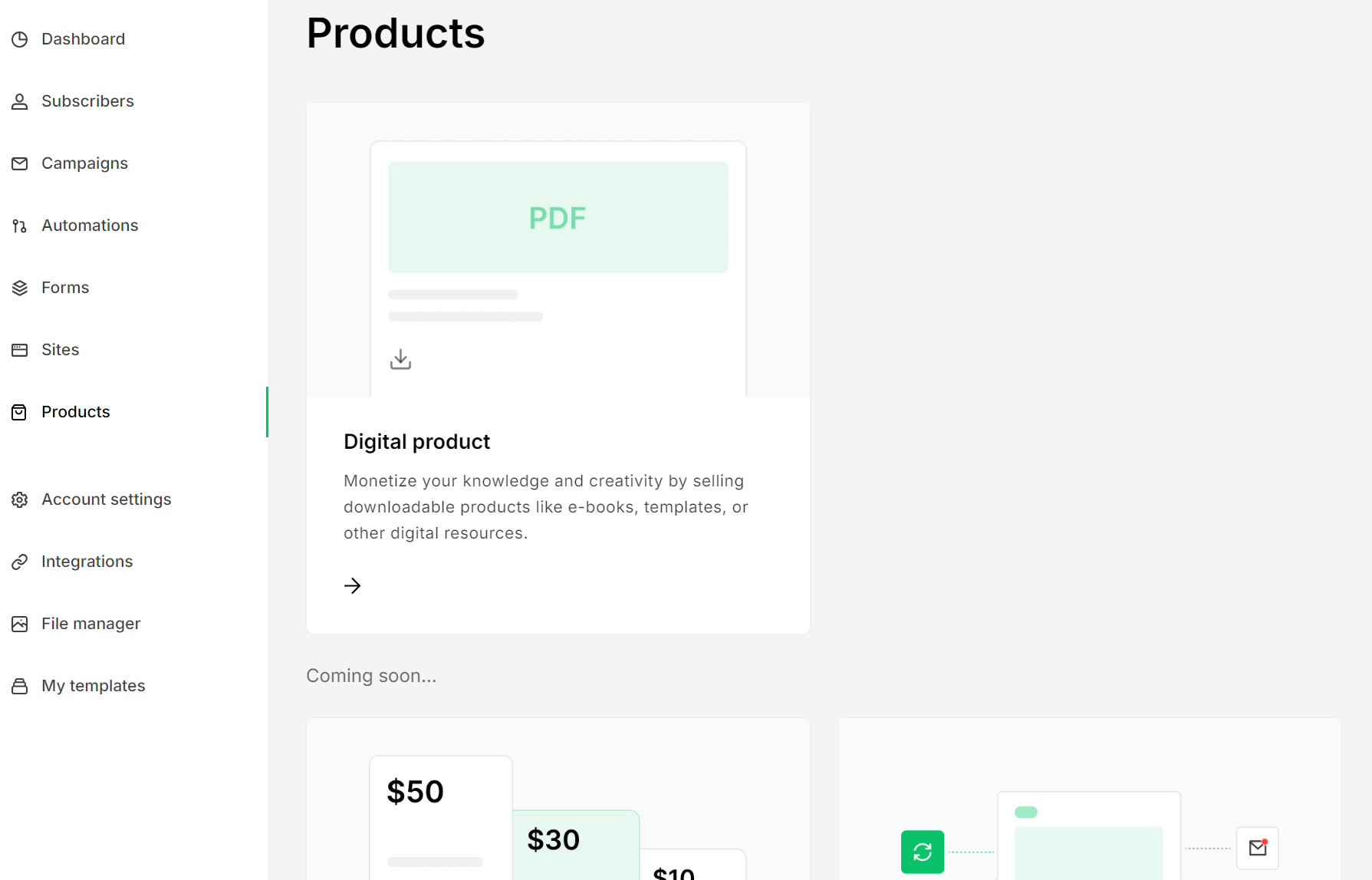
In fact, our favorite MailerLite feature is the recently-added Products tab in the sidebar, which provides fast access to creating digital products and other coming soon formats:
Key features
- Generous send limits: You’re looking at monthly quotas of 12,000 emails for free, and all paid plans get unlimited email sends.
- It lets you earn money alongside sending emails: As mentioned above, you can create digital products in MailerLite and sell them on landing pages, with Stripe connection handling the payments.
- Automates your customer experience: And that extends into the ecommerce angle. If you create a welcome email, an abandoned cart message, and a review request, those serve the customers who purchased through your landing pages.
- Reports on what you need to know: You’ll see your unsubscribes, spam complaints, bounces, opens, and click-throughs. If you want, you can also integrate ChatGPT via the MailerLite MCP server and ask it to explain your data.
- Available customer support (albeit per plan): Only available for up to 14 days on the free plan and always available with the Advanced plan. The Growing Business plan (MailerLite’s cheapest paid plan) offers email support.
Pricing
- Free: For 500 subscribers, gives you a 12,000/month email limit
- Growing Business: $10/month for 500 subscribers, unlimited sends, and several ecommerce-crucial features, such as multivariate testing and campaign auto-resend
- Advanced: $20/month for the same subscriber count, lets you customize emails in HTML and use promotional popups for list building
MailerLite vs. Mailchimp
MailerLite’s send limits outstrip Mailchimp’s by some margin, so it’s a top alternative if you’re sending in bulk to a small contact list. It also beats Mailchimp if you’re a digital product seller and fancy one email tool + ecommerce solution.
Mailchimp is better than MailerLite if you send infrequently to a small list and want more pre-built automations and integrations for your tech stack.
5. HubSpot — best for free campaign tools and CRM features
G2 rating: 4.4/5 (based on 14,521 reviews)
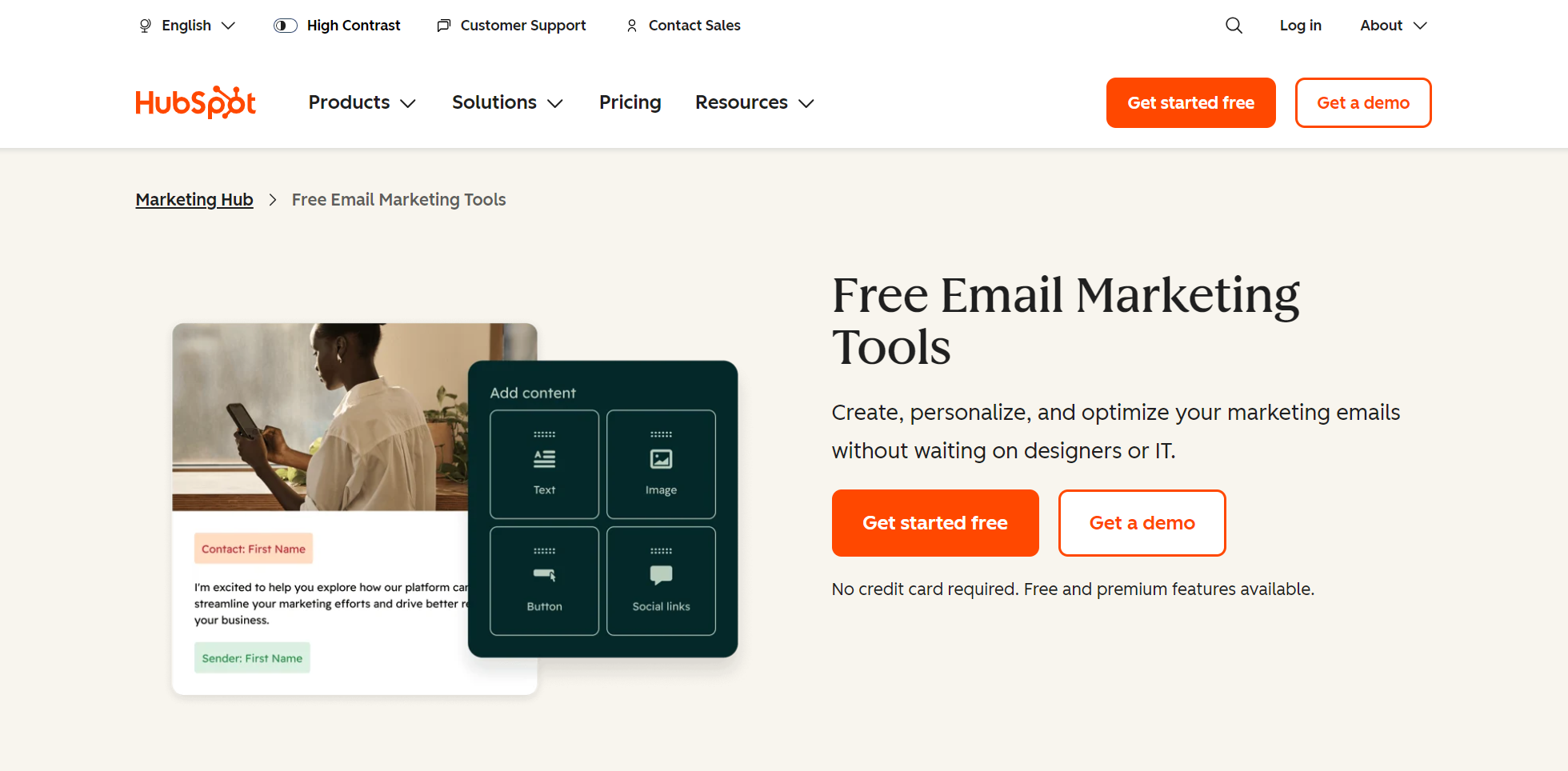
HubSpot is the Mailchimp alternative to pick if you need your email activity to feed directly into a sales pipeline and contact records automatically. Of course, it also makes sense if you’re already using HubSpot’s CRM features.
Its free plan covers email campaigns, forms, landing pages, and CRM contact management, with every open, click, and form submission logging against a contact.
Our last point about contact records is what you’re really paying for here. Not email features, but visibility into how individual people move through your funnel over time:
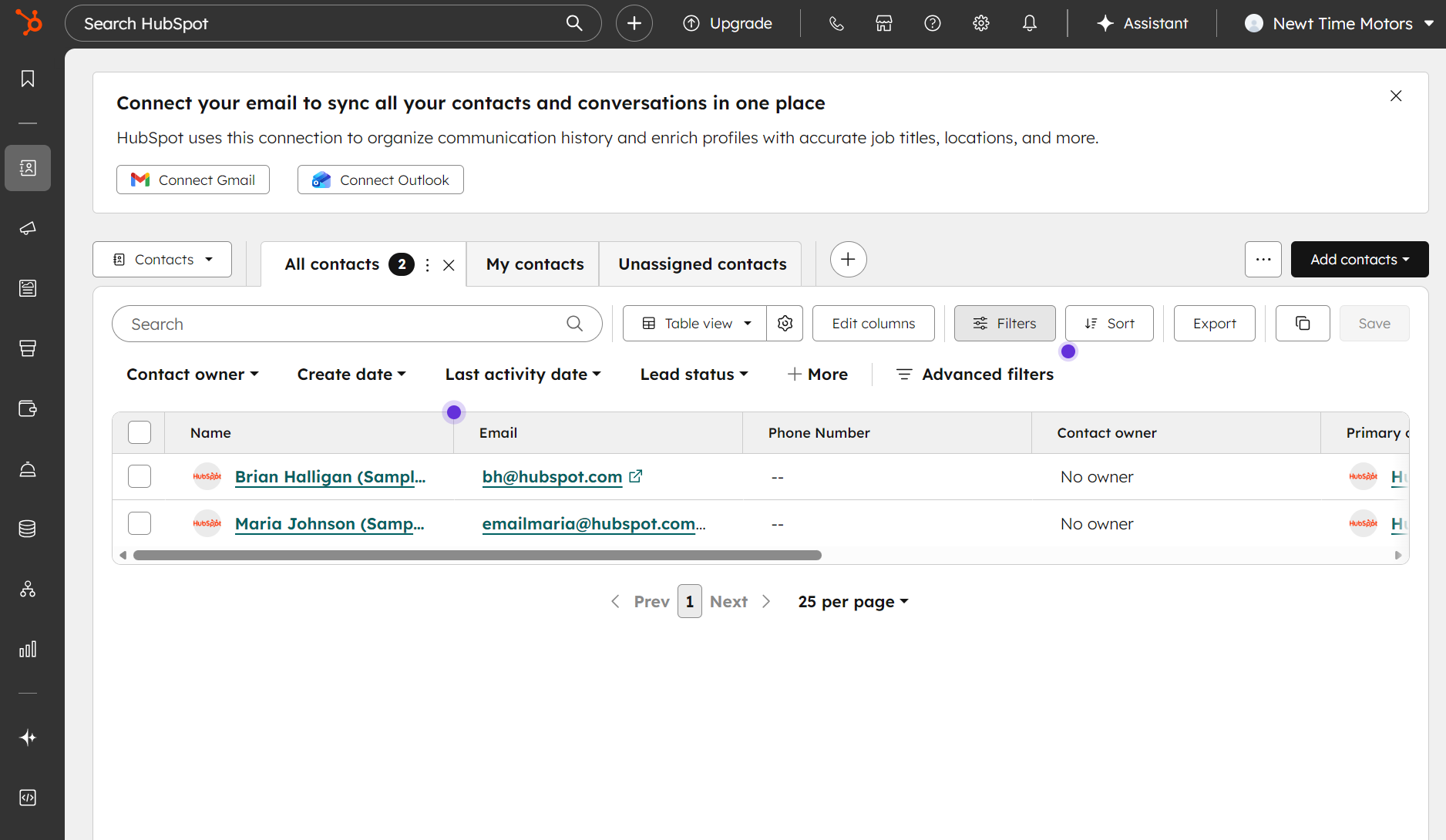
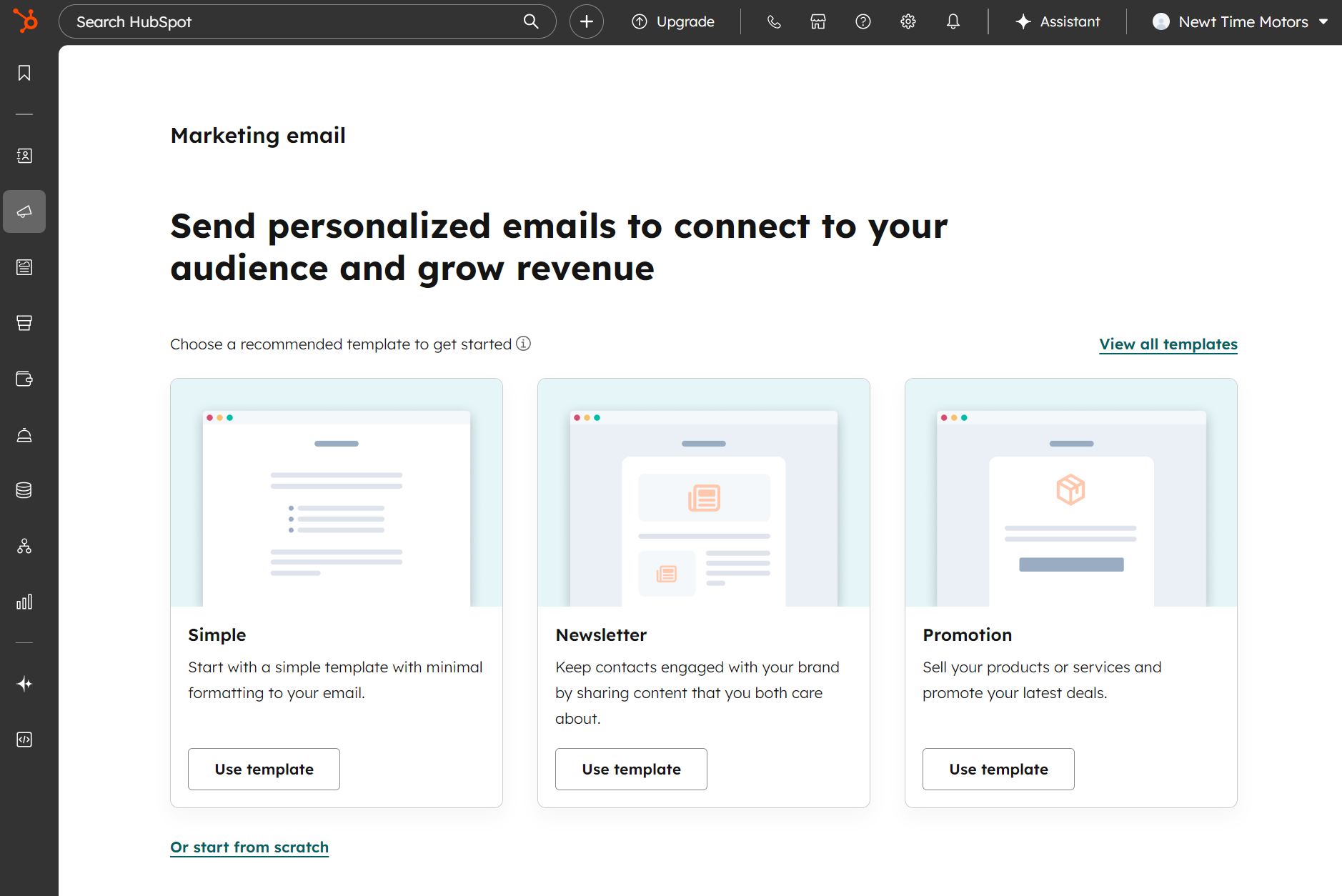
Despite its focus on CRM features, HubSpot’s email marketing capabilities are decent enough for small to mid-sized ecommerce stores. We like how the dashboard gets us started with creating an email immediately:
Key features
- Workflow triggers that use contact behavior: Your automations, such as welcome emails, can respond to opens, clicks, and bounces, and trigger different messages for non-openers than clickers.
- Contact timeline: Extremely useful if you have lengthy sales processes because it logs email interactions against an individual record, so you can see what they last received before picking up the phone.
- AI writing tools: Rather than write yourself or use a chatbot, basically. They work well and extend to subject lines.
- A/B testing tied to revenue: Test subject lines and content with results connected to contact and deal data, not just open rates and other email marketing metrics.
- 2,000+ integrations: More than any other tool on this list, including Gmail, Shopify, Salesforce, LinkedIn, and Jira.
Pricing
- Free: Gives you access to basic marketing and CRM tools
- Starter: €15/month/seat with support for 1,000 marketing contacts
- Professional: €899/month, a massive leap but provides access to significantly more of HubSpot’s ecosystem
HubSpot vs. Mailchimp
With Mailchimp, you see how a campaign performed. With HubSpot, you see how each person responded to it, what they clicked, what they ignored, and where they are in your pipeline.
That contact-level visibility is what you’re paying for, and on the free plan, you get it without spending anything. Mailchimp is the better fit if you have no sales team and no need to tie email activity to individual customer records.
6. AWeber — best for email marketing with built-in ecommerce
G2 rating: 4.2/5 (647 reviews)
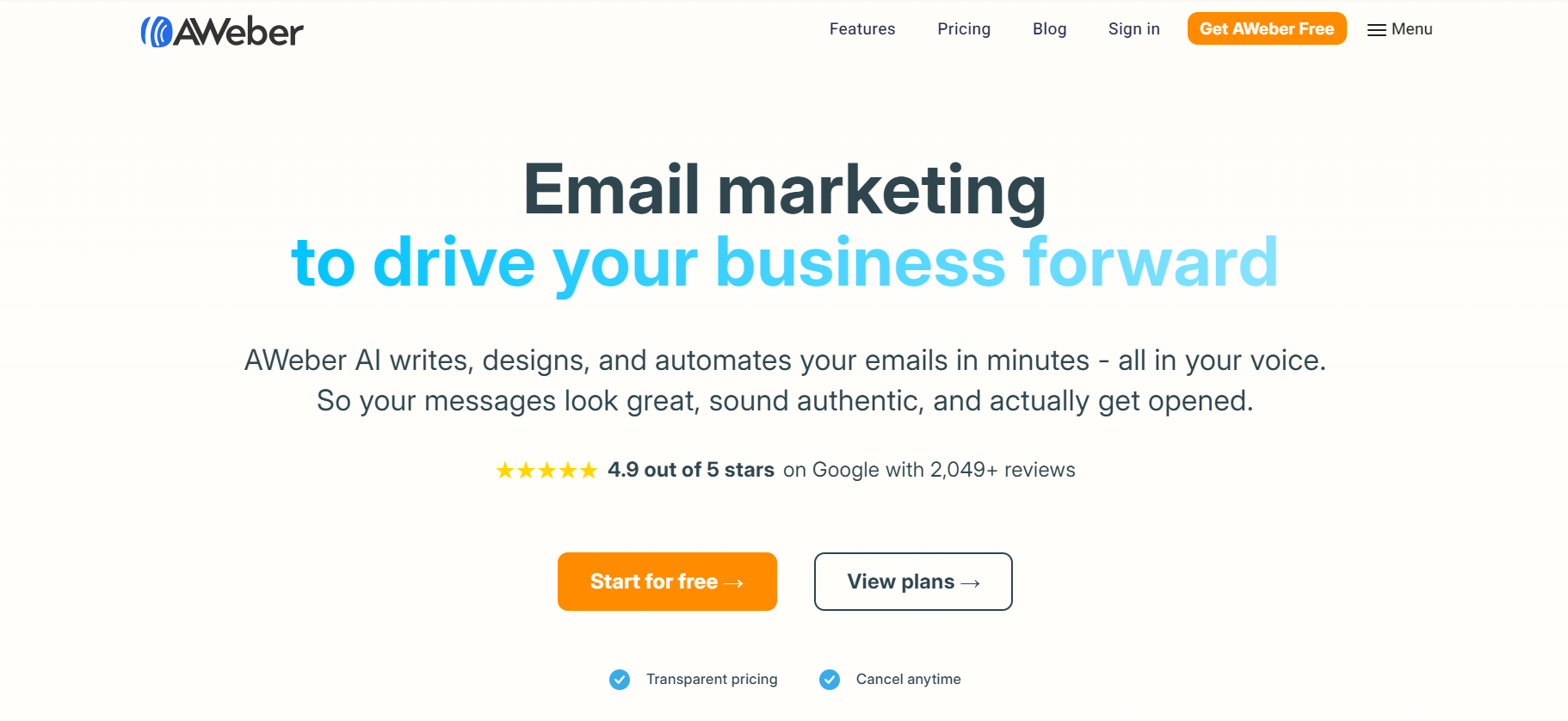
AWeber brings selling capabilities to your emails and landing pages and lets you build complete customer journeys that nurture and generate revenue.
Its landing page templates are more modern than Mailchimp’s, and you can buy and connect domains directly in AWeber. Digital product sales can occur within AWeber via Stripe, letting you sell without Shopify or another platform.
Email automation and segmentation are well-covered here, with your small or mid-sized store able to create sequences and manage customers effectively.
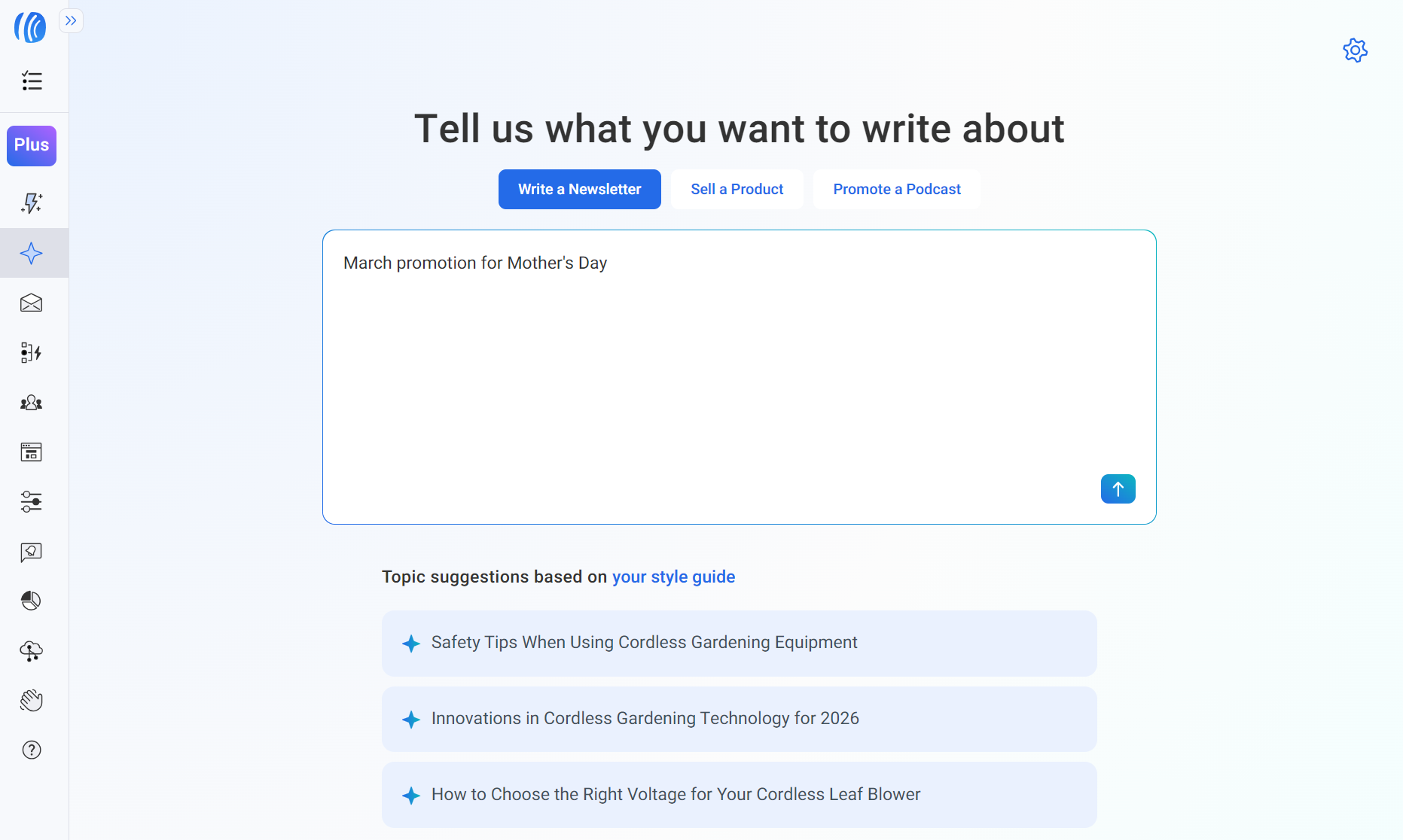
We particularly like the AI newsletter feature, which analyzes your store and pulls its branding to create newsletters based on whatever theme you input:
Key features
- AWeber Ecommerce: For one-off and recurring payments, the transaction fees range from 0.6% to 1%, depending on your plan.
- AMP emails: Add image carousels and polls inside the email itself, so recipients interact without clicking through to a separate page.
- 600+ templates: More than any other tool on this list, with reusable content blocks and a drag-and-drop editor with HTML access.
- Behavioral automation triggers: Tag changes and purchase activity start workflows automatically, so a completed sale rolls straight into a post-purchase sequence.
- Done For You setup: Pay a one-time $79 fee, and AWeber’s team builds your template, landing page, and form, and delivers weekly newsletter drafts alongside it.
- Phone support on all plans: In addition to email and live chat, with priority support if you’re a Plus plan customer.
Pricing
- Free: 500 subscribers, 3,000 emails/month, access to all email design tools
- Lite: $15/month for 500 subscribers and a 10x contact send limit, it adds advanced message analytics and lets you add three users, but it only lets you build three flows and three landing pages (making Plus the only plan suitable for most)
- Plus: This one’s $30/month for 500 subscribers, it lets you build unlimited email lists, landing pages, automations, and segments
AWeber vs. Mailchimp
AWeber covers ground Mailchimp doesn’t, such as native product sales, recurring payments, AMP emails, and phone support, but you will pay massively for it. $30/month is the minimum spend to access all its features.
Mailchimp is the better pick if you need a broad integration library and straightforward campaigns. It’s cheaper and covers the basics.
7. Constant Contact — best for bringing events, email, and social media management together
G2 rating: 4.1/5 (7,253 reviews)
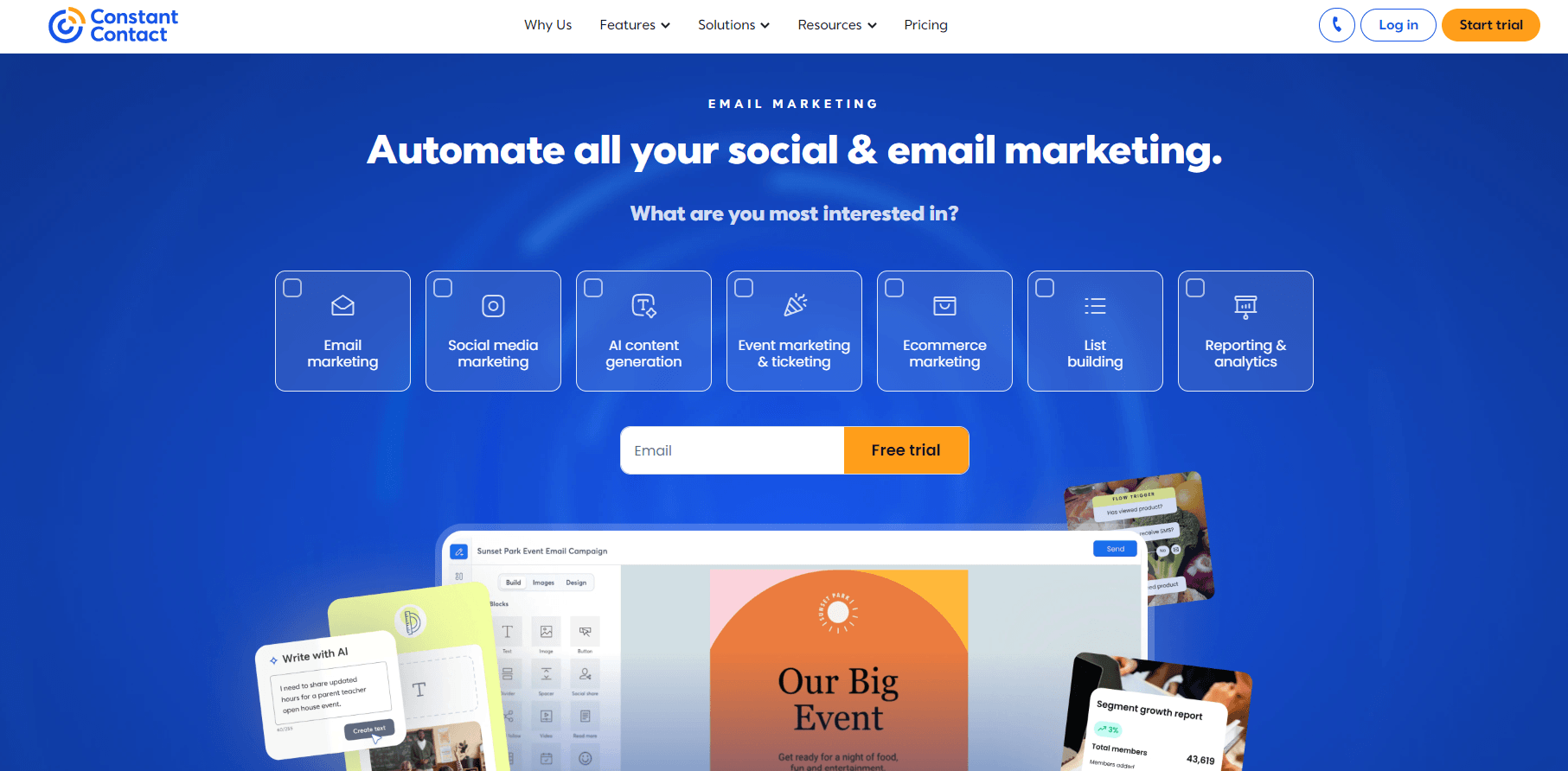
Constant Contact’s a fantastic Mailchimp alternative if social media is as important to your marketing as email.
It schedules and posts to Facebook, Instagram, and LinkedIn from the same dashboard you use to send campaigns, which removes the need for a separate social tool at this price point.
It’s been around since 1996, and that experience shows in the deliverability. Constant Contact publishes its rate openly at 97%, something most tools on this list won’t do.
Key features
- Social posting and scheduling: Post and schedule content across Facebook, Instagram, and LinkedIn from inside the platform, with short video support and social reporting included from the Standard plan.
- AI campaign builder: Available on Standard and above, it builds automations based on your goal rather than requiring you to construct flows manually.
- Automatic resend to non-openers: Campaigns resend to contacts who didn’t open the first time with a different subject line, without setting it up as a separate send.
- Handles your events: You can host events and sell products, plus collect payments and link these to your welcome sequences
- 300 integrations: Covers most requirements, including Google, Canva, Shopify, Eventbrite, Video, and many more.
Pricing
- Lite: $12/month for 500 contacts, the downside is it limits you to one user and one automation template, making Standard the first plan worth serious consideration
- Standard: Bumps your price by over double to $35/month in return for three users, post scheduling, advanced reporting, non-opener resend, and three automation templates
- Premium: It’ll cost you $80/month and increase your user limit to unlimited, plus it bundles in 500 SMS messages
Constant Contact vs. Mailchimp
Constant Contact is better than Mailchimp for events and email tools that connect and create unique customer touchpoints. Also, being able to manage your social media alongside email is another fantastic feature that Mailchimp lacks.
However, Constant Contact does restrict your capabilities below its Premium plan, and it isn’t as suitable for ecommerce as Mailchimp.
8. Campaign Monitor — best for AI-first email automation
G2 rating: 4.1/5 (717 reviews)
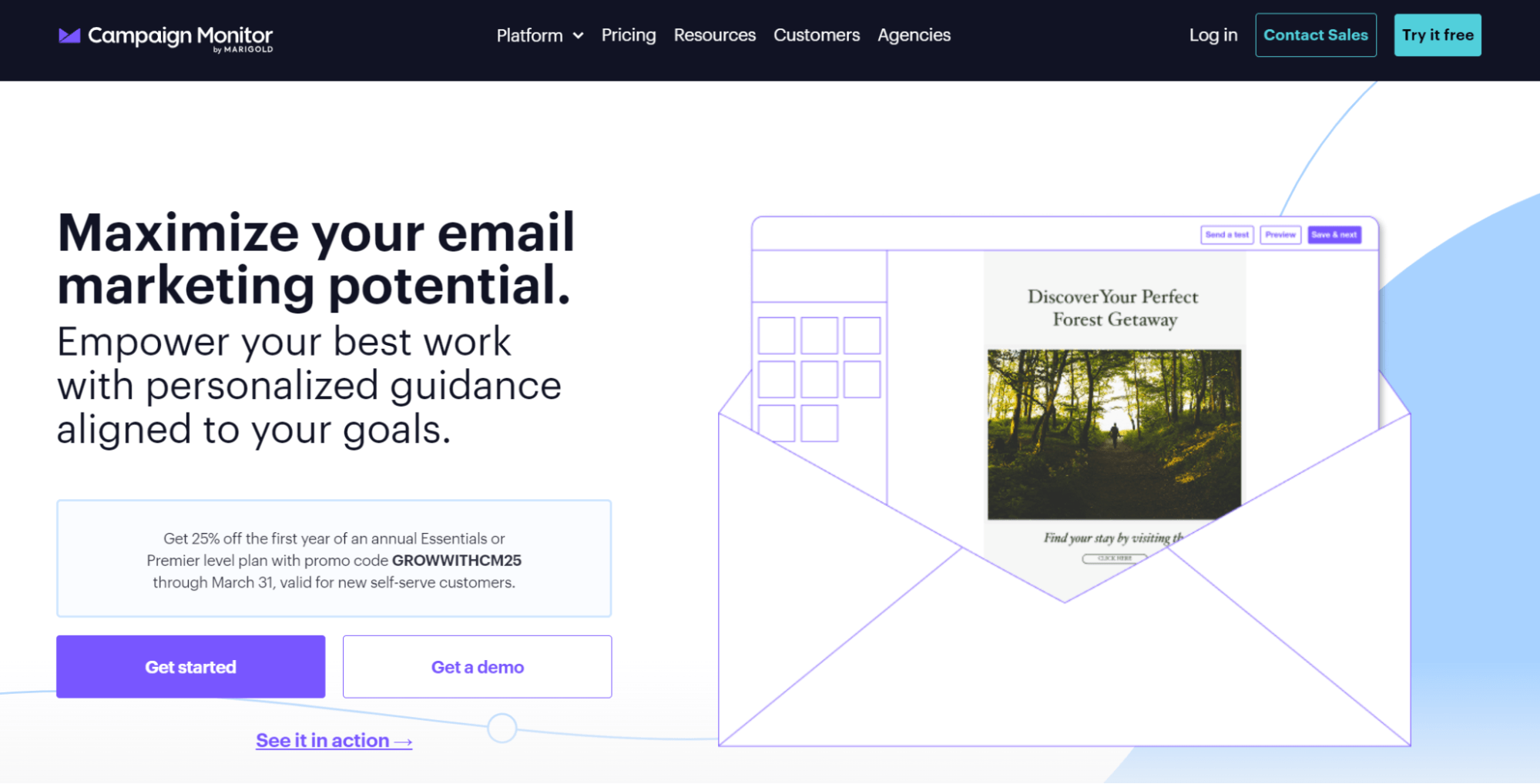
Campaign Monitor works well as an alternative to Mailchimp when you want AI working on your campaigns rather than just generating content for them.
The Segment Mapper builds audiences from plain language prompts, the Email Booster scores campaigns before they go out, and Marketing Monitor flags performance problems without you having to find them yourself.
If you manage email for multiple brands, the agency features are worth noting, with private labelling, dashboards, and template sharing built in rather than available as expensive add-ons.
Key features
- 100+ email templates: They’re of good quality and easily editable using drag-and-drop. The Lite plan supports custom HTML templates. Also useful for email design is the image gallery with two million+ images you can use.
- Pre-built journeys: Ready-made automation sequences covering the standard triggers, editable without building flows from scratch.
- Send time optimization: On the Premier plan, each contact gets their own optimal send window based on their historical engagement, rather than your whole list receiving the email at the same time.
- Non-human click filter: Campaign Monitor strips out bots so that your campaign numbers accurately reflect people, not crawlers.
- Website builder: A new feature that lets you create websites and manage them within your Campaign Monitor account.
Pricing
- Free: Cheekily, this is not a free plan; it’s a 30-day trial for 500 contacts and 500 sends
- Lite: $12/month, but the 5x monthly send cap makes it impractical for anyone emailing their list more than a handful of times a month
- Essentials: $29/month with unlimited sends and the full AI toolkit, which is where most users will land
- Premier: $159/month, the website builder is included here after costing $10/month extra on the two plans below it
Campaign Monitor vs. Mailchimp
Mailchimp’s AI writes, but Campaign Monitor reads, scores, and flags what’s wrong before you send. If you’re investing in AI to improve results rather than save time, that’s the tool to be on.
Mailchimp is a better pick if you want a traditional email marketing tool with basic flows and the ability to segment your audience without fuss.
9. Moosend — best for getting the most features per dollar
G2 rating: 4.7/5 (730 reviews)
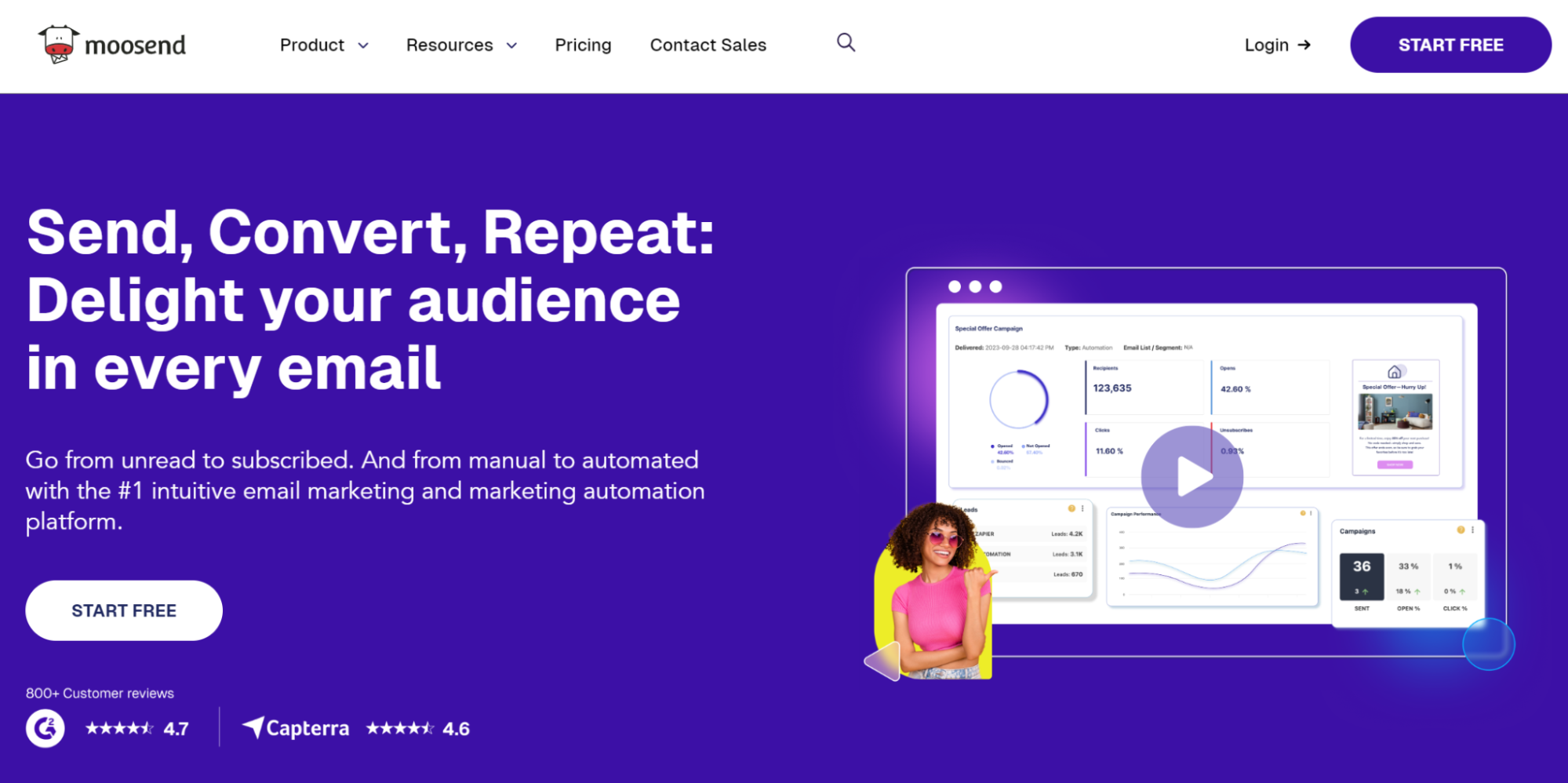
We recommend Moosend as a Mailchimp alternative when you want a capable entry-level plan without paying mid-tier prices.
At $9/month, Pro includes unlimited sends, the full automation builder, landing pages, heatmaps, AI product recommendations, and predicted weather analytics.
The feature ladder kicks in above Pro. Browse and product view triggers, audience discovery, and transactional emails all require Moosend+ or Enterprise, which have custom prices, so in this respect, Mailchimp has more transparency.
Key features
- Predicted weather analytics: Tracks forecast data against contact locations and factors it into send timing, something no other tool on this list offers
- AI product recommendations: Your customers’ browsing history and product preferences dictate the products they see in emails
- Conditional visibility content: If you feed in enough contact data, such as the categories they purchase in, you can exclude certain sections from email templates
- Spam analysis and testing: When you create a campaign, Moosend will push it through internal filters to see if inbox providers are likely to flag it
- Email heatmaps: Shows where contacts click inside emails, included on all paid plans.
Pricing
- Free trial: 30 days, 1,000 contacts, unlimited sends, but automation is limited to one published workflow, and forms and landing pages are unpublished only
- Pro: $9/month for 500 contacts, unlimited sends, full automation builder, landing pages, and heatmaps, browse and product triggers not included.
- Moosend+: You’ll have to contact Moosend for pricing, it’s effectively the Pro plan but with transactional email, dedicated IPs, and hosted files
Moosend vs. Mailchimp
At $9/month, Moosend includes automation, landing pages, heatmaps, and AI tools that Mailchimp reserves for higher tiers.
The integration library is narrower at 80+, and transactional emails require a custom plan, but for stores that don’t need behavioral site triggers, the value at Pro is difficult to match.
10. Kit — best for content and newsletter monetization
G2 rating: 4.4/5 (218 reviews)
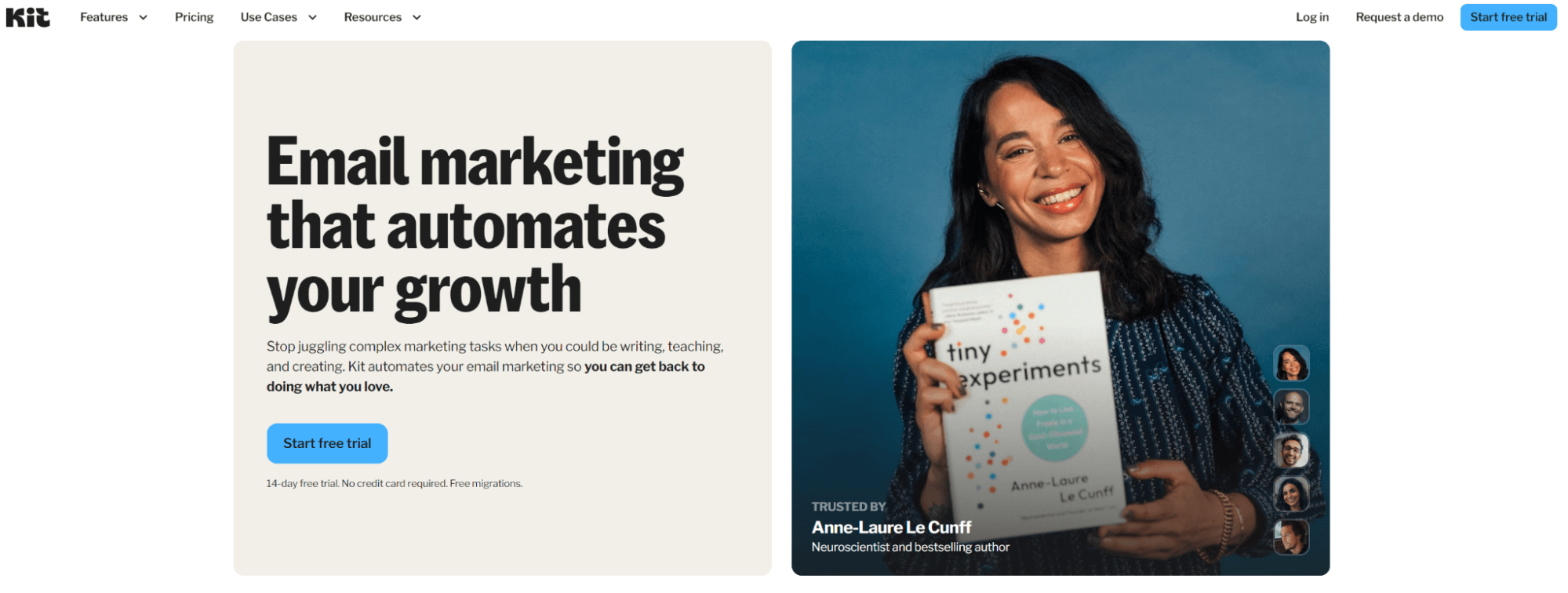
Kit is the tool for you if you have an audience and want to make money from it directly. Selling digital products, paid subscriptions, and recommendations are built into it rather than handled through a separate tool.
Although Kit pitches its email marketing and automation as general tools any business can use, it lacks the ecommerce focus of Mailchimp and is best for creatives. For instance, if you have a blog, magazine, or podcast, then Kit works.
The free plan lets you build landing pages and send unlimited email broadcasts to 10,000 people. To sell to them, you don’t need anything else, although the Creator plan lets you get paid to promote others and send RSS campaigns.
Key features
- Newsletter feed and website: The mini website and newsletter feed you build can sync with similar branding to create a cohesive customer experience.
- Landing pages: Unlimited builds across all plans is the headline, but equally impressive is the template quality. They require minimal editing and can get you selling fast.
- Sell digital products and content: One-off sales and subscriptions, or sell other people’s products and get paid for that.
- Automated email sequences: They’re perfectly fine for a welcome series and newsletters, and can link to your customers’ actions, such as purchases.
- Content ecosystem: Kit provides 30+ email templates, an image library linked to Unsplash, and lets you build unique templates with HTML and CSS.
Pricing
- Newsletter: Kit’s free plan, good for 1,000 subscribers and unlimited email sends
- Creator: Has the same contact limit as the Newsletter plan, costs $33/month in return for unlimited visual automations, email sequences, and A/B testing
- Pro: $66/month, the best choice if you have a team since it lets you add unlimited users and provides deliverability reporting
Kit vs. Mailchimp
Pick Kit if you create content and want to earn from it. That could be a newsletter, digital subscription, podcast, or blog access. You can not only earn from your own stuff, but also refer people to other creators and get paid for it.
Mailchimp does not let you build an audience or earn revenue in the same way, but it is a better fit if you sell physical products.
Free alternatives to Mailchimp: What’s actually available
There are several top-tier alternatives to Mailchimp. Some restrict access to features (like Mailchimp), and some have more generous send and contact limits. These are the best ones:
- Omnisend’s Free Forever plan matches Mailchimp’s contact/send limit and gives you access to all automations, behavioral targeting, email scheduling, generative AI, and 24/7 live chat support (Mailchimp’s free plan offers none of these).
- Sender. Provides a truly generous 15,000 monthly send limit for 2,500 contacts. Unlike Mailchimp, it includes basic automations and transactional emails. Falls short of Omnisend’s features, with no A/B testing or SMS.
- MailerLite. 12,000 emails/month for 500 subscribers, with access to automations and comparative reporting. Doesn’t have campaign auto-resend or popups.
- AWeber. The free plan’s good for 500 contacts and 5,000 emails/month. You can create one list profile and one workflow automation or autoresponder campaign, but can’t save custom segments or split test emails.
- Kit. Not a traditional email marketing tool, but a publishing platform and email tool that lets you add 10,000 subscribers and send unlimited email broadcasts. However, you can only build one visual automation.
- Brevo. Among the best free Mailchimp alternatives for sending lots of daily emails. The 300 emails/day limit also includes a 3,000 contact limit. Lacks reusable content sections and content feeds for things like best-sellers.
Migrating from Mailchimp
Migrating is low-risk and won’t interrupt your email marketing efforts, provided you keep your Mailchimp account active and connected to your store.
There are then four factors to consider when migrating to Mailchimp alternatives:
- The first is how to import your data from Mailchimp into your new tool. Some tools make it easier than others via API, which auto-imports subscribers, custom data, and tags, but not templates, forms, or automations (these require rebuilds).
- Second, how to connect your new tool to your ecommerce store. Again, this will import customers, orders, and products. The best Mailchimp alternatives have apps for the likes of Shopify and Wix to make it easy.
- Third, to build on the end of our first point, how easy is it to rebuild what you have in Mailchimp? You will need to create flows and rebuild your popups and other elements to recreate your customer experience.
- Last but not least, migration. Do you need assistance? Omnisend offers 24/7 live chat with migration support. It helps you create the optimal setup, and it’s one of the reasons why customers achieved an average $79 ROI for every $1 spent in 2025.
Migrating Mailchimp to Omnisend
Rest assured that migrating to Omnisend is highly automated. An hour of your time to set up syncing is all you’ll need, after which you can start exploring and building your flows, forms, and other elements. Follow these steps to start:
Ecommerce connection
1. Log in to your ecommerce platform and search for the Omnisend app. Here are a few quick links for them — Shopify, WooCommerce, Wix, BigCommerce
2. Follow the steps to create your Omnisend account and complete the connection to your ecommerce store.
Mailchimp connection
3. Log in to Mailchimp to generate an API key, follow these steps:
a. Click the profile icon, click Profile
b. Click Extras
c. Choose API keys
d. Click Create A Key, name it
e. Click Generate Key, copy it
4. Head back to Omnisend and go to Audience > Contacts > click Add or update contacts and select the option for Mailchimp:
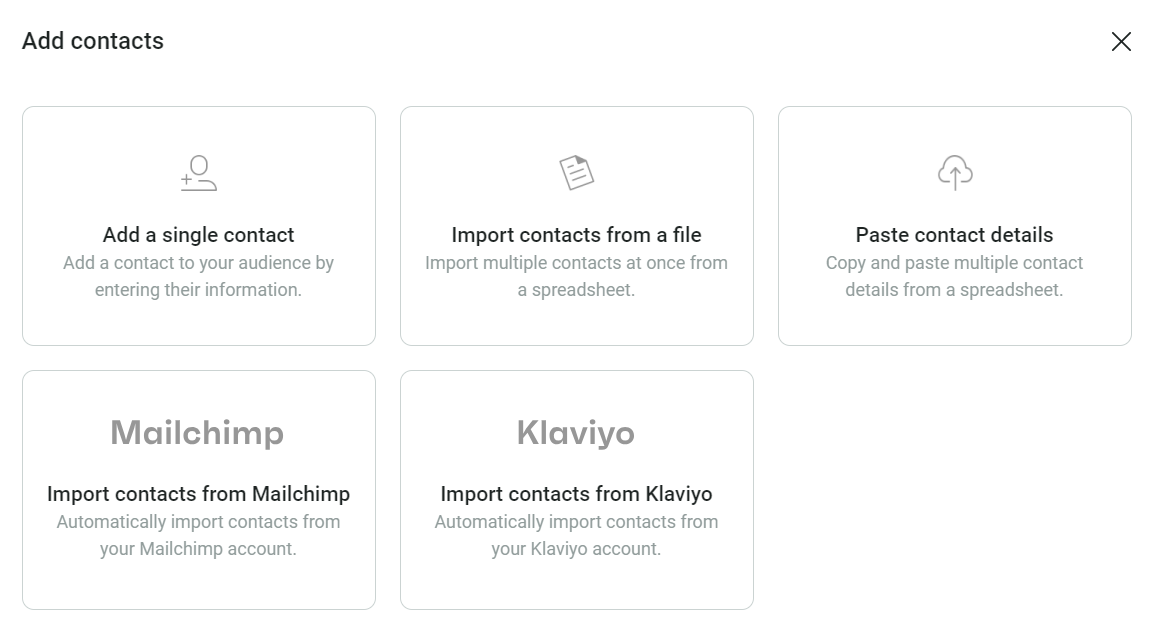
5. Select Connect now
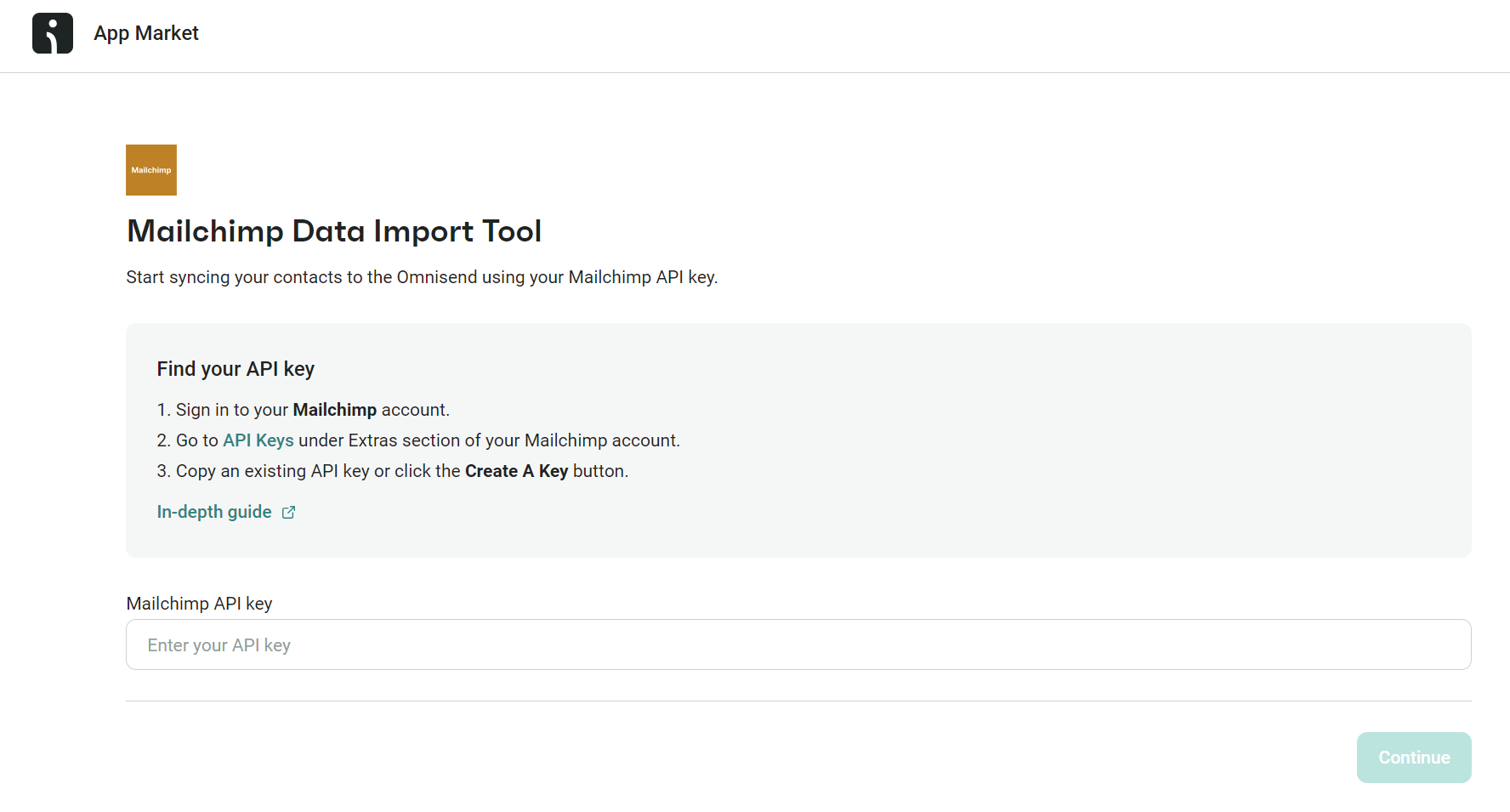
6. Enter your Mailchimp API key to import your data. Your contacts, custom data, and tags will import into Omnisend automatically:
Recreating your elements
7. For campaigns:
a. Head to Campaigns > click Create campaign
b. Select your campaign type and input your settings
c. For emails, then click Choose email template and browse the library:
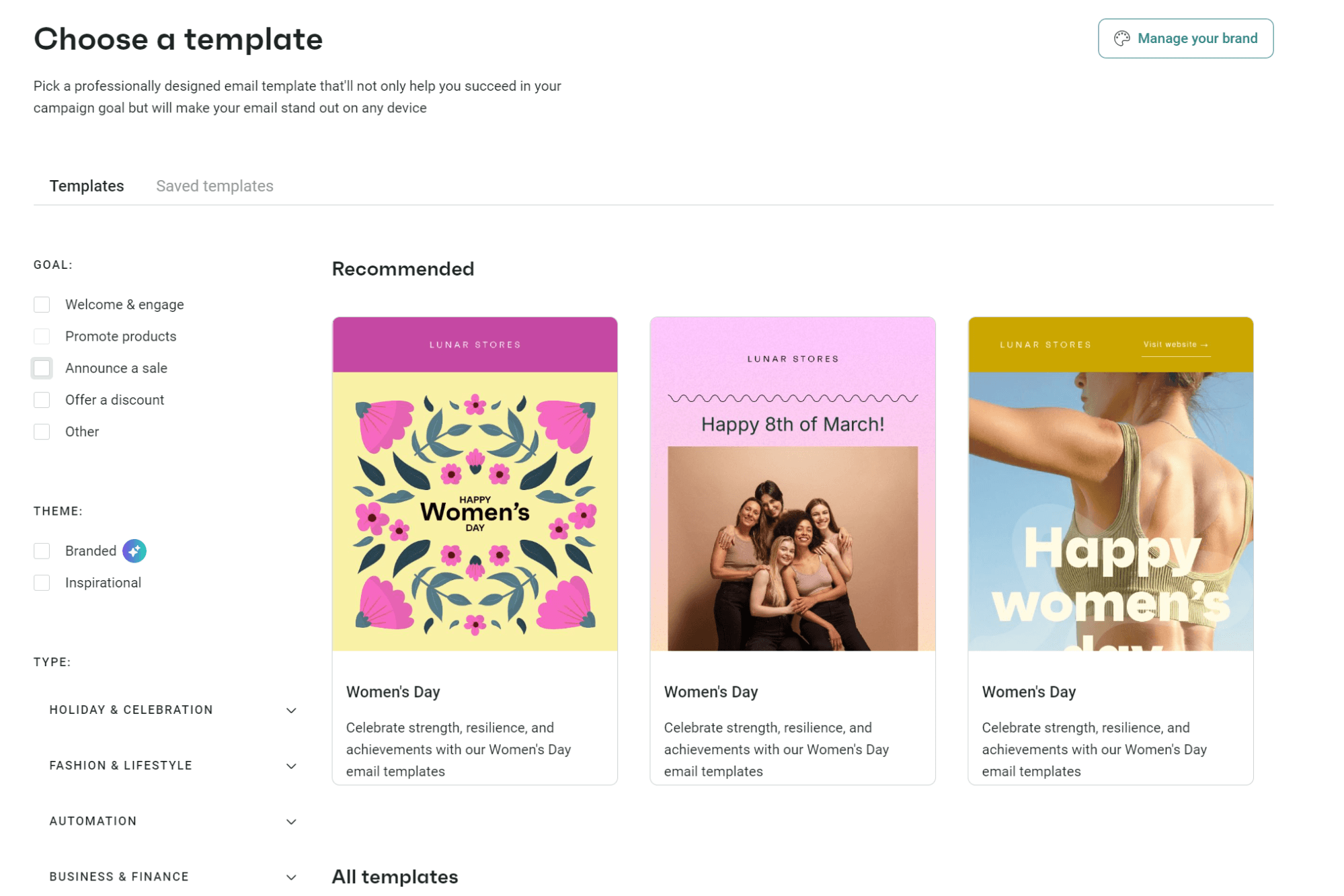
d. Select a template and edit it. Click Save & choose recipients, and then Review campaign to schedule or send now.
8. For automations:
a. Navigate to the dashboard and select Automation > click Create workflow
b. Browse the pre-built templates and click Customize workflow to open the editor:
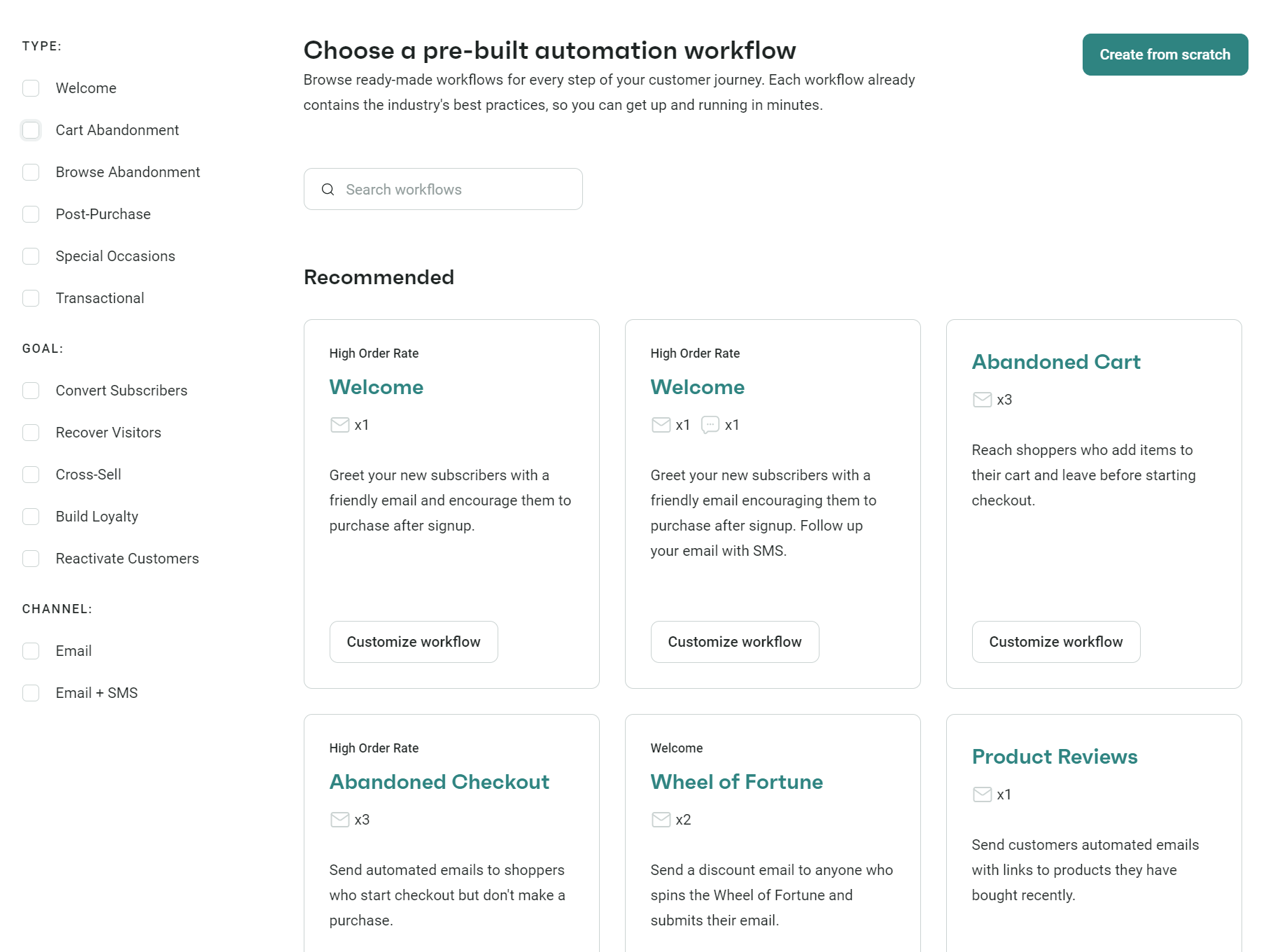
c. The triggers are pre-applied in pre-built flows, but this is the stage where you can edit them and add new filters
d. Click the email element in your flow and scroll down the right-hand sidebar until you see Edit content. Click it to open the email editor:
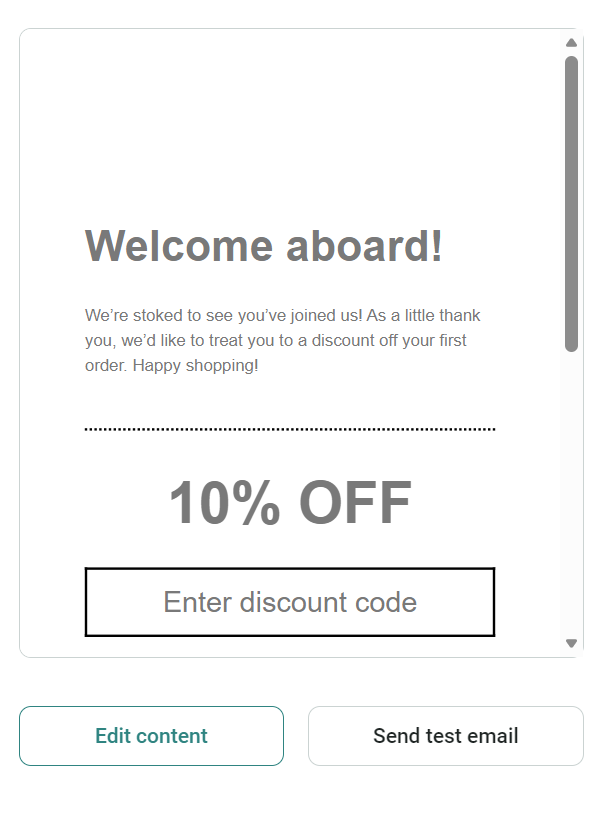
e. Edit your email template and click Finish editing
f. You’ll then hit the flow builder again > click Start workflow to activate it
Repeat these steps for all your flows and campaigns.
123Presets switched and has no regrets
After switching from Mailchimp to Omnisend, 123Presets doubled its revenue, increased open rates by 62.3%, and saw click rates jump 600%. It also fixed the deliverability issues that had been silently tanking their sales.
Read the case study.
Final thoughts
Mailchimp is a set-and-leave-it email tool in 2026. What we mean is, it’s for when your customer journeys are simple and static. The moment they require complex targeting or data, it falls short.
Another possibility is that your list is growing so fast that Mailchimp starts eating too much of your marketing budget without the ROI to show for it.
Omnisend offers more features for less, and it reaches your customers at more high-intent moments. The cost-to-feature ratio is enormous, at $16/month versus Mailchimp’s $20/month for 500 contacts when comparing both their Standard plans.
Other cheaper alternatives to Mailchimp include Sender and MailerLite. For CRM features, look to Brevo or HubSpot. Start with Omnisend for multichannel.
Omnisend’s multichannel automations cover more of your customer journey to maximize revenue
Quick sign up | No credit card required
FAQs
Who is Mailchimp’s biggest competitor?
The title has to go to Omnisend for ecommerce. Mailchimp’s pitch for online sellers doesn’t provide value anymore due to feature restrictions and poor multichannel capabilities. For large send limits, Sender and MailerLite are its main alternatives.
Is there a cheaper option than Mailchimp?
Two main ones are similar to Mailchimp. Sender and MailerLite are the absolute cheapest alternatives, with plans costing as little as $10/month. However, they have feature restrictions. For $16/month, Omnisend provides access to all standard features.
What is the downside of Mailchimp?
Massive feature gating and a lack of advanced features compared to other services like Mailchimp. A case in point, its lowest-cost plans have no custom reports, send time optimization, behavioral targeting, or purchase likelihood stats.
Is Mailchimp still relevant?
Yes, if you’re a small business with basic automation requirements, not so much if you’re a growing store collecting increasing amounts of data and serving complex customer journeys. A more scalable tool, such as Omnisend, offers better value.
This article was researched and written by our experts following a precise process.
See the process
TABLE OF CONTENTS
TABLE OF CONTENTS


Subscribe and don’t miss any updates!
No fluff, no spam, no corporate filler. Just a friendly letter, twice a month.