Omnisend AI

 OFFER
OFFER









SMS marketing vs. email marketing has a simple answer: use both for your campaigns and flows when appropriate to your customer journey.
Omnisend’s data is clear that brands using email and SMS as complementary channels, and in multichannel flows, achieve a higher ROI than those using any one channel.
This complete guide compares email and SMS marketing from an ecommerce standpoint to help you prioritize both channels in ways that maximize results.
Quick sign up | No credit card required
What is the difference between SMS marketing and email marketing?
Your customer has one phone number, so SMS reaches one device that’s highly personal to them. Email is personal too, but it reaches multiple apps and devices, with more room for detail but less immediacy.
Here’s how SMS and email marketing compare across the metrics that matter most:
| Feature | SMS | |
|---|---|---|
| Open rate | Not tracked (no open signal in SMS) | 30.7% (2025, up from 26.6%) |
| Best at | Immediacy and urgency | Depth, storytelling, and scale |
| Automation value | $0.74 per send vs $0.15 for campaigns (5×) | $2.87 per send vs $0.18 for campaigns (16×); 2% of sends generated 30% of revenue |
| Click-to-conversion | 0.97% global (5.1% UK) | 9% (up 53% YoY) |
| Cost structure | Per message | Flat or by list size |
| Content and length | ~160 characters, plain text | Unlimited, with rich media |
| Consent | Explicit opt-in (TCPA, GDPR, CASL) | Explicit opt-in (GDPR, CASL, CAN-SPAM) |
The table tells us that both channels are suited for different things. SMS is suited to immediacy and one-to-one urgency; email is better for depth and reach.
Both achieve the highest ROI as automations, rather than manual campaigns, and each requires explicit opt-in for promotional messages.
You’ll notice there’s no open rate for SMS. Unlike email, SMS has no way to track opens, since there’s no signal sent back when someone reads a text. Instead, you’ll track conversion rates and click rates to assess performance and ROI. For a broader look at how the channel is performing, see the latest SMS marketing statistics.
When to use SMS marketing
Use SMS marketing when it’s your customer’s preference to receive text messages, or when your campaign calls for the channel’s immediacy.
Divatress, for instance, sees SMS click-throughs of 8% versus 3% for email, with text campaigns generating $123,000 in its first year.
The likes of low-stock and back-in-stock alerts, flash sales, and abandoned cart reminders are ripe for SMS marketing. You can pack what your customers need into 160 characters and attract a high click-through rate.
Get a head start on writing your text messages:
50+ text message templates for marketing & ecommerce [2026]
When to use email marketing
Use email as your default marketing channel to reach customers with informational and promotional messages. Email has a higher fatigue ceiling than SMS, so it suits greater send volumes to cover your complete customer journey – email marketing statistics back this up as well.
For instance, To’ak Chocolate grew its email revenue by 460% after making it a central pillar rather than an afterthought.
Another reason to use email over SMS is for detail-rich campaigns. Your emails can display product recommendations and social proof as content rather than providing links that people need to click to learn more.
The real answer: Use both
Email and SMS marketing work best together. You create standalone email and SMS campaigns for different segments and flows that use both channels.
A combined approach will help you nurture, convert, and retain people with more contextual messaging. Omnisend provides one platform to unify your data, letting you create omnichannel experiences for the best customer journey.
Here are two examples of how using both can work in automations:
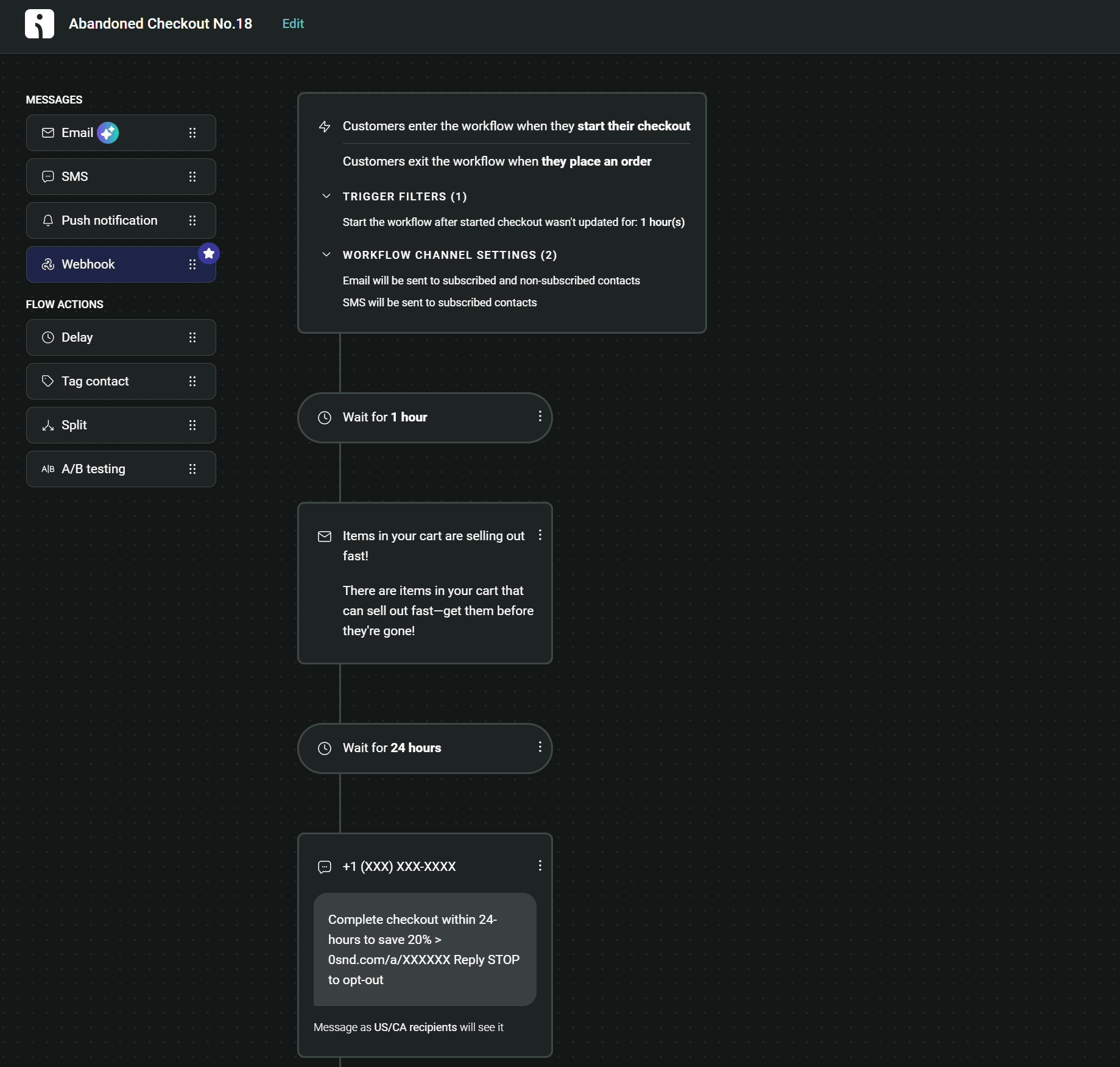
- An abandoned checkout flow sends an email one hour after abandonment and then an SMS 24 hours later with a time-limited discount. The flow imaged below, built in Omnisend, shows this in action:
- Your welcome flow sends an email immediately, then an SMS six hours later if the email went unopened
The above examples combine email and SMS in flows, but some customers will take journeys where the two channels work together across separate touchpoints. A few examples:
- A flash sale text brings a customer back to buy, and the order confirmation email closes the loop
- For a product launch, you might text VIPs an early access code, then welcome the ones who buy into a post-purchase email flow with styling tips and care guides
The table below provides additional insights into using email and text marketing together. You can see the moments where each channel works well:
| Moment | SMS | |
|---|---|---|
| New subscriber | Welcome email with brand story | Welcome offer if they haven't engaged |
| Browsing/cart | Browse and cart abandonment emails | Cart reminder with a time-limited nudge |
| Purchase | Order confirmation, upsell and cross-sell | Shipping and delivery updates |
| Promotions | Newsletters, holiday and seasonal campaigns | Flash sales and time-limited offers |
| Retention | Back-in-stock, birthday, review requests | Restock alerts, thank-you offers |
The bottom line is that SMS marketing vs. email marketing isn’t a one-or-the-other choice. Using both makes sense to create a cohesive customer experience.
Real-world results of using email and SMS marketing together
The ecommerce brands below each use email and SMS together in Omnisend. Their mixes generally lean towards using SMS in revenue recovery and time-sensitive sales:
Divatress: SMS and email together pull 20% of total revenue
Divatress creates scheduled campaigns and automations with email and SMS. One of its best-performers is the abandoned cart flow, which converts at 29% to capture 28% of revenue from 5% of sends. Multichannel marketing accounts for 20% of revenue in total.
INGLOT Canada: 117% higher conversion rates from its multichannel cart abandonment workflow
INGLOT Canada’s 2,130% lift in revenue per message came from pairing SMS with email. It also added web push to the mix, with its multichannel cart abandonment series converting 117% better than email-only sends.
Kate Backdrop: 1:300 ROI with an omnichannel approach
Kate Backdrop reached a 1:300 ROI with three channels: email, SMS, and web push notifications. One of its top-performers is the flash sale, which pairs SMS and email with push for immediate action, with email achieving an 87% open rate.
B-Wear Sportswear: Omnisend generates 40% of company sales
B-Wear Sportswear pairs email and SMS to extend each promotion’s reach, sending an email in the morning and an SMS in the evening to catch customers who missed the email before a sale ends. Omnisend drives 40% of the company’s total sales.
“Ecommerce brands that know their customers don’t pitch email marketing vs. SMS marketing against one another. Instead, they send texts and emails strategically to build high-quality customer experiences that maximize revenue and retention.”
— Karolina Petraškienė, Marketing Projects Lead at Omnisend
Run email and SMS marketing in one app with Omnisend
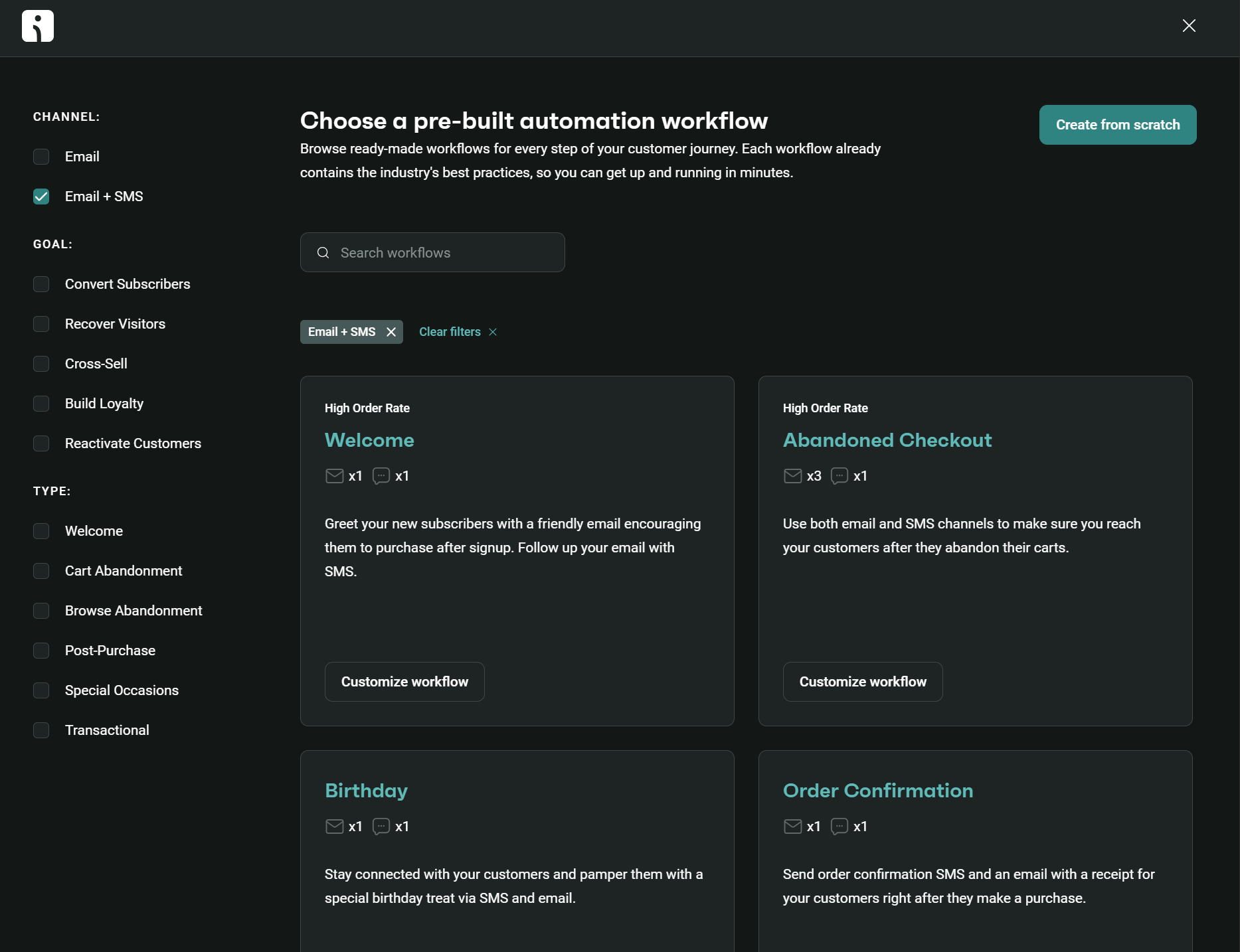
Omnisend integrates with your Shopify, WooCommerce, BigCommerce, or other store via a native app. It then syncs your customers and lets you reach them with automated email and SMS based on their behavior, activity, and preferences:
The Pro plan is what you need to create multichannel SMS. It adds SMS to your email and web push, with volume-based pricing starting at $10/month for 1,111 U.S. SMS credits, equating to a per-message price of $0.009.
The video below provides a tutorial for creating your first email and SMS campaign:
Quick sign up | No credit card required
FAQs
SMS vs. email marketing, which is best?
Email marketing for broadcasts and detail-rich content, SMS for immediate and urgent messages, such as low-stock alerts. Both contribute to a high-quality customer experience and work best together, such as in an abandoned cart series.
Is SMS more effective than email?
SMS is a more effective personal line to your customer. Your marketing texts reach one customer device, rather than an email client accessible across multiple devices. That lets you cover moments where immediacy is the key to revenue.
How much does SMS cost compared to email?
SMS carries a per-credit price, usually bought in bundles. Email is usually charged based on contacts or send volume. Omnisend lets you purchase SMS credits from $10/month at $0.009/SMS. You also need to be on the Pro plan, which costs $59/month. The Pro plan provides unlimited emails. Estimate your spend with the SMS pricing calculator.
Should I use SMS and email together?
SMS vs. email statistics show that using both channels together has proven itself for ROI. INGLOT Canada’s 2,130% lift in revenue per message came from pairing SMS with email, and Kate Backdrop reached a 1:300 ROI with email, SMS, and web push notifications.