
 Omnisend AI


 OFFER
OFFER







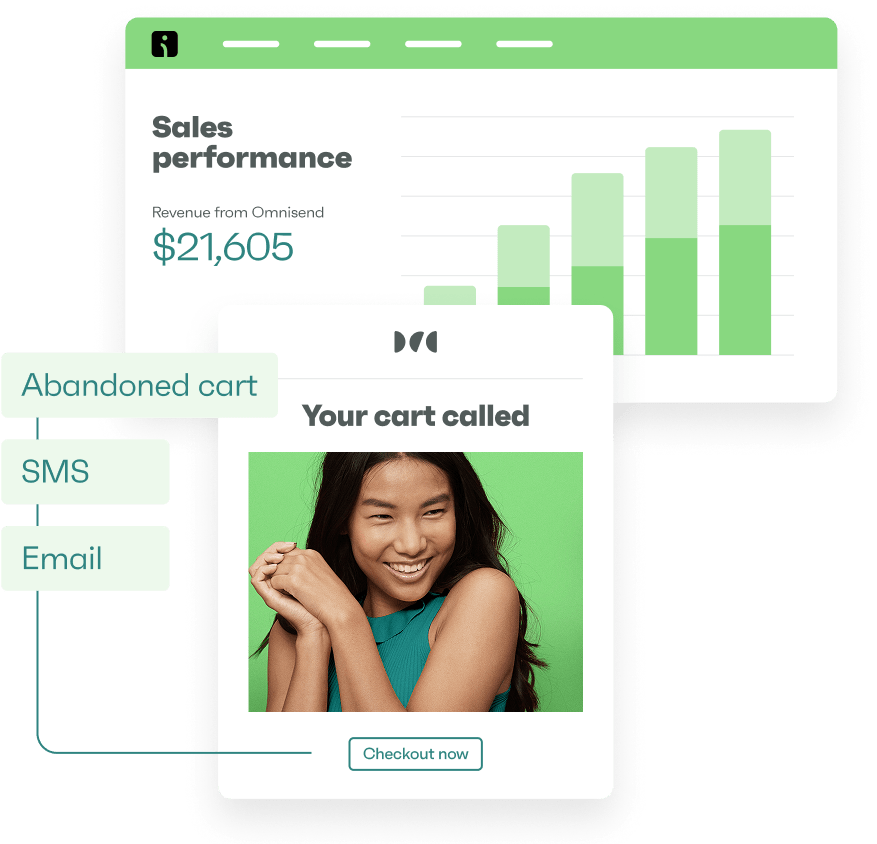
Drive sales on autopilot with ecommerce-focused features
See Features
A/B testing on Shopify replaces guesswork with data-driven decisions, optimizing pages, messages, and offers to enhance conversion rates and revenue.
Systematically testing across the entire sales funnel—from product pages to post-purchase engagement—helps identify and address conversion leaks effectively.
Utilizing specialized tools like Omnisend enables seamless multi-channel A/B testing across email and SMS, maximizing insights and optimizing the customer journey.
Consistent documentation of test results and insights fosters a culture of continuous improvement, allowing stores to refine strategies and boost performance over time.
AB testing on Shopify and other ecommerce platforms helps you compare variations to see what drives conversions. Instead of relying on guesses or assumptions, you test what works using real customer behavior.
The process allows you to compare two versions of a page, message, or offer to determine which one performs better.
On Shopify, this applies to testing pricing, layouts, upsells, emails, SMS campaigns, and entire lifecycle flows for ecommerce growth and conversion rate optimization.
Consider this guide a multi-channel guide for AB testing on Shopify. You’ll learn the basics of AB testing in ecommerce and how to run tests on Shopify stores. You’ll also see how to run email and SMS tests using Shopify with Omnisend.
The focus here is practical execution, not theory. You’ll find step-by-step workflows, real-world examples, and best practices you can apply immediately to improve conversion rates and revenue.
Quick sign up | No credit card required
Why AB testing on Shopify is essential for growth
A/B testing on Shopify improves growth by replacing guesswork with data-backed decisions. It helps you optimize pages, messages, and offers based on what customers like.
Here’s how testing helps you:
- Higher revenue: Increase conversion rates, average order value, and sales per visitor
- Better UX: Improve navigation, reduce friction, and make buying decisions easier
- Smarter marketing spend: Test before scaling, lower acquisition costs, and maximize ROI
“Testing once improves a campaign, but testing everywhere, like sites, email, and SMS, creates momentum. That’s how leading brands stay ahead and build trust in a highly competitive market.” — Evaldas Mockus, VP of Marketing, Omnisend
How Shopify stores typically lose conversions without testing
Many Shopify stores lose conversions because decisions are made without precise performance data. Minor issues across the funnel often go unnoticed, but they have a direct impact on revenue and growth.
Standard conversion leaks include:
- Weak product descriptions that fail to explain benefits or differentiate the product
- Low-quality or missing images that reduce trust and confidence
- Unclear shipping information, including vague costs or delivery timelines
- Missing trust signals, such as reviews, ratings, or guarantees
- Generic emails that fail to re-engage shoppers due to poor email marketing
Shopify AB testing helps you systematically identify and address these issues, pinpointing which product page elements, shipping messages, or engagement triggers actually influence buying decisions.
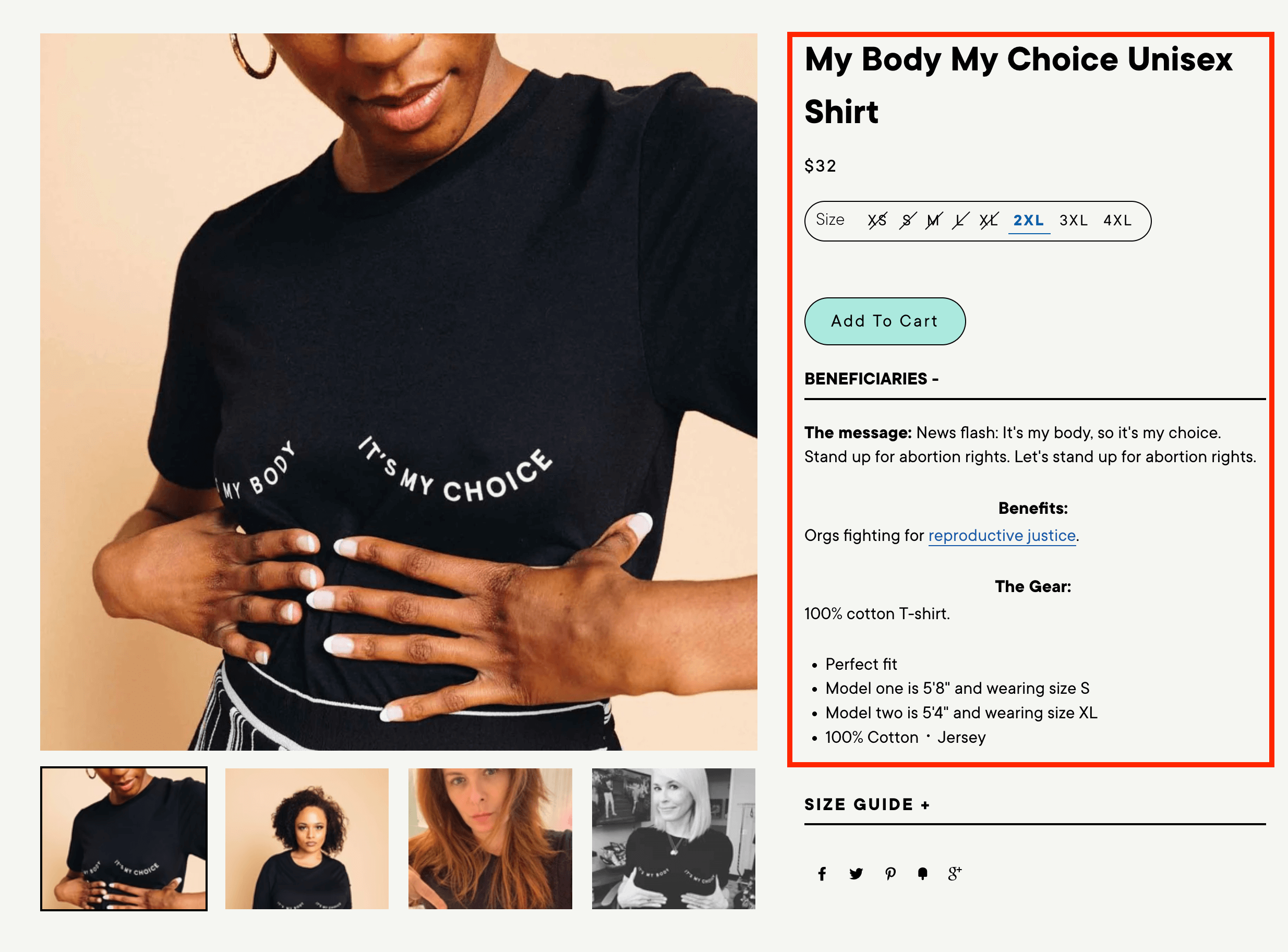
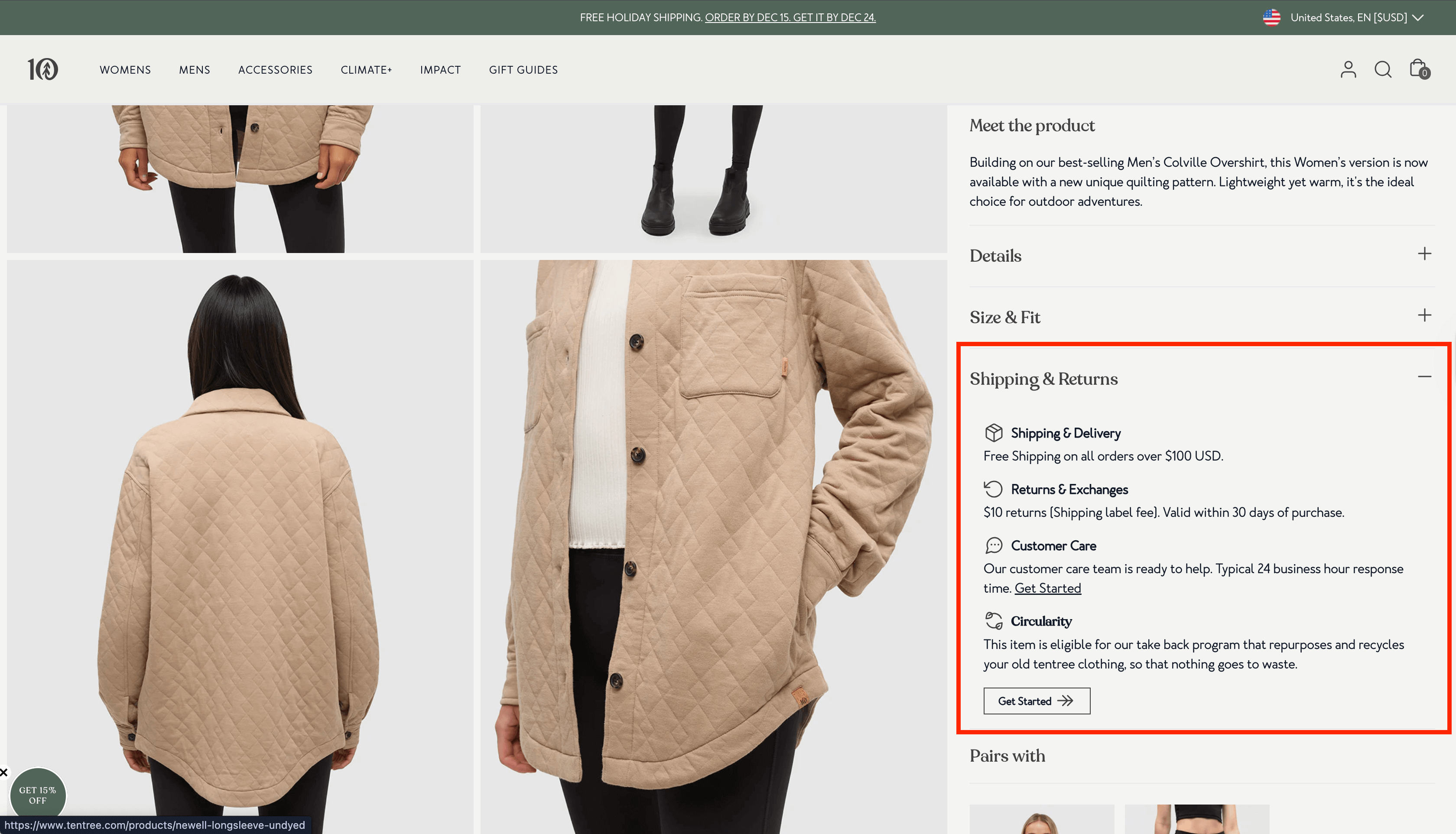
The image below compares The Outrage and The Tentree brand. The Outrage below has unclear shipping information, while Tentree (under the Outrage) shows precise shipping and return details:
Where A/B testing on Shopify fits into your sales funnel
AB testing on Shopify works best when it supports every stage of your sales funnel, not just a single page.
Most Shopify funnels leak conversions at multiple points. These issues often show up as low product page conversion rates, cart abandonment, weak email engagement, or missed repeat purchases.
Here’s how testing works across the funnel:
- Product detail pages (PDPs): Compare product descriptions, image order, reviews placement, and value messaging to improve product-page conversion
- Cart: Test free shipping thresholds, urgency messages, and trust badges to reduce cart abandonment.
- Checkout: Experiment with layout, payment options, and reassurance copy to remove friction before purchase
- Post-purchase engagement: Test timing, subject lines, and personalization to increase engagement and purchases
When you test each stage, small gains add up. These incremental improvements compound into measurable revenue growth.
Is Shopify still relevant in 2026 for serious ecommerce brands?
Absolutely, Shopify powers about 29% of all U.S. ecommerce websites, showing strong domestic adoption and influence in online retail:
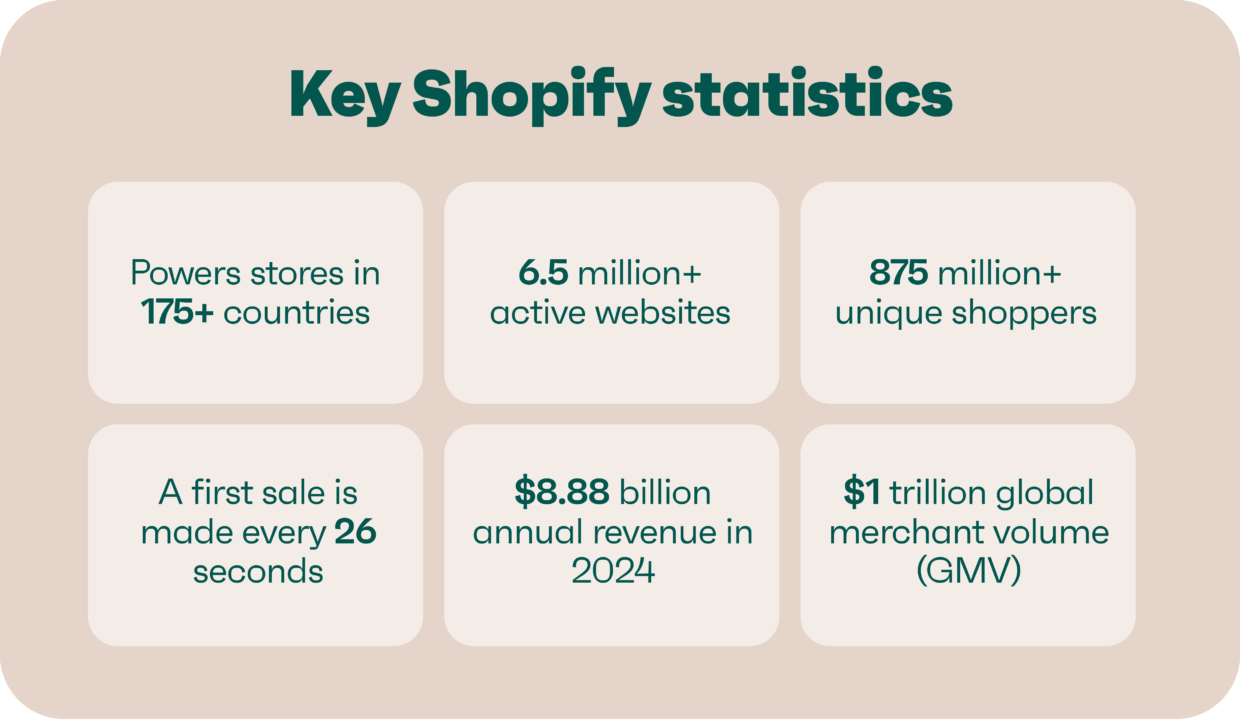
Its ecosystem includes well over 12,000 apps, making it one of the broadest marketplaces for extensions and integrations.
Shopify also has ongoing investment in innovations like headless commerce, AI‑assisted features, and a vast developer community.
With competition increasing from multiple ecommerce stores, A/B testing on Shopify is more critical now than ever to capture your audience’s attention.
While Shopify offers a strong foundation, it doesn’t provide flexible, built-in A/B testing for every stage of the funnel. That’s where specialized tools become essential.
Platforms like Omnisend integrate directly with Shopify and support continuous testing across your website, email, and SMS. This makes it easier to run actual multi-channel experiments and optimize the entire customer journey.
How to run your first A/B test on Shopify (step-by-step)
Running your first AB test on Shopify doesn’t require advanced analytics skills. Below is a practical step-by-step framework to run your first AB test on Shopify:
Step 1: Choose a high-impact page or flow to test
Start where buying intent is strongest. For most Shopify stores, these insights can come from the most common flows or high-impact pages, like:
- Top-selling products
- Abandoned cart emails or SMS
- Welcome or post-purchase flows
To know which to test, ask this question: “Where are customers already close to converting but dropping off?”
Once you have an answer, use this decision framework:
- Test pages first if traffic is substantial, but conversions lag
- Test SMS and email flows first if revenue depends heavily on automation
- Test pages for engagement issues, flows for conversion issues
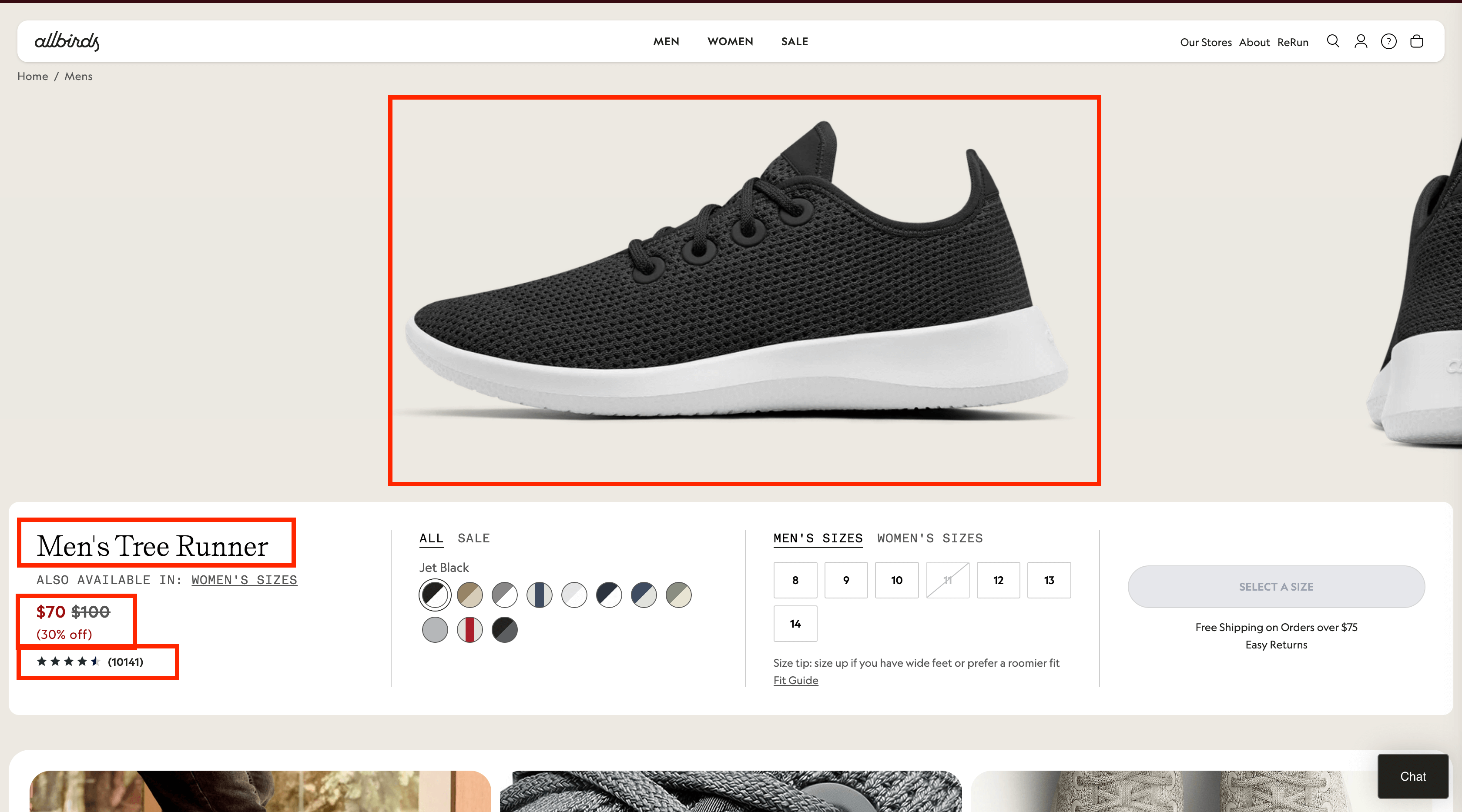
A Shopify store like Allbirds can prioritize A/B testing on high-traffic product pages, such as bestsellers. The highlighted areas below show key elements worth testing:
Step 2: Form a clear hypothesis and define success metrics
Before you run any test, you need a clear hypothesis to tell you what you’re testing and why. A strong hypothesis follows the format:
“If we [change X], then [result Y] will happen because [reason Z].”
For example, you might hypothesize:
“If we add a scarcity banner on our bestselling sneaker page, then add-to-cart rates will increase by 8% because urgency encourages purchases.”
Next, define your success metrics. These are the numbers that tell you whether your hypothesis is correct.
Step 3: Set up the test using Shopify A/B testing tools
Once you have your hypothesis and metrics, it’s time to set up the test. Shopify doesn’t have a built-in A/B testing feature for all store elements, but you can use intuitive, thoughtfully designed tools like Omnisend.
For email and SMS campaigns, Omnisend offers built-in AB testing that works both in campaigns and automated workflows. These workflows include welcome series, abandoned cart flows, and post-purchase messages. You can also test various elements, such as subject lines, images, and CTAs.
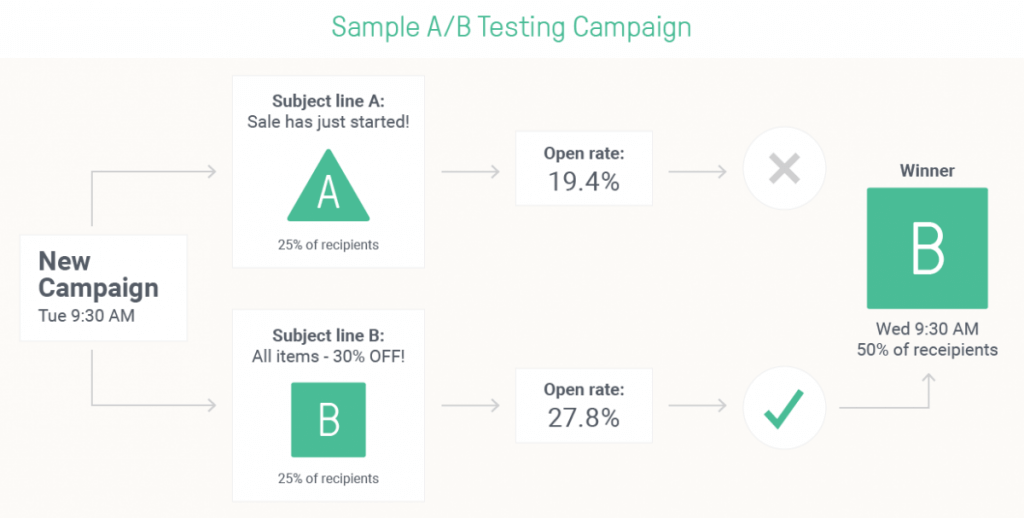
Here’s a sample A/B testing campaign for subject lines:
When setting up your test, keep these key points in mind:
- Split traffic evenly between variations to ensure fair results
- Change only one primary variable at a time, so you know what drives the difference in performance
Step 4: Run the test, reach significance, and pick a winner
Once A/B testing on Shopify is set up, let it run for a sufficient amount of time to collect reliable data. For Shopify stores, this typically means completing at least one full business cycle or an adequate number of orders to achieve statistical significance.
Avoid stopping early, even if one version appears to perform better, because small sample sizes can be misleading.
Monitor your success metrics and wait until the results are reliable and consistent. Once significance is reached, select the winning variation and roll it out across your store or campaigns with confidence.
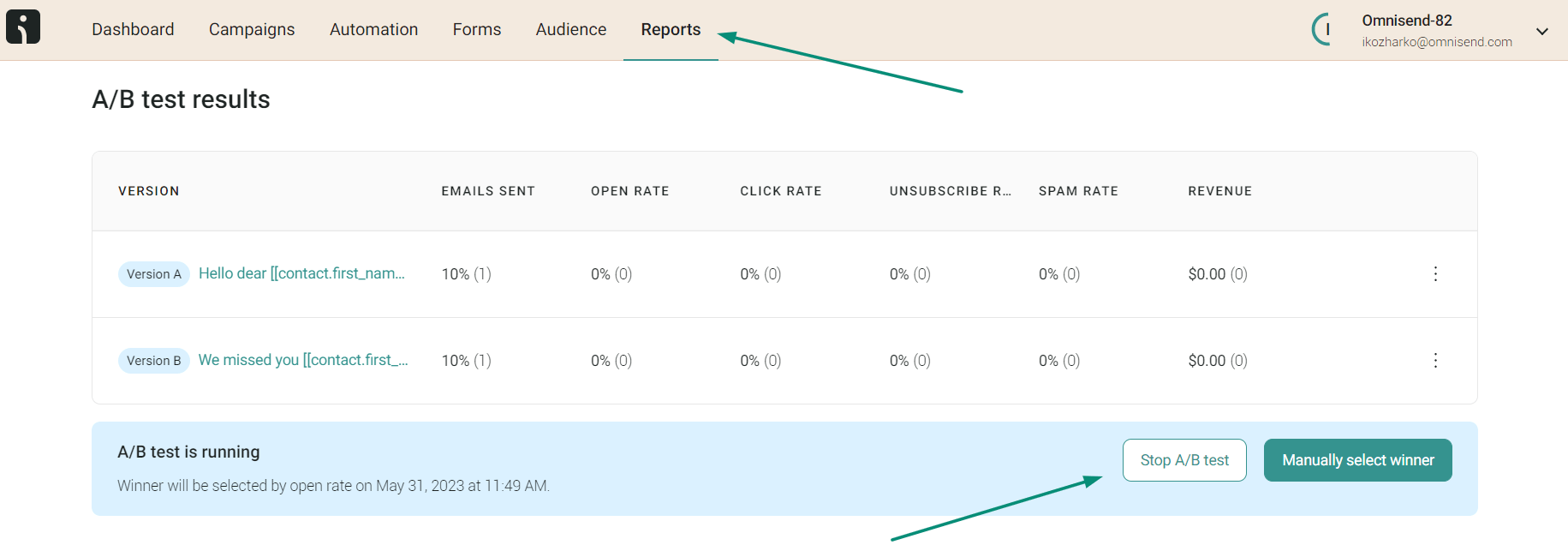
Here is how an A/B test report shows up on Omnisend:
Step 5: Document learnings and plan your next experiment
After your test concludes, document all the details. Include your hypothesis, variations, metrics, results, and key insights:
- Note what worked and what didn’t
- Record statistical significance and audience details
- Highlight actionable takeaways for future tests
Maintaining a clear record enables you to plan your next experiment more efficiently. Over time, this creates a library of tested strategies to consistently optimize cart abandonment, product pages, campaigns, and flows.
Best Shopify A/B testing tools and upsell apps
The right A/B testing tools depend on where you want to optimize. Below is a breakdown of the best Shopify A/B testing tools by use case.
On-site Shopify A/B testing tools (landing pages, PDPs, checkout)
For on-site experiments, these tools enable you to test landing pages, product detail pages, and checkout experiences without writing any code.
Leading options for Shopify AB testing tools include:
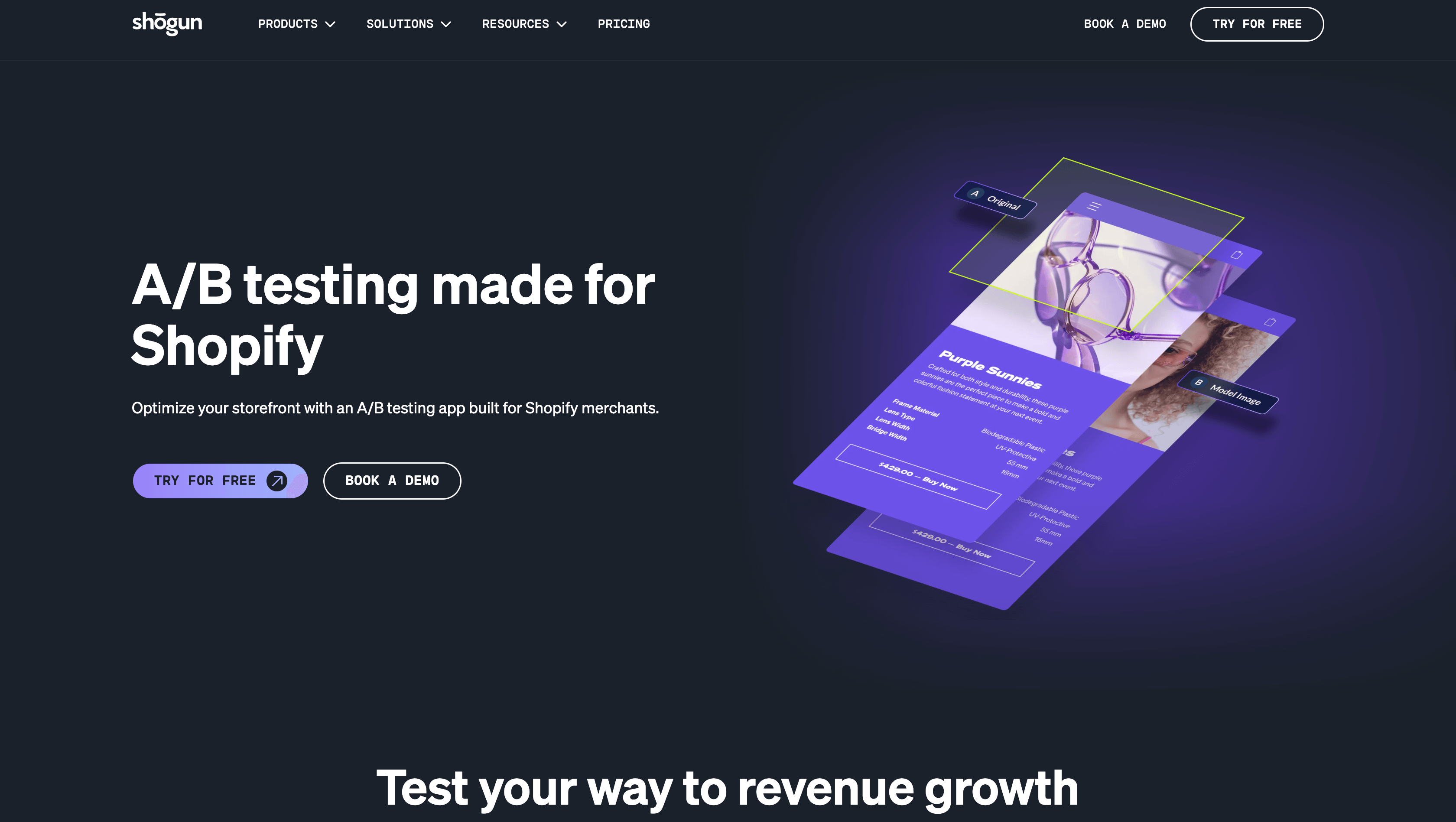
Shogun
Features
- Built-in Shopify workflow to create and manage variants inside the Shopify admin
- Tests span pages, templates, themes, and even price experiments
- Supports audience segmentation and downstream goal tracking
- Positioned as lightweight and performance-focused
Best for: Merchants testing landing pages and PDP layouts
Pricing: Starts at $39/month to $199/month for Grow, and $499/month for Advanced
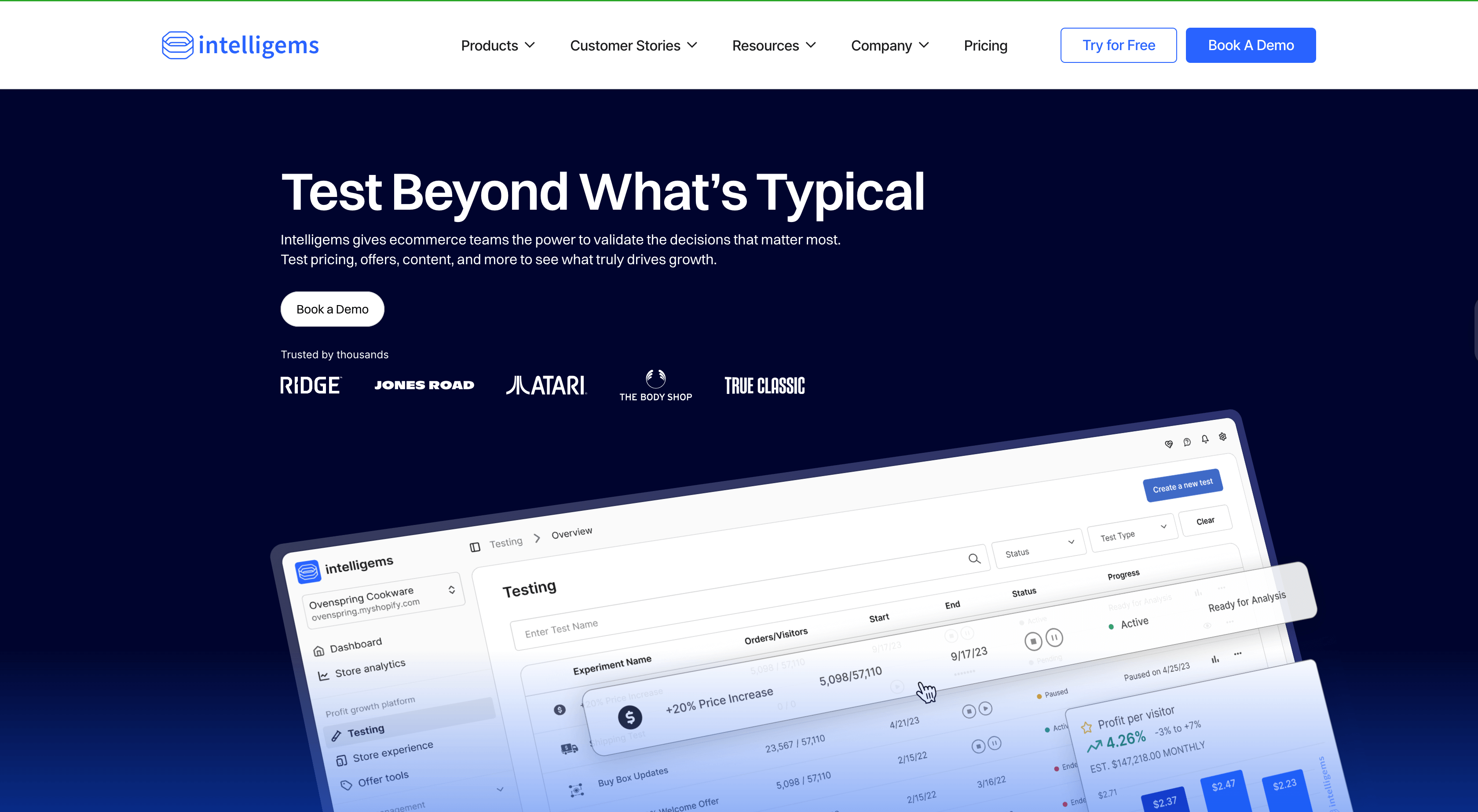
Intelligems
Features
- A/B tests images, copy, pages, themes, and PDPs site-wide
- Uses redirects, theme variants, and a JS API for custom tests
- Shows analytics on revenue and profit per visitor
- Designed for merchants running frequent, high-impact experiments
Best for: Brands testing pricing, discounts, and promotions
Pricing: Starts at $79/month for Core to $499/month for Plus, and $999/month for Blue
Replo
Features
- Build landing and product pages without coding
- Test variants and track conversions
- Use prebuilt, fast-loading templates
- Launch test pages without affecting the main store
Best for: Design-forward brands with higher traffic
Pricing: Basic plan starts at $119/month, Growth begins at $599/month, and Custom pricing for Enterprise
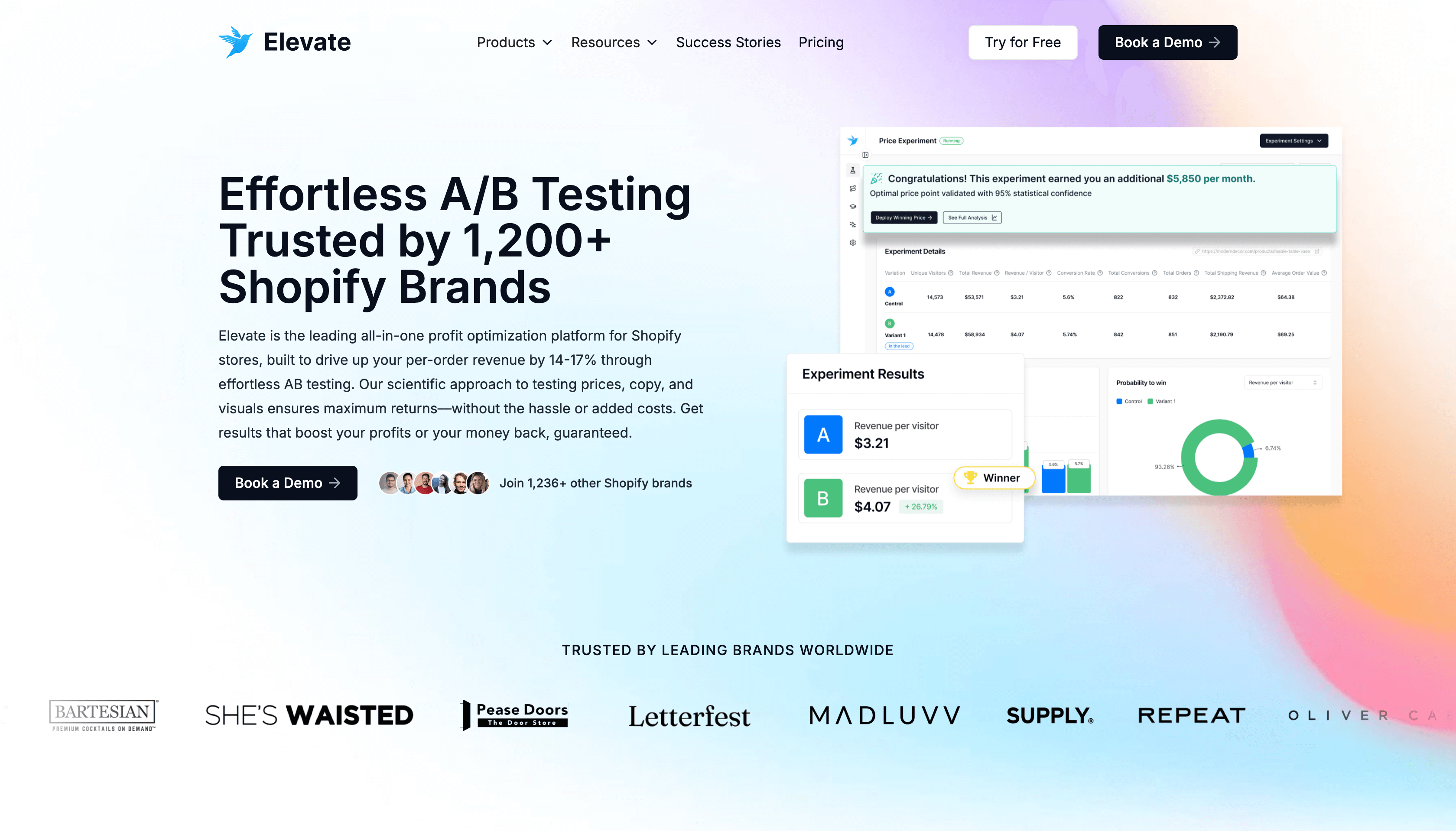
Elevate
Features
- Run A/B tests on product pages, landing pages, and more using the page builder
- Anyone can launch and manage tests without technical skills or coding
- Tests run with zero impact on page speed and zero flickering for visitors
- Get live analytics and accurate test attribution to see which version drives better results
Best for: Stores focused on CRO and checkout improvements
Pricing: Starts at $49/month for basic to $99/month for standard, and $499/month for the premium plan
Here is a short comparison:
| Tool | Primary focus | Key A/B testing capabilities | Best for | Pricing (starts at) |
|---|---|---|---|---|
| Shogun | Page building and layout testing | Split URL testing, template-based variants, performance dashboards | Merchants testing landing pages and PDP layouts | $39/month |
| Intelligems | Pricing and offer optimization | Multi-variant testing, dynamic upsells, personalized offers | Brands testing pricing, discounts, and promotions | $79/month |
| Replo | Custom page design | Multi-variant A/B testing, no-code layouts, and mobile optimization | Design-forward brands with higher traffic | $99/month |
| Elevate | Conversion optimization | Visual A/B testing, checkout customization, and integrated analytics | Stores focused on CRO and checkout improvements | $49/month |
Email and SMS A/B testing with Omnisend
Omnisend integrates with Shopify and Shopify Plus to enable data experiments across email and SMS campaigns.
With Omnisend, you can test:
- Subject lines
- Sender names
- Complete email content
- SMS copy
- Timing
- Promotional offers
- Automated flows
Tests run directly inside Omnisend’s workflow builder, linking results to Shopify behaviors. This allows precise, actionable insights and measurable impact on conversions.
Omnisend’s core strengths include:
- Free plan includes all ecommerce-focused features
- ROI of $79 for every $1 spent for Omnisend US merchants
- 24/7 customer support for all plans
- Integration with Shopify and Shopify Plus
Watch this video for a better understanding of AB testing on Omnisend for emails:
Best upsell app for Shopify with A/B testing
When choosing an upsell app for Shopify, look for tools that support A/B testing for offers, placements, and discount levels. This helps you see precisely which upsells convert best.
Top upsell apps let you test product recommendations on product pages, checkout, and post-purchase flows.
For a full-fledged upsell strategy, on-site upsell apps can be paired with Omnisend’s product recommendation and upsell-focused email and SMS campaigns.
This combination lets you test upsells both on-site and in your automated workflows for maximum conversions.
Using this Shopify upsell approach, you can refine upsells continuously, increase average order value, and create a seamless shopping experience.
How to choose the right Shopify A/B testing stack
Selecting the right Shopify AB testing tools for your store depends on the key factors, including:
- Budget: How much can you invest in your Shopify AB testing tools?
- Traffic level: Do you have enough traffic to get significant results quickly?
- Technical comfort: Do you prefer no-code drag-and-drop builders or more advanced tools?
- Channels to test: Which channels matter most?
- On-site pages
- Checkout flows
- Email campaigns
- SMS
- All of the above?
Your ideal AB testing Shopify stack should align with your traffic, budget, and technical capabilities. Combining on-site testing apps with Omnisend’s email and SMS A/B testing will provide a comprehensive approach to conversion and engagement across the whole funnel.
A multi-channel A/B testing framework for Shopify
On-site testing alone only tells part of the story. To maximize Shopify growth, you need a framework that combines site, email, and SMS.
Coordinating tests across channels helps you see how changes interact with each other. For example, a shift in product page layout may influence email click-through rates, while SMS reminders can reinforce a tested offer.
On-site tests: Homepage, product pages, cart, checkout
On-site A/B testing on Shopify focuses on the pages where customers make purchase decisions. Key variables include:
- Headlines
- Value propositions
- Product images
- Trust badges
- Social proof
- Free shipping or promotional messages
- CTA buttons
Testing these components reveals what captures attention, builds trust, and drives conversions. Even minor tweaks to a homepage or product page can significantly increase add-to-cart and engagement rates.
Email tests: Subject lines, offers, layouts, product recommendations
Email A/B testing on Shopify lets you optimize every message in your customer journey. With Omnisend, you can run accessible yet powerful tests across campaigns and automated workflows.
Standard variables to test include:
- Subject lines
- Sender names
- Offers
- Discounts
- Email layouts
- Design elements
- Product recommendations and personalization
Omnisend’s split-testing and analytics features help you quickly identify what drives opens, clicks, and conversions. This makes every email resonate with your audience and contributes to higher revenue and engagement.
SMS tests: Timing, copy, and offer type
SMS A/B testing on Shopify is ideal for time-sensitive messages. With Omnisend, you can also test send timing, message copy, and offer type to see what drives immediate clicks and purchases.
This channel is especially effective for:
- Flash sales or limited-time promotions
- Cart abandonment
- Back-in-stock reminders
Omnisend’s global SMS reach makes it easy to run time-sensitive tests across regions, which helps you optimize messages at scale.
How channels influence each other (and how Omnisend helps)
A/B testing on Shopify works best when channels operate in tandem, rather than in isolation.
Insights from on-site tests can inform email layouts, while winning email offers can shape SMS copy and timing. This cross-channel attribution helps you understand how each point contributes to conversions.
Omnisend connects site behavior, email, and SMS data in one platform. This makes it easier to apply learnings across channels and run smarter, consistent tests.
Your Shopify A/B testing maturity roadmap
A/B testing on Shopify works best when treated as a system. This roadmap will help you identify your current position and determine where to focus next.
Each level builds on the previous one. Find your stage, then pick the next to move forward:
Level 1 – Foundation: Basic on-site and email tests
At this stage, testing is simple and primarily exploratory. You’re focused on understanding what resonates with shoppers and subscribers.
Typical tests and activities include:
- Homepage or product page headline tests
- Product image or CTA button tests
- Basic email subject line A/B tests
- Comparing two promotional email versions
The goal here is consistency. Establish a baseline of understanding your customer behavior and build testing habits.
Level 2 – Expansion: Segmented and behavioral tests
Here, you move beyond one-size-fits-all testing and start segmenting your audience. This is where Omnisend becomes valuable for segmentation.
In this stage, you should:
- Segment AB test email campaigns by customer type or behavior
- Test personalized offers on-site or in emails
- Compare discount or upsell strategies for different cohorts
- Analyze cart abandonment patterns and optimize follow-ups
Testing becomes more targeted in this stage, helping you understand who responds best, not just what works.
Level 3 – Automation: Workflow and lifecycle A/B testing
At this stage, testing becomes part of your lifecycle marketing. With Omnisend, you can preview and test campaigns automations directly inside automated workflows.
Examples of tests at this level include:
- Welcome series email variations
- Abandoned cart email vs. SMS tests
- Post-purchase upsell message tests
- Timing and frequency tests across workflows
When you add tests to automation, you can scale experimentation with minimal effort and continuously improve engagement and revenue.
Level 4 – Mastery: Personalization and predictive testing
This is where testing becomes a strategic advantage. You’re optimizing at scale using deeper insights and personalization, where tools segmentation, personalization, and optimization tools like Omnisend can help.
Advanced tests often include:
- Personalized product recommendations
- Dynamic content based on predicted behavior
- Cross-channel offer sequencing
- Continuous optimization across site, email, and SMS
At this level, testing is always on. Each insight feeds the next experiment, creating a compounding growth loop.
15 high-impact A/B tests every Shopify store should run
Below are 15 high-impact AB tests to run across email, SMS, and on-site experiences. Each test includes a clear hypothesis, what to test, the primary success metric, and a difficulty rating:
Email tests to increase opens, clicks, and revenue
- Subject line style
- Hypothesis: Curiosity-driven subject lines increase opens more than benefit-driven ones
- Test: Compare two subject lines with different approaches
- Metric: Open rate
- Difficulty: Low
- Single hero product vs. product recommendations
- Hypothesis: Featuring multiple product recommendations drives higher click-throughs than a single hero item
- Test: Compare a Single hero image vs. three to five recommended products
- Metric: Click-through rate
- Difficulty: Medium
- Discount type
- Hypothesis: Percentage discounts may encourage larger baskets than fixed-amount discounts
- Test: Compare 10% off vs. Save up to 10% campaigns
- Metric: Revenue per email
- Difficulty: Medium
- Layout and imagery
- Hypothesis: Adding lifestyle images increases engagement
- Test: Standard product shots vs. lifestyle/usage images
- Metric: CTR and conversions
- Difficulty: Medium
- Send timing
- Hypothesis: Emails sent at different times of day can impact engagement
- Test: Morning vs. evening sends using Omnisend’s workflow scheduling
- Metric: Open rate
- Difficulty: Low
Additionally, Omnisends’ product recommendation blocks make it easy to test personalized recommendations against single hero products using real Shopify data.
SMS tests for engagement and quick conversions
- Timing of messages
- Hypothesis: Evening messages generate more clicks than morning messages
- Test: Send identical offers at different times
- Metric: CTR
- Difficulty: Low
- Copy length
- Hypothesis: Short, concise messages outperform longer copy
- Test: 50-character vs. 120-character SMS
- Metric: Conversion rate
- Difficulty: Low
- Offer type
- Hypothesis: Flash sales create urgency, but early access builds loyalty
- Test: Flash sale SMS vs. early-access offer
- Metric: Revenue per SMS
- Difficulty: Medium
Product page and collection page tests
- Hero image
- Hypothesis: Lifestyle images increase add-to-cart rates
- Test: Product-only vs. in-context lifestyle images
- Metric: Product-page conversion
- Difficulty: Medium
- Above-the-fold content
- Hypothesis: Highlighting key benefits above the fold reduces bounce
- Test: Benefits-first layout vs. standard layout
- Metric: Page engagement
- Difficulty: Medium
- Reviews placement
- Hypothesis: Reviews near the CTA increase conversions
- Test: Reviews above vs. below the fold
- Metric: Add-to-cart rate
- Difficulty: Medium
- Shipping info phrasing
- Hypothesis: Clarifying shipping timelines drives checkout completion
- Test: “Ships in three to five days” vs. “Delivered by Friday”
- Metric: Cart-to-checkout conversion
- Difficulty: Low
Cart, checkout, and abandoned cart tests
- Abandoned cart email sequence
- Hypothesis: Three-touch sequence outperforms a single reminder
- Test: Single email vs. three-email sequence via Omnisend
- Metric: Recovery rate
- Difficulty: Medium
- Reminder timing
- Hypothesis: Sending reminders within one hour improves recovery
- Test: one hour vs. 24-hour delay
- Metric: Conversion rate
- Difficulty: Low
- Incentives
- Hypothesis: Free shipping recovers more carts than discount codes
- Test: Offer free shipping vs. 10% off
- Metric: Recovery revenue
- Difficulty: Medium
- Checkout page layout
- Hypothesis: Simplified checkout reduces drop-off
- Test: One-page checkout vs. multi-step
- Metric: Checkout completion
- Difficulty: Medium
Upsell, cross-sell, and pricing tests (including on Shopify)
- Upsell placement
- Hypothesis: In-cart offers perform differently from post-purchase offers
- Test: Compare in-cart vs. post-purchase upsells
- Metric: Average order value (AOV)
- Difficulty: Medium
- Offer type
- Hypothesis: Free shipping may drive more add-ons than discount percentages
- Test: Free shipping vs. 10% off upsell
- Metric: Upsell conversion
- Difficulty: Medium
- Price point experiments
- Hypothesis: Adjusting bundle pricing impacts purchase likelihood
- Test: Bundle at $39 vs. $49
- Metric: Revenue per customer
- Difficulty: Medium
- Cross-channel upsell
- Hypothesis: Combining on-site upsells with Omnisend email/SMS recommendations increases repeat purchases
- Test: Post-purchase email vs. post-purchase email + SMS
- Metric: Repeat purchase rate
- Difficulty: Medium
A/B testing best practices for ecommerce brands
Ecommerce brands need structured processes, clear goals, and ethical data practices to generate actionable insights.
In this section, you’ll see how long to run your AB testing for and the common mistakes to avoid when AB testing on Shopify.
How long to run tests and what “statistical significance” means
Before making changes based on a test, confirm that the observed difference between variations is meaningful.
To get reliable results, follow these guidelines when A/B testing on Shopify:
- Run tests for one to two complete business cycles to capture normal customer behavior
- Ensure enough traffic to detect meaningful differences between variations
- Don’t stop early — small samples can mislead
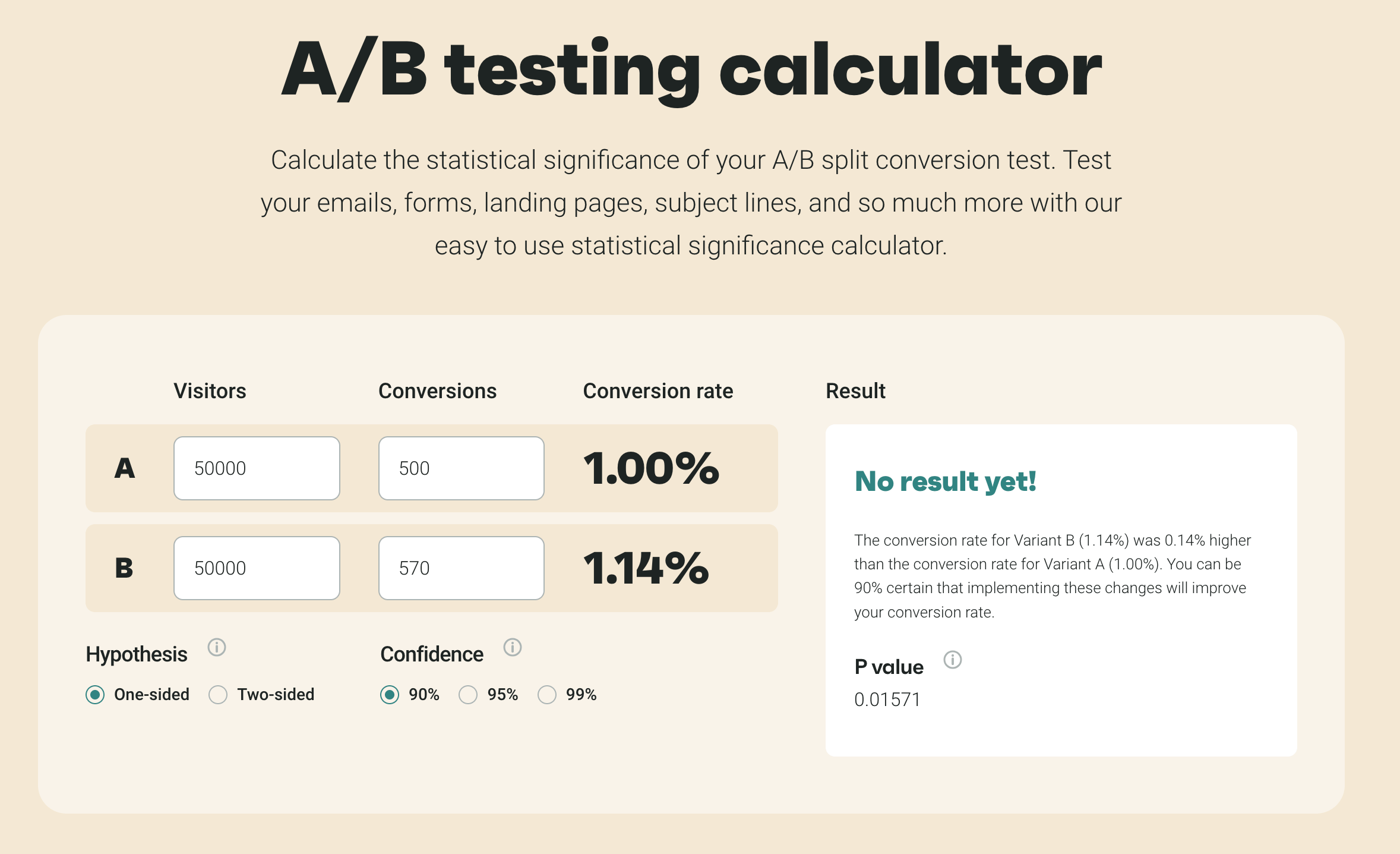
- Use statistical significance calculators to confirm results are valid
- Consider ROI calculators to measure the real impact on revenue
You can use the A/B testing calculator below:
Common A/B testing mistakes to avoid on Shopify
Minor errors can invalidate your A/B test results. Understanding and avoiding these common mistakes will help your experiments stay reliable and actionable:
- Testing multiple variables at once without proper control
- Cutting tests short before reaching statistical significance
- Using tiny sample sizes that affect the results
- Ignoring consistency in variation design and messaging
- Overlooking compliance or privacy concerns
- Failing to segment audiences appropriately for behavior-driven insights
Seasonal and promotional testing (BFCM and beyond)
Peak seasons, such as Black Friday, Cyber Monday, and holiday periods, require a slightly different A/B testing approach. Test campaigns should account for higher traffic and shifting customer behavior.
Some ideas include:
- Urgency-driven messaging: Test countdown timers or “limited stock” alerts
- Offer types: Compare bundles, percentage discounts, or free shipping
- Send timing adjustments: Test emails and SMS at different times to capture holiday shopping peaks
Measuring success from AB testing on Shopify
Tracking the right metrics will help your A/B tests generate meaningful insights. But beyond simple conversion rates optimization, consider both short-term performance and long-term business impact.
Core metrics: conversion rate, AOV, revenue per visitor
For AB testing on Shopify, focus on metrics that show immediate impact:
- Conversion rate (CR): Percentage of visitors completing a desired action
- Average order value (AOV): Revenue per transaction
- Revenue per visitor (RPV): Direct measurement of test impact
Long-term impact metrics: CLV, unsubscribe rate, churn
To understand customers’ behavior on a broader scale, track the following metrics:
- Customer lifetime value (CLV): The revenue each customer generates over their relationship with your store
- Unsubscribe and spam rates: Helps emails and SMS campaigns remain engaging and trusted
- Churn: Measures retention effects of messaging or offers
Cross-channel attribution with email, SMS, and on-site tests
Omnisend offers integrated reporting that connects email and SMS campaigns to on-site conversions. To make the most of these insights, focus on these three actions:
- Attribute revenue from automated workflows and campaigns
- Compare performance across cross-channel experiments
- Use insights to optimize holistic Shopify strategies
Conclusion
A/B testing on Shopify helps you understand what drives customer behavior and increases conversions.
By testing page, email, and SMS variations, you can make data-driven decisions to improve revenue and engagement.
You don’t need to start big; just begin with one or two experiments and scale into a structured testing program over time. This fosters a culture of continuous optimization, keeping your store competitive.
Omnisend simplifies email and SMS A/B testing on Shopify with integrated reporting, automated workflows, and product recommendation tests that support on-site experiments.
Together, these tools help you run smarter tests and maximize ROI across your store.
Quick sign up | No credit card required
FAQs
Shopify’s native capabilities are limited. Most merchants use apps or platforms like Omnisend to run A/B tests across pages, emails, and SMS for reliable results.
Test different price points or bundles on product pages or during upsell offers. Measure conversion and revenue per session to determine your optimal pricing strategy.
Yes. Shopify powers about 29% of U.S. ecommerce and innovates with AI checkout and headless commerce.
Here’s what to do:
— Identify a high-impact page or flow
— Form a clear hypothesis
— Create variations and split traffic
— Run the test for significance
— Analyze results and apply learnings
Run tests for at least one to two complete business cycles, or until statistical significance is reached, to ensure reliable results.

TABLE OF CONTENTS
TABLE OF CONTENTS


No fluff, no spam, no corporate filler. Just a friendly letter, twice a month.