Omnisend AI


 OFFER
OFFER









Time-bound deals and deadlines create a sense of urgency. Brands use an email countdown timer to encourage subscribers to act.
Because they don’t want to miss any deals, customers react sooner rather than later. Emails with countdown timers have higher open and click rates. They’re also likely to increase sales and profit.
In this article, we’ll explain the benefits of adding an email countdown timer to your campaigns. These timers perform well for product launches, events, and promos.
We’ll also provide a step-by-step guide for creating these emails with Omnisend. We’ll also share real examples from Google, Kinn, Chipotle, and more to inspire your own campaigns.
Quick sign up | No credit card required
What is a countdown timer in an email?
An email countdown timer is a visual element embedded in your email, showing the time left before an event or offer ends. Instead of just saying a sale “ends soon,” it shows days, hours, minutes, and even seconds ticking down. With urgency showing how much time is left, this timer can help increase clicks and conversions.
A great example is from White Fox:
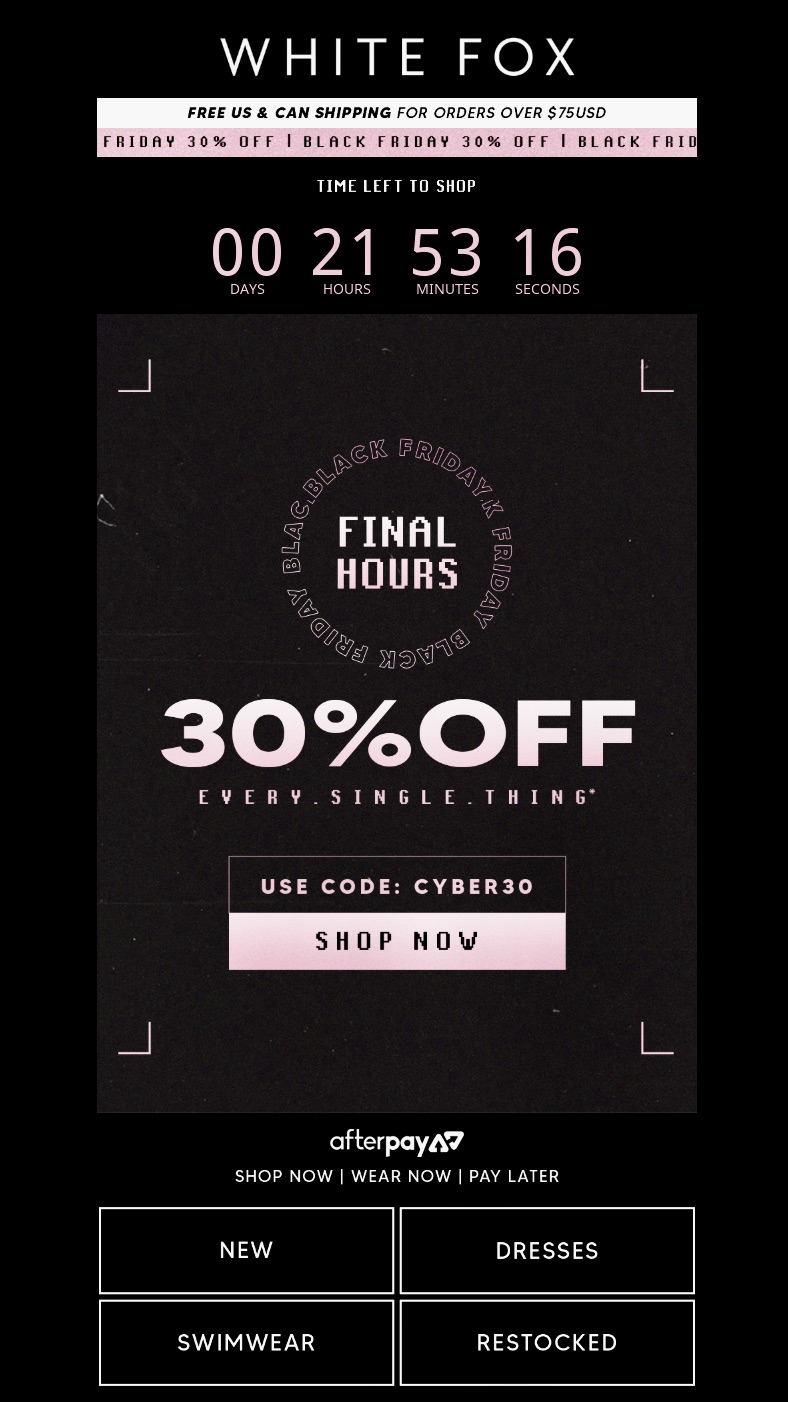
The timer sits under the headline and above the product section, ensuring that shoppers see the deadline before they even start reading the email. This email countdown timer uses boxed numbers and strong color contrast, ensuring that it’s displayed prominently among the rest of the copy. It catches the reader’s eye effectively.
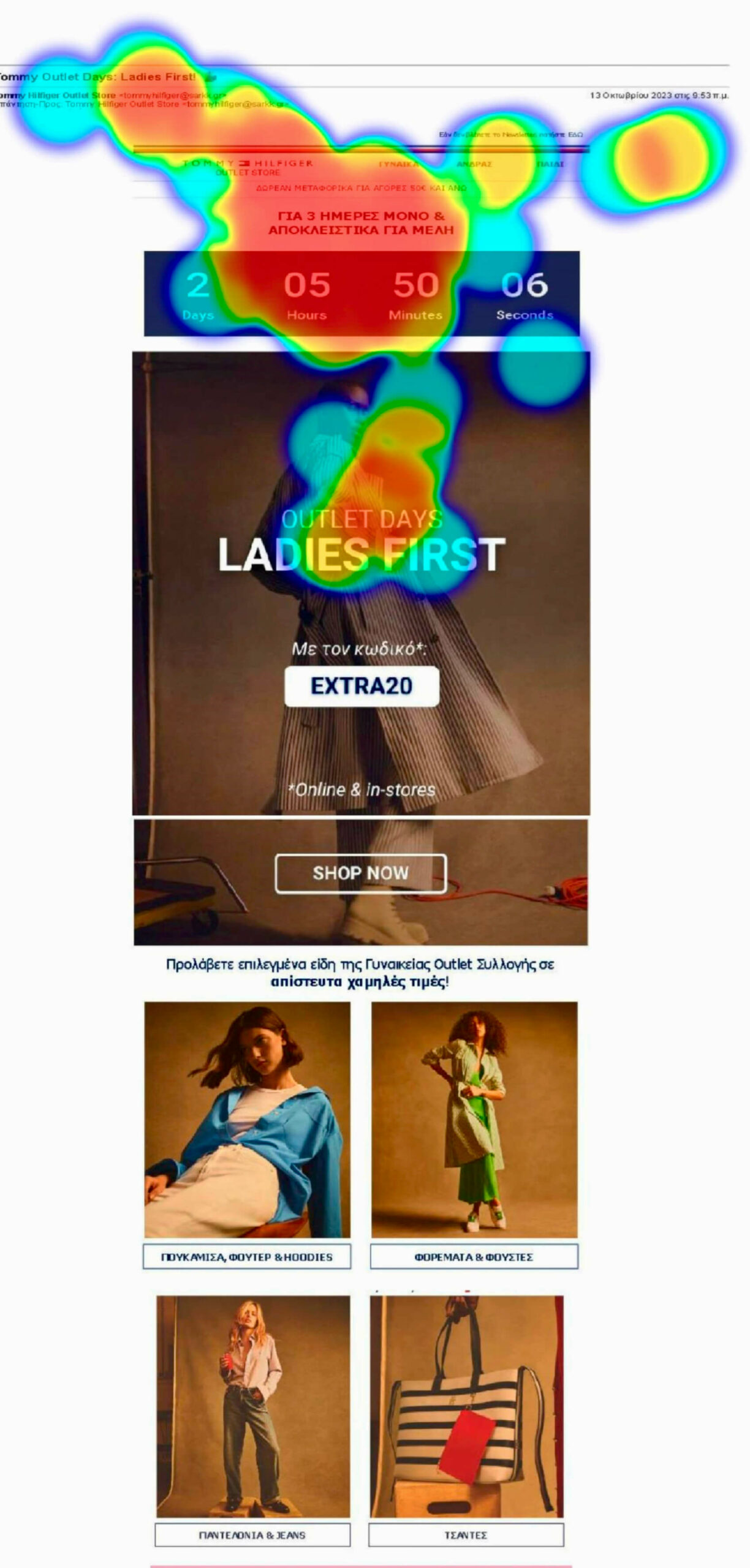
In fact, an eye-tracking study on promotional emails found that visually prominent elements received significantly more attention than smaller text blocks. Take a look at this heatmap showing where viewers’ attention goes:
Email countdown timers come in two main formats: HTML and GIF timers. Understanding how these two differ helps you choose the right type of timer for your campaign.
GIF vs. HTML countdown timers
GIF timers are animated images. They loop through pre-made frames to simulate a countdown. You can easily create a GIF email countdown timer with any GIF tool. They display correctly in almost every email client.
The downside is that they’re not truly real-time. The numbers don’t adjust based on when the email is opened.
On the other hand, an HTML countdown timer for email is generated by a server and updates when the email is opened. As such, it displays the exact remaining time in real time. This accuracy is perfect for short, time-sensitive campaigns.
However, we’d like to note that some email apps like Outlook may block HTML timers. If that happens, a backup static image usually shows instead.
Here’s a side-by-side comparison of HTML vs. GIF timers:
| Feature | HTML/live timer | GIF timer |
|---|---|---|
| Accuracy | Counts down in real time | Fixed animation, numbers don’t adjust according to the time the email was opened |
| Works in email apps | Some email clients, like Outlook, may block it and if blocked, the timer won’t update | Works in all apps |
| Setup complexity | Requires a third-party tool to generate the live timer | Can be created with any GIF tool |
| Best for | Short, urgent promotions | Longer campaigns, product launches, or newsletters |
| Backup display | Shows a static image with the final deadline if email apps block the live timer | Always plays as intended, no backup needed |
Why use a countdown timer in an email?
Countdown timers are a simple but powerful way to urge subscribers to take action. A well-placed email countdown timer shows exactly how much time is left for an offer or event.
This creates pressure to act fast. Guide your subscribers to click links, explore products, or complete purchases before time runs out. Let’s break down why they work.
Create urgency and trigger FOMO
An email countdown timer triggers emotions like FOMO (fear of missing out) and anticipation, which directly increases purchases. A 2025 study of 303 online shoppers found that limited-time discounts are strongly linked to emotional reactions like urgency and desire to act.
The emotional response to time-limited offers depended on how compelling people found the deals and whether shoppers saw these offers as more valuable and trustworthy.
Improve click-through and conversion rates
A countdown timer email does more than create urgency. It can also directly improve metrics like click-through rate (CTR) and conversions.
According to 2024 campaign data from Zigpoll, emails that included an email countdown timer saw an average of up to 20% improvement in overall conversion rates and a 10–25% higher click-through rate (CTR) compared to emails without timers.
In practical terms, this results in more subscribers clicking through to product pages, more completed checkouts, and fewer abandoned carts during limited-time promotions.
Even a 10% increase in CTR can translate into thousands of additional visits for large email lists. When more visitors convert, campaign revenue grows.
Make your campaigns more visually engaging
An email countdown timer makes your email design more dynamic. Most marketing emails are static but a timer adds movement and contrast. This contrast helps the promotion stand out from the rest of the content, while the timer improves visual hierarchy.
Visual hierarchy is the order in which people notice things. When placed near the headline or above the CTA button, the timer becomes a focal point. The reader’s attention moves from the timer to the offer, then to the button.
Your email countdown timer can also break up blocks of text and make the deadline clearer. Instead of reading a sentence like “Offer ends soon,” subscribers see the exact time remaining. When used correctly, it supports the layout rather than overcrowding it.
Boost participation in giveaways and contests
Contests and giveaways often run for several days, and some people may delay entering. An email countdown timer shows the exact time left, making it easier for subscribers to decide when to enter.
For marketers, timers ensure all reminder emails display the same deadline. This means that the countdown timer automatically counts down to one set end time in every reminder email. This reduces confusion about when the contest closes, ensuring smooth operations from start to finish.
How to create a countdown timer in an email with Omnisend
Creating a countdown timer for emails can be complicated and time-consuming. However, you don’t need to code one from scratch. Omnisend’s drag-and-drop email editor and Custom HTML content block make the process straightforward.
Email timers are built using HTML code from tools like Sendtric. To display the timer in your email, the code must live inside a block that supports HTML. Omnisend’s editor has a dedicated block for this: the Custom HTML content block.
To locate the HTML block, simply open the Omnisend Email Editor, click on Add elements, and locate the HTML block:
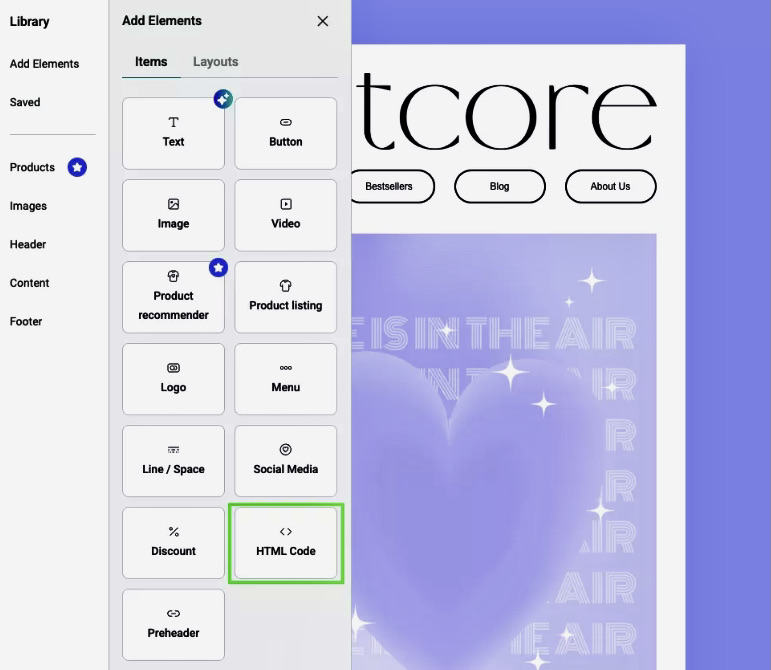
Follow these steps to get your email countdown timer up and running:
- Open your campaign in Omnisend and drag the Custom HTML content block into your email template
- Go to Sendtric.com and create your timer (Sendtric requires a paid subscription to generate active timers)
- Set your deadline, customize the design, and click Generate
- Copy the email countdown timer HTML code provided by Sendtric
- Paste the code into the Custom HTML block inside Omnisend, and click Save
- Before launching the campaign, send a test email to yourself to see how the email countdown timer is displayed
By carefully following these steps, you can create your mail timers in minutes.
Free email countdown timer tools
If you’re looking for a simple, no-cost way to embed a countdown timer in email campaigns, EmailCountdownTimer.com is your best choice.
Unlike many paid services, it doesn’t require you to sign up or create an account. You can jump straight into building your timer.
The tool is very beginner-friendly. You don’t need any advanced setup. Everything is done in just a few clicks. You can also fully customize your timer.
Once you finish, the platform instantly generates both HTML code and a GIF version of your timer. You can copy either one and paste it directly into Omnisend’s Custom HTML content block — the same way you would with paid countdown tools.
Here’s a preview of the platform:
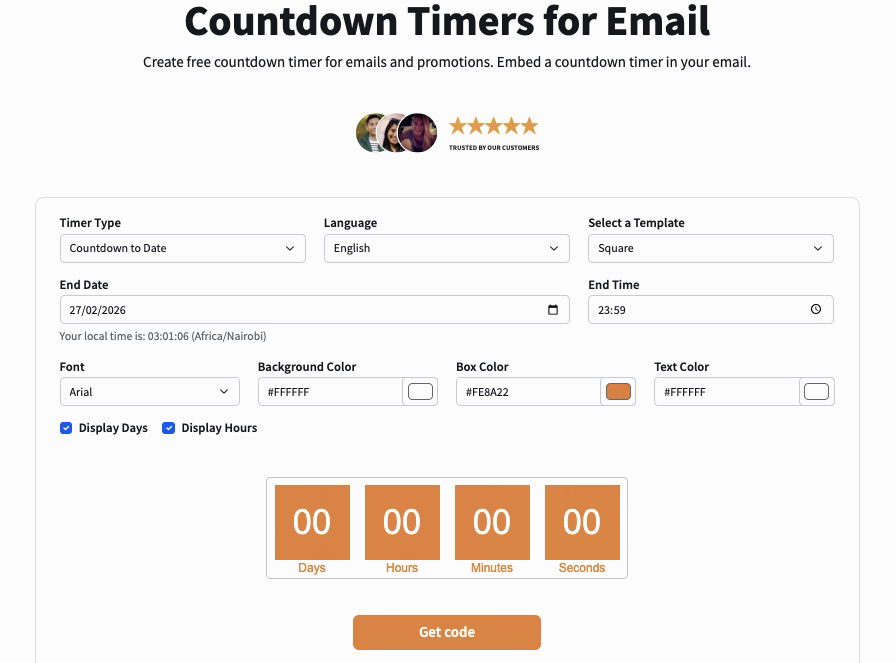
Omnisend’s free plan also provides access to all ecommerce-focused email features, including the custom HTML block needed to embed a countdown timer in email.
Using countdown timers in automated workflows
An email countdown timer isn’t limited to just promotional campaigns.
In Omnisend, you can add a countdown timer to other email workflows, like:
- Cart abandonment
- Browse abandonment
- Welcome emails
- Win-back sequences
These workflows are triggered by specific customer actions. For example, a cart abandonment email is sent automatically after someone leaves items in their cart.
When you place an email countdown timer in that automated email, the timer starts when the email is sent. Since the email is triggered by the customer’s action, the deadline is directly connected to that action.
Each subscriber receives the same offer, but the timing aligns with when they entered the workflow. Unlike standalone timer tools used in bulk campaigns, Omnisend lets you use countdown timers within behavior-based automations.
Since the offer feels more relevant and timely, more subscribers are likely to complete their purchase and turn into repeat customers.
When to use a countdown timer in email
Not every email needs an email countdown timer. Use it when you want to implement a fixed deadline. For example, a sale ending at midnight, a price increase, or an event registration closing. An email countdown timer makes these deadlines visible and harder to ignore.
Let’s break down when to use countdown timers in your email marketing campaigns, along with examples.
Sales and flash promotions
Flash sales have very short time windows, often lasting only hours instead of days. An email countdown timer shows the exact remaining time, helping customers visualize how much time is left to claim the promo.
For example, The Popcorn Factory sent an email that emphasizes free shipping on all products, including a countdown to the final hours.
In this design, the countdown sits near the top of the message above the discount details. This placement ensures people immediately see the remaining time and how much they can save, making them more likely to act quickly:

Cart abandonment emails
A countdown timer in abandoned cart emails helps turn passive browsers into active buyers. It works well because it breaks through procrastination and compels the customer to act before the incentive expires.
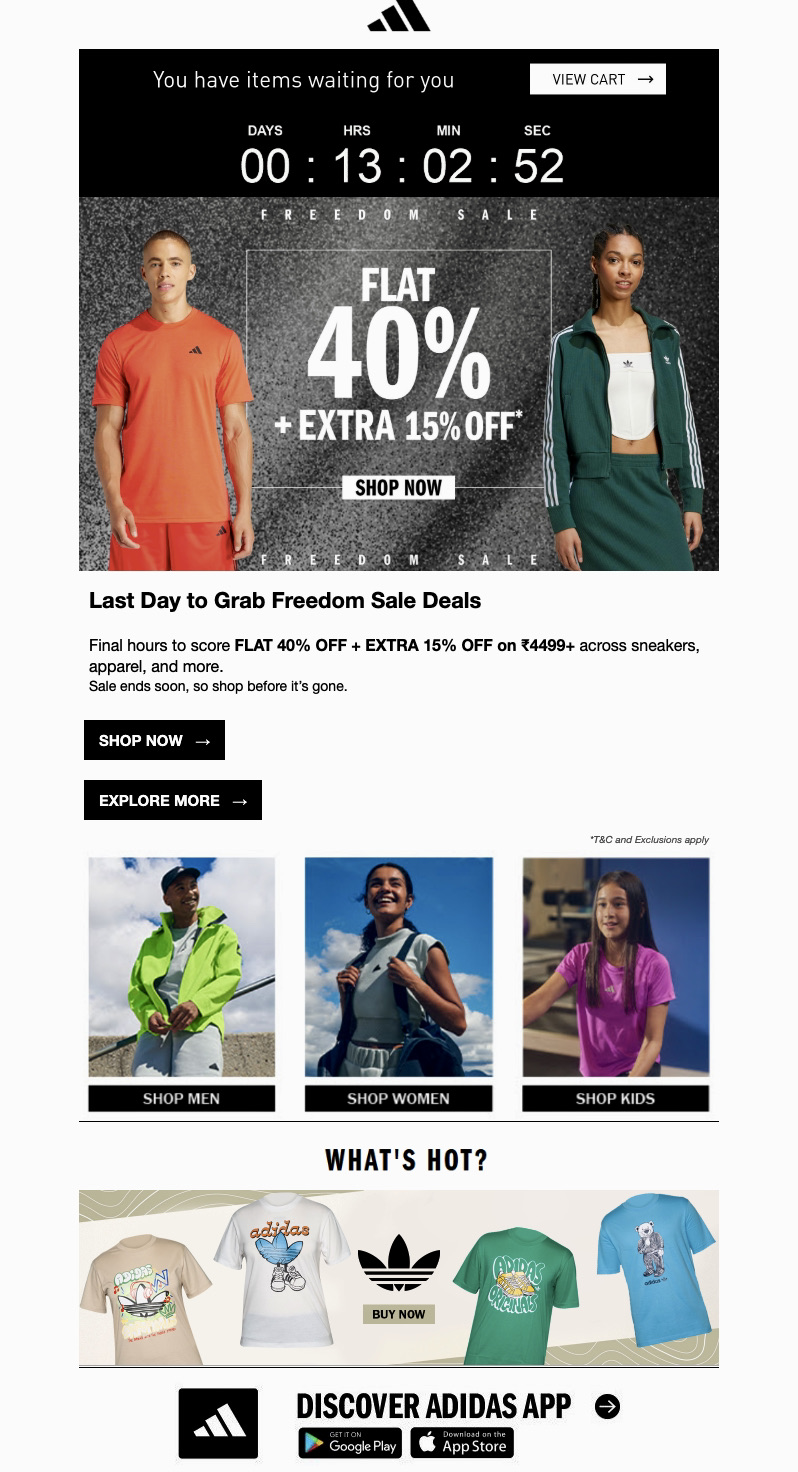
For example, Adidas’ Freedom Sale email first reminds users of items left in their cart, then shows a countdown for the discount. This works because the subscriber has already shown interest in the item.
It frames the abandoned cart items within a larger, exciting event. The customer feels like they’re missing out on a bigger opportunity, not just the items they left in their cart:
Black Friday and Cyber Monday emails
Countdown emails perform well on Black Friday/Cyber Monday because shoppers expect big deals during this time. Seeing an email countdown timer turns that expectation into immediate action.
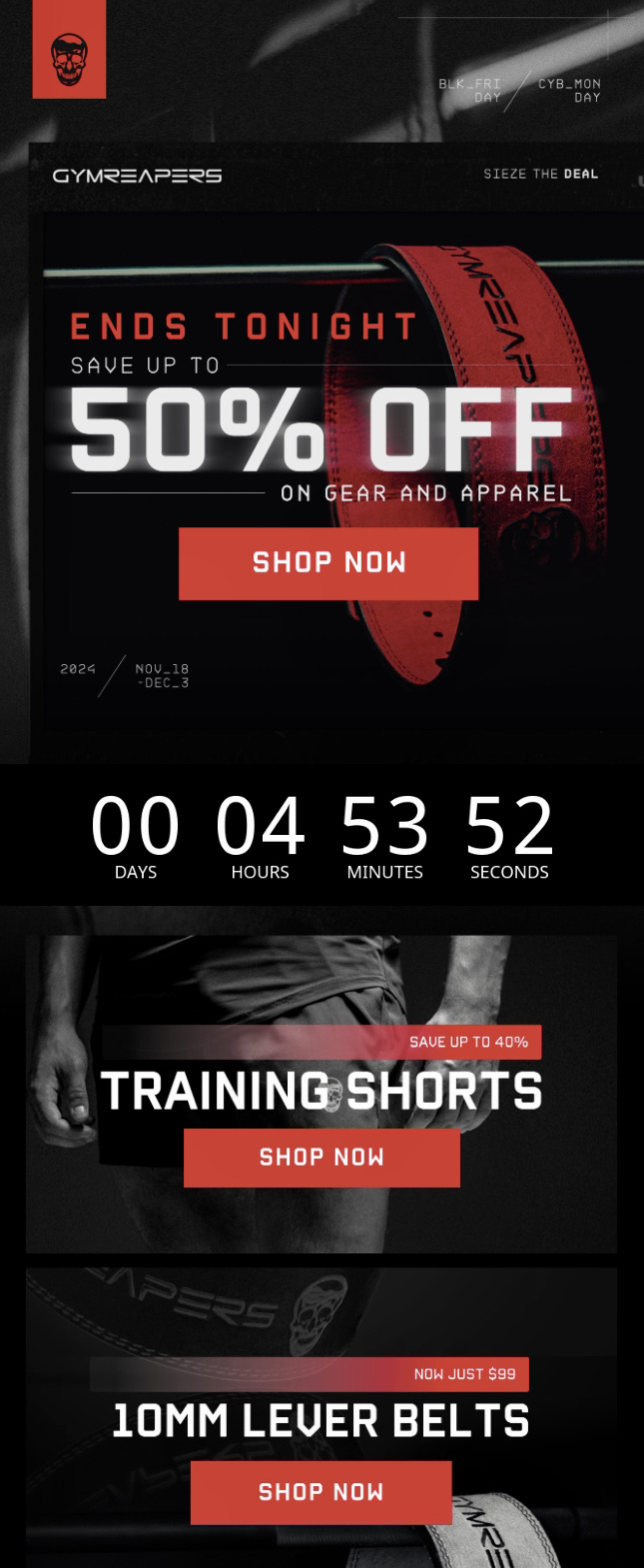
For example, Gymreapers’ Black Friday email places the countdown timer directly under the “Ends Tonight” copy. This placement ties the urgency to that specific deal, making it clear what’s expiring before customers scroll to the other offers in the email:
Special occasions and holidays
During these times, shoppers naturally expect deals and offers, and they’re often ready to buy. Adding a countdown timer helps your email stand out in a crowded inbox and urges immediate action and purchases.
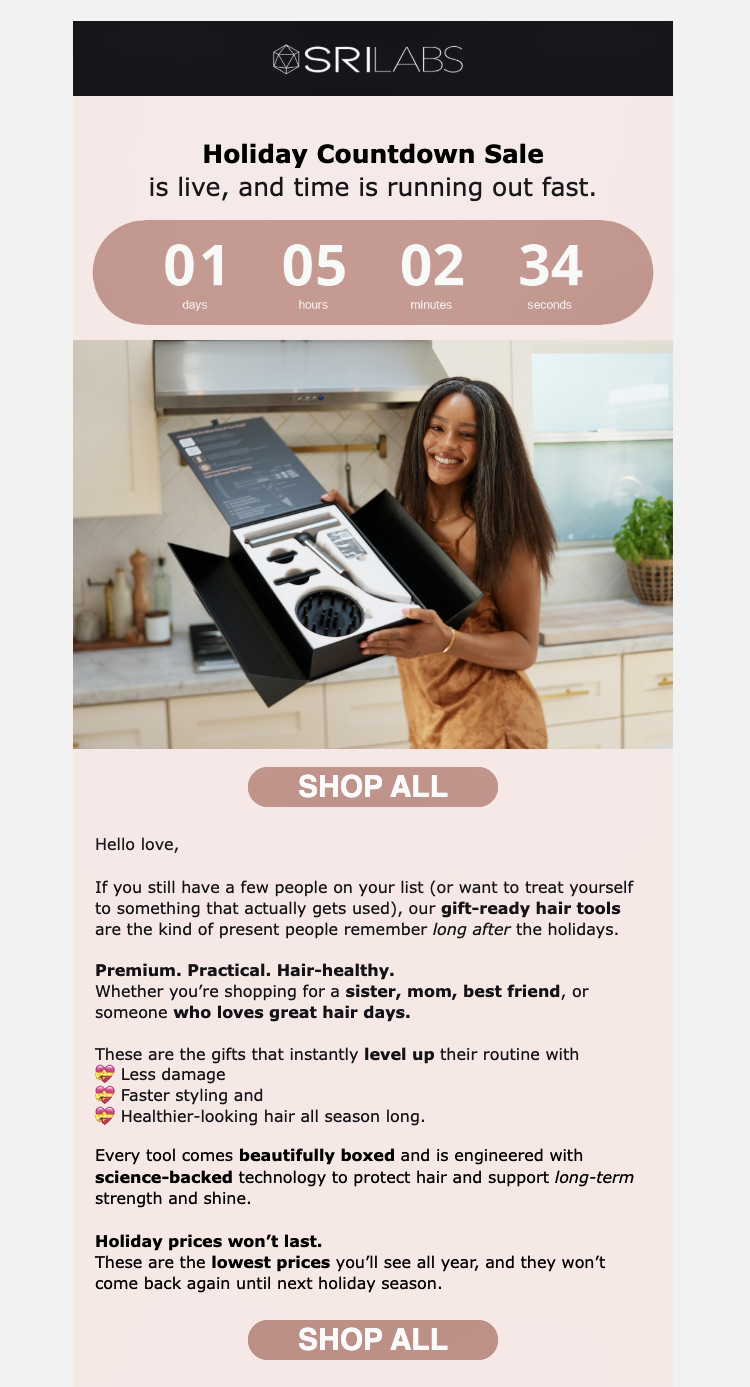
In Skin Research Institute’s email, the subject line, “Lowest Prices of 2025 – End Soon,” immediately signals a deadline, prompting subscribers to open the email. Moreover, the timer is placed under the “Holiday Countdown Sale” header.
To further urge shoppers to take action, this is followed by personal and gift-focused copy which provide emotional motivation to act:
Pricing changes
Businesses often raise prices when promotional or introductory offers end, when demand is high, or when costs go up. An email countdown timer works for price changes because it shows exactly how much time subscribers have to buy at the current rate.
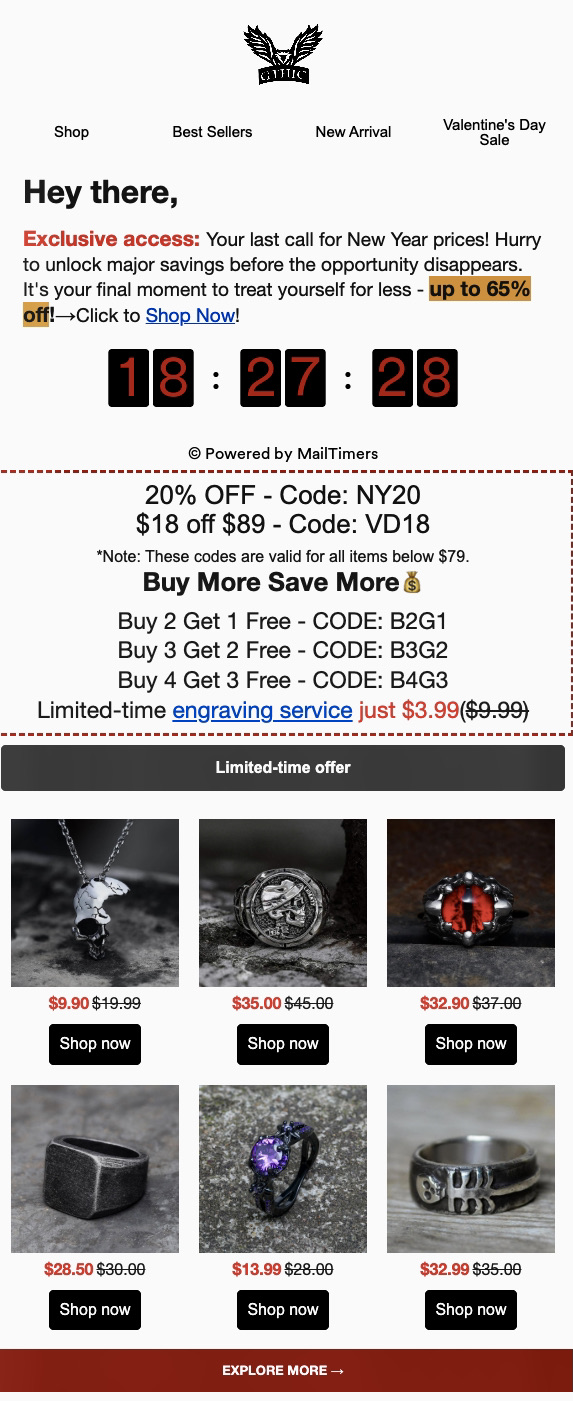
In Gthic’s email, the copy uses phrases like “Your last call for New Year prices” and “Final moment to treat yourself for less.” These phrases turn the countdown into a last-chance reminder to avoid paying more later.
The email countdown timer is placed early, so customers see it before the email’s images and promo codes. This positions the time limit as the primary reason to act:
New product launches
Countdown emails work well for new product launches because they build anticipation and show exactly when a product will be available. It can also pair this future release with an immediate action from subscribers, such as signing up for early access.
Aside from building excitement, this approach helps brands acquire new customers by encouraging interested subscribers to join early access lists or SMS updates before the product goes live.
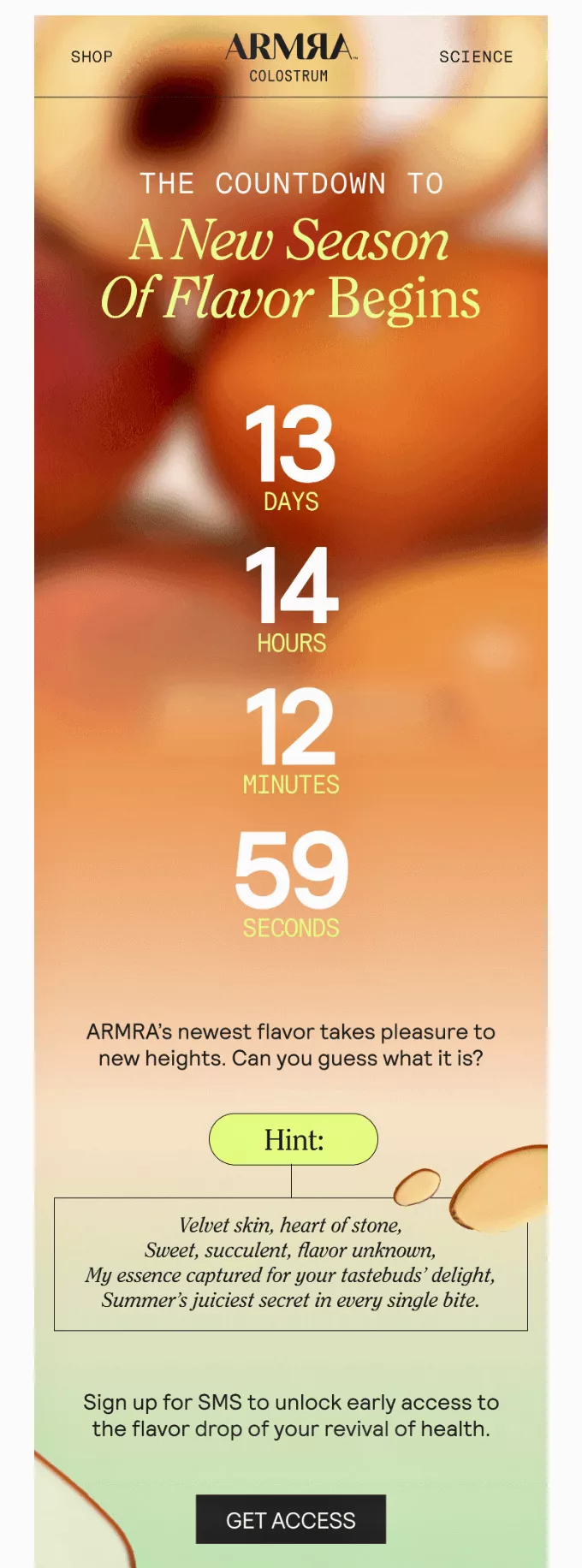
The ARMRA email below teases its upcoming summer flavor. It places an email countdown timer front and center to signal how many days, hours, and minutes are left until the launch. Below it, a CTA invites shoppers to sign up for SMS to unlock early access:
Events and webinars
Countdown emails are perfect for events and webinars because they show exactly when registration closes or the event starts. Seeing the ticking clock prompts subscribers to sign up on time to avoid missing out.
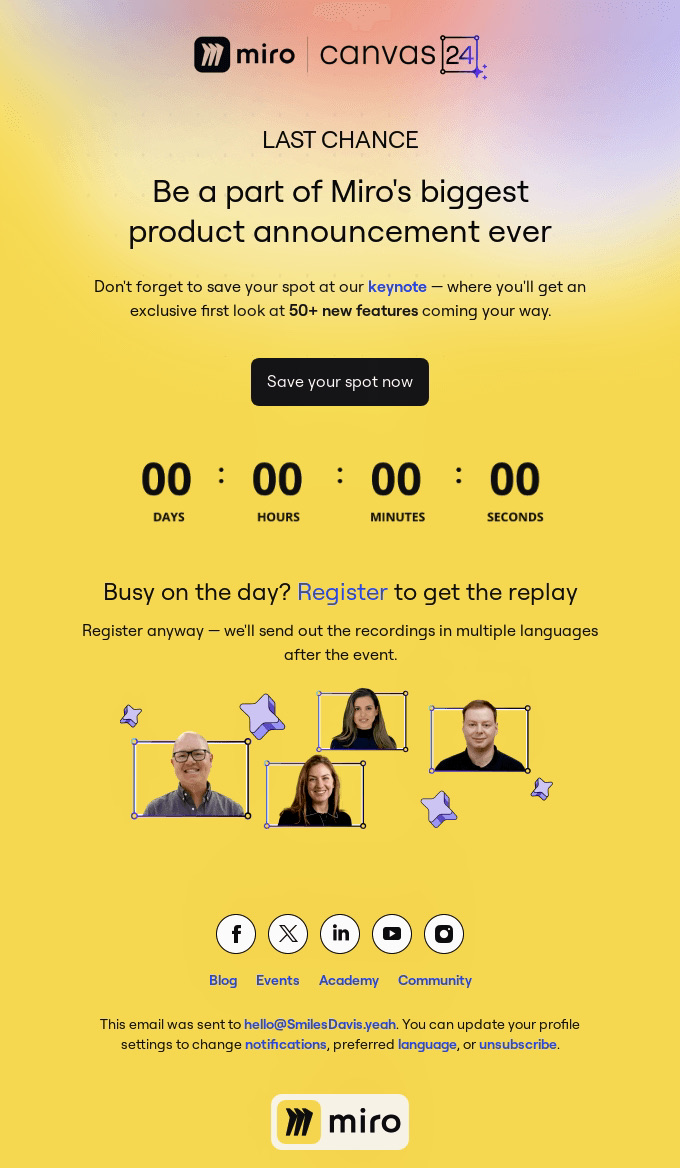
For example, Miro’s email first highlights the scale of the event with statements like “biggest product announcement ever” and “50+ new features.”
Then, the email countdown timer appears right after the “Save your spot” CTA, reinforcing urgency at this decision point. Below the timer, they add “Busy on the day? Register for the replay.” This helps keep registrations high by offering a way for busy subscribers to participate:
Tips to succeed with email countdown timers
The countdown in your email helps turn subscribers’ hesitation into clicks, signups, or purchases. This helps you achieve better ROI from your email campaigns.
An effective email countdown timer helps subscribers instantly understand these three things:
- When the deadline is
- What happens when it ends
- What they need to do next
If the email countdown timer is hard to see, placed too low in the email, or not clearly tied to the offer, people won’t feel encouraged to take action.
Additionally, design, placement, and timing matter. Your timer must reflect a real deadline and stop when the offer ends. For instance, if your offers/promotions keep running after the deadline, subscribers will notice. This can damage credibility and trust.
Follow the email countdown timer tips below to increase conversions in your next campaign.
Position your countdown timer at the top of the email
Place your countdown timer near the top so subscribers see it right away. Many people scan emails before reading the copy. If the timer is buried in between product images or copy and instantly visible, urgency is lost.
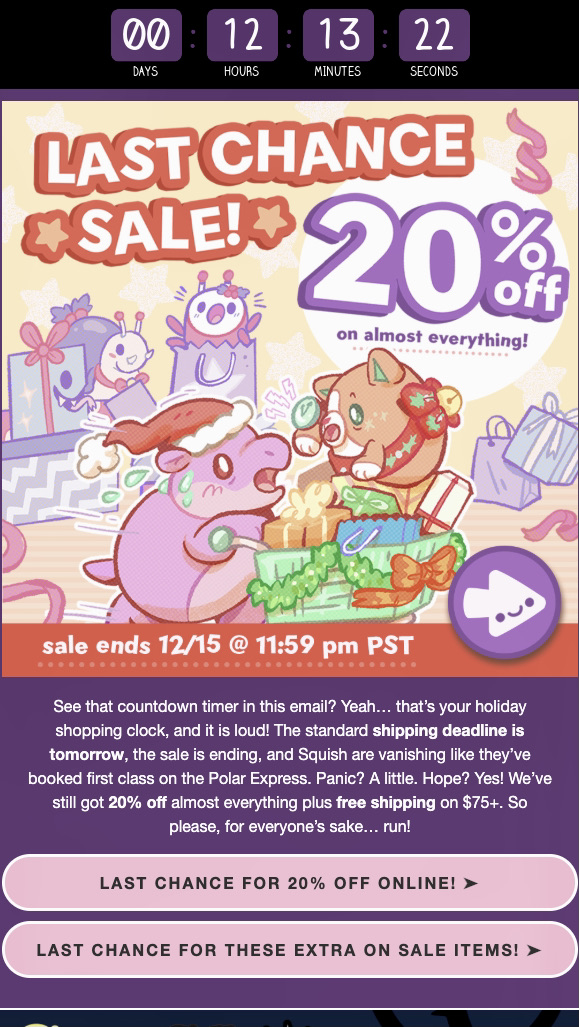
In Squishable’s Last Chance email, the timer sits just below the main headline and above the product blocks. With this placement, the deadline becomes the first thing people notice.
By leading with urgency, the email naturally guides readers toward the email CTA and featured offers. The main promotional offer of 20% off and free shipping over $75 is clearly tied to the ticking clock.
The email copy explains why the timer matters and shows what’s at stake. It informs recipients that the promotions are slipping away. This emphasizes the urgency and helps increase clicks:
Use a subject line that incites urgency
When creating countdown emails, include a compelling subject line that captures the receiver’s attention. This will entice recipients to open the email and act when they can.
Using words like “urgent,” “hurry,” or “limited time” will encourage people to click on the link and make the purchase.
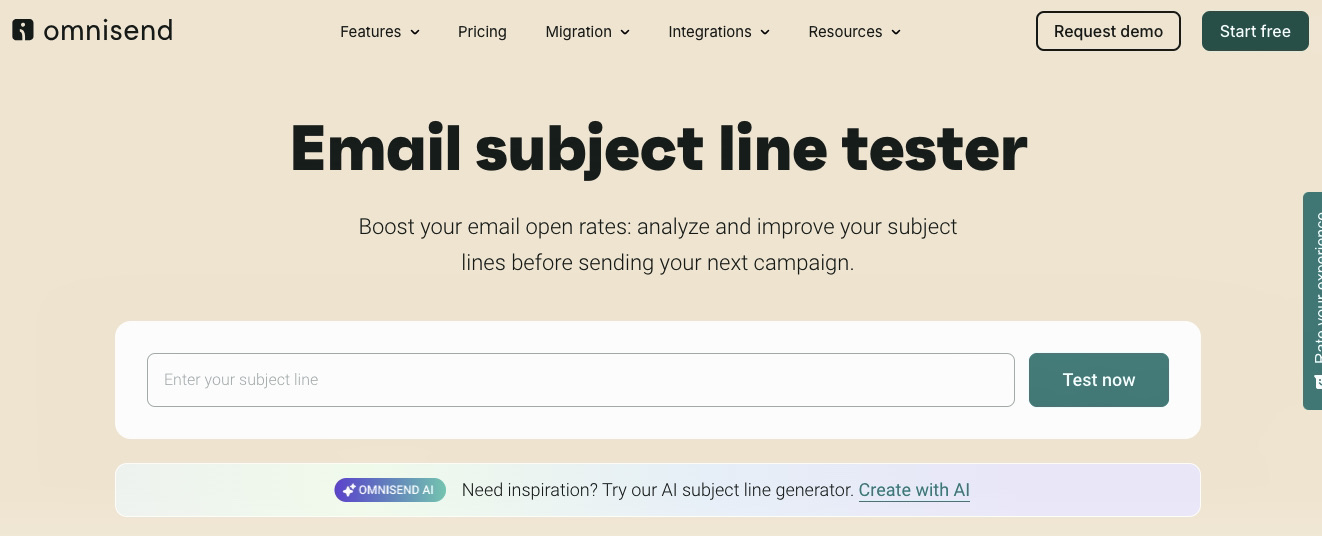
To make sure your subject line is optimized, you can test it with Omnisend’s free subject line tester. This tool helps you check the effectiveness of your subject line before sending your campaign:
Use a clear CTA button
Your countdown emails must include a clear, prominent CTA button.
It should be easily visible and stand out from the rest of the email so people can quickly click on it and take advantage of the offer or promotion.
A good practice is keeping your CTA button below the countdown timer. Also, include a clear and effective conversion-focused message.
Use countdown timers for email sparingly
To make countdown emails more effective, it’s essential to strike a balance between creating excitement and urgency. Avoid overusing countdown timers in emails so they don’t lose their impact.
Too many countdown timers can annoy people, causing them to unsubscribe from your mailing list. Instead, it’s best to use countdown timers only during the most important events or promotions.
Test your countdown timer across email clients
Countdown timers, especially HTML timers, don’t always render the same in every inbox. This means that some email clients show a moving timer, while others freeze it and only show a still image.
For example, Gmail, Apple Mail, and Yahoo can usually play live timers correctly. However, Outlook may not fully support HTML email countdown timer code. Even if the animation settings are “on,” the timer might freeze or show only a single frame.
Instead, you can use a GIF fallback. It may not be live code, but it still moves and shows the countdown visually.
To avoid these surprises, always test your email countdown timer before sending. Send previews to Gmail, Apple Mail, Yahoo, and Outlook accounts. Check that the timer appears and moves as expected.
5 best countdown email examples
To understand why countdown timers work so well, it helps to look at how real brands use them.
Below, we’ll break down five countdown email examples from top brands. We’ll unpack what they did, why it works, and how you can apply the same strategy to your own emails.
1. Google
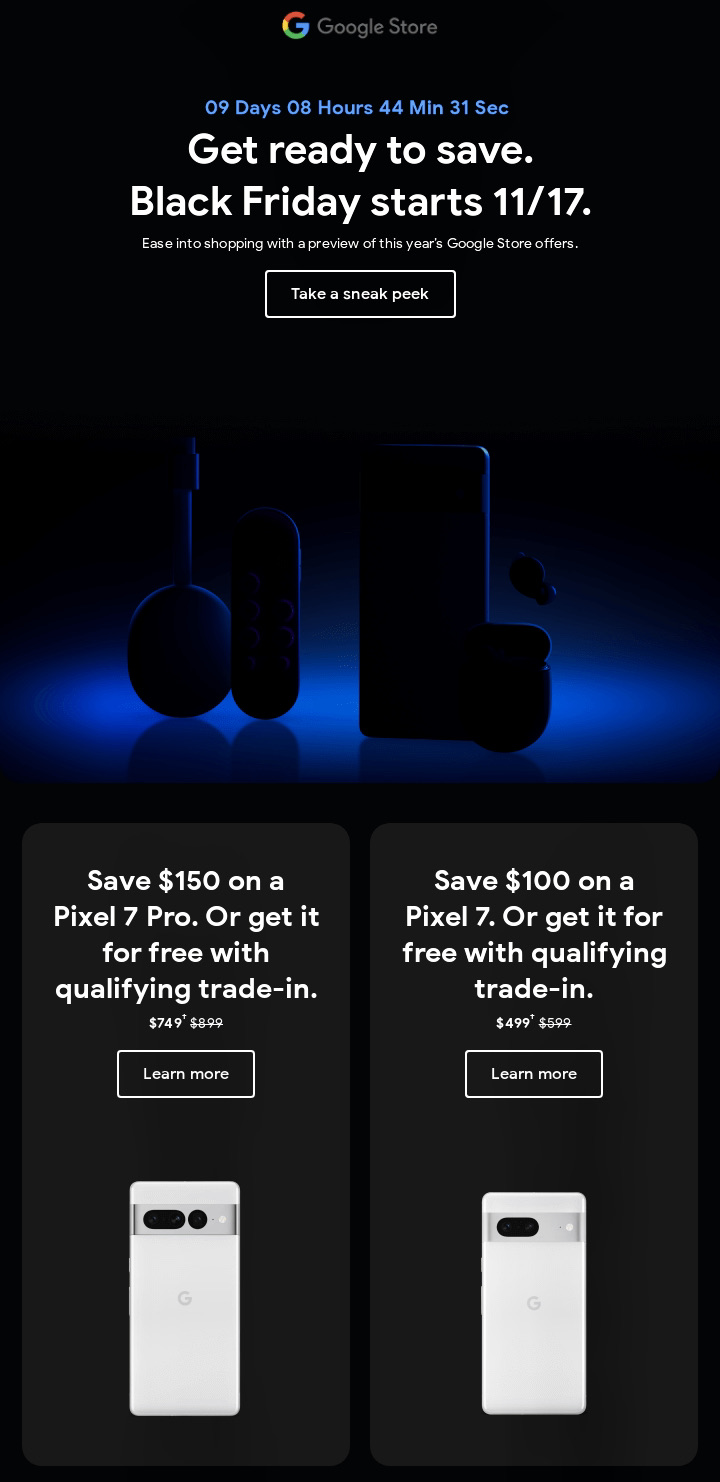
Google’s Black Friday email uses an email countdown timer with bold typography and minimalist, dark product silhouettes. It teases the sale instead of showing every detail at once.
This works because the countdown timer is placed at the top and immediately signals urgency, making the deadline impossible to miss. The dark, minimalist silhouettes also trigger curiosity.
When creating your own emails, use a clear countdown timer to signal deadlines and combine it with a teaser or sneak-peek approach. Keep visuals simple and bold, and limit calls to action to one or two. This balances urgency with curiosity without overwhelming your audience:
2. Kinn
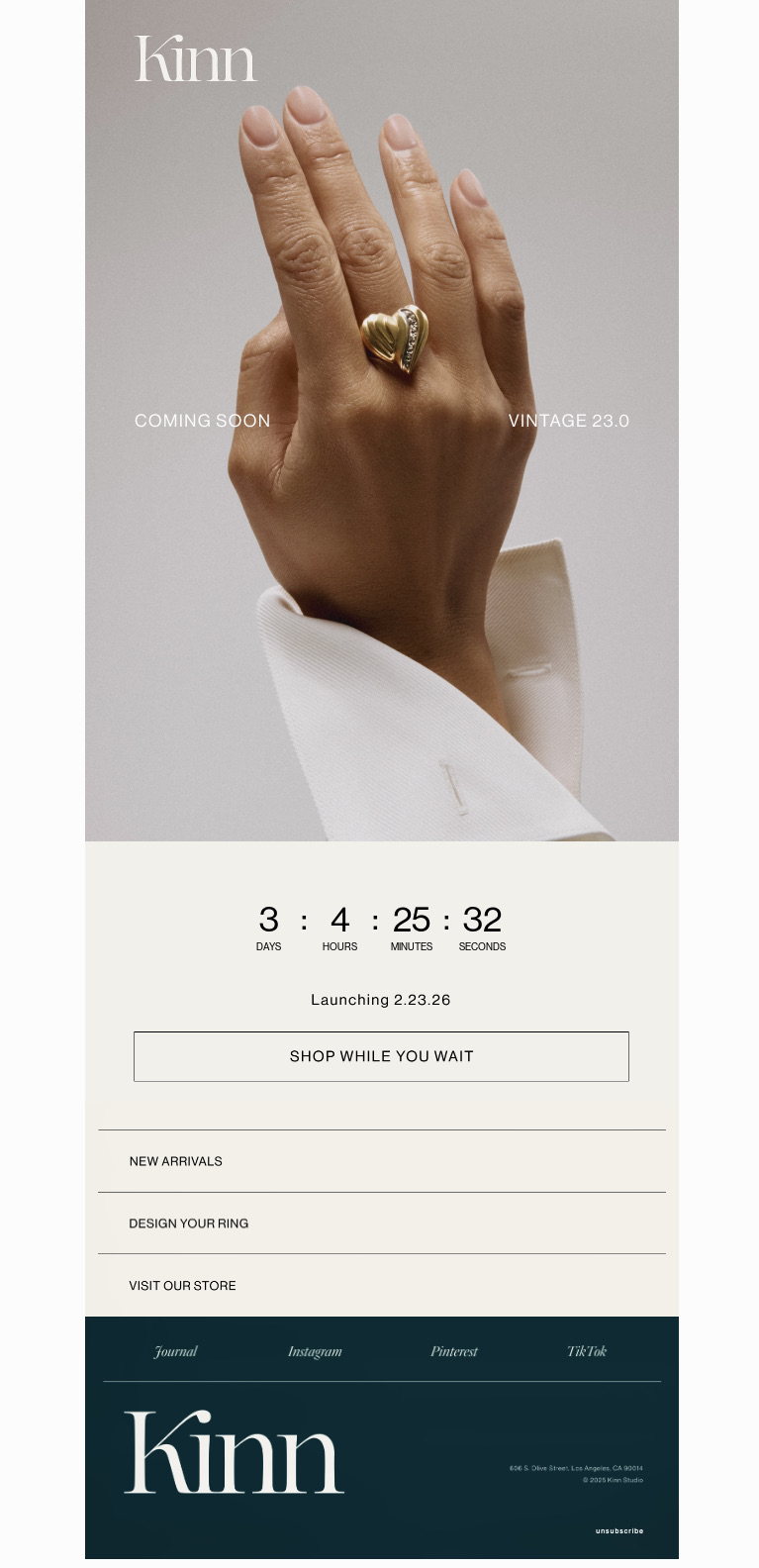
Kinn’s “Vintage 23.0” launch email is one of the best email countdown timer examples that signals a future release. It leads with a product image, minimal text, and white space around the timer and CTA.
The timer builds anticipation for what’s coming. Watching it count down makes shoppers excited for the launch, so when it finally goes live, people are ready to buy.
You can use your email countdown timer to emphasize when something starts, not just when it ends. Pair it with minimalist visuals and clear dates so people remember the release timing:
3. Chipotle
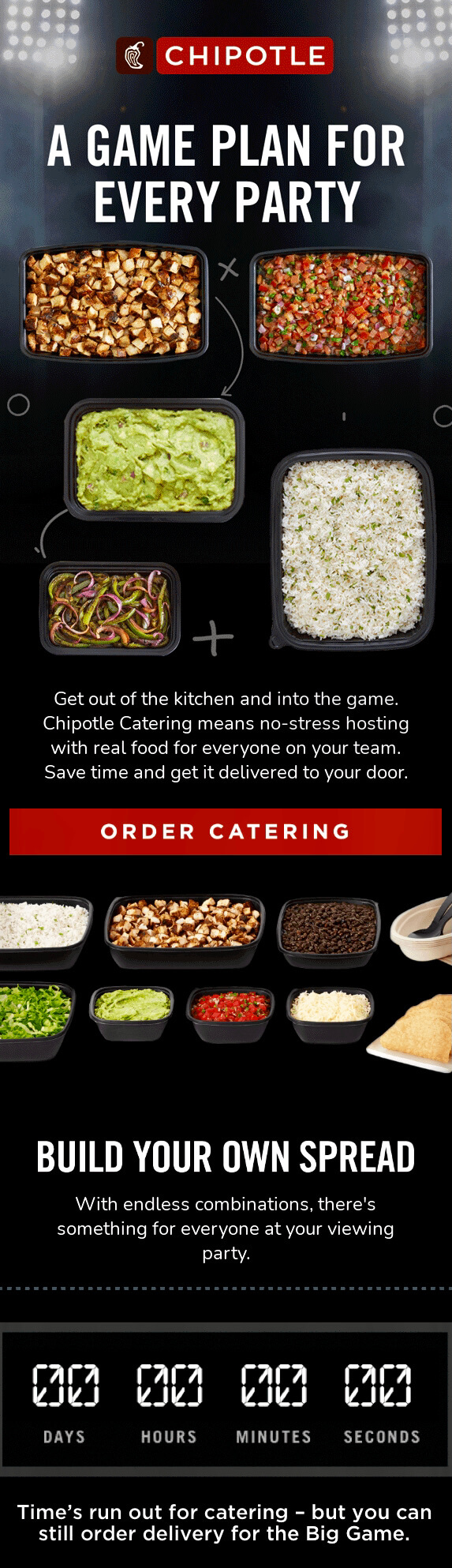
Chipotle’s game day email uses a visible countdown timer to promote catering as a hassle-free party solution. It entices subscribers with bold food photography, contrasting colors, and the highlighted copy, “Build Your Own Spread.”
The timer shows the offer is limited, nudging recipients to plan catering before the game. Coupled with playful visuals and clear instructions, it makes hosting feel easy and fun.
You can pair an email countdown timer with tangible benefits like time saved or convenience. Use bold visuals and one clear CTA. Make the experience feel simple and exciting, not stressful:
4. Cunard
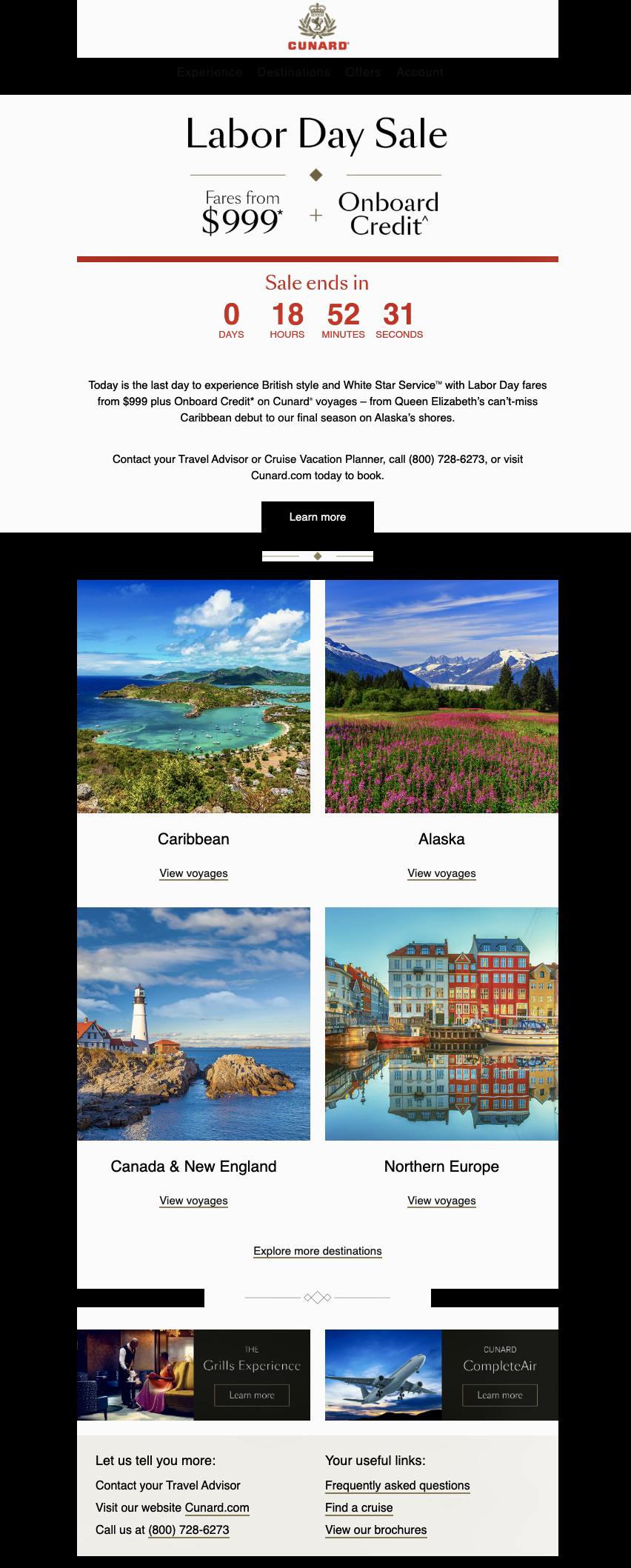
Luxury cruise line, Cunard, sent a Labor Day email showing a countdown timer after promoting limited-time cruise fares and onboard credit to urge readers to make a booking.
Vacations can take time to plan and budget for. However, the sale and the timer create a sense of urgency and trigger FOMO. The countdown email ties a desire (vacation) to a real deadline, encouraging subscribers to take action right away.
In your own email campaigns, tie your countdown timer not just to savings but a valued experience. Use clear pricing and compelling outcomes, such as perks or experiences, alongside the email countdown timer:
5. Alexis
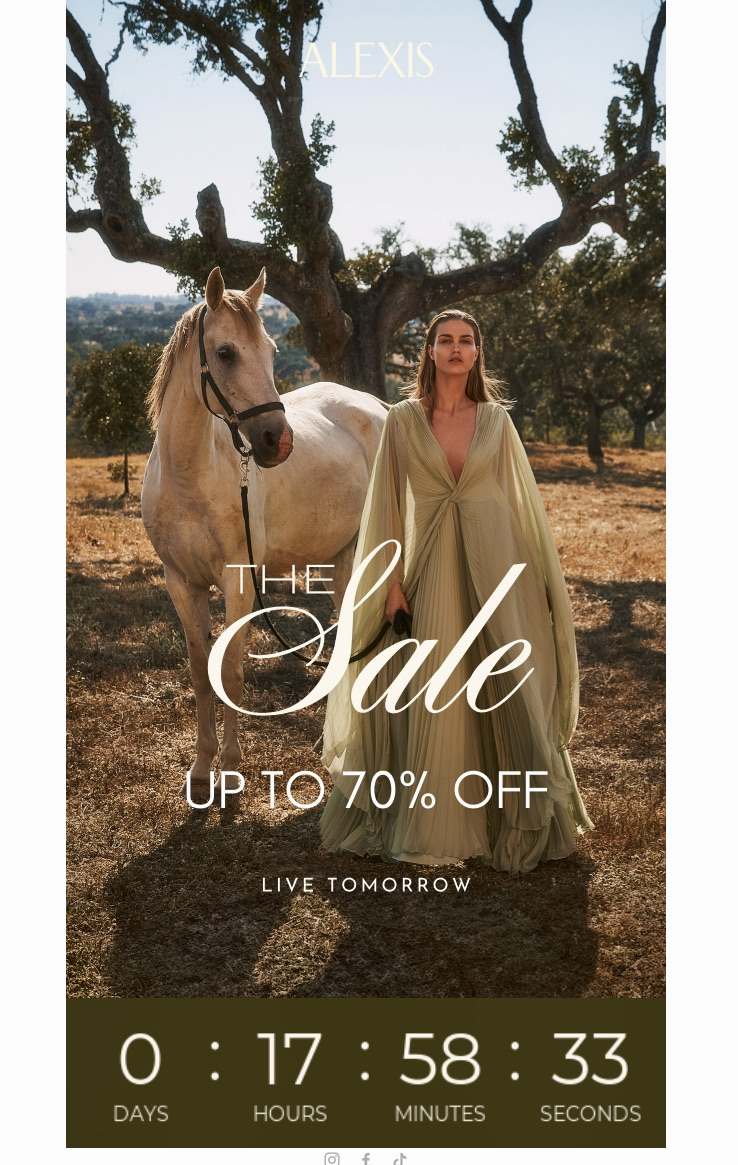
This email promotes a 70% off sale. The countdown timer appears just below a bold image with the copy, “Sale, up to 70% off, live tomorrow.”
By placing the email countdown timer below the image and announcement, recipients can see the value first. Then, the ticking clock signals the time until the deal starts, effectively creating anticipation. Note that this simple email removes any distractions.
When announcing a sale, you can use this format to capture attention early. This way, customers can prepare for the sale, which increases conversions because they don’t want to risk products going out of stock before they can get one:
Start using an email countdown timer today
An email countdown timer turns casual readers into motivated buyers. It highlights limited-time offers and helps increase engagement and email ROI.
It encourages subscribers to act quickly, whether it’s for abandoned carts, promo codes, product launches, event invitations, or birthday emails. Seeing the timer counting down creates a sense of urgency that motivates readers to take action before it’s too late.
With tools like Omnisend, you can use automation to ensure timers appear at the best exact moment for each subscriber, making your campaigns even more effective. You can also experiment with a free countdown timer for email or embed a countdown clock in email campaigns for specific promotions.
Quick sign up | No credit card required
FAQs
Yes. Many email marketing tools let you embed a countdown timer as an image or HTML snippet that updates in real time.
Outlook doesn’t support live timers directly, but you can use third-party tools like Mailtimers or Sendtric to add a GIF or HTML embed.
Gmail doesn’t support live timers natively, but you can use an external tool to generate a GIF or image-based timer and insert it in your emails.
A top free option is EmailCountdownTimer.com. You can set the end date, customize colors, and generate a GIF or HTML snippet in minutes. You don’t even have to create an account. Use it for promotions, sales, or events when you want a simple timer that works across most email clients.
Yes. Most email marketing platforms, including Omnisend, let you embed an email countdown timer in automated workflows. All you have to do is create the timer, add it to the template, and set the automation schedule.