Omnisend AI


 OFFER
OFFER








10+ businesses with the best loyalty programs [2025]
With over 130+ pre-built integrations and flexible APIs, you can easily centralize data from across your tech stack
Make the most out of your data and unlock powerful growth marketing possibilities with these other top marketing tools.
Build any custom integration with our open, flexible APIs that are simple to use and implement.
Check out apps that have been stealing all the spotlight.
Email and SMS marketing insights, ecommerce resources, and the latest Omnisend news
Expert-led sessions covering email, SMS, and ecommerce marketing strategies.
Educational video and live training to help you make the most out of Omnisend.
Drive sales on autopilot with ecommerce-focused features
See Features
Retention marketing is crucial for sustainable business growth as it focuses on nurturing existing customer relationships, leading to increased customer lifetime value and reduced acquisition costs.
Unlike acquisition marketing, which targets new customers, retention marketing leverages personalized communication and loyalty programs to engage and retain existing customers, resulting in higher profitability.
Effective retention strategies include personalized messaging, post-purchase follow-ups, and loyalty programs, all of which can significantly boost repeat purchases and customer satisfaction.
Tracking key metrics like retention rate and customer lifetime value is essential for evaluating the success of retention efforts and making data-driven improvements to marketing strategies.
Retention rate is one of the clearest indicators of a business’s health and sustainability. It measures your ability to build lasting relationships with customers, and when customers keep coming back, sales grow more predictably, and profits increase.
Higher retention also drives up customer lifetime value and shifts growth from acquisition-heavy to loyalty-led. That means you can scale without continually increasing costs to attract new customers.
This article breaks down retention marketing, how it differs from acquisition marketing, and why it’s essential for long-term growth. You’ll also learn proven strategies, key metrics, and real-world examples that show retention marketing in action.
Quick sign up | No credit card required
Retention marketing focuses on keeping existing customers engaged, satisfied, and coming back to buy again. Rather than chasing only new customers, it aims to strengthen long-term relationships that lead to consistent growth.
This marketing strategy aims to accomplish several objectives, such as:
Retention marketing and acquisition marketing both play important roles in building a sustainable business. However, they serve different purposes and require distinct strategies.
Acquisition marketing targets a broader audience that may be interested in your product. Conversely, retention marketing focuses on existing customers who’ve already used your services.
Acquisition marketing relies on channels such as social media advertising, search engine marketing (SEM), content marketing, and email acquisition campaigns to attract new leads. It also measures success using metrics such as customer acquisition cost (CAC), conversion rates, and brand awareness.
Retention marketing, on the other hand, uses email marketing, loyalty programs, and exceptional customer service to retain existing customers. It tracks progress through customer churn rate, customer lifetime value (CLTV), and repeat purchase rate.
While acquisition marketing tends to be more expensive, retention marketing is generally less costly. That’s because it targets a pre-qualified audience of people who’ve already used your products.
Here’s a comparison of acquisition vs. retention marketing:
| Aspects | Retention marketing | Acquisition marketing |
|---|---|---|
| Primary focus | Retaining existing customers | Acquiring new customers |
| Key metrics | Customer lifetime value, churn rate | Customer acquisition cost, conversion rate |
| Strategies | Loyalty programs, tailored communication, and customer feedback | Advertising, promotions, social media campaigns |
| Communication | Personalized | Broad |
| Timeframe | Long-term relationship building | Short-term, campaign-focused |
After comparing retention and acquisition side by side, the differences become even clearer when you look at cost, value, and long-term impact.
Retention marketing allows you to maximize the value of your existing customers by:
In ecommerce, the average customer acquisition cost ranges from $64 to $68, making retention a far more cost-effective way to drive repeat revenue.
In a recent report, 42% of sales leaders said recurring revenue from long-term customers was their biggest revenue source, shifting the focus from one-off transactions to long-term stability.
Tools like AI-powered personalization can help deliver relevant recommendations, which 64% of USA shoppers say have improved their retail experiences, further increasing conversion rates for returning customers.
If you want recent proof that retention is getting more “intent-driven,” the Omnisend 2026 Ecommerce Marketing Report shows a clear pattern: open rates continued rising, even as click rates declined — but click-to-conversion jumped 53% YoY, meaning fewer clicks, but higher-intent buyers when people do click. That’s one reason retention messaging works best when it’s personalized and timed to behavior rather than sent as broad blasts.
Understanding how to calculate the retention rate is essential for ecommerce marketers seeking insights into customer loyalty. It shows how well your business retains customers. This makes it a direct indicator of whether your retention marketing efforts are working.
While the calculation may look complicated at first, it’s simple once you understand the formula and know which customer data to use. In this section, we’ll cover the retention rate formula, walk through step-by-step instructions, and share a real example of retention rate calculation.
You’ll also get access to a free retention rate calculator and industry benchmarks to help you evaluate your results.
Tracking retention rate on a monthly, quarterly, or annual basis helps ecommerce businesses identify trends over time. It also measures whether your retention strategies, such as email automation, loyalty programs, or winback campaigns, are yielding positive results.
Retention rate is the percentage of customers who continue to buy from your business over a specific period. It shows how effectively your brand engages customers after their first purchase and encourages repeat buying.
It’s one of the most important metrics for ecommerce businesses because it directly impacts customer lifetime value, revenue stability, and the return on your marketing efforts.
Retention rate calculation is the process of measuring the percentage of customers, users, or employees who remain with a company or service over a specific period.
To calculate the retention rate, start by selecting a specific time period, then record how many customers you had at the start. Subtract new customers gained within that period from your ending total. Divide that number by your starting customers and multiply by 100 to get a percentage. Here’s the formula to use:
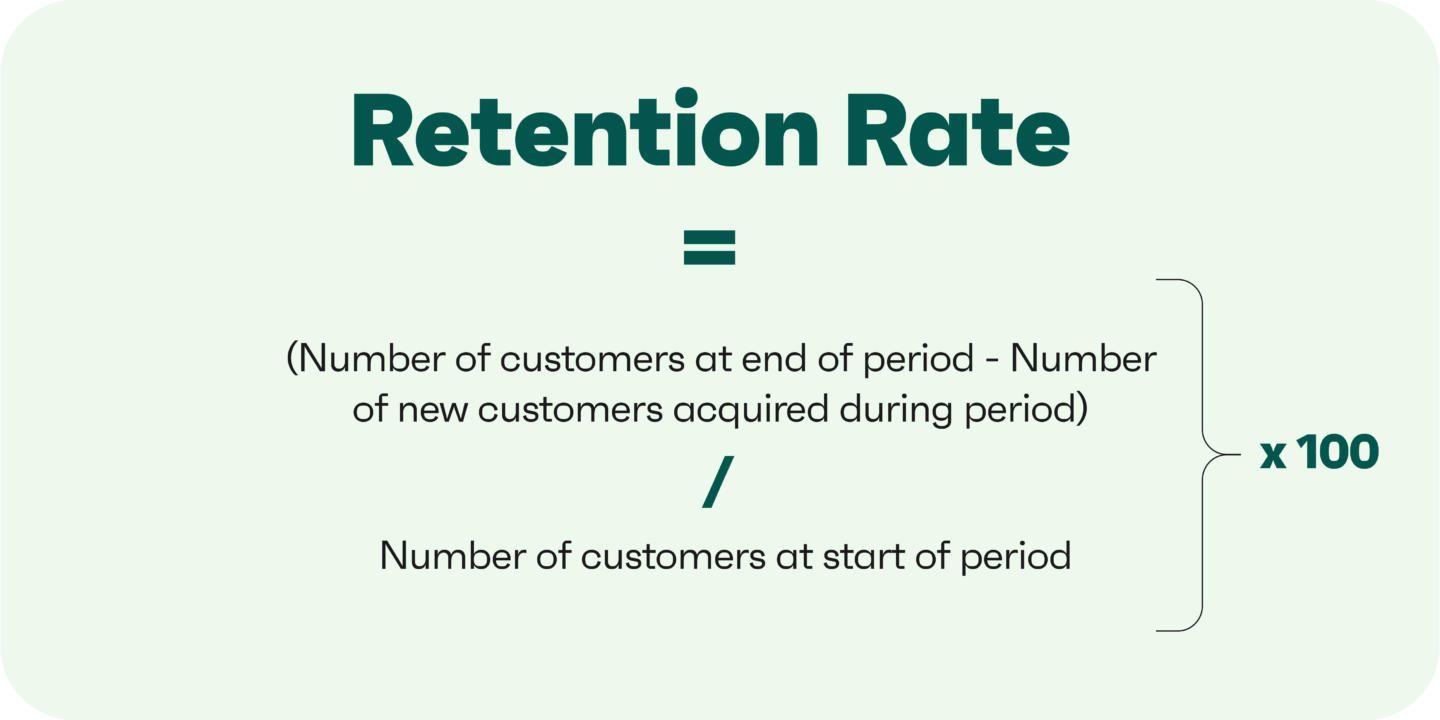
If you started the month with 1,000 customers, acquired 200 new customers, and ended the month with 900 customers, your retention rate would be: ((900 − 200) / 1,000) × 100 = 70%.
A retention rate calculator helps you measure how well your business is keeping customers without manually working through the formula. It simplifies the process, reduces the risk of errors, and saves time when analyzing performance. Simply enter the data for the selected period to instantly calculate your retention rate.
Measure how well you’re retaining users over time. Enter users at the start, users acquired, and users at the end of a period to calculate your retention rate.
Enter the number of users you had at the beginning of the selected period.
Enter the number of new users gained during this period.
Enter the total number of users you had at the end of the period.
–
Ensure to use the calculator with your business data to get an accurate view of customer loyalty and track how your retention strategies perform over time.
A “good” retention rate depends on your industry, business model, and the type of product you sell. There’s no single universal benchmark, but in most cases, a retention rate that meets or exceeds the industry average can be considered “good.”
Common benchmarks for ecommerce businesses include:
That said, industry benchmarks should be used as a reference point. It’s not a final verdict, so don’t feel inadequate if yours doesn’t measure up.
Retention rate is most valuable when tracked over time and compared against your own historical performance. This reveals whether your retention strategies are improving results. An optimal retention rate for your business will also depend on factors like purchase frequency, product type, and price point.
Here’s the average retention for different industries:
Your retention rate reveals a lot about how customers experience your brand and where your retention strategies may need improvement.
High retention rate indicators
A high retention rate usually indicates that customers are satisfied, see value in your products, and are willing to return after their first purchase. This translates into more predictable revenue, higher customer lifetime value (CLV), and lower marketing costs. You’ll spend fewer resources to bring in repeat purchases.
Low retention rate indicators
A low retention rate may signal friction in the customer experience, product quality issues, stronger competition, or underperforming retention strategies. Identifying the issue requires analyzing churn reasons, reviewing customer feedback, and closely examining purchase patterns to identify where customers drop off.
Here’s how to improve a low retention rate:
“To improve low retention rates, you have to stop looking at the exit and start considering your entry point. If the first impression you leave on customers is mediocre, everything that follows may feel like a sales pitch instead of a relationship.”
— Andrius Šeršniovas, Conversion Specialist at Omnisend
Tracking the right metrics is essential for measuring the success of your retention marketing efforts. Together, these metrics provide a complete picture of customer loyalty, engagement, and long-term business health.
They can also help you identify patterns and evaluate the impact of your retention campaigns. This way, you can make data-driven decisions to strengthen customer loyalty over time.
Retention marketing works across multiple channels, like email, SMS, and social media. However, the best strategy combines several channels. Below is an overview of six retention marketing channels to increase customer retention.
The above mentioned report also highlights why retention-friendly channels and triggers are pulling ahead: automations made up just 2% of email sends but drove 30% of revenue, earning 16× more per send than scheduled campaigns by hitting high-intent moments. And on the “direct line” channels, SMS click rates more than doubled YoY, while push automation conversion rates reached 22.9% — strong support for an email + SMS + push retention mix.
The next sections explore specific strategies for using each retention marketing channel effectively.
Quick sign up | No credit card required
While every retention marketing strategy aims to keep customers, effective ones go beyond basic reminders. They engage people on a personal level, based on their needs and buying behavior. Rather than relying on one-off campaigns, these proven approaches help you build ongoing relationships that drive repeat purchases and long-term value.
If you prefer a quick visual refresher, here’s a short Omnisend Academy video you can watch in under a minute to reinforce the core retention mindset before you implement the strategies below:
Personalized communication delivers relevant content based on purchase history, browsing behavior, and engagement signals. This approach works because customers are more likely to respond to messages that feel relevant to their interests.
Personalization thrives on behavioral segmentation, which makes it easier to identify loyal customers and reward them appropriately. When messaging is tailored to where customers are in the ecommerce lifecycle, you build relevance and drive long-term engagement.
Actionable tactics:
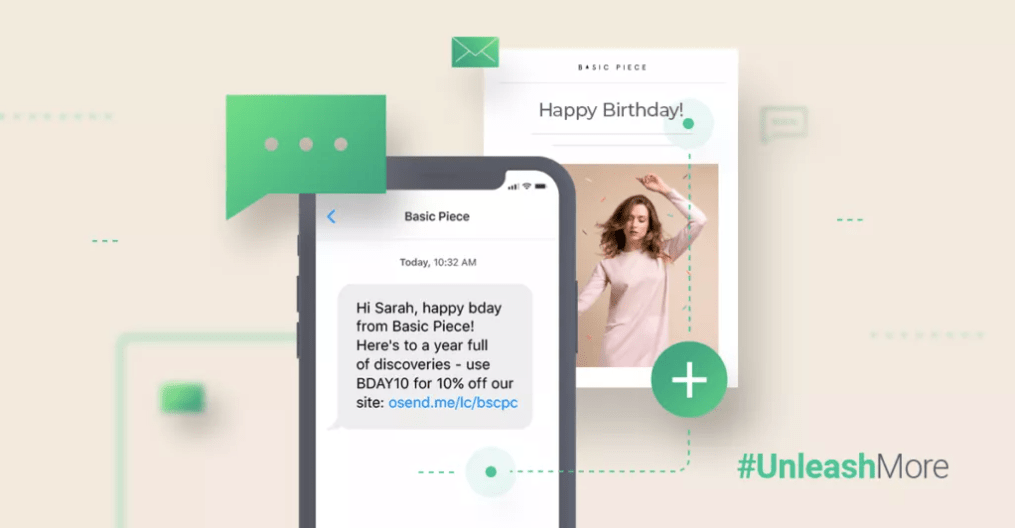
Staying in touch with customers after they’ve made a purchase is essential for both first-time buyers and repeat customers. It creates natural opportunities for additional sales, feedback, and trust-building.
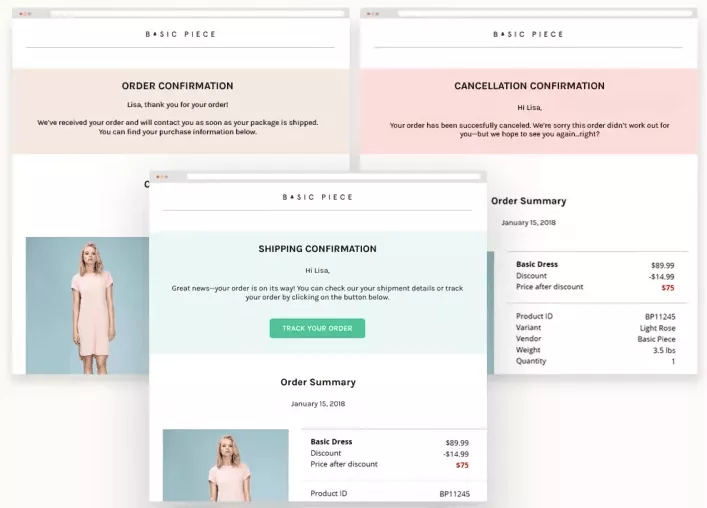
Relevant follow-ups, such as a thank-you message or product usage tips, reinforce the value of the purchase. Also, sending automated messages, such as order and shipping confirmations, as shown below, allows you to suggest complementary products that can drive repeat purchases.
Actionable tactics:
Loyalty programs are designed to reward repeat purchases while creating a stronger emotional connection with the brand. Customers are more likely to stay engaged when you reward them for being loyal. And referral programs add an extra growth lever by bringing in high-quality new customers through trusted recommendations.
When customers understand your loyalty and referral programs, it becomes easier for them to participate and deliver real value. Combining rewards with exclusivity helps customers feel appreciated and motivated to continue shopping with your brand.
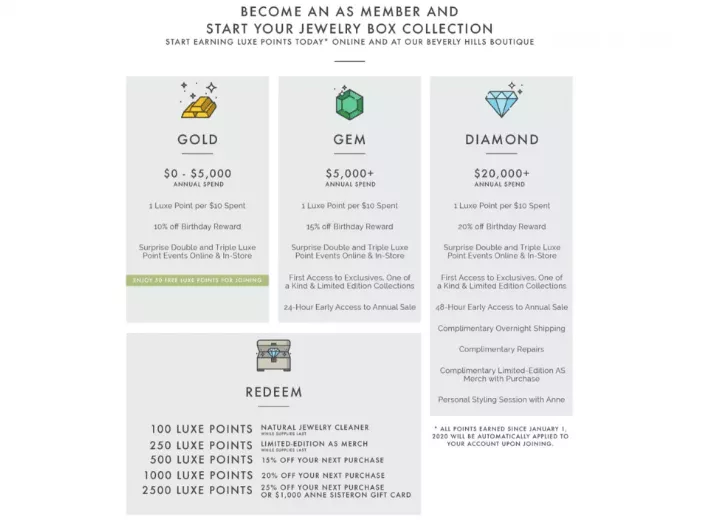
In the example below, Beverly Hills Boutique itemizes its rewards for customers based on their annual spend. The difference between each tier can motivate customers to increase spending and earn more rewards:
Actionable tactics:
With automated text messages and emails, your brand can deliver timely, consistent communication to a large audience without manual sends. Automated workflows are built to respond to real-time customer actions, helping your business save time and resources.
When messages are triggered based on customer behavior and lifecycle events, customers are engaged at every stage of their journey. This ensures that no opportunity, before or after a purchase, is missed.
Actionable tactics:
When customers haven’t purchased in a while, they may be at risk of losing interest. However, a winback email can help you re-engage them. It’s cost-effective and faster than acquiring new ones, especially since these customers already know your brand.
When timed correctly, winback campaigns can reignite interest and bring customers back into your active ecommerce lifecycle. You need to identify the right reactivation window based on how often customers typically purchase.
Actionable tactics:
Collecting feedback and reviews helps you understand how customers truly feel about your products and their experiences. When you act on those opinions, customers feel heard and valued. As a result, they’re more likely to stay loyal and continue buying from your brand.
Additionally, customers’ opinions give you direct insights into what’s working and what needs improvement. It makes it easier to optimize products, services, messaging, and the customer experience.
Actionable tactics:
Customers expect to reach your brand through their preferred channels and receive fast responses every time. This is important because responsive and reliable support builds trust, reduces frustration, and directly impacts whether customers return.
When support is easy to access and expectations are clear, customers can confidently buy again from your brand. Exceptional customer service also helps differentiate your brand from competitors and strengthens long-term customer relationships.
Actionable tactics:
Tracking retention metrics helps you understand which strategies are working and which customers may be at risk of churning. This approach allows you to optimize campaigns based on real customer behavior rather than assumptions.
With consistent performance monitoring, you can identify challenges early and adjust your retention strategies before issues escalate. We’ve covered the key metrics you should track in the previous section.
Actionable tactics:
Retention marketing strategies are effective when they work together, not in isolation. Start by implementing two or three tactics that align with your business model, purchase cycle, and customer behavior. Then expand as you gain insights from your data.
These customer retention examples from Omnisend showcase how real ecommerce brands successfully used retention marketing to achieve measurable results. You can draw inspiration from these stories and adapt similar strategies to increase engagement and retention in your own business.
Inglot Canada is a high-end cosmetics and beauty brand. Despite being a global brand, it struggled to connect its online store data with its physical retail locations to grow ecommerce sales.
To tackle this, Inglot implemented Omnisend’s email automation to deliver value-packed promotional emails. It also relied on customer purchase history to send relevant product offers and recommendations.
Later, the brand combined SMS and push notifications for its cart abandonment workflow. Customers who left items in their cart received a combination of email, SMS, and push notifications to capture them while they were still in a “shopping mood.”
The SMS and email combination resulted in a 2130% increase in revenue per message. There was also a 4798% increase in revenue-per-message for abandoned cart push messages. Overall, the automated workflow accounted for a 117% increase in conversion rates and 8% of annual email revenue.
Inglot proved that retention marketing isn’t centered around emails. You need to use data to meet customers on their preferred channels and when they’re ready to make a buying decision.
Rachel Riley, an award-winning British children’s clothing brand known for its traditional craftsmanship, faced the challenge of modernizing its marketing to meet the expectations of today’s shoppers.
The brand shifted to a customer lifecycle marketing strategy using Omnisend. This ensured its emails met customers at each stage of their journey.
The brand used Omnisend’s welcome series, order confirmations, abandonment workflows, reactivation, and personalized thank-you messages. These automations helped the brand understand customers’ needs, building loyalty and retention.
Rachel Riley also adopted Omnisend’s omnichannel marketing. It used SMS (which became a massive sales driver in the USA) and push notifications to engage its growing subscriber list.
These efforts paid off, as 46% of all revenue driven by Omnisend came from automated workflows. Also, during the peak Black Friday Cyber Monday (BFCM) period, personalized retention marketing efforts accounted for 48% of total store revenue. The brand’s yearly revenue from Omnisend increased by 77%.
Rachel Riley’s success shows that retention is related to the relevance of your marketing messages. By using automation to send the right message at the right time, you can turn one-time buyers into loyal customers.
Pasignia (Passion + Insignia) is a unique brand that creates premium hand-casting kits for capturing memories in 3D. While its product was deeply personal and emotional, its marketing was stuck. It was missing out on revenue because it wasn’t effectively re-engaging customers.
Through a partnership with Ecommerce Boost, Pasignia migrated to Omnisend and rebuilt its retention marketing strategy. It activated email automation for welcome series, abandoned cart, post-purchase, milestone reminders, and re-engagement emails.
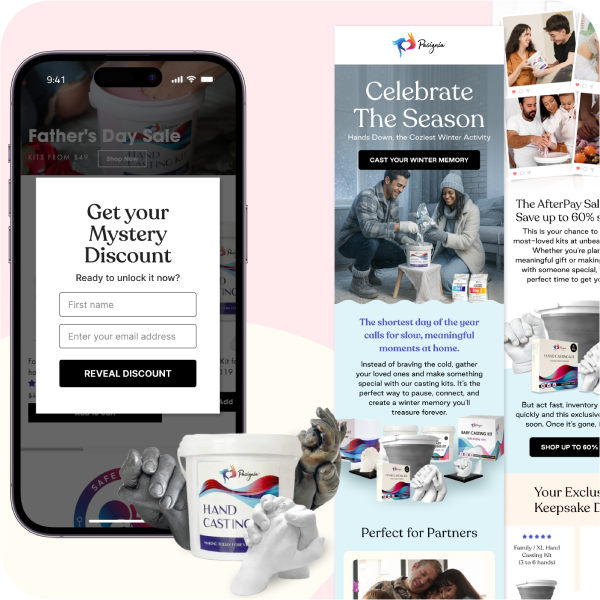
The brand also combined SMS and push notifications to coordinate campaigns. While emails were used for storytelling and detailed instructions, SMS and push messages were used for high-urgency updates.
Pasignia started segmenting its audience into VIPs, repeat buyers, and first-time shoppers. This ensured the message matched the customer’s buying journey.
This shift helped Pasignia launch campaigns 50% faster, saving them thousands on platform fees. Revenue from automated flows and campaigns increased by more than 25%. The brand recorded an average open rate of 55%, demonstrating that its segmented, omnichannel approach was resonating with customers.
When Pasignia layered its marketing with SMS and push notifications, it captured revenue that had previously been left on the table by relying solely on email. This proves that retention scales when you use a combination of channels.
Following proven retention marketing best practices helps you get more value from every customer interaction. It also maximizes the impact of your retention efforts. The following tips apply across all retention strategies and channels:
“An expensive mistake you can make is treating your entire database as a single entity. With behavioral segmentation, you’ll naturally figure out your customers’ needs and respond to what they’re actually doing on your website.”
— Iryna Shatalo, Lead of Product Knowledge Enablement at Omnisend
“If you treat subscribers like a walking wallet, they’ll tune out quickly. Balance your offers with educational content or exclusive information that only loyal customers have firsthand access to.”
— Karolina Petraškienė, Marketing Projects Lead at Omnisend
“A coordinated omnichannel strategy ensures your message is seen on the customer’s most preferred platform, which keeps your brand top-of-mind without being intrusive.”
— Andrius Šeršniovas, Conversion Specialist at Omnisend
Retention marketing is one of the most effective ways to drive sustainable growth. It turns first-time buyers into loyal, repeat customers. With an in-depth understanding of retention rates and by applying best practices such as personalization, automation, and omnichannel support, you can increase customer lifetime value.
However, the results only come when you take action. Start by implementing two or three retention tactics that align with your business model and customer behavior. Make sure to focus on consistently delivering value.
Marketing automation platforms like Omnisend make retention marketing more accessible and effective. They provide pre-built automation workflows, advanced segmentation, and multi-channel capabilities across email and SMS. Using such platforms can help you turn retention strategies into measurable results.
Quick sign up | No credit card required
An example of retention is an ecommerce brand sending post-purchase emails with product tips, personalized recommendations, and replenishment reminders that encourage customers to buy again. Loyalty programs that reward repeat purchases are another common retention example.
The best retention strategies include:
— Personalized communication
— Email and SMS automation
— Loyalty and referral programs
— Post-purchase follow-ups
— Winback campaigns
— Responsive customer support
These strategies engage customers, encouraging repeat purchases over time.
Retention in the marketing funnel refers to the stage after conversion, where the goal is to keep customers engaged and returning. It focuses on repeat purchases, loyalty, and long-term relationships rather than acquiring new customers.
Retention rate is the percentage of customers who continue to buy from a business over a specific period. It measures how effectively your company keeps customers engaged after their first purchase.
An 80% retention rate means 80 out of 100 customers remained active over a given period. It indicates strong customer loyalty and effective retention efforts.
A 90% retention rate is considered excellent in most industries, especially for subscription-based businesses. It indicates customer satisfaction, high product value, and effective retention marketing tactics.

TABLE OF CONTENTS
TABLE OF CONTENTS

What’s next


No fluff, no spam, no corporate filler. Just a friendly letter, twice a month.