Omnisend AI

 OFFER
OFFER









SMS marketing gives your store a direct line to customers who opted to hear from you. It reaches them in seconds, on the device they check most. But the channel doesn’t pay evenly.
Automated texts earned $0.74 per send, according to Omnisend’s 2026 Ecommerce Marketing Report. One-off campaigns returned $0.15 across the same 321 million messages.
That’s five times the return, and it’s what this guide is built around.
This guide is for ecommerce marketers starting SMS marketing or restarting a stalled program. You’ll get the mechanics, six examples, and a six-step launch plan. You’ll also learn which flows to build first and the compliance rules that matter most.
What is SMS marketing?
SMS marketing is a permission-based channel for sending text messages. SMS messages fall into three groups: promotional, transactional, and conversational.
Every text needs consent first, because that opt-in is your legal basis for sending. That’s the core SMS marketing definition, and it’s what separates the channel from publish-first media.
The greatest advantage of SMS is that it’s an owned marketing channel, unlike most social media. You don’t have to worry about a sudden algorithm update hiding your content from your audience. Instead, you have complete control over your timing, targeting, and messaging.
It’s one of the few marketing channels your brand owns outright, right alongside email, giving you a reliable, direct line to your customers.
The acronym SMS stands for Short Message Service, meaning these messages only consist of plain text. This differs from Multimedia Messaging Service (MMS), which lets you to send media like images, GIFs, and videos.
How does SMS marketing work?
SMS marketing works by routing your text from a marketing platform to the recipient’s phone through the mobile carrier network.
At its core, the mechanics are quite simple. A brand signs up with an SMS marketing platform (like Omnisend), builds a list of opted-in subscribers, and uses that platform to send text messages.
All of that is straightforward, but when you set up your account, you’ll need to choose the type of phone number you want to send from, which could be a little more complicated for SMS rookies. There are three main options available:
- Short codes: These are 5-6 digit numbers typically used for high-volume sends, like mass promotional campaigns. They’re well recognized by mobile carriers, so you don’t need to worry about deliverability rates, as they will be high for large lists.
- Long codes 10DLC: These are standard 10-digit phone numbers registered specifically for business use. They’re usually better suited for conversational messaging and lower-volume sends.
- Toll-free numbers: These are 1-800-style numbers that can be enabled for text messaging. They serve as a great middle ground between the high volume of short codes and the conversational nature of long codes.
Once you get all that sorted out and finally hit “Send” on a campaign, your messages travel through SMS gateways. SMS gateways are the technology that connects your marketing platform directly to mobile carriers.
The messages are then delivered straight to your subscribers’ native messaging app, so recipients don’t need to download any apps to get your texts.
Because this technology is so direct, most SMS messages are delivered within seconds of sending, which makes it an incredibly effective tool for time-sensitive offers and updates.
Quick sign up | No credit card required
What are the main types of SMS marketing?
The three main types of SMS marketing are promotional, transactional, and conversational.
Promotional texts drive a commercial action. Transactional texts follow the customer’s own behavior, like an order or a shipment. Conversational texts adapt to each reply in a live thread.
They differ in the consent they need, what triggers them, and when they land. Consent for one type never covers another.
| Type | Consent required | What triggers it | Timing | Example |
|---|---|---|---|---|
| Promotional | Express written consent for marketing | You schedule it, or a behavior rule fires it | Scheduled, or triggered by behavior | Flash sale, back-in-stock alert |
| Transactional | Implied by the purchase, but marketing consent is separate | The customer's own action on your store | Within seconds of the event | Order confirmation, shipping update |
| Conversational | Marketing consent, plus a reply path you monitor | The customer replies, or an agent opens the thread | Ongoing, paced by the exchange | A sizing question before checkout |
These three types cover most SMS text message marketing you’ll run. Here’s how each one works in practice.
1. Promotional SMS
Promotional SMS is any text sent to drive a commercial action. It needs express written consent before you send anything.
You’ll use these for regular sales, product launches, flash sales, and exclusive offers. You can send them as one-off text marketing campaigns or as behavior-triggered automations.
Common promotional use cases include:
- Flash sales
- Abandoned cart reminders
- Back-in-stock alerts
- Anniversary offers
- Birthday discounts
- VIP early access
Behavior-triggered texts have higher returns than one-off campaigns. Omnisend highlighted in its 2026 report that automated SMS messages earned $0.74 per send. Regular campaigns earned just $0.15.
2. Transactional SMS
The customer’s action triggers transactional SMS, which reports what happened to their order. These texts are informational, and customers expect them.
One legal point matters more than the rest here. Being allowed to send transactional SMS doesn’t mean you have consent for promotional SMS.
A few transactional use cases include:
- Order confirmation
- Shipping updates
- Delivery notifications
- Password reset links
- Payment receipts
Consent is what decides what else you can add. If a customer opted in to promotional messages, you can add more. Pair the transactional text with a post-purchase cross-sell or upsell.
3. Conversational SMS
Conversational SMS is a two-way thread where each message adapts to the customer’s last reply. It reads the response and picks what to send next.
It helps to separate three formats that look similar. A traditional promotional text is one-way and identical for everyone. A two-way text takes a reply but answers from a fixed keyword rule:
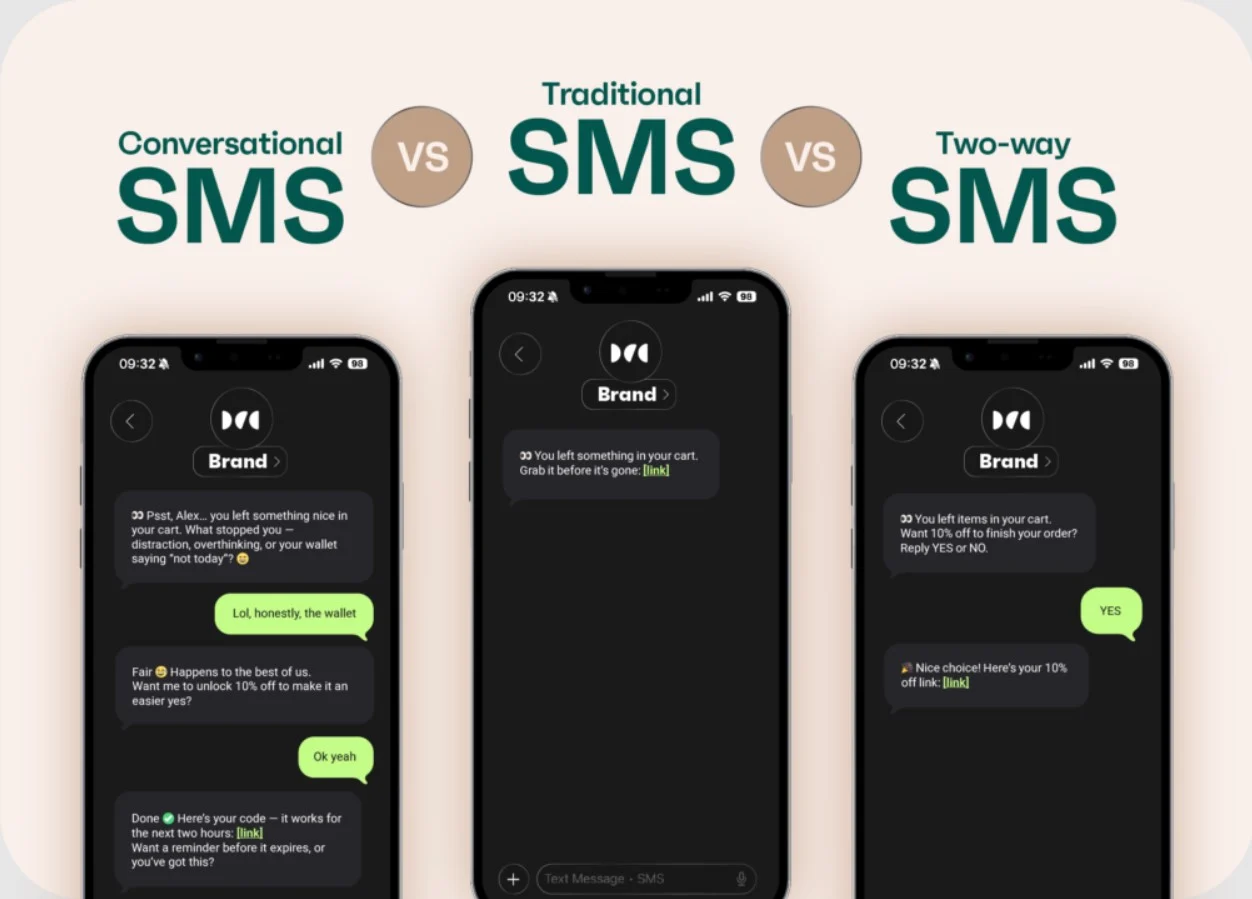
So the keyword “SIZE” always returns the same chart. Conversational SMS reads each reply and responds. That’s why it needs a person or system watching the thread.
That monitoring costs money — it’s best reserved for high-value moments. A pre-sale sizing question or a VIP order is worth a live reply. A routine promotion usually isn’t, so most stores use conversational SMS selectively.
Why does SMS marketing work? Benefits and 2026 benchmarks
SMS marketing works because it reaches an opted-in audience, delivers in seconds, and pays the most when a customer’s behavior triggers the send.
Those are the core SMS marketing benefits, and the numbers below show what a send is worth:
| Benchmark | Figure | What it tells you |
|---|---|---|
| Revenue per automated send | $0.74 | Triggered messages are the profitable half of the channel |
| Revenue per campaign send | $0.15 | Scheduled sends still pay, at roughly a fifth of the rate |
| Click-to-conversion, automated | 3.81% | Triggered sends convert well above scheduled ones |
| Click-to-conversion, campaigns | 0.97% | The global average for scheduled sends |
| Delivery rate, campaigns vs automated | 96.6% and 92.8% | Most texts reach the phone, but long-running flows dip lower and need list cleaning |
Sourced from SMS marketing statistics: Key data for 2026
The first four figures come from Omnisend’s 2026 Ecommerce Marketing Report, which covers 321 million SMS sent in 2025.
That five-to-one gap comes down to timing. A triggered text lands right after someone abandons a cart. It can also fire when an item they wanted is back in stock.
The shopper’s intent is already there, so the message supports a decision they’re close to making. A scheduled campaign arrives on your clock, not the shopper’s.
The click figures carry one limit worth knowing. A Q4 operating system update inflated SMS click volumes, likely due to bot activity.
Revenue per send doesn’t rely on click tracking, so it stays the figure to plan against.
More scheduled sends won’t reproduce those automated returns, so the triggers come first. Those per-send economics make the strongest case for the benefits of SMS marketing at scale.
SMS marketing examples
These six SMS marketing examples come from ecommerce brands. Each one shows a single job the channel does well. Together they cover six jobs:
- Welcoming a subscriber
- Recovering a cart
- Running a flash sale
- Flagging back-in-stock items
- Confirming an opt-in
- Marking an occasion
What makes these SMS marketing examples worth copying is the shape they share. Each one leads with a single offer and a single action. None of them asks the reader to scroll, choose, or decide between options.
1. Welcome SMS
A welcome text delivers the incentive the subscriber just signed up for within seconds of joining. Draper James does it with a discount code that applies on its own:
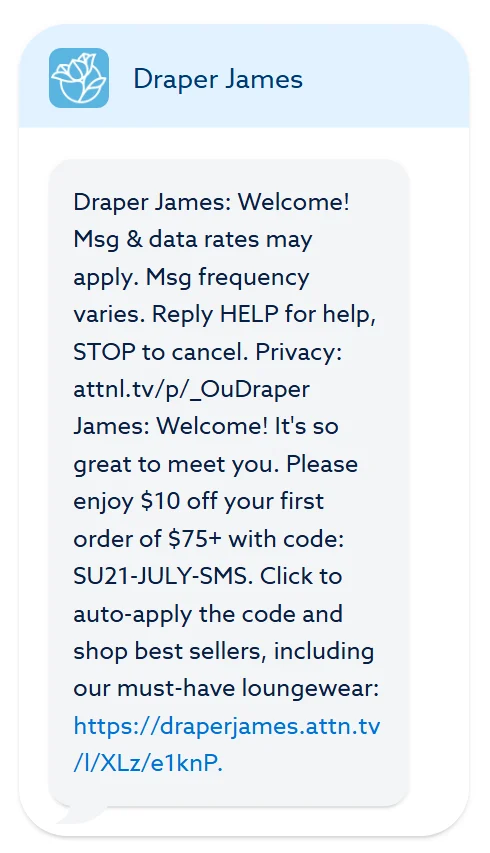
- The copy is friendly and delivers on the promise made at opt-in
- A clear $10 off code encourages that first purchase
Key takeaway: Deliver the incentive you promised in the first welcome text, and let the code auto-apply.
2. Abandoned cart SMS
An abandoned cart SMS highlights what a shopper left behind and links straight to checkout. Knix uses scarcity to nudge the customer to return:
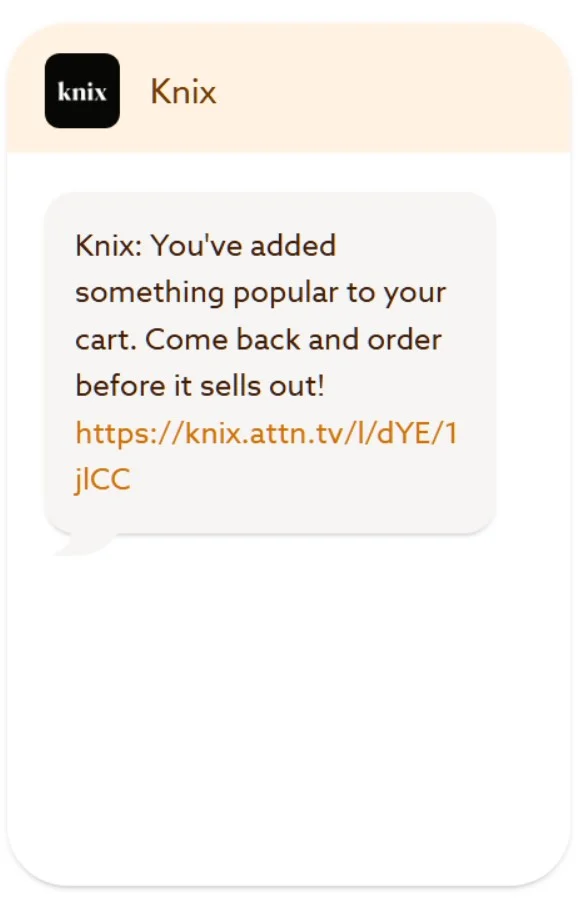
- The SMS copy signals that the abandoned item is popular and could run out of stock
- A direct link directs the shopper straight to checkout, removing unnecessary steps
Key takeaway: Keep the cart reminder to one step, with a link that lands on checkout.
3. Flash sale SMS
A flash sale text carries the offer, the deadline, and the link — nothing else. Lovesac fits all three into 13 words:
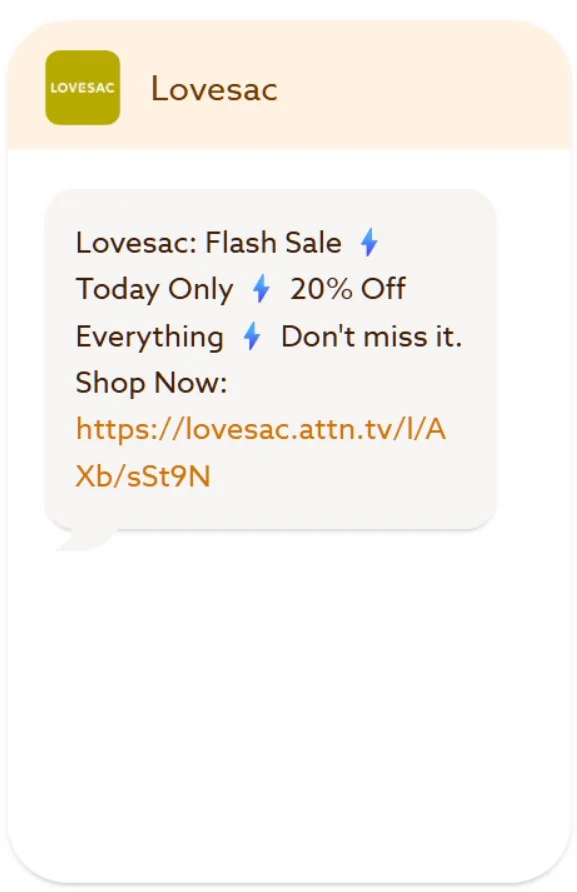
- It says everything needed in 13 words, with no confusion about the offer
- The end-of-day deadline drives urgency and prompts an immediate response
Key takeaway: Use a strict time limit to drive action, and keep the promotional text short.
4. Back-in-stock SMS
A back-in-stock text tells a high-intent shopper their item has returned. Parks Project re-sells the product in the same message:
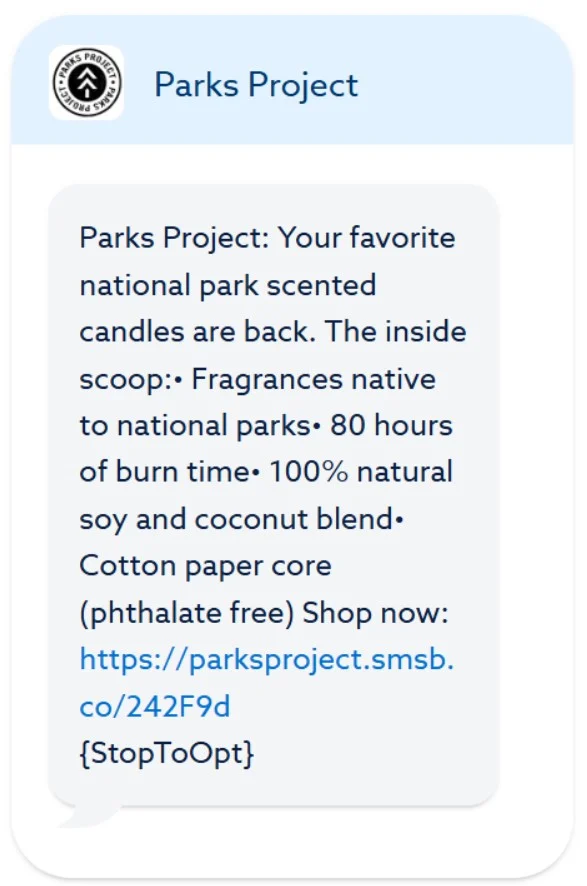
- It adds the product’s main selling points instead of a generic alert
- The link drops the shopper on the product page and removes navigation
Key takeaway: Alert high-intent shoppers the moment an item returns, and remind them why they wanted it.
5. Opt-in SMS + promotion
An opt-in confirmation SMS sets message frequency and rewards subscribers for opting in. Forever 21 pairs a “help” SMS with clear opt-out instructions. This SMS also comes with a clear target frequency:
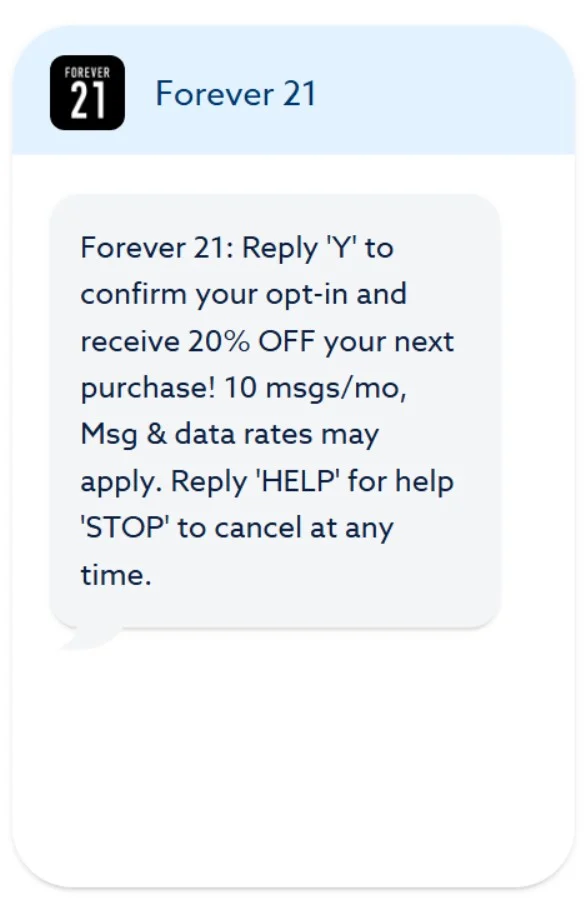
- It states the specific message frequency and offers a reward to subscribers
- It gives an opt-out keyword and a help option, saving a confused contact
Key takeaway: When confirming an opt-in, set expectations clearly and reward the subscriber for the effort.
6. Birthday SMS
A birthday text turns a customer’s special day into a timely, personal offer. Jennifer Miller Jewelry sends a warm birthday note with a discount code that expires in a week:
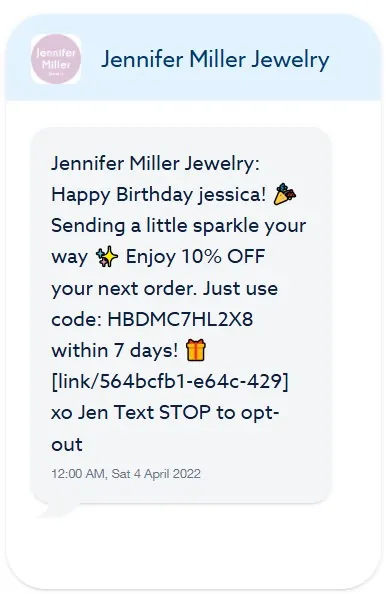
- Focusing on its own birthday rather than the customer’s reads as more honest
- The offer suits both sides, lifting order value while the shopper gets a free item
Key takeaway: You don’t have to wait for the customer’s birthday. Your brand’s own can work too.
These six cover the everyday jobs SMS marketing handles. If you’re planning launches, win-backs, or seasonal pushes, there are more SMS use cases worth modeling yours on.
How to build an SMS marketing strategy: 6 steps to launch
To build an SMS marketing strategy, decide the goal and the message mix first. Then collect consent, build the flow that earns on its own, and send your first campaign.
One task takes the longest, though. Getting a verified phone number can take up to two weeks, so start that early.
If you’re sending to the US or Canada, verification is mandatory before your first send. Skip it, and your messages fail silently, with no error to warn you.
The following steps show how to set up your SMS marketing from scratch:
1. Define the goal and the message mix
Decide what the SMS is for before you shop for a platform. Pick a task, like recovering carts or launching drops. After that, set your split between triggered flows and manual sends.
A useful starting mix is one weekly campaign against two always-on flows. From there, weigh your SMS marketing software options against one test. Find out if it reports email and text against a single revenue number.
2. Get a compliant number, and secure verification first
Choose between a short code, a 10-digit long code, or a toll-free phone number. If you’re sending messages to subscribers in the US or Canada, your toll-free number must pass verification before you send a single message.
Omnisend’s documentation puts that at around five business days and up to two weeks in some cases. There’s no expedited option, so start it early.
Check your SMS credit balance in the same place, under Store settings → SMS:
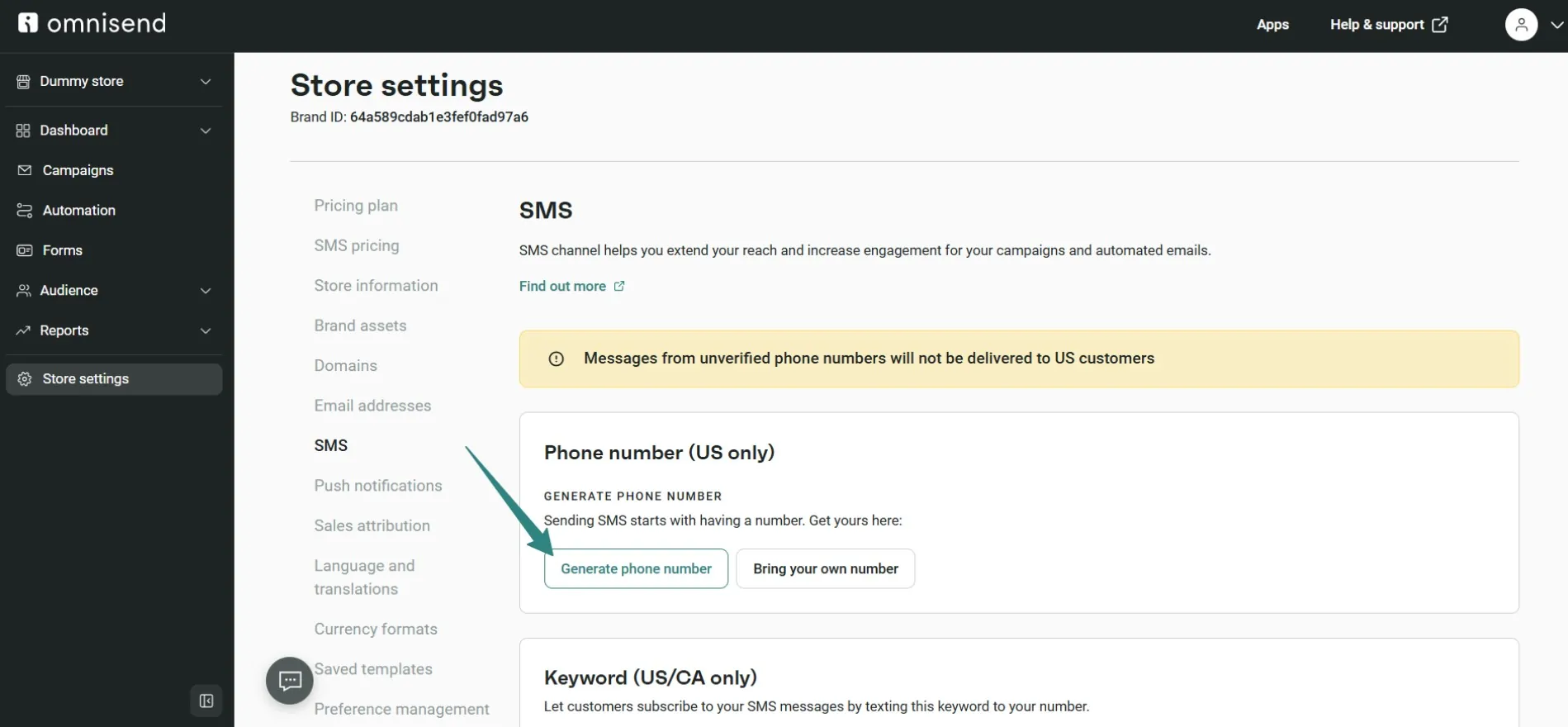
A campaign with no credits won’t go out either. These two checks are the most common reason a first campaign never sends.
3. Set up opt-in collection
Add a phone number field to your website pop-ups or checkout flow. State clearly what subscribers will receive, and give a strong reason to sign up, like a discount. Fewer fields mean more completed sign-ups.
4. Build your first automation
Start with a basic workflow, like a welcome series or a cart reminder. These campaigns run automatically once activated and don’t need follow-up input. That’s what makes them the safest first build.
5. Send your first campaign
Prepare a time-sensitive promotional message for your opted-in subscribers. Put your brand name at the start so recipients know who it’s from when it arrives. Add a clickable link too, since a tap is the only engagement signal SMS reports.
Keep it short, include your opt-out instruction, and adopt proven SMS campaign structures for the rest.
6. Review and optimize
After a few hours, check your delivery, click-through, and conversion rates. Use the data to optimize send times, copy, calls to action, and other SMS elements. Making changes on live data is much better than guessing.
These are the core SMS marketing strategies every ecommerce store should have running.
SMS marketing automation: Which flows to build first
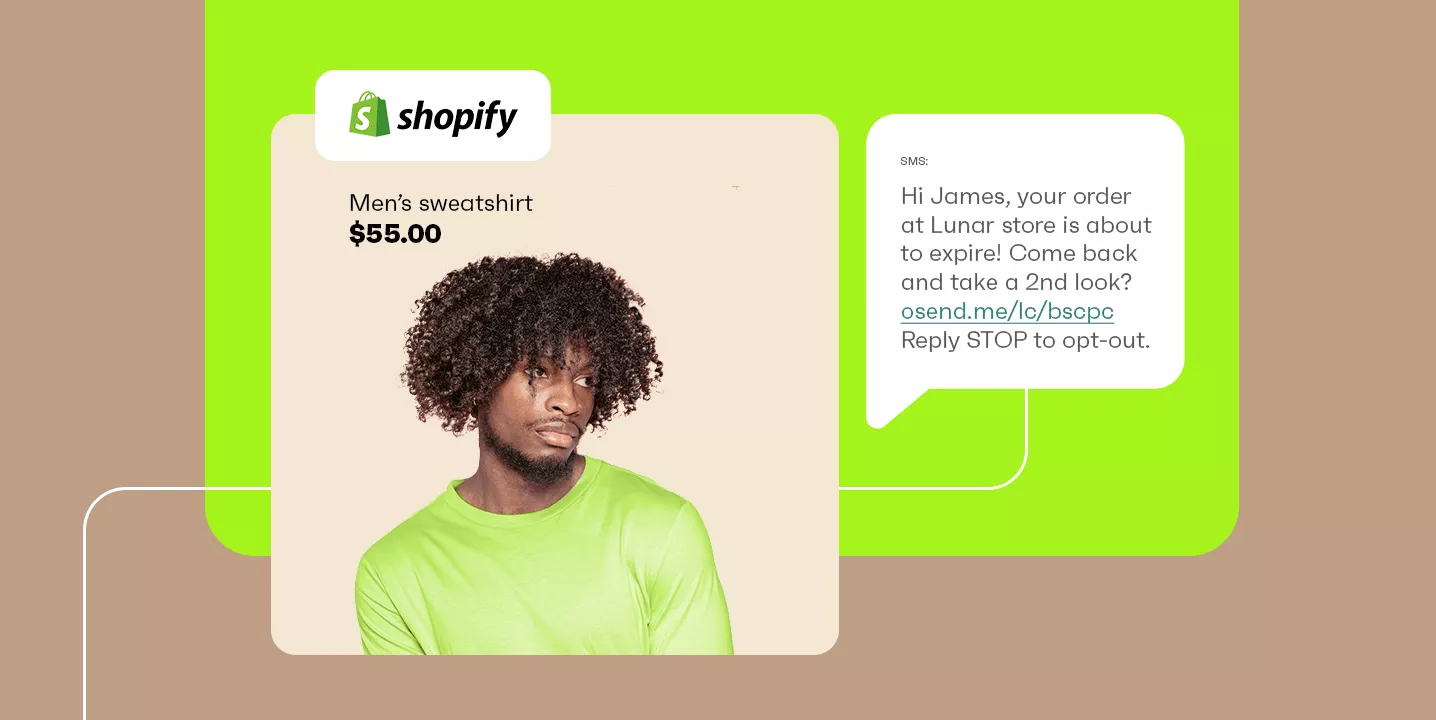
Build welcome and cart recovery first, followed by browse abandonment and post-purchase. Welcome and cart recovery target two particularly valuable moments: when someone has just subscribed and when a shopper has shown clear purchase intent by adding an item to their cart.
For example, Omnisend’s 2026 ecommerce marketing report shows that abandoned cart and welcome messages drove 76% of all automation-generated orders.
It’s also important to take note of which channel you’re using for these automations. On the SMS side, automated messages earned $0.74 per send in 2025, against $0.15 for one-off campaigns.
However, because SMS has limited space and costs money or credits per send, keep it focused on one key message. Email is better when you need more room to explain an offer, showcase products, or provide additional details. Here’s how that split works for each of the four flows.
Welcome automation
A welcome series greets new subscribers and usually includes some kind of reward.
Send an SMS first. It should include the offer, the code, and a direct link to the reward. After that, follow up with an email to share your brand story or explain the product.
Immediacy is important here because a new subscriber is paying attention right after they opt in. As such, an SMS is the best method to meet the subscriber in that window of attention. An email could sit in the inbox for a while without getting opened.

Mudgee Meat is an independent Australian online butcher running email and SMS through Omnisend. It reserves SMS for high-intent moments rather than duplicating every email, and its SMS welcome automation clicks at 38.5% against a 5.9% average across all its automations. “We find that we get really strong results with SMS. But we’re deliberate about who receives it. We don’t want to send an SMS to everybody in every automation when email has already done the job.”
Cart recovery
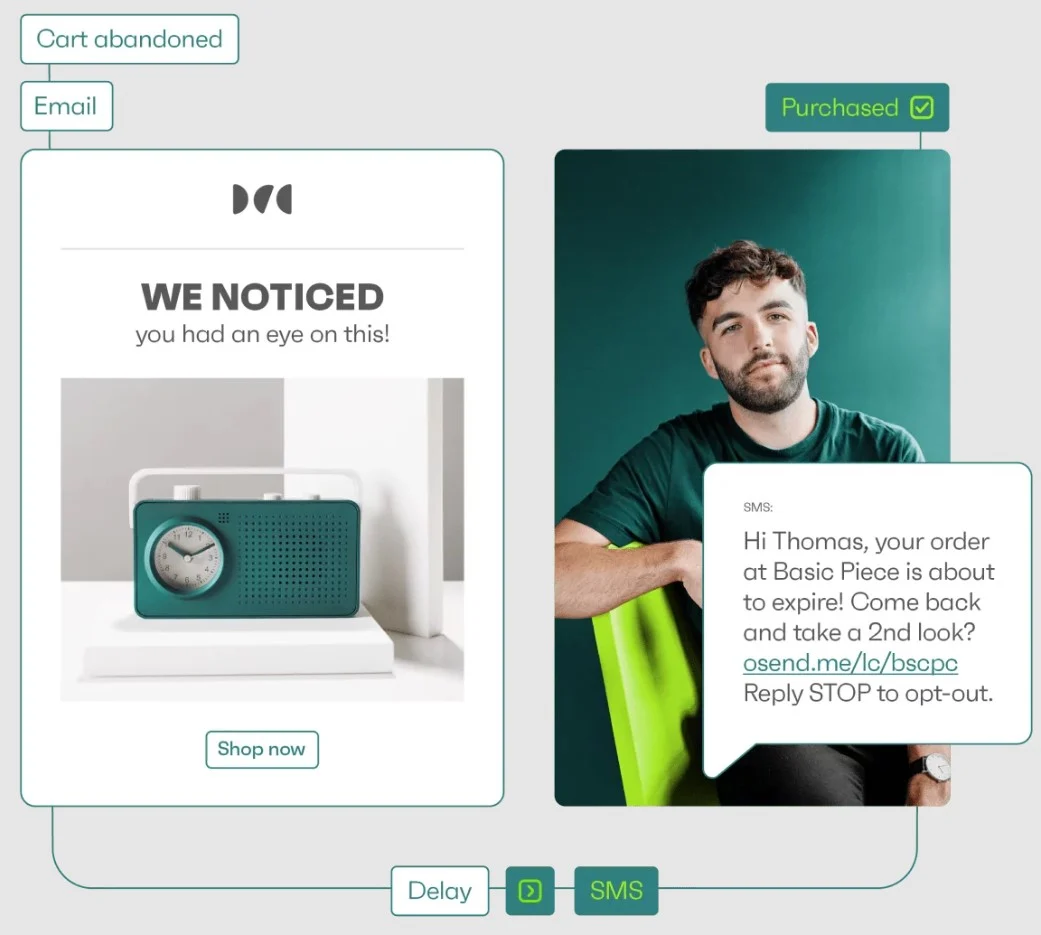
A cart recovery series is used to nudge shoppers who have added items to their cart but didn’t follow through with a purchase.
Send an email with social proof, the cart details, and relevant recommendations to persuade a return to checkout.
After that, send an SMS naming the abandoned item or items, provide an incentive if possible, and add a link that takes them straight to checkout.
For timing, send the first reminder after a few hours. Then, watch what converts your subscribers and adjust your timing convention accordingly.
Browse abandonment
A browse-abandonment flow follows someone who viewed a product but never added it to a cart.
The main difference between browse abandonment flows and cart abandonment is intent. Browsing a product shows mild interest, while adding it to a cart signals intent to buy. That’s why a browse signal is weaker than a cart abandonment signal.
Because the signal is weaker, email should handle this flow as a gentle reminder, with SMS included only as a last resort if the email hasn’t been opened. Avoid automatically discounting a browser, since many would have returned anyway, and a reflex discount trains shoppers to wait for one.
Post-purchase
A post-purchase series is used to keep your brand on the minds of your customers and assist them with their new purchases. This helps encourage them to make subsequent purchases.
Use SMS only for time-sensitive transactional updates, like an order or shipping confirmation. Leave reviews, care instructions, product education, and cross-sells to email, which handles that longer content better.
Do not send a promotional SMS to a customer right after they have made a purchase, as it can feel intrusive. Give them a few days or weeks to enjoy their purchase before sending any promotional text.
Building an abandonment flow
Build an abandonment flow by choosing the right trigger, then setting an exit condition that stops messages once the shopper acts. Omnisend gives you two separate triggers, and the one you pick decides who enters the flow:
- Abandoned cart: This flow starts when a shopper adds a product to the cart but leaves without buying
- Abandoned checkout: This flow starts only when a shopper reaches the checkout page and then stops
Exit conditions stop a shopper from getting messages they no longer need.
The abandoned cart flow exits on a placed order or a started checkout event. So a shopper who moves to checkout leaves the cart flow and enters the checkout flow. This stops two flows from texting the same person at once.
The abandoned checkout flow exits only on a placed order. These conditions are checked continuously, while audience filters are checked only at entry.
Two setup steps decide whether the flow runs, and both are easy to miss:
- Confirm the flow is activated: Activation takes two actions in Omnisend. You publish your changes, and then you switch the workflow to active. A flow that’s published but never activated might look finished but stays switched off.
- Review the default filters: The default triggers on a welcome flow usually filter returning contacts out. It could exclude those who joined your list at checkout, through an import, or via API.
Widen these filters so you capture every subscriber you want. You can spot these filters in the workflow’s trigger panel:
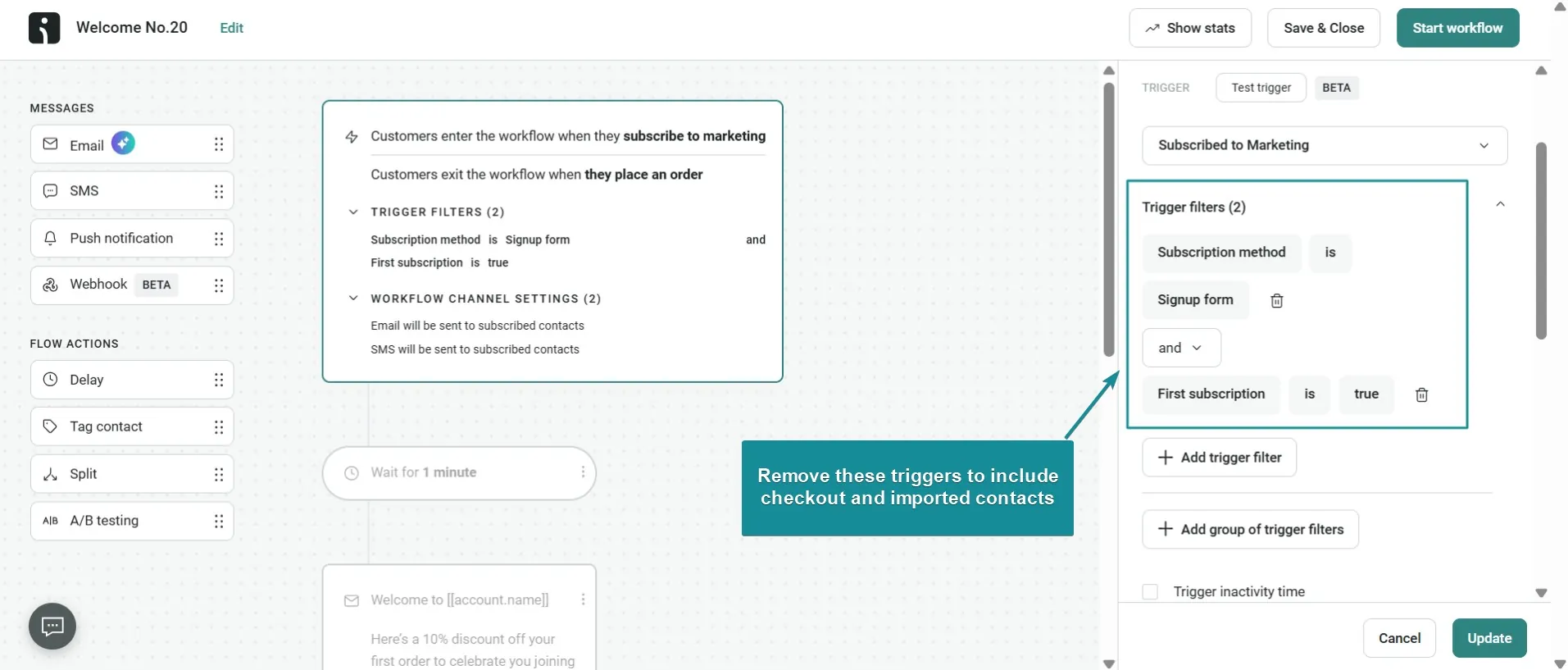
Before you run a live campaign, run a test through your flow to verify it works correctly. Do this by placing a test cart, triggering abandonment, and watching the order in which your SMS and email are sent.
Since most automations run on pre-built ecommerce flows, the trigger, delay, and exit logic already exist. The main task is editing a flow, not assembling one. That’s where Omnisend’s SMS automation flows save the most setup time.
Brands that rely on automation don’t have to convince people to buy. They’re just responding to customers who’ve already shown intent.

How do you build an SMS subscriber list?
You build an SMS subscriber list by collecting consent before anyone joins. Every subscriber must knowingly agree to receive your text messages.
You gather that consent through opt-in tools like pop-ups, checkout fields, and keywords. Each tool records who agreed and when, which is your proof of consent.
A clear incentive (usually a discount) can easily turn more visitors into subscribers. But size isn’t the goal. A smaller list of people who want your texts protects your delivery and keeps your costs down.
There are five channels to build an SMS subscriber list, and they typically cover most stores. These channels capture both phone numbers and consent:
- Sign-up forms and pop-ups: A phone field beside the email field captures the number and consent together
- Checkout opt-in: An unchecked consent box at checkout adds buyers without assuming agreement
- Keyword opt-in: A customer texts a keyword like JOIN, and the auto-reply confirms the subscription
- Landing pages: A dedicated page pairs one strong offer with a single phone field
- Social and QR codes: A link in bio or scannable code opens a pre-filled text to subscribe
Whatever the method, the mechanism stays the same: the subscriber’s consent and timestamp should be logged.
Each of these channels logs subscribers’ consent and timestamp. This record comes in handy if or when a carrier or regulator asks for it.
Also, use a double opt-in to add an extra layer of consent confirmation on your list. After a subscriber submits their phone number, the platform sends a text asking them to reconfirm.
Only contacts that confirm the second opt-in make it to your list. This way, you’re sure you have a clean and eager subscriber list.
These opt-in methods anchor most text marketing strategies. When you have engaged and active subscribers, they’re more likely to read and act on your messages. That can help you boost conversion rates.
If you want to learn more specifically about growing your SMS list, check out this video on it:
SMS marketing compliance and legal requirements
SMS marketing compliance means texting only the subscribers who gave clear consent and giving them an easy way to opt out. Non-compliant campaigns face heavy fines and carrier filtering that wrecks your delivery.
The rules vary by country, but the core duties stay the same everywhere. Get consent before the first text, identify your brand, and honor every opt-out at once.
In the United States, SMS marketing is legal, but the TCPA sets strict conditions. You need express written consent before you send a marketing text. A pre-checked box doesn’t count, and neither does an implied opt-in.
You can only send during permitted hours, which run from 8 am to 9 pm in the recipient’s local time. Some states set tighter windows, so the stricter rule wins.
The specifics change by country, but these rules apply just about everywhere:
- Get explicit opt-in first: Collect a clear agreement before any text, and never buy or import lists
- Include an opt-out in every message: A simple instruction like “Reply STOP to unsubscribe” should be in each send
- Honor opt-outs immediately: Remove unsubscribed contacts from every future send, with no delay
- Identify your brand: Name your business in each message, so the recipient knows it’s from you
- Respect sending hours: Keep to local awake hours, generally 8 am to 9 pm
- Keep consent records: Store proof of each opt-in in case a carrier or regulator asks
Managing your SMS marketing compliance manually can lead to avoidable mistakes. Omnisend includes TCPA-compliant opt-in flows and processes opt-outs on its own, lowering risk for ecommerce brands.
This section is a general overview, not legal advice. For your specific situation, check with a qualified legal professional.
SMS marketing best practices
Lead with your offer, respect local hours, and utilize automation over regular campaigns. Keep your frequency reasonable, and pair SMS with email so each channel does what it does best.
Here are the key SMS marketing best practices you should follow:
- Lead with the value: You only have 160 characters to capture your subscriber’s attention, so put your strongest offer upfront. If you’re offering a major discount, place it in the first few words rather than burying it at the end of the text.
- Send at the right time: Respect your subscribers’ local time zones. Only send promotional campaigns when people are awake and ready to engage, which is typically between 8 AM and 9 PM, especially in the US.
- Prioritize automation over blasts: Triggered messages are highly relevant because they respond directly to customer behavior. According to our 2026 ecommerce marketing report, click-to-conversion for manual SMS campaigns averaged 0.97% in 2025. Automated messages averaged 3.81%.
- Keep frequency in check: Sending too many texts is the fastest way to lose your audience. Set a cadence your subscribers can expect, and ease off if you see opt-outs climb after a change. According to EZ Texting’s 2026 data, only 59% of consumers are open to 2+ text messages per day. This number is down from 69% in 2025.
- Combine SMS with email: Don’t treat text messaging as a standalone strategy. Use email for long-form content and visual storytelling, and use SMS for when you want to communicate immediate urgency and quick conversions.
- Make opt-out easy: Always provide a clear, simple way to unsubscribe in every message (“Reply STOP”, for example). This protects your delivery and ensures your list stays filled with engaged shoppers instead of dummy contacts.
Instead of blasting the audience with SMS, think about building an omnichannel strategy, especially around product launches and holidays. Use SMS selectively so it complements your strategy, not drives subscribers away.


CLVmaxers is a boutique agency focused on raising customer lifetime value for ecommerce brands. It builds a solid email foundation first, then adds the SMS layer for extra push. The result runs mostly on autopilot, with occasional manual campaigns.
How do you measure SMS marketing performance?
You measure SMS marketing performance with six core metrics, including delivery rate, click-through rate, conversion rate, and revenue per send.
Delivery and click-to-send rate tell you if the text got through and got a response. Conversion and revenue per send tell you if it made money.
Of the four, revenue per send matters most. It connects each message to revenue and gives you the piece the other metrics miss.
Here are the key metrics you need to track:
| Metric | What it tells you | Healthy range | Where to find it in Omnisend |
|---|---|---|---|
| Delivery rate | Share of texts that reached a phone — a drop points to filtering or dead numbers | 92.8% for automations, 96.6% for regular campaigns | Reports, per campaign and per flow |
| Click-to-sent rate | Share of sent texts that got a tap. Weak numbers flag the offer or CTA. | 20.32% for automations, 12.38% for regular campaigns | Reports, per send |
| Conversion rate | Share who bought after tapping the link — a low rate here points to issues with the landing page | 21% to 30% complete a purchase after visiting via SMS | Reports, with revenue attribution |
| Revenue per send | Average money each message earns — you can weigh it against cost | $0.74 for automations, $0.15 for regular campaigns | Reports, per campaign and per flow |
| Opt-out rate | Share unsubscribing — a rise usually means too many sends or weak relevance | Watch for rises against your own baseline — a jump usually means too many sends | Reports, per send |
| List growth rate | How fast your subscriber count climbs — a stall means opt-in needs work | Positive and steady over time | Audience, over a date range |
Sourced from Omnisend’s 2026 ecommerce marketing report, SimpleTexting’s SMS marketing statistics 2025, and SimpleTexting’s average SMS conversion rates by industry
Delivery and deliverability get mixed up a lot, so it’s worth being clear. Delivery is whether a text reached the phone. Deliverability is often used loosely for the same thing, but the metric you track is delivery.
Any “open rate” here is inferred from delivery receipts, since the SMS spec reports delivery, not opens.
Delivery is the one benchmark the report puts a number on. According to Omnisend, campaign SMS averaged 96.6% delivery, while automated flows ran at 92.8%.
Long-running flows tend to dip with time, so welcome and win-back series need regular list cleaning.
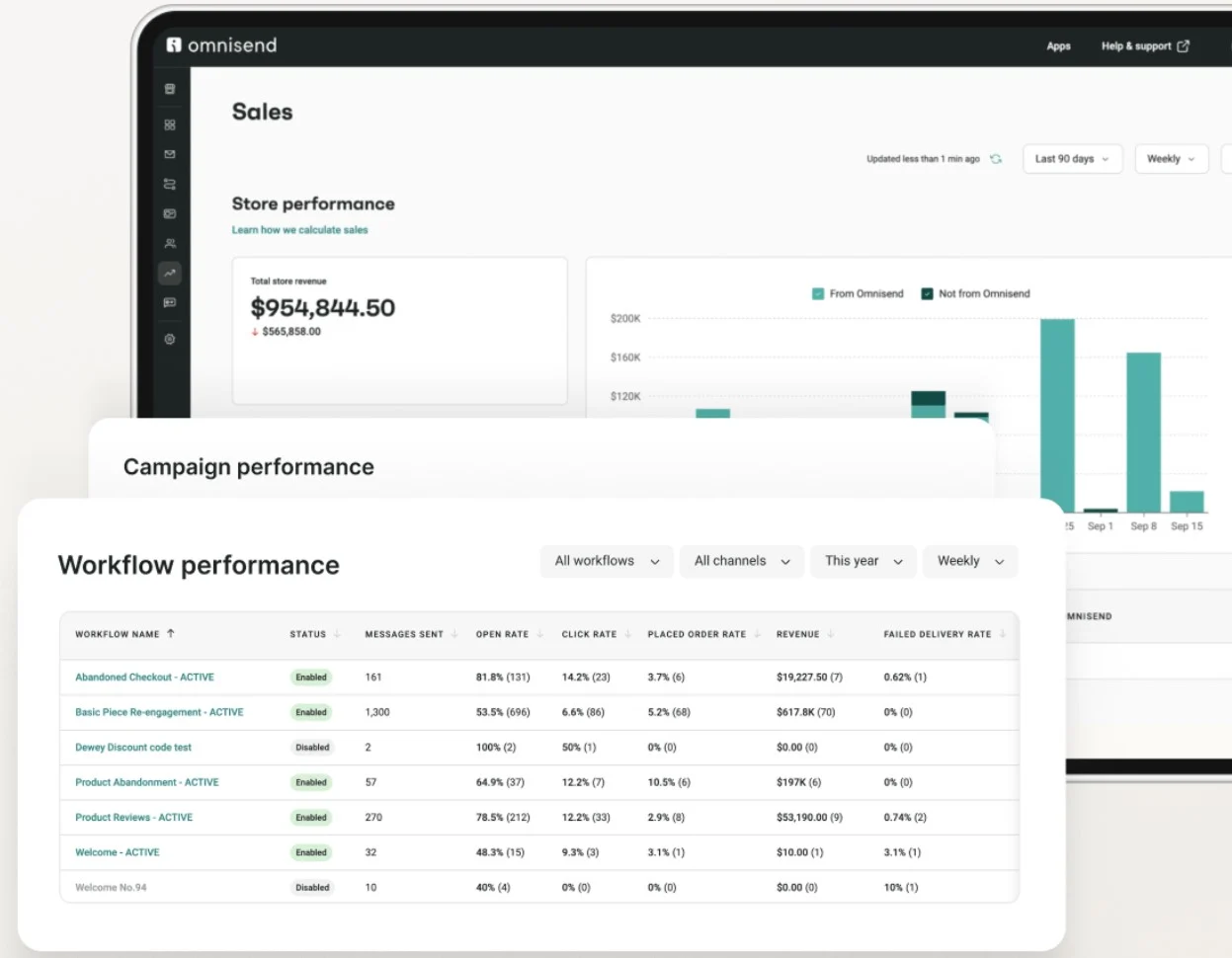
Revenue per send is the figure to plan against. It doesn’t rely on click tracking, so a bot-inflated click quarter can’t distort it. That’s why it closes the loop the other five metrics leave open.
Is SMS marketing worth it for a small business?
SMS marketing is worth it for a small business once you have a few hundred engaged subscribers. Below roughly 200 to 300 opted-in contacts, the setup costs more time than it returns.
Getting a number, a platform, and customers’ consent in place takes time. With a small list and no regular sends, that effort outweighs the return.
So a small store shouldn’t start with one-off campaigns. Start with two triggered flows instead: a welcome and an abandoned cart SMS.
Both fire on their own, so they need no daily attention. And triggered sends earn far more per message than scheduled ones. That’s the whole channel working for a store that can’t text every week.
Cost is the other half of the “worth-it” question. At Omnisend, US texts start around $0.009 each, dropping toward $0.007 at higher volume. SMS runs on the Pro plan, which starts at $59 a month.
That structure rewards a tight, engaged list over a big, quiet one, which is exactly how SMS marketing pricing works in your favor at a small scale.
Add up what one recovered order is worth, then compare it with a month of texts. For most small stores, the flows pay for themselves long before the campaigns do.
Omnisend suits a small store here because its free plan lets you build the list and the flows before you pay. You can add SMS when the list is ready to earn.
Put SMS marketing to work for your business
SMS marketing offers a direct line of communication to a highly engaged, opted-in audience. If you pair text messages with email marketing, it can become a serious engine of ROI for your business.
If you’re looking for the right platform, Omnisend is built specifically for ecommerce email and SMS marketing. It offers global SMS coverage, behavior-triggered automations, and TCPA-compliant list-building tools.
What’s more, because email and SMS live under one roof, you don’t need to sign up for different tools and handle different tabs and bills. And if you missed it, keep in mind that Omnisend customers earn $79 back for every $1 spent, which is one of the strongest documented ROI figures in the industry.*
*Based on Omnisend’s internal analysis of paid customer accounts in 2025.
Quick sign up | No credit card required
FAQ
What is text marketing?
Is texting and SMS the same thing?
Is SMS marketing legal?
Does SMS marketing still work?
How to make money with SMS marketing?
How do I start SMS marketing?
How often should I send SMS marketing messages?
Is SMS becoming obsolete?
Is SMS marketing worth it?
How much does SMS marketing cost?
What are the three types of SMS?
— Promotional texts drive sales, like a flash offer
— Transactional texts confirm an action, like an order or shipping update
— Conversational texts run a two-way thread that adapts to each reply