Omnisend AI


 OFFER
OFFER









When you open a new ecommerce store, Shopify Email is the obvious email marketing tool to use because it’s free and you can run it straight from the Shopify admin. One thing to keep in mind before we continue is that the Shopify Email has recently rebranded to Shopify Messaging.
But as your business grows, you might find its features a bit limiting. With scale comes the need to set up more complex automations, segment your audience more precisely, or even add SMS or push notifications to the mix. When that happens, you’ll need to look for alternatives to Shopify Email.
In this guide, we’ll explore the 10 best options for 2026 to help you scale your revenue and build better customer relationships.
At a glance:
- Omnisend: The best overall choice for ecommerce merchants. It combines email, SMS, and web push notifications into a single platform with deep Shopify integration and pre-built workflows.
- Klaviyo: A powerful, data-heavy option for enterprise-level stores that require highly complex segmentation and granular reporting.
- Mailchimp: A well-known general marketing platform. It works well for basic newsletters and standard campaigns.
Quick sign up | No credit card required
Why merchants outgrow Shopify Email
As mentioned before, Shopify Email is a great tool until your business starts demanding more complex workflows and more detailed analytics. Let’s take a look at what Shopify Email offers and when it makes sense to switch.
What is Shopify Messaging (formerly Shopify Email)?
What used to be Shopify Email is now Shopify Messaging, so don’t get confused if we use these two terms interchangeably throughout the article. The main change is that they’ve added SMS capabilities alongside the existing email features.
If you’re just beginning your ecommerce journey, it’s still a logical and convenient starting point since there’s absolutely no setup required, and it integrates natively with your store’s admin dashboard.
You get 10,000 free emails per month, which makes it easy to launch your first newsletters without having to worry about the budget. While it’s not the most sophisticated email automation software, it still handles some basic automations well, like abandoned checkout reminders and welcome series.
However, Shopify Messaging has distinct limitations that ultimately hinder brand scaling. You’re pretty much restricted to a small selection of pre-built templates and basic segmentation features. Plus, relying on general Shopify support isn’t ideal when you need specialized help that only dedicated ESP-savvy people can provide.
When it makes sense to switch to a dedicated platform
Ecommerce marketing should be straightforward and accessible, but it also needs to drive measurable revenue. If you’re actively looking for the best email marketing for Shopify, you likely realize that basic tools often leave money on the table.
Scaling stores need email and SMS marketing software that offers deep behavioral data, advanced capabilities, and proactive guidance. For instance, a quick review of an Omnisend vs. Shopify Email comparison highlights the gap between basic native tools and purpose-built platforms. At the end of the day, growing stores require reliable customer data and specialized tools to maximize their return on investment.
If you’re wondering if it’s already time for you to make the switch, here are six clear signs that show you may have outgrown Shopify Messaging already:
- Wanting multi-step automation workflows
- Needing email + SMS + push in one platform
- Requiring purchase-frequency segmentation
- Wanting A/B testing for entire emails
- Needing revenue attribution per campaign/automation
- Desiring 24/7 dedicated support
Pros of Shopify Email
- Simple setup: Shopify Email integrates directly with Shopify. After installation, it’s incorporated into your Shopify Admin panel for seamless campaign management.
- Ready-to-use templates: The Shopify Email app helps you save time with its pre-built email templates. These are effective for promoting featured products, running sales, and sharing important news with your subscribers.
- Affordable pricing: Shopify Email is a cost-effective option for marketers with basic email marketing requirements. It’s completely free to send the first 10,000 emails every month. After that, you’ll pay $1 per 1,000 emails.
- Easy to use: Shopify Email is beginner-friendly. It has an intuitive campaign builder that makes it easy to design email campaigns without tech skills.
- Targeted campaigns: Shopify Email gives you multiple options to segment your customers based on user data. This allows you to send highly-targeted emails that inspire action.
Cons of Shopify Email
- Few email templates: The platform offers fewer email templates than the leading Shopify Email alternatives. Currently, there are 33 pre-built templates for creating your email campaigns.
- Limited features: Shopify Email lacks advanced features such as A/B testing and personalized recommendations. These are tools marketers need to run sophisticated campaigns and more effective mass email services.
- Bug/feature problems: Verified reviews published on the Shopify App Store reveal that some merchants have experienced bugs. This can be worrying as it could disrupt the user experience and cause them to leave the site.
- Basic automation capabilities: The platform has basic automation capabilities compared to other Shopify Email alternatives with dedicated email automation software. This would limit your ability to run complex automations.
- Limited support options: Shopify Email only offers general Shopify email support. There’s no phone or live chat support. This can be frustrating when you need immediate assistance.
How we evaluated these Shopify Email alternatives
Finding the best Shopify email marketing apps means looking past the marketing hype to see how a platform actually performs. To give you recommendations you can trust, we’ve fully updated the 2026 evaluation.
We analyzed these platforms and Shopify email automation tools using seven specific criteria to ensure they meet the needs of growing ecommerce stores:
- Shopify integration depth
- Automation capabilities
- Segmentation options
- Pricing transparency
- Support quality and availability
- Shopify App Store and G2 ratings
- Hands-on testing
This article was researched and written by our experts following a precise process.
See the processQuick comparison of the best Shopify Email alternatives
Finding the best email platform for Shopify depends on your goals and budget. This breakdown will help you compare some of the best options out there in terms of use case, value, channel availability, and more.
Top 3 picks:
- Omnisend: Best overall for ecommerce. Omnichannel marketing with email, SMS, and push. Full feature set on every plan, including free.
- Klaviyo: Best for data-driven stores.
- MailerLite: Best value for starting stores.
| Platform | Best for | Shopify rating | SMS included | Automation depth | Free plan | Paid plans from |
|---|---|---|---|---|---|---|
| Omnisend | Ecommerce businesses | 4.8 | Yes | Highly advanced | Yes | $16/month |
| Klaviyo | Data-driven stores need deep analytics | 4.5 | Yes | Highly advanced | Yes | $20/month |
| Mailchimp | Brands wanting an all-in-one suite | 4.7 | Yes | Advanced | Yes | $13/month |
| Brevo | Stores needing a built-in CRM | 4.8 | Yes | Advanced | Yes | $9/month |
| ActiveCampaign | Stores needing deep automation workflows | 4.5 | Yes | Highly advanced | No | $15/month (billed annually) |
| MailerLite | Budget-conscious starting stores | 2.6 | No | Basic | Yes | $10/month |
| Constant Contact | Straightforward newsletters | 3.1 | Yes | Basic | No | $12/month |
| Drip | Established stores investing in automation | 4.2 | Yes | Highly advanced | No | $39/month |
| Sender | Stores wanting a generous free plan | 4.6 | Yes | Basic | Yes | $10/month |
| Privy | Stores focused on list growth and popups | 4.5 | Yes | Basic | Yes | $30/month |
1. Omnisend
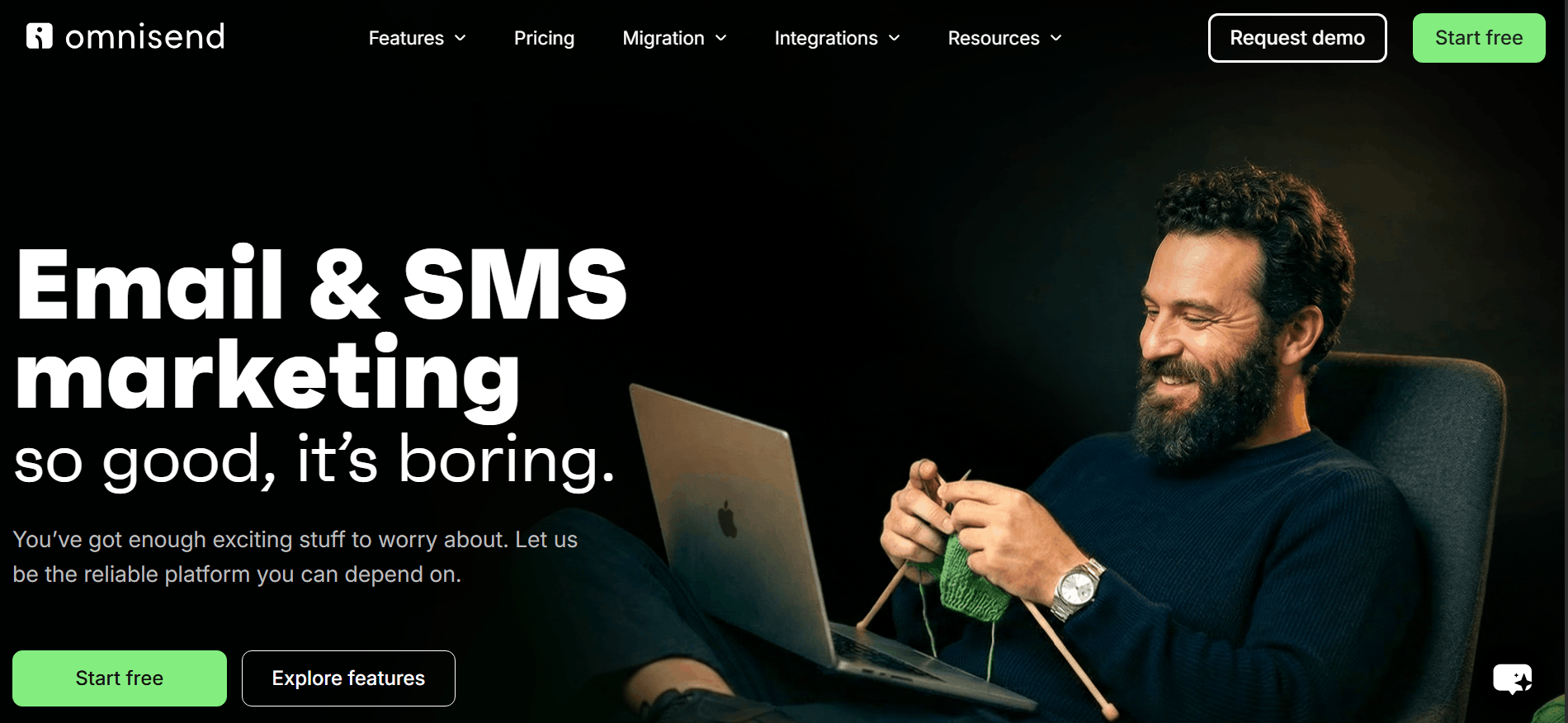
G2 rating: 4.6
Shopify App Store rating: 4.8
Best for: Ecommerce stores, especially those that need omnichannel marketing (email + SMS + push) on a single platform.
When evaluating Omnisend vs. Shopify Email, Omnisend stands out as an intuitive, powerful platform without a steep learning curve. It handles all the heavy lifting so you can focus on growing your business. Omnisend for Shopify is an ecommerce-focused solution that integrates seamlessly with your store and over 160 ecommerce and marketing tools.
You gain access to pre-built marketing automation workflows and advanced segmentation to target customers based on shopping behavior. It provides an omnichannel approach that combines the email builder, SMS marketing, and push notifications on a single platform. Plus, with the Pro plan, you can send SMS messages around the world, unlike some competitors that are limited to a few countries.
What’s more, Omnisend delivers a comparable feature set at a smarter price point. Its biggest competitor, Klaviyo, is nearly twice as expensive for similar capabilities at scale. This focus on strong value drives tangible results, with Omnisend merchants reporting an average return of $79 for every $1 spent. For example, Kate Backdrop achieved a 1:300 ROI with omnichannel marketing, and Vagari Bags achieved a 1:121 ROI with SMS marketing.
The free plan grants access to every ecommerce feature: automation, segmentation, A/B testing, reporting, and more. Other providers, on the other hand, gate some of the most valuable features behind paid tiers. Furthermore, you receive award-winning customer support with 24/7 email and live chat on every plan, including the free plan. Accounts at $400/month or more receive a dedicated Account Expert. In contrast, Klaviyo limits support to 60 days on its free plan, and Mailchimp limits it to 30 days.
Standout features:
- Free plan comes with unrestricted access to all features
- Advanced automation workflows and a massive library of templates
- 24/7 live chat and email customer support for every single user
Limitations:
- The free plan is limited to 250 contacts
- Some older templates could use a visual refresh
| Plan | Pricing |
|---|---|
| Free | $0/month (250 contacts, 500 emails/month) |
| Standard | From $16/month |
| Pro | From $59/month (unlimited emails) |
Support: 24/7 live chat and email support available for every user, free plan included.
Quick sign up | No credit card required
2. Klaviyo
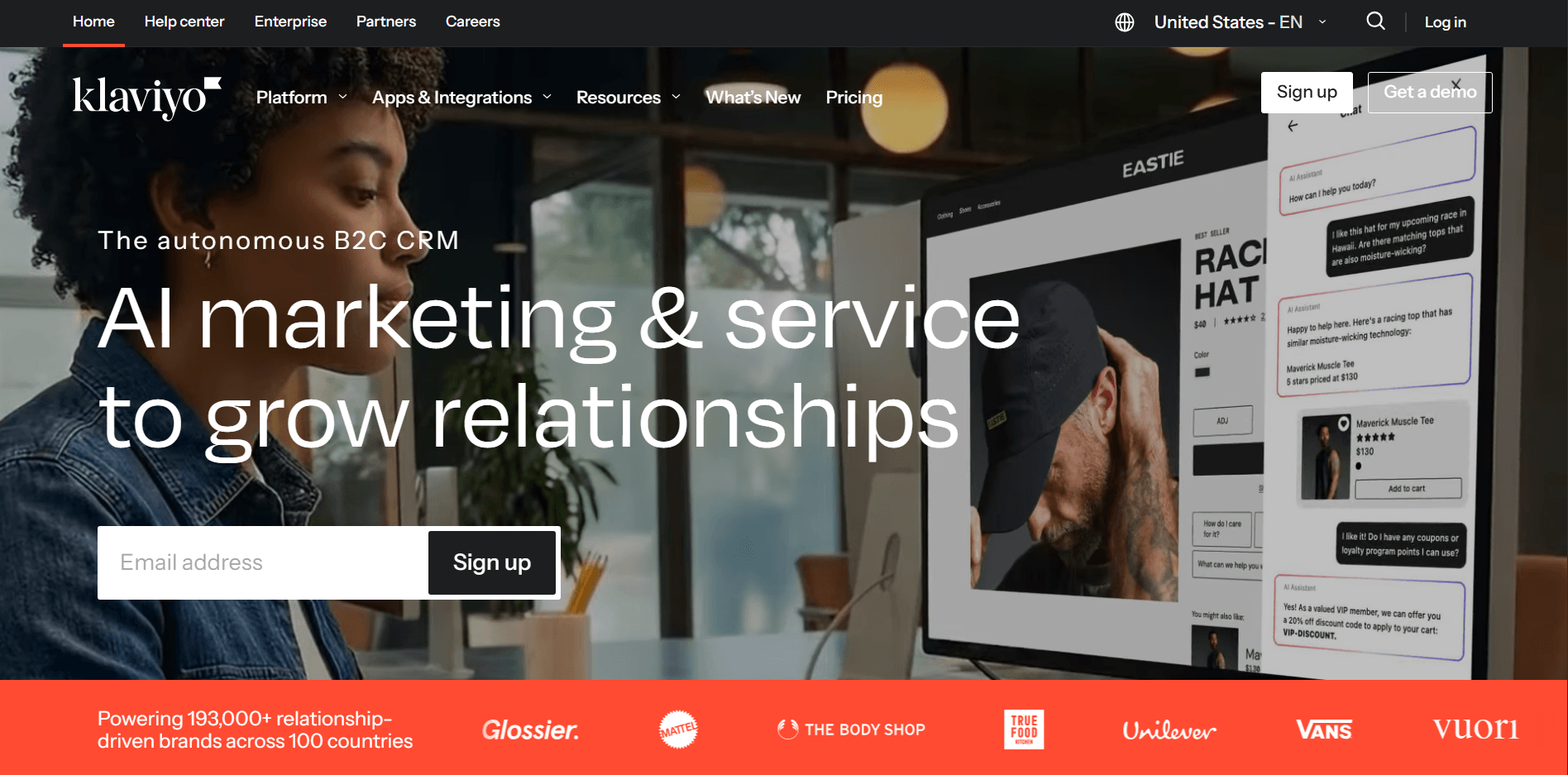
G2 rating: 4.6
Shopify App Store rating: 4.5
Best for: Data-driven stores needing deep analytics and granular data tools.
Klaviyo is a common choice among Shopify email alternatives for its deep data integration and advanced reporting. In February 2025, they changed their billing model, and now it’s focused on active profiles instead of total contacts, which makes it more attractive but still expensive.
Klaviyo is known for highly sophisticated automation triggers, which allow you to map the customer journey more precisely than with most other platforms. The automation builder also allows you to work with highly complex branching and conditional-splitting logic. It does, unfortunately, come with a respective learning curve that’s not suitable for beginners.
For Shopify merchants, the platform provides strong segmentation and predictive analytics that forecast customer lifetime value. While the features are abundant, they also come at a high price tag, especially as your list grows and your business scales. As a result, Klaviyo is a better fit for enterprises that require highly complex segmentation and automation and have the appropriate budget and a team of experts.
For more information and deeper insights, check out Omnisend vs. Klaviyo and Klaviyo alternatives.
Standout features:
- Predictive analytics for anticipating customer lifetime value
- Highly advanced automation building with complex branching logics
- Deep segmentation capabilities
Limitations:
- Costs rise significantly at higher subscriber lists
- Advanced features come with a steep learning curve
- Support is limited to 60 days on the free tier
| Plan | Pricing |
|---|---|
| Free | $0/month (250 active profiles, 500 emails, 150 SMS credits) |
| Marketing | From $20/month (251-500 profiles) |
| Professional services | From $500/month |
Support: 24/7 email and chat support for paid plans, and a 60-day email support trial period for free accounts.
3. Mailchimp
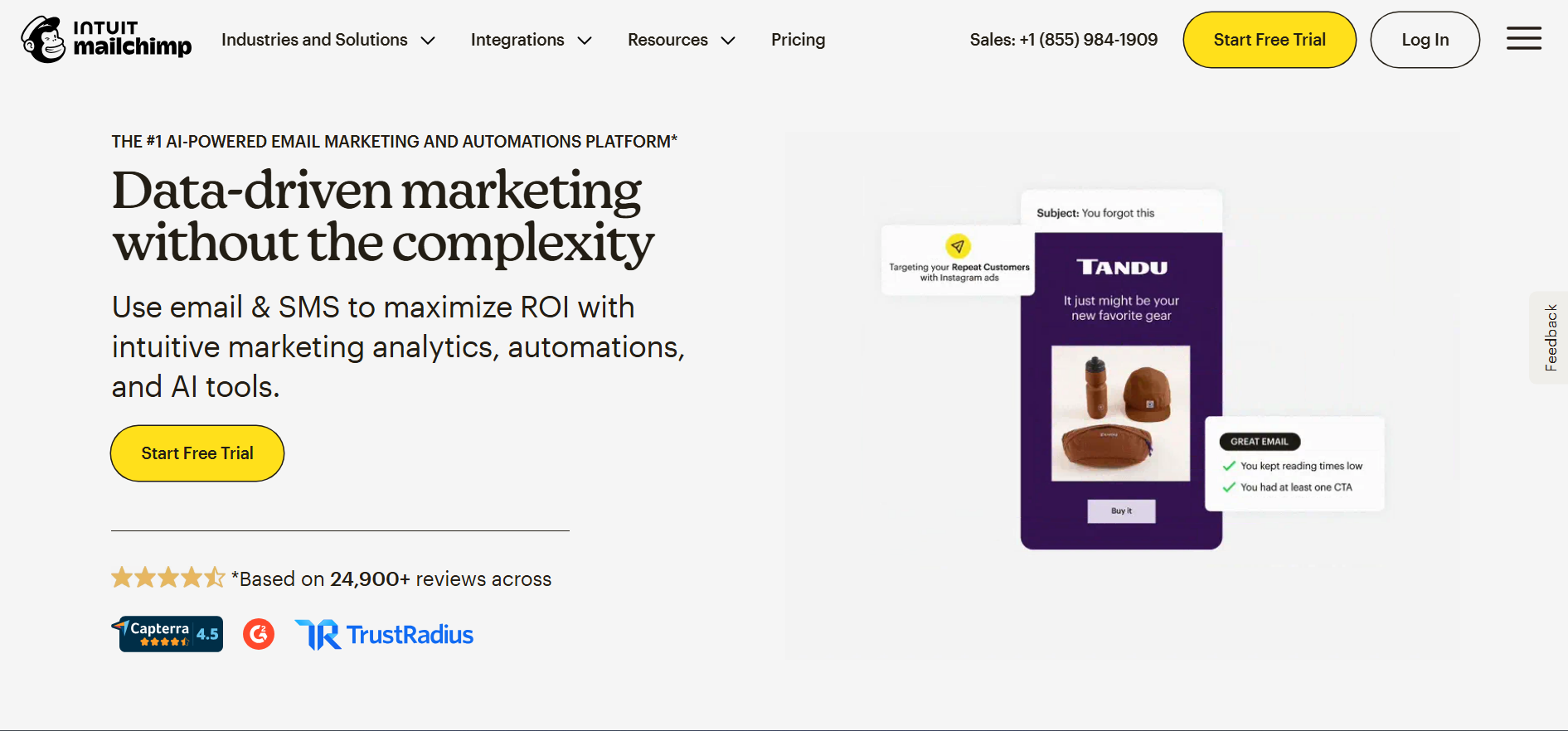
G2 rating: 4.3
Shopify App Store rating: 4.7
Best for: Brands that need an all-in-one marketing suite
Mailchimp is one of the most popular marketing tools in the industry, offering not only email and SMS but also landing page builders and social media management. While it had a historical integration dispute with Shopify several years ago, the native integration is now fully restored and stable. Comparing Shopify Email vs. Mailchimp, It comes with a familiar interface that many small business owners find super approachable for creating standard newsletters.
It does come with a few issues, however. After signing up to try the platform, you’ll notice that Mailchimp gates many essential ecommerce features behind higher-tier paid plans. You won’t be able to access advanced reporting, multi-step automations, and some segmentation tools unless you decide to pay.
What’s more, the pricing structure can also become a burden over time, especially if you’re getting more contacts or figure out that you need more advanced features for your campaigns. For growing businesses, it can do you better to go with a Mailchimp alternative.
Standout features:
- All-in-one marketing platform with email, SMS, landing pages, social media, and more
- Extensive third-party integration library
- Easy-to-use drag-and-drop editor and an intuitive interface
Limitations:
- Some essential ecommerce features demand higher-tier plans
- Support is limited to only 30 days on the free plan
- Advanced reporting is unavailable on lower tiers
| Plan | Pricing |
|---|---|
| Free | $0/month (500 contacts, 1,000 emails/month) |
| Essentials | From $13/month |
| Standard | From $20/month |
Support: 24/7 email and chat for paid plans, and a 30-day limit for free accounts.
4. Brevo
G2 rating: 4.5
Shopify App Store rating: 4.8
Best for: Stores that need built-in CRM and transactional email features.
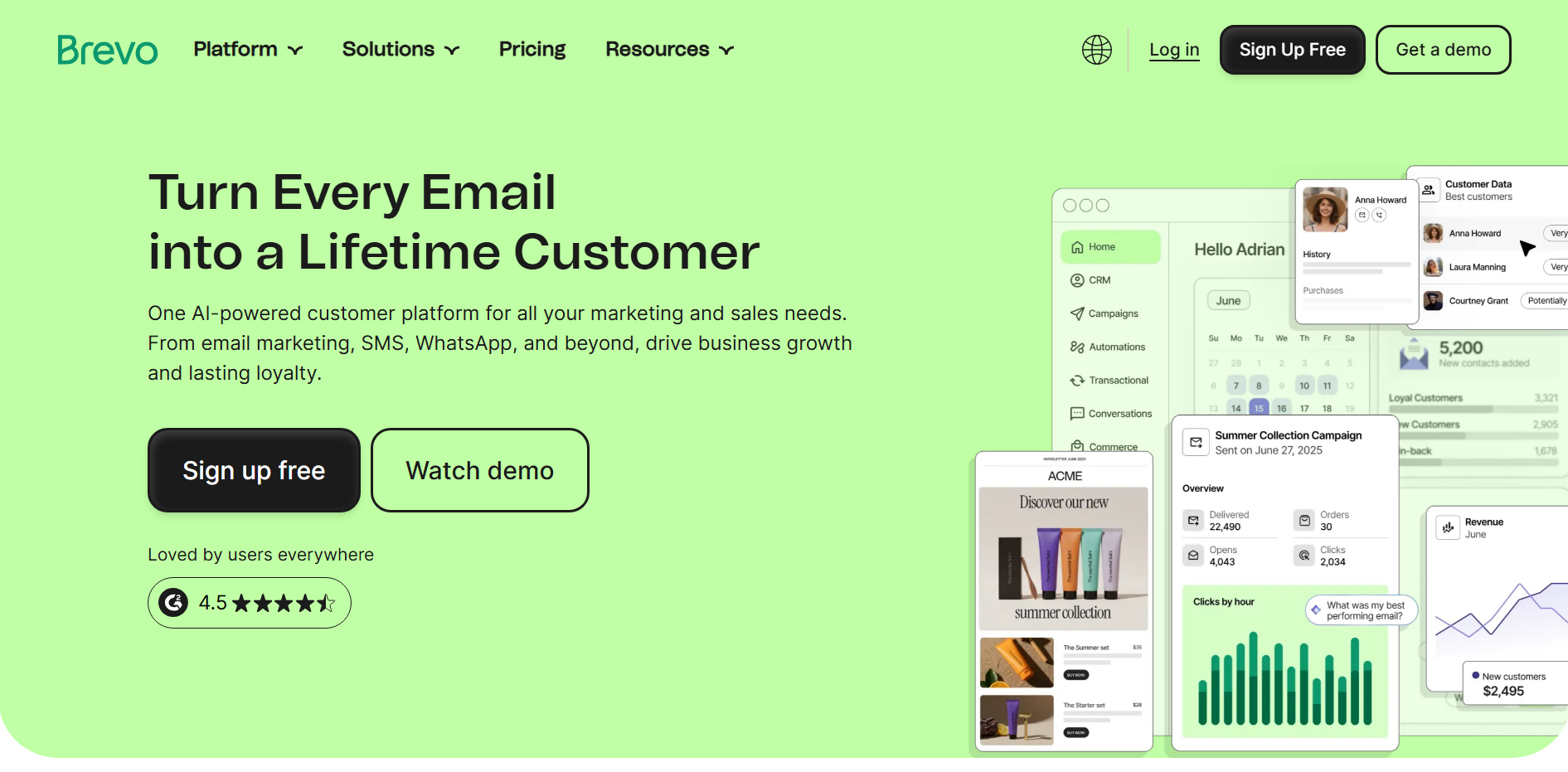
Brevo (formerly Sendinblue) is an ESP that also includes a CRM as a native feature. What’s more interesting is that Brevo has recently merged with PushOwl and, in doing so, has strengthened its web push notification capabilities. As a result, Brevo has become more competitive in terms of providing omnichannel services. The biggest competitive distinction, aside from the CRM, is likely the transactional email capabilities and shipping updates that are enabled by its reliable delivery infrastructure.
The above-mentioned information makes Brevo solid in terms of the features it offers, but its Shopify integration depth is relatively lacking compared to ecommerce-native platforms like Omnisend. The free plan is also generous but limited, as it only allows you to send 300 emails per day, which can be a problem for larger marketing campaigns.
Standout features:
- Native CRM and transactional email features
- Advanced push notification capabilities, thanks to the PushOwl merger
- Pricing based on email volume, not the contact list size
Limitations:
- Restrictive daily sending limit on the free plan
- Weaker Shopify integration when compared to other Brevo alternatives
- CRM features can make the general interface feel a bit cluttered
| Plan | Pricing |
|---|---|
| Free | $0/month (unlimited contacts, 300 emails/day) |
| Starter | From $9/month |
| Standard | From $18/month |
| Professional | From $499/month |
Support: Email support is available on all plans, while phone and chat support are reserved for higher tiers.
5. ActiveCampaign
G2 rating: 4.4
Shopify App Store rating: 4.5
Best for: Stores that need deep automation workflows and complex logic building.
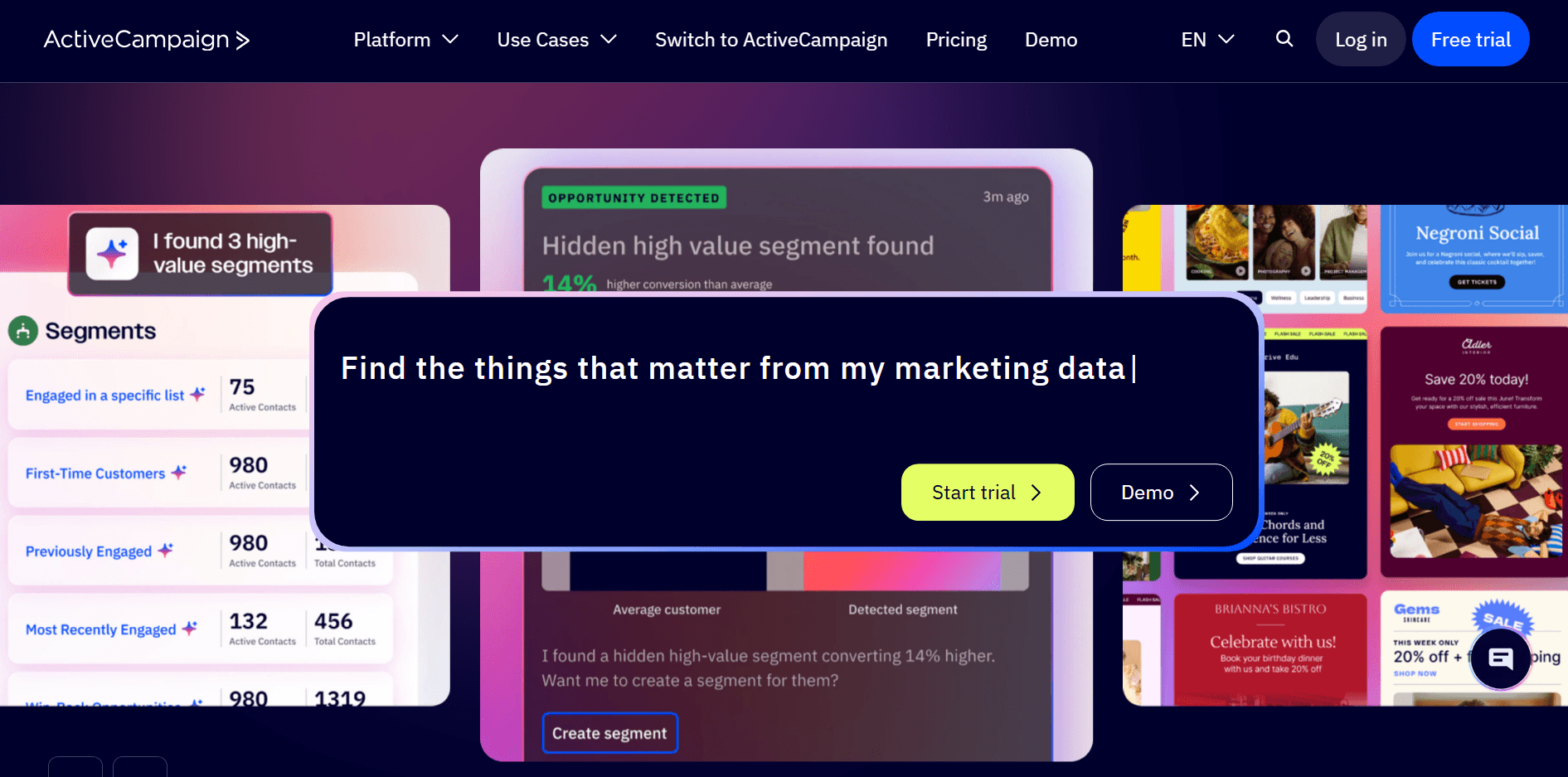
ActiveCampaign is widely known for its automation depth and its powerful visual builder. The platform supports complex split logic and multi-channel sequences. It also acts as a bridge between a traditional email tool and a full-on sales CRM. This combination makes it a great choice for brands that often deal with complex sales cycles.
All this power, however, comes at a cost. And not only the financial one. You’ll also need to put in the work to learn how to use the platform properly, or you can hire someone who specializes in ActiveCampaign.
There’s no free plan available, only a 14-day trial, which can make it difficult to fully test the platform due to its steep learning curve that we mentioned earlier. If you’re looking for the best Shopify Email marketing apps but aren’t prepared to deal with the technical side, you may want to consider other alternatives. ActiveCampaign is often a better fit for established businesses with dedicated marketing teams.
Standout features:
- Industry-leading automation workflow builder
- Built-in CRM and lead scoring features
- Dynamic content for highly personalized emails
Limitations:
- No free-forever plan
- Steep learning curve for new users
- It can be expensive for smaller stores
| Plan | Pricing |
|---|---|
| Starter | Starts at $15/month (billed annually) |
| Plus | Starts at $49/month (billed annually) |
| Pro | Starts at $79/month (billed annually) |
| Enterprise | Starts at $145/month (billed annually) |
Support: 24/7 chat and email support for all paid customers.
6. MailerLite
G2 rating: 4.6
Shopify App Store rating: 2.6
Best for: Small stores on a tight budget that need only basic features.
MailerLite is often praised for its clean interface and strong value, which is only natural for a platform that only focuses on essential features at a low price. To attest to that, even their free plan includes 12,000 monthly emails, which is a feature that not many tools (if any) can match.
It provides all the basic tools needed for email marketing, including a drag-and-drop editor and simple automation sequences. This makes it a popular choice for bloggers and very small ecommerce stores looking to keep their overhead as low as possible. In short, it’s a great entry point.
The main drawback for Shopify users, though, is the integration itself, which currently has a very low rating of 2.6/5 on the Shopify App Store. Setting up the integration often requires an API key, which is less intuitive than the one-click setup offered by ecommerce-native tools. Furthermore, the automation and segmentation features are relatively basic compared to more specialized alternatives.
To get even more details on the platform, you may want to read Omnisend vs MailerLite.
Standout features:
- Generous free plan for up to 500 subscribers and 12,000 monthly sends
- Clean and intuitive user interface
- Built-in landing page and website builder
Limitations:
- Weak Shopify integration with low App Store ratings
- Requires technical API setup for many features
- Limited advanced automation and ecommerce triggers
| Plan | Pricing |
|---|---|
| Free | $0/month (500 subscribers, 12,000 emails/month) |
| Growing Business | From $10/month |
| Advanced | From $20/month |
Support: 24/7 email and chat support for up to 14 days
7. Constant Contact
G2 rating: 4.1
Shopify App Store rating: 3.1
Best for: Straightforward newsletters and basic list management.
Constant Contact has been in the email marketing space for years and is best known as a straightforward platform that lets you manage email lists and send basic newsletters. The main focus is on ease of use for small business owners who don’t want or require complex marketing workflows or deep data analysis.
Unfortunately, the platform has recently removed several features, including event management, and its automation capabilities remain fairly limited. For those using Shopify, the rating is relatively low at 3.1/5, which suggests a less-than-ideal experience. There’s also the matter of having a difficult time trying to cancel the subscription once you start the free trial.
You’ll most likely have to call them and provide your account details to unsubscribe. Otherwise, once the free trial ends, you’ll be charged until you cancel.
Standout features:
- Simple and fast email building
- Straightforward and easy-to-understand interface
- Social media posting and scheduling tools
Limitations:
- No free-forever plan
- Limited automation and segmentation for ecommerce
- Notoriously annoying subscription cancellation policy
| Plan | Pricing |
|---|---|
| Lite | From $12/month |
| Standard | From $35/month |
| Premium | From $80/month |
Support: Phone and chat support available.
8. Drip
G2 rating: 4.4
Shopify App Store rating: 4.2
Best for: Established Shopify stores that need highly advanced automation and customer journey mapping.
Drip is one of the most sophisticated email marketing platforms that also provides you with an ecommerce CRM. You can use said CRM to track shopper activity and create highly personalized campaigns and experiences. To execute these personalized communications, you can use their visual workflow builder, which offers advanced automation capabilities.
While most competitors offer a free plan, Drip doesn’t, so you’ll need to settle for a 14-day free trial, after which you’ll have to pay. The good thing is that Drip doesn’t require you to enter your credit card details to access the free trial, so that you won’t get any unexpected charges at the end of the final date.
It’s also one of the most expensive tools to start with. But the price is justified by their granular ecommerce triggers, intuitive editors, complex customer journey mapping, and more. At the end of the day, Drip is more focused on large stores with more unique needs than most modern ecommerce businesses.
Standout features:
- Granular ecommerce triggers
- Facebook Customer Audiences integration
- Advanced shopper activity tracking
Limitations:
- Higher starting price than most other platforms
- Email template selection is more limited
- No free plan available
| Plan | Pricing |
|---|---|
| Standard | From $39/month |
Support: Email support during working hours, higher-paying customers get access to live chat support during working hours.
9. Sender
G2 rating: 4.7
Shopify App Store rating: 4.6
Best for: Stores that want a generous free plan with ecommerce automation.
Sender can be great for you if a generous free plan that still includes core ecommerce automation is what you need. However, in that case, you can just use Omnisend, as it provides all its features without restrictions on the free plan as well. While Sender is not as popular or as widespread as some other email marketing tools on the market, it still has a reputation for providing reliable services and an intuitive interface.
As a result, the learning curve is minimal. If you need to onboard new team members or do it yourself, you can launch campaigns pretty quickly because there’s no excessive technical overhead.
Standout features:
- Free plan with up to 2,500 subscribers and 15,000 emails/month
- Pre-built automation workflows
- SMS marketing and reporting
Limitations:
- Lesser-known brand
- Fewer advanced features than top-tier tools
| Plan | Pricing |
|---|---|
| Free | $0/month (Up to 2,500 subscribers and 15,000 emails/month) |
| Standard | $10/month |
| Professional | $20/month |
Support: 24/7 email and live chat support.
10. Privy
G2 rating: 4.6
Shopify App Store rating: 4.5
Best for: Shopify stores focused on list growth with popups and lead capture.
Privy is a staple tool in the Shopify ecosystem, maintaining a high 4.5 rating and more than 18,000 reviews. The setup for this platform is simple; it comes with a one-click installation that automatically syncs your entire customer data.
It provides features like spin-to-win wheels, coupon popups, free shipping bars, and more to help you drive repeat purchases and build your list effectively. While it’s true that Privy has expanded its services to include SMS and basic email marketing, its features are incomparable to those of dedicated platforms. There are no multi-step workflows or deep segmentation capabilities to help you personalize your recipients’ experience.
Many stores find the best results by using Privy as a complementary lead-capture tool alongside a more dedicated email platform. This allows you to combine high-converting popups with the advanced automation needed to turn those visitors into long-term customers.
Standout features:
- High Shopify App Store rating (4.6/5 with 18,000+ reviews)
- Spin-to-win wheels
- Coupon popups
- Free shipping bars
Limitations:
- Limited automation (no multi-step workflows)
- Basic email marketing compared to dedicated ESPs
| Plan | Pricing |
|---|---|
| Starts from $30/month |
Support: Email and live chat support during business hours.
Shopify Email alternatives pricing compared
Finding the cheapest email marketing software for Shopify usually comes down to understanding contact tiers and feature limits. To simplify the decision, we grouped these platforms into three starting budget tiers:
- Free options: Omnisend, Shopify Email, Sender, and MailerLite
- Under $20/month: Brevo, ActiveCampaign, and Mailchimp
- $20+/month: Klaviyo, Drip, and Constant Contact
Many merchants initially ask, “Is Shopify Email free?” Yes, but while it offers a great starting point, you must keep the Shopify Email free limit of 10,000 emails per month in mind.
Furthermore, the lowest starting price does not always mean the best overall value for your store. It’s crucial to look at the return on investment and feature depth. Omnisend’s free plan, for example, stands out for including the full feature set: automation, segmentation, A/B testing, reporting, and more. Most competitors, on the other hand, limit these features to paid plans. Omnisend users see an average return of $79 for every $1 spent.
Because costs scale dramatically across different platforms as your subscriber list expands, comparing raw numbers can be difficult or overwhelming. To battle that, we’ve built a pricing comparison calculator you can use to see exactly what you will pay on different platforms.
Use our interactive pricing comparison calculator and see your final price tag
How to choose the right Shopify Email alternative
Finding the best email platform for Shopify requires looking past basic newsletter builders. You need a powerful yet intuitive platform that actively drives your revenue growth.
Essential features to evaluate
When evaluating email marketing software, make sure you assess these specific capabilities to find the best Shopify email automation tool for your use case:
- Shopify integration depth: Check whether the tool supports direct product sync, order triggers, and detailed customer data, as these will be the most important factors for your automations.
- Automation capabilities: See whether the platform offers multi-step workflows, A/B testing, split logic, and more capabilities you may need to achieve your goals.
- Segmentation power: Test the segmentation to see if you can filter your audience using behavioral, purchase-based, and lifecycle data.
- Multi-channel support: If you need SMS or push notifications, make sure the platform lets you set up steps across different channels in a single workflow.
- Deliverability and analytics: Check how the platform displays data such as revenue attribution, email metrics, and clickmaps so you can make data-driven decisions.
- Support availability: Look for 24/7 email and live chat support instead of restricting yourself to business hours only.
Matching the platform to your store’s growth stage
It’s rarely (if ever) a good decision to just go for the cheapest one or the most expensive one. Every tool is different, and each caters to a different audience. You need to make sure you find the one that reflects your needs today, and that will likely be able to meet them as you grow. For example:
- Choose MailerLite or Sender if: Your store is under $50K/year and you need to keep your costs minimal. They provide strong starting points for tight budgets.
- Choose Omnisend if: You’re doing $50K-$500K/year and need omnichannel capabilities. It’s a tool that allows you to send messages via email, SMS, and push notifications without the complexity and excessive price tag. Omnisend consistently delivers one of the strongest balances of features, support, and value. Use Omnisend for Shopify if that’s what you’re looking for.
- Choose Klaviyo if: You’re a data-driven store at $500K+ and budget is secondary to analytics depth. Klaviyo offers the most granular data tools for large teams.
Find the right Shopify Email alternative for your store
The right choice for your business depends entirely on your store size, growth trajectory, and marketing complexity. For most growing Shopify stores, Omnisend provides the strongest combination of ecommerce-focused features, omnichannel capabilities, and value.
Here’s a quick recap of our top picks:
- Omnisend: Best overall for ecommerce with full features on every plan, omnichannel capabilities, and a $79 average ROI
- Klaviyo: Best for data-driven analytics at scale
- MailerLite: Best value for new stores
If you’re ready to make the switch, you can migrate to Omnisend seamlessly or check pricing tiers that scale alongside your success.
Quick sign up | No credit card required
FAQs
If you are looking for the best email marketing for Shopify, Omnisend stands out as the overall top choice for ecommerce, delivering an average return of $79 for every $1 spent. Klaviyo serves data-heavy stores well with its deep analytics, while MailerLite is a strong option for new stores that prioritize their budget.
Yes, you receive 10,000 free emails per month. Once you hit the Shopify email free limit, you pay $1 for every additional 1,000 emails sent. Note that standard abandoned checkout automations are always free to run regardless of your sending volume.
You outgrow the native tool when you start needing multi-step automations, SMS integration, advanced segmentation, or precise revenue attribution. Reviewing an Omnisend vs. Shopify Email breakdown shows exactly how a dedicated platform provides the advanced tools scaling stores require.
Yes, you can run both natively in Shopify Messaging or via third-party platforms. If you’re wondering where Shopify merchants can find reliable email marketing software for omnichannel campaigns, Omnisend seamlessly unifies email, SMS, and push notifications into one cohesive workflow.
Costs range from $0 for fully-featured free plans to $20 or more per month for paid tiers, depending on your list size. Use our pricing comparison calculator to see exactly what you will pay based on your specific audience size and feature needs.