Omnisend AI

 OFFER
OFFER










Knowing how to grow your email list is one of the most valuable skills you can have as an ecommerce operator.
Unlike social media, email is an owned channel. That means no algorithm can cut your reach overnight.
In this guide, we organize email list growth into three speed tiers, mapped to your store’s lifecycle.
New to list building entirely? Learn how to build an email list from scratch first.
Why growing your email list is the highest-ROI investment for ecommerce
Growth in email lists is important because email is owned, algorithm-proof, and compounds lifetime value per subscriber. Your list remains yours, but social reach may disappear quickly. It’s the most dependable method for increasing recurring revenue and safeguarding your brand against platform modifications.
Email campaigns made $0.18 for each email sent worldwide, according to the 2026 Omnisend Ecommerce Marketing Report.
Meanwhile, automations made $2.87 per email, nearly 16x more. Welcome flows alone hit $6.30 per email, with a 2% conversion rate and an average order value of $315.
2026 Omnisend email benchmarks
— Revenue per email: $0.18 (campaigns) vs. $2.87 (automations)
— Welcome flow performance: 33.79% open rate and 52.98% click-to-conversion
— Welcome flow value: $6.30 per email, 2% conversion rate, $315 AOV
Brands that invest early in email list growth often see better long-term returns. This is where Shopify and WooCommerce stores have a real edge.
Both platforms give you native checkout opt-ins. That means you can capture subscribers at the highest-intent moment in the customer journey, right when they’re about to buy.
They also track browsing, purchases, and behavior. This lets you send more relevant emails and grow your email list by targeting more effectively. Generic tools cannot match this level of insight.
Quick wins: 7 tactics to grow your email list in 0–30 days
Stacking an exit-intent popup, a checkout opt-in, and a mobile-specific form is the fastest way to hit a meaningful signup rate. Gamified spin‑wheel popups convert 8–15%, delivering 2–3x gains over standard 3–5% discounts by leveraging engagement psychology.
Deploy all three formats together, and a 3–5% site-wide email capture rate is a realistic 30-day target. Here are the seven tactics to get you there:
1. Exit-intent popup with a discount offer (⏱ 1–2 hours)
When a visitor tries to dismiss the tab or navigate away, an exit-intent dialog appears. This is your final opportunity to capture them.
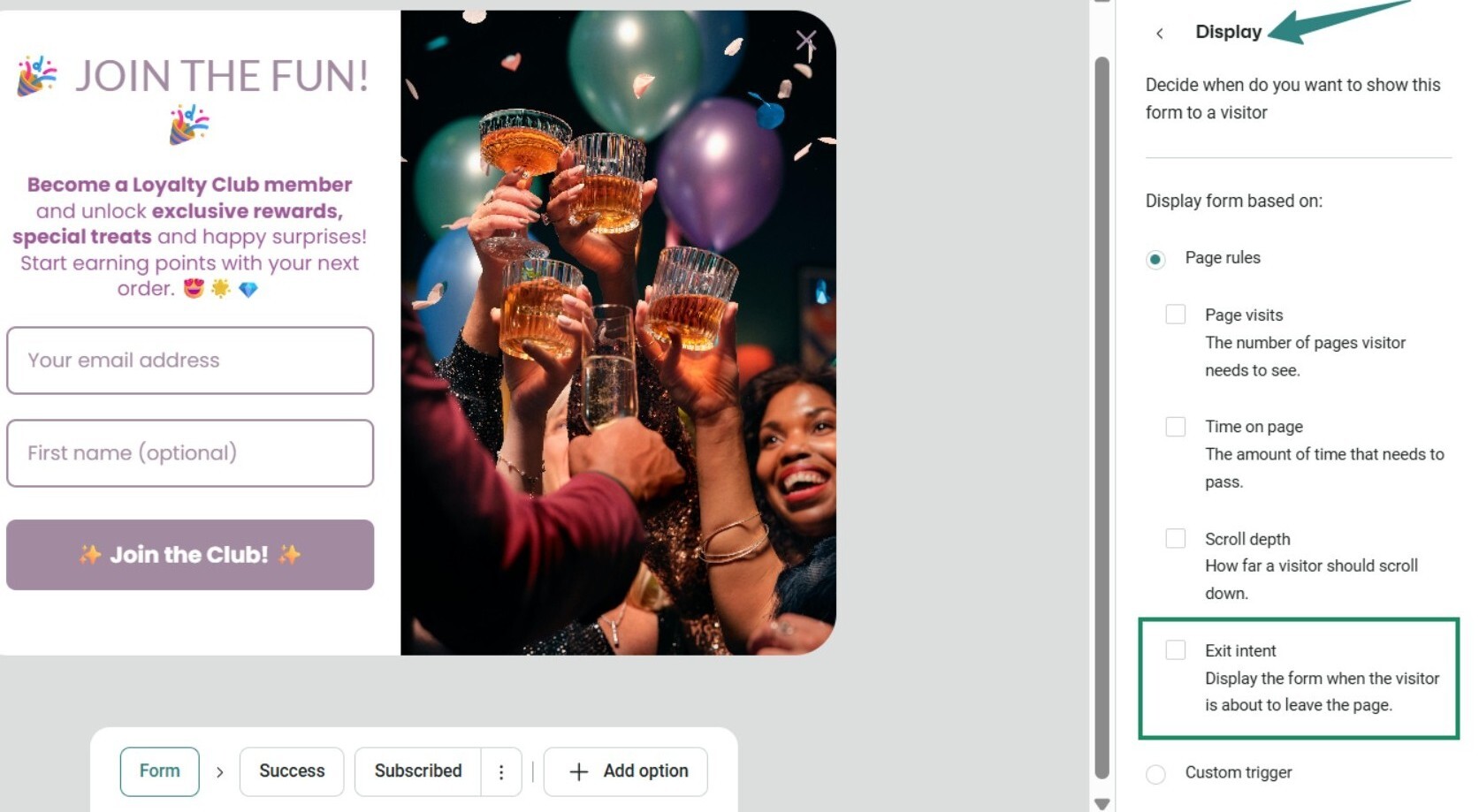
Give a clear incentive, such as a 15% discount. Often, a 5% or 10% discount doesn’t seem significant enough to take advantage of, particularly if a visitor was already leaving. The “is this worth my email?” standard that most consumers set, however, is lifted by a compelling offer.
Also, it rapidly increases signup rates and enhances email capture. For high-converting signup forms, pair the discount with a single email field and a clear CTA button. Keep the copy simple and focus on one action: sign up and save.

Omnisend success story
Organic Aromas ran a four-week email capture experiment with Omnisend. The brand invested just one hour of setup time and captured 661 new leads — a 150% increase in monthly signups. An immediate popup alone drove a 6.8% subscription rate during its test week.
Read the full case study
2. Checkout opt-in (⏱ 30 minutes)
The checkout page is the highest-intent moment in your entire store. A visitor filling in their email to complete a purchase is already giving you their address. So, adding a checkbox to opt into marketing is one of the lowest-friction email list growth strategies available.
On Shopify, this is built into the checkout settings natively. On WooCommerce, a plugin like Mailchimp for WooCommerce or Email Marketing for WooCommerce by Omnisend handles it.
Keep the opt-in label benefit-focused. For instance, “Get order updates and exclusive offers” outperforms the generic “Subscribe to our newsletter.”
3. Wheel of Fortune (spin-to-win) popup (⏱ 1–2 hours)
Gamified popups are effective because they make your signup form more enjoyable and compelling. Visitors spin the wheel for a chance to win one of several prizes. The mechanism is straightforward.
These can range from percentage-based discounts to free shipping or a surprise gift. The possibility of winning a prize removes the friction of uncertainty about whether the offer is worth it.
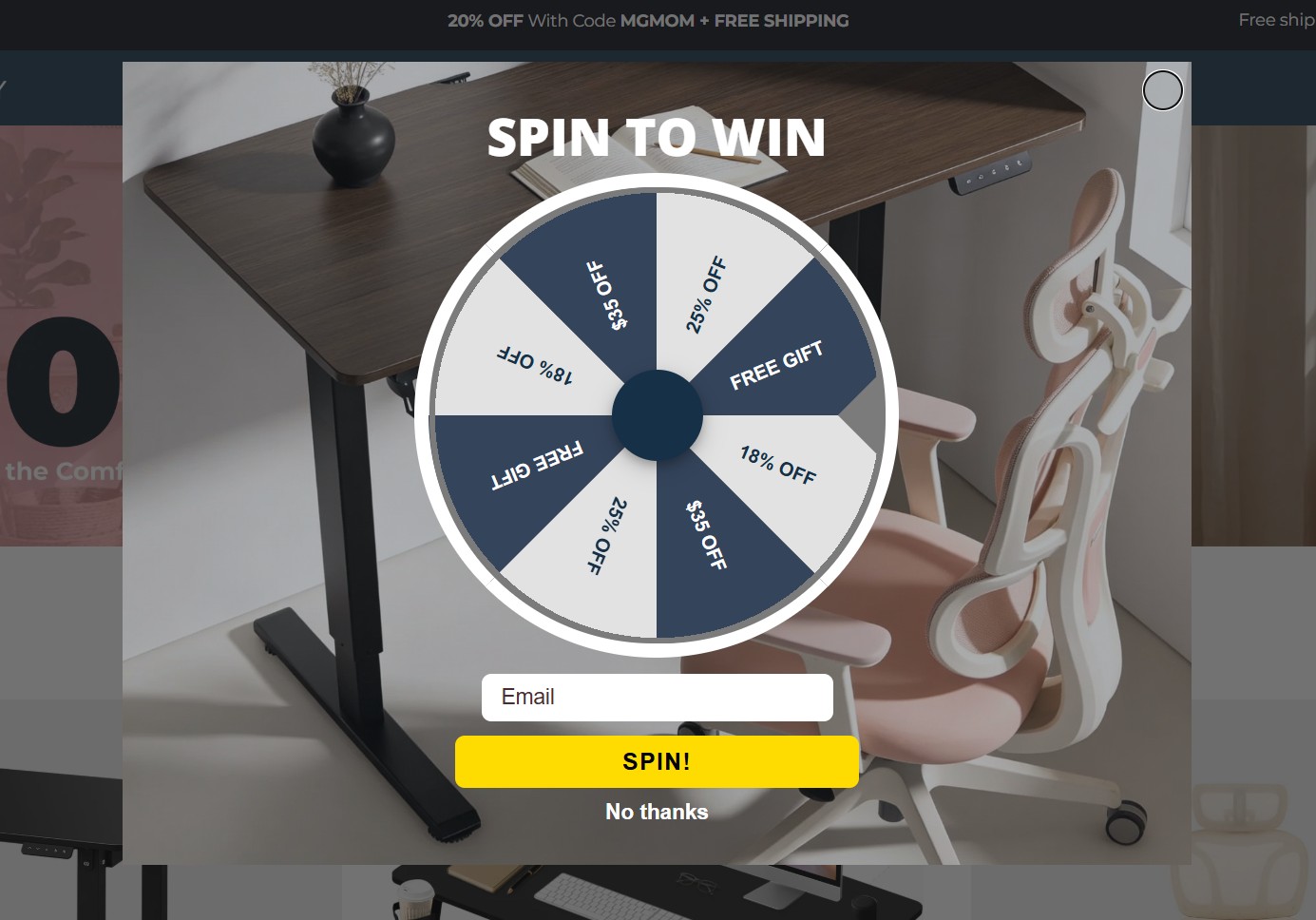
Omnisend data reveals that gamification features like Wheel of Fortune drive an increase of up to 11% in signup rate. That’s far higher than the 4% achieved by standard popups.
4. Social bio link to landing page (⏱ 1–2 hours)
Your Facebook, Instagram, and TikTok profiles are excellent places to expand your email list. However, many stores waste them by linking to a generic homepage.
A dedicated landing page with one opt-in form and a clear offer performs far better for email signups. For example: “Join 12,000 customers and get 15% off your first order.”
Using tools like Omnisend’s landing page builder or a basic page in your Shopify or WooCommerce theme gets you there fast. If you’re active on multiple platforms, a link-in-bio tool like Linktree points all channels to the same page.
5. SMS-to-email cross-promo (⏱ 1 hour)
You have access to a warm and motivated audience if you already have an SMS subscriber list. Within hours, a little SMS campaign can increase the number of people who sign up for emails.
Use SMS to invite subscribers to join your email list for exclusive content, early product drops, or larger discounts. Here’s an example: “Get email-only deals this week. Sign up here: [link].”
Omnisend makes this easy by automating SMS messages that link to your email signup form or opt-in landing page. You can use a tracked link to monitor performance. Always give SMS subscribers a clear reason to join your email list.
6. Embedded forms on blog posts and category pages (⏱ 2–4 hours)
Including static embedded forms in your most popular content is a reliable, low-maintenance way to increase the number of people who sign up for your email list. The logic is simple. Someone reading your blog post about “how to choose a yoga mat” is showing purchase intent.
An embedded form mid-post, “Get our full gear guide + 10% off your first order,” meets them at exactly the right moment. The same applies to category pages on large catalogs.
These aren’t aggressive popups. They’re contextual, relevant, and easy to scroll past if visitors aren’t interested. That makes them particularly useful for good email list management.
7. Mobile‑specific popup design (⏱ 2–3 hours)
Mobile devices drive around 60% of ecommerce traffic, so your forms must be optimized for mobile users.
A popup that looks clean on a 1440px screen but covers the entire viewport on a phone will be dismissed immediately. Even worse, it might trigger a Google penalty for intrusive or disruptive overlays.
Create a mobile-specific version of your popup instead. Use smaller popups, faster load times, and thumb-friendly buttons. Avoid full-screen interruptions that frustrate users. Instead, trigger popups on a time delay or when visitors scroll a set percentage down the page.
Medium-term: 7 ways to grow your email list in 1–3 months
Quizzes, SEO-integrated forms, giveaways, and referral schemes add up over weeks rather than days. Through interaction and sharing, they gain momentum, converting early signups into consistent growth.
If you want to grow your email list in a steady, scalable way, this is your next layer.
8. On-brand giveaway campaign (⏱ Setup: 3–5 days | Growth window: 2–6 weeks)
A well-run giveaway is one of the fastest ways to accelerate email list growth at a fraction of the cost of paid ads. The keyword is on-brand.
A generic prize (think iPad or cash) attracts freebie hunters who’ll unsubscribe the moment the contest ends. A prize tied to your product category, your best-seller, a curated bundle, or an exclusive experience, attracts your actual target customer.
Why it works for ecommerce: Giveaways turn uninterested social media users into loyal email subscribers in a matter of days rather than months. Giveaways typically draw more active members than generic lead magnets because they involve enrollment.

Omnisend success story
Influencer‑led giveaways at CA Design offered prizes consistent with its furniture aesthetic. Its Omnisend-powered campaigns brought in 200, 800, and then 2,000 new entrants, respectively. Each time, its list grew 10–15% in a short period. Entrants were tagged in Omnisend for segmentation and engagement tracking.
Read the full case study
9. Double opt-in referral program (⏱ Setup: 1–2 weeks | Growth window: Ongoing)
A referral program turns your existing subscribers into promoters. Each subscriber gets a unique share link. For each friend who signs up, the referrer earns a reward. This can be a discount, store credit, or early access to a drop.
Use a double opt-in flow to maintain list quality and reduce fake entries. This builds a cleaner, more engaged WooCommerce or Shopify email list over time. With this tactic, your brand gains new subscribers and reinforces loyalty among referrers.
Why it works for ecommerce: Most acquisition channels don’t convert as well as word-of-mouth recommendations. Social proof is already present when a referred subscriber shows up.
10. SEO-embedded forms in top-traffic blog posts (⏱ Setup: 2–4 hours | Growth window: Compounding over months)
Your best-performing blog posts are already getting the right visitors. An embedded email signup form, placed mid-article rather than just in the footer, captures them at peak engagement.
Readers already trust your content, so conversion rates rise naturally. Check Google Analytics or Search Console for your top organic-traffic posts, then build targeted offers for each. Contextual offers that match your content will improve conversions.
Why it works for ecommerce: Organic search visitors have high purchase intent. Capturing them before they bounce turns passive traffic into an owned asset.
11. Email-gated product recommendation quiz (⏱ Setup: 3–7 days | Growth window: Ongoing)
Quizzes work because they offer personalization before purchase. A visitor who takes a “Which mattress is right for you?” quiz is invested. They’ve already spent 60–90 seconds answering questions. Gating the results behind an email field converts that investment into a signup.
The key here is that the email ask must come after the quiz, not before. Visitors will not start a quiz they know is just a lead capture. Beyond list growth, quiz responses give you first-party insights on every subscriber. This enables segmented flows from day one.
Why it works for ecommerce: Quiz opt-in rates consistently outperform static popups since subscribers have already indicated purchase intent through their answers.
12. Dedicated paid-social landing page (⏱ Setup: 1–3 days | Growth window: Scales with budget)
Running social ads to your homepage is the most common paid acquisition mistake in ecommerce. The homepage has navigation, competing CTAs, and no single focus, which leads to lower conversion rates.
A dedicated landing page with one offer, one form, and no escape routes dramatically changes the economics. Omnisend’s Create a mobile-specific version of your popup instead. It comes with pre-tested layouts that connect directly to your automation flows on Shopify and WooCommerce.
Why it works for ecommerce: Paid traffic is expensive. A dedicated landing page maximizes every dollar by removing the friction that a general homepage creates.
13. SMS-to-email targeting of SMS-only subscribers (⏱ Setup: under 1 hour (requires Omnisend SMS) | Growth window: 2–4 weeks)
Have you been collecting SMS subscribers without a corresponding email capture step? You have a warm, high-intent audience that’s already opted into your marketing. They just haven’t given you their email yet.
A targeted SMS message with a clear email-exclusive value proposition converts well because the trust barrier is already crossed. With this Omnisend-native tactic, you can build an SMS-only subscribers segment and trigger an email opt-in flow directly from SMS.
Why it works for ecommerce: SMS-only subscribers are already engaged contacts. Adding them to your email list gives you another reliable channel for campaigns, promotions, and product launches.
14. Facebook and Instagram lead ads with 1% lookalike audiences (⏱ Setup: 3–5 days | Growth window: Scales with budget)
Meta’s Lead Ads let visitors submit their email without ever leaving Facebook or Instagram. Use them to eliminate the landing page friction that kills most cold-traffic campaigns.
To improve lead quality, you can build 1% lookalike audiences from your highest-LTV customers. This kind of audience tells Meta’s algorithm to find people who statistically behave like your best buyers.
Why it works for ecommerce: You’re not guessing at audience quality. Instead, you’re targeting based on a proven behavioral profile, not a random interest category. Every email captured via an LTV-based lookalike has a higher probability of converting.
Long-term growth engines: 6 strategies for 3–6 months
Loyalty programs, brand partnerships, offline QR signups, and multi-step welcome automation are compounding infrastructure.
They take more time to set up, but become cheaper over time and mostly run on autopilot.
Below are six long‑term strategies that scale your list between months 3 and 6.
15. Loyalty/VIP program with email as the entry point (⏱ Setup: 2–4 weeks | Growth window: Permanent)
A loyalty program makes email signup feel more valuable than simply opting in to promotions. Instead of simply joining a mailing list, customers are joining a community. You want to promote the program across your site and in your emails to drive steady growth.
When customers know their email gives them access to points tracking, VIP tiers, birthday rewards, and member-only offers, the signup becomes self-motivating. That improves the quality of every subscriber you capture, so you get high-intent buyers who convert repeatedly.
Why it works for ecommerce: Loyalty-gated email subscribers have a clear reason to stay engaged long after signup. Churn rates are significantly lower than those of pop-up-captured subscribers.

Omnisend success story
Salomon Japan scaled its subscriber base to over 130,000 through loyalty-driven acquisition.
It’s segmented by sport category, with member-only emails sent to loyalty-tier holders. Omnisend’s API integration with Salomon’s loyalty system automatically triggers personalized emails when customers reach a new tier or celebrate a birthday.
Read the full case study
16. Brand partnerships and joint giveaways (⏱ Setup: 2–6 weeks | Growth window: Per campaign)
Find a brand with a complementary audience and a non-competing product, then run a joint giveaway or bundle offers. Think skincare + wellness or apparel + gear. Whatever the combination, participation should require an email signup with both brands.
Clearly state in the entry terms that co-subscription is required. Also, make sure that each new subscriber from the partner’s audience receives a clear double opt-in confirmation flow.
A short, interest-based segmentation question at signup helps you tailor welcome flows accordingly.
Why it works for ecommerce: You acquire subscribers from a warm, pre-qualified audience that already buys in your category. Plus, you do so at a fraction of the cost of paid acquisition.
17. Affiliate program structured around list signups (⏱ Setup: 3–6 weeks | Growth window: Ongoing)
Set up an affiliate program where partners drive traffic to email-focused landing pages. Reward affiliates not just for sales, but also for qualified signups. An affiliate-to-signup model works well for stores in content-heavy niches (fitness, home, beauty, and outdoor) where influencers and bloggers already send targeted traffic.
The incentive for affiliates is predictable, recurring income that doesn’t depend on conversion. The incentive for you is list growth from warm, niche-relevant traffic, with zero upfront ad spend.
Why it works for ecommerce: Affiliates with niche audiences deliver subscribers who are far more engaged than cold ad traffic. Also, you only pay when the signup is confirmed.
18. QR codes on packaging, receipts, and in-store materials (⏱ Setup: 1–3 days | Growth window: Permanent)
Use QR codes to link directly to your email sign-up page with a specific offer. This could include restock alerts, VIP access, or downloadable care guides.
Packages and receipts can also help drive signups. Add QR codes inside boxes, on product cards, or near checkout counters. For stores with a physical retail presence, place them on shelf cards, fitting‑room mirrors, or paper receipts.
Why it works for ecommerce: In the customer journey, the post-purchase phase is typically marked by high satisfaction. These subscribers already have faith in your brand and are more likely to interact.
19. Content upgrades behind an email gate (⏱ Setup: 1–3 days per upgrade | Growth window: Compounding)
Bonus content provided within a relevant blog post or product page that is gated behind an email signup is called a content upgrade. Consider a recipe card, checklist, sizing chart, or PDF instructions.
Unlike a generic lead magnet, it’s context-specific. For example, a cookware brand might gate a “10-minute meal planner” inside a recipe post. Because the offer closely matches the visitor’s interest, it feels helpful and converts better than a generic newsletter form.
Why it works for ecommerce: Subscribers who opt-in for specific, useful content are self-segmenting. You know exactly what they’re interested in before you send a single email.
20. Multi-step welcome automation with conditional splits (⏱ Setup: 3–7 days | Growth window: Permanent)
A welcome flow is one of the highest-converting automations in email marketing. With a multi-step welcome series (three to five emails over three to five days) with conditional splits, you can dramatically increase first-purchase conversion rates.
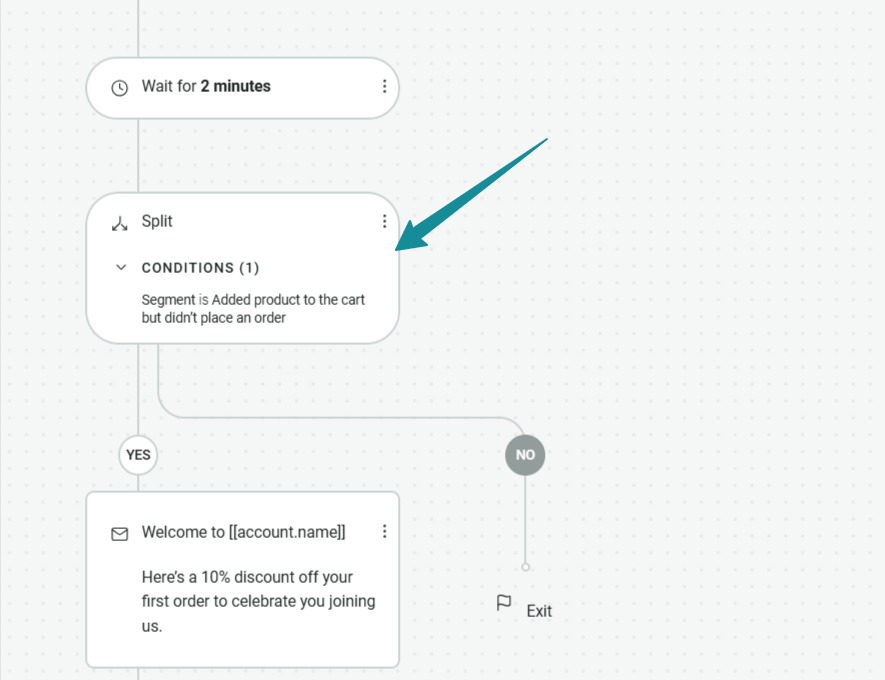
The conditional splits can be based on whether a subscriber opened, clicked, or purchased. Subscribers who buy via email are moved to a post-purchase path — those who don’t get a different offer on email two.
Here’s an example of a conditional split in a welcome automation.
Why it works for ecommerce: Welcome flows run 24/7 and require no ongoing input. They compound engagement, turning one signup into multiple touchpoints.
“As a small business owner, I’m constantly pulled between product, manufacturing, and sales. Knowing these automations are running in the background, even on quiet days, gives us peace of mind. We don’t need to come up with a campaign every week. The automations are doing the heavy lifting.”
— Dallas Singer, Co-Founder of Bowy Made
70% of Bowy Made’s total revenue comes from pre-purchase automation flows. Read the full case study.

Omnisend success story
Gamehide uses a sequenced flow built in Omnisend that triggers immediately after signup.
Its welcome series converts at 7.7%, with a 42% open rate and 6.6% click-through rate. Checkout abandonment automations get a 49% open rate and a 6.66% CTR.
Read the full case study
Next, let’s break down how to prioritize these tactics based on your current list size.
How to grow your email list by list-size stage
Priorities shift as your list expands. What works for 500 subscribers won’t scale for 50k. That’s why you need stage-specific email list growth strategies. Here’s how to grow your Shopify or WooCommerce email list strategically.
| Stage | Subscriber band | Priority tactics | Success indicator |
|---|---|---|---|
| Launch | 0–1,000 | Exit-intent popup, checkout opt-in, social bio link | 2–3% site-wide signup rate |
| Scaling | 1,000–10,000 | Post-purchase opt-in, SMS-to-email, referral program | 5%+ monthly list growth |
| Mature | 10,000–50,000 | Paid lookalikes, brand partnerships, and affiliate signups | Paid cost per sale is trending down |
| Enterprise | 50,000+ | Co-promos, data enrichment, predictive segmentation | Engagement rate stable at scale |
0–1,000 subscribers (launch stage)
At this stage, focus on fast wins and strong fundamentals. You want visibility and a frictionless signup.
Use an optimized email sign-up form, exit-intent popups, and a simple lead magnet, such as a discount or a guide. Also, add links in your social bios to drive traffic. Your goal is to validate what converts and build early momentum.
Aim for a 2–3% site-wide signup rate. Keep testing offers and placements to improve email capture and early email list growth without overcomplicating your setup.
1,000–10,000 subscribers (scaling stage)
Now the goal is momentum. Here, you shift to systems that build on existing traffic and customers.
Add post-purchase opt-ins at checkout and promote your email list through SMS. Launch a referral program to turn subscribers into growth channels. These tactics help you grow your email list faster without relying only on new visitors.
Aim for 5%+ monthly growth. Focus on list quality and engagement, not just volume, to support long-term revenue. Good email list management practices at this stage protect your deliverability as volume increases.
10,000–50,000 subscribers (mature stage)
At this level, growth comes from amplification. The growth pace you require cannot be sustained by organic and on-site strategies alone.
Invest in paid retargeting and lookalike audiences based on your best customers. Build partnerships with complementary brands and creators, and consider doing joint giveaways to reach new audiences. These channels require more planning but offer strong scale.
Your focus should be efficient acquisition and consistent email list growth. Use performance data to double down on what works and cut what doesn’t.
50,000+ subscribers (enterprise stage)
At scale, growth becomes more strategic and data-driven. At this stage, the focus shifts from acquisition to enrichment and predictive targeting.
Run co-promotions with large brands and invest in data enrichment to improve targeting. Use predictive segmentation to identify high-value prospects and personalize acquisition.
Even little improvements can now have a significant impact on revenue. Growth comes from more intelligent targeting rather than wider reach when automation and analytics replace manual strategies.
“We send emails based on categories like ski, snowboard, outdoor, and running. We also have a membership program, so we make use of that segment to send member-only information. These automations have been really effective, especially for growing our membership base.
— ”Maria Nakazono, CRM/Digital Marketing Specialist at Salomon Japan
Omnisend seamlessly connects to Salomon Japan’s loyalty system via API to automate personalized tier and birthday emails. Read the full case study.
These subscriber thresholds are directional, not rigid. Your growth path may vary based on your niche, traffic, and resources.
How Omnisend helps Shopify and WooCommerce stores grow email lists faster
Shopify and WooCommerce stores grow faster when their tools connect forms, automation, and targeting in one place. That is how many Omnisend users grow their email list performance without adding complex setups.
The platform connects natively with both ecommerce systems and includes list-building tools even on its free plan. Here’s how Omnisend users put these tools to work:
- Trigger exit-intent popups before visitors leave their site
- Create landing pages specifically for sponsored social media campaigns
- Integrate checkout opt-ins straight into WooCommerce and Shopify processes
- Use Wheel of Fortune popups to increase engagement and email capture
- Build multi-step forms to pre-qualify or segment subscribers before signup
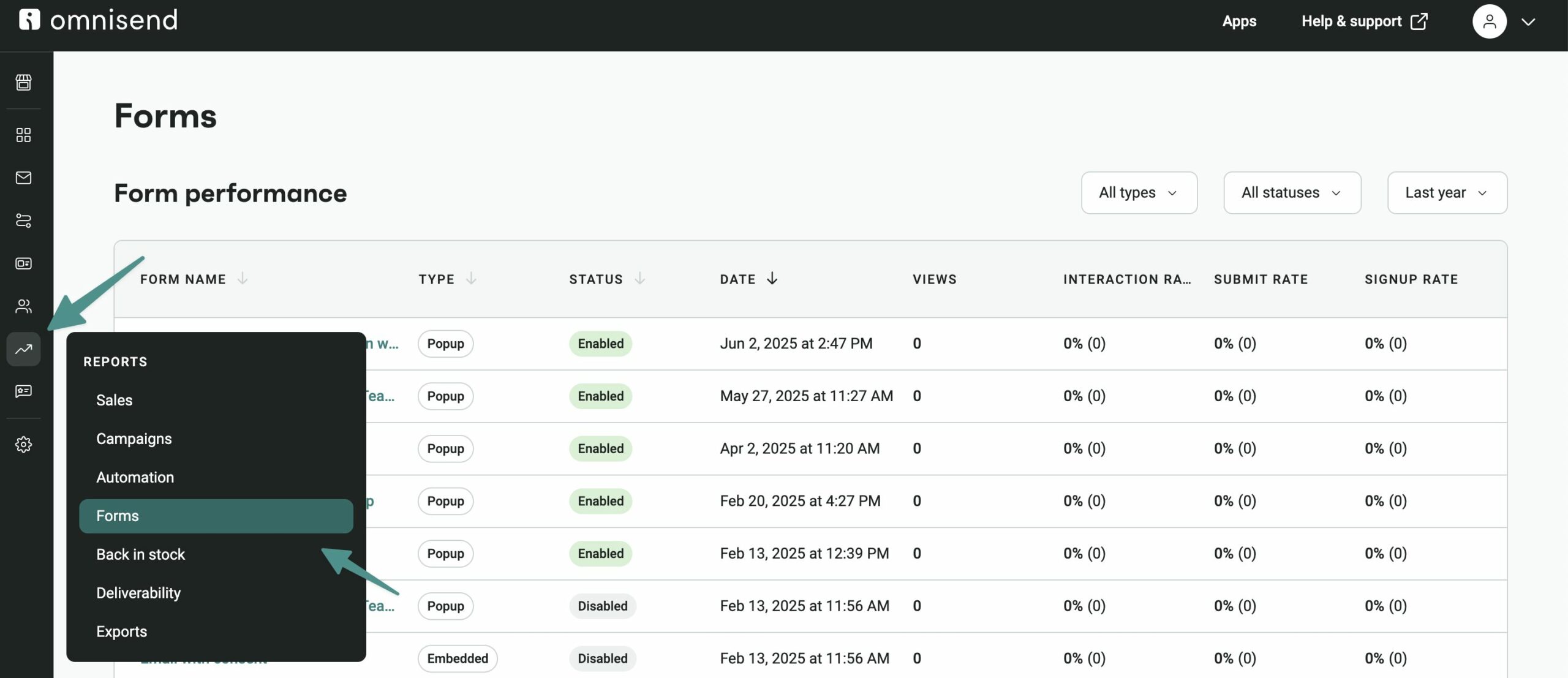
Take a look at Omnisend’s signup forms dashboard, with both active and in-draft forms.
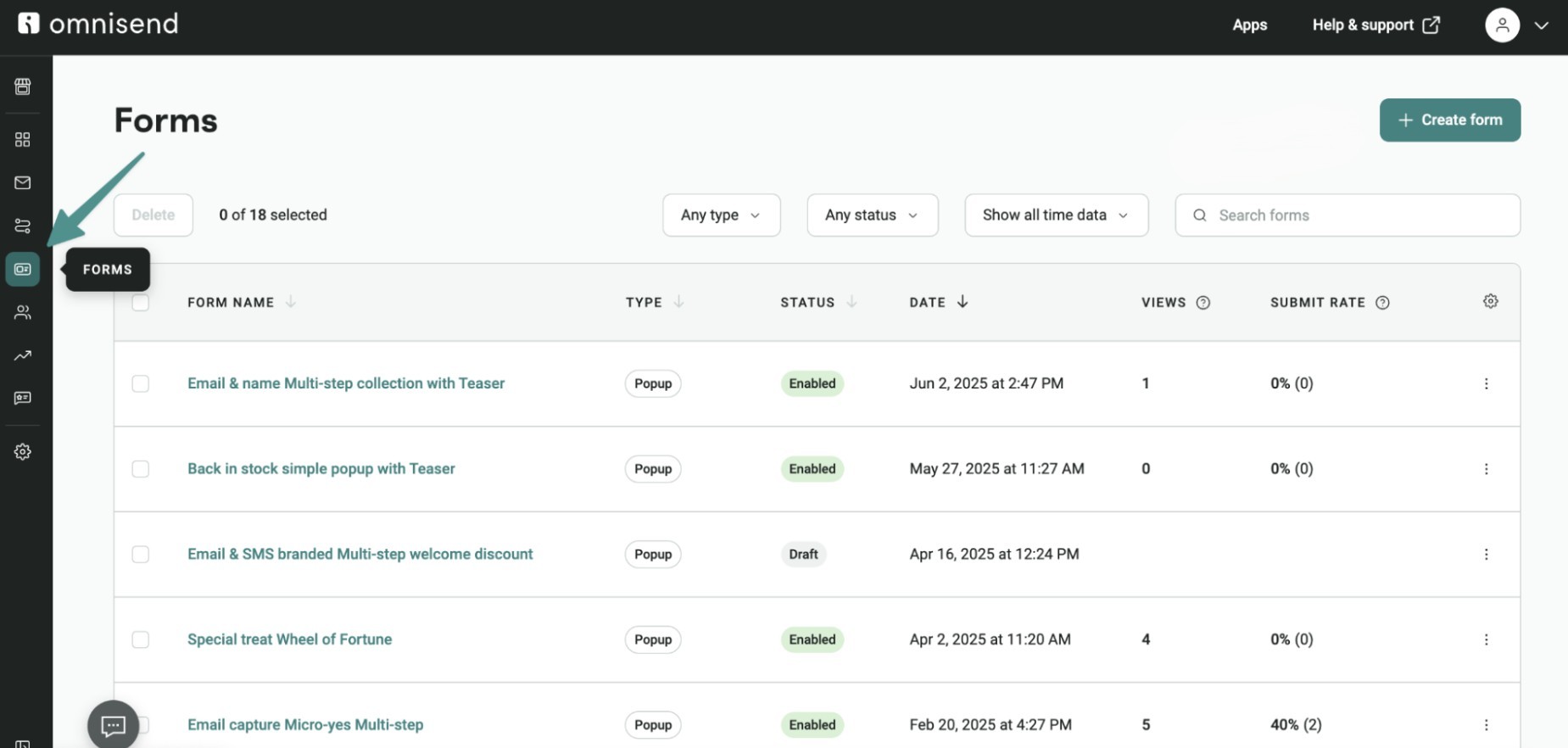
Smaller brands looking to improve email list performance can test Omnisend’s free plan before scaling. It includes forms, automation, segmentation, and even SMS popups.
“We’re really happy with how our automations are performing. The numbers speak for themselves.”
— Matthew Brueske, Director of Ecommerce at Gamehide
Gamehide’s welcome series, built entirely in Omnisend, has a 42% open rate and converts 7.7% of new subscribers. Read the full case study.
Here’s how different tactics compare by effort, speed, and more:
| Tactic | Effort | Time-to-result | Expected CVR | Best-for stage |
|---|---|---|---|---|
| Exit-intent popup | Low | 1–7 days | 3–8% | 0–1k |
| Checkout opt-in | Low | Same day | 5–15% | 1k–10k |
| Wheel of Fortune popup | Medium | 1–7 days | 6–12% | 0–10k |
| Social bio landing page | Medium | 1–7 days | 2–15% | 0–1k |
| SMS-to-email cross-promo | Medium | 1–7 days | 5–15% | 1k–10k |
| Embedded blog form | Low | 1–3 weeks | 1–3% | 0–10k |
| Referral program | High | 2–8 weeks | Varies | 1k–10k |
| On-brand giveaway | High | 2–6 weeks | 8–30% | 10k–50k |
| Product quiz | Medium | 1–2 months | 15–30% | 1k–50k+ |
| Welcome automation | High | 1–3 months | 5–15% | All stages |
Quick sign up | No credit card required
How to measure email list growth (and what to do when it stalls)
Healthy ecommerce brands typically see 2–5% monthly growth in their email lists. If your list grows by less than 1%, you likely have a traffic, placement, or offer problem. Knowing how to grow your email list fast and consistently starts with tracking the right number.
List growth rate formula
[(New subscribers — Unsubscribers) ÷ Total list size] x 100
Example: [(350 new − 80 unsubs) ÷ 4,000 total] × 100 = 6.75% monthly growth
Five metrics to track
Track these core metrics every month:
- List growth rate: Shows whether your overall subscriber count is increasing month over month
- Form CVR by placement: Reveals which popup, page, or embedded signup form converts best
- Unsubscribe rate: Helps flag content relevance or frequency issues (like email fatigue) and weak targeting
- UTM source attribution: Tracks which channels drive the highest-quality subscribers
- Revenue per subscriber: Measures the business value each subscriber generates over time
What to do when growth stalls
Here are some actions you can take when you notice slow or no growth:
- Refresh your lead magnet or signup incentive to match current buyer intent and improve conversions
- Add a new capture placement, like category pages, footer sticky bars, or inline blog forms for fresh exposure
- Re-promote your best-performing landing page through social channels and SMS campaigns
- A/B test popup headlines, timing, and copy to refine messaging and improve performance

Omnisend success story
AcreValue fixed major deliverability issues by switching to Omnisend.
The result? Highly segmented audiences, sharply improved open rates, and stronger overall performance. Open rates increased from 5–7% to 60–70%, while web traffic from these emails grew by 10%.
Read the full case study
Email list growth mistakes that are costing ecommerce store subscribers
It gets harder to grow your email list with small conversion problems stacking up. Most ecommerce stores don’t fail from a lack of traffic. These five growth-specific mistakes are the most common and easiest to fix.
1. Running untested popups: A popup that’s never been A/B tested is leaving conversions on the table every day it runs. Offers, timing, and copy lose effectiveness over time. So, test one variable at a time, whether that’s the headline, offer amount, or trigger timing, and pick the winning variant.
2. Sending paid traffic to the homepage: Homepage traffic rarely converts as well as focused landing pages. Omnisend benchmark data shows landing pages convert at 6.47%, while embedded forms on general pages average 1.28%. Send paid traffic somewhere built to convert.
3. Skipping source segmentation: Subscribers from a giveaway need a different welcome than those from a checkout opt-in. Without segmenting by source, campaign, or signup intent, every new subscriber gets the same email. Yet, its relevance, not volume, that drives welcome flow revenue.
4. Designing forms for desktop only: Ignoring mobile can be costly. As of October 2025, 93.7% of internet users aged 16+ used smartphones, while only 59.6% used laptops or desktops. Use mobile-first forms with fast load times, thumb-friendly buttons, and short copy to improve conversions, or you risk losing this demographic.
5. Having no welcome flow: Without a welcome automation, new subscribers cool off before the first campaign arrives. This wastes valuable signup momentum and loses you revenue. Launch a simple, multi-step welcome flow that includes education, offers, and product discovery to convert subscribers faster.
Quick sign up | No credit card required
Frequently asked questions
What’s the fastest way to grow a Shopify email list?
The fastest way to grow your email list on Shopify is by stacking these tactics:
- Activate an exit-intent popup with a 15%+ discount
- Enable the checkout opt-in in Shopify settings
- Update your social bio link to point to a dedicated signup landing page
As your list grows from 1,000 to 10,000 subscribers, add post-purchase opt-ins, SMS-to-email campaigns, and referral programs to maintain momentum. Together, these tactics can help you reach a 3–5% site-wide capture rate within 30 days.
What’s a good email list growth rate for ecommerce?
A good email list growth rate for ecommerce is 2–5% per month on a net basis (new subscribers minus unsubscribes).
Monthly growth under 1% signals a problem with your offer, form placement, or traffic volume. Tracking signup conversion rates by placement helps identify where your email list growth strategy needs improvement.
How do I grow my email list from 1,000 to 10,000 subscribers?
Growing from 1,000 to 10,000 subscribers requires layering growth multipliers onto your existing capture setup. These include:
- A referral program
- SMS-to-email cross-promo
- A product quiz (during months one to three)
Also consider introducing paid social lead ads with LTV-based lookalike audiences in the second or third month.
Do I need a lead magnet to grow my email list?
Not always. However, most ecommerce stores benefit from lead magnets because shoppers expect value before sharing an email address.
Discounts work well, but guides, quizzes, and loyalty rewards also perform strongly. The best lead magnets align with customer intent rather than generic incentives that offer little long-term value.
How much does it cost to grow an email list?
The cost of growing your email list varies by strategy and traffic source. Organic tactics like SEO-driven forms and referral programs cost little to nothing. Paid social campaigns and giveaways scale faster but require a budget.
Most brands start with free or low-cost tools before expanding into paid acquisition. Omnisend’s free plan includes core list growth tools to get you started.
Should I use paid or organic tactics first to grow my email list?
Start with organic tactics first. Get your exit-intent popup, checkout opt-in, and embedded forms converting reliably before spending on paid traffic.
Paid acquisition amplifies an already-working system. This means that sending ad traffic to an unoptimized capture setup wastes budget. Once your on-site signup rate consistently hits 2–3%, introduce paid social lead ads to accelerate growth.
What’s the best-converting email signup form type for ecommerce?
The best-converting email signup form type for ecommerce is the gamified spin-to-win popup. Wheel of Fortune averages a 13.23% conversion rate.
Meanwhile, discount popups convert at 8.53%, and embedded forms at around 1–3%, according to Omnisend data. The gamified format wins for combining novelty with a guaranteed reward.
Can I use Instagram and TikTok to grow my email list?
Yes, you can pair both platforms with a dedicated landing page to grow your email list. Add signup offers to bio links, Stories, and creator collaborations.
While landing pages convert that interest into actual email signups that you can monitor and expand, short-form videos help in quickly grabbing attention.
How long does it take to reach 10,000 subscribers?
A store with 1,000 subscribers and growing at 5% monthly reaches 10,000 in roughly 18–20 months organically. Add paid lead ads and a referral program, and that timeline compresses to 9–12 months.
Traffic volume, niche, and marketing consistency are the biggest variables. At this level, compounding tactics also matter more than chasing short-term spikes.
Should I ever buy an email list to grow faster?
No, buying an email list is never worth it. It hurts deliverability, damages sender reputation, and violates GDPR and CAN-SPAM regulations.
Purchased contacts rarely engage because they neither consented nor requested your emails. Organic subscriber growth creates better engagement, stronger conversions, and healthier long-term email list management.